
Deuteronomy 4:21

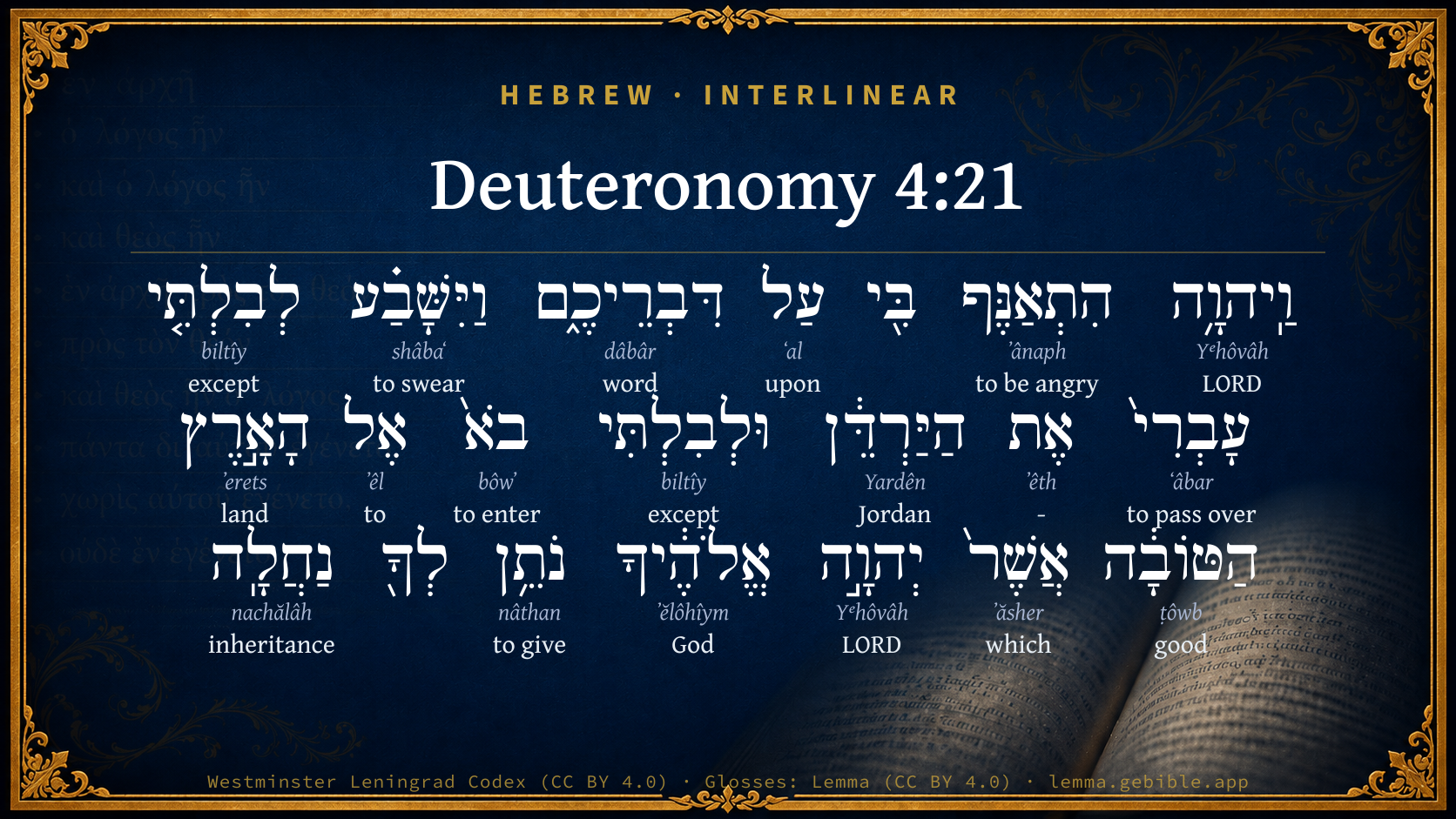
Hebrew (Westminster Leningrad Codex) Deuteronomy 4:21 appears in the Hebrew Old Testament. The text above is from the Westminster Leningrad Codex. Each word links to its Strong’s number, a concise gloss, and parsing drawn from the Open Scriptures Hebrew Bible morphology. Click any word for its full Brown-Driver-Briggs (BDB) entry.
Download image
Cite this verse

Deuteronomy 4:21 (World English Bible). Public Domain. Lemma interlinear Bible study tool, https://lemma.gebible.app/v/deuteronomy/4/21.

Show BibTeX & RIS
BibTeX
RIS
English Translation
Furthermore Yahweh was angry with me for your sakes, and swore that I should not go over the Jordan, and that I should not go in to that good land, which Yahweh your God gives you for an inheritance:
World English Bible · Public Domain
Download a study sheet

One document with this verse’s original text, its word-by-word gloss line, the meaning frame, cross-references with their text, attributed commentary, and full source and license credits — printable, and it pastes into notes with its structure intact.

This verse Autodidact and up

Study sheet (.html) Plain text (.txt)

A passage Seminary Student

Up to 50 verses in one chapter. A passage sheet keeps up to 6 commentary sources and 12 cross-references per verse, in the order this page ranks them, and says so on the sheet whenever that leaves anything out. Ask for a single verse and you get the Autodidact verse sheet above.

Everything on this page stays free to read, with no account — the sheet is a download of what is already on screen, not access to it.

Want to remove ads? Support Godless Engineer
Compare translations 3

The same verse in 3 English versions, stacked beneath the original-language interlinear above. Click any original word for its lexicon entry.

Each is an independent rendering of the whole verse — the interlinear is not word-aligned to these translations.

Highlighted words mark where these versions differ — a whole-verse word diff, not a word-by-word alignment.

  • World English Bible Public Domain
    Furthermore Yahweh was angry with me for your sakes, and swore that I should not go over the Jordan, and that I should not go in to that good land, which Yahweh your God gives you for an inheritance:
  • King James Version Public Domain
    Furthermore the LORD was angry with me for your sakes, and sware that I should not go over Jordan, and that I should not go in unto that good land, which the LORD thy God giveth thee for an inheritance:
  • unfoldingWord Literal Text CC BY-SA 4.0
    And Yahweh was angry with me on account of your words. And he swore I would not cross the Jordan, and I would not go in to the good land that Yahweh your God is giving to you an inheritance.

unfoldingWord Literal Text — © unfoldingWord, licensed CC BY-SA 4.0. Word-aligned USFM3 via Door43 (git.door43.org/unfoldingWord/en_ult).

Versions to compare (up to 4)

3 of 4 selected

Show all 18 translations

Every available English version of this verse, each an independent rendering of the whole verse.

  • World English Bible Public Domain
    Furthermore Yahweh was angry with me for your sakes, and swore that I should not go over the Jordan, and that I should not go in to that good land, which Yahweh your God gives you for an inheritance:
  • Berean Standard Bible Public Domain
    The LORD, however, was angry with me on account of you, and He swore that I would not cross the Jordan to enter the good land that the LORD your God is giving you as an inheritance.
  • Majority Standard Bible Public Domain
    The LORD, however, was angry with me on account of you, and He swore that I would not cross the Jordan to enter the good land that the LORD your God is giving you as an inheritance.
  • King James Version Public Domain
    Furthermore the LORD was angry with me for your sakes, and sware that I should not go over Jordan, and that I should not go in unto that good land, which the LORD thy God giveth thee for an inheritance:
  • American Standard Version (1901) Public Domain
    Furthermore Jehovah was angry with me for your sakes, and sware that I should not go over the Jordan, and that I should not go in unto that good land, which Jehovah thy God giveth thee for an inheritance:
  • Revised Version (1885) Public Domain
    Furthermore the LORD was angry with me for your sakes, and sware that I should not go over Jordan, and that I should not go in unto that good land, which the LORD thy God giveth thee for an inheritance:
  • Geneva Bible (1599) Public Domain
    And the Lord was angrie with me for your words, and sware that I should not goe ouer Iorden, and that I should not goe in vnto that good land, which the Lord thy God giueth thee for an inheritance.
  • Douay-Rheims (1899) Public Domain
    And the Lord was angry with me for your words, and he swore that I should not pass over the Jordan, nor enter into the excellent land, which he will give you.
  • Young's Literal Translation Public Domain
    `And Jehovah hath shewed himself wroth with me because of your words, and sweareth to my not passing over the Jordan, and to my not going in unto the good land which Jehovah thy God is giving to thee -- an inheritance;
  • Literal Standard Version CC BY-SA 4.0
    And YHWH has showed Himself angry with me because of your words, and swears to my not passing over the Jordan, and to my not going into the good land which your God YHWH is giving to you [for] an inheritance;
  • Unlocked Literal Bible CC BY-SA 4.0
    Yahweh was angry with me because of you; he swore that I should not go over the Jordan, and that I should not go into that good land, the land that Yahweh your God is giving to you as an inheritance.
  • unfoldingWord Literal Text CC BY-SA 4.0
    And Yahweh was angry with me on account of your words. And he swore I would not cross the Jordan, and I would not go in to the good land that Yahweh your God is giving to you an inheritance.
  • Darby Bible Public Domain
    And Jehovah was angry with me on your account, and swore that I should not go over the Jordan, and that I should not enter in to that good land which Jehovah thy God giveth thee [for] an inheritance;
  • World Messianic Bible Public Domain
    Furthermore the LORD was angry with me for your sakes, and swore that I should not go over the Jordan, and that I should not go in to that good land which the LORD your God gives you for an inheritance;
  • Webster's Bible Public Domain
    Furthermore the LORD was angry with me for your sakes, and swore that I should not go over Jordan, and that I should not enter that good land which the LORD thy God giveth thee for an inheritance:
  • Free Bible Version CC BY-SA 4.0
    But the Lord was angry with me because of you, and he vowed that I wouldn't cross the Jordan to enter the good land that the Lord your God is giving you to own.
  • Bible in Basic English Public Domain
    And the Lord was angry with me because of you, and made an oath that I was not to go over Jordan into the good land which the Lord is giving you for your heritage:
  • JPS Tanakh (1917) Public Domain
    Now the LORD was angered with me for your sakes, and swore that I should not go over the Jordan, and that I should not go in unto that good land, which the LORD thy God giveth thee for an inheritance;

Literal Standard Version (2020), Covenant Press — licensed CC BY-SA 4.0. Text via the HelloAO Bible API (eBible.org). Unlocked Literal Bible (unfoldingWord) — licensed CC BY-SA 4.0. Text via the HelloAO Bible API (eBible.org). unfoldingWord Literal Text — © unfoldingWord, licensed CC BY-SA 4.0. Word-aligned USFM3 via Door43 (git.door43.org/unfoldingWord/en_ult). Free Bible Version, Dr. Jonathan Gallagher — licensed CC BY-SA 4.0. Text via the HelloAO Bible API (eBible.org).

Word by word

More ways to search: Search by grammar → Find every occurrence → Compare this word →

Practice this passage: Drill this verse → Learn its vocabulary →

הִתְאַנֶּף
ʼânaph
H599
“to be angry”
Verb, Hithpael, Perfect, 3rd Person, Masculine, Singular
Part of Speech
Verb
Stem
Hithpael
Form
Perfect
Person
3rd Person
Gender
Masculine
Number
Singular
Full BDB Definition

Origin: a primitive root

TWOT: 133

to be angry, to be displeased, to breathe hard - (Qal) to be angry (of God) - (Hithpael) to be angry (always of God)
  1. וַֽיהוָ֥ה Yᵉhôvâh H3068 “and · LORD” Conjunction + Noun, Proper
  2. עַל ʻal H5921 “upon” Preposition
  3. דִּבְרֵיכֶ֑ם dâbâr H1697 “words · your” Noun, Common, Masculine, Plural, Construct + Suffix, Personal, 2nd Person, Masculine, Plural
  4. וַיִּשָּׁבַ֗ע shâbaʻ H7650 “and · to swear” Conjunction + Verb, Niphal, Sequential Imperfect, 3rd Person, Masculine, Singular
  5. לְבִלְתִּ֤י biltîy H1115 “to/for · except” Preposition + Conjunction
  6. עָבְרִי֙ ʻâbar H5674 “to pass over · me” Verb, Qal, Infinitive Construct + Suffix, Personal, 1st Person, Common, Singular
  7. אֶת ʼêth H853 “-” Particle, Direct Object
  8. הַיַּרְדֵּ֔ן Yardên H3383 “the · Jordan” Particle, Definite Article + Noun, Proper
  9. וּלְבִלְתִּי biltîy H1115 “and · to/for · except” Conjunction + Preposition + Conjunction
  10. בֹא֙ bôwʼ H935 “to enter” Verb, Qal, Infinitive Construct
  11. אֶל ʼêl H413 “to” Preposition
  12. הָאָ֣רֶץ ʼerets H776 “the · land” Particle, Definite Article + Noun, Common, Both, Singular, Absolute
  13. הַטּוֹבָ֔ה ṭôwb H2896 “the · good” Particle, Definite Article + Adjective, Adjective, Feminine, Singular, Absolute
  14. אֲשֶׁר֙ ʼăsher H834 “which” Particle, Relative
  15. יְהוָ֣ה Yᵉhôvâh H3068 “LORD” Noun, Proper
  16. אֱלֹהֶ֔יךָ ʼĕlôhîym H430 “God(s) · your” Noun, Common, Masculine, Plural, Construct + Suffix, Personal, 2nd Person, Masculine, Singular
  17. נֹתֵ֥ן nâthan H5414 “giving” Verb, Qal, Participle Active, Masculine, Singular, Absolute
  18. נַחֲלָֽה nachălâh H5159 “inheritance” Noun, Common, Feminine, Singular, Absolute

About this verse

These counts appear in no published source. They are computed here, from the morphology-tagged text and Lemma’s own curated glosses. What Lemma adds →

21
words
17
distinct lemmas
Pentateuch
section

Notable vocabulary

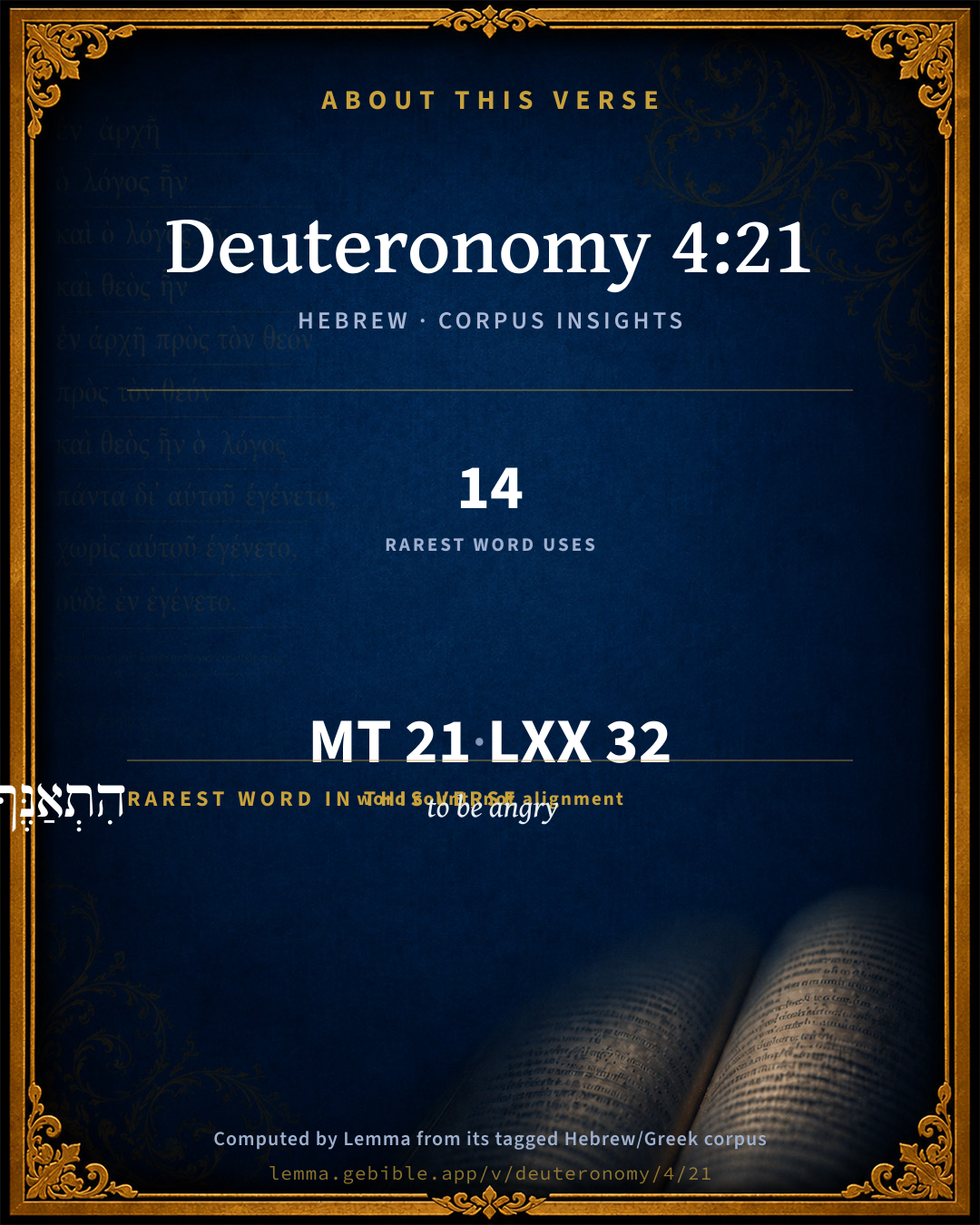
The rarest word here is הִתְאַנֶּף to be angry H599 — appearing just 14 times in the whole Hebrew Bible.

Shared distinctive vocabulary

הִתְאַנֶּף to be angry H599 occurs in 14 verses of the Hebrew Bible. Also found in:

Grammatical profile

  • 5 verbs
  • 7 nouns
  • 1 adjective
  • 4 prepositions
  • 2 conjunctions
  • 2 particles

Verb forms

  • הִתְאַנֶּף Hithpael · Perfect
  • וַיִּשָּׁבַ֗ע Niphal · Sequential Imperfect
  • עָבְרִי֙ Qal · Infinitive Construct
  • בֹא֙ Qal · Infinitive Construct
  • נֹתֵ֥ן Qal · Participle Active

Repetition

Words recur within this verse — often emphatic in Hebrew:

  • וַֽיהוָ֥ה LORD H3068 ×2
  • לְבִלְתִּ֤י except H1115 ×2

Hebrew & Septuagint length

In English translation the verse runs 39 words from the Hebrew and 43 from the Septuagint (LXX English) — closely comparable.

A rough comparison of the two English renderings, which tokenize alike — not a word-level alignment.

Word counts can differ between the Hebrew and the Greek without any difference in meaning — e.g. the Hebrew direct-object marker אֵת has no separate Greek word, and Greek often adds the article ὁ.

In the original languages it is 21 Hebrew tokens and 32 Greek tokens — but the two are counted differently (Hebrew bundles its prefixes and suffixes into one token; the Greek is in lemma form), so that isn’t a like-for-like length.

Cross-references

5

Topical passages linked to Deuteronomy 4:21 in the Treasury of Scripture Knowledge — connected by theme and wording, ordered by reader-vote popularity; previews shown in the World English Bible.

  • Numbers 20:12 Yahweh said to Moses and Aaron, Because you didn't believe in me, to sanctify me in the eyes of the children of Israel, therefore you shall not bring this assembly into the land which I have given them.
  • Deuteronomy 1:37 Also Yahweh was angry with me for your sakes, saying, You also shall not go in there:
  • Psalms 106:32–33 They angered him also at the waters of Meribah, So that Moses was troubled for their sakes;
  • Deuteronomy 3:26 But Yahweh was angry with me for your sakes, and didn't listen to me; and Yahweh said to me, Let it suffice you; speak no more to me of this matter.
  • Deuteronomy 31:2 He said to them, I am one hundred twenty years old this day; I can no more go out and come in: and Yahweh has said to me, You shall not go over this Jordan.

Cross-references courtesy of OpenBible.info (CC BY 4.0).

Hebrew and Greek witnesses Masoretic Hebrew ↔ Greek Septuagint

The same verse in the two great witnesses to the Old Testament, shown verse-for-verse.

These are two independent witnesses, not word-aligned to each other, and the Septuagint is shown in lemma (dictionary) form.

Hebrew Deuteronomy 4:21 Masoretic · Westminster Leningrad Codex

וַֽיהוָ֥ה הִתְאַנֶּף בִּ֖י עַל דִּבְרֵיכֶ֑ם וַיִּשָּׁבַ֗ע לְבִלְתִּ֤י עָבְרִי֙ אֶת הַיַּרְדֵּ֔ן וּלְבִלְתִּי בֹא֙ אֶל הָאָ֣רֶץ הַטּוֹבָ֔ה אֲשֶׁר֙ יְהוָ֣ה אֱלֹהֶ֔יךָ נֹתֵ֥ן לְךָ֖ נַחֲלָֽה

Furthermore Yahweh was angry with me for your sakes, and swore that I should not go over the Jordan, and that I should not go in to that good land, which Yahweh your God gives you for an inheritance:

World English Bible · Public Domain

Greek LXX Deuteronomy 4:21 Septuagint · lemma form

καί κύριος θυμόω ἐγώ περί ὁ λέγω ὑπό σύ καί ὄμνυμι ἵνα μή διαβαίνω ὁ ἰορδάνης οὗτος καί ἵνα μή εἰςἔρχομαι εἰς ὁ γῆ ὅς κύριος ὁ θεός δίδωμι σύ ἐν κλῆρος

And the Lord God was angry with me for the things said by you, and swore that I should not go over this Jordan, and that I should not enter into the land, which the Lord your God gives you for an inheritance.

LXX2012 (modern English Septuagint) · Public Domain

On this verse, The Cambridge Bible for Schools and Colleges discusses the Septuagint’s reading. Read the note in Commentary ↓

Hebrew: Westminster Leningrad Codex (CC BY 4.0). Greek: Septuagint (public domain); English from LXX2012 (modern English Septuagint) (Public Domain). How the Septuagint differs from the Hebrew →

Targum (Aramaic paraphrase)

2

The Targum is the ancient Jewish Aramaic paraphrase of the Hebrew Scriptures — an interpretive translation, not the Hebrew text itself. Onkelos (literal) and Pseudo-Jonathan (expansive) render the Torah, and Jonathan the Prophets. Coverage is partial: where no permissively-licensed English translation exists for a verse, only the Aramaic is shown. This is verse-level text, not a word-by-word alignment to the Hebrew.

  1. Targum Onkelos Torah (Genesis–Deuteronomy)
    וּמִן קֳדָם יְיָ הֲוָה רְגַז עֲלַי עַל פִּתְגָמֵיכוֹן וְקַיִים בְּדִיל דְלָא לְמֵעֲבַר יָת יַרְדְנָא וּבְדִיל דְלָא לְמֵיעַל לְאַרְעָא טָבָא דִי יְיָ אֱלָהָךְ יָהֵבּ לָךְ אַחֲסָנָא

    (no public-domain English translation for this verse)

    Targum Onkelos — Aramaic: “Onkelos Genesis” (public domain); “Onkelos Exodus” (public domain); “Onkelos Leviticus” (public domain); “Onkelos Numbers” (public domain); “Onkelos Deuteronomy” (public domain). English: “Sefaria Community Translation” (CC0 1.0 (public-domain dedication)); “J.W. Etheridge. The Targums of Onkelos and Jonathan Ben Uzziel on the Pentateuch. London: Longmans, Green, 1862” (public domain). Text via Sefaria.

  2. Targum Pseudo-Jonathan Torah (Genesis–Deuteronomy)
    וּמִן קֳדָם יְיָ הֲוָה רְגַז עָלַי עַל פִּתְגָמֵיכוֹן דְּאִתְרַעַמְתּוּן עַל מַיָא וְקַיֵּים דְּלָא אֲעִיבַר יַת יוֹרְדְּנָא וּדְלָא אֵיעוּל לְאַרְעָא דַיְיָ אֱלָהָכוֹן יָהֵיב לְכוֹן אַחֲסָנָא

    But against me was displeasure before the Lord on account of your words, because you had murmured for the water; and He sware that I should not pass the Jordan, nor go into the land which the Lord your God giveth you to inherit.

    Targum Pseudo-Jonathan — Aramaic: “Targum Jonathan on Genesis” (public domain); “Targum Jonathan on Exodus” (public domain); “Targum Jonathan on Leviticus” (public domain); “Targum Jonathan on Numbers” (public domain); “Targum Jonathan on Deuteronomy” (public domain). English: “The Targum of Jonathan ben Uzziel, trans. J. W. Etheridge, London, 1862” (public domain). Text via Sefaria.

Commentary

Notes on Deuteronomy 4:21 from classic Christian and Jewish commentators (each source and its license shown beneath its notes). The classic Christian expositions comment on the surrounding passage and are grouped to its opening verse, so a note may address several verses; the Jewish commentaries on the Tanakh (Rashi and others) are per-verse, so they appear only where the commentator wrote on this verse.

Lemma curates 59 commentaries, every one of them public domain or Creative Commons licensed, each selected and text-cleaned for this edition rather than reprinted as found. About our sources →

Trapp's Complete Commentary

John Trapp

Deu 4:21 Furthermore the LORD was angry with me for your sakes, and sware that I should not go over Jordan, and that I should not go in unto that good land, which the LORD thy God giveth thee [for] an inheritance:

Ver. 21. And sware that I should not.] So that you have a privilege above me; only beware how you provoke him, as I did, through unbelief.

John Trapp, A Commentary or Exposition upon All the Books of the Old and New Testament (1647–1656) — public domain. Text from a community e-Sword module.

The Biblical Illustrator

Joseph S. Exell

Deu_4:21-22

I must die in this land.

The death of Moses

1. Though a life may appear to us to receive the crown of failure, it may for all that be acceptable in Gods sight. No life on earth is complete, for its completion and fulness is destroyed by sin. Just as a man in things temporal often falls short of being successful, so does a man in things eternal. But the latter knows his life will receive its completion hereafter.

2. God is very strict with His children. The service of God is not to be trifled with. If we are careless we may prevent ourselves from obtaining some spiritual success in this world which might be a crowning point to our life.

3. Moses was alone at his death. We must die alone. Our friends cannot pass through the dark valley with us. But stay--must we be really alone? The Prince of Life will be with us with His rod and staff, if we ask Him.

4. Moses could not lead the Israelites into Canaan; that was the work of Joshua. Moses, by giving us the moral law, cannot lead us into heaven. The moral law in the hand of Moses is unable to accomplish that which the precious blood of Jesus alone can do. Is Jesus our Leader? (The Weekly Pulpit.)

The Biblical Illustrator, edited by Joseph S. Exell (c. 1880s–1900s) — public domain. Text from a community e-Sword module.

Joseph Benson's Commentary

Deu 4:21. That I should not go over Jordan — And as God has granted you the favour which he has denied me, your obligation to him is greatly increased.

Joseph Benson's Commentary on the Old and New Testaments (1811–1818) — public domain. Text from a community e-Sword module.

Keil & Delitzsch

C. F. Keil & F. Delitzsch

The bringing of Israel out of Egypt reminds Moses of the end, viz., Canaan, and leads him to mention again how the Lord had refused him permission to enter into this good land; and to this he adds the renewed warning not to forget the covenant or make any image of God, since Jehovah, as a jealous God, would never tolerate this. The swearing attributed to God in Deu 4:21 is neither mentioned in Num 20 nor at the announcement of Moses' death in Num 27:12.; but it is not to be called in question on that account, as Knobel supposes. It is perfectly obvious from Deu 3:23. that all the details are not given in the historical account of the event referred to. כּל תּמוּנת פּסל, "image of a form of all that Jehovah has commanded," sc., not to be made (Deu 4:16-18). "A consuming fire" (Deu 4:24): this epithet is applied to God with special reference to the manifestation of His glory in burning fire (Exo 24:17). On the symbolical meaning of this mode of revelation, see at Exo 3:2. "A jealous God:" see at Exo 20:5.

Keil & Delitzsch — Biblical Commentary on the Old Testament (1861–1891) — public domain (CC PDM 1.0). Text via the HelloAO Bible API. (Old Testament only.)

Adam Clarke's Commentary

Verse 21. The Lord was angry with me] And if with me, so as to debar me from entering into the promised land, can you think to escape if guilty of greater provocations?

Adam Clarke's Commentary on the Bible (1810–1826) — public domain. Text from a community e-Sword/MySword module.

Ellicott's Commentary for English Readers

(21-23) The Lord was angry with me for your sakes . . . I must die in this land . . . but ye shall go over . . . Take heed unto yourselves.—The argument appears to be this: “I cannot go with you to warn you; therefore take the more heed when you are alone.” The same line of thought appears in St. Paul’s last appeal to Timothy: “Fulfil thy ministry; for I am now ready to be offered” (2Ti_4:6).

A Bible Commentary for English Readers, edited by Charles John Ellicott (1878–1897) — public domain. Text from a community e-Sword module.

The Cambridge Bible for Schools and Colleges

gen. ed. J. J. S. Perowne

21. Furthermore the Lord was angry with me for your sakes] See on Deu_1:37, Deu_3:26. The fact is again introduced here as a relevant motive to the following exhortation; this answers the proposal to treat it, on account of its repetition, as an intrusion.

that good land] Heb. the; see on Deu_1:35.

which the Lord thy God giveth thee for an inheritance] Heb. partic. is about to give thee, Deu_19:10, Deu_20:16, Deu_21:23, Deu_24:4, Deu_26:1; as an inheritance to possess it, Deu_15:4, Deu_25:19; cp. Deut 19:31; only in D, and almost always with the Sg. address, but cp. Deu_29:8, The transition to the Sg. is confirmed by Sam. and LXX.

The Cambridge Bible for Schools and Colleges (gen. ed. J. J. S. Perowne; Cambridge University Press, 1878–1918) — public domain. Text from a community e-Sword module.

John Gill's Exposition

Furthermore the Lord was angry with me for your sakes,.... See Deu 3:26,

and sware that I should not go over Jordan; this circumstance of swearing is nowhere else expressed:

and that I should not go in unto that good land; the land of Canaan; he might see it, as he did from Pisgah, but not enter into it:

which the Lord thy God giveth thee for an inheritance; to them and to their children after them.

John Gill's Exposition of the Whole Bible (1746–1763) — public domain (CC PDM 1.0). Text via the HelloAO Bible API.

Haydock's Catholic Bible Commentary

Words. The murmurs of the people occasioned the diffidence of Moses, and he often reminds them of it, that they may reflect how severely God will punish them, if they transgress, since he spares not his greatest favourites. (Calmet) --- Even venial faults must be punished. (Worthington)

George Leo Haydock (1774–1849), Haydock's Catholic Family Bible and Commentary, 1859 edition — public domain. Excludes Psalms (Douay-Rheims chapter numbering differs from Protestant) and Deuterocanonical books (Catholic canon only).

Matthew Poole's English Annotations

God hath granted you the favour which he denied to me, which greatly increaseth your obligation to God.

Matthew Poole's English Annotations on the Holy Bible (1683–1685) — public domain. Text from a community e-Sword/MySword module.

Whedon's Commentary on the Bible

Daniel D. Whedon

21. Angry with me — Comp. Deu_1:37.

Daniel D. Whedon (gen. ed.), Commentary on the Old and New Testaments (1874–1909) — public domain. Text from a community e-Sword module.

The Pulpit Commentary

Vers. 21-24. Moses, after again referring to his being not permitted to enter Canaan, takes occasion anew to warn the people against forgetting the covenant of Jehovah and making any image of God, seeing he is a jealous God, and a consuming fire.

The Lord was angry with me... and swore, etc. Neither in Num_20:12, nor in Num_27:12-14, is there any mention of God"s having sworn that Moses should not enter Canaan with the people; but it is absurd to suppose, as some have done, that the writer here has confounded this with what is recorded in Num_14:21, Num_14:28, that is inconceivable; and it certainly does not follow, because no mention is made in Numbers of God"s having sworn, that he did not swear on this occasion; if he confirmed with an oath his decree that the generation that rebelled at Kadesh should not enter Canaan, the probability surely is that he would do the same when he announced to Moses the decree that he should not conduct Israel into the promised laud. "It is perfectly obvious, from Deu_3:23, sqq., that all the details are not given in the historical account of the event referred". (Keil)

Vers. 21-24. God a consuming fire.

Lord thy God is a consuming fire, even a jealous God." This is no obsolete sentence. The writer of the Epistle to the Hebrews quotes it, and urges the truth it expresses as a reason for serving God "with reverence and godly fear; for," he adds, even "our God is a consuming fire." Perhaps the first impression which these words would convey to the earnest and thoughtful mind would be that of terror. Perhaps, too, some may even almost shudder at such a representation of God, and may at once declare that it belongs to a past age, and to a decaying order of ideas. But others who are more cautious would be likely to say, "We must be quite sure that we understand the phrase before we say that." Doubtless we say with pleasure, "God is light," "God is love," but who can delight in saying, "God is fire?" Is it possible that any one can go even further, and delight in saying, Our God the God who is in covenant relation to us is a consuming fire"? Does not the phrase act as a repellent force, and inspire one with dread? No doubt it may have that effect in many cases, specially if men have carelessly fastened on one aspect of things, or where they have been misled by a popular misquotation, "God out of Christ is a consuming fire." For whatever the phrase means, it is just as true that God in Christ is a consuming fire, as that God out of Christ is so. The phrase is one which should be thoughtfully and devoutly studied in the general light of Scripture teaching, in order that in God"s light we may see light. It may be, if thus we try to feel our way to its meaning, that it opens up views of God with which we would not willingly part.

I WHAT IS THE MEANING OF THE PHRASE IN THE TEXT? It must have often struck an attentive reader of the Bible how frequently the figure of fire is found therein, both in connection with man"s offerings to God, and with God"s manifestations of himself to man (cf. Gen_3:24 Gen_8:20 Gen_15:17 Exo_3:19; Isa 4:31:9) Now, whatever may be the attribute of God here set forth under the figure of fire, it, like all God"s attributes, must he twofold in its action in a sinful world. The action of fire is according to the object on which it acts.

1. There is a terrific action of fire. It tries what is bad. (1Co_3:13) It consumes. (Lev_10:2) It appalls (Num_11:1-3; Isa_33:14) It destroys (2Ki_1:12; Luk_3:17; Psa_98:3; Heb_6:8)

2. There is a kindly action of flame. It enkindles. (Lev_9:24) It (1Pe_1:7; Isa_48:10) It purifies. (Psa_12:6) It guards (Zec_2:5; 2Ki_6:17; Deu_9:3) It escorts. (2Ki_2:11) It guides. (Exo_40:38) It enlightens. (Psa_78:14) It is as a pavilion of glory (Exo_3:2; Isa_33:14-17) Now, widely different as is the action or the meaning of flaming fire from heaven in all these cases, the difference is not in the flame, but in the material on which it acts. The same fire that melts the wax will bake the clay. So the very same attribute of God in which the righteous may glory will be a terror to his enemies.

3. Fire, when spoken of in reference to God, is an emblem of:

(1) Purity in Exo_3:2-5, God would signify that in his redeeming love he, the holy God, would dwell with men, and that men might dwell in the midst of his blazing holiness, and yet be perfectly at home.

(2) Power. (Deu_9:3 Deu_7:8) Power exerting itself on behalf of those who love him.

(3) Jealousy. (Deu_4:23, Deu_4:24)

(4) Anger. (Deu_6:15) Thus there are these four conceptions to be attached to the use of the phrase "a consuming fire," viz. a pavilion of purity in which Israel might dwell unharmed; a jealousy which could brook no rival; an anger which would go forth against sin; a power which would guard its own as with tongues, yea, with walls of flame.

1. But we may take another step, and reduce this fourfold conception to a twofold one. There is anger against sin because of spotless purity. There is jealousy which will brook no rival, and a power, that will guard its own because of intensest love. Thus the consuming fire is purity, in which righteousness may dwell, and in which sin is consumed; and love, which is mighty in its active care, and jealous of any rival in the human heart.

2. We may simplify yet again, and reduce the twofold conception to a unity, and say that God is a consuming fire, inasmuch as he is perfect love pure love, active love, jealous love; so that oar text is but another wayof saying, "God is light, God is love." Let us now

II LOOK AT THESE THREE FORMS OF THE EXPRESSION "PERFECT LOVE," AND SEE WHAT THEY INVOLVE.

1. Pure love. God is a flaming fire of infinite purity, and yet a burning flame of tenderest love. He receives the sinner on a basis of righteousness. He makes men who are in covenant relation to him perfectly pure. They are to be tried and purified and made white, till they are without fault before the throne of God. Would we have it otherwise? God"s love without its purity would be worthless to us!

2. Active love. God castles his saints in a wall of fire, (Isa_4:6) while he also destroys their foes as with a tongue of fire.

3. Jealous love. There is a hateful jealousy. There is a rightful one. The first it would be unworthy of a man to possess; the second, a man would be unworthy of himself if he did not. A father would be worth little if he were not jealous for the purity of his child; so would a husband if not jealous for the honor of his wife; or an Englishman, if not jealous for the honor of his queen! Even so, it would be unworthy of God if he were not jealous, in the scriptural sense. Note:

1. God"s love is jealous for the first place in our hearts.

2. God is jealous for his own purity, holiness, and truth.

3. He is jealous for the honor of his Son.

He will not let one be lost who receives him, nor will he let one be saved who trifles with him. To go against Christ is to rush into the consuming flame!

III WHAT ARE THE PRACTICAL USES TO RE MADE OF THIS SUBLIME ATTRIBUTE OF GOD? (See the use made of it in the Epistle to the Hebrews, Deuteronomy 12., the last three or four verses.)

1. Is God thus a consuming fire? Then let us never attempt to draw nigh unto him without a recognition both of his purity and of our sinfulness. No service is accepted before God which does not take account of sin, and in connection with which there is not "reverence and godly fear.

2. Do not let us think of any mode of recognition of sin which ignores God"s own way, viz. that of an atoning sacrifice. God will jealously guard the honor of his dear Son. "If they escaped not who refused him that spake on earth, much more shall not we escape, if we turn away from him that speaketh from heaven.

3. If thus we are penitently making use of the atoning sacrifice of Christ as our only means of approach to and ground of hope in God, then let us glory in this holy, jealous love, which guards us as with a wall of fire, and is our everlasting guarantee that we shall not be put to shame.

4. Let us remember that it depends on ourselves whether the "consuming fire" is a flame at which we tremble, or a pavilion in which we can hide. God cannot deny himself. He will not deal with the sinner on any principle which ignores the great atonement which his Son has effected, or which admits of his accepting the service of a divided heart. It is for us to say whether the great redeeming work of Jesus shall be the means by which we are raised to fellowship in infinite holiness, or whether it shall be to us the savor of death unto death. It must be one or the other. If we receive it, it will bring us to eternal rest in God; if we reject it, it will deepen our condemnation more terribly than if no Savior had been provided! Our God is a consuming fire. If, in Jesus, we draw near to him, that burning, blazing holiness shall be the secret place of his tabernacle in which we are safely hidden. If we neglect this great salvation, as men unpardoned and unsaved, we shall remain, and at the flame of Jehovah"s purity we shall tremble forever! Sinner, say, oh say, shall this fire of God"s perfect love surround you ever as a wall of protection, or shall it terrify and consume you as devouring flame?

The Pulpit Commentary (1880–1919), ed. H.D.M. Spence-Jones & Joseph S. Exell — public domain. Text from a community e-Sword module.

unfoldingWord translationNotes

Door43 World Missions Community

General Information:

Moses continues speaking to the people of Israel.

Yahweh was angry with me because of you

This refers to when Moses disobeyed what Yahweh told him to do because Moses was angry with the people of Israel. The full meaning of this statement can be made clear. See how you translated this in Deuteronomy 1:37. (See: Assumed Knowledge and Implicit Information)

Yahweh your God is giving to you

Moses speaks to the Israelites as if they were one man, so "you" and "your" are singular. (See: Forms of You)

translationWords

Yahweh

anger

oath

Jordan River

God

inherit

die

possess

unfoldingWord translationNotes — © Distant Shores Media and the Door43 World Missions Community, licensed CC BY-SA 4.0. Source: git.door43.org/Door43/en_tn.

Rashi

Rabbi Shlomo Yitzchaki (Rashi)

התאנף means, HE WAS FILLED WITH WRATH.

על דבריכם means, "on your account”, "because of your doings”.

Rashi on the Tanakh — English translations: “The Judaica Press complete Tanach with Rashi, translated by A. J. Rosenberg” (CC BY 4.0); “Pentateuch with Rashi's commentary by M. Rosenbaum and A.M. Silbermann, 1929-1934” (public domain); “The Metsudah Tanach series, Lakewood, N.J” (CC BY 4.0); and “The Book of Joshua, Metsudah Publications, 1997” (CC BY 4.0). Text via Sefaria.

Ramban (Nachmanides)

Rabbi Moshe ben Nachman (Ramban / Nachmanides)

AND THE ETERNAL WAS ANGERED WITH ME FOR YOUR SAKES, AND SWORE THAT I SHOULD NOT GO OVER THE JORDAN. He repeated it in this place [despite having already mentioned it above, 1:37] as if to say: “The Eternal commanded me at that time to teach you the commandments that ye might do them in the Land whither ye go over to possess it; now accept instruction from my mouth, for I must die in this land, (I must not go over the Jordan), and I will not be able to teach you in the Land [of Israel] and so do not forget there what I have taught you [here], nor what you have seen at Sinai.”By way of the Truth, [the mystic teachings of the Cabala], Moses is stating: Take good heed of yourselves lest you corrupt yourselves, for the Eternal was angered with me in His concern over this matter lest ye forget the covenant of the Eternal your G-d in the devouring fire on the top of the Mount, and you will make the likeness of any thing, this being the sense of the expression, which the Eternal thy G-d commanded thee. This has already been alluded to in the section Chukath Hatorah. And Rashi wrote: “Which the Eternal thy G-d commanded thee — which He commanded thee not to do.” This is the simple meaning of Scripture. But one learned in the mystic teachings of the Cabala will understand these verses in the light of their true meaning. And the sense of the verse For the Eternal thy G-d is a devouring fire is “as you have seen on the top of the Mount, ” the intent being that it is the attribute of justice that is jealous of idols [and as the verse concludes, a jealous G-d]. From this verse you will understand the expression the Eternal thy G-d that is always mentioned in the Book of Deuteronomy.

Ramban (Nachmanides) on the Tanakh — English translation: “Commentary on the Torah by Ramban (Nachmanides). Translated and annotated by Charles B. Chavel. New York, Shilo Pub. House, 1971-1976” (CC BY 4.0). Text via Sefaria.

Lesson kit

Teaching starters — assembled from the data on this page, not authored interpretation. Every prompt links to the verse data it draws on. Edit before teaching.

Deuteronomy, in the Pentateuch, opens this verse with 21 words (17 distinct Hebrew lemmas). Its most distinctive word is ʼânaph (“to be angry”). A historical commentator’s framing appears above. Read the whole chapter for the surrounding context.

Discussion questions

  1. The word ʼânaph carries the sense “to be angry.” How does it shape the verse?
  2. Deuteronomy 1:37 shares the word «to be angry» with this verse. How do the two illuminate each other?
  3. “LORD” occurs 2× in this one verse. What is the effect of the repetition?
  4. The translations on this page render this verse differently — a whole-verse word diff, not a word-by-word alignment. What might account for the different wordings?
  5. The verb «הִתְאַנֶּף» is Hithpael Perfect. How does its form color the action?
  6. Reading how Trapp's Complete Commentary and The Biblical Illustrator read this verse, where do the two commentators agree and where do they part?

Things to notice

Reading settings

Reading text

Shown beneath each verse's original-language words.

Old Testament
Old Testament edition

Read the OT as the Masoretic Hebrew (MT) or the Greek Septuagint (LXX).

English shown for the Greek Septuagint (in the Hebrew ↔ Greek comparison).

Comparing translations? Open the Compare panel on any verse page to stack up to four side by side.