
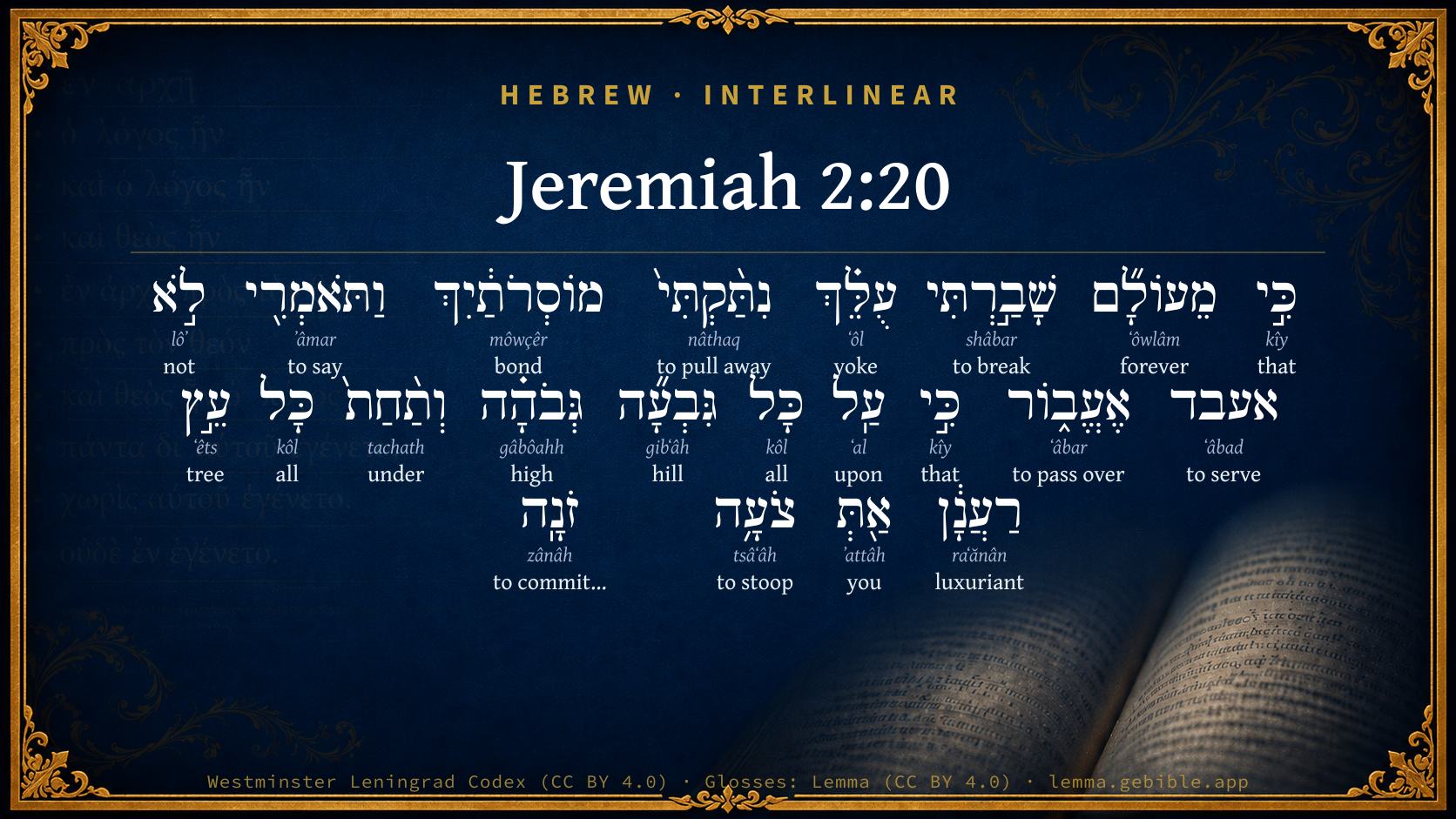
Jeremiah 2:20

Hebrew (Westminster Leningrad Codex) Jeremiah 2:20 appears in the Hebrew Old Testament. The text above is from the Westminster Leningrad Codex. Each word links to its Strong’s number, a concise gloss, and parsing drawn from the Open Scriptures Hebrew Bible morphology. Click any word for its full Brown-Driver-Briggs (BDB) entry.
Download image
Cite this verse

Jeremiah 2:20 (World English Bible). Public Domain. Lemma interlinear Bible study tool, https://lemma.gebible.app/v/jeremiah/2/20.

Show BibTeX & RIS
BibTeX
RIS
English Translation
For of old time I have broken your yoke, and burst your bonds; and you said, I will not serve; for on every high hill and under every green tree you did bow yourself, playing the prostitute.
World English Bible · Public Domain
Download a study sheet

One document with this verse’s original text, its word-by-word gloss line, the meaning frame, cross-references with their text, attributed commentary, and full source and license credits — printable, and it pastes into notes with its structure intact.

This verse Autodidact and up

Study sheet (.html) Plain text (.txt)

A passage Seminary Student

Up to 50 verses in one chapter. A passage sheet keeps up to 6 commentary sources and 12 cross-references per verse, in the order this page ranks them, and says so on the sheet whenever that leaves anything out. Ask for a single verse and you get the Autodidact verse sheet above.

Everything on this page stays free to read, with no account — the sheet is a download of what is already on screen, not access to it.

Want to remove ads? Support Godless Engineer
Compare translations 3

The same verse in 3 English versions, stacked beneath the original-language interlinear above. Click any original word for its lexicon entry.

Each is an independent rendering of the whole verse — the interlinear is not word-aligned to these translations.

Highlighted words mark where these versions differ — a whole-verse word diff, not a word-by-word alignment.

  • World English Bible Public Domain
    For of old time I have broken your yoke, and burst your bonds; and you said, I will not serve; for on every high hill and under every green tree you did bow yourself, playing the prostitute.
  • King James Version Public Domain
    For of old time I have broken thy yoke, and burst thy bands; and thou saidst, I will not transgress; when upon every high hill and under every green tree thou wanderest, playing the harlot.
  • unfoldingWord Literal Text CC BY-SA 4.0
    For from long ago I broke your yoke; I tore to pieces your fetters. But you said, ‘I will not serve!’ For on every high hill and beneath every leafy tree, you yourself lie down, prostitute.

unfoldingWord Literal Text — © unfoldingWord, licensed CC BY-SA 4.0. Word-aligned USFM3 via Door43 (git.door43.org/unfoldingWord/en_ult).

Versions to compare (up to 4)

3 of 4 selected

Show all 18 translations

Every available English version of this verse, each an independent rendering of the whole verse.

  • World English Bible Public Domain
    For of old time I have broken your yoke, and burst your bonds; and you said, I will not serve; for on every high hill and under every green tree you did bow yourself, playing the prostitute.
  • Berean Standard Bible Public Domain
    “For long ago you broke your yoke and tore off your chains, saying, ‘I will not serve!’ Indeed, on every high hill and under every green tree you lay down as a prostitute.
  • Majority Standard Bible Public Domain
    “For long ago you broke your yoke and tore off your chains, saying, ‘I will not serve!’ Indeed, on every high hill and under every green tree you lay down as a prostitute.
  • King James Version Public Domain
    For of old time I have broken thy yoke, and burst thy bands; and thou saidst, I will not transgress; when upon every high hill and under every green tree thou wanderest, playing the harlot.
  • American Standard Version (1901) Public Domain
    For of old time I have broken thy yoke, and burst thy bonds; and thou saidst, I will not serve; for upon every high hill and under every green tree thou didst bow thyself, playing the harlot.
  • Revised Version (1885) Public Domain
    For of old time I have broken thy yoke, and burst thy bands; and thou saidst, I will not serve; for upon every high hill and under every green tree thou didst bow thyself, playing the harlot.
  • Geneva Bible (1599) Public Domain
    For of olde time I haue broken thy yoke, and burst thy bondes, and thou saidest, I will no more transgresse, but like an harlot thou runnest about vpon al hie hilles, and vnder all greene trees.
  • Douay-Rheims (1899) Public Domain
    Of old time thou hast broken my yoke, thou hast burst my bands, and thou saidst: I will not serve. For on every high hill, and under every green tree thou didst prostitute thyself.
  • Young's Literal Translation Public Domain
    For from of old thou hast broken thy yoke, Drawn away thy bands, and sayest, `I do not serve,' For, on every high height, and under every green tree, Thou art wandering -- a harlot.
  • Literal Standard Version CC BY-SA 4.0
    “For from of old you have broken your yoke, || Drawn away your bands, and say, I do not serve, || For on every high height, and under every green tree, || You are wandering—a harlot.
  • Unlocked Literal Bible CC BY-SA 4.0
    For I broke your yoke that you had in ancient days; I tore your fetters off you. Still you said, 'I will not serve!' since you bowed down on every high hill and beneath every leafy tree, you adulterer.
  • unfoldingWord Literal Text CC BY-SA 4.0
    For from long ago I broke your yoke; I tore to pieces your fetters. But you said, ‘I will not serve!’ For on every high hill and beneath every leafy tree, you yourself lie down, prostitute.
  • Darby Bible Public Domain
    For of old thou hast broken thy yoke, [and] burst thy bands; and thou saidst, I will not serve. For upon every high hill, and under every green tree, thou bowest down, playing the harlot.
  • World Messianic Bible Public Domain
    “For long ago I broke off your yoke, and burst your bonds. You said, ‘I will not serve;’ for on every high hill and under every green tree you bowed yourself, playing the prostitute.
  • Webster's Bible Public Domain
    For of old time I have broken thy yoke, and burst thy bands; and thou saidst, I will not transgress; when upon every high hill and under every green tree thou wanderest, playing the harlot.
  • Free Bible Version CC BY-SA 4.0
    You broke off your yoke and ripped off your chains long ago. “I won't worship you!” you declared. On the contrary, you lay down like a prostitute on every high hill and under every green tree.
  • Bible in Basic English Public Domain
    For in the past, your yoke was broken by your hands and your cords parted; and you said, I will not be your servant; for on every high hill and under every branching tree, your behaviour was like that of a loose woman
  • JPS Tanakh (1917) Public Domain
    For of old time I have broken thy yoke, and burst thy bands, and thou saidst: 'I will not transgress'; upon every high hill and under every leafy tree thou didst recline, playing the harlot.

Literal Standard Version (2020), Covenant Press — licensed CC BY-SA 4.0. Text via the HelloAO Bible API (eBible.org). Unlocked Literal Bible (unfoldingWord) — licensed CC BY-SA 4.0. Text via the HelloAO Bible API (eBible.org). unfoldingWord Literal Text — © unfoldingWord, licensed CC BY-SA 4.0. Word-aligned USFM3 via Door43 (git.door43.org/unfoldingWord/en_ult). Free Bible Version, Dr. Jonathan Gallagher — licensed CC BY-SA 4.0. Text via the HelloAO Bible API (eBible.org).

Word by word

More ways to search: Search by grammar → Find every occurrence → Compare this word →

Practice this passage: Drill this verse → Learn its vocabulary →

צֹעָ֥ה
tsâʻâh
H6808
“stooping”
Verb, Qal, Participle Active, Feminine, Singular, Absolute
Part of Speech
Verb
Stem
Qal
Form
Participle Active
Gender
Feminine
Number
Singular
State
Absolute
Full BDB Definition

Origin: a primitive root

TWOT: 1944

to stoop, bend, incline - (Qal) - to stoop, bend - to incline, tip - (Piel) to tip over
  1. כִּ֣י kîy H3588 “that” Conjunction
  2. מֵעוֹלָ֞ם ʻôwlâm H5769 “from · forever” Preposition + Noun, Common, Masculine, Singular, Absolute
  3. שָׁבַ֣רְתִּי shâbar H7665 “to break” Verb, Qal, Perfect, 1st Person, Common, Singular
  4. עֻלֵּ֗ךְ ʻôl H5923 “yoke · your” Noun, Common, Masculine, Singular, Construct + Suffix, Personal, 2nd Person, Feminine, Singular
  5. נִתַּ֨קְתִּי֙ nâthaq H5423 “to pull away” Verb, Piel, Perfect, 1st Person, Common, Singular
  6. מוֹסְרֹתַ֔יִךְ môwçêr H4147 “bonds · your” Noun, Common, Both, Plural, Construct + Suffix, Personal, 2nd Person, Feminine, Singular
  7. וַתֹּאמְרִ֖י ʼâmar H559 “and · to say” Conjunction + Verb, Qal, Sequential Imperfect, 2nd Person, Feminine, Singular
  8. לֹ֣א lôʼ H3808 “not” Particle, Negative
  9. אעבד ʻâbad H5647 “to serve” Verb, Qal, Imperfect, 1st Person, Common, Singular
  10. אֶעֱב֑וֹר ʻâbar H5674 “to pass over” Verb, Qal, Imperfect, 1st Person, Common, Singular
  11. כִּ֣י kîy H3588 “that” Conjunction
  12. עַֽל ʻal H5921 “upon” Preposition
  13. כָּל kôl H3605 “all of” Noun, Common, Masculine, Singular, Construct
  14. גִּבְעָ֞ה gibʻâh H1389 “hill” Noun, Common, Feminine, Singular, Absolute
  15. גְּבֹהָ֗ה gâbôahh H1364 “high” Adjective, Adjective, Feminine, Singular, Absolute
  16. וְתַ֨חַת֙ tachath H8478 “and · under” Conjunction + Preposition
  17. כָּל kôl H3605 “all of” Noun, Common, Masculine, Singular, Construct
  18. עֵ֣ץ ʻêts H6086 “tree” Noun, Common, Masculine, Singular, Absolute
  19. רַעֲנָ֔ן raʻănân H7488 “luxuriant” Adjective, Adjective, Masculine, Singular, Absolute
  20. אַ֖תְּ ʼattâh H859 “you” Pronoun, Personal, 2nd Person, Feminine, Singular
  21. זֹנָֽה zânâh H2181 “committing fornication” Verb, Qal, Participle Active, Feminine, Singular, Absolute

About this verse

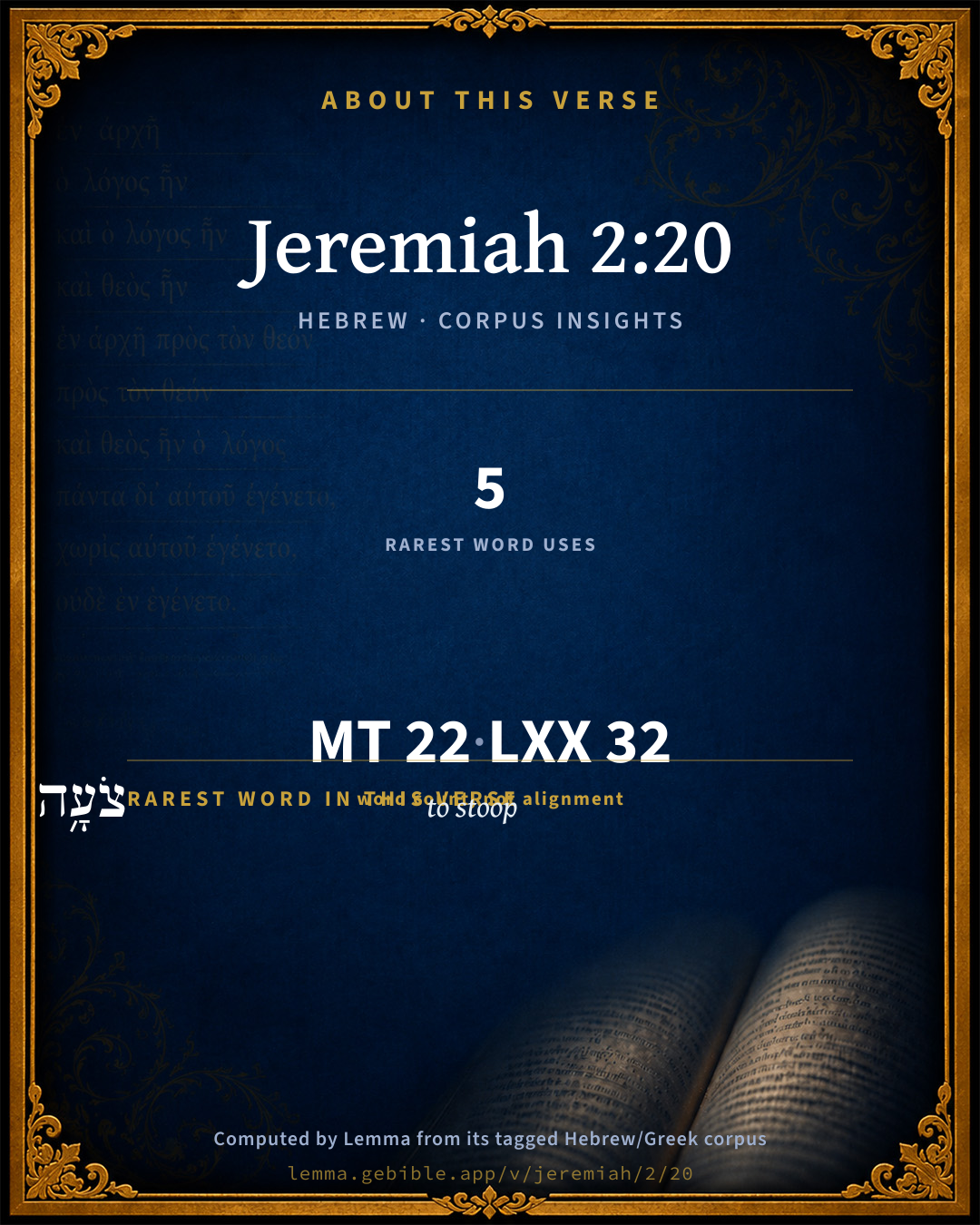
These counts appear in no published source. They are computed here, from the morphology-tagged text and Lemma’s own curated glosses. What Lemma adds →

22
words
20
distinct lemmas
Prophets
section

Notable vocabulary

The rarest word here is צֹעָ֥ה to stoop H6808 — appearing just 5 times in the whole Hebrew Bible.

Shared distinctive vocabulary

צֹעָ֥ה to stoop H6808 occurs in 4 verses of the Hebrew Bible. Also found in:

Grammatical profile

  • 7 verbs
  • 7 nouns
  • 2 adjectives
  • 1 pronoun
  • 2 prepositions
  • 2 conjunctions
  • 1 particle

Verb forms

  • שָׁבַ֣רְתִּי Qal · Perfect
  • נִתַּ֨קְתִּי֙ Piel · Perfect
  • וַתֹּאמְרִ֖י Qal · Sequential Imperfect
  • אעבד Qal · Imperfect
  • אֶעֱב֑וֹר Qal · Imperfect
  • צֹעָ֥ה Qal · Participle Active
  • זֹנָֽה Qal · Participle Active

Repetition

Words recur within this verse — often emphatic in Hebrew:

  • כָּל all H3605 ×2
  • כִּ֣י that H3588 ×2

Hebrew & Septuagint length

In the original languages it is 22 Hebrew tokens and 32 Greek tokens — but the two are counted differently (Hebrew bundles its prefixes and suffixes into one token; the Greek is in lemma form), so that isn’t a like-for-like length.

Cross-references

36

Topical passages linked to Jeremiah 2:20 in the Treasury of Scripture Knowledge — connected by theme and wording, ordered by reader-vote popularity; previews shown in the World English Bible.

  • Deuteronomy 12:2 You shall surely destroy all the places in which the nations that you shall dispossess served their gods, on the high mountains, and on the hills, and under every green tree:
  • Leviticus 26:13 I am Yahweh your God, who brought you forth out of the land of Egypt, that you should not be their slaves; and I have broken the bars of your yoke, and made you go upright.
  • Jeremiah 17:2 while their children remember their altars and their Asherim by the green trees on the high hills.
  • Isaiah 1:21 How the faithful city has become a prostitute! She was full of justice; righteousness lodged in her, But now murderers.
  • Jeremiah 30:8 It shall come to pass in that day, says Yahweh of Hosts, that I will break his yoke from off your neck, and will burst your bonds; and strangers shall no more make him their bondservant;
  • Hosea 3:3 I said to her, "You shall stay with me many days. You shall not play the prostitute, and you shall not be with any other man. I will also be so toward you."
  • Exodus 3:8 I have come down to deliver them out of the hand of the Egyptians, and to bring them up out of that land to a good and large land, to a land flowing with milk and honey; to the place of the Canaanite, the Hittite, the Amorite, the Perizzite, the Hivite, and the Jebusite.
  • Exodus 19:8 All the people answered together, and said, "All that Yahweh has spoken we will do." Moses reported the words of the people to Yahweh.
  • Exodus 24:3 Moses came and told the people all the words of Yahweh, and all the ordinances; and all the people answered with one voice, and said, "All the words which Yahweh has spoken will we do."
  • Exodus 34:14–16 for you shall worship no other god: for Yahweh, whose name is Jealous, is a jealous God.
  • Deuteronomy 4:20 But Yahweh has taken you, and brought you forth out of the iron furnace, out of Egypt, to be to him a people of inheritance, as at this day.
  • Deuteronomy 4:34 Or has God tried to go and take him a nation from the midst of [another] nation, by trials, by signs, and by wonders, and by war, and by a mighty hand, and by an outstretched arm, and by great terrors, according to all that Yahweh your God did for you in Egypt before your eyes?
  • Deuteronomy 5:27 Go you near, and hear all that Yahweh our God shall say: and speak you to us all that Yahweh our God shall speak to you; and we will hear it, and do it.
  • Deuteronomy 15:15 You shall remember that you were a bondservant in the land of Egypt, and Yahweh your God redeemed you: therefore I command you this thing today.
  • Deuteronomy 26:17 You have declared Yahweh this day to be your God, and that you would walk in his ways, and keep his statutes, and his commandments, and his ordinances, and listen to his voice:
  • Joshua 1:16 They answered Joshua, saying, All that you have commanded us we will do, and wherever you send us we will go.
  • Joshua 24:24 The people said to Joshua, Yahweh our God will we serve, and to his voice will we listen.
  • Joshua 24:26 Joshua wrote these words in the book of the law of God; and he took a great stone, and set it up there under the oak that was by the sanctuary of Yahweh.
  • 1 Samuel 12:10 They cried to Yahweh, and said, We have sinned, because we have forsaken Yahweh, and have served the Baals and the Ashtaroth: but now deliver us out of the hand of our enemies, and we will serve you.
  • 1 Kings 12:32 Jeroboam ordained a feast in the eighth month, on the fifteenth day of the month, like the feast that is in Judah, and he went up to the altar; so did he in Bethel, sacrificing to the calves that he had made: and he placed in Bethel the priests of the high places that he had made.
  • Psalms 78:58 For they provoked him to anger with their high places, And moved him to jealousy with their engraved images.
  • Isaiah 9:4 For the yoke of his burden, and the staff of his shoulder, the rod of his oppressor, you have broken as in the day of Midian.
  • Isaiah 10:27 It shall happen in that day, that his burden shall depart from off your shoulder, and his yoke from off your neck, and the yoke shall be destroyed by reason of fatness.
  • Isaiah 14:25 that I will break the Assyrian in my land, and on my mountains tread him under foot: then shall his yoke depart from off them, and his burden depart from off their shoulder.
  • Isaiah 57:5–7 you who inflame yourselves among the oaks, under every green tree; who kill the children in the valleys, under the clefts of the rocks?
  • Jeremiah 3:1–2 They say, If a man put away his wife, and she go from him, and become another man's, will he return to her again? Won't that land be greatly polluted? But you have played the prostitute with many lovers; yet return again to me, says Yahweh.
  • Ezekiel 16:15–16 But you did trust in your beauty, and played the prostitute because of your renown, and poured out your prostitution on everyone who passed by; his it was.
  • Ezekiel 16:24–25 that you have built to you a vaulted place, and have made you a lofty place in every street.
  • Ezekiel 16:28 You have played the prostitute also with the Assyrians, because you were insatiable; yes, you have played the prostitute with them, and yet you weren't satisfied.
  • Ezekiel 16:31 in that you build your vaulted place at the head of every way, and make your lofty place in every street, and have not been as a prostitute, in that you scorn pay.
  • Ezekiel 16:41 They shall burn your houses with fire, and execute judgments on you in the sight of many women; and I will cause you to cease from playing the prostitute, and you shall also give no hire any more.
  • Ezekiel 20:28 For when I had brought them into the land, which I swore to give to them, then they saw every high hill, and every thick tree, and they offered there their sacrifices, and there they presented the provocation of their offering; there also they made their sweet savor, and they poured out there their drink-offerings.
  • Ezekiel 23:5 Oholah played the prostitute when she was mine; and she doted on her lovers, on the Assyrians [her] neighbors,
  • Hosea 2:5 For their mother has played the prostitute. She who conceived them has done shamefully; For she said, 'I will go after my lovers, Who give me my bread and my water, My wool and my flax, My oil and my drink.'
  • Nahum 1:13 Now will I break his yoke from off you, and will burst your bonds apart."
  • Jeremiah 3:6–8 Moreover Yahweh said to me in the days of Josiah the king, Have you seen that which backsliding Israel has done? she is gone up on every high mountain and under every green tree, and there has played the prostitute.

Cross-references courtesy of OpenBible.info (CC BY 4.0).

Hebrew and Greek witnesses Masoretic Hebrew ↔ Greek Septuagint

The same verse in the two great witnesses to the Old Testament, shown verse-for-verse.

These are two independent witnesses, not word-aligned to each other, and the Septuagint is shown in lemma (dictionary) form.

Hebrew Jeremiah 2:20 Masoretic · Westminster Leningrad Codex

כִּ֣י מֵעוֹלָ֞ם שָׁבַ֣רְתִּי עֻלֵּ֗ךְ נִתַּ֨קְתִּי֙ מוֹסְרֹתַ֔יִךְ וַתֹּאמְרִ֖י לֹ֣א אעבד אֶעֱב֑וֹר כִּ֣י עַֽל כָּל גִּבְעָ֞ה גְּבֹהָ֗ה וְתַ֨חַת֙ כָּל עֵ֣ץ רַעֲנָ֔ן אַ֖תְּ צֹעָ֥ה זֹנָֽה

For of old time I have broken your yoke, and burst your bonds; and you said, I will not serve; for on every high hill and under every green tree you did bow yourself, playing the prostitute.

World English Bible · Public Domain

Greek LXX Structure differs

In the Septuagint, Jeremiah is about an eighth shorter than the Hebrew and arranges its material differently — the Oracles Against the Nations (Hebrew chapters 46–51) appear in the middle of the Greek book, after 25:13. Because the chapter and verse boundaries do not line up, a verse-for-verse comparison with the Hebrew is not shown.

A verse-for-verse comparison isn’t shown here because the chapters and verses don’t line up. Switch to the LXX edition with the MT / LXX toggle above to read the Greek directly.

On this verse, Joseph Benson's Commentary discusses the Septuagint’s reading. Read the note in Commentary ↓

Hebrew: Westminster Leningrad Codex (CC BY 4.0). Greek: Septuagint (public domain); English from a public-domain English Septuagint. How the Septuagint differs from the Hebrew →

Targum (Aramaic paraphrase)

1

The Targum is the ancient Jewish Aramaic paraphrase of the Hebrew Scriptures — an interpretive translation, not the Hebrew text itself. Onkelos (literal) and Pseudo-Jonathan (expansive) render the Torah, and Jonathan the Prophets. Coverage is partial: where no permissively-licensed English translation exists for a verse, only the Aramaic is shown. This is verse-level text, not a word-by-word alignment to the Hebrew.

  1. Targum Jonathan Prophets (Joshua–Malachi)
    אֲרֵי מֵעַלְמָא תַּבָרֵית נִיר עַמְמַיָא מִצַוְרֵיכוֹן פְסָקִית חֲנִיקֵיכוֹן וַאֲמַרְתּוּן לָא נוֹסִיף עוֹד לְמֶעְבַּר עַל מֵימְרָךְ אֲרֵי עַל רָמָא מְנַטְלָא וּתְחוֹת כָּל אִילַן עַבּוּף אַתְּ פָּלְחָא לְטַעֲוָֹתָא:

    (no public-domain English translation for this verse)

    Targum Jonathan — Aramaic: “Mikraot Gedolot” (public domain). English: “Sefaria Community Translation” (CC0 1.0 (public-domain dedication)); “London "Chaldee Paraphrase," 1871” (public domain). Text via Sefaria.

Commentary

Notes on Jeremiah 2:20 from classic Christian and Jewish commentators (each source and its license shown beneath its notes). The classic Christian expositions comment on the surrounding passage and are grouped to its opening verse, so a note may address several verses; the Jewish commentaries on the Tanakh (Rashi and others) are per-verse, so they appear only where the commentator wrote on this verse.

Lemma curates 59 commentaries, every one of them public domain or Creative Commons licensed, each selected and text-cleaned for this edition rather than reprinted as found. About our sources →

Matthew Henry's Commentary

In these verses the prophet goes on with his charge against this backsliding people. Observe here,

I. The sin itself that he charges them with - idolatry, that great provocation which they were so notoriously guilty of. 1. They frequented the places of idol-worship (Jer 2:20): "Upon every high hill and under every green tree, in the high places and the groves, such as the heathen had a foolish fondness and veneration for, thou wanderest, first to one and then to another, like one unsettled, and still uneasy and unsatisfied; but in all playing the harlot," worshipping false gods, which is spiritual whoredom, and was commonly accompanied with corporal whoredom too. Note, Those that leave God wander endlessly, and a vagrant lust is insatiable. 2. They made images for themselves, and gave divine honour to them (Jer 2:26, Jer 2:27); not only the common people, but even the kings and princes, who should have restrained the people from doing ill, and the priests and prophets, who should have taught them to do well, were themselves so wretchedly sottish and stupid, and under the power of such a strong delusion, as to say to a stock, "Thou art my father (that is, Thou art my god, the author of my being, to whom I owe duty and on whom I have a dependence)," and to a stone, to an idol made of stone, "Thou hast begotten me, or brought me forth; therefore protect me, provide for me, and bring me up." What greater affront could men put upon God, who is our Father that has made us? It was a downright disowning of their obligations to him. What greater affront could men put upon themselves and their own reason than to acknowledge that which is in itself absurd and impossible, and, by making stocks and stones their parents, to make themselves no better than stocks and stones? When these were first made the objects of worship they were supposed to be animated by some celestial power or spirit; but by degrees the thought of this was lost, and so vain did idolaters become in their imagination, even the princes and priests themselves, that the very idol, though made of wood and stone, was supposed to be their father, and adored accordingly. 3. They multiplied these dunghill deities endlessly (Jer 2:28): According to the number of thy cities are thy gods, O Judah! When they had forsaken that God who is one, and all-sufficient for all, (1.) They were not satisfied with any gods they had, but still desired more, that idolatry being in this respect of the same nature with covetousness, which is spiritual idolatry (for the more men have the more they would have), which is a plain evidence that what men make an idol of they find to be insufficient and unsatisfying, and that it cannot make the comers thereunto perfect. (2.) They could not agree in the same god. Having left the centre of unity, they fell into endless discord; one city fancied one deity and another another, and each was anxious to have one of its own to be near them and to take special care of them. Thus did they in vain seek that in many gods which is to be found in one God only.

II. The proof of this. No witnesses need be called; it is proved by the notorious evidence of the facts. 1. They went about to deny it, and were ready to plead, Not guilty. They pretended that they would acquit themselves from this guilt, they washed themselves with nitre, and took much soap, offered many things in excuse and extenuation of it, Jer 2:22. They pretended that they did not worship these as gods, but as demons, and mediators between the immortal God and mortal men, or that it was not divine honour that they gave them, but civil respect; thus they sought to evade the convictions of God's word and to screen themselves from the dread of his wrath. Nay, some of them had the impudence to deny the thing itself; they said, I am not polluted, I have not gone after Baalim, Jer 2:23. Because it was done secretly, and industriously concealed (Eze 8:12), they thought it could never be proved upon them, and they had impudence enough to deny it. In this, as in other things, their way was like that of the adulterous woman, that says, I have done no wickedness, Pro 30:20. 2. Notwithstanding all their evasions, they are convicted of it and found guilty: "How canst thou deny the fact, and say, I have not gone after Baalim? How canst thou deny the fault, and say, I am not polluted?" The prophet speaks with wonder at their impudence: "How canst thou put on a face to say so, when it is certain?" (1.) "God's omniscience is a witness against thee: Thy iniquity is marked before me, saith the Lord God; it is laid up and hidden, to be produced against thee in the day of judgment, sealed up among his treasures," Deu 32:34; Job 21:19; Hos 13:12. "It is imprinted deeply and stained before me;" so some read it. "Though thou endeavour to wash it out, as murderers to get the stain of the blood of the person slain out of their clothes, yet it will never be got out." God's eye is upon it, and we are sure that his judgment is according to truth. (2.) "Thy own conscience is a witness against thee. See thy way in the valley" (they had worshipped idols, not only on the high hills, but in the valleys, Isa 57:5, Isa 57:6), in the valley over-against Beth-peor (so some), where they worshipped Baal-peor (Deu 34:6, Num 25:3), as if the prophet looked as far back as the iniquity of Peor; but, if it mean any particular valley, surely it is the valley of the son of Hinnom, for that was the place where they sacrificed their children to Moloch and which therefore witnessed against them more than any other: "look into that valley, and thou canst not but know what thou hast done."

III. The aggravations of this sin with which they are charged, which made it exceedingly sinful.

1. God had done great things for them, and yet they revolted from him and rebelled against him (Jer 2:20): Of old time I have broken thy yoke and burst thy bonds; this refers to the bringing of them out of the land of Egypt and the house of bondage, which they would not remember (Jer 2:6), but God did; for, when he told them that they should have no other gods before him, he prefixed this as a reason: I am the Lord thy God that brought thee out of the land of Egypt! These bonds of theirs which God had loosed should have bound them for ever to him; but they had ungratefully broken the bonds of duty to that God who had broken the bonds of their slavery.

2. They had promised fair, but had not made good their promise: "Thou saidst, I will not transgress; then, when the mercy of thy deliverance was fresh, thou wast so sensible of it that thou wast willing to lay thyself under the most sacred ties to continue faithful to thy God and never to forsake him." Then they said, Nay, but we will serve the Lord, Jos 24:21. How often have we said that we would not transgress, we would not offend any more, and yet we have started aside, like a deceitful bow, and repeated and multiplied our transgressions!

3. They had wretchedly degenerated from what they were when God first formed them into a people (Jer 2:21). I had planted thee a noble vine. The constitution of their government both in church and state was excellent, their laws were righteous, and all the ordinances instructive and very significant; and a generation of good men there was among them when they first settled in Canaan. Israel served the Lord, and kept close to him all the days of Joshua, and the elders that out-lived Joshua, Jos 24:31. They were then wholly a right seed, likely to replenish the vineyard they were planted in with choice vines. But it proved otherwise; they very next generation knew not the Lord, nor the works which he had done (Jdg 2:10), and so they were worse and worse till they became the degenerate plants of a strange vine. They were now the reverse of what they were at first. Their constitution was quite broken, and there was nothing in them of that good which one might have expected from a people so happily formed, nothing of the purity and piety of their ancestors. Their vine is as the vine of Sodom, Deu 32:32. This may fitly be applied to the nature of man; it was planted by its great author a noble vine, a right seed (God made man upright); but it is so universally corrupt that it has become the degenerate plant of a strange vine, that bears gall and wormwood, and it is so to God, it is highly distasteful and offensive to him.

4. They were violent and eager in the pursuit of their idolatries, doted on their idols, and were fond of new ones, and they would not be restrained form them either by the word of God or by his providence, so strong was the impetus with which they were carried out after this sin. They are here compared to a swift dromedary traversing her ways, a female of that species of creatures hunting about for a male (Jer 2:23), and, to the same purport, a wild ass used to the wilderness (Jer 2:24), not tamed by labour, and therefore very wanton, snuffing up the wind at her pleasure when she comes near the he-ass, and on such an occasion who can turn her away? Who can hinder her from that which she lusts after? Those that seek her then will not weary themselves for her, for they know it is to no purpose; but will have a little patience till she is big with young, till that month comes which is the last of the months that she fulfils (Job 39:2), when she is heavy and unwieldy, and then they shall find her, and she cannot out-run them. Note, (1.) Eager lust is a brutish thing, and those that will not be turned away from the gratifying and indulging of it by reason, and conscience, and honour, are to be reckoned as brute-beasts and no better, such as were born, and still are, like the wild ass's colt; let them not be looked upon as rational creatures. (2.) Idolatry is strangely intoxicating, and those that are addicted to it will with great difficulty be cured of it. That lust is as headstrong as any. (3.) There are some so violently set upon the prosecution of their lusts that it is to no purpose to attempt to give check to them: those that do so weary themselves in vain. Ephraim is joined to idols; let him alone. (4.) The time will come when the most fierce will be tamed and the most wanton will be manageable; when distress and anguish come upon them, then their ears will be open to discipline, that is the month in which you may find them, Psa 141:5, Psa 141:6.

5. They were obstinate in their sin, and, as they could not be restrained, so they would not be reformed, Jer 2:25. Here is, (1.) Fair warning given them of the ruin that this wicked course of life would certainly bring them to at last, with a caution therefore not to persist in it, but to break off from it. He would certainly bring them into a miserable captivity, when their feet should be unshod, and they should be forced to travel barefoot, and when they would be denied fair water by their oppressors, so that their throat should be dried with thirst; this will be in the end hereof. Those that affect strange gods, and strange ways of worship, will justly be made prisoners to a strange king in a strange land. "Take up in time therefore; thy running after thy idols will run the shoes off thy feet, and thy panting after them will bring thy throat to thirst; withhold therefore thy foot from these violent pursuits, and thy throat from these violent desires." One would think that it should effectually check us in the career of sin to consider what it will bring us to at last. (2.) Their rejecting this fair warning. They said to those that would have persuaded them to repent and reform, "There is no hope; no, never expect to work upon us, or prevail with us to cast away our idols, for we have loved strangers, and after them we will go; we are resolved we will, and therefore trouble not yourselves nor us any more with your admonitions; it is to no purpose. There is no hope that we should ever break the corrupt habit and disposition we have got, and therefore we may as well yield to it as go about to get the mastery of it." Note, Their case is very miserable who have brought themselves to such a pass that their corruptions triumph over their convictions; they know they should reform, but own they cannot, and therefore resolve they will not. But, as we must not despair of the mercy of God, but believe that sufficient for the pardon of our sins, though ever so heinous, if we repent and sue for that mercy, so neither must we despair of the grace of God, but believe that able to subdue our corruptions, though ever so strong, if we pray for and improve that grace. A man must never say There is no hope, as long as he is on this side hell.

6. They had shamed themselves by their sin, in putting confidence in that which would certainly deceive them in the day of their distress, and putting him away that would have helped them, Jer 2:26-28. As the thief is ashamed when, notwithstanding all his arts and tricks to conceal his theft, he is found, and brought to punishment, so are the house of Israel ashamed, not with a penitent shame for the sin they had been guilty of, but with a penal shame for the disappointment they met with in that sin. They will be ashamed when they find, (1.) That they are forced to cry to the God whom they had put contempt upon. In their prosperity they had turned the back to God and not the face; they had slighted him, acted as if they had forgotten him, or did what they could to forget him, would not look towards him, but looked another way; they went from him as fast and as far as they could; but in the time of their trouble they will find no satisfaction but in applying to him; then they will say, Arise, and save us. Their fathers had many a time taken this shame to themselves (Jdg 3:9, Jdg 4:3, Jdg 10:10), yet they would not be persuaded to cleave to God, that they might come to him in their trouble with the more confidence. (2.) That they have no relief from the gods they have made their court to. They will be ashamed when they perceive that the gods they have made cannot serve them, and that the God who made them will not serve them. To bring them to this shame, if so be they might hereby be brought to repentance, they are here sent to the gods whom they served, Jdg 10:14. They cried to God, Arise, and save us. God says of the idols, "Let them arise, and save thee, for thou hast no reason to expect that I should Let them arise, if they can, from the places where they are fixed; let them try whether they can save thee: but thou wilt be ashamed when thou findest that they can do thee no good, for, though thou hadst a god for every city, yet thy cities are burnt without inhabitant," Jer 2:15. Thus it is the folly of sinners to please themselves with that which will certainly be their grief, and pride themselves in that which will certainly be their shame.

Matthew Henry's Commentary on the Whole Bible (1708–1710) — public domain (CC PDM 1.0). Text via the HelloAO Bible API.

Trapp's Complete Commentary

John Trapp

Jer 2:20 For of old time I have broken thy yoke, [and] burst thy bands; and thou saidst, I will not transgress; when upon every high hill and under every green tree thou wanderest, playing the harlot.

Ver. 20. For of old time I have broken thy yoke.] Or, For when of old I broke thy yoke, &c. - sc., in Egypt; {Psa 81:5-6; Psa 81:10} while the deliverance was fresh, thou hadst very good resolutions.

And thou saidst, I will not transgress.] Or, I will not serve, sc., other gods. Good words, hadst thou been as good as thy word. But what followeth?

When upon every high hill, and under every green tree, &c.] No sooner did her old heart and her old temptations meet, but they presently fell into mutual embraces. When men have made good vows, let them be as careful to make good their vows unto the Lord. {Psa 76:11}

Thou wanderest, playing the harlot.] Thou runnest to madding and gadding after idols, ειδωλομανης.

John Trapp, A Commentary or Exposition upon All the Books of the Old and New Testament (1647–1656) — public domain. Text from a community e-Sword module.

Joseph Benson's Commentary

Jer 2:20-21. For of old time I have broken thy yoke — That is, I have delivered thee from the bondage and tyranny that thou wast under, of old time, in Egypt; as also divers times besides. See the book of Judges. And burst thy bands — Alluding either to the bands and fetters with which prisoners were wont to be bound, Jer 40:4, or those bands wherewith yokes were usually fastened upon the necks of beasts. And thou saidst, I will not transgress — When the deliverance was fresh, thou didst form good resolutions. This translation is according to the marginal reading of the Masoretes; but in the Hebrew text, confirmed by the LXX., Syriac, and Vulgate, we read לא אעבוד, I will not serve, namely, Jehovah. According to this reading, which seems very just and unexceptionable, and is approved by Houbigant and Dr. Waterland, the meaning of the passage is, that even after the Jews had been freed, by God, from their Egyptian bondage, and admitted into an immediate covenant and alliance with him, they had been guilty of the utmost ingratitude in refusing obedience to the divine law, and particularly in respect to the prohibition of idolatry. When upon every high hill, and under every green tree, &c. — Alluding to their worshipping their idols upon the hills, and under the trees; thou wanderest, playing the harlot — Worshipping false gods. As idolatry is frequently called whoredom in the Scripture language, so the prophet describes the Israelites under the image of a strolling harlot, seeking for lovers wherever she can, without any shame. Yet I planted thee a noble vine — Hebrew, the vine of Sorek; concerning which see note on Isa 5:2. Israel is here compared to a shoot, or branch, taken from a generous or good vine, and transferred to another soil, where it degenerates. Wholly a right seed — Without any mixture; the offspring of those true believers, Abraham, Isaac, and Jacob: and the laws which I gave thee, and the means of grace which I afforded thee, were sufficient to have made thee fruitful in every good work. How then art thou turned into the degenerate plant of a strange vine? — That is, one which has degenerated from the nature of the vine whence it was taken, and bears worse fruit than that did. The constitution of the Israelitish government, both in church and state, was excellent; their laws righteous, and all their ordinances instructive, and very significant; and there was a generation of good men among them, when they first settled in Canaan. For we learn, Jos 24:31, that Israel served the Lord, and kept close to him, all the days of Joshua, and of the elders that outlived Joshua. They were then wholly a right seed, likely to replenish the vineyard they were planted in with choice vines: but it proved otherwise; the very next generation knew not the Lord, nor the works that he had done, Jdg 2:10, and they grew worse and worse, till they became the degenerate plant of a strange vine — The very reverse of what they were at first. Their constitution was now quite broken, and there was nothing in them of that good which one might have expected from a people so happily formed; nothing of the purity or piety of their ancestors; but their vine was, according to Moses’s prediction, as the vine of Sodom.

Joseph Benson's Commentary on the Old and New Testaments (1811–1818) — public domain. Text from a community e-Sword module.

Whedon's Commentary on the Bible

Daniel D. Whedon

GROSSNESS OF ISRAEL’S IDOLATRY, Jer_2:20-28.

20. Of old time — From immemorial antiquity. The exact thing implied is, that no limit comes into view, either because none is seen or because there is none. For rhetorical purposes this term, eternity, in Hebrew more than in English, is used in an accommodated sense. The text should not read, I have broken, though in this the English follows both the Chaldee and Syriac, but thou hast broken thy yoke, and burst thy bands. The term “bands” is used in the sense of commandments of God which restrain men from rushing into ruin, (see Psa_2:3,) and so the two phrases have substantially the same import.

High hill… green tree — In these expressions there is a double allusion to the idolatrous shrines so numerous in the land, and also to terrible and common facts of individual vileness.

The union of these in this passage is probably in perfect accord with the actual facts in the case. The connexion between the sin of idolatry and of impurity has always been most intimate.

Daniel D. Whedon (gen. ed.), Commentary on the Old and New Testaments (1874–1909) — public domain. Text from a community e-Sword module.

Keil & Delitzsch

C. F. Keil & F. Delitzsch

All along Israel has been refractory; it cannot and will not cease from idolatry. Jer 2:20. "For of old time thou hast broken thy yoke, torn off thy bands; and hast said: I will not serve; but upon every high hill, and under every green tree, thou stretchedst thyself as a harlot. Jer 2:21. And I have planted thee a noble vine, all of genuine stock: and how hast thou changed thyself to me into the bastards of a strange vine? Jer 2:22. Even though thou washedst thee with natron and tookest much soap, filthy remains thy guilt before me, saith the Lord Jahveh. Jer 2:23. How canst thou say, I have not defiled me, after the Baals have I not gone? See thy way in the valley, know what thou hast done-thou lightfooted camel filly, entangling her says. Jer 2:24. A wild she-ass used to the wilderness, that in her lust panteth for air; her heat, who shall restrain it? all that seek her run themselves weary; in her month they will find her. Jer 2:25. Keep thy foot from going barefoot, and thy throat from thirst; but thou sayest, It is useless; no; for I have loved strangers, and after them I go." Jer 2:20. מעולם, from eternity, i.e., from immemorial antiquity, has Israel broken the yoke of the divine law laid on it, and torn asunder the bands of decency and order which the commands of God, the ordinances of the Torah, put on, to nurture it to be a holy people of the Lord; torn them as an untamed bullock (Jer 31:18) or a stubborn cow, Hos 4:16. מוסרות, bands, are not the bands or cords of love with which God drew Israel, Hos 11:4 (Graf), but the commands of God whose part it was to keep life within the bounds of purity, and to hold the people back from running riot in idolatry. On this head see Jer 5:5; and for the expression, Psa 2:3. The Masoretes have taken שׁברתי and נתקתי for the 1st person, pointing accordingly, and for אעבוד, as unsuitable to this, they have substituted אעבור. Ewald has decided in favour of these readings; but he is thus compelled to tear the verse to pieces and to hold the text to be defective, since the words from ותּאמרי onwards are not in keeping with what precedes. Even if we translate: I offend transgress not, the thought does not adapt itself well to the preceding; I have of old time broken thy yoke, etc.; nor can we easily reconcile with it the grounding clause; for on every high hill,...thou layest a whoring, where Ew. is compelled to force on כּי the adversative sig. Most commentators, following the example of the lxx and Vulg., have taken the two verbs for 2nd person; and thus is maintained the simple and natural thought that Israel has broken the yoke laid on it by God, renounced allegiance to Him, and practised idolatry on every hand. The spelling ,נתּקתּי ,שׁברתּי i.e., the formation of the 2nd pers. perf. with y, is frequently found in Jer.; cf. Jer 2:33; Jer 3:4; Jer 4:19; Jer 13:21, etc. It is really the fuller original spelling tiy which has been preserved in Aramaic, though seldom found in Hebrew; in Jer. it must be accounted an Aramaism; cf. Ew. 190, c; Gesen. 44, 2, Rem. 4. With the last clause, on every high hill, etc., cf. Hos 4:13 and Eze 6:13 with the comm. on Deu 12:2. Stretchest thyself as a harlot or a whoring, is a vivid description of idolatry. צעה, bend oneself, lie down ad coitum, like κατακλίνεσθαι, inclinari.

Jer 2:21

In this whoring with the false gods, Israel shows its utter corruption. I have planted thee a noble vine; not, with noble vines, as we translate in Isa 5:2, where Israel is compared to a vineyard. Here Israel is compared to the vine itself, a vine which Jahveh has planted; cf. Psa 80:9; Hos 10:1. This vine was all (כּלּה, in its entirety, referred to שׂורק, as collect.) genuine seed; a proper shoot which could bear good grapes (cf. Eze 17:5); children of Abraham, as they are described in Gen 18:19. But how has this Israel changed itself to me (לי, dativ. incommodi) into bastards! סוּרי is accus., dependent on נהפכתּ; for this constr. cf. Lev 13:25; Psa 114:8. סוּרים sig. not shoots or twigs, but degenerate sprouts or suckers. The article in הגּפן is generic: wild shoots of the species of the wild vine; but this is not the first determining word; cf. for this exposition of the article Jer 13:4; Sa2 12:30, etc., Ew. 290, a3); and for the omission of the article with נכריּה, cf. Ew. 293, a. Thus are removed the grammatical difficulties that led Hitz. to take ' סוּרי וגוquite unnaturally as vocative, and Graf to alter the text. "A strange vine" is an interloping vine, not of the true, genuine stock planted by Jahveh (Jer 2:10), and which bears poisonous berries of gall. Deu 32:32.

Jer 2:22

Though thou adoptedst the most powerful means of purification, yet couldst thou not purify thyself from the defilement of thy sins. נתר, natron, is mineral, and בּרית vegetable alkali. נכתּם introduces the apodosis; and by the participle a lasting condition is expressed. This word, occurring only here in the O.T., sig. in Aram. to be stained, filthy, a sense here very suitable. לפני, before me, i.e., before my eyes, the defilement of thy sins cannot be wiped out. On this head see Isa 1:18; Psa 51:4, Psa 51:9.

Jer 2:23

And yet Judah professes to be pure and upright before God. This plea Jeremiah meets by pointing to the open practising of idolatrous worship. The people of Judah personified as a woman - זונה in Jer 2:20 - is addressed. איך is a question expressing astonishment. נדמאתי, of defilement by idolatry, as is shown by the next explanatory clause: the Baals I have not followed. בּעלים is used generically for strange gods, Jer 1:16. The public worship of Baal had been practised in the kingdom of Judah under Joram, Ahaziah, and Athaliah only, and had been extirpated by Jehu, Kg2 10:18. Idolatry became again rampant under Ahaz (by his instigation), Manasseh, and Amon, and in the first year of Josiah's reign. Josiah began to restore the worship of Jahveh in the twelfth year of his reign; but it was not till the eighteenth that he was able to complete the reformation of the public services. There is then no difficulty in the way of our assuming that there was yet public worship of idols in Judah during the first five years of Jeremiah's labours. We must not, however, refer the prophet's words to this alone. The following of Baal by the people was not put an end to when the altars and images were demolished; for this was sufficient neither to banish from the hearts of the people the proneness to idolatry, nor utterly to suppress the secret practising of it. The answer to the protestation of the people, blinded in self-righteousness, shows, further, that the grosser publicly practised forms had not yet disappeared. "See thy way in the valley." Way, i.e., doing and practising. בּגּיא with the article must be some valley known for superstitions cultivated there; most commentators suggest rightly the valley of Ben or Bne-Hinnom to the south of Jerusalem, where children were offered to Moloch; see on Jer 7:31. The next words, "and know what thou hast done," do not, taken by themselves, imply that this form of idol-worship was yet to be met with, but only that the people had not yet purified themselves from it. If, however, we take them in connection with what follows, they certainly do imply the continued existence of practices of that sort. The prophet remonstrates with the people for its passionate devotion to idolatry by comparing it to irrational animals, which in their season of heat yield themselves to their instinct. The comparison gains in pointedness by his addressing the people as a camel-filly and a wild she-ass. 'בּכרה is vocative, co-ordinate with the subject of address, and means the young filly of the camel. קלּה, running lightly, nimbly, swiftly. 'משׂרכת דר, intertwining, i.e., crossing her says; rushing right and left on the paths during the season of heat. Thus Israel ran now after one god, now after another, deviating to the right and to the left from the path prescribed by the law, Deu 28:14. To delineate yet more sharply the unruly passionateness with which the people rioted in idolatry, there is added the figure of a wild ass running herself weary in her heat. Hitz. holds the comparison to be so managed that the figure of the she-camel is adhered to, and that this creature is compared to a wild ass only in respect of its panting for air. But this view could be well founded only if the Keri נפשׁהּ were the original reading. Then we might read the words thus: (like) a wild ass used to the wilderness she (the she-camel) pants in the heat of her soul for air. But this is incompatible with the Cheth. נפשׁו, since the suffix points back to פּרה, and requires בּאוּת נפשׁו to be joined with 'פּרה ל, so that שׁאפה must be spoken of the latter. Besides, taken on its own account, it is a very unnatural hypothesis that the behaviour of the she-camel should be itself compared to the gasping of the wild ass for breath; for the camel is only a figure of the people, and Jer 2:24 is meant to exhibit the unbridled ardour, not of the camel, but of the people. So that with the rest of the comm. we take the wild ass to be a second figure for the people. פּרה differs only orthographically from פּרא, the usual form of the word, and which many codd. have here. This is the wood ass, or rather wild ass, since the creature lives on steppes, not in woods. It is of a yellowish colour, with a white belly, and forms a kind of link between the deer species and the ass; by reason of its arrow-like speed not easily caught, and untameable. Thus it is used as an emblem of boundless love of freedom, Gen 16:12, and of unbridled licentiousness, see on Job 24:5 and Job 39:5. פּרהas nom. epicaen. has the adj. next it, למּד ,ti t, in the masc., and so too in the apposition בּאוּת נפשׁו; the fem. appears first in the statement as to its behaviour, שׁאפה: she pants for air to cool the glow of heat within. תּאנה sig. neither copulation, from אנה, approach (Dietr.), nor aestus libidinosus (Schroed., Ros.). The sig. approach, meet, attributed to אנה, Dietr. grounds upon the Ags. gelimpan, to be convenient, opportune; and the sig. slow is derived from the fact that Arab. ̀ny is used of the boiling of water. The root meaning of אנה, Arab. ̀ny, is, according to Fleischer, tempestivus fuit, and the root indicates generally any effort after the attainment of the aim of a thing, or impulse; from which come all the meanings ascribed to the word, and for תּאנה in the text before us the sig. heat, i.e., the animal instinct impelling to the satisfaction of sexual cravings.

Jer 2:24-25

In Jer 2:24 בּחדשׁהּ is variously interpreted. Thus much is beyond all doubt, that the words are still a part of the figure, i.e., of the comparison between the idolatrous people and the wild ass. The use of the 3rd person stands in the way of the direct reference of the words to Israel, since in what precedes and in what follows Israel is addressed (in 2nd pers.). חדשׁ can thus mean neither the new moon as a feast (L. de Dieu, Chr. B. Mich.), still less tempus menstruum (Jerome, etc.), but month; and the suffix in הדשׁהּ is to be referred, not with Hitz. to תּאנתהּ, but to פּרה. The suffixes in מבקשׁיה and ימצאוּנה absolutely demand this. "Her month" is the month appointed for the gratification of the wild ass's natural impulse, i.e., as Bochart rightly explains it (Hieroz. ii. p. 230, ed. Ros.) mensis quo solent sylvestres asinae maris appetitu fervere. The meaning of the comparison is this: the false gods do not need anxiously to court the favour of the people; in its unbridled desires it gives itself up to them; cf. Jer 3:2; Hos 2:7, Hos 2:15. With this is suitably coupled the warning of Jer 2:25 : hold back, i.e., keep thy foot from getting bare (יהף is subst. not adjective, which would have had to be fem., since רגל is fem.), and thy throat from thirst, viz., by reason of the fever of running after the idols. This admonition God addresses by the prophet to the people. It is not to wear the sandals off its feet by running after amours, nor so to heat its throat as to become thirsty. Hitz. proposes unsuitably, because in the face of the context, to connect the going barefoot with the visiting of the sanctuary, and the thirsting of the throat (Kg1 18:26) with incessant calling on the gods. The answer of the people to this admonition shows clearly that it has been receiving an advice against running after the gods. The Chet. וגורנך is evidently a copyists's error for וּגרונך. The people replies: נואשׁ, desperatum (est), i.e., hopeless; thy advice of all in vain; cf. Jer 18:12, and on Isa 57:10. The meaning is made clearer by לוא: no; for I love the aliens, etc. זרים are not merely strange gods, but also strange peoples. Although idolatry is the matter chiefly in hand, yet it was so bound up with intriguing for the favour of the heathen nations that we cannot exclude from the words some reference to this also.

Keil & Delitzsch — Biblical Commentary on the Old Testament (1861–1891) — public domain (CC PDM 1.0). Text via the HelloAO Bible API. (Old Testament only.)

Tyndale Open Study Notes

Tyndale Open Resources

2:20-21 Long ago: Lessons from Israel’s history concerning the Israelites’ rescue from slavery in Egypt had little effect, and the people of Israel defiantly refused to serve God (Exod 19:8; 34:15; Lev 26:13; Deut 12:2; Josh 24:16; Judg 10:16; Isa 57:5, 7). • you have prostituted yourselves: This metaphor was especially apt regarding the Israelites’ bowing down to idols. The Israelites backed their defiant words with rebellious behavior. They repeatedly worshiped fertility deities in hopes of good crops and green pastures. Their rituals were useless because the Lord is the one who had planted the Israelites in Canaan, and he creates life and fertility.

Tyndale Open Study Notes — © Tyndale Open Resources, licensed CC BY-SA 4.0. Text via the HelloAO Bible API.

Geneva Bible (1599)

Geneva Bible translators

When I delivered thee out of Egypt, Exod. 19:8; Deut. 5:27; Josh. 24:16; Ezra 10:12; Heb. 8:6.

Geneva Bible (1599) marginal notes — public domain. Text via Bolls.life.

Jamieson, Fausset & Brown

Robert Jamieson, A. R. Fausset & David Brown

I--the Hebrew should be pointed as the second person feminine, a form common in Jeremiah: "Thou hast broken," &c. So the Septuagint, and the sense requires it.

thy yoke . . . bands--the yoke and bands which I laid on thee, My laws (Jer 5:5).

transgress--so the Keri, and many manuscripts read. But the Septuagint and most authorities read, "I will not serve," that is, obey. The sense of English Version is, "I broke thy yoke (in Egypt)," &c., "and (at that time) thou saidst, I will not transgress; whereas thou hast (since then) wandered (from Me)" (Exo 19:8).

hill . . . green tree--the scene of idolatries (Deu 12:2; Isa 57:5, Isa 57:7).

wanderest--rather, "thou hast bowed down thyself" (for the act of adultery: figurative of shameless idolatry, Exo 34:15-16; compare Job 31:10).

Jamieson, Fausset & Brown — Commentary Critical and Explanatory on the Whole Bible (1871) — public domain (CC PDM 1.0). Text via the HelloAO Bible API.

Adam Clarke's Commentary

Verse 20. Of old time I have broken thy yoke] It is thought by able critics that the verbs should be read in the second person singular, THOU hast broken thy yoke, THOU hast burst thy bonds; and thus the Septuagint, συνετριψας τον ζυγον σου, "thou hast broken thy yoke." And the Vulgate, Confregisti jugum meum, rupisti, vincula mea; "Thou hast broken my yoke; thou hast burst my bonds;" and so the Arabic. But the Chaldee gives it a meaning which removes the difficulty: "I have broken the yoke of the people from thy neck; I have cut your bonds asunder." And when this was done, they did promise fair: for "thou saidst, I will not transgress;" but still they played the harlot-committed idolatrous acts in the high places, where the heathen had built their altars, pretending that elevation of this kind assisted their devotion.

Adam Clarke's Commentary on the Bible (1810–1826) — public domain. Text from a community e-Sword/MySword module.

John Calvin's Commentaries

As there are two readings in Hebrew, two meanings are given; for some think the verb to be, עבד obed, and others, עבר ober, the two letters being very similar. If we read, “I will not pass over,” or, I will not transgress, the sense is, “When I broke thy yoke;” that is, “When I delivered thee from the tyranny of Egypt, then thou didst pledge thy faith to me.” The covenant then made between God and the Israelites was mutual; for as God received them under his protection, when he became, as it were, their patron, so they, on the other hand, promised to submit to his authority. If we take this reading, the passage is an expostulation; as though God condemned here the people, for their ingratitude and perfidy. But the Prophet seems to mean another thing; and therefore I prefer the other reading, “I will not serve:” and yet I reject what interpreters have alleged; for this passage, I have no doubt, has been perverted. The prevailing exposition has been this, “I will not serve idols;” and they who seemed endued with some judgment did not see that this sense is unsuitable, and strained, or too far — fetched: and it may have been, and it seems to me probable, that for this reason the letter has been changed; for all gave this explanation, “Thou hast said, I will not serve idols:” but it is wholly a strained comment.

Now, on the contrary, I think that God here complains that the liberty which he had given to his people was turned into licentiousness: and this view is exactly suitable, as it is evident from the context, — For from old time have I broken thy yoke and burst thy bonds: therefore thou hast said, (the ו here is an illative,) I will not serve; that is, “When thou oughtest to have devoted thyself to me, who had become thy Redeemer, thou thoughtest that liberty to do thine own will was granted thee.” And then the proof given of this is in every way appropriate, for on every high hill, and under every shady tree, didst thou run here and there like a harlot Then God shews that his redemption had been ill bestowed on the ungodly, who made a bad use of their privilege; for hence it was that they gave themselves up to all kinds of lasciviousness.

If any one prefers the other reading, I will not contend with him; and then the sense is, “I have long ago shaken off thy yoke, and burst thy bands; and thou hast said, (he speaks of the people as of a woman, for the feminine gender is used; and this is done, because God sustained the character of a husband towards that people; and whenever he accused them of defection, it was as though a husband charged an unchaste wife with the crime of adultery,) thou hast then said to me, that is, promised to me that thou wouldest not transgress;” or, in other words, “thou hast promised to be faithful to me, and pledged mutual chastity.” Then the particle, כי, ki, which is commonly a causative, is to be taken here, according to its meaning in some other parts of Scripture, as an adversative, Yet on every high hill and under every shady tree, thou didst run here and there like harlots, who are seeking lovers.

But as I have already said, it seems to me more probable that God is here expostulating with the people, because they availed themselves of the favor of liberty as an occasion for licentiousness and wantonness: and thus the whole passage reads well, and every clause is most suitable, consistent the one with the other.

What God says, that he had broken the yoke and burst the bands, is confined by some to their first redemption: but I approve of what others say, — that the Prophet speaks here of many deliverances. We indeed know that the people were brought out of Egypt but once; but when they were afterwards oppressed, he stretched forth his hand to deliver them: God then had from old time, but at various periods, shaken off the yoke of the people; for this is evident from the book of Judges. As, then, the people were not made free, except through God’s kindness, who redeemed them, ought they not to have devoted themselves to the service of their Redeemer? For on this condition, and for this end, they were redeemed by God, — that they might consecrate themselves wholly to him. God then now condemns the people for their ingratitude, because they thought that the yoke was shaken off, that they might be, as we shall hereafter find, like untamable wild beasts.

That what the Prophet means may be more evident to us, let us remember what Paul teaches us in the sixth chapter of his Epistle to the Romans (Romans 6), — that while we serve sin we are free from righteousness; for we go astray after our lusts, and are restrained by no bridle: but when God really sets us free from the miserable bondage of sin, we begin to be his servants, and the servants of righteousness; for being freed from sin we become the servants of righteousness: and this is the end of our redemption. But many turn the favor of God into an occasion for licentiousness, and thus abandon themselves, as though there was no law and no rule for a holy and upright life. God complains that this was the case with the people of Israel: Thou hast said, I will not serve “It is base ingratitude, that thou hast not in the first place regarded me as thy Redeemer; and that in the second place thou hast not considered that I dealt so kindly with thee for this very purpose — that thou mightest be mine: for he who has been redeemed by another’s kindness is no longer his own.” God had redeemed that people; and redemption brought with it an obligation, by which the people were bound willingly to submit to God as their Ruler and King. Thou hast then said, I will not serve Thus God complains that his favor had been ill bestowed on the people, because they had abused their liberty, and turned it into lasciviousness.

And the reason that is subjoined more fully explains the meaning, for thou didst run here and there as a harlot, on every high hill and under every shady tree For we know that the Israelites, whenever they departed from God, had some particular places, on hills and under trees, as though greater sanctity were there than anywhere else. And at this day the case is the same with the Papists; for the devotion, or rather the diabolical madness, by which they are carried away, is of a similar kind. “O! this place, they say, “is more favorable to devotion than another; there is in it more sanctity.” Of the same opinion were the Israelites: for they thought that they were nearer heaven when they went up to a mountain; they also thought that they had a more familiar intercourse with God when concealed under shady trees. And we see that the same folly has ever bewitched all heathen nations: for they imagined that God was nigher them on hills, and thought that there was some hidden divinity in fountains and under the shades of trees. As, then, this superstition had long prevailed among the Israelites, God here reproves them, because they ran here and there

But we must further notice the comparison: he says, that they were like harlots, who, having cast off all shame, run here and there, not only because they burn with insane lust, but are also carried away by their own avariciousness. Thou, harlot, he says, didst run here and there on all the high hills, and under all the shady trees; as though he had said, “This is what I have effected in delivering thee! thou thinkest that unbridled liberty has been granted thee! Hence, then, it is that thou art become so wanton as to follow thy base lusts.” It follows —

John Calvin's Commentaries (1540-1563) — public domain. Text from the Calvin Translation Society English edition (1840s-50s) via the Christian Classics Ethereal Library (ccel.org). Calvin's coverage is partial (roughly two-thirds of the Bible); uncommented books and verses are honest gaps, never fabricated. The 19th-century editor's footnotes and remarks are omitted so the notes are faithfully Calvin's own voice.

Ellicott's Commentary for English Readers

(20) I have broken thy yoke.—Better, with the LXX. and Vulg., thou hast broken thy yoke—i.e., cast off all allegiance and restraint. The Authorised Version, which follows the received Hebrew reading, may, however, be understood as referring to the deliverance of Israel from their Egyptian bondage.

Thou saidst, I will not transgress—Perhaps, following a various reading adopted by the LXX., Vulg., and Luther, I will not serve. The words so taken paint vividly the wilful defiance of the rebellious nation. It threw off its allegiance. If we retain the Authorised version rendering, it would be better to take the verb in the present, I transgress not, as expressing a like defiance.

When.—Better, for, as giving an illustration of the rebellious temper. The “high hill” and the “green tree” point to the localities of idol-worship—the “high places” that meet us so frequently in 1 and 2 Kings, the “tops of the mountains,” and the “oaks and poplars and elms” of Hos_4:13. Tree-worship in Judæa, as elsewhere, appears to have exercised a wonderful power of fascination, and though the word translated “grove” (Asherah) has not that meaning, it was probably connected with the same cultus.

Playing the harlot.—Literally, laying thyself down. The idolatrous prostration was as an act of spiritual prostitution, often, as in the orgiastic worship of Baal and Ashtaroth, united with actual impurity.

A Bible Commentary for English Readers, edited by Charles John Ellicott (1878–1897) — public domain. Text from a community e-Sword module.

The Cambridge Bible for Schools and Colleges

gen. ed. J. J. S. Perowne

20. I have broken thy yoke, and burst thy bands] mg. thou hast is doubtless right. So LXX and Vulg. The identity of the archaic form of the pronominal ending for the 2nd person fem. with the ordinary 1st person sing. sufficiently accounts for the error. Israel’s rebellion is of long standing.

serve] The other reading, transgress, is no doubt later and formed by a very slight change in one of the letters of the verb in the original, which was made probably in consequence of the preceding verbs being taken to be in the 1st person.

didst bow thyself] The reference is to the rendering of idolatrous worship, renouncing of allegiance to the true God Who has espoused the people to Himself, and readiness to indulge in the gross immoralities of non-Israelitish cults. The passage appears to be an echo of Hos_4:13 f. (cp. Amo_2:7), and the charge made in the last part not to be merely a metaphor denoting unfaithfulness to their Divine Spouse. The danger involved in retaining the places of worship which the heathen inhabitants had used is indicated by the command in Deu_12:2 f.

The Cambridge Bible for Schools and Colleges (gen. ed. J. J. S. Perowne; Cambridge University Press, 1878–1918) — public domain. Text from a community e-Sword module.

John Gill's Exposition

Yet I had planted thee a noble vine, wholly a right seed,.... It is usual to compare the people of the Jews to a vineyard, and to vines; and their settlement in the land of Canaan to the planting of vines in a vineyard; see Isa 5:1. Kimchi says this is spoken concerning Abraham; no doubt respect is had to the Jewish fathers, such as Abraham, Isaac, and Jacob, the twelve patriarchs, Moses, Joshua, and Caleb, and the like; who, having the true and right seed of grace in them, became like choice and noble vines, and brought forth much fruit, and were deserving of imitation by their posterity:

how then art thou turned into the degenerate plant of a strange vine unto me? like a vine that grows in the woods, and brings forth wild grapes; so these, their sons, degenerating in practice from their fathers, became corrupt in themselves, and unprofitable to God. The Targum of the whole is,

"I set you before me as the plant of a choice vine, all of you doing truth; but how are you changed before me in your corrupt works? ye have declined from my worship, ye are become as a vine in which there is no profit.''

John Gill's Exposition of the Whole Bible (1746–1763) — public domain (CC PDM 1.0). Text via the HelloAO Bible API.

Albert Barnes' Notes on the Bible

Transgress - Rather, as in marg. If the “yoke” and “bands” refer to the slavery in Egypt from which Yahweh freed Israel, the sense is - “For of old time I Yahweh broke thy yoke, I burst thy bands,” not that thou mightest be free to do thy own will, but that thou mightest serve me: “and thou saidst, I will not serve.”

When ... - “For ... under every leafy tree thou” layest thyself down as a harlot. The verb indicates the eagerness with which she prostrates herself before the objects of her idolatrous worship.

Albert Barnes' Notes on the Bible (1834–1885) — public domain. Text from a community e-Sword/MySword module.

Haydock's Catholic Bible Commentary

Thou. Septuagint. Yet Hebrew and Chaldean have, "I have permissively broken," or foretold this infidelity.

George Leo Haydock (1774–1849), Haydock's Catholic Family Bible and Commentary, 1859 edition — public domain. Excludes Psalms (Douay-Rheims chapter numbering differs from Protestant) and Deuterocanonical books (Catholic canon only).

Matthew Poole's English Annotations

Of old time I have broken thy yoke, i.e. the bondage and tyranny that thou wert under in old time in Egypt, as also divers times besides, as appears through the Book of Judges. The Hebrew elam, that signifies everlasting, is sometimes used for a long time to come, and also for a long time past; so here, and Gen 6:4; Isa 57:11.

And burst thy bands; a double allusion, either to the bands and fetters with which prisoners are wont to be bound, Jer 40:4, or those bands wherewith the ends of the yoke of beasts were wont to be bound. See Poole "Isa 58:6".

Thou saidst, I will not transgress; when the deliverance was fresh, thou didst put on good resolutions. Heb.

serve, i.e. serve or worship idols: the word is of the feminine gender, because God speaks of his people as of a woman promising faithfulness, but breaking covenant. Some understand thee; I will not serve time, q.d. which thou madest appear,

when upon every hill, & c. And thus he accuseth them of their ingratitude, who owed themselves to their Redeemer. But this doth not so well agree with their engagement, Exo 19:8. When; or, notwithstanding all thy promises.

Upon every high hill: idolaters were wont to sacrifice upon the tops of high hills, because there they thought themselves nearer heaven; nay, some have esteemed high hills to be gods, as the Indians of Peru at this day.

Under every green tree: under these shades idolaters thought there lay some hidden deity, with which they conversed.

Thou wanderest, viz. changing thy way to gad after idols, as one that hast broken covenant. See on Isa 57:8. The word properly signifies to go from one’s place, as harlots use to do, instigated either by unbridled lust, or covetousness; i.e. making great haste from one tree to another, or from one idol to another. See Jer 2:23,24. Others, thou liest down, or, thou settest thyself.

Playing the harlot; committing idolatry, which is a spiritual harlotry, Jer 3:1,2. This is frequent. Some read the former part of the text otherwise, making it the daring boast of the people, Thou hast said, I have broken, &c. and saidst, I will not serve, i.e. I will not obey. But this will not suit well with the rest of the text.

Matthew Poole's English Annotations on the Holy Bible (1683–1685) — public domain. Text from a community e-Sword/MySword module.

The Pulpit Commentary

Here a new section begins. I have broken... burst. This is, grammatically, a possible rendering, but inconsistent with the second person in thou saidst, unless indeed (with Ewald) we suppose that something has fallen out of the text between the first and the second clauses of the verse. The best critics, except Ewald and Dr. Payne Smith, are agreed that we should follow the Septuagint and Vulgate in rendering "thou hast broken... (and) burst." This does not, strictly speaking, imply a new reading of the text, for ti was the old form of the suffix of the 2nd pers. fem, sing.; there is a precisely similar case in Mic_4:13. It is a true description of the history of Israel before the exile. It would almost seem as if there was a fusion of two races among the Israelites, and that the smaller but nobler stock supplied all the great men in the sphere of religion; just as in Florence, most of the men who have illustrated her annals bear names of Teutonic origin. So we might argue, if we wished to explain the Biblical history from purely natural causes. But God (to apply the Caliph Omar"s words) "knoweth his own." Bands. (see on Jer_5:5) I will not transgress. This is the translation of the marginal reading in the Hebrew Bible, which, though implied also in the Targum, is probably a conjecture of the Jewish critics. The text reading (also that of the Septuagint and the Syriac) is, "I will not serve," (equivalent to "I will not be a slave any longer"). Obviously this does not harmonize with the rendering "I have broken," etc., in the first clause (unless, with Dr. Payne Smith, we explain "I will not serve" as virtually equivalent to "I will still serve my idol-gods"); hence the Jewish critics, by just adding a keraia , (Mat_5:18) changed "serve" into "transgress." They did not venture to alter the next clause, which, quite as much as the first, presupposes the reading "serve" (see next note). When rather, forupon every high hill, etc. Bare, treeless heights were favorite spots for sacrifices, especially for Baal; groves, and leafy trees, in general, for the lascivious rites of Asherah and Ashtoreth. The apparently extreme statement of the prophet is not to be minimized. Travelers still tell us of vestiges of ancient and doubtless pro-Christian idolaters worship still visible on almost every attractive spot in the open country in Palestine. Under every green tree. We have no single word to convey the "fluid" meaning of this expressive word. It combines, in fact, the senses of pliant, sappy, leafy. (comp. note on Jer_11:16) Thou wanderest; rather, thou wast stretching thyself out.

Vers. 20-37. Jehovah"s indictment against Israel.

NoteI ITS MANY COUNTS.

1. Their sin of outrageous character. It is spoken of as in ver. 20, because it so commonly involved the grossest fleshly sins, and because it involved shameful denial of God. Cf. ver. 27, "Saying to a stock, Thou art my father," etc. And it was chargeable with numerous and shameful murders (ver. 30). Killing the prophets of God; ver. 34, "In thy skirts is found the blood of the souls of the poor innocents," etc.

2. Of long standing. Ver. 20, "Of old time thou hast broken thy yoke" (see exegesis for true translation), "and saidst, I will not serve.

3. In no wise chargeable to God. Ver. 21, "Yet I had planted thee a noble vine," etc.

4. Was ingrained into their very nature (ver. 22). All manner of endeavor had been made to cleanse away the defilement, but its stain remained in them still.

5. Was fiercely and determinately pursued after (vers. 23, 24, 33; see exegesis). They "worked all uncleanness with greediness.

6. And this in spite of all that might have taught them better.

(1) Warnings (ver. 25, where they are entreated to have done with such wickedness).

(2) Miserable results of their idolatry in the past (vers. 26-28).

(3) Divine chastisements (ver. 30).

(4) God"s great mercy in the past (ver. 31). God had not been to them as a wilderness.

(5) The honor and glory God was ready to place upon them (ver. 32), like as a husband would adorn his bride with jewels.

7. And their sin is aggravated by

(1) their shameless assertion of innocence (vers. 23, 35);

(2) their persistence in sin (ver 36), "gadding about to change their way," going from one idolatry to another, one heathen alliance to another.

II THE MISERABLE DEFENSE OFFERED. It consisted simply in denial (vers. 23, 35). It augmented their guilt and condemnation (ver. 37).

III THE INSTRUCTION FROM ALL THIS FOR OUR OWN DAY AND FOR OUR OWN LIVES.

1. It shows us the terrible nature of sin.

a. The lengths it will go.

b. The gracious Barriers it will break through.

c. The condemnation it will surely meet.

2. It bids us not trust to any early advantages. Israel was planted "a noble vine, wholly a right seed,

3. The folly and guilt of denying our sin. (cf. 1Jn_1:8, "If we say that we have no sin,:" etc.)

4. The needs be there is for us all of the pardoning and preserving grace of our Lord Jesus Christ. C.

The Pulpit Commentary (1880–1919), ed. H.D.M. Spence-Jones & Joseph S. Exell — public domain. Text from a community e-Sword module.

John Wesley's Explanatory Notes

Broken - The bondage and tyranny that thou wert under in old time in Egypt, as also divers times besides. Tree - Under these shades idolaters thought there lay some hidden deity. Wanderest - The word properly signifies, making hast from one tree to another, or from one idol to another. Playing - Committing idolatry, which is a spiritual harlotry, chap. iii, 1, 2.

John Wesley, Explanatory Notes Upon the Whole Bible (1754–1765) — public domain. Text via the GEBible commentary corpus.

Kretzmann's Popular Commentary

Paul E. Kretzmann

The Sin of Idolatry

v. 20. For of old time I have broken thy yoke and burst thy bands, rather, "For from ancient times thou hast broken thy yoke and burst thy bands," namely, the laws and ordinances of God; and thou saidst, I will not transgress, literally, "I will not serve," thus obstinately refusing obedience to the Lord, when upon every high hill and under every green tree thou wanderest, where the sanctuaries of idolatry were always found, playing the harlot, the act of adultery, as practiced in connection with heathen rites, being figurative of shameless idolatry.

v. 21. Yet I had planted thee a noble vine, the finest and most fruitful of the Holy Land, wholly a right seed, Cf Deu 32:32; Psa 80:8-9; Isa 5:1; how, then, art thou turned into the degenerate plant of a strange vine unto Me? After all the pains which the Lord had taken with Israel it certainly was a matter which could not be laid to His charge that Israel had turned out so badly.

v. 22. For though thou wash thee with niter, an alkali having the properties of lye, used for washing, and take thee much soap, the potash which, mixed with oil, was used for washing clothes, yet thine iniquity is marked before me, is a stain before the eyes of the Lord, saith the Lord God. All the efforts of men are not sufficient to purge away the ugly spots of sin on their hearts.

v. 23. How canst thou say, I am not polluted, denying the guilt of her wickedness, I have not gone after Baalim? the plural being used to characterize the many forms which this god took among the various nations. See thy way in the valley, considering the course which she had followed, know what thou hast done. Thou art a swift dromedary, a young she-camel, traversing her ways, literally, "braiding (or twisting) her ways," doubling and turning back and forth in her lust;

v. 24. a wild ass used to the wilderness, not to be tamed, that snuffeth up the wind at her pleasure, both to cool her ardor and to direct her way; in her occasion, her anxiety to accomplish her purpose, who can turn her away? All they that seek her will not weary themselves, have no need to tire themselves out in finding her; in her month, at the season of the year when this impulse is strongest, they shall find her, for she will readily be found, since she acts under the uncontrollable impulse of her instinct. With the same fierceness and disregard of consequences Israel was addicted to her idolatry.

v. 25. Withhold thy foot from being unshod, in running so violently after idolatry as to wear out her shoes, and thy throat from thirst, as a result of her excessive exertion in seeking strangers and their idolatrous customs; but thou saidst, There is no hope, no; it is useless to argue, since she is firmly resolved to go on on her sinful course; for I have loved strangers, strange gods in place of the one true God, and after them will I go, determined to persist in her wickedness.

v. 26. As the thief is ashamed when he is found, put to shame by the evidences of his guilt, so is the house of Israel ashamed; they, their kings, their princes, and their priests, and their prophets, leaders and people in the same condemnation,

v. 27. saying to a stock, to a tree or log. Thou art my father, hailing the dead creature as god; and to a stone, Thou hast brought me forth; for they have turned their back unto Me and not their face, that is their transgression; but in the time of their trouble they will say, Arise and save us. When affliction and trouble bring them to their senses, then they will turn to Jehovah for help. Cf Luk 15:16-18. Over against this insulting behavior the Lord tells them:

v. 28. But where are thy gods that thou hast made thee? Let them arise it they can save thee in the time of thy trouble; for according to the number of thy cities are thy gods, O Judah! Idolaters of all times and places have had the same experience, namely, that idols of every kind cannot deliver from trouble, no matter how great their number.

Paul E. Kretzmann, Popular Commentary of the Bible (1921–1924) — public domain. Text from a community e-Sword module.

unfoldingWord translationNotes

Door43 World Missions Community

For I broke your yoke that you had in ancient days; I tore your fetters off you. Still you said, 'I will not serve!'

Here "broke your yoke" and "tore your fetters off you" are metaphors for setting them free from slavery. The people of Israel had been slaves in Egypt. AT: "Long ago I released you from slavery, but still you refused to worship me!" (See: Metaphor)

fetters

chains used to restrain a person or an animal

since you bowed down on every high hill and beneath every leafy tree, you adulterer

What they bowed down to can be stated clearly. Here "adulterer" is a metaphor for someone who is unfaithful to God. AT: "You bowed down to idols and worshiped them instead of me, like an adulterous wife who is unfaithful to her husband" (See: Metaphor)

beneath

below

I planted you as a choice vine, completely from pure seed

God speaks of making his people into a great nation in Canaan as if they were the seed of a grapevine that he had planted. AT: "I, Yahweh, started you with a very good beginning, like a farmer who uses excellent seed to plant the best kind of vine" (See: Metaphor)

a choice vine

"a vine of very good quality"

completely from pure seed

Here "pure seed" is the best seed that has not been mixed with seed that is not good. AT: "that grew from excellent seed"

How then have you have changed yourself into a corrupt, worthless vine?

God uses this question to rebuke his people for changing and becoming like a corrupt worthless vine. AT: "But you have changed yourself into a corrupt, worthless vine!" (See: Rhetorical Question)

your iniquity is a stain before me

Something that is unacceptable to God is spoken of as being unclean. Here "stain" represents the constant reminder of Israel's sin. AT: "I see your sin like a stain" or "your sin is like a stain; your guilt remains" (See: Metaphor)

this is the declaration of the Lord Yahweh

Yahweh speaks of himself by name to express the certainty of what he is declaring. See how you translated a similar phrase in Jeremiah 1:8. AT: "this is what the Lord Yahweh has declared" or "this is what I, the Lord Yahweh, have declared" (See: First, Second, or Third Person)

translationWords

yoke

servant

bow

adultery

vine

true

seed

alien

clean

iniquity

unfoldingWord translationNotes — © Distant Shores Media and the Door43 World Missions Community, licensed CC BY-SA 4.0. Source: git.door43.org/Door43/en_tn.

Rashi

Rabbi Shlomo Yitzchaki (Rashi)

I broke your yoke To the wooden yoke an expression of breaking applies, and to the yoke-bands which are of leather an expression of tearing open applies.

yoke-bands [מוסרותיך are the] ropes used to shackle the yoke [to the animal].

and you said, “I will not transgress.” your words.

but on every lofty hill Put you did not keep your promise, for on every lofty hill you recline (צעה). This is an expression of a bed and a sheet (מצע). [The word] כי serves as an expression of ‘but.’

Rashi on the Tanakh — English translations: “The Judaica Press complete Tanach with Rashi, translated by A. J. Rosenberg” (CC BY 4.0); “Pentateuch with Rashi's commentary by M. Rosenbaum and A.M. Silbermann, 1929-1934” (public domain); “The Metsudah Tanach series, Lakewood, N.J” (CC BY 4.0); and “The Book of Joshua, Metsudah Publications, 1997” (CC BY 4.0). Text via Sefaria.

Lesson kit

Teaching starters — assembled from the data on this page, not authored interpretation. Every prompt links to the verse data it draws on. Edit before teaching.

Jeremiah, in the Prophets, opens this verse with 22 words (20 distinct Hebrew lemmas). Its most distinctive word is tsâʻâh (“to stoop”). A historical commentator’s framing appears above. Read the whole chapter for the surrounding context.

Discussion questions

  1. How does “to stoop” (tsâʻâh) shape what this verse is saying?
  2. How does Isaiah 51:14, which shares the word «to stoop», read alongside this verse?
  3. What does the repetition of “all” (2× in this one verse) do in this verse?
  4. These translations render this verse differently. What is at stake in choosing one wording over another?
  5. «שָׁבַ֣רְתִּי» is a Qal Perfect verb. How does that grammatical form shape the action described?
  6. Compare how Matthew Henry's Commentary and Trapp's Complete Commentary read this verse. Where do they agree or differ?

Things to notice

Reading settings

Reading text

Shown beneath each verse's original-language words.

Old Testament
Old Testament edition

Read the OT as the Masoretic Hebrew (MT) or the Greek Septuagint (LXX).

English shown for the Greek Septuagint (in the Hebrew ↔ Greek comparison).

Comparing translations? Open the Compare panel on any verse page to stack up to four side by side.