
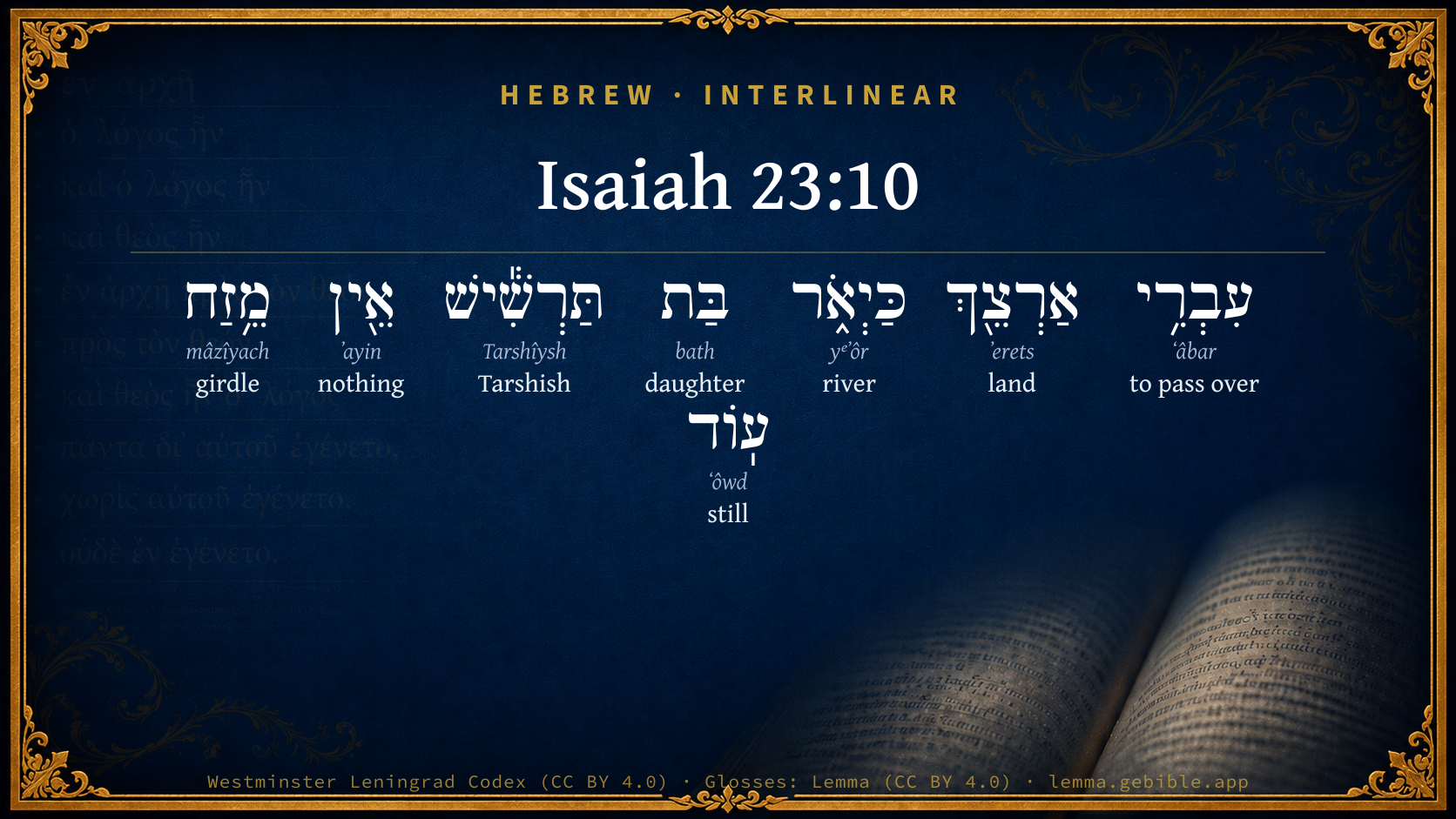
Isaiah 23:10

Hebrew (Westminster Leningrad Codex) Isaiah 23:10 appears in the Hebrew Old Testament. The text above is from the Westminster Leningrad Codex. Each word links to its Strong’s number, a concise gloss, and parsing drawn from the Open Scriptures Hebrew Bible morphology. Click any word for its full Brown-Driver-Briggs (BDB) entry.
Download image
Cite this verse

Isaiah 23:10 (World English Bible). Public Domain. Lemma interlinear Bible study tool, https://lemma.gebible.app/v/isaiah/23/10.

Show BibTeX & RIS
BibTeX
RIS
English Translation
Pass through your land as the Nile, daughter of Tarshish; there is no restraint any more.
World English Bible · Public Domain
Download a study sheet

One document with this verse’s original text, its word-by-word gloss line, the meaning frame, cross-references with their text, attributed commentary, and full source and license credits — printable, and it pastes into notes with its structure intact.

This verse Autodidact and up

Study sheet (.html) Plain text (.txt)

A passage Seminary Student

Up to 50 verses in one chapter. A passage sheet keeps up to 6 commentary sources and 12 cross-references per verse, in the order this page ranks them, and says so on the sheet whenever that leaves anything out. Ask for a single verse and you get the Autodidact verse sheet above.

Everything on this page stays free to read, with no account — the sheet is a download of what is already on screen, not access to it.

Want to remove ads? Support Godless Engineer
Compare translations 3

The same verse in 3 English versions, stacked beneath the original-language interlinear above. Click any original word for its lexicon entry.

Each is an independent rendering of the whole verse — the interlinear is not word-aligned to these translations.

Highlighted words mark where these versions differ — a whole-verse word diff, not a word-by-word alignment.

  • World English Bible Public Domain
    Pass through your land as the Nile, daughter of Tarshish; there is no restraint any more.
  • King James Version Public Domain
    Pass through thy land as a river, O daughter of Tarshish: there is no more strength.
  • unfoldingWord Literal Text CC BY-SA 4.0
    Pass through your land like the Nile, daughter of Tarshish; there is no restraint anymore.

unfoldingWord Literal Text — © unfoldingWord, licensed CC BY-SA 4.0. Word-aligned USFM3 via Door43 (git.door43.org/unfoldingWord/en_ult).

Versions to compare (up to 4)

3 of 4 selected

Show all 18 translations

Every available English version of this verse, each an independent rendering of the whole verse.

  • World English Bible Public Domain
    Pass through your land as the Nile, daughter of Tarshish; there is no restraint any more.
  • Berean Standard Bible Public Domain
    Cultivate your land like the Nile, O Daughter of Tarshish; there is no longer a harbor.
  • Majority Standard Bible Public Domain
    Cultivate your land like the Nile, O Daughter of Tarshish; there is no longer a harbor.
  • King James Version Public Domain
    Pass through thy land as a river, O daughter of Tarshish: there is no more strength.
  • American Standard Version (1901) Public Domain
    Pass through thy land as the Nile, O daughter of Tarshish; there is no restraint any more.
  • Revised Version (1885) Public Domain
    Pass through thy land as the Nile, O daughter of Tarshish; there is no girdle about thee any more.
  • Geneva Bible (1599) Public Domain
    Passe through thy lande like a flood to the daughter of Tarshish: there is no more strength.
  • Douay-Rheims (1899) Public Domain
    Pass thy land as a river, O daughter of the sea, thou hast a girdle no more.
  • Young's Literal Translation Public Domain
    Pass through thy land as a brook, Daughter of Tarshish, there is no more a girdle.
  • Literal Standard Version CC BY-SA 4.0
    Pass through your land as a brook, || Daughter of Tarshish, || There is no longer a girdle.
  • Unlocked Literal Bible CC BY-SA 4.0
    Plow your land, as one plows the Nile, daughter of Tarshish. There is no longer a marketplace in Tyre.
  • unfoldingWord Literal Text CC BY-SA 4.0
    Pass through your land like the Nile, daughter of Tarshish; there is no restraint anymore.
  • Darby Bible Public Domain
    Overflow thy land like the Nile, daughter of Tarshish: there is no more restraint.
  • World Messianic Bible Public Domain
    Pass through your land like the Nile, daughter of Tarshish. There is no restraint any more.
  • Webster's Bible Public Domain
    Pass through thy land as a river, O daughter of Tarshish: there is no more strength.
  • Free Bible Version CC BY-SA 4.0
    Work your land, people of Tarshish, as they do beside the Nile, for you don't have a harbor anymore.
  • Bible in Basic English Public Domain
    Let your land be worked with the plough, O daughter of Tarshish; there is no longer any harbour.
  • JPS Tanakh (1917) Public Domain
    Overflow thy land as the Nile, O daughter of Tarshish! there is no girdle any more.

Literal Standard Version (2020), Covenant Press — licensed CC BY-SA 4.0. Text via the HelloAO Bible API (eBible.org). Unlocked Literal Bible (unfoldingWord) — licensed CC BY-SA 4.0. Text via the HelloAO Bible API (eBible.org). unfoldingWord Literal Text — © unfoldingWord, licensed CC BY-SA 4.0. Word-aligned USFM3 via Door43 (git.door43.org/unfoldingWord/en_ult). Free Bible Version, Dr. Jonathan Gallagher — licensed CC BY-SA 4.0. Text via the HelloAO Bible API (eBible.org).

Word by word

More ways to search: Search by grammar → Find every occurrence → Compare this word →

Practice this passage: Drill this verse → Learn its vocabulary →

About this verse

These counts appear in no published source. They are computed here, from the morphology-tagged text and Lemma’s own curated glosses. What Lemma adds →

8
words
8
distinct lemmas
Prophets
section

Notable vocabulary

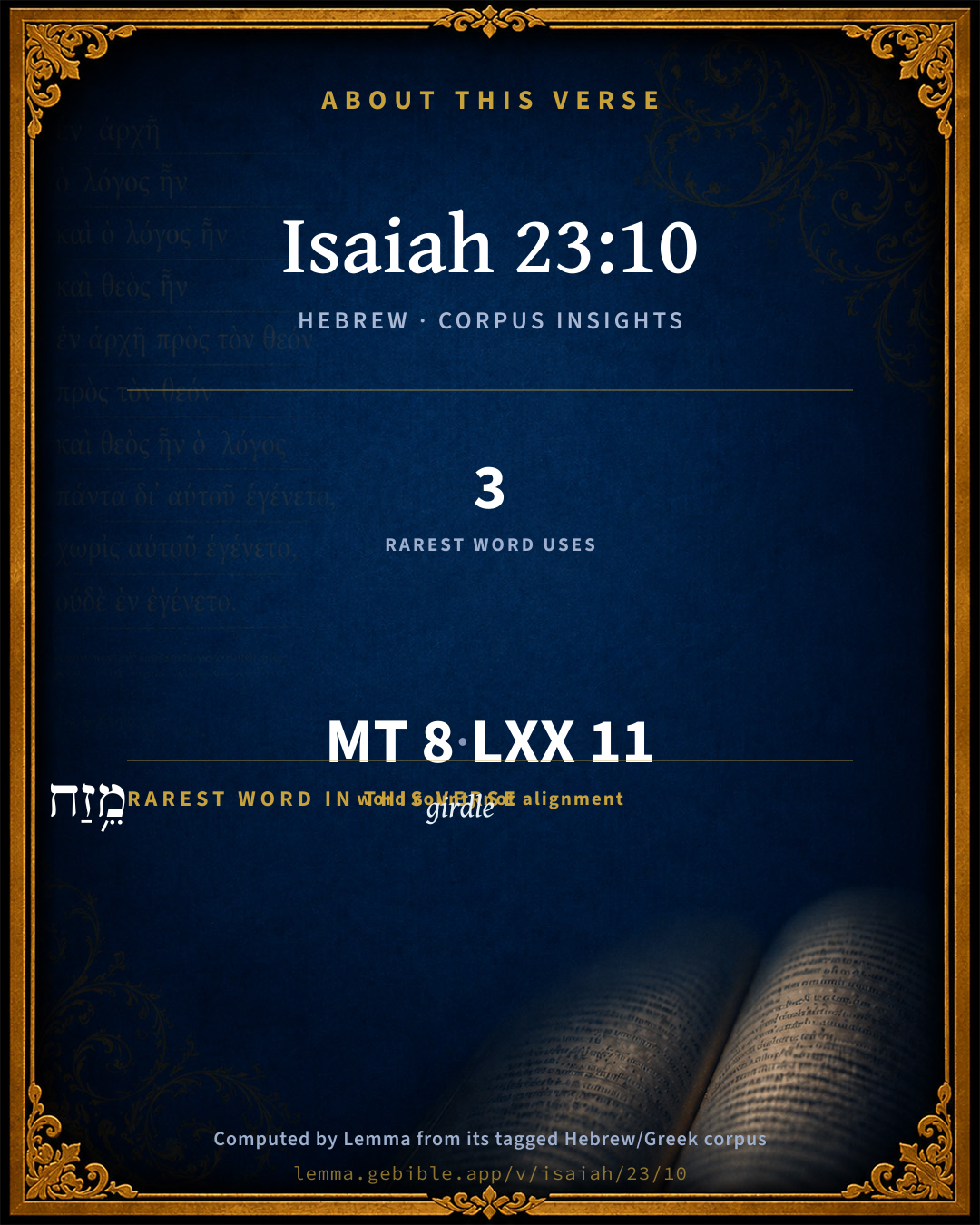
The rarest word here is מֵ֥זַח girdle H4206 — appearing just 3 times in the whole Hebrew Bible.

Shared distinctive vocabulary

מֵ֥זַח girdle H4206 occurs in 3 verses of the Hebrew Bible. Also found in:

Grammatical profile

  • 1 verb
  • 5 nouns
  • 1 adverb
  • 1 particle

Verb forms

  • עִבְרִ֥י Qal · Imperative

Hebrew & Septuagint length

In English translation the verse runs 16 words from the Hebrew and 11 from the Septuagint (LXX English) — the Septuagint runs noticeably shorter here. See the side-by-side →

A rough comparison of the two English renderings, which tokenize alike — not a word-level alignment.

Word counts can differ between the Hebrew and the Greek without any difference in meaning — e.g. the Hebrew direct-object marker אֵת has no separate Greek word, and Greek often adds the article ὁ.

In the original languages it is 8 Hebrew tokens and 11 Greek tokens — but the two are counted differently (Hebrew bundles its prefixes and suffixes into one token; the Greek is in lemma form), so that isn’t a like-for-like length.

Cross-references

7

Topical passages linked to Isaiah 23:10 in the Treasury of Scripture Knowledge — connected by theme and wording, ordered by reader-vote popularity; previews shown in the World English Bible.

  • 1 Samuel 28:20 Then Saul fell immediately his full length on the earth, and was sore afraid, because of the words of Samuel: and there was no strength in him; for he had eaten no bread all the day, nor all the night.
  • Job 12:21 He pours contempt on princes, And loosens the belt of the strong.
  • Psalms 18:32 The God who arms me with strength, and makes my way perfect?
  • Isaiah 23:14 Howl, you ships of Tarshish; for your stronghold is laid waste.
  • Lamentations 1:6 From the daughter of Zion all her majesty is departed: Her princes are become like harts that find no pasture, They are gone without strength before the pursuer.
  • Haggai 2:22 I will overthrow the throne of kingdoms. I will destroy the strength of the kingdoms of the nations. I will overthrow the chariots, and those who ride in them. The horses and their riders will come down, everyone by the sword of his brother.
  • Romans 5:6 For while we were yet weak, at the right time Christ died for the ungodly.

Cross-references courtesy of OpenBible.info (CC BY 4.0).

Hebrew and Greek witnesses Masoretic Hebrew ↔ Greek Septuagint

The same verse in the two great witnesses to the Old Testament, shown verse-for-verse.

Here the Septuagint runs noticeably shorter than the Hebrew — LXX2012 (modern English Septuagint) 11 words vs World English Bible 16. A rough length comparison of the two English translations, not a word-level alignment — read both below.

These are two independent witnesses, not word-aligned to each other, and the Septuagint is shown in lemma (dictionary) form.

Hebrew Isaiah 23:10 Masoretic · Westminster Leningrad Codex

עִבְרִ֥י אַרְצֵ֖ךְ כַּיְאֹ֑ר בַּת תַּרְשִׁ֕ישׁ אֵ֖ין מֵ֥זַח עֽוֹד

Pass through your land as the Nile, daughter of Tarshish; there is no restraint any more.

World English Bible · Public Domain

Greek LXX Isaiah 23:10 Septuagint · lemma form

ἐργάζομαι ὁ γῆ σύ καί γάρ πλοῖον οὐκέτι ἔρχομαι ἐκ καρχηδών

Till your land; for ships no more come out of Carthage.

LXX2012 (modern English Septuagint) · Public Domain

On this verse, Albert Barnes' Notes on the Bible discusses the Septuagint’s reading. Read the note in Commentary ↓

Hebrew: Westminster Leningrad Codex (CC BY 4.0). Greek: Septuagint (public domain); English from LXX2012 (modern English Septuagint) (Public Domain). How the Septuagint differs from the Hebrew →

Targum (Aramaic paraphrase)

1

The Targum is the ancient Jewish Aramaic paraphrase of the Hebrew Scriptures — an interpretive translation, not the Hebrew text itself. Onkelos (literal) and Pseudo-Jonathan (expansive) render the Torah, and Jonathan the Prophets. Coverage is partial: where no permissively-licensed English translation exists for a verse, only the Aramaic is shown. This is verse-level text, not a word-by-word alignment to the Hebrew.

  1. Targum Jonathan Prophets (Joshua–Malachi)
    גְלָא מֵאַרְעִיךְ כְּמֵי נַהֲרָא עֲרוֹקִי לִמְדִינַת יַמָא לֵית תְּקוֹף עוֹד:

    Remove from thy land, as the waters of a river; flee to a province of the sea: there is no more strength.

    Targum Jonathan — Aramaic: “Mikraot Gedolot” (public domain). English: “Sefaria Community Translation” (CC0 1.0 (public-domain dedication)); “London "Chaldee Paraphrase," 1871” (public domain). Text via Sefaria.

Commentary

Notes on Isaiah 23:10 from classic Christian and Jewish commentators (each source and its license shown beneath its notes). The classic Christian expositions comment on the surrounding passage and are grouped to its opening verse, so a note may address several verses; the Jewish commentaries on the Tanakh (Rashi and others) are per-verse, so they appear only where the commentator wrote on this verse.

Lemma curates 59 commentaries, every one of them public domain or Creative Commons licensed, each selected and text-cleaned for this edition rather than reprinted as found. About our sources →

Trapp's Complete Commentary

John Trapp

Isa 23:10 Pass through thy land as a river, O daughter of Tarshish: [there is] no more strength.

Ver. 10. Pass through the land as a river,] i.e., Hastily: {a} Abi praeceps, pack up and begone with all speed, be there never so many of you here at Tyre.

There is no more strength.] Heb., Girdle - that is, soldiery, or shipping, or sea to encompass it. Oecolampadius sets this sense upon the words, Non est ei cingulum reliquum, There is not so much as a girdle or such like lowly commodity left in Tyre, she had been so plundered.

{a} Indefinenter et cito. - Jun.

John Trapp, A Commentary or Exposition upon All the Books of the Old and New Testament (1647–1656) — public domain. Text from a community e-Sword module.

Joseph Benson's Commentary

Isa 23:10. Pass through thy land — Tarry no longer in thy own territories, but flee through them, into other countries, for safety and relief. As a river — Swiftly, lest you be prevented; continually, till you be all gone, and in shoals and multitudes. O daughter of Tarshish — Tyre is here called the daughter of Tarshish, because it was enriched and increased by trade to that place: or, rather, as Bishop Lowth supposes, “because of the close connection and perpetual intercourse between the two cities, according to that latitude of signification in which the Hebrews used the word son and daughter, to express any sort of conjunction and dependance whatever.” There is no more strength — Or, no more a girdle, as in the margin: the girdle which strengthens the loins of a man being here put for strength, as frequently elsewhere, as if he had said, It behooves you, O Tyrians, to flee away, as I advise, for your city is unable to defend you; your wealth, the sinews of war, is lost; your walls are broken down; and your former friends and allies have forsaken you.

Joseph Benson's Commentary on the Old and New Testaments (1811–1818) — public domain. Text from a community e-Sword module.

Keil & Delitzsch

C. F. Keil & F. Delitzsch

The consequence of the fall of Tyre is, that the colonies achieve their independence, Tartessus being mentioned by way of example. "Overflow thy land like the Nile, O daughter of Tarshish! No girdle restrains thee any longer." The girdle (mēzach) is the supremacy of Tyre, which has hitherto restrained all independent action on the part of the colony. Now they no longer need to wait in the harbour for the ships of the mother city, no longer to dig in the mines as her tributaries for silver and other metals. The colonial territory is their own freehold now, and they can spread themselves over it like the Nile when it passes beyond its banks and overflows the land. Koppe has already given this as the meaning of Isa 23:10.

Keil & Delitzsch — Biblical Commentary on the Old Testament (1861–1891) — public domain (CC PDM 1.0). Text via the HelloAO Bible API. (Old Testament only.)

Tyndale Open Study Notes

Tyndale Open Resources

23:10 Sweep over the land like the flooding Nile: This difficult phrase means either (1) that the sailors who had returned from Tarshish were being invited to loot ruined Tyre; or (2) that the people of Tarshish were forced to move back to their agricultural fields to make their living (instead of trading) now that Tyre had been destroyed.

Tyndale Open Study Notes — © Tyndale Open Resources, licensed CC BY-SA 4.0. Text via the HelloAO Bible API.

Geneva Bible (1599)

Geneva Bible translators

Thy strength will no more serve thee: therefore flee to other countries for succor.

Geneva Bible (1599) marginal notes — public domain. Text via Bolls.life.

Jamieson, Fausset & Brown

Robert Jamieson, A. R. Fausset & David Brown

a river--Hebrew, "the river," namely, Nile.

daughter of Tarshish--Tyre and its inhabitants (Isa 1:8), about henceforth, owing to the ruin of Tyre, to become inhabitants of its colony, Tartessus: they would pour forth from Tyre, as waters flow on when the barriers are removed [LOWTH]. Rather, Tarshish, or Tartessus and its inhabitants, as the phrase usually means: they had been kept in hard bondage, working in silver and lead mines near Tarshish, by the parent city (Eze 26:17): but now "the bond of restraint" (for so "strength," Margin, "girdle," that is, bond, Psa 2:3, ought to be translated) is removed, since Tyre is no more.

Jamieson, Fausset & Brown — Commentary Critical and Explanatory on the Whole Bible (1871) — public domain (CC PDM 1.0). Text via the HelloAO Bible API.

Adam Clarke's Commentary

Verse 10. O daughter of Tarshish] Tyre is called the daughter of Tarshish; perhaps because, Tyre being ruined, Tarshish was become the superior city, and might be considered as the metropolis of the Tyrian people; or rather because of the close connexion and perpetual intercourse between them, according to that latitude of signification in which the Hebrews use the words son and daughter to express any sort of conjunction and dependence whatever. מזח mezach, a girdle, which collects, binds, and keeps together the loose raiment, when applied to a river, may mean a mound, mole, or artificial dam, which contains the waters and prevents them from spreading abroad. A city taken by siege and destroyed, whose walls are demolished, whose policy is dissolved, whose wealth is dissipated, whose people is scattered over the wide country, is compared to a river whose banks are broken down, and whose waters, let loose and overflowing all the neighbouring plains, are wasted and lost. This may possibly be the meaning of this very obscure verse, of which I can find no other interpretation that is at all satisfactory. - L.

Adam Clarke's Commentary on the Bible (1810–1826) — public domain. Text from a community e-Sword/MySword module.

Ellicott's Commentary for English Readers

(10) Pass through thy land as a river . . .—The word for “river” is that used in Isa_23:3 with special reference to the Nile. Here the inundation of the Nile gives special force to the comparison. The daughter of Tarshish (i.e., Tarshish itself) is to spread and overflow in independent action. The colonies of Tyre are no longer subject to her, paying tribute or custom duties as she might ordain. There is no “strength,” no “girdle” now to restrain them, no limit such as Tyre had imposed on their commerce or colonisation. It is significant that Cyprus revolted about this time, and that the Phœnician colonies took part in attacking the mother city under Sennacherib (Jos. Ant. ix. 14. 2).

A Bible Commentary for English Readers, edited by Charles John Ellicott (1878–1897) — public domain. Text from a community e-Sword module.

The Cambridge Bible for Schools and Colleges

gen. ed. J. J. S. Perowne

10. as a river] Rather: as the Nile (as R.V.). The people of Tarshish are now as free of the land they live in as the Nile is of Egypt in the time of the annual inundation.

there is no more strength] Render as in R.V. there is no girdle (about thee) any more. The “girdle” (cf. Psa_109:19) is supposed to be a symbol of the restraints hitherto imposed on the colonists by Tyre. But nowhere else is a man represented as hampered by his own girdle; the removal of it is rather a synonym for weakness (Job_12:21—the same root as here—cf. Isa_5:27).

10–14. The third strophe, as usually explained, deals mainly with the emancipation of the Phœnician colonies from the somewhat stringent control of Tyre. But the passage presents many difficulties; and from the utter uncertainty as to the meaning of Isa_23:13 the general sense is doubtful.

The Cambridge Bible for Schools and Colleges (gen. ed. J. J. S. Perowne; Cambridge University Press, 1878–1918) — public domain. Text from a community e-Sword module.

John Gill's Exposition

Pass through thy land as a river, O daughter of Tarshish,.... Or, "of the sea", as the Vulgate Latin; meaning Tyre, which was situated in the sea, and did, as it were, spring from it, and was fortified by it, and supported by ships of merchandise on it, from various places; but now, being about to be destroyed, the inhabitants of it are called upon to pass through it, and get out of it as fast as they could, even as swiftly as a river runs, and in great abundance or multitudes. Kimchi thinks the Tyrians are bid to pass to the daughter of Tarshish, that is, to Tarshish itself, to make their escape out of their own land, and flee thither for safety; this the accents will not admit of, there being an "athnach" upon the word "river"; rather the merchants of Tarshish, that were in Tyre, are exhorted to depart to their own land with all possible haste, lest they should be involved in its ruin; though the Targum inclines to the other sense,

"pass out of thy land, as the waters of a river flee to a province of the sea:''

there is no more strength; in Tyre, to defend themselves against the enemy, to protect their trade, and the merchants that traded with them; or, "no more girdle" (e); about it; no more girt about with walls, ramparts, and other fortifications, or with soldiers and shipping, or with the sea, with which it was encompassed, while an island, but now no more, being joined to the continent by the enemy. Some think, because girdles were a part of merchandise, Pro 31:24, that this is said to express the meanness and poverty of the place, that there was not so much as a girdle left in it; rather that it was stripped of its power and authority, of which the girdle was a sign; see Isa 22:21.

(e) "nulla est zona amplius", Junius & Tremellius, Piscator; "non est cingulum amplius", Cocceius.

John Gill's Exposition of the Whole Bible (1746–1763) — public domain (CC PDM 1.0). Text via the HelloAO Bible API.

Albert Barnes' Notes on the Bible

Pass through thy land as a river - This verse has been very variously understood. Vitringa supposes that it means that all that held the city together - its fortifications, walls, etc., would be laid waste, and that as a river flows on without obstruction, so the inhabitants would be scattered far and near. Everything, says he, would be leveled, and the field would not be distinguishable from the city. Grotius thus renders it: ‘Pass to some one of thy colonies; as a river flows from the fountain to the sea, so do you go to the ocean.’ Lowth understands it also as relating to the time of the destruction of Tyre, and to the escape which the inhabitants would then make.

‘Overflow thy land like a river,

O daughter of Tarshish; the mound (that kept in thy waters)

Is no more.’

The Septuagint renders it, ‘Cultivate (Ἐργάζον Ergazon) thy land, for the ships shall no more come from Carthage’ (Καρχηδόνος Karchēdonos) Probably the true meaning is that which refers it to the time of the siege, and to the fact that the inhabitants would seek other places when their defense was destroyed. That is, ‘Pass through thy territories, thy dependent cities, states, colonies, and seek a refuge there; or wander there like a flowing stream.’

As a river - Perhaps the allusion is to the Nile, as the word יאר ye'or is usually given to the Nile; or it may be to any river that flows on with a mighty current when all obstructions are removed. The idea is, that as waters flow on when the barriers are removed, so the inhabitants of Tyre would pour forth from their city. The idea is not so much that of rapidity, as it is they should go like a stream that has no dikes, barriers, or obstacles now to confine its flowing waters.

O daughter of Tarshish - Tyre; so called either because it was in some degree sustained and supplied by the commerce of Tarshish; or because its inhabitants would become the inhabitants of Tarshish, and it is so called by anticipation. The Vulgate renders this, “Filia marias” - ‘Daughter of the sea. Juntos supposes that the prophet addresses those who were then in the city who were natives of Tarshish, and exhorts them to flee for safety to their own city.

There is no more strength - Margin, ‘Girdle.’ The word מזח mēzach means properly a girdle Job 12:31. It is applied to that which binds or secures the body; and may be applied here perhaps to that which secured or bound the city of Tyre; that is, its fortifications, its walls, its defenses. They would all be leveled; and nothing would secure the inhabitants, as they would flow forth as waters that are pent up do, when every barrier is removed.

Albert Barnes' Notes on the Bible (1834–1885) — public domain. Text from a community e-Sword/MySword module.

Haydock's Catholic Bible Commentary

Girdle, fortress; or rather, thou art naked, like a slave, chap. xx. 4.

George Leo Haydock (1774–1849), Haydock's Catholic Family Bible and Commentary, 1859 edition — public domain. Excludes Psalms (Douay-Rheims chapter numbering differs from Protestant) and Deuterocanonical books (Catholic canon only).

Matthew Poole's English Annotations

Pass through the land; tarry no longer in thy own territories, but flee through them, and beyond them, into other countries, for safety and relief.

As a river; swiftly, lest you be prevented; and continually, till you be all gone; and in shoals and multitudes.

O daughter of Tarshish; O Tyrus; for of her he speaks both in the foregoing and following words. And Tyrus might well be called the daughter of Tarshish, i.e. of the sea, as that word is used, Isa 23:1, and elsewhere, because it then was an island, and therefore as it were born of the sea, and nourished and brought up by it.

No more strength, Heb. no more girdle: the girdle, which strengthens the loins of a man, is put for strength, as Job 12:21; 38:3. It behoveth you, O people of Tyrus, to flee away, as I advise you; for your city is unable to defend you; your wealth, the sinews of war, is lost; your walls broken down; the sea, which, like a girdle, surrounded and defended you, is now in part filled up by your enemies, who have joined you to the main land; your former friends and allies forsake you.

Matthew Poole's English Annotations on the Holy Bible (1683–1685) — public domain. Text from a community e-Sword/MySword module.

Whedon's Commentary on the Bible

Daniel D. Whedon

10. Pass through… as a river — As freely as a river flows, overflows, and rushes, so let the population go hence.

Daughter of Tarshish — Dependent, henceforth, on the colonies for existence and a home.

No more strength — Girdle is the word — a figure of strength. No more home girding of the loins or fortifications. The cincture of beauty and strength is gone from Tyre.

Daniel D. Whedon (gen. ed.), Commentary on the Old and New Testaments (1874–1909) — public domain. Text from a community e-Sword module.

The Pulpit Commentary

Pass through thy laud as a river; rather, overflow thy land, as the Nile. Shake off all restraint; that is, give thy desires free vent be no longer cramped and confined by the restrictions of the metro-polls. Tartessus is addressed, as the leading colony, and perhaps the one most oppressed; and in her person all the colonies are called on to shake themselves free of the mother city. There is no more strength; rather, there is no more a girdle; i.e. there is nothing that need restrain yon the power of Tyre is gone!

The Pulpit Commentary (1880–1919), ed. H.D.M. Spence-Jones & Joseph S. Exell — public domain. Text from a community e-Sword module.

John Wesley's Explanatory Notes

Pass through - Tarry no longer in thy own territories, but flee through them, into other countries, for safety and relief. As a river - Swiftly, lest you be prevented. Tarshish - O Tyre, which might well be called daughter of Tarshish, that is, of the sea, as that word is used, ver. 1, and elsewhere, because it was an island, and therefore as it were, born of the sea, and nourished and brought up by it.

John Wesley, Explanatory Notes Upon the Whole Bible (1754–1765) — public domain. Text via the GEBible commentary corpus.

J. A. Alexander on Isaiah

Joseph Addison Alexander

“Pass through thy land like the river (Nile). Daughter of Tarshish, there is no girdle (any) longer.” It is commonly agreed that the phrase means, as the Nile passes, (i.e., quickly or without restraint). ‘The daughter of Tarshish’ is Tarshish itself. ‘There is no more girdle,’ may be taken in opposite senses, as denoting the failure of strength and general dissolution, or the absence of restraint and freedom from oppression.

Joseph Addison Alexander, The Prophecies of Isaiah (1846–1847; New York: Scribner, 1870–1878) — public domain. Text from a community e-Sword module.

unfoldingWord translationNotes

Door43 World Missions Community

Plow your land, as one plows the Nile, daughter of Tarshish. There is no longer a marketplace in Tyre

Possible meanings are 1) Isaiah is telling the people of Tarshish to start planting crops since they can no longer trade with Tyre or 2) Isaiah is telling the people of Tarshish they are free from Tyre's control. AT: "Pass through your land like a river, daughter of Tarshish. The people of Tyre no longer have any power" (See: Simile)

daughter of Tarshish

The "daughter" of a city represents the people of the city. AT: "the people of Tarshish" or "the people who live in Tarshish" (See: Metonymy)

Yahweh has reached out with his hand over the sea, and he has shaken the kingdoms

Yahweh using his power to control the sea and the people of mighty kingdoms is spoken of as if Yahweh reached out his hand and shook kingdoms. (See: Metaphor)

has reached out with his hand over the sea

Here "hand" refers to God's power and control. AT: "has shown his power over the sea" (See: Metonymy)

oppressed virgin daughter of Sidon

Here "virgin daughter" represents the people of Sidon. AT: "people of Sidon, because other people will oppress you" (See: Metonymy)

translationWords

Nile River

Tarshish

Tyre

Yahweh

hand

kingdom

command

Phoenicia

stronghold

joy

oppress

Sidon

Cyprus

unfoldingWord translationNotes — © Distant Shores Media and the Door43 World Missions Community, licensed CC BY-SA 4.0. Source: git.door43.org/Door43/en_tn.

Rashi

Rabbi Shlomo Yitzchaki (Rashi)

Cross your land into exile.

like a river Like this river that rises and spreads out.

O daughter of Tarshish Tyre, which is situated on the Sea of Tarshish.

there is no more strength (אֵין מֵזַח עוֹד). You have no more strength or girdle to gird your loins. מֵזַח is an expression of a girdle. Comp. (Psalms 109: 19) “And for a girdle (וּלְמֵֵזַח) he shall always gird himself with it.” And every ‘girdle’ is an expression of strength.

Rashi on the Tanakh — English translations: “The Judaica Press complete Tanach with Rashi, translated by A. J. Rosenberg” (CC BY 4.0); “Pentateuch with Rashi's commentary by M. Rosenbaum and A.M. Silbermann, 1929-1934” (public domain); “The Metsudah Tanach series, Lakewood, N.J” (CC BY 4.0); and “The Book of Joshua, Metsudah Publications, 1997” (CC BY 4.0). Text via Sefaria.

Ibn Ezra

Rabbi Abraham ibn Ezra

עברי ארצך כיאור Pass over to thy land as a river (עברי אל ארצך═עברי ארצך); that is, hasten to thy country, as quickly as the river flows, or, pass through thy land as the river which overflows the country.

מזח Strength. Literally, girdle. (Comp. Ps. 109:19). It is used as a figure for strength, because a girdle supports the loins.

Ibn Ezra on the Tanakh — English translations: “Sefaria Community Translation” (CC0 1.0 (public-domain dedication)); “Yalkut, Sifsei Chachomim Chumash, Metsudah Publications, 2009” (CC BY 4.0); and “Commentary of Ibn Ezra on Isaiah - trans. by M. Friedlander, 1873” (public domain). Text via Sefaria.

Lesson kit

Teaching starters — assembled from the data on this page, not authored interpretation. Every prompt links to the verse data it draws on. Edit before teaching.

Isaiah, in the Prophets, opens this verse with 8 words (8 distinct Hebrew lemmas). Its most distinctive word is mâzîyach (“girdle”). The Greek Septuagint runs shorter here. A historical commentator’s framing appears above. Read the whole chapter for the surrounding context.

Discussion questions

  1. The word mâzîyach carries the sense “girdle.” How does it shape the verse?
  2. How does Job 12:21, which shares the word «girdle», read alongside this verse?
  3. The Septuagint runs shorter here than the Hebrew. What might account for the difference?
  4. These translations render this verse differently. What is at stake in choosing one wording over another?
  5. «עִבְרִ֥י» is a Qal Imperative verb. How does that grammatical form shape the action described?
  6. Compare how Trapp's Complete Commentary and Joseph Benson's Commentary read this verse. Where do they agree or differ?

Things to notice

Reading settings

Reading text

Shown beneath each verse's original-language words.

Old Testament
Old Testament edition

Read the OT as the Masoretic Hebrew (MT) or the Greek Septuagint (LXX).

English shown for the Greek Septuagint (in the Hebrew ↔ Greek comparison).

Comparing translations? Open the Compare panel on any verse page to stack up to four side by side.