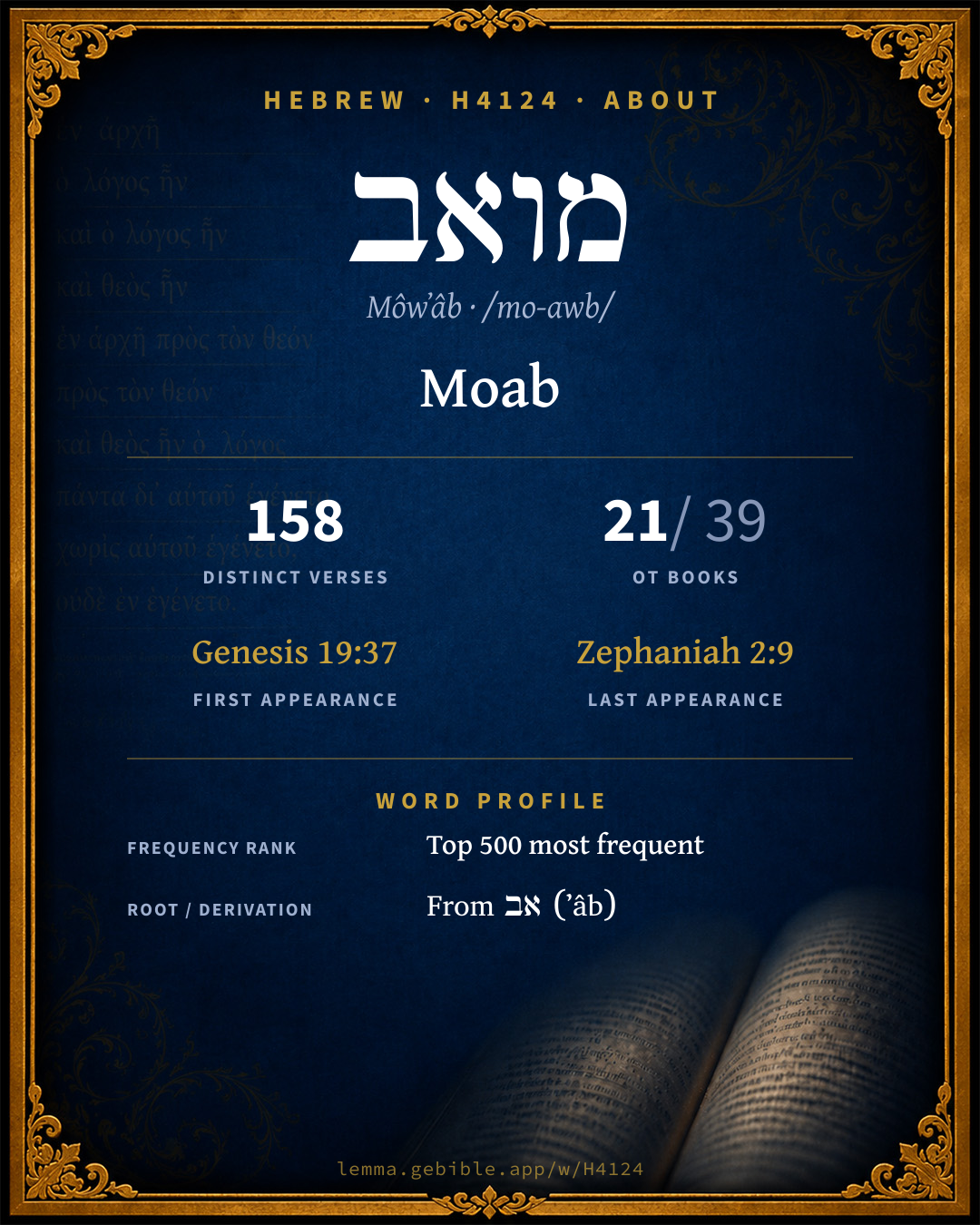
מוֹאָב
Moab
BDB lists 4 entries for ‘Moab’ fuller range ↓
Full lexicon entry — Brown-Driver-Briggs (BDB)
From Brown-Driver-Briggs (BDB)
Where this word appears
Grammar key — what these labels mean
Part of speech
- Noun
- A naming word — a person, place, thing, or idea.
Noun type
- Proper
- A name of a specific person, place, or people (e.g. Abraham, Zion, Israel).
Every verse where H4124 appears — 158 distinct verses across 21 books. Click any verse to open its interlinear word-by-word view. Verse text shown in the World English Bible for context — . Each verse’s Hebrew form is shown with its reference; the English is not keyword-highlighted, since the data carries no word-level English alignment. Use “Compare translations” on any verse to read it across multiple English versions. This concordance covers the Hebrew Bible; Septuagint (Greek Old Testament) occurrences are not indexed here.
Genesis 2 verses
- Genesis 19:37 מוֹאָ֑ב מוֹאָ֖ב n Proper n Proper The firstborn bore a son, and named him Moab. The same is the father of the Moabites to this day.
- Genesis 36:35 מוֹאָ֔ב n Proper Husham died, and Hadad, the son of Bedad, who struck Midian in the field of Moab, reigned in his place. The name of his city was Avith.
Exodus 1 verse
Numbers 30 verses
- Numbers 21:11 מוֹאָ֔ב n Proper They traveled from Oboth, and encamped at Iyeabarim, in the wilderness which is before Moab, toward the sunrise.
- Numbers 21:13 מוֹאָ֔ב מוֹאָ֖ב n Proper n Proper From there they traveled, and encamped on the other side of the Arnon, which is in the wilderness, that comes out of the border of the Amorites: for the Arnon is the border of Moab, between Moab and the Amorites.
- Numbers 21:15 מוֹאָֽב n Proper The slope of the valleys That inclines toward the dwelling of Ar, Leans on the border of Moab.
- Numbers 21:20 מוֹאָ֔ב n Proper and from Bamoth to the valley that is in the field of Moab, to the top of Pisgah, which looks down on the desert.
- Numbers 21:26 מוֹאָב֙ n Proper For Heshbon was the city of Sihon the king of the Amorites, who had fought against the former king of Moab, and taken all his land out of his hand, even to the Arnon.
- Numbers 21:28 מוֹאָ֔ב n Proper For a fire is gone out of Heshbon, A flame from the city of Sihon: It has devoured Ar of Moab, The lords of the high places of the Arnon.
- Numbers 21:29 מוֹאָ֔ב n Proper Woe to you, Moab! You are undone, people of Chemosh: He has given his sons as fugitives, His daughters into captivity, To Sihon king of the Amorites.
- Numbers 22:1 מוֹאָ֔ב n Proper The children of Israel traveled, and encamped in the plains of Moab beyond the Jordan at Jericho.
- Numbers 22:3 מוֹאָ֜ב מוֹאָ֔ב n Proper n Proper Moab was sore afraid of the people, because they were many: and Moab was distressed because of the children of Israel.
- Numbers 22:4 מוֹאָ֜ב לְ/מוֹאָ֖ב n Proper prep + n Proper Moab said to the elders of Midian, Now will this multitude lick up all that is round about us, as the ox licks up the grass of the field. Balak the son of Zippor was king of Moab at that time.
- Numbers 22:7 מוֹאָב֙ n Proper The elders of Moab and the elders of Midian departed with the rewards of divination in their hand; and they came to Balaam, and spoke to him the words of Balak.
- Numbers 22:8 מוֹאָ֖ב n Proper He said to them, Lodge here this night, and I will bring you word again, as Yahweh shall speak to me: and the princes of Moab abode with Balaam.
- Numbers 22:10 מוֹאָ֖ב n Proper Balaam said to God, Balak the son of Zippor, king of Moab, has sent to me, [saying],
- Numbers 22:14 מוֹאָ֔ב n Proper The princes of Moab rose up, and they went to Balak, and said, Balaam refuses to come with us.
- Numbers 22:21 מוֹאָֽב n Proper Balaam rose up in the morning, and saddled his donkey, and went with the princes of Moab.
- Numbers 22:36 מוֹאָ֗ב n Proper When Balak heard that Balaam was come, he went out to meet him to the City of Moab, which is on the border of the Arnon, which is in the utmost part of the border.
- Numbers 23:6 מוֹאָֽב n Proper He returned to him, and, behold, he was standing by his burnt-offering, he, and all the princes of Moab.
- Numbers 23:7 מוֹאָב֙ n Proper He took up his parable, and said, From Aram has Balak brought me, The king of Moab from the mountains of the East: Come, curse me Jacob, Come, defy Israel.
- Numbers 23:17 מוֹאָ֖ב n Proper He came to him, and, behold, he was standing by his burnt offering, and the princes of Moab with him. Balak said to him, What has Yahweh spoken?
- Numbers 24:17 מוֹאָ֔ב n Proper I see him, but not now; I see him, but not near: There shall come forth a star out of Jacob, A scepter shall rise out of Israel, Shall strike through the corners of Moab, Break down all the sons of tumult.
- Numbers 25:1 מוֹאָֽב n Proper Israel abode in Shittim; and the people began to play the prostitute with the daughters of Moab:
- Numbers 26:3 מוֹאָ֑ב n Proper Moses and Eleazar the priest spoke with them in the plains of Moab by the Jordan at Jericho, saying,
- Numbers 26:63 מוֹאָ֔ב n Proper These are those who were numbered by Moses and Eleazar the priest, who numbered the children of Israel in the plains of Moab by the Jordan at Jericho.
- Numbers 31:12 מוֹאָ֔ב n Proper They brought the captives, and the prey, and the spoil, to Moses, and to Eleazar the priest, and to the congregation of the children of Israel, to the camp at the plains of Moab, which are by the Jordan at Jericho.
- Numbers 33:44 מוֹאָֽב n Proper They traveled from Oboth, and encamped in Iye-abarim, in the border of Moab.
- Numbers 33:48 מוֹאָ֔ב n Proper They traveled from the mountains of Abarim, and encamped in the plains of Moab by the Jordan at Jericho.
- Numbers 33:49 מוֹאָֽב n Proper They encamped by the Jordan, from Beth-jeshimoth even to Abel Shittim in the plains of Moab.
- Numbers 33:50 מוֹאָ֑ב n Proper Yahweh spoke to Moses in the plains of Moab by the Jordan at Jericho, saying,
- Numbers 35:1 מוֹאָ֑ב n Proper Yahweh spoke to Moses in the plains of Moab by the Jordan at Jericho, saying,
- Numbers 36:13 מוֹאָ֔ב n Proper These are the commandments and the ordinances which Yahweh commanded by Moses to the children of Israel in the plains of Moab by the Jordan at Jericho.
Deuteronomy 10 verses
- Deuteronomy 1:5 מוֹאָ֑ב n Proper Beyond the Jordan, in the land of Moab, began Moses to declare this law, saying,
- Deuteronomy 2:8 מוֹאָֽב n Proper So we passed by from our brothers the children of Esau, who dwell in Seir, from the way of the Arabah from Elath and from Ezion Geber. We turned and passed by the way of the wilderness of Moab.
- Deuteronomy 2:9 מוֹאָ֔ב n Proper Yahweh said to me, Don't bother Moab, neither contend with them in battle; for I will not give you of his land for a possession; because I have given Ar to the children of Lot for a possession.
- Deuteronomy 2:18 מוֹאָ֖ב n Proper You are this day to pass over Ar, the border of Moab:
- Deuteronomy 29:1 מוֹאָ֑ב n Proper These are the words of the covenant which Yahweh commanded Moses to make with the children of Israel in the land of Moab, besides the covenant which he made with them in Horeb.
- Deuteronomy 32:49 מוֹאָ֔ב n Proper Go up into this mountain of Abarim, to Mount Nebo, which is in the land of Moab, that is over against Jericho; and see the land of Canaan, which I give to the children of Israel for a possession;
- Deuteronomy 34:1 מוֹאָב֙ n Proper Moses went up from the plains of Moab to Mount Nebo, to the top of Pisgah, that is over against Jericho. Yahweh shown him all the land of Gilead, to Dan,
- Deuteronomy 34:5 מוֹאָ֖ב n Proper So Moses the servant of Yahweh died there in the land of Moab, according to the word of Yahweh.
- Deuteronomy 34:6 מוֹאָ֔ב n Proper He buried him in the valley in the land of Moab over against Beth Peor: but no man knows of his tomb to this day.
- Deuteronomy 34:8 מוֹאָ֖ב n Proper The children of Israel wept for Moses in the plains of Moab thirty days: so the days of weeping in the mourning for Moses were ended.
Joshua 2 verses
- Joshua 13:32 מוֹאָ֑ב n Proper These are the inheritances which Moses distributed in the plains of Moab, beyond the Jordan at Jericho, eastward.
- Joshua 24:9 מוֹאָ֔ב n Proper Then Balak the son of Zippor, king of Moab, arose and fought against Israel: and he sent and called Balaam the son of Beor to curse you;
Judges 12 verses
- Judges 3:12 מוֹאָב֙ n Proper The children of Israel again did that which was evil in the sight of Yahweh: and Yahweh strengthened Eglon the king of Moab against Israel, because they had done that which was evil in the sight of Yahweh.
- Judges 3:14 מוֹאָ֔ב n Proper The children of Israel served Eglon the king of Moab eighteen years.
- Judges 3:15 מוֹאָֽב n Proper But when the children of Israel cried to Yahweh, Yahweh raised them up a savior, Ehud the son of Gera, the Benjamite, a man left-handed. The children of Israel sent tribute by him to Eglon the king of Moab.
- Judges 3:17 מוֹאָ֑ב n Proper He offered the tribute to Eglon king of Moab: now Eglon was a very fat man.
- Judges 3:28 מוֹאָ֖ב לְ/מוֹאָ֔ב n Proper prep + n Proper He said to them, Follow after me; for Yahweh has delivered your enemies the Moabites into your hand. They went down after him, and took the fords of the Jordan against the Moabites, and didn't allow a man to pass over.
- Judges 3:29 מוֹאָ֜ב n Proper They struck of Moab at that time about ten thousand men, every lusty man, and every man of valor; and there escaped not a man.
- Judges 3:30 מוֹאָב֙ n Proper So Moab was subdued that day under the hand of Israel. The land had rest eighty years.
- Judges 10:6 מוֹאָ֗ב n Proper The children of Israel again did that which was evil in the sight of Yahweh, and served the Baals, and the Ashtaroth, and the gods of Syria, and the gods of Sidon, and the gods of Moab, and the gods of the children of Ammon, and the gods of the Philistines; and they forsook Yahweh, and didn't serve him.
- Judges 11:15 מוֹאָ֔ב n Proper and he said to him, Thus says Jephthah: Israel didn't take away the land of Moab, nor the land of the children of Ammon,
- Judges 11:17 מוֹאָ֛ב n Proper then Israel sent messengers to the king of Edom, saying, Please let me pass through your land; but the king of Edom didn't listen. In the same way, he sent to the king of Moab; but he would not: and Israel abode in Kadesh.
- Judges 11:18 מוֹאָ֔ב מוֹאָ֔ב מוֹאָ֔ב מוֹאָֽב n Proper n Proper n Proper n Proper Then they went through the wilderness, and went around the land of Edom, and the land of Moab, and came by the east side of the land of Moab, and they encamped on the other side of the Arnon; but they didn't come within the border of Moab, for the Arnon was the border of Moab.
- Judges 11:25 מוֹאָ֑ב n Proper Now are you anything better than Balak the son of Zippor, king of Moab? did he ever strive against Israel, or did he ever fight against them?
Ruth 6 verses
- Ruth 1:1 מוֹאָ֔ב n Proper It happened in the days when the judges judged, that there was a famine in the land. A certain man of Bethlehem Judah went to sojourn in the country of Moab, he, and his wife, and his two sons.
- Ruth 1:2 מוֹאָ֖ב n Proper The name of the man was Elimelech, and the name of his wife Naomi, and the name of his two sons Mahlon and Chilion, Ephrathites of Bethlehem Judah. They came into the country of Moab, and continued there.
- Ruth 1:6 מוֹאָ֑ב מוֹאָ֔ב n Proper n Proper Then she arose with her daughters-in-law, that she might return from the country of Moab: for she had heard in the country of Moab how that Yahweh had visited his people in giving them bread.
- Ruth 1:22 מוֹאָ֑ב n Proper So Naomi returned, and Ruth the Moabitess, her daughter-in-law, with her, who returned out of the country of Moab: and they came to Bethlehem in the beginning of barley harvest.
- Ruth 2:6 מוֹאָֽב n Proper The servant who was set over the reapers answered, It is the Moabite lady who came back with Naomi out of the country of Moab:
- Ruth 4:3 מוֹאָֽב n Proper He said to the near kinsman, Naomi, who has come back out of the country of Moab, is selling the parcel of land, which was our brother Elimelech's:
1 Samuel 4 verses
- 1 Samuel 12:9 מוֹאָ֔ב n Proper But they forgot Yahweh their God; and he sold them into the hand of Sisera, captain of the host of Hazor, and into the hand of the Philistines, and into the hand of the king of Moab; and they fought against them.
- 1 Samuel 14:47 בְּ/מוֹאָ֣ב prep + n Proper Now when Saul had taken the kingdom over Israel, he fought against all his enemies on every side, against Moab, and against the children of Ammon, and against Edom, and against the kings of Zobah, and against the Philistines: and wherever he turned himself, he put [them] to the worse.
- 1 Samuel 22:3 מוֹאָ֑ב מוֹאָ֗ב n Proper n Proper David went there to Mizpeh of Moab: and he said to the king of Moab, Please let my father and my mother come forth, [and be] with you, until I know what God will do for me.
- 1 Samuel 22:4 מוֹאָ֑ב n Proper He brought them before the king of Moab: and they lived with him all the while that David was in the stronghold.
2 Samuel 3 verses
- 2 Samuel 8:2 מוֹאָ֗ב מוֹאָב֙ n Proper n Proper He struck Moab, and measured them with the line, making them to lie down on the ground; and he measured two lines to put to death, and one full line to keep alive. The Moabites became servants to David, and brought tribute.
- 2 Samuel 8:12 וּ/מִ/מּוֹאָב֙ conj + prep + n Proper of Syria, and of Moab, and of the children of Ammon, and of the Philistines, and of Amalek, and of the spoil of Hadadezer, son of Rehob, king of Zobah.
- 2 Samuel 23:20 מוֹאָ֔ב n Proper Benaiah the son of Jehoiada, the son of a valiant man of Kabzeel, who had done mighty deeds, he killed the two [sons of] Ariel of Moab: he went down also and killed a lion in the midst of a pit in time of snow.
1 Kings 2 verses
- 1 Kings 11:7 מוֹאָ֔ב n Proper Then did Solomon build a high place for Chemosh the abomination of Moab, on the mountain that is before Jerusalem, and for Molech the abomination of the children of Ammon.
- 1 Kings 11:33 מוֹאָ֔ב n Proper because that they have forsaken me, and have worshiped Ashtoreth the goddess of the Sidonians, Chemosh the god of Moab, and Milcom the god of the children of Ammon; and they have not walked in my ways, to do that which is right in my eyes, and [to keep] my statutes and my ordinances, as did David his father.
2 Kings 15 verses
- 2 Kings 1:1 מוֹאָב֙ n Proper Moab rebelled against Israel after the death of Ahab.
- 2 Kings 3:4 מוֹאָ֖ב n Proper Now Mesha king of Moab was a sheep-master; and he rendered to the king of Israel the wool of one hundred thousand lambs, and of one hundred thousand rams.
- 2 Kings 3:5 מוֹאָ֖ב n Proper But it happened, when Ahab was dead, that the king of Moab rebelled against the king of Israel.
- 2 Kings 3:7 מוֹאָב֙ מוֹאָ֖ב n Proper n Proper He went and sent to Jehoshaphat the king of Judah, saying, The king of Moab has rebelled against me: will you go with me against Moab to battle? He said, I will go up: I am as you are, my people as your people, my horses as your horses.
- 2 Kings 3:10 מוֹאָֽב n Proper The king of Israel said, Alas! for Yahweh has called these three kings together to deliver them into the hand of Moab.
- 2 Kings 3:13 מוֹאָֽב n Proper Elisha said to the king of Israel, What have I to do with you? get you to the prophets of your father, and to the prophets of your mother. The king of Israel said to him, No; for Yahweh has called these three kings together to deliver them into the hand of Moab.
- 2 Kings 3:18 מוֹאָ֖ב n Proper This is but a light thing in the sight of Yahweh: he will also deliver the Moabites into your hand.
- 2 Kings 3:21 מוֹאָב֙ n Proper Now when all the Moabites heard that the kings had come up to fight against them, they gathered themselves together, all who were able to put on armor, and upward, and stood on the border.
- 2 Kings 3:22 מוֹאָ֥ב n Proper They rose up early in the morning, and the sun shone on the water, and the Moabites saw the water over against them as red as blood:
- 2 Kings 3:23 מוֹאָֽב n Proper and they said, This is blood; the kings are surely destroyed, and they have struck each man his fellow: now therefore, Moab, to the spoil.
- 2 Kings 3:24 מוֹאָ֔ב מוֹאָֽב n Proper n Proper When they came to the camp of Israel, the Israelites rose up and struck the Moabites, so that they fled before them; and they went forward into the land smiting the Moabites.
- 2 Kings 3:26 מוֹאָ֔ב n Proper When the king of Moab saw that the battle was too severe for him, he took with him seven hundred men who drew sword, to break through to the king of Edom; but they could not.
- 2 Kings 13:20 מוֹאָ֛ב n Proper Elisha died, and they buried him. Now the bands of the Moabites invaded the land at the coming in of the year.
- 2 Kings 23:13 מוֹאָ֔ב n Proper The high places that were before Jerusalem, which were on the right hand of the mountain of corruption, which Solomon the king of Israel had built for Ashtoreth the abomination of the Sidonians, and for Chemosh the abomination of Moab, and for Milcom the abomination of the children of Ammon, did the king defile.
- 2 Kings 24:2 מוֹאָ֗ב n Proper Yahweh sent against him bands of the Chaldeans, and bands of the Syrians, and bands of the Moabites, and bands of the children of Ammon, and sent them against Judah to destroy it, according to the word of Yahweh, which he spoke by his servants the prophets.
1 Chronicles 6 verses
- 1 Chronicles 1:46 מוֹאָ֔ב n Proper Husham died, and Hadad the son of Bedad, who struck Midian in the field of Moab, reigned in his place; and the name of his city was Avith.
- 1 Chronicles 4:22 לְ/מוֹאָ֖ב prep + n Proper and Jokim, and the men of Cozeba, and Joash, and Saraph, who had dominion in Moab, and Jashubilehem. The records are ancient.
- 1 Chronicles 8:8 מוֹאָ֔ב n Proper Shaharaim became the father of children in the field of Moab, after he had sent them away; Hushim and Baara were his wives.
- 1 Chronicles 11:22 מוֹאָ֔ב n Proper Benaiah the son of Jehoiada, the son of a valiant man of Kabzeel, who had done mighty deeds, he killed the two [sons of] Ariel of Moab: he went down also and killed a lion in the midst of a pit in time of snow.
- 1 Chronicles 18:2 מוֹאָ֑ב מוֹאָב֙ n Proper n Proper He struck Moab; and the Moabites became servants to David, and brought tribute.
- 1 Chronicles 18:11 וּ/מִ/מּוֹאָב֙ conj + prep + n Proper These also did king David dedicate to Yahweh, with the silver and the gold that he carried away from all the nations; from Edom, and from Moab, and from the children of Ammon, and from the Philistines, and from Amalek.
2 Chronicles 4 verses
- 2 Chronicles 20:1 מוֹאָב֩ n Proper It happened after this, that the children of Moab, and the children of Ammon, and with them some of the Ammonites, came against Jehoshaphat to battle.
- 2 Chronicles 20:10 וּ/מוֹאָ֜ב conj + n Proper Now, behold, the children of Ammon and Moab and Mount Seir, whom you would not let Israel invade, when they came out of the land of Egypt, but they turned aside from them, and didn't destroy them;
- 2 Chronicles 20:22 מוֹאָ֧ב n Proper When they began to sing and to praise, Yahweh set liers-in-wait against the children of Ammon, Moab, and Mount Seir, who had come against Judah; and they were struck.
- 2 Chronicles 20:23 וּ/מוֹאָ֛ב conj + n Proper For the children of Ammon and Moab stood up against the inhabitants of Mount Seir, utterly to kill and destroy them: and when they had made an end of the inhabitants of Seir, everyone helped to destroy another.
Psalms 3 verses
- Psalms 60:8 מוֹאָ֤ב n Proper Moab is my wash basin. I will throw my shoe on Edom. I shout in triumph over Philistia."
- Psalms 83:6 מוֹאָ֥ב n Proper The tents of Edom and the Ishmaelites; Moab, and the Hagrites;
- Psalms 108:9 מוֹאָ֤ב n Proper Moab is my wash pot. I will toss my sandal on Edom. I will shout over Philistia."
Isaiah 16 verses
- Isaiah 11:14 וּ/מוֹאָב֙ conj + n Proper They shall fly down on the shoulder of the Philistines on the west; together shall they despoil the children of the east: they shall put forth their hand on Edom and Moab; and the children of Ammon shall obey them.
- Isaiah 15:1 מוֹאָ֑ב מוֹאָב֙ מוֹאָ֖ב n Proper n Proper n Proper The burden of Moab. For in a night Ar of Moab is laid waste, [and] brought to nothing; for in a night Kir of Moab is laid waste, [and] brought to nothing.
- Isaiah 15:2 מוֹאָ֣ב n Proper They are gone up to Bayith, and to Dibon, to the high places, to weep: Moab wails over Nebo, and over Medeba; on all their heads is baldness, every beard is cut off.
- Isaiah 15:4 מוֹאָב֙ n Proper Heshbon cries out, and Elealeh; their voice is heard even to Jahaz: therefore the armed men of Moab cry aloud; his soul trembles within him.
- Isaiah 15:5 לְ/מוֹאָ֣ב prep + n Proper My heart cries out for Moab; her nobles [flee] to Zoar, to Eglath Shelishiyah: for by the ascent of Luhith with weeping they go up; for in the way of Horonaim they raise up a cry of destruction.
- Isaiah 15:8 מוֹאָ֑ב n Proper For the cry is gone round about the borders of Moab; the wailing of it to Eglaim, and the wailing of it to Beer-elim.
- Isaiah 15:9 מוֹאָב֙ n Proper For the waters of Dimon are full of blood; for I will bring yet more on Dimon, a lion on them of Moab that escape, and on the remnant of the land.
- Isaiah 16:2 מוֹאָ֔ב n Proper For it shall be that, as wandering birds, as a scattered nest, so shall the daughters of Moab be at the fords of the Arnon.
- Isaiah 16:4 מוֹאָ֛ב n Proper Let my outcasts dwell with you; as for Moab, be a covert to him from the face of the destroyer. For the extortioner is brought to nothing, destruction ceases, the oppressors are consumed out of the land.
- Isaiah 16:6 מוֹאָ֖ב n Proper We have heard of the pride of Moab, [that] he is very proud; even of his arrogance, and his pride, and his wrath; his boastings are nothing.
- Isaiah 16:7 מוֹאָ֛ב לְ/מוֹאָ֖ב n Proper prep + n Proper Therefore shall Moab wail for Moab, everyone shall wail: for the raisin-cakes of Kir Hareseth shall you mourn, utterly stricken.
- Isaiah 16:11 לְ/מוֹאָ֔ב prep + n Proper Why my heart sounds like a harp for Moab, and my inward parts for Kir Heres.
- Isaiah 16:12 מוֹאָ֖ב n Proper It shall happen, when Moab presents himself, when he wearies himself on the high place, and shall come to his sanctuary to pray, that he shall not prevail.
- Isaiah 16:13 מוֹאָ֖ב n Proper This is the word that Yahweh spoke concerning Moab in time past.
- Isaiah 16:14 מוֹאָ֔ב n Proper But now Yahweh has spoken, saying, Within three years, as the years of a hireling, the glory of Moab shall be brought into contempt, with all his great multitude; and the remnant shall be very small and of no account.
- Isaiah 25:10 מוֹאָב֙ n Proper For in this mountain will the hand of Yahweh rest; and Moab shall be trodden down in his place, even as straw is trodden down in the water of the dung-hill.
Jeremiah 33 verses
- Jeremiah 9:26 מוֹאָ֔ב n Proper Egypt, and Judah, and Edom, and the children of Ammon, and Moab, and all that have the corners [of their hair] cut off, who dwell in the wilderness; for all the nations are uncircumcised, and all the house of Israel are uncircumcised in heart.
- Jeremiah 25:21 מוֹאָ֖ב n Proper Edom, and Moab, and the children of Ammon;
- Jeremiah 27:3 מוֹאָ֗ב n Proper and send them to the king of Edom, and to the king of Moab, and to the king of the children of Ammon, and to the king of Tyre, and to the king of Sidon, by the hand of the messengers who come to Jerusalem to Zedekiah king of Judah;
- Jeremiah 40:11 בְּ/מוֹאָ֣ב prep + n Proper Likewise when all the Jews who were in Moab, and among the children of Ammon, and in Edom, and who were in all the countries, heard that the king of Babylon had left a remnant of Judah, and that he had set over them Gedaliah the son of Ahikam, the son of Shaphan;
- Jeremiah 48:1 לְ/מוֹאָ֡ב prep + n Proper Of Moab. Thus says Yahweh of Hosts, the God of Israel: Woe to Nebo! for it is laid waste; Kiriathaim is disappointed, it is taken; Misgab is put to shame and broken down.
- Jeremiah 48:2 מוֹאָב֒ n Proper The praise of Moab is no more; in Heshbon they have devised evil against her: Come, and let us cut her off from being a nation. You also, Madmen, shall be brought to silence: the sword shall pursue you.
- Jeremiah 48:4 מוֹאָ֑ב n Proper Moab is destroyed; her little ones have caused a cry to be heard.
- Jeremiah 48:9 לְ/מוֹאָ֔ב prep + n Proper Give wings to Moab, that she may fly and get her away: and her cities shall become a desolation, without any to dwell therein.
- Jeremiah 48:11 מוֹאָ֜ב n Proper Moab has been at ease from his youth, and he has settled on his lees, and has not been emptied from vessel to vessel, neither has he gone into captivity: therefore his taste remains in him, and his scent is not changed.
- Jeremiah 48:13 מוֹאָ֖ב n Proper Moab shall be ashamed of Chemosh, as the house of Israel was ashamed of Bethel their confidence.
- Jeremiah 48:15 מוֹאָב֙ n Proper Moab is laid waste, and they are gone up into his cities, and his chosen young men are gone down to the slaughter, says the King, whose name is Yahweh of Hosts.
- Jeremiah 48:16 מוֹאָ֖ב n Proper The calamity of Moab is near to come, and his affliction hurries fast.
- Jeremiah 48:18 מוֹאָב֙ n Proper You daughter who dwells in Dibon, come down from your glory, and sit in thirst; for the destroyer of Moab is come up against you, he has destroyed your strongholds.
- Jeremiah 48:20 מוֹאָ֛ב מוֹאָֽב n Proper n Proper Moab is disappointed; for it is broken down: wail and cry; tell you it by the Arnon, that Moab is laid waste.
- Jeremiah 48:24 מוֹאָ֔ב n Proper and on Kerioth, and on Bozrah, and on all the cities of the land of Moab, far or near.
- Jeremiah 48:25 מוֹאָ֔ב n Proper The horn of Moab is cut off, and his arm is broken, says Yahweh.
- Jeremiah 48:26 מוֹאָב֙ n Proper Make you him drunken; for he magnified himself against Yahweh: and Moab shall wallow in his vomit, and he also shall be in derision.
- Jeremiah 48:28 מוֹאָ֑ב n Proper You inhabitants of Moab, leave the cities, and dwell in the rock; and be like the dove that makes her nest over the mouth of the abyss.
- Jeremiah 48:29 מוֹאָ֖ב n Proper We have heard of the pride of Moab, [that] he is very proud; his loftiness, and his pride, and his arrogance, and the haughtiness of his heart.
- Jeremiah 48:31 מוֹאָ֣ב וּ/לְ/מוֹאָ֥ב n Proper conj + prep + n Proper Therefore will I wail for Moab; yes, I will cry out for all Moab: for the men of Kir Heres shall they mourn.
- Jeremiah 48:33 מוֹאָ֑ב n Proper Gladness and joy is taken away from the fruitful field and from the land of Moab; and I have caused wine to cease from the wine presses: none shall tread with shouting; the shouting shall be no shouting.
- Jeremiah 48:35 לְ/מוֹאָ֖ב prep + n Proper Moreover I will cause to cease in Moab, says Yahweh, him who offers in the high place, and him who burns incense to his gods.
- Jeremiah 48:36 לְ/מוֹאָב֙ prep + n Proper Therefore my heart sounds for Moab like pipes, and my heart sounds like pipes for the men of Kir Heres: therefore the abundance that he has gotten is perished.
- Jeremiah 48:38 מוֹאָ֛ב מוֹאָ֗ב n Proper n Proper On all the housetops of Moab and in the streets of it there is lamentation every where; for I have broken Moab like a vessel in which none delights, says Yahweh.
- Jeremiah 48:39 מוֹאָ֖ב מוֹאָ֛ב n Proper n Proper How is it broken down! [how] do they wail! how has Moab turned the back with shame! so shall Moab become a derision and a terror to all who are round about him.
- Jeremiah 48:40 מוֹאָֽב n Proper For thus says Yahweh: Behold, he shall fly as an eagle, and shall spread out his wings against Moab.
- Jeremiah 48:41 מוֹאָב֙ n Proper Kerioth is taken, and the strongholds are seized, and the heart of the mighty men of Moab at that day shall be as the heart of a woman in her pangs.
- Jeremiah 48:42 מוֹאָ֖ב n Proper Moab shall be destroyed from being a people, because he has magnified himself against Yahweh.
- Jeremiah 48:43 מוֹאָ֖ב n Proper Fear, and the pit, and the snare, are on you, inhabitant of Moab, says Yahweh.
- Jeremiah 48:44 מוֹאָ֛ב n Proper He who flees from the fear shall fall into the pit; and he who gets up out of the pit shall be taken in the snare: for I will bring on him, even on Moab, the year of their visitation, says Yahweh.
- Jeremiah 48:45 מוֹאָ֔ב n Proper Those who fled stand without strength under the shadow of Heshbon; for a fire is gone forth out of Heshbon, and a flame from the midst of Sihon, and has devoured the corner of Moab, and the crown of the head of the tumultuous ones.
- Jeremiah 48:46 מוֹאָ֔ב n Proper Woe to you, O Moab! the people of Chemosh is undone; for your sons are taken away captive, and your daughters into captivity.
- Jeremiah 48:47 מוֹאָ֛ב מוֹאָֽב n Proper n Proper Yet will I bring back the captivity of Moab in the latter days, says Yahweh. Thus far is the judgment of Moab.
Ezekiel 3 verses
- Ezekiel 25:8 מוֹאָב֙ n Proper Thus says the Lord Yahweh: Because Moab and Seir say, Behold, the house of Judah is like all the nations;
- Ezekiel 25:9 מוֹאָב֙ n Proper therefore, behold, I will open the side of Moab from the cities, from his cities which are on his frontiers, the glory of the country, Beth-jeshimoth, Baal Meon, and Kiriathaim,
- Ezekiel 25:11 וּ/בְ/מוֹאָ֖ב conj + prep + n Proper and I will execute judgments on Moab; and they shall know that I am Yahweh.
Daniel 1 verse
Amos 2 verses
- Amos 2:1 מוֹאָ֔ב n Proper Thus says Yahweh: "For three transgressions of Moab, yes, for four, I will not turn away its punishment; Because he burned the bones of the king of Edom into lime;
- Amos 2:2 בְּ/מוֹאָ֔ב מוֹאָ֔ב prep + n Proper n Proper But I will send a fire on Moab, And it will devour the palaces of Kerioth; And Moab will die with tumult, with shouting, and with the sound of the trumpet;
Micah 1 verse
Zephaniah 2 verses
- Zephaniah 2:8 מוֹאָ֔ב n Proper I have heard the reproach of Moab, and the insults of the children of Ammon, with which they have reproached my people, and magnified themselves against their border.
- Zephaniah 2:9 מוֹאָ֞ב n Proper Therefore as I live, says Yahweh of Hosts, the God of Israel, surely Moab will be as Sodom, and the children of Ammon as Gomorrah, a possession of nettles, and salt pits, and a perpetual desolation. The remnant of my people will plunder them, and the survivors of my nation will inherit them.
About this entry
At a glance — auto-summarized from this page’s data, not written by a person. Every figure links to its source below. This summary describes the numbers; it doesn’t interpret them.
מואב — transliterated Môwʼâb — is a Hebrew name carrying the sense “Moab.” Debuting at Genesis 19:37, it then recurs through the corpus. The Hebrew Bible uses it across 158 verses — common. See 158-verse concordance and the renderings breakdown below.
Gloss history
Strong's 1890 vs modern scholarship
About this word
Strong's H4124 catalogs a Hebrew word from the Hebrew Old Testament.
These counts are not copied from any lexicon or concordance. They are computed here, from the morphology-tagged Hebrew Old Testament. What Lemma adds →
- 158
- distinct verses
- The word appears in 158 distinct verses.
- 21 / 39
- OT books
- The word appears in 21 of 39 Old Testament books.
- #258
- by frequency
- Top 500 most frequent Hebrew words (rank 258 of 8,640 Hebrew words by occurrence).
View all 158 occurrences in the concordance →
By section of the Old Testament
By traditional corpus
Conventional, traditional groupings — biblical authorship is debated, so this is a traditional corpus grouping, not an authorship claim. Each share is this word’s portion of its verses in that division of the Hebrew canon. Each figure is a share of the word’s 158 distinct verses.
- Prophets (Nevi'im) 95 verses · 60%
- Torah (Pentateuch) 43 verses · 27%
- Writings (Ketuvim) 20 verses · 13%
How translations render this word
Counts come from each version’s own published word-to-Strong’s tagging or interlinear alignment — an approximate guide to how each version renders this word, not a word-level alignment the data otherwise carries. Because each total is that version’s own tagged count, the per-version totals vary from one another and need not match the appearance or distinct-verse counts above. These counts may also differ from a printed concordance because Lemma counts each distinctly tagged rendering and does not collapse phrase taggings into a single head-word total. This is a fixed set of word-tagged versions (KJV, ASV, BSB, ULT) and does not change with the reading translation you choose elsewhere. Each version’s license is shown beside its name below (and on Sources).
- King James Version: Moab 149×, Moabites 14×, Against moab 3×
- American Standard Version: Moab 143×, Moabites 9×, Thee 3×
- Berean Standard Bible: Moab 144×, Moabites 17×, Moab’s 5×
- unfoldingWord Literal Text: Moab 143×
King James Version Public Domain
Renders H4124 across 181 tagged occurrences — most commonly:
Plus 13 renderings that appear only once — usually multi-word phrases or single function words the recovered tagging swept in, not distinct renderings.
American Standard Version Public Domain
Renders H4124 across 181 tagged occurrences — most commonly:
Plus 22 renderings that appear only once — usually multi-word phrases or single function words the recovered tagging swept in, not distinct renderings.
Berean Standard Bible Public Domain
Renders H4124 across 178 tagged occurrences — most commonly:
Plus 8 renderings that appear only once — usually multi-word phrases or single function words the recovered tagging swept in, not distinct renderings. Not rendered by a distinct English word in 3 further occurrences.
unfoldingWord Literal Text CC BY-SA 4.0
Renders H4124 across 146 tagged occurrences — most commonly:
Plus 3 renderings that appear only once — usually multi-word phrases or single function words the recovered tagging swept in, not distinct renderings.
Senses in the full BDB
What do BDB’s symbols mean?
BDB uses these scholarly abbreviations:
| Symbol | Meaning |
|---|---|
| 𝔊 | the Septuagint (the ancient Greek translation, LXX) |
| 𝔙 | the Vulgate (the Latin translation) |
| 𝔖 | the Syriac version (the Peshitta) |
| 𝔗 | the Targum (the Aramaic translation) |
| ψ | the Psalms |
| √ | root (the underlying root or stem) |
| ‖ | parallel passage (a synonymous or contrasted parallel) |
| † | the dagger: every passage where the word occurs is cited |
The 4 senses and sub-senses the full Brown-Driver-Briggs lexicon distinguishes for this word, in lexicon order (not ranked by frequency), with BDB’s own verbatim wording and sub-sense lettering. Shown in Hebrew script with BDB’s own scholarly abbreviations. The condensed entry is in the Lexicon Entry tab. See also the Forms in the corpus table below.
- 1. Moab as son of Lot by his elder daughter according to Gn 19:37. e.g. Genesis 19:37
- 2. Moab:
- a. = nation of which Lot’s son is represented as ancestor Gn 19:37 Nu 21:29; 22:3(×2) Am 2:1, 2 Je 48:1, 2 + 30 times Je 48 + often; having a king, Nu 21:26; 22:4, 10 Ju 3:12 1 S 12:9 +. e.g. Genesis 19:37
- b. = territory of Moab Nu 21:11, 13(×2), 15 +; שְׂדֵה מ׳ †Gn 36:25 Nu 15:20 Ru 1:1, 2, 6(×2), 22; 2:6; 4:3 1 Ch 1:46; 8:8; אֶרֶץ מ׳ †Dt 1:5; 28:69; 32:49; 34:5, 6 Ju 11:15, 18(×2) Je 48:24, 33; מִדְבַּר מ׳ †Dt 2:8; עַרְבוֹת מ׳ †Nu 22:1; 26:3, 63; 31:12; 33:48, 49, 50; 35:1; 36:13; Dt 34:1, 8 Jos 13:32. e.g. Numbers 21:11
Senses from the full Brown-Driver-Briggs lexicon (Brown, Driver, Briggs; Oxford 1906 — public domain), digitized via Sefaria, supplemented by the OpenScriptures HebrewLexicon (CC BY 4.0). Full attribution on Sources.
Word origin
n.pr. gent. et terr. Moab (MI 1, 2, 5, 6, 12, 20 מאב; Assyrian Maʾaba, Maʾbu, Muʾâba, etc., Schr COT Gloss., and on Gn 19, 37 DlPar. 294 f., 296;—on etym. cf. LagBN 90 Anm., NeSK 1892, 573, GrayProp. N. 25);—מו׳ Gn 19:37 + 178 times; מֹאָב 2 S 8:12; 𝔊 Μωαβ;—
— Brown-Driver-Briggs (Oxford 1906, public domain), digitized via Sefaria, supplemented by the OpenScriptures HebrewLexicon (CC BY 4.0). See Sources.
Derived from אב (ʼâb) (H1) — father.
Jastrow Dictionary
A second Hebrew/Aramaic lexicon for comparison, covering Aramaic and post-biblical (Talmudic, Targumic, Midrashic) usage that the biblical-Hebrew BDB does not. Matched by lemma rather than by Strong’s number, so a lemma may carry more than one Jastrow headword (shown separately below), and the entries cover usage well beyond the Bible.
מוֹאָב
- (b. h.) Moab, son of Lot; the Moabite people. Gen. R. s. 51, end בזכות מ׳ מי אב through the merits of Moab, that is mi ab, of him who is called father (Abraham). Num. R. s. 20 נתחברו מ׳ עם מדין Moab and Midian formed an alliance; a. fr.—Targ. Y. Num. XXV, 15. Targ. Gen. XIX, 37; a. fr.
A Dictionary of the Targumim, the Talmud Babli and Yerushalmi, and the Midrashic Literature (Marcus Jastrow; London, Luzac, 1903) — Public Domain. Digitized via Sefaria. Digitized via Sefaria. Full attribution on Sources.
Forms in the corpus
The 29 distinct written forms H4124 takes in the Hebrew Bible, most frequent first — each parse links to that state’s occurrences in the concordance. Hebrew forms include their vowel points and cantillation, so a single lemma takes many written forms.
| Form | Parsing | Example | Uses |
|---|---|---|---|
| מוֹאָ֔ב | Noun, Proper | Amos 2:1 | 47 |
| מוֹאָ֖ב | Noun, Proper | Deuteronomy 2:18 | 25 |
| מוֹאָב֙ | Noun, Proper | Deuteronomy 34:1 | 21 |
| מוֹאָ֑ב | Noun, Proper | Deuteronomy 1:5 | 19 |
| מוֹאָֽב | Noun, Proper | Deuteronomy 2:8 | 18 |
| מוֹאָ֛ב | Noun, Proper | 2 Kings 13:20 | 9 |
| מוֹאָ֗ב | Noun, Proper | 1 Samuel 22:3 | 7 |
| לְ/מוֹאָ֖ב | Noun, Proper | 1 Chronicles 4:22 | 4 |
| מוֹאָ֜ב | Noun, Proper | Jeremiah 48:11 | 4 |
| לְ/מוֹאָ֔ב | Noun, Proper | Isaiah 16:11 | 3 |
| בְּ/מוֹאָ֣ב | Noun, Proper | 1 Samuel 14:47 | 2 |
| וּ/מִ/מּוֹאָב֙ | Noun, Proper | 1 Chronicles 18:11 | 2 |
| מוֹאָ֣ב | Noun, Proper | Isaiah 15:2 | 2 |
| מוֹאָ֤ב | Noun, Proper | Psalms 60:8 | 2 |
| מוֹאָ֥ב | Noun, Proper | 2 Kings 3:22 | 2 |
| בְּ/מוֹאָ֔ב | Noun, Proper | Amos 2:2 | 1 |
| וּ/בְ/מוֹאָ֖ב | Noun, Proper | Ezekiel 25:11 | 1 |
| וּ/לְ/מוֹאָ֥ב | Noun, Proper | Jeremiah 48:31 | 1 |
| וּ/מוֹאָ֔ב | Noun, Proper | Daniel 11:41 | 1 |
| וּ/מוֹאָ֛ב | Noun, Proper | 2 Chronicles 20:23 | 1 |
| וּ/מוֹאָ֜ב | Noun, Proper | 2 Chronicles 20:10 | 1 |
| וּ/מוֹאָב֙ | Noun, Proper | Isaiah 11:14 | 1 |
| לְ/מוֹאָ֡ב | Noun, Proper | Jeremiah 48:1 | 1 |
| לְ/מוֹאָ֣ב | Noun, Proper | Isaiah 15:5 | 1 |
| לְ/מוֹאָב֙ | Noun, Proper | Jeremiah 48:36 | 1 |
| מוֹאָ֞ב | Noun, Proper | Zephaniah 2:9 | 1 |
| מוֹאָ֧ב | Noun, Proper | 2 Chronicles 20:22 | 1 |
| מוֹאָב֒ | Noun, Proper | Jeremiah 48:2 | 1 |
| מוֹאָב֩ | Noun, Proper | 2 Chronicles 20:1 | 1 |
Same root — word family
Other BDB entries built from the same root as H4124, grouped by Strong’s listed origin. These share a root / origin per the lexicon — not necessarily a shared meaning. Each links to that word’s own entry.
Derives from
Shares the same root
Proper names from this root
People and places named from this root — a name, not an additional meaning of the word.
- אבי ʼĂbîy H21 Abi
- אביאל ʼĂbîyʼêl H22 Abiel
- אביאסף ʼĂbîyʼâçâph H23 Abiasaph
- אבי גבעון ʼĂbîy Gibʻôwn H25 father of Gibeon
- אביגיל ʼĂbîygayil H26 Abigail
- אבידן ʼĂbîydân H27 Abidan
- אבידע ʼĂbîydâʻ H28 Abida
- אביה ʼĂbîyâh H29 Abijah
- אביהוא ʼĂbîyhûwʼ H30 Abihu
- אביהוד ʼĂbîyhûwd H31 Ahihud
- אביהיל ʼĂbîyhayil H32 Abihail
- אביטוב ʼĂbîyṭûwb H36 Abitub
- אביטל ʼĂbîyṭâl H37 Abital
- אבים ʼĂbîyâm H38 Abijam
- אבימאל ʼĂbîymâʼêl H39 Abimael
- אבימלך ʼĂbîymelek H40 Abimelech
- אבינדב ʼĂbîynâdâb H41 Abinadab
- אבינעם ʼĂbîynôʻam H42 Abinoam
- אביעזר ʼĂbîyʻezer H44 Abiezer
- אביעלבון ʼĂbîy-ʻalbôwn H45 Abialbon
- אבירם ʼĂbîyrâm H48 Abiram
- אבישג ʼĂbîyshag H49 Abishag
- אבישוע ʼĂbîyshûwaʻ H50 Abishua
- אבישור ʼĂbîyshûwr H51 Abishur
- מואבי Môwʼâbîy H4125 Moabite
+6 more proper names from this root (not shown).
Compare all same-root words → Showing 4 of 35 — not the complete family. 31 of the same-root words are proper names (people or places). They share a root, not necessarily a meaning.
Bible dictionary
Public-domain dictionary articles matched to this entry by name (Moab). A biblical name can be shared by more than one person or place, so an article may treat several.
Easton's Bible Dictionary · M. G. Easton, 1897
The seed of the father, or, according to others, the desirable land, the eldest son of Lot (Gen. 19:37), of incestuous birth.
(2.) Used to denote the people of Moab (Num. 22:3-14; Judg. 3:30; 2 Sam. 8:2; Jer. 48:11, 13).
(3.) The land of Moab (Jer. 48:24), called also the "country of Moab" (Ruth 1:2, 6; 2:6), on the east of Jordan and the Dead Sea, and south of the Arnon (Num. 21:13, 26). In a wider sense it included the whole region that had been occupied by the Amorites. It bears the modern name of Kerak.
In the Plains of Moab, opposite Jericho (Num. 22:1; 26:63; Josh. 13:32), the children of Israel had their last encampment before they entered the land of Canaan. It was at that time in the possession of the Amorites (Num. 21:22). "Moses went up from the plains of Moab unto the mountain of Nebo, to the top of Pisgah," and "died there in the land of Moab, according to the word of the Lord" (Deut. 34:5, 6). "Surely if we had nothing else to interest us in the land of Moab, the fact that it was from the top of Pisgah, its noblest height, this mightiest of the prophets looked out with eye undimmed upon the Promised Land; that it was here on Nebo, its loftiest mountain, that he died his solitary death; that it was here, in the valley over against Beth-peor, he found his mysterious sepulchre, we have enough to enshrine the memory in our hearts."
Smith's Bible Dictionary · William Smith, 1863
(of his father), Mo'abites. Moab was the son of the Lot's eldest daughter, the progenitor of the Moabites. Zoar was the cradle of the race of Lot. From this centre the brother tribes spread themselves. The Moabites first inhabited the rich highlands which crown the eastern side of the chasm of the Dead Sea, extending as far north as the mountain of Gilead, from which country they expelled the Emims, the original inhabitants, (2:11) but they themselves were afterward driven southward by the warlike Amorites, who had crossed the Jordan, and were confined to the country south of the river Arnon, which formed their northern boundary. (Numbers 21:13; Judges 11:18) The territory occupied by Moab at the period of its greatest extent, before the invasion of the Amorites, divided itself naturally into three distinct and independent portions:-- (1) The enclosed corner or canton south of the Arnon was the "field of Moab." (Ruth 1:1,2,6) etc. (2) The more open rolling country north of the Arnon, opposite Jericho, and up to the hills of Gilead, was the "land of Moab." (1:5; 32:49) etc. (3) The sunk district in the tropical depths of the Jordan valley. (Numbers 22:1) etc. The Israelites, in entering the promised land, did not pass through the Moabites, (Judges 11:18) but conquered the Amorites, who occupied the country from which the Moabites had been so lately expelled. After the conquest of Canaan the relations of Moab with Israel were of a mixed character, sometimes warlike and sometimes peaceable. With the tribe of Benjamin they had at least one severe struggle, in union with their kindred the Ammonites. (Judges 3:12-30) The story of Ruth, on the other hand, testifies to the existence of a friendly intercourse between Moab and Bethlehem, one of the towns of Judah. By his descent from Ruth, David may be said to have had Moabite blood in his veins. He committed his parents to the protection of the king of Moab, when hard pressed by Saul. (1 Samuel 22:3,4) But here all friendly relations stop forever. The next time the name is mentioned is in the account of David's war, who made the Moabites tributary. (2 Samuel 8:2; 1 Chronicles 18:2) At the disruption of the kingdom Moab seems to have fallen to the northern realm. At the death of Ahab the Moabites refused to pay tribute and asserted their independence, making war upon the kingdom of Judah. (2 Chronicles 22:1) ... As a natural consequence of the late events, Israel, Judah and Edom united in an attack on Moab, resulting in the complete overthrow of the Moabites. Falling back into their own country, they were followed and their cities and farms destroyed. Finally, shut up within the walls of his own capital, the king, Mesha, in the sight of the thousands who covered the sides of that vast amphitheater, killed and burnt his child as a propitiatory sacrifice to the cruel gods of his country. Isaiah, chs. (Isaiah 15,16,25:10-12) predicts the utter annihilation of the Moabites; and they are frequently denounced by the subsequent prophets. For the religion of the Moabites see Chemosh; Molech; Peor. See also Tristram's "Land of Moab." Present condition.--(Noldeke says that the extinction of the Moabites was about A.D. 200, at the time when the Yemen tribes Galib and Gassara entered the eastern districts of the Jordan. Since A.D. 536 the last trace of the name Moab, which lingered in the town of Kir-moab, has given place to Kerak, its modern name. Over the whole region are scattered many ruins of ancient cities; and while the country is almost bare of larger vegetation, it is still a rich pasture-ground, with occasional fields of grain. The land thus gives evidence of its former wealth and power.--ED.)
Hitchcock's Bible Names Dictionary · Roswell D. Hitchcock, 1869
of his father
Classic public-domain reference works; full attribution on Sources.
Septuagint verse parallels
This word appears in 135 verses that also exist in the Greek Old Testament (Septuagint), out of the 158 Hebrew verses it occurs in. You can read those verses in Greek by switching the Old Testament edition to the Septuagint.
Read these verses in the Septuagint
- Genesis 19:37
- Exodus 15:15
- Numbers 21:11
- Deuteronomy 1:5
- Joshua 13:32
- Judges 3:12
- Ruth 1:1
- 1 Samuel 12:9
- 2 Samuel 8:2
- 1 Kings 11:7
- 2 Kings 1:1
- 1 Chronicles 4:22
This is a verse-level parallel only — the same verses exist in both the Hebrew and Greek Old Testaments. No word-level Hebrew↔Greek correspondence is claimed: the data carries no such alignment, so no Greek word is shown as this Hebrew word’s translation. Coverage is not total — the Septuagint omits the deuterocanon and renumbers the Psalms, so some Hebrew verses have no direct Greek parallel.