Ezekiel 25:8

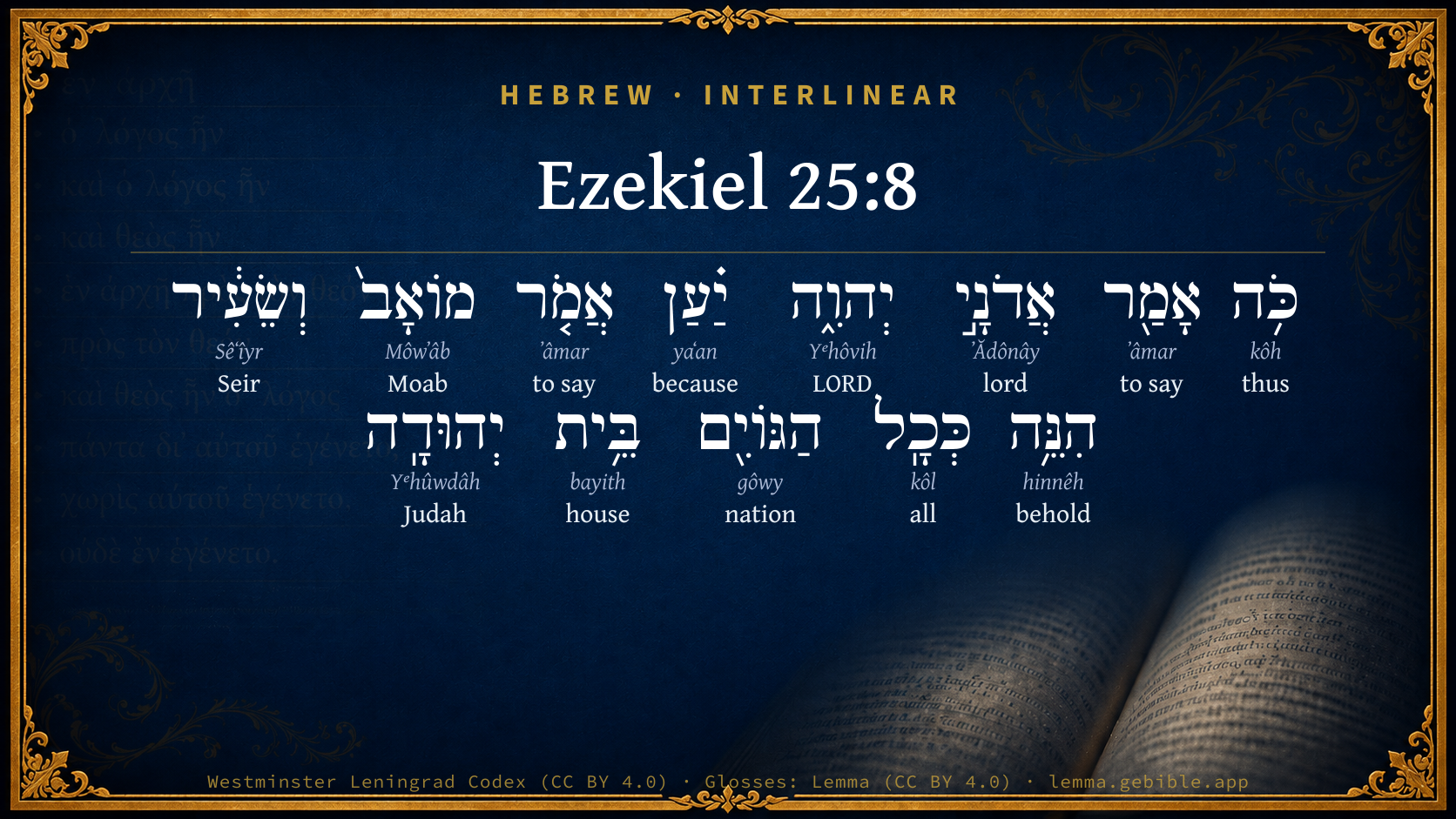
Hebrew (Westminster Leningrad Codex) Ezekiel 25:8 appears in the Hebrew Old Testament. The text above is from the Westminster Leningrad Codex. Each word links to its Strong’s number, a concise gloss, and parsing drawn from the Open Scriptures Hebrew Bible morphology. Click any word for its full Brown-Driver-Briggs (BDB) entry.
Download image
Cite this verse

Ezekiel 25:8 (World English Bible). Public Domain. Lemma interlinear Bible study tool, https://lemma.gebible.app/v/ezekiel/25/8.

Show BibTeX & RIS
BibTeX
RIS
English Translation
Thus says the Lord Yahweh: Because Moab and Seir say, Behold, the house of Judah is like all the nations;
World English Bible · Public Domain
Download a study sheet

One document with this verse’s original text, its word-by-word gloss line, the meaning frame, cross-references with their text, attributed commentary, and full source and license credits — printable, and it pastes into notes with its structure intact.

This verse Autodidact and up

Study sheet (.html) Plain text (.txt)

A passage Seminary Student

Up to 50 verses in one chapter. A passage sheet keeps up to 6 commentary sources and 12 cross-references per verse, in the order this page ranks them, and says so on the sheet whenever that leaves anything out. Ask for a single verse and you get the Autodidact verse sheet above.

Everything on this page stays free to read, with no account — the sheet is a download of what is already on screen, not access to it.

Want to remove ads? Support Godless Engineer
Compare translations 3

The same verse in 3 English versions, stacked beneath the original-language interlinear above. Click any original word for its lexicon entry.

Each is an independent rendering of the whole verse — the interlinear is not word-aligned to these translations.

Highlighted words mark where these versions differ — a whole-verse word diff, not a word-by-word alignment.

  • World English Bible Public Domain
    Thus says the Lord Yahweh: Because Moab and Seir say, Behold, the house of Judah is like all the nations;
  • King James Version Public Domain
    Thus saith the Lord GOD; Because that Moab and Seir do say, Behold, the house of Judah is like unto all the heathen;
  • unfoldingWord Literal Text CC BY-SA 4.0
    The Lord Yahweh says this, ‘Because Moab and Seir say, “Behold! The house of Judah is like every other nation.”

unfoldingWord Literal Text — © unfoldingWord, licensed CC BY-SA 4.0. Word-aligned USFM3 via Door43 (git.door43.org/unfoldingWord/en_ult).

Versions to compare (up to 4)

3 of 4 selected

Show all 18 translations

Every available English version of this verse, each an independent rendering of the whole verse.

  • World English Bible Public Domain
    Thus says the Lord Yahweh: Because Moab and Seir say, Behold, the house of Judah is like all the nations;
  • Berean Standard Bible Public Domain
    This is what the Lord GOD says: ‘Because Moab and Seir said, “Look, the house of Judah is like all the other nations,”
  • Majority Standard Bible Public Domain
    This is what the Lord GOD says: ‘Because Moab and Seir said, “Look, the house of Judah is like all the other nations,”
  • King James Version Public Domain
    Thus saith the Lord GOD; Because that Moab and Seir do say, Behold, the house of Judah is like unto all the heathen;
  • American Standard Version (1901) Public Domain
    Thus saith the Lord Jehovah: Because that Moab and Seir do say, Behold, the house of Judah is like unto all the nations;
  • Revised Version (1885) Public Domain
    Thus saith the Lord GOD: Because that Moab and Seir do say, Behold, the house of Judah is like unto all the nations;
  • Geneva Bible (1599) Public Domain
    Thus saith the Lord God, Because that Moab and Seir doe say, Beholde, the house of Iudah is like vnto all the heathen,
  • Douay-Rheims (1899) Public Domain
    Thus saith the Lord God: Because Moab and Seir have said: Behold the house of Juda is like all other nations:
  • Young's Literal Translation Public Domain
    Thus said the Lord Jehovah: Because of the saying of Moab and Seir: Lo, as all the nations `is' the house of Judah;
  • Literal Standard Version CC BY-SA 4.0
    Thus said Lord YHWH: Because of the saying of Moab and Seir: Behold, the house of Judah [is] as all the nations;
  • Unlocked Literal Bible CC BY-SA 4.0
    The Lord Yahweh says this, 'Because Moab and Seir say, “Behold! The house of Judah is like every other nation.”
  • unfoldingWord Literal Text CC BY-SA 4.0
    The Lord Yahweh says this, ‘Because Moab and Seir say, “Behold! The house of Judah is like every other nation.”
  • Darby Bible Public Domain
    Thus saith the Lord Jehovah: Because Moab and Seir do say, Behold, the house of Judah is like unto all the nations,
  • World Messianic Bible Public Domain
    “‘The Lord GOD says: “Because Moab and Seir say, ‘Behold, the house of Judah is like all the nations,’
  • Webster's Bible Public Domain
    Thus saith the Lord GOD; Because that Moab and Seir do say, Behold, the house of Judah is like all the heathen;
  • Free Bible Version CC BY-SA 4.0
    This is what the Lord God says: Because the people of Moab and Seir said, ‘Look, the people of Judah are just like everybody else,’
  • Bible in Basic English Public Domain
    This is what the Lord has said: Because Moab and Seir are saying, See, the people of Judah are like all the nations;
  • JPS Tanakh (1917) Public Domain
    Thus saith the Lord GOD: Because that Moab and Seir do say: Behold, the house of Judah is like unto all the nations,

Literal Standard Version (2020), Covenant Press — licensed CC BY-SA 4.0. Text via the HelloAO Bible API (eBible.org). Unlocked Literal Bible (unfoldingWord) — licensed CC BY-SA 4.0. Text via the HelloAO Bible API (eBible.org). unfoldingWord Literal Text — © unfoldingWord, licensed CC BY-SA 4.0. Word-aligned USFM3 via Door43 (git.door43.org/unfoldingWord/en_ult). Free Bible Version, Dr. Jonathan Gallagher — licensed CC BY-SA 4.0. Text via the HelloAO Bible API (eBible.org).

Word by word

More ways to search: Search by grammar → Find every occurrence → Compare this word →

Practice this passage: Drill this verse → Learn its vocabulary →

וְשֵׂעִ֔יר
Sêʻîyr
H8165
“and · Seir”
Conjunction + Noun, Proper
Part of Speech
Conjunction + Noun
Type
Proper
Full BDB Definition

Origin: formed like H8163

TWOT: 2274h , 2274g

Seir = "hairy" or " shaggy" - patriarch of the Horites, the inhabitants of Edom before the descendants of Esau, the Edomites (noun proper masculine) - the land of Edom, south of the Dead Sea (noun proper territorial) - a mountain range in Edom extending from the Dead Sea to the Elanitic Gulf (noun proper mountain) - apparently also called 'Mount Seir' and extending most of the distance of the mountain range itself - a mountain in northern Judah lying westward from Kirjath-jearim (noun proper mountain)
  1. כֹּ֥ה kôh H3541 “thus” Adverb
  2. אָמַ֖ר ʼâmar H559 “to say” Verb, Qal, Perfect, 3rd Person, Masculine, Singular
  3. אֲדֹנָ֣י ʼĂdônây H136 “Lord · my” Noun, Common, Masculine, Plural, Construct + Suffix, Personal, 1st Person, Common, Singular
  4. יְהוִ֑ה Yᵉhôvih H3069 “LORD” Noun, Proper
  5. יַ֗עַן yaʻan H3282 “because” Conjunction
  6. אֲמֹ֤ר ʼâmar H559 “to say” Verb, Qal, Infinitive Construct
  7. מוֹאָב֙ Môwʼâb H4124 “Moab” Noun, Proper
  8. הִנֵּ֥ה hinnêh H2009 “behold” Particle, Demonstrative
  9. כְּכָֽל kôl H3605 “like/as · all of” Preposition + Noun, Common, Masculine, Singular, Construct
  10. הַגּוֹיִ֖ם gôwy H1471 “the · nations” Particle, Definite Article + Noun, Common, Masculine, Plural, Absolute
  11. בֵּ֥ית bayith H1004 “house of” Noun, Common, Masculine, Singular, Construct
  12. יְהוּדָֽה Yᵉhûwdâh H3063 “Judah” Noun, Proper

About this verse

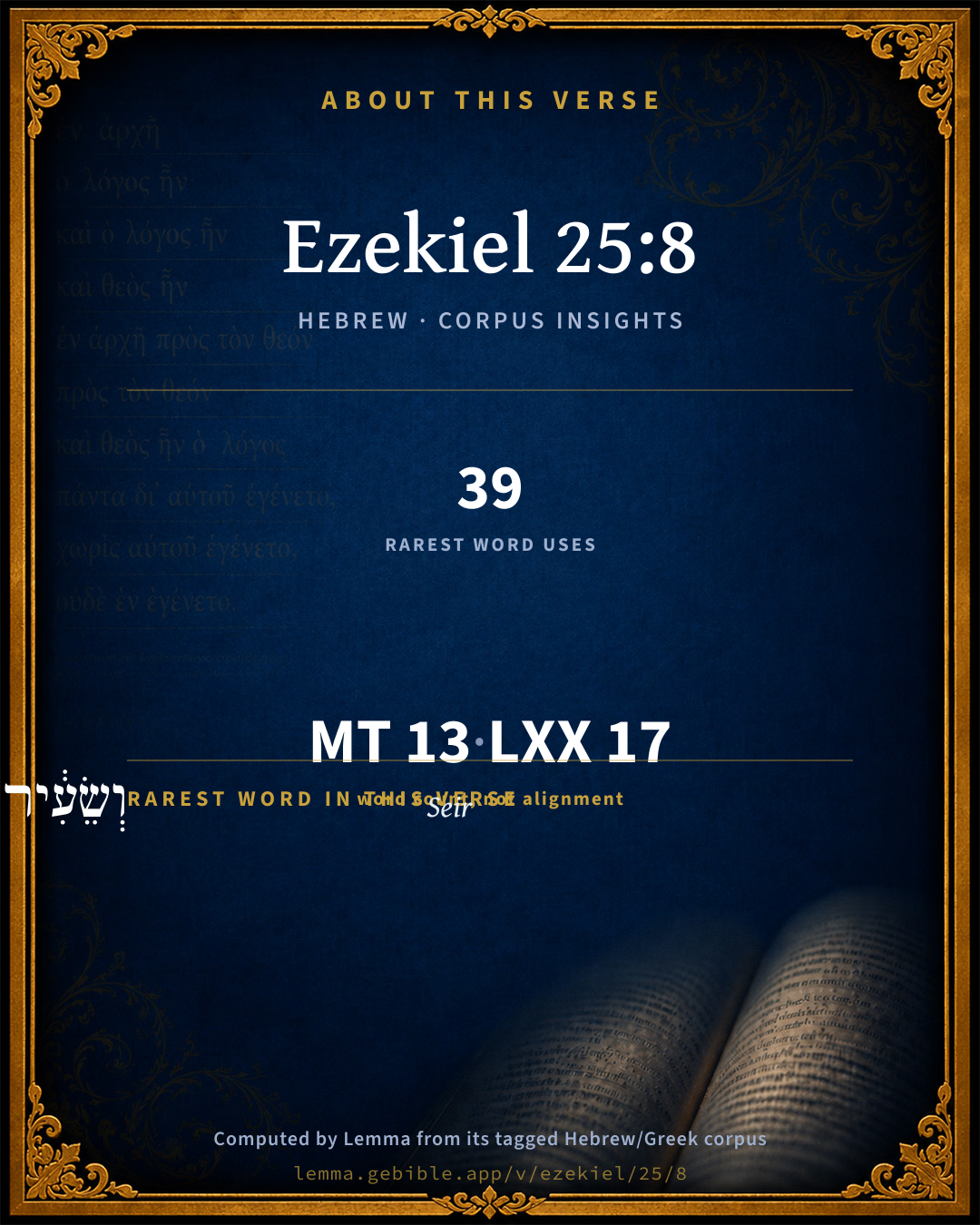
These counts appear in no published source. They are computed here, from the morphology-tagged text and Lemma’s own curated glosses. What Lemma adds →

13
words
12
distinct lemmas
Prophets
section

Shared distinctive vocabulary

וְשֵׂעִ֔יר Seir H8165 occurs in 38 verses of the Hebrew Bible. Also found in:

Grammatical profile

  • 2 verbs
  • 8 nouns
  • 1 conjunction
  • 1 adverb
  • 1 particle

Verb forms

  • אָמַ֖ר Qal · Perfect
  • אֲמֹ֤ר Qal · Infinitive Construct

Repetition

A word recurs within this verse — often emphatic in Hebrew:

  • אָמַ֖ר to say H559 ×2

Hebrew & Septuagint length

In English translation the verse runs 20 words from the Hebrew and 22 from the Septuagint (LXX English) — closely comparable.

A rough comparison of the two English renderings, which tokenize alike — not a word-level alignment.

Word counts can differ between the Hebrew and the Greek without any difference in meaning — e.g. the Hebrew direct-object marker אֵת has no separate Greek word, and Greek often adds the article ὁ.

In the original languages it is 13 Hebrew tokens and 17 Greek tokens — but the two are counted differently (Hebrew bundles its prefixes and suffixes into one token; the Greek is in lemma form), so that isn’t a like-for-like length.

Cross-references

19

Topical passages linked to Ezekiel 25:8 in the Treasury of Scripture Knowledge — connected by theme and wording, ordered by reader-vote popularity; previews shown in the World English Bible.

  • Isaiah 15:1–9 The burden of Moab. For in a night Ar of Moab is laid waste, [and] brought to nothing; for in a night Kir of Moab is laid waste, [and] brought to nothing.
  • Jeremiah 25:21 Edom, and Moab, and the children of Ammon;
  • Jeremiah 48:1–47 Of Moab. Thus says Yahweh of Hosts, the God of Israel: Woe to Nebo! for it is laid waste; Kiriathaim is disappointed, it is taken; Misgab is put to shame and broken down.
  • Numbers 24:17 I see him, but not now; I see him, but not near: There shall come forth a star out of Jacob, A scepter shall rise out of Israel, Shall strike through the corners of Moab, Break down all the sons of tumult.
  • Deuteronomy 2:5 don't contend with them; for I will not give you of their land, no, not so much as for the sole of the foot to tread on; because I have given Mount Seir to Esau for a possession.
  • Psalms 83:4–8 "Come," they say, "and let's destroy them as a nation, That the name of Israel may be remembered no more."
  • Isaiah 10:9–11 Isn't Calno as Carchemish? Isn't Hamath as Arpad? Isn't Samaria as Damascus?
  • Isaiah 25:10 For in this mountain will the hand of Yahweh rest; and Moab shall be trodden down in his place, even as straw is trodden down in the water of the dung-hill.
  • Isaiah 34:1–17 Come near, you nations, to hear; and listen, you peoples: let the earth hear, and the fullness of it; the world, and all things that come forth from it.
  • Isaiah 36:18–20 Beware lest Hezekiah persuade you, saying, Yahweh will deliver us. Has any of the gods of the nations delivered his land out of the hand of the king of Assyria?
  • Isaiah 63:1–6 Who is this who comes from Edom, with dyed garments from Bozrah? this who is glorious in his clothing, marching in the greatness of his strength? I who speak in righteousness, mighty to save.
  • Jeremiah 27:3 and send them to the king of Edom, and to the king of Moab, and to the king of the children of Ammon, and to the king of Tyre, and to the king of Sidon, by the hand of the messengers who come to Jerusalem to Zedekiah king of Judah;
  • Jeremiah 49:7–22 Of Edom. Thus says Yahweh of Hosts: Is wisdom no more in Teman? is counsel perished from the prudent? is their wisdom vanished?
  • Ezekiel 25:12–14 Thus says the Lord Yahweh: Because Edom has dealt against the house of Judah by taking vengeance, and has greatly offended, and revenged himself on them;
  • Ezekiel 35:1–15 Moreover the word of Yahweh came to me, saying,
  • Amos 2:1–3 Thus says Yahweh: "For three transgressions of Moab, yes, for four, I will not turn away its punishment; Because he burned the bones of the king of Edom into lime;
  • Amos 2:11–12 I raised up some of your sons for prophets, And some of your young men for Nazirites. Isn't this true, You children of Israel?" says Yahweh.
  • Obadiah 1:1–9 The vision of Obadiah. This is what the Lord Yahweh says about Edom. We have heard news from Yahweh, and an ambassador is sent among the nations, saying, "Arise, and let's rise up against her in battle.
  • Zephaniah 2:8–11 I have heard the reproach of Moab, and the insults of the children of Ammon, with which they have reproached my people, and magnified themselves against their border.

Cross-references courtesy of OpenBible.info (CC BY 4.0).

Hebrew and Greek witnesses Masoretic Hebrew ↔ Greek Septuagint

The same verse in the two great witnesses to the Old Testament, shown verse-for-verse.

These are two independent witnesses, not word-aligned to each other, and the Septuagint is shown in lemma (dictionary) form.

Hebrew Ezekiel 25:8 Masoretic · Westminster Leningrad Codex

כֹּ֥ה אָמַ֖ר אֲדֹנָ֣י יְהוִ֑ה יַ֗עַן אֲמֹ֤ר מוֹאָב֙ וְשֵׂעִ֔יר הִנֵּ֥ה כְּכָֽל הַגּוֹיִ֖ם בֵּ֥ית יְהוּדָֽה

Thus says the Lord Yahweh: Because Moab and Seir say, Behold, the house of Judah is like all the nations;

World English Bible · Public Domain

Greek LXX Ezekiel 25:8 Septuagint · lemma form

ὅδε λέγω κύριος ἀντί ὅς εἶπον μωαβ ἰδού ὅς τρόπος πᾶς ὁ ἔθνος οἶκος ἰσραήλ καί ιουδα

Thus says the Lord; Because Moab has said, Behold, are not the house of Israel and Juda like all the other nations?

LXX2012 (modern English Septuagint) · Public Domain

On this verse, Joseph Benson's Commentary discusses the Septuagint’s reading. Read the note in Commentary ↓

Hebrew: Westminster Leningrad Codex (CC BY 4.0). Greek: Septuagint (public domain); English from LXX2012 (modern English Septuagint) (Public Domain). How the Septuagint differs from the Hebrew →

Targum (Aramaic paraphrase)

1

The Targum is the ancient Jewish Aramaic paraphrase of the Hebrew Scriptures — an interpretive translation, not the Hebrew text itself. Onkelos (literal) and Pseudo-Jonathan (expansive) render the Torah, and Jonathan the Prophets. Coverage is partial: where no permissively-licensed English translation exists for a verse, only the Aramaic is shown. This is verse-level text, not a word-by-word alignment to the Hebrew.

  1. Targum Jonathan Prophets (Joshua–Malachi)
    כִּדְנַן אֲמַר יְיָ אֱלֹהִים חֲלַף דַאֲמַרוּ מוֹאֲבָאֵי וְשֵׂעִיר מַה שְׁנוֹ מִכָּל עַמְמַיָא דְבֵית יְהוּדָה:

    (no public-domain English translation for this verse)

    Targum Jonathan — Aramaic: “Mikraot Gedolot” (public domain). English: “Sefaria Community Translation” (CC0 1.0 (public-domain dedication)); “London "Chaldee Paraphrase," 1871” (public domain). Text via Sefaria.

Commentary

Notes on Ezekiel 25:8 from classic Christian and Jewish commentators (each source and its license shown beneath its notes). The classic Christian expositions comment on the surrounding passage and are grouped to its opening verse, so a note may address several verses; the Jewish commentaries on the Tanakh (Rashi and others) are per-verse, so they appear only where the commentator wrote on this verse.

Lemma curates 59 commentaries, every one of them public domain or Creative Commons licensed, each selected and text-cleaned for this edition rather than reprinted as found. About our sources →

Matthew Henry's Commentary

Three more of Israel's ill-natured neighbours are here arraigned, convicted, and condemned to destruction, for contributing to and triumphing in Jerusalem's fall.

I. The Moabites. Seir, which was the seat of the Edomites, is joined with them (Eze 25:8), because they said the same as the Moabites; but they were afterwards reckoned with by themselves, Eze 25:12. Now observe,

1. What was the sin of the Moabites; they said, Behold, the house of Judah is like unto all the heathen. They triumphed, (1.) In the apostasies of Israel, were please to see them forsake their God and worship idols, and hoped that in a while their religion would be quite lost and forgotten and the house of Judah would be like all the heathen, perfect idolaters. When those that profess religion walk unworthy of their profession they encourage the enemies of religion to hope that it will in time sink, and be run down, and quite abandoned; but let the Moabites know that, though there are those of the house of Judah who have made themselves like the heathen, yet there is a remnant that retain their integrity, the religion of the house of Judah shall recover itself, its peculiarities shall be preserved, it shall not lose itself among the heathen, but distinguish itself from them, till it deliver itself honourably into a better institution. (2.) In the calamities of Israel. They said, "The house of Judah is like all the heathen, in as bad a state as they; their God is no more able to deliver them from this overflowing scourge of these parts of the world than the gods of the heathen are to deliver them. Where are the promises they gloried in and all the wonders which they and their fathers told us of? What the better are they for the covenant of peculiarity, upon which they so much valued themselves? Those that looked with so much scorn upon all the heathen are now set upon a level with them, or rather sunk below them." Note, Those who judge only by outward appearance are ready to conclude that the people of God have lost all their privileges when they have lost their worldly prosperity, which does not follow, for good men, even in affliction, in captivity among the heathen, have graces and comforts within sufficient to distinguish them from all the heathen. Though the event seem one to the righteous and wicked, yet indeed it is vastly different.

2. What should be the punishment of Moab for this sin; because they triumphed in the overthrow of Judah, their country shall be in like manner overthrown with that of the Ammonites, who were guilty of the same sin (Eze 25:9, Eze 25:10): "I will open the side of Moab, will uncover its shoulder, will take away all its defences, that it may become an easy prey to any that will make a prey of it." (1.) See here how it shall be exposed; the frontier-towns, that were its strength and guard, shall be demolished by the Chaldean forces, and laid open. Some of the cities are here named, which are said to be the glory of the country, which they trusted in, and boasted of as impregnable; these shall decay, be deserted, or betrayed, or fall into the enemies' hands, so that Moab shall lie exposed, and whoever will may penetrate into the heart of the country. Note, Those who glory in any other defence and protection than that of the divine power, providence, and promise, will sooner or later see cause to be ashamed of their glorying. (2.) See here to whom it shall be exposed: The men of the east, when they come to take possession of the country of the Ammonites, shall seize that of the Moabites too. God, the Lord of all lands, will give them that land; for the kingdoms of men he gives to whomsoever he will. The Arabians, who are shepherds, and live quietly, plain men dwelling in tents, shall by an overruling Providence be put in possession of the land of the Moabites, who are soldiers, men of war, and cunning hunters, that live turbulently. The Chaldeans shall get it by war, and the Arabians shall enjoy it in peace. Concerning the Ammonites it is said, They shall no more be remembered among the nations (Eze 25:10), for they had been accessory to the murder of Gedaliah, Jer 40:14. But of the Moabites it is said, I will execute judgments upon Moab; they shall feel the weight of God's displeasure, but perhaps not to that degree that the Ammonites shall; however, so far as that they shall know that I am the Lord, that the God of Israel is a God of power, and that his covenant with his people is not broken.

II. The Edomites, the posterity of Esau, between whom and Jacob there had been an old enmity. And here is,

1. The sin of the Edomites, Eze 25:12. They not only triumphed in the ruin of Judah and Jerusalem, as the Moabites and Ammonites had done, but they took advantage from the present distressed state to which the Jews were reduced to do them some real mischiefs, probably made inroads upon their frontiers and plundered their country: Edom has dealt against the house of Judah by taking vengeance. The Edomites had of old been tributaries to the Jews, according to the sentence that the elder should serve the younger. In Jehoram's time they revolted. Amaziah severely chastised them (Kg2 14:7), and for this they took vengeance. Now they would pay off all the old scores, and not only incensed the Babylonians against Jerusalem, crying, Rase it, rase it (Psa 137:7), but cut off those that escaped, as we find in the prophecy of Obadiah, which is wholly directed against Edom, Eze 25:11, Eze 25:12, etc. It is called here revenging a revenge, which intimates that they were not only eager upon it, but very cruel in it, and recompensed to the Jews more than double. "Herein he has greatly offended." Note, It is a great offence to God for us to revenge ourselves upon our brother; for God has said, Vengeance is mine. We are forbidden to revenge or to bear a grudge. Suppose Judah had been hard upon Edom formerly, it was a base thing for the Edomites now, in revenge for it, to smite them secretly. But the Jews had a divine warrant to reign over the Edomites, for that therefore they ought not to have made reprisals; and it was the more disingenuous for them to retain the old enmity when God had particularly commanded his people to forget it. Deu 23:7, Thou shalt not abhor an Edomite.

2. The judgments threatened against them for this sin. God will take them to task for it (Eze 25:13): I will stretch out my hand upon Edom Their country shall be desolate from Teman, which lay in the south part of it; and they shall fall by the sword unto Dedan, which lay north; the desolations of war should go through the nation. (1.) They had taken vengeance, and therefore God will lay his vengeance upon them (Eze 25:14): They shall know my vengeance. Those that will not leave it to God to take vengeance for them may expect that he will take vengeance on them; and those that will not believe and fear his vengeance shall be made to know and feel his vengeance; they shall be dealt with according to God's anger and according to his fury, not according to the weakness of the instruments that are employed in it, but according to the strength of the arm that employs them. (2.) They had taken vengeance on Israel, and God will lay his vengeance on them by the hand of his people Israel. They suffered much by the Chaldeans, which seems to be referred to, Jer 49:8. But besides that there were saviours to come upon Mount Zion, who should judge the mount of Esau (Oba 1:21), and Israel's Redeemer comes with dyed garments from Bozrah (Isa 63:1), this implies a promise that Israel should recover itself again to such a degree as to be in a capacity of curbing the insolence of its neighbours. And we find (1 Macc. 5:3) that Judas Maccabeus fought against the children of Esau in Idumea, gave them a great overthrow, abated their courage, and took their spoil; and Josephus says (Antiq. 13.257), that Hircanus made the Edomites tributaries to Israel. Note, The equity of God's judgments is to be observed when he not only avenges injuries upon those that did them, but by those against whom they were done.

III. The Philistines. And, 1. Their sin is much the same with that of the Edomites: They have dealt by revenge with the people of Israel, and have taken vengeance with a despiteful heart, not to disturb them only, but to destroy them, for the old hatred (Eze 25:15), the old grudge they bore them, or (as the margin reads it) with perpetual hatred, a hatred that began long since and which they resolved to continue. The anger was implacable: they dealt by revenge, traded in the acts of malice; it was their constant practice, and their heart, their spiteful heart, was upon it. 2. Their punishment likewise is much the same, Eze 25:16. Those that were for destroying God's people shall themselves be cut off and destroyed; and (Eze 25:17) those that were for avenging themselves shall find that God will execute great vengeance upon them. This was fulfilled when that country was wasted by the Chaldean army, not long after the destruction of Jerusalem, which is foretold, Jer 47:1-7. It was strange that these nations, which bordered upon the land of Israel, were not alarmed by the success of the Chaldean army, and made to tremble in the apprehension of their own danger; when their neighbour's house was on fire it was time to look to their own; but their impiety and malice made them forget their politics, till God by his judgments convinced them that the cup was going round, and they were the less safe for being secure.

Matthew Henry's Commentary on the Whole Bible (1708–1710) — public domain (CC PDM 1.0). Text via the HelloAO Bible API.

Ellicott's Commentary for English Readers

(8) Moab and Seir.—The two nations, here mentioned together, are afterwards treated separately—Moab, Eze_25:8-11, and Edom, Eze_25:12-14. Moab, springing from the same source with Ammon, was closely associated with it in its history and fortune, and is denounced in nearly the same prophecies. It was a more settled and stronger people, and also contributed its quota to the armies of Nebuchadnezzar. Additional prophecies in regard to it may be found in Num_24:17 and Isaiah 15, 16, besides those immediately connected with the prophecies expressly against Ammon already cited. The Moabites, so far as they were separated from the Ammonites, lay immediately to the south of them.

A Bible Commentary for English Readers, edited by Charles John Ellicott (1878–1897) — public domain. Text from a community e-Sword module.

Trapp's Complete Commentary

John Trapp

Eze 25:8 Thus saith the Lord GOD; Because that Moab and Seir do say, Behold, the house of Judah [is] like unto all the heathen;

Ver. 8. Behold, the house of Judah is like unto all the heathen.] As ill-protected and provided for as they; as much scourged by the Babylonian. See to the contrary in Deu 33:29, "Happy art thou, O Israel; who is like unto thee, O people saved by the Lord, the shield of thy help, and who is the sword of thine excellency! and thine enemies shall be found liars unto thee; and thou shalt tread upon their high places!" Some read it, ‘Behold the house of Jehovah,’ and note an emphasis in that word, as savouring of contempt and blasphemy, as in 2Ki 18:33-34.

John Trapp, A Commentary or Exposition upon All the Books of the Old and New Testament (1647–1656) — public domain. Text from a community e-Sword module.

Joseph Benson's Commentary

Eze 25:8-10. Because that Moab and Seir, &c. — By Seir the Idumeans are intended. The prophet joins them together as guilty of the same crime, and then denounces particular judgments against each of them. Behold, the house of Judah is like unto all the heathen — Hebrew ככל הגוים, like all the nations; subdued by Nebuchadnezzar indiscriminately with them; they are not distinguished from their neighbours by the protection of the God whom they worship, and they find no advantage in worshipping of him, over those who worship other gods. It appears from hence, that the Jews had boasted, and the Gentiles till then acknowledged, that the Jews were under an extraordinary providence. The LXX. here read, the house of Israel and Judah. Therefore will I open the side of Moab from the cities — I will expose Moab to be invaded, and open a passage for his enemies to enter his frontier cities, and from thence to possess themselves of the best part of his country. Unto the men of the east — See Eze 25:4. That the Ammonites may not be remembered, &c. — May make no figure among their neighbours, their strength being entirely broken.

Joseph Benson's Commentary on the Old and New Testaments (1811–1818) — public domain. Text from a community e-Sword module.

Keil & Delitzsch

C. F. Keil & F. Delitzsch

Against the Moabites

Eze 25:8. Thus saith the Lord Jehovah, Because Moab, like Seir, saith, Behold, like all other nations is the house of Judah: Eze 25:9. Therefore, behold, I will open the shoulder of Moab from the cities, from its cities even to the last, the ornament of the land, Beth-hayeshimoth, Baal-meon, and as far as Kiryathaim, Eze 25:10. To the sons of the east, together with the sons of Ammon, and will give it for a possession, that the sons of Ammon may no more be remembered among the nations. Eze 25:11. Upon Moab will I execute judgments; and they shall learn that I am Jehovah. - Moab has become guilty of the same sin against Judah, the people of God, as Ammon, namely, of misunderstanding and despising the divine election of Israel. Ammon gave expression to this, when Judah was overthrown, in the malicious assertion that the house of Judah was like all the heathen nations, - that is to say, had no pre-eminence over them, and shared the same fate as they. There is something remarkable in the allusion to Seir, i.e., Edom, in connection with Moab, inasmuch as no reference is made to it in the threat contained in Eze 25:9-11; and in Eze 25:12-13, there follows a separate prediction concerning Edom. Hitzig therefore proposes to follow the example of the lxx, and erase it from the text as a gloss, but without being able in the smallest degree to show in what way it is probable that such a gloss could have found admission into an obviously unsuitable place. Seir is mentioned along with Moab to mark the feeling expressed in the words of Moab as springing, like the enmity of Edom towards Israel, from hatred and envy of the spiritual birthright of Israel, i.e., of its peculiar prerogatives in sacred history. As a punishment for this, Moab was to be given up, like Ammon, to the Bedouins for their possession, and the people of the Moabites were to disappear from the number of the nations. Eze 25:9 and Eze 25:10 form one period, לבני קדם in Eze 25:10 being governed by פּתח in Eze 25:9. The shoulder of Moab is the side of the Moabitish land. In the application of the word כּתף to lands or provinces, regard is had to the position of the shoulder in relation to the whole body, but without reference to the elevation of the district. We find an analogy to this in the use of כּתף in connection with the sides of a building. In 'מהערים וגו' , the מן cannot be taken, in a privative sense, for מהיות; for neither the article הערים, nor the more emphatic מעריו מקּצהוּ, allows this; but מן indicates the direction, "from the cities onwards," "from its cities onwards, reckoning to the very last," - that is to say, in its whole extent. מקּצהוּ, as in Isa 56:11; Gen 19:4, etc. This tract of land is first of all designated as a glorious land, with reference to its worth as a possession on account of the excellence of its soil for the rearing of cattle (see the comm. on Num 32:4), and then defined with geographical minuteness by the introduction of the names of some of its cities. Beth-Hayeshimoth, i.e., house of wastes (see the comm. on Num 22:1), has probably been preserved in the ruins of Suaime, which F. de Saulcy discovered on the north-eastern border of the Dead Sea, a little farther inland (vid., Voyage en terre sainte, Paris 1865, t. i. p. 315). Baal-meon, - when written fully, Beth-Baal-Meon (Jos 13:17) - contracted into Beth-Meon in Jer 48:23, is to be sought for to the south-east of this, in the ruins of Myun, three-quarters of an hour's journey to the south of Heshbon (see the comm. on Num 32:38). Kiryathaim was still farther south, probably on the site of the ruins of El Teym (see the comm. on Gen 14:5 and Num 32:37). The Chetib קריתמה is based upon the form קריתם, a secondary form of קריתים , like דּתן, a secondary form of דּתין, in Kg2 6:13. The cities named were situated to the north of the Arnon, in that portion of the Moabitish land which had been taken from the Moabites by the Amorites before the entrance of the Israelites into Canaan (Num 21:13, Num 21:26), and was given to the tribe of Reuben for its inheritance after the defeat of the Amoritish kings by the Israelites; and then, still later, when the tribes beyond the Jordan were carried into captivity by the Assyrians, came into the possession of the Moabites again, as is evident from Isa 15:1-9 and Isa 16:1-14, and Jer 48:1, Jer 48:23, where these cities are mentioned once more among the cities of the Moabites. This will explain not only the naming of this particular district of the Moabitish country, but the definition, "from its cities." For the fact upon which the stress is laid in the passage before us is, that the land in question rightfully belonged to the Israelites, according to Num 32:37-38; Num 33:49; Jos 12:2-3; Jos 13:20-21, and that it was therefore unlawfully usurped by the Moabites after the deportation of the trans-Jordanic tribes; and the thought is this, that the judgment would burst upon Moab from this land and these cities, and they would thereby be destroyed (Hvernick and Kliefoth). על, not "over the sons of Ammon," but "in addition to the sons of Ammon." They, that is to say, their land, had already been promised to the sons of the east (Eze 25:4). In addition to this, they are now to receive Moab for their possession (Hitzig and Kliefoth). Thus will the Lord execute judgments upon Moab. Eze 25:11 sums up what is affirmed concerning Moab in Eze 25:9 and Eze 25:10, in the one idea of the judgments of God upon this people.

The execution of these judgments commenced with the subjugation of the Ammonites and Moabites by Nebuchadnezzar, five years after the destruction of Jerusalem (vid., Josephus, Antt. x. 9. 7, and M. von Niebuhr, Gesch. Assurs, etc., p. 215). Nevertheless the Ammonites continued to exist as a nation for a long time after the captivity, so that Judas the Maccabaean waged war against them (1 Macc. 5:6, 30-43); and even Justin Martyr speaks of ̓Αμμανιτῶν νῦν πολὺ πληθος (Dial. Tryph. p. 272). - But Origen includes their land in the general name of Arabia (lib. i. in Job). The name of the Moabites appears to have become extinct at a much earlier period. After the captivity, it is only in Ezr 9:1; Neh 13:1, and Dan 11:41, that we find any notice of them as a people. Their land is mentioned by Josephus in the Antiq. xiii. 14. 2, and xv. 4, and in the Bell. Jud. iii. 3. 3. - A further fulfilment by the Messianic judgment, which is referred to in Zep 2:10, is not indicated in these words of Ezekiel; but judging from the prophecy concerning the Edomites (see the comm. on Eze 25:14), it is not to be excluded.

Keil & Delitzsch — Biblical Commentary on the Old Testament (1861–1891) — public domain (CC PDM 1.0). Text via the HelloAO Bible API. (Old Testament only.)

Fairbairn on Ezekiel, Jonah & the Pastoral Epistles

Patrick Fairbairn

II. The judgment of Moab (Eze 25:8-11).

Eze 25:8. Thus saith the Lord Jehovah, Because Moab says, and Seir, Lo! like all the nations is the house of Judah;

Eze 25:9. Therefore, behold, I open the side of Moab from the cities, from his cities, from his end, a glorious land, Beth-jeshimoth, Baal-meon, and Kiriathaim;

Eze 25:10. To the men of the east, over (or upon) the children of Ammon (elliptically, for: to the men of the east, who have overrun the children of Ammon, the tide of conquest being viewed as flowing onwards from the territory of Ammon to that of Moab), and I give it for a possession; in order that the children of Ammon may not be remembered among the nations;

Eze 25:11. And against Moab will I execute judgments; and they shall know that I am Jehovah.

There is a certain degree of indistinctness in this sentence upon Moab, arising chiefly from the manner in which it is mixed up with Seir and Ammon. Yet we have no reason to think there is any corruption in the text. In regard to Seir, which is coupled with Moab at the beginning as joining in the congratulation that it was no better with Judah than the rest of the nations, Hitzig, in his usual smart and somewhat flippant way, declares it to be out of place, as it is also omitted in the LXX., and supposes it to have been introduced by some ignorant emendator, probably from Eze 35:10. It is quite unnecessary to resort to any such supposition. Ammon, Moab, and Edom were all contiguous countries, stretching from the land of Gilead on the north, in an unbroken line, to the shores of the Red Sea, and acted very much, in concert in their hostile feelings and operations toward the covenant-people. It was not, therefore, unnatural, though it might be somewhat out of the most exact order, for the prophet to connect the two latter of these together in the expression of delight over the downfall of Judah, to show how generally the sentiment was participated in. And that Moab and Ammon should toward the close be coupled together as alike suffering under the same inundation of eastern hordes, and perishing, as it were, together—this is not to be wondered at, considering that the two tribes were originally of one origin, and kept so close together that their respective territories were not separated from each other by any very definite landmarks. It was inevitable that the same destroying wave which swallowed up the one of these nations should also sweep over the other.

It would seem that the territory of Moab was, upon the whole, of a richer and more cultivated character than that of Ammon. It comprehended the district which goes by the name of the Belka, and which, even in the present times, is described by travellers as the best in all the southern parts of Syria, and on that account is the scene of many a contest among the Bedâwin. Hence it is called here by the prophet a glorious land (literally, an ornament of a land); and hence also he makes particular mention of the cities belonging to it—natural indications of prosperity, and, in times of danger, important means of defence. Yet the prophet declares, these should not protect them against the coming desolation; for the Lord was going to lay open the side or border of Moab from the cities—those cities belonging to him upon his end, or extremity—viz. the extreme north-western border, where the cities here specially mentioned lay, considerably beyond the river Arnon (the old boundary of the kingdom in that direction), and even within the territory usually assigned to Ammon. These cities, with various others in the same region, were among those apportioned to Reuben in Joshua (chap. Jos 13:15-21), but had again fallen into the hands of their original owners. Yet only for a time. The men of the East were to come down from Ammon, through the cities on the frontier, and were to waste the land of Moab, till it had ceased to be an independent nation, and had melted away among the hordes of the desert.

Of the precise manner and period of the accomplishment of this prophecy we have no record. We know that the country was overrun by the arms of Nebuchadnezzar, and must consequently have become impaired in strength. But it was chiefly by the encroachments of the men of the East, the wandering Bedâwin, the great enemies of civilised and settled life, that the desolation was to be produced. And so completely had this been done, that long before the time of Christ all traces had ceased of Moab’s separate existence as a people; and for many an age their country has worn the bare and ruined aspect which are the unfailing characteristics of an Arabian ascendancy.

Patrick Fairbairn — An Exposition of Ezekiel (1851), Jonah (1849), and The Pastoral Epistles (1874) — public domain. Text from a community e-Sword module.

Tyndale Open Study Notes

Tyndale Open Resources

25:8-11 The people of Moab thought that they could attack Judah with impunity, as though it were just like all the other nations. This was not true—even though Judah had been acting as though it were (see 20:32)—because Judah had a covenant with God, and God would not ultimately reject Judah. Instead, like Ammon, Moab would be removed from the register of the nations and left perpetually desolate.

Tyndale Open Study Notes — © Tyndale Open Resources, licensed CC BY-SA 4.0. Text via the HelloAO Bible API.

Jamieson, Fausset & Brown

Robert Jamieson, A. R. Fausset & David Brown

Moab, Seir, and Ammon were contiguous countries, stretching in one line from Gilead on the north to the Red Sea. They therefore naturally acted in concert, and in joint hostility to Judea.

Judah is like . . . all . . . heathen--The Jews fare no better than others: it is of no use to them to serve Jehovah, who, they say, is the only true God.

Jamieson, Fausset & Brown — Commentary Critical and Explanatory on the Whole Bible (1871) — public domain (CC PDM 1.0). Text via the HelloAO Bible API.

Adam Clarke's Commentary

Verse 8. Moab and Seir do say] Seir means the Idumeans. It appears that both these, with the Ammonites, had made a league with Zedekiah, Jer 27:3, which they did not keep; and it is supposed that they even joined with the Chaldeans.

Adam Clarke's Commentary on the Bible (1810–1826) — public domain. Text from a community e-Sword/MySword module.

The Cambridge Bible for Schools and Colleges

gen. ed. J. J. S. Perowne

8. Moab and Seir] LXX. omits and Seir. Ezek. elsewhere always says “mount Seir” (Eze_35:2-3; Eze_35:7; Eze_35:15), and Edom, with which mount Seir is joined (Eze_35:15) has a special prophecy directed against it (Eze_25:12-14). The phrase “like unto all the nations” implies knowledge of some claim to preeminence on the part of Judah. Moab rejoices that these pretensions have received a signal refutation.

8–11. Prophecy against Moab

The Moabites, like the Ammonites, were recognised by Israel as a kindred people (Gen_19:30). Technically the border of Moab on the N. was the Arnon, but they had pretensions to the district lying beyond this stream at least as far as the head of the Dead Sea, and these pretensions they often asserted. Practically the tribes of Reuben and Gad seem to have been unable to make good their claim to this territory by dispossessing the Moabites. The peoples appear to have mixed together, and frequently Moab is found in possession of the fertile district and the numerous cities which covered it (Mesha’s Inscrip.). The country was subdued by David, and on the division of the kingdom fell as a dependency to northern Israel, to which it paid a yearly tribute of 200,000 fleeces of wool (2Ki_3:4), though making frequent struggles for independence (2Ki_1:1; 2Ki_3:5; 2Ki_13:20). Unlike the Ammonites, who continued a half-nomad people, the Moabites became more a settled nation, and appear to have attained to a considerable degree of civilization. Their language was closely allied to Hebrew, and the art of writing appears familiar as early as the beginning of the 9th century (Mesha’s Inscrip.). After the intervention of the Assyrians in western Asia Moab with the neighbouring peoples became tributary to that power. Hostilities between Israel and Moab were too frequent, and along with Ammon they helped towards the downfall of Judah at the hands of the Chaldeans (2Ki_24:2; Zep_2:8). Their warfare was characterized by inhuman excesses (Amo_2:1), and the people are stigmatised as proud and boastful (Isaiah 15, 16; Zep_2:8-10). Moab is referred to after the return (Ezr_9:1; Neh_13:1; the ref. Isa_25:10 is of uncertain date and meaning), and as late as Dan_11:41.

The Cambridge Bible for Schools and Colleges (gen. ed. J. J. S. Perowne; Cambridge University Press, 1878–1918) — public domain. Text from a community e-Sword module.

John Gill's Exposition

Thus saith the Lord God,.... By his servant the prophet, to whom the word of the Lord came; as concerning the Ammonites, so likewise concerning the Moabites, as follows:

because that Moab and Seir do say; that is, the Moabites, and the Edomites, which latter are meant by Seir, that being the seat of them; these lived near one another, and bore a like enmity to the Israelites and Jews, and had the same sentiments concerning them, and said the same things of them: only Moab is mentioned in the Septuagint and Arabic versions: the Moabites are first prophesied of, and then the Edomites, who both joined in saying, behold, the house of Judah is like unto all the Heathen; it fares no better with them than with the rest of the nations, who do not profess and serve the same God they do; they are fallen into the hands of the king of Babylon, as well as others; and have no more security against him, nor protection from him, than other people; they pretend to serve and worship the one only living and true God, and to be his covenant people, and to be favoured with privileges above all other nations; and yet are brought into the same miserable circumstances, and left in them, as others are; where is the God they boast of, and their superior excellence to the rest of the world? thus blasphemously, as well as wickedly, did they insult them, which was provoking to the Lord. The Targum renders it interrogatively,

in what do the house of Judah differ from all people?''

and so the Septuagint,

"behold, are not the house of Israel and Judah in like manner as all nations?''

Jerom, on the place, relates a fable of the Jews, that when the city and temple were opened, the Ammonites, Moobites, and Edomites, went into the temple, and saw the cherubim over the mercy seat, and said, as all nations worship images, so Judah hath the idols of their religion. Jarchi makes mention of such a Midrash, but with some difference.

John Gill's Exposition of the Whole Bible (1746–1763) — public domain (CC PDM 1.0). Text via the HelloAO Bible API.

Albert Barnes' Notes on the Bible

Prophecies against Moab which lay south of Ammon, and shared Ammon’s implacable hostility to the children of Israel.

Seir was close to Moab. Edom is identified with Mount “Seir” in Eze 35:1-15; and “Seir” is therefore probably coupled with “Moab” here because, being near neighbors closely leagued together, they expressed a common exultation at Jerusalem’s fall.

Albert Barnes' Notes on the Bible (1834–1885) — public domain. Text from a community e-Sword/MySword module.

Haydock's Catholic Bible Commentary

Seir; Idumea. --- Nations, whose gods could not defend them. (Calmet) --- Thus they blasphemed the Lord. (Theodoret)

George Leo Haydock (1774–1849), Haydock's Catholic Family Bible and Commentary, 1859 edition — public domain. Excludes Psalms (Douay-Rheims chapter numbering differs from Protestant) and Deuterocanonical books (Catholic canon only).

Matthew Poole's English Annotations

Moab; the children of Lot by the elder daughter, the whole nation going under the name of the first father of them, near but evil neighbours to Israel and Judah.

Seir; the seed of Esau, who are, Edom, Idumeans, or Seir, from the mountain where they first planted themselves; near of kin in blood, but bitter enemies to the Jews: though both here joined, yet Moab is first doomed, Eze 25:9-11, and Seir next, Eze 25:12-14.

The house of Judah; the peculiar people of God, who had his law, temple, worship of his own appointment, among them.

Is like unto all the heathen; are no more a select people than others; their religion no better, nor their god but as the gods of their neighbours, and they no more benefited by their, worshipping of him. Thus, atheist-like, they dethrone God, and debase him to an equality with their own idols. More particularly Moab’s sin is set out, Jer 48.

Matthew Poole's English Annotations on the Holy Bible (1683–1685) — public domain. Text from a community e-Sword/MySword module.

Whedon's Commentary on the Bible

Daniel D. Whedon

8. Moab — Beyond the brief biblical references (as Gen_19:30; 2Ki_1:1; 2Ki_3:4-5; 2Ki_13:20) and the well-known Mesha inscription (ninth century B.C.) which the Moabite king set up as a monument of salvation in praise of his god Ashtor-Chemosh for his help in defeating the “son” (successor) of Omri, little is known of this great nation. Their literature and royal monuments may any day be discovered, as it was by the merest chance that the above-mentioned monument came to light. We already know that they greatly resembled the Hebrews, not only in language, but in their method of literary composition and in their national and religious spirit. Some one has justly said that if the name for Jehovah were substituted for Chemosh the Mesha inscription would read like an extract from the Book of Kings. Their orthography, however, and chief deity ally them to the Minaeans (South Arabians), while they are always closely associated with the Ammonites (Eze_25:2). They, too, were always bitter enemies of Israel, of haughty spirit (Isaiah 15, 16; Zep_2:8-10), and very inhuman (Amo_2:1).

And Seir — Omitted by LXX. “Mount Seir” is elsewhere joined to Edom (Eze_35:15). At this time it may have been connected politically with Moab, as at other times both Moab and Ammon seem to have turned against the hardy inhabitants of the hill country (2Ch_20:23).

Daniel D. Whedon (gen. ed.), Commentary on the Old and New Testaments (1874–1909) — public domain. Text from a community e-Sword module.

The Pulpit Commentary

Moab and Seir. "Seir" stands elsewhere for Edom, but here appears as distinguished from it, the latter nation having a distinct message in Ver. 12. A possible explanation is found in 2Ch_20:23, where we find Moab and Ammon joined together against the inhabitants of Mount Seir. The Moabites may have retained possession of it, and so Ezekiel may have coupled the two names together. Their sin also, like that of Ammon, is that they exulted in the fall of Jerusalem. It was come down to the level of other cities, no longer exalted above them by the blessing of Jehovah. The Moabite Stone, found in the ruins of Dibon ("Records of the Past," 9:165), on which Mesha, King of Moab, narrates his conquests over neighboring nations, including Israel, testifies to the strength of the kingdom, and in Isa 15 and Isa 16. it is represented as conspicuous for its pride. They too, like the Ammonites, served in Nebuchadnezzar"s army. (2Ki_24:2)

Vers. 8-11. The skeptical nation.

The sister nation of Moab, lying just to the south of Ammon, comes second in the order of the peoples whose doom is pronounced by the prophet of Jehovah. It has its characteristic sin, and it will have its characteristic punishment.

I THE RECKLESS SCEPTICISM. "Moab and Seir do say, Behold, the house of Judah is like unto all the heathen." This utterance expressed unbelief in regard to the peculiar privileges of Judah. The Jews had given themselves out as the chosen people of God, and their claim was disputed by Moab.

1. The skepticism was prompted by jealousy. Moab was vexed at the pretensions of the Jews. What right had one little nation to arrogate to itself the favor of Heaven? The same jealousy leads those who are outside the Christian profession to depreciate the privileges of the Church. But in the latter case there is far less excuse, because the doors of the Church are open for all to enter it. There is no exclusiveness in Christianity. Judaism was narrow, and while men of most heathen nations could only enter the covenant by becoming Jews, i.e. by renouncing their own nation, an express provision was made to rigorously exclude Moabites and Ammonites. (Deu_23:3)

2. The skepticism was encouraged by the sins of the Jews. Unhappily there was a sting of truth in the taunt which the Moabites had flung at the degenerate Jews. As a fact, Judah had become only too like the heathen. Her separateness was based on a distinction of faith and morals; but alas! this distinction was fast melting away, and both in the practice of idolatry and in a departure from the high ethical standard of the Law, the Jews were assimilating themselves to their pagan neighbors. In the same way, the sins of Christians sow seeds of skepticism in the world. The Church is too much like the world, and the consequence is that the world doubts the high pretensions of the Church.

3. This skepticism was grounded in error. The view of the Moabites was superficial. They saw the glaring faults of the Jews, they observed the external likeness of Judah to heathen people, but they did not look beneath the surface to certain great spiritual truths. They did not see "the remnant" of the faithful, in which the prophets detected the germ of the future and recognized already the true Israel of God. They failed to note that a people may fall grievously from its mission, and yet may not utterly lose its vocation. It is the same with the world"s judgment of the Church. In the darkest ages there has ever been a remnant of true Christians with whom could be found the sacred deposit of truth and grace. Even when the Church had sinned greatly, "the root of the matter" may still be in her, so that after heavy chastisement she may learn to repent and be restored. Moreover, the real Christian privileges which distinguish the true and faithful people of God from the world, the privileges of membership in the kingdom of heaven, fellowship with God, etc., are not perceived by the worldly, for they are spiritually discerned", (1Co_2:14) and eye hath not seen the things which God hath prepared," etc.. (1Co_2:9)

II THE JUST PUNISHMENT. This is assimilated to the guilt. There is to be nothing distinctive in the punishment of Moab, only a repetition of that of Ammon. Denying the distinction of the Jews, the Moabites are not to be distinguished in their doom. Refusing to admit the unique national destiny of Israel, they themselves are to cease to be remembered among the nations. Now look at the just irony of history. In course of time, the skeptical nation melts out of memory, while the people of God grow into a greater distinction and fulfill a higher destiny than they ever anticipated.

Vers. 8-11. The blasphemy and the punishment of Moab.

Although Ezekiel, speaking as the prophet of the Lord, has words of upbraiding and of threatening for the several nations from whose hostility Israel suffered, it is not the case that these words are words of indiscriminate application. On the contrary, they have special reference to the circumstances of the several peoples and to their peculiar relations with Israel. In the case of Moab, the prophet urges a peculiar charge, which is not, indeed, supported by detailed facts, but which he was nevertheless assured was a just charge and a heinous offence.

I THE PECULIAR OFFENSE. Moab was convicted of saying, "The house of Judah is like unto all the nations." The prophet knew, and we know, that the descendants of Jacob were a separated, chosen, and peculiar people. And to assert the contrary, as Moab had done, was to cast a slur upon the revelation of God, upon the vocation with which his people were called, upon the purpose which Divine wisdom had in view in conferring upon them special privileges.

II THE MORAL ENORMITY OF THE OFFENSE. It is only when the character of this sin of Moab is carefully considered, with all that it involves, that the guilt of Moab appears in its proper blackness.

1. It involves the classing of the holy and ever-blessed Jehovah with the idols which were the expression of human injustice, cruelty, caprice, and lust.

2. It involves the confusion of the righteous laws of Moses with the regulations and observances which obtained in heathen communities, some just and some unjust, and many of them superstitious and impure.

3. It involves the confusion of the Divine ordinances of sacrifice, of priesthood, of religious service, of sacred festivals, with the debasing rites practiced among the unenlightened idolaters.

4. It involves the classing together of the people consecrated to Jehovah with those who had abandoned themselves to systems of selfishness, worldliness, or superstition. All this was just calling darkness light, and light darkness. It, indeed, reminds us of what our Lord has said regarding blasphemy against the Holy Ghost. We cannot, therefore, look upon this offence of the Moabites as something which has no application to ourselves. The offence of calling evil good and good evil is an offence which, in various forms, is committed in our own day, and against which, therefore, men need still to be warned. There are blemishes in the Church of Christ as it actually exists upon earth; but still it is the Church of Christ, and it must not, therefore, be confounded with institutions of human origin, and to speak of it as we might speak of other organizations and institutions is to sin somewhat after the manner of the sin of Moab in the days of the Captivity.

III THE PUNISHMENT OF THE OFFENSE. In the case of Moab this was terrible indeed. The territory was to be laid open to the incursions of the Eastern foe, the cities were to be taken by a foreign force, judgments were to be executed upon the people, and, like the Ammonites, they were to be overtaken by speedy and irremediable ruin. The very thought of such infliction is enough to make the sinner tremble, to induce him to repent of his evil words and actions, and to seek, in God"s own way, reconciliation with the authority which he has despised, Silence, contrition, and true submission of heart are the true way of peace. T.

Vers. 8-11. The sin and punishment of the Moabites.

"Thus saith the Lord God; Because that Moab and Seir do say, Behold, the house of Judah is like unto all the heathen," etc. The Moabites were the descendants of Moab, the son of Lot by his elder daughter. They occupied the fertile district east of the Dead Sea, and south of the territory of the Ammonites. The condition of the Moabites may be gathered from Isa 15 Isa 16, and Jeremiah 48. The latter prophecy was pronounced about "ten or twelve years before the invasion of Nebuchadnezzar by which Jerusalem was destroyed;" so that it may be taken as setting forth their condition in the time of our prophet. That condition is well stated by Sir George Grove, in Dr. Smith"s "Dictionary of the Bible: nation appears in them as high-spirited, wealthy, populous, and even to a certain extent civilized, enjoying a wide reputation and popularity. With a metaphor which well expresses at once the pastoral wealth of the country and its commanding, almost regal, position, but which cannot be conveyed in a translation, Moab is depicted as the strong scepter, the beautiful staff, whose fracture will be bewailed by all about him, and by all who know him. In his cities we discern a " great multitude" of people living in "glory," and in the enjoyment of great "treasure," crowding the public squares, the house-tops, and the ascents and descents of the numerous high places and sanctuaries where the " priests and princes" of Chemosh or Baal-peor minister to the anxious devotees. Outside the towns lie the "plentiful fields," luxuriant as the renowned Carmel the vineyards and gardens of "summer fruits;" the harvest is being reaped, and the " hay stored in its abundance," the vineyards and the presses are crowded with peasants, gathering and treading the grapes, the land resounds with the clamor of the vintagers. These characteristics contrast very favorably with any traits recorded of Ammon, Edom, Midian, Amalek, the Philistines, or the Canaanite tribes. And since the descriptions we are considering are adopted by certainly two, and probably three, prophets Jeremiah, Isaiah, and the older seer extending over a period of nearly two hundred years, we may safely conclude that they are not merely temporary circumstances, but were the enduring characteristics of the people. In this case there can be no doubt that, amongst the pastoral people of Syria, Moab stood next to Israel in all matters of material wealth and civilization." Our text presents to our notice

I A SIN SEEMINGLY SLIGHT, BUT ESSENTIALLY HEINOUS. "Moab and Seir do say, Behold, the house of Judah is like unto all the heathen." In these words we have:

1. A decrial of the superiority of the Jews over their heathen neighbors. In many respects they were their superiors. God had granted to them the clearest revelation of his character and will, his temple also, and the ordinances of his worship. His mighty hand had frequently been stretched out in glorious deeds on their behalf. He had assured them of many blessings and of a bright future. Jerusalem "was great among the nations, and princess among the provinces." But now that Nebuchadnezzar has quite vanquished them, taken their famous city, and destroyed their holy and beautiful temple, the Moabites say, "The house of Judah is like unto all the nations." By this they probably meant:

(1) They are no better in their character. "By their idolatries and idolatrous customs, and by their political treacheries, the Jews had given their enemies too much occasion to say this. Yet the religion which was prescribed to them was incomparably superior to those of their heathen neighbors; and there was at least a small remnant that was faithful to that religion.

(2) They are no better in their condition. When the Chaldeans came against them, they were no more able to resist them than any heathen people would have been. And these things were said by the Moabites, not sorrowfully, but scornfully. Like the Ammonites, they rejoiced over the miseries of the people of Israel and Judah. (Zep_2:8) Hence the Prophet Jeremiah cries, shall be in derision. For was not Israel a derision unto thee? ... for as often as thou speakest of him thou waggest the head". (Jer_48:26, Jer_48:27)

2. A denial of the superiority of the Lord Jehovah over heathen gods. This aspect of the sin of the Moabites is clearly and forcibly presented by Hengstenberg: "The guilt consists in the denial of the true Deity of the God of Israel; for only on this ground could Israel be placed on the same level with all other nations. The pretence for this denial they take from the misery of Israel, which they derive, not from their guilt, but from the feebleness of their God, and discern therein a palpable proof against his true and full Deity. Their God Jehovah, the absolutely pure Being, the primeval Ground of all things, the absolutely certain Helper of his people, is a mere fancy: otherwise must they soar above, and not sink beneath. This full Deity, against whose historically extant evidence they rashly close their eyes, they must now discover by their own destruction. The transgression is seemingly small; but it is that by which the nations perish even to the present day. As each takes its stand towards God, who is historically revealed in his Church, so is its destiny measured out." Thus "Moab magnified himself against the Lord". (Jer_48:26)

II A PUNISHMENT CORRESPONDING TO THEIR SIN.

1. The Moabites had rejoiced in the overthrow and exile of the Jews, and they also should be overthrown and their land possessed by others. "Therefore, behold, I wilt open the side of Mesh from the cities, from his cities which are on his frontiers." He would expose Moab to the assaults of its enemy. Certain cities are mentioned, and are appropriately described as "on his frontiers." They lay to the north of the river Amen, which was the proper boundary of Moab. (Num_21:13) Again, these cities are called "the glory of the country." The tract in which they were situated, "belonging to the district called by the Arabians Al Belka, has been at all times highly valued on account of the excellence of its pastures for cattle. Among others, Bochart writes, " As the pasturage in Belka is far better than in the rest of Southern Syria, there has been a continual struggle among the various Arab tribes as to who should secure it. The Bedouins are accustomed to say, "Thou canst find no land like Belka" (Havernieh) ("Speaker"s Commentary"). Moreover, their country was ultimately to pass away from them into the possession of "the children of the east," the wandering Arab tribes. Like Ammon, the land was ravaged by hostile armies, and at last was left unoccupied except by the Bedouins.

2. The Moabites had denied the superiority of Jehovah over heathen gods, and they should be brought by painful experience to know his supremacy. "And I will execute judgments upon Moab; and they shall know that I am the Lord." Says Hengstenberg, "Through the judgments under which Moab falls, it is forced to acknowledge the true Deity of Jehovah, which it did not willingly accept." (See our notes on Eze_6:7, 10 7:4)

CONCLUSION.

1. Let those who are avowedly followers of Christ take heed that they do not give occasion to sinners to blaspheme the Name or the cause of God. Let them show "all good fidelity, that they may adorn the doctrine of God our Savior in all things;" "Walk worthily of the calling wherewith ye were called.

2. Let those who are not Christians take heed that they do not bring upon themselves the anger of the Lord by speaking against his cause or his people. W.J.

The Pulpit Commentary (1880–1919), ed. H.D.M. Spence-Jones & Joseph S. Exell — public domain. Text from a community e-Sword module.

John Wesley's Explanatory Notes

Seir - The seed of Esau, the Edomites. Seir was the mountain where they first planted themselves. Is like - Are no more a select people than others.

John Wesley, Explanatory Notes Upon the Whole Bible (1754–1765) — public domain. Text via the GEBible commentary corpus.

Scofield Reference Notes

C. I. Scofield

Thus

The prophecies upon Gentile powers, extending to Eze 32:32 have doubtless had partial fulfilments of which history and the present condition of those cities and countries bear witness, but the mention of the day of Jehovah Eze 30:3 makes it evident that a fulfilment in the final sense is still future. See "Day of Jehovah" Isa 2:10-22. (See Scofield "Rev 19:19"). Also "Armageddon" Rev 16:14. See Scofield "Rev 19:17". Those countries are once more to be the battle ground of the nations.

The Scofield Reference Bible (1917 edition), notes by C. I. Scofield — public domain. Text from a community e-Sword module.

unfoldingWord translationNotes

Door43 World Missions Community

Moab and Seir

These places refer to the people who live in them. AT: "the people of Moab and Seir" (See: Metonymy)

Behold! The house of Judah is like

"Look at the house of Judah. It is like"

The house of Judah is

The word "house" is a metonym for the family that lives in the house, in this case the descendants of Judah over many years. See how you translated these words in Ezekiel 3:1. AT: "The Judah people group are" or "The people of Judah are" (See: Metonymy)

behold! I will open

"look! I will open" or "listen! I will open" or "pay attention to what I am about to tell you! I will open"

I will open the slopes of Moab, starting at his cities on the border

This means that he will destroy the cities on the border of Moab first to clear the way for the army to attack Moab itself. AT: "I will open the path to Moab by destroying the cities on its border" (See: Assumed Knowledge and Implicit Information)

starting at his cities

Here the city of Moab is spoken of with the masculine pronoun "his." AT: "starting at its cities" (See: Personification)

the splendor of Beth Jeshimoth, Baal Meon, and Kiriathaim

"I will start at the great cities of Beth Jeshimoth, Baal Meon, and Kiriathaim." These three places are cities. (See: How to Translate Names)

to the people of the east who have been against the people of Ammon

"I will send the same army from the people in the east who attacked Ammon"

I will give them up as a possession

Here Yahweh speaks of allowing the armies from the east to conquer Ammon as if Ammon were a possession that he was giving them. AT: "I will allow the armies to conquer them" (See: Metaphor)

so that the people of Ammon will not be remembered among the nations

This can be stated in active form. AT: "so that the nations will not remember the people of Ammon" (See: Active or Passive)

translationWords

Moab

splendor

judge

unfoldingWord translationNotes — © Distant Shores Media and the Door43 World Missions Community, licensed CC BY-SA 4.0. Source: git.door43.org/Door43/en_tn.

Rashi

Rabbi Shlomo Yitzchaki (Rashi)

Behold the house of Judah is like all the nations The love of the Holy One, blessed be He, has been annulled from them, and they are rejected, to be given into the hands of Nebuchadnezzar like the other nations. The Midrash Aggadah (see Lam. Rabbah, Proem 9) [says] that they entered the Temple and peeled off the pictures of the cherubim that Solomon had painted on the wall of the Temple (I Kings 7:36): “according to the attachment of a man and the joining, etc.” They took them outside and said, “Look at what these [Jews], who were showing themselves as decent people, were occupied with.”

Rashi on the Tanakh — English translations: “The Judaica Press complete Tanach with Rashi, translated by A. J. Rosenberg” (CC BY 4.0); “Pentateuch with Rashi's commentary by M. Rosenbaum and A.M. Silbermann, 1929-1934” (public domain); “The Metsudah Tanach series, Lakewood, N.J” (CC BY 4.0); and “The Book of Joshua, Metsudah Publications, 1997” (CC BY 4.0). Text via Sefaria.

Lesson kit

Teaching starters — assembled from the data on this page, not authored interpretation. Every prompt links to the verse data it draws on. Edit before teaching.

Ezekiel, in the Prophets, opens this verse with 13 words (12 distinct Hebrew lemmas). Its most distinctive word is Sêʻîyr (“Seir”). A historical commentator’s framing appears above. Read the whole chapter for the surrounding context.

Discussion questions

  1. The word Sêʻîyr carries the sense “Seir.” How does it shape the verse?
  2. Genesis 14:6 shares the word «Seir» with this verse. How do the two illuminate each other?
  3. “to say” occurs 2× in this one verse. What is the effect of the repetition?
  4. The translations on this page render this verse differently — a whole-verse word diff, not a word-by-word alignment. What might account for the different wordings?
  5. The verb «אָמַ֖ר» is Qal Perfect. How does its form color the action?
  6. Reading how Matthew Henry's Commentary and Ellicott's Commentary for English Readers read this verse, where do the two commentators agree and where do they part?

Things to notice

Reading settings

Reading text

Shown beneath each verse's original-language words.

Old Testament
Old Testament edition

Read the OT as the Masoretic Hebrew (MT) or the Greek Septuagint (LXX).

English shown for the Greek Septuagint (in the Hebrew ↔ Greek comparison).

Comparing translations? Open the Compare panel on any verse page to stack up to four side by side.