Jeremiah 48:9

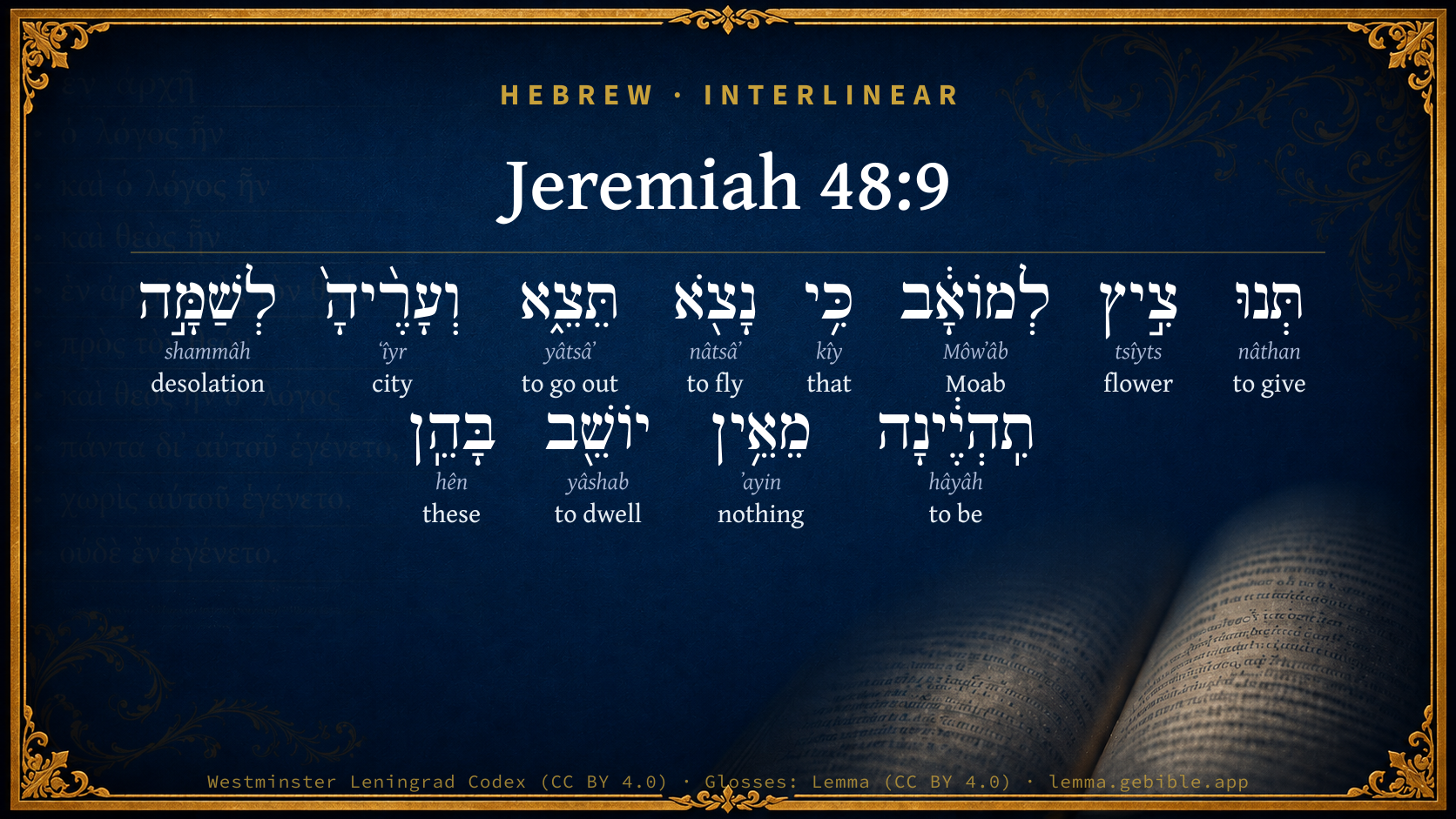
Hebrew (Westminster Leningrad Codex) Jeremiah 48:9 appears in the Hebrew Old Testament. The text above is from the Westminster Leningrad Codex. Each word links to its Strong’s number, a concise gloss, and parsing drawn from the Open Scriptures Hebrew Bible morphology. Click any word for its full Brown-Driver-Briggs (BDB) entry.
Download image
Cite this verse

Jeremiah 48:9 (World English Bible). Public Domain. Lemma interlinear Bible study tool, https://lemma.gebible.app/v/jeremiah/48/9.

Show BibTeX & RIS
BibTeX
RIS
English Translation
Give wings to Moab, that she may fly and get her away: and her cities shall become a desolation, without any to dwell therein.
World English Bible · Public Domain
Highlights
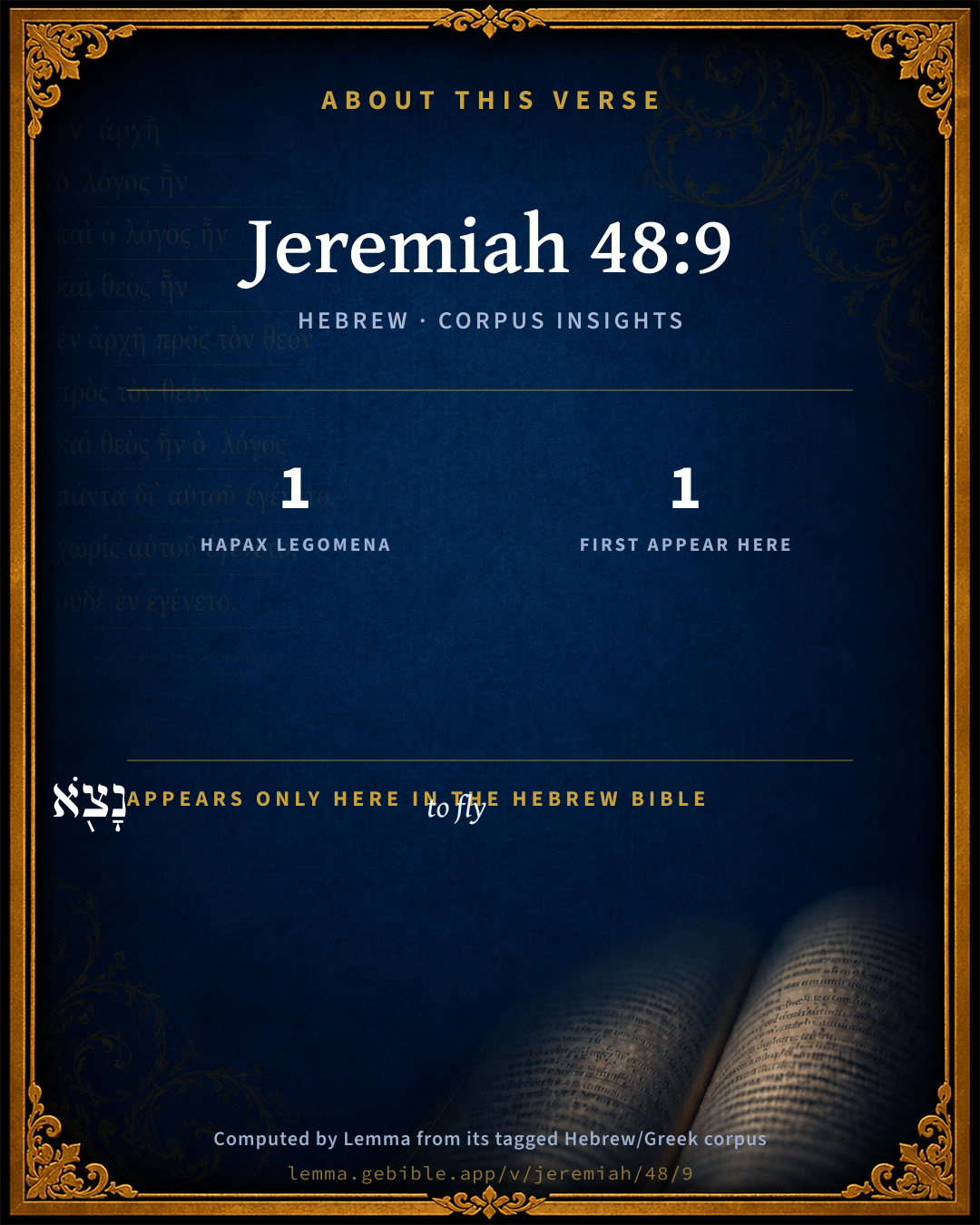
  • 1 hapax legomenon — only here in the Hebrew Bible
  • 1 first appearance in the Hebrew Bible
Full analysis ↓
Download a study sheet

One document with this verse’s original text, its word-by-word gloss line, the meaning frame, cross-references with their text, attributed commentary, and full source and license credits — printable, and it pastes into notes with its structure intact.

This verse Autodidact and up

Study sheet (.html) Plain text (.txt)

A passage Seminary Student

Up to 50 verses in one chapter. A passage sheet keeps up to 6 commentary sources and 12 cross-references per verse, in the order this page ranks them, and says so on the sheet whenever that leaves anything out. Ask for a single verse and you get the Autodidact verse sheet above.

Everything on this page stays free to read, with no account — the sheet is a download of what is already on screen, not access to it.

Want to remove ads? Support Godless Engineer
Compare translations 3

The same verse in 3 English versions, stacked beneath the original-language interlinear above. Click any original word for its lexicon entry.

Each is an independent rendering of the whole verse — the interlinear is not word-aligned to these translations.

Highlighted words mark where these versions differ — a whole-verse word diff, not a word-by-word alignment.

  • World English Bible Public Domain
    Give wings to Moab, that she may fly and get her away: and her cities shall become a desolation, without any to dwell therein.
  • King James Version Public Domain
    Give wings unto Moab, that it may flee and get away: for the cities thereof shall be desolate, without any to dwell therein.
  • unfoldingWord Literal Text CC BY-SA 4.0
    Give wings to Moab, for she must certainly fly away. Her cities will become a wasteland, where there is no one to live in them.

unfoldingWord Literal Text — © unfoldingWord, licensed CC BY-SA 4.0. Word-aligned USFM3 via Door43 (git.door43.org/unfoldingWord/en_ult).

Versions to compare (up to 4)

3 of 4 selected

Show all 18 translations

Every available English version of this verse, each an independent rendering of the whole verse.

  • World English Bible Public Domain
    Give wings to Moab, that she may fly and get her away: and her cities shall become a desolation, without any to dwell therein.
  • Berean Standard Bible Public Domain
    Put salt on Moab, for she will be laid waste; her cities will become desolate, with no one to dwell in them.
  • Majority Standard Bible Public Domain
    Put salt on Moab, for she will be laid waste; her cities will become desolate, with no one to dwell in them.
  • King James Version Public Domain
    Give wings unto Moab, that it may flee and get away: for the cities thereof shall be desolate, without any to dwell therein.
  • American Standard Version (1901) Public Domain
    Give wings unto Moab, that she may fly and get her away: and her cities shall become a desolation, without any to dwell therein.
  • Revised Version (1885) Public Domain
    Give wings unto Moab, that she may fly and get her away: and her cities shall become a desolation, without any to dwell therein.
  • Geneva Bible (1599) Public Domain
    Giue wings vnto Moab, that it may flee and get away: for the cities thereof shalbe desolate, without any to dwell therein.
  • Douay-Rheims (1899) Public Domain
    Give a flower to Moab, for in its flower it shall go out: and the cities thereof shall be desolate, and uninhabited.
  • Young's Literal Translation Public Domain
    Give wings to Moab, for she utterly goeth out, And her cities are for a desolation, Without an inhabitant in them.
  • Literal Standard Version CC BY-SA 4.0
    Give wings to Moab, that she may go forth and flee away, || And her cities are for a desolation, || Without an inhabitant in them.
  • Unlocked Literal Bible CC BY-SA 4.0
    Give wings to Moab, for she must certainly fly away. Her cities will become a wasteland, where there is no one to live in them.
  • unfoldingWord Literal Text CC BY-SA 4.0
    Give wings to Moab, for she must certainly fly away. Her cities will become a wasteland, where there is no one to live in them.
  • Darby Bible Public Domain
    Give wings unto Moab, that she may flee and get away; and the cities thereof shall become a desolation, without inhabitant.
  • World Messianic Bible Public Domain
    Give wings to Moab, that she may fly and get herself away: and her cities will become a desolation, without anyone to dwell in them.
  • Webster's Bible Public Domain
    Give wings to Moab, that it may flee and get away: for its cities shall be desolate, without any to dwell in them.
  • Free Bible Version CC BY-SA 4.0
    Put up gravestones in Moab, because the country will become a wasteland. Its towns will be turned into ruins where no one lives.
  • Bible in Basic English Public Domain
    Put up a pillar for Moab, for she will come to a complete end: and her towns will become a waste, without anyone living in them.
  • JPS Tanakh (1917) Public Domain
    Give wings unto Moab, for she must fly and get away; and her cities shall become a desolation, without any to dwell therein.

Literal Standard Version (2020), Covenant Press — licensed CC BY-SA 4.0. Text via the HelloAO Bible API (eBible.org). Unlocked Literal Bible (unfoldingWord) — licensed CC BY-SA 4.0. Text via the HelloAO Bible API (eBible.org). unfoldingWord Literal Text — © unfoldingWord, licensed CC BY-SA 4.0. Word-aligned USFM3 via Door43 (git.door43.org/unfoldingWord/en_ult). Free Bible Version, Dr. Jonathan Gallagher — licensed CC BY-SA 4.0. Text via the HelloAO Bible API (eBible.org).

Word by word

More ways to search: Search by grammar → Find every occurrence → Compare this word →

Practice this passage: Drill this verse → Learn its vocabulary →

נָצֹ֖א
nâtsâʼ
H5323
“to fly”
Verb, Qal, Infinitive Absolute
Part of Speech
Verb
Stem
Qal
Form
Infinitive Absolute
Full BDB Definition

Origin: a primitive root

TWOT: 1397

(Qal) to fly
  1. תְּנוּ nâthan H5414 “give” Verb, Qal, Imperative, 2nd Person, Masculine, Plural
  2. צִ֣יץ tsîyts H6731 “flower” Noun, Common, Masculine, Singular, Absolute
  3. לְמוֹאָ֔ב Môwʼâb H4124 “to/for · Moab” Preposition + Noun, Proper
  4. כִּ֥י kîy H3588 “that” Conjunction
  5. תֵּצֵ֑א yâtsâʼ H3318 “to go out” Verb, Qal, Imperfect, 3rd Person, Feminine, Singular
  6. וְעָרֶ֨יהָ֙ ʻîyr H5892 “and · cities · her” Conjunction + Noun, Common, Feminine, Plural, Construct + Suffix, Personal, 3rd Person, Feminine, Singular
  7. לְשַׁמָּ֣ה shammâh H8047 “to/for · desolation” Preposition + Noun, Common, Feminine, Singular, Absolute
  8. תִֽהְיֶ֔ינָה hâyâh H1961 “to be” Verb, Qal, Imperfect, 3rd Person, Feminine, Plural
  9. מֵאֵ֥ין ʼayin H369 “from · nothing” Preposition + Particle, Negative
  10. יוֹשֵׁ֖ב yâshab H3427 “dwelling” Verb, Qal, Participle Active, Masculine, Singular, Absolute
  11. בָּהֵֽן hên H2004 “in/at · them” Preposition + Suffix, Personal, 3rd Person, Feminine, Plural

About this verse

These counts appear in no published source. They are computed here, from the morphology-tagged text and Lemma’s own curated glosses. What Lemma adds →

12
words
12
distinct lemmas
Prophets
section

Notable vocabulary

1 hapax legomenon — a word that appears only here in the entire Hebrew Bible:

  • נָצֹ֖א to fly H5323

First appearance in Scripture

This word makes its first canonical appearance in the Hebrew Bible here:

  • נָצֹ֖א to fly H5323

Shared distinctive vocabulary

בָּהֵֽן these H2004 occurs in 14 verses of the Hebrew Bible. Also found in:

Grammatical profile

  • 5 verbs
  • 4 nouns
  • 1 preposition
  • 1 conjunction
  • 1 particle

Verb forms

  • תְּנוּ Qal · Imperative
  • נָצֹ֖א Qal · Infinitive Absolute
  • תֵּצֵ֑א Qal · Imperfect
  • תִֽהְיֶ֔ינָה Qal · Imperfect
  • יוֹשֵׁ֖ב Qal · Participle Active

Cross-references

7

Topical passages linked to Jeremiah 48:9 in the Treasury of Scripture Knowledge — connected by theme and wording, ordered by reader-vote popularity; previews shown in the World English Bible.

  • Psalms 11:1 In Yahweh, I take refuge. How can you say to my soul, "Flee as a bird to your mountain!"
  • Isaiah 16:2 For it shall be that, as wandering birds, as a scattered nest, so shall the daughters of Moab be at the fords of the Arnon.
  • Jeremiah 48:28 You inhabitants of Moab, leave the cities, and dwell in the rock; and be like the dove that makes her nest over the mouth of the abyss.
  • Psalms 55:6 I said, "Oh that I had wings like a dove! Then I would fly away, and be at rest.
  • Jeremiah 46:19 You daughter who dwell in Egypt, furnish yourself to go into captivity; for Memphis shall become a desolation, and shall be burnt up, without inhabitant.
  • Zephaniah 2:9 Therefore as I live, says Yahweh of Hosts, the God of Israel, surely Moab will be as Sodom, and the children of Ammon as Gomorrah, a possession of nettles, and salt pits, and a perpetual desolation. The remnant of my people will plunder them, and the survivors of my nation will inherit them.
  • Revelation 12:14 Two wings of the great eagle were given to the woman, that she might fly into the wilderness to her place, so that she might be nourished for a time, and times, and half a time, from the face of the serpent.

Cross-references courtesy of OpenBible.info (CC BY 4.0).

Hebrew and Greek witnesses Masoretic Hebrew ↔ Greek Septuagint

The same verse in the two great witnesses to the Old Testament, shown verse-for-verse.

These are two independent witnesses, not word-aligned to each other, and the Septuagint is shown in lemma (dictionary) form.

Hebrew Jeremiah 48:9 Masoretic · Westminster Leningrad Codex

תְּנוּ צִ֣יץ לְמוֹאָ֔ב כִּ֥י נָצֹ֖א תֵּצֵ֑א וְעָרֶ֨יהָ֙ לְשַׁמָּ֣ה תִֽהְיֶ֔ינָה מֵאֵ֥ין יוֹשֵׁ֖ב בָּהֵֽן

Give wings to Moab, that she may fly and get her away: and her cities shall become a desolation, without any to dwell therein.

World English Bible · Public Domain

Greek LXX Structure differs

In the Septuagint, Jeremiah is about an eighth shorter than the Hebrew and arranges its material differently — the Oracles Against the Nations (Hebrew chapters 46–51) appear in the middle of the Greek book, after 25:13. Because the chapter and verse boundaries do not line up, a verse-for-verse comparison with the Hebrew is not shown.

A verse-for-verse comparison isn’t shown here because the chapters and verses don’t line up. Switch to the LXX edition with the MT / LXX toggle above to read the Greek directly.

On this verse, Haydock's Catholic Bible Commentary discusses the Septuagint’s reading. Read the note in Commentary ↓

Hebrew: Westminster Leningrad Codex (CC BY 4.0). Greek: Septuagint (public domain); English from a public-domain English Septuagint. How the Septuagint differs from the Hebrew →

Targum (Aramaic paraphrase)

1

The Targum is the ancient Jewish Aramaic paraphrase of the Hebrew Scriptures — an interpretive translation, not the Hebrew text itself. Onkelos (literal) and Pseudo-Jonathan (expansive) render the Torah, and Jonathan the Prophets. Coverage is partial: where no permissively-licensed English translation exists for a verse, only the Aramaic is shown. This is verse-level text, not a word-by-word alignment to the Hebrew.

  1. Targum Jonathan Prophets (Joshua–Malachi)
    אַעְדוֹ בִתְרָא מִן מוֹאָב אֲרֵי מִגְלָא תִגְלֵי וְקַרְוָהָא לְצָדוּ יֶהֱוְיַן מִבְּלִי יָתֵיב בְּהוֹן:

    (no public-domain English translation for this verse)

    Targum Jonathan — Aramaic: “Mikraot Gedolot” (public domain). English: “Sefaria Community Translation” (CC0 1.0 (public-domain dedication)); “London "Chaldee Paraphrase," 1871” (public domain). Text via Sefaria.

Commentary

Notes on Jeremiah 48:9 from classic Christian and Jewish commentators (each source and its license shown beneath its notes). The classic Christian expositions comment on the surrounding passage and are grouped to its opening verse, so a note may address several verses; the Jewish commentaries on the Tanakh (Rashi and others) are per-verse, so they appear only where the commentator wrote on this verse.

Lemma curates 59 commentaries, every one of them public domain or Creative Commons licensed, each selected and text-cleaned for this edition rather than reprinted as found. About our sources →

Trapp's Complete Commentary

John Trapp

Jer 48:9 Give wings unto Moab, that it may flee and get away: for the cities thereof shall be desolate, without any to dwell therein.

Ver. 9. Give wings unto Moab.] Let him flea his utmost - addat timor alas: but the Chaldean eagle will easily overcatch him.

John Trapp, A Commentary or Exposition upon All the Books of the Old and New Testament (1647–1656) — public domain. Text from a community e-Sword module.

Whedon's Commentary on the Bible

Daniel D. Whedon

DEVASTATION OF MOAB, Jer_48:9-15.

9. Give wings unto Moab, etc. — The expression suggests the suddenness of the devastation. The word for “wings” elsewhere means a flower, as in Job_14:2.

Daniel D. Whedon (gen. ed.), Commentary on the Old and New Testaments (1874–1909) — public domain. Text from a community e-Sword module.

Keil & Delitzsch

C. F. Keil & F. Delitzsch

Moab is laid waste, and its inhabitants carried captive. - Jer 48:9. "Give pinions to Moab, for he will flee and get away, and his cities shall become a waste, with no one dwelling in them. Jer 48:10. Cursed is he that doeth the work of Jahveh negligently, and cursed is he that restraineth his sword from blood. Jer 48:11. Moab hath been at ease from his youth, and lay still upon his lees; he was not poured out from vessel to vessel, neither hath he gone into captivity, therefore his taste hath remained in him, and his smell hath not changed. Jer 48:12. Therefore, behold, days come, saith Jahveh, when I will send to him those who pour out, and they shall pour him out; and they shall empty his vessels, and break their bottles. Jer 48:13. And Moab shall be ashamed of Chemosh, as the house of Israel was ashamed of Bethel their confidence. Jer 48:14. How can ye say, We are mighty, and men of valour for the war? Jer 48:15. Moab is laid waste, and people ascend into his cities, and the choice of his young men go down to the slaughter, saith the King, whose name is Jahveh of hosts."

The devastation will come so suddenly, that Moab, in order to escape it, uses wings for enabling him to flee from it. The request "give" is not ironical, but a mere rhetorical employment of the idea that wings would be necessary in order to escape. ציץ, which elsewhere means a flower, here signifies wings or waving plumes, as in the Targum on Psa 139:9, and in the Rabbinical writings. נצא, written with א for the sake of obtaining similarity of sound, stands for נצה = נצץ, to flee.

Jer 48:10-12

The devastation is a work of the Lord, and those who execute it must carry out the divine decree, so that they may not bring the curse upon themselves. The first clause is taken quite generally: the more exact specification of the work of the Lord follows in the second clause; it is the employment of the sword against Moab. "His sword" does not mean Jahveh's, but the sword carried by the devastator. רמיּה is used adverbially, but not in the sense of "deceitfully," rather "carelessly, negligently;" cf. כּף רמיּה, Pro 10:4; Pro 12:24. In Jer 48:11 follows the reason why the judgment has necessarily come on Moab. Moab is compared to old wine that has lain long on its lees, and thereby preserved its flavour and smell unchanged. The taste and odour of Moab signify his disposition towards other nations, particularly towards Israel, the people of God. Good wine becomes stronger and more juicy by lying pretty long on its lees (see on Isa 25:6); inferior wine, however, becomes thereby more harsh and thick. The figure is used here in the latter sense, after Zep 1:12. Moab's disposition towards Israel was harsh and bitter; the people were arrogant and proud (Jer 48:29.; Isa 16:6), and so hostile towards Israel, that they sought every opportunity of injuring them (see above, p. 385f., and the comments on Sa2 8:2). From his youth, i.e., from the time when Moab, after subduing the Emims (Deu 2:10), had established himself in his own land, or had become enrolled among the nations of history, - from that time forward had he remained undisturbed in his own land, i.e., without being driven out of it, had not gone into captivity (as is shown by the figure of the wine poured from one vessel into another). In this way there is a qualification made of the general statement that he remains at rest on his lees, and undisturbed. For Moab has often carried on wars, and even suffered many defeats, but has never yet been driven from his own land; nor had the temporary dependence on Israel exercised any transforming influence on the ordinary life of the people, for they were simply made tributary. This quiet continuance in the country is to cease. The God of Israel "will send to them cellarmen (Germ. Schrter), who shall bring them out of the cellar" (Germ. ausschroten), as Luther translates Jer 48:12. "Schrter" are men who bring the wine-casks out of the cellar; for "schroten" means to bring out heavy burdens, especially full casks on a strong kind of hand-barrow (Germ. Hebewerkzeug), like a ladder in appearance. צעים (from צעה, to bend, incline) are those who incline a barrel or vessel for the purpose or pouring out its contents. These will not merely empty the vessels, but also break the pitchers; i.e., not merely carry away the Moabites, but also break down their political organization, and destroy their social arrangements.

Jer 48:13-15

In this way Moab will come to dishonour through his god Chemosh, i.e., experience his powerlessness and nothingness, and perish with him, just as Israel (the ten tribes) came to dishonour through Bethel, i.e., through their golden calf at Bethel. As to the form מבטחם, with Segol in the pretone, cf. Ewald, 70, a; Olshausen, Gram. S. 377. Moab will then be no longer able to boast of his valour; this is the meaning of the question in Jer 48:14 : on this term in the address, cf. Jer 2:23; Jer 8:8. In Jer 48:15 it is further stated that the result will show this: "Moab is laid waste." ועריה עלה is variously interpreted. An explanation which has met with much acceptance, but which nevertheless is really untenable, is founded on Jdg 20:40 ("The whole city went up towards heaven" i.e., in smoke and fire): "As for his cities, fire or smoke ascends;" but there is no mention here either of smoke or fire. Kimchi long ago came near the truth when he sought to find the subject שׁדד in shudad שׁדּד: "and the devastator comes against his cities." However, the contrast between עלה and ירדוּ is not fully brought out in this way: it is better to leave the subject indeterminate: "and his cities they climb" (Kueper), or: "they go up to his cities" (Bttcher, Neue Aehrenlese, ii. 163). The enemy who mounts the cities is evidently intended. The change שׁדּד into שׁדד is both unnecessary and unsuitable; but J. D. Michaelis, Ewald, Dahler, Graf, after making the alteration, translate, "The destroyer of Moab and of his cities draws near." Hitzig justly remarks, in opposition to this conjecture: "There is nothing to justify the mere placing of the subject at the head of the sentence (contrast Jer 48:8, Jer 48:18); besides, one does not see why the cities of Moab are distinguished from Moab itself; and cf. 20b." ירד לבּטח, "to sink down to the slaughter," cf. Jer 50:27; and on this use of ירד, Isa 34:7. The enemy ascends into the cities, the young soldiers of Moab descend to the shambles. This threatening is enforced by the addition, "saith the King," etc. Jahveh is called the King, in contrast with the belief of the Moabites, that their god Chemosh was the king of his people (see on Jer 48:7). The true King of the Moabites also is Jahveh, the God of hosts, i.e., the Ruler of the whole world.

Keil & Delitzsch — Biblical Commentary on the Old Testament (1861–1891) — public domain (CC PDM 1.0). Text via the HelloAO Bible API. (Old Testament only.)

Jamieson, Fausset & Brown

Robert Jamieson, A. R. Fausset & David Brown

Give wings, &c.-- (Psa 55:6). Unless it get wings, it cannot escape the foe. "Wings," the Hebrew root meaning is a "flower" (Job 14:2); so the flower-like plumage of a bird.

Jamieson, Fausset & Brown — Commentary Critical and Explanatory on the Whole Bible (1871) — public domain (CC PDM 1.0). Text via the HelloAO Bible API.

Adam Clarke's Commentary

Verse 9. Give wings unto Moab] There is no hope in resistance, and to escape requires the speediest flight. I cannot conceive how Dahler came to translate thus: Tirez Moab par les chevaux, "Drag Moab away by the hair of the head."

Adam Clarke's Commentary on the Bible (1810–1826) — public domain. Text from a community e-Sword/MySword module.

John Calvin's Commentaries

Here is a bitter derision; for it was necessary not only to goad the Moabites, but also to pierce them through, because they were inflated with so much pride, and also because they cruelly raged against God’s people, as we shall more fully see hereafter. When the Israelites were conquered, these ungodly men cast forth their taunts, and also betrayed them to their enemies. Hence the Prophet now says, Give wings to Moab Though the word ציף, tsits, properly means a flower, yet it means here a wing, put for wings; as though he had said, that the Moabites could not escape destruction except by flying. In short, as they had not only so proudly despised, but had also persecuted their miserable brethren, the Prophet says, “Come shall the time when feet for running or for flight shall not be sufficient for you, your enemies being so eager in pursuit; but you will desire to have wings.” But, as we shall see, he will presently tell us, that Moab had been quiet and settling on its dregs.

He then adds, that its cities would be a waste, so as to have no inhabitant He mentions the reason why Moab would need wings, even because there would be no refuge for them, for wherever it would betake itself, it would be thence driven away; for the enemy would take all the cities, so that the whole people would be under the necessity of removing elsewhere; he intimates, in short, that there would be no hope for life to the Moabites, except by flight, and that the swiftest. At length he adds, —

John Calvin's Commentaries (1540-1563) — public domain. Text from the Calvin Translation Society English edition (1840s-50s) via the Christian Classics Ethereal Library (ccel.org). Calvin's coverage is partial (roughly two-thirds of the Bible); uncommented books and verses are honest gaps, never fabricated. The 19th-century editor's footnotes and remarks are omitted so the notes are faithfully Calvin's own voice.

Ellicott's Commentary for English Readers

(9) Give wings unto Moab . . .—“No other prayer,” the prophet seems to say, in grave, stern irony, “is left but this. Resistance is hopeless. There is nothing left but to wish for the wings of a bird that safety may be found in flight.” (Comp. Ps. Iv. 6.)

A Bible Commentary for English Readers, edited by Charles John Ellicott (1878–1897) — public domain. Text from a community e-Sword module.

The Cambridge Bible for Schools and Colleges

gen. ed. J. J. S. Perowne

9. wings] The sense is that nothing short of wings would enable the Moabites to escape before their enemies.

that she may fly and get her away] or as mg. for she must fly; but better (so Dr.) for she would fain fly away.

The Cambridge Bible for Schools and Colleges (gen. ed. J. J. S. Perowne; Cambridge University Press, 1878–1918) — public domain. Text from a community e-Sword module.

John Gill's Exposition

Give wings unto Moab that it may flee and get away,.... That is, give wings to the inhabitants of Moab; signifying that they were in great danger, and there was no probability of escaping it, unless they had the wings of a swift bird, or were as swift as such, and even that would not do; though perhaps their fleeing, and passing away with wings, may signify not their fleeing from danger, and their attempt to escape; but their swift and sudden destruction, compared to the swift flight of a bird; for the last clause may be rendered, "for in flying it shall fly away" (o). Some render the first clause, "give a flower to Moab", as the Vulgate Latin version; and so the word sometimes signifies, Isa 40:7; and the sense may be, hold up a flower to Moab, or a feather, such as is light, as the down of a thistle, as an emblem of its destruction; which shall pass away as easily and swiftly as so light a thing before the wind; but Jarchi and Kimchi interpret the word as we do, a wing. The Targum is,

"take away the crown from Moab, for going it shall go away into captivity.''

The word is used of the plate of gold on the high priest's mitre, Exo 28:36;

for the cities thereof shall be desolate, without any to dwell therein; which expresses the utter destruction of them.

(o) "quia volando volabit", Pagninus, Montanus, Vatablus; "quia avolando avolabit", Schmidt; "nam avolabit", Piscator.

John Gill's Exposition of the Whole Bible (1746–1763) — public domain (CC PDM 1.0). Text via the HelloAO Bible API.

Haydock's Catholic Bible Commentary

Flower: an usual ceremony at funerals. (Cornelius a Lapide) (Menochius) --- Manibus date lilia plenis. (Virgil, Æneid vi.) --- Hebrew, "wings." Protestants, "signs." Septuagint, (Haydock) "that they may know how to return." Let Moab flee. (Calmet)

George Leo Haydock (1774–1849), Haydock's Catholic Family Bible and Commentary, 1859 edition — public domain. Excludes Psalms (Douay-Rheims chapter numbering differs from Protestant) and Deuterocanonical books (Catholic canon only).

Matthew Poole's English Annotations

That is, the Moabites had need of wings like a bird to escape that ruin which is coming upon them. Yea, if they had wings, they should not escape, for the Lord is resolved that the cities of Moab shall be all brought to desolation, so as no inhabitants shall be left in them.

Matthew Poole's English Annotations on the Holy Bible (1683–1685) — public domain. Text from a community e-Sword/MySword module.

The Pulpit Commentary

Vers. 9-16. So sudden is the blow that Moab stands in need of wings to make good his escape. Were the human instrument to delay, the curse meant for Moab would come upon himself. Is a reason demanded? It is that Moab has long been in a state of morally perilous security, and requires to be thoroughly shaken and aroused, in order that he may discover the inability of Chemosh to help his worshippers.

Give wings, etc. Comp. ver. 28; also Isa_16:2, where the fugitive Moabites are likened to "wandering birds."

The Pulpit Commentary (1880–1919), ed. H.D.M. Spence-Jones & Joseph S. Exell — public domain. Text from a community e-Sword module.

John Wesley's Explanatory Notes

Give wings - The Moabites have need of wings like a bird to escape that ruin which is coming upon them.

John Wesley, Explanatory Notes Upon the Whole Bible (1754–1765) — public domain. Text via the GEBible commentary corpus.

Rashi

Rabbi Shlomo Yitzchaki (Rashi)

Give wings to Moab Heb. ציץ. Give wings to Moab. Every appendage that hangs or protrudes from man or beast is called ציץ. Cf. “And it shall be to you for fringes (לציצית)” (Num. 15:39); “And He took me by the locks (בציצית) of my head” (Ezek. 8:3).

for she shall fly away Heb. נצא תצא. For with flight and haste you shall go forth into exile, and נָצֹא will be of the conjugation of נוֹצָה, a feather. So did Menahem (Machbereth Menahem p. 151) classify it, and so “Yea, they fled away (נָצוּ) and wandered” (Lam. 4:15). Jonathan renders: Remove the crown from Moab. Give others the crown of Moab.

Rashi on the Tanakh — English translations: “The Judaica Press complete Tanach with Rashi, translated by A. J. Rosenberg” (CC BY 4.0); “Pentateuch with Rashi's commentary by M. Rosenbaum and A.M. Silbermann, 1929-1934” (public domain); “The Metsudah Tanach series, Lakewood, N.J” (CC BY 4.0); and “The Book of Joshua, Metsudah Publications, 1997” (CC BY 4.0). Text via Sefaria.

Lesson kit

Teaching starters — assembled from the data on this page, not authored interpretation. Every prompt links to the verse data it draws on. Edit before teaching.

Jeremiah, in the Prophets, opens this verse with 12 words (12 distinct Hebrew lemmas). Its most distinctive word is nâtsâʼ (“to fly”). A historical commentator’s framing appears above. Read the whole chapter for the surrounding context.

Discussion questions

  1. What does “to fly” (nâtsâʼ) contribute to the verse as a whole?
  2. This verse holds 1 word here found nowhere else in the Hebrew Bible. What might the rare word draw attention to?
  3. The word “to fly” first appears here in Scripture. What is being introduced at this debut?
  4. Genesis 19:29 shares the word «these» with this verse. How do the two illuminate each other?
  5. The translations on this page render this verse differently — a whole-verse word diff, not a word-by-word alignment. What might account for the different wordings?
  6. The verb «תְּנוּ» is Qal Imperative. How does its form color the action?
  7. Reading how Trapp's Complete Commentary and Whedon's Commentary on the Bible read this verse, where do the two commentators agree and where do they part?

Things to notice

  • 1 word in this verse appears nowhere else in the Hebrew Bible.
  • 1 word makes its first canonical appearance in Scripture here.
  • These translations choose different wording for 21 words in this verse.
  • 12 distinct Hebrew lemmas span 12 words in this verse.

Reading settings

Reading text

Shown beneath each verse's original-language words.

Old Testament
Old Testament edition

Read the OT as the Masoretic Hebrew (MT) or the Greek Septuagint (LXX).

English shown for the Greek Septuagint (in the Hebrew ↔ Greek comparison).

Comparing translations? Open the Compare panel on any verse page to stack up to four side by side.