Joshua 24:9

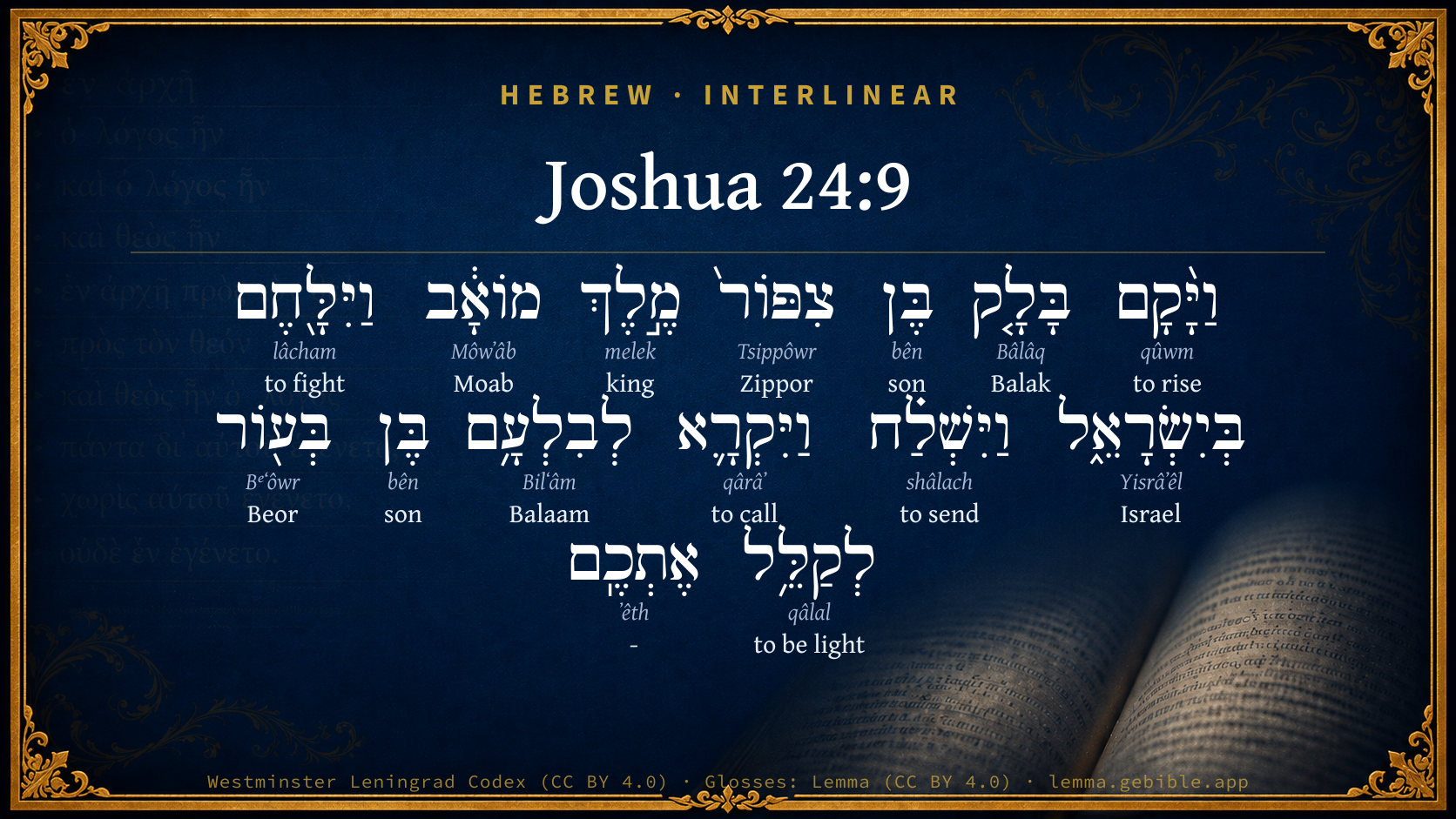
Hebrew (Westminster Leningrad Codex) Joshua 24:9 appears in the Hebrew Old Testament. The text above is from the Westminster Leningrad Codex. Each word links to its Strong’s number, a concise gloss, and parsing drawn from the Open Scriptures Hebrew Bible morphology. Click any word for its full Brown-Driver-Briggs (BDB) entry.
Download image
Cite this verse

Joshua 24:9 (World English Bible). Public Domain. Lemma interlinear Bible study tool, https://lemma.gebible.app/v/joshua/24/9.

Show BibTeX & RIS
BibTeX
RIS
English Translation
Then Balak the son of Zippor, king of Moab, arose and fought against Israel: and he sent and called Balaam the son of Beor to curse you;
World English Bible · Public Domain
Download a study sheet

One document with this verse’s original text, its word-by-word gloss line, the meaning frame, cross-references with their text, attributed commentary, and full source and license credits — printable, and it pastes into notes with its structure intact.

This verse Autodidact and up

Study sheet (.html) Plain text (.txt)

A passage Seminary Student

Up to 50 verses in one chapter. A passage sheet keeps up to 6 commentary sources and 12 cross-references per verse, in the order this page ranks them, and says so on the sheet whenever that leaves anything out. Ask for a single verse and you get the Autodidact verse sheet above.

Everything on this page stays free to read, with no account — the sheet is a download of what is already on screen, not access to it.

Want to remove ads? Support Godless Engineer
Compare translations 3

The same verse in 3 English versions, stacked beneath the original-language interlinear above. Click any original word for its lexicon entry.

Each is an independent rendering of the whole verse — the interlinear is not word-aligned to these translations.

Highlighted words mark where these versions differ — a whole-verse word diff, not a word-by-word alignment.

  • World English Bible Public Domain
    Then Balak the son of Zippor, king of Moab, arose and fought against Israel: and he sent and called Balaam the son of Beor to curse you;
  • King James Version Public Domain
    Then Balak the son of Zippor, king of Moab, arose and warred against Israel, and sent and called Balaam the son of Beor to curse you:
  • unfoldingWord Literal Text CC BY-SA 4.0
    And Balak, the son of Zippor, the king of Moab, arose and fought with Israel. And he sent and called for Balaam, the son of Beor, to curse you.

unfoldingWord Literal Text — © unfoldingWord, licensed CC BY-SA 4.0. Word-aligned USFM3 via Door43 (git.door43.org/unfoldingWord/en_ult).

Versions to compare (up to 4)

3 of 4 selected

Show all 18 translations

Every available English version of this verse, each an independent rendering of the whole verse.

  • World English Bible Public Domain
    Then Balak the son of Zippor, king of Moab, arose and fought against Israel: and he sent and called Balaam the son of Beor to curse you;
  • Berean Standard Bible Public Domain
    Then Balak son of Zippor, the king of Moab, set out to fight against Israel. He sent for Balaam son of Beor to curse you,
  • Majority Standard Bible Public Domain
    Then Balak son of Zippor, the king of Moab, set out to fight against Israel. He sent for Balaam son of Beor to curse you,
  • King James Version Public Domain
    Then Balak the son of Zippor, king of Moab, arose and warred against Israel, and sent and called Balaam the son of Beor to curse you:
  • American Standard Version (1901) Public Domain
    Then Balak the son of Zippor, king of Moab, arose and fought against Israel: and he sent and called Balaam the son of Beor to curse you;
  • Revised Version (1885) Public Domain
    Then Balak the son of Zippor, king of Moab, arose and fought against Israel; and he sent and called Balaam the son of Beor to curse you:
  • Geneva Bible (1599) Public Domain
    Also Balak the sonne of Zippor King of Moab arose and warred against Israel, and sent to call Balaam the sonne of Beor for to curse you,
  • Douay-Rheims (1899) Public Domain
    And Balac son of Sephor king of Moab arose and fought against Israel. And he sent and called for Balaam son of Beor, to curse you:
  • Young's Literal Translation Public Domain
    `And Balak son of Zippor, king of Moab, riseth and fighteth against Israel, and sendeth and calleth for Balaam son of Beor, to revile you,
  • Literal Standard Version CC BY-SA 4.0
    And Balak son of Zippor, king of Moab, rises and fights against Israel, and sends and calls for Balaam son of Beor, to revile you,
  • Unlocked Literal Bible CC BY-SA 4.0
    Then Balak son of Zippor, king of Moab, got up and attacked Israel. He sent and called for Balaam son of Beor, to curse you.
  • unfoldingWord Literal Text CC BY-SA 4.0
    And Balak, the son of Zippor, the king of Moab, arose and fought with Israel. And he sent and called for Balaam, the son of Beor, to curse you.
  • Darby Bible Public Domain
    And Balak the son of Zippor, king of Moab, arose and warred against Israel, and sent and called Balaam the son of Beor to curse you;
  • World Messianic Bible Public Domain
    Then Balak the son of Zippor, king of Moab, arose and fought against Israel. He sent and called Balaam the son of Beor to curse you,
  • Webster's Bible Public Domain
    Then Balak the son of Zippor, king of Moab, arose and warred against Israel, and sent and called Balaam the son of Beor to curse you:
  • Free Bible Version CC BY-SA 4.0
    When Balak, son of Zippor, the king of Moab, wanted to fight against Israel, he sent for Balaam, son of Beor, to come and curse you.
  • Bible in Basic English Public Domain
    Then Balak, the son of Zippor, king of Moab, went up to war against Israel; and he sent for Balaam, the son of Beor, to put a curse on you:
  • JPS Tanakh (1917) Public Domain
    Then Balak the son of Zippor, king of Moab, arose and fought against Israel; and he sent and called Balaam the son of Beor to curse you.

Literal Standard Version (2020), Covenant Press — licensed CC BY-SA 4.0. Text via the HelloAO Bible API (eBible.org). Unlocked Literal Bible (unfoldingWord) — licensed CC BY-SA 4.0. Text via the HelloAO Bible API (eBible.org). unfoldingWord Literal Text — © unfoldingWord, licensed CC BY-SA 4.0. Word-aligned USFM3 via Door43 (git.door43.org/unfoldingWord/en_ult). Free Bible Version, Dr. Jonathan Gallagher — licensed CC BY-SA 4.0. Text via the HelloAO Bible API (eBible.org).

Word by word

More ways to search: Search by grammar → Find every occurrence → Compare this word →

Practice this passage: Drill this verse → Learn its vocabulary →

צִפּוֹר֙
Tsippôwr
H6834
“Zippor”
Noun, Proper
Part of Speech
Noun
Type
Proper
Full BDB Definition

Origin: the same as H6833

TWOT: None

Zippor = "sparrow" - father of Balak the king of Moab at the time of the exodus
  1. וַיָּ֨קָם qûwm H6965 “and · to rise” Conjunction + Verb, Qal, Sequential Imperfect, 3rd Person, Masculine, Singular
  2. בָּלָ֤ק Bâlâq H1111 “Balak” Noun, Proper
  3. בֶּן bên H1121 “son of” Noun, Common, Masculine, Singular, Construct
  4. מֶ֣לֶךְ melek H4428 “king of” Noun, Common, Masculine, Singular, Construct
  5. מוֹאָ֔ב Môwʼâb H4124 “Moab” Noun, Proper
  6. וַיִּלָּ֖חֶם lâcham H3898 “and · to fight” Conjunction + Verb, Niphal, Sequential Imperfect, 3rd Person, Masculine, Singular
  7. בְּיִשְׂרָאֵ֑ל Yisrâʼêl H3478 “in/at · Israel” Preposition + Noun, Proper
  8. וַיִּשְׁלַ֗ח shâlach H7971 “and · to send” Conjunction + Verb, Qal, Sequential Imperfect, 3rd Person, Masculine, Singular
  9. וַיִּקְרָ֛א qârâʼ H7121 “and · to call” Conjunction + Verb, Qal, Sequential Imperfect, 3rd Person, Masculine, Singular
  10. לְבִלְעָ֥ם Bilʻâm H1109 “to/for · Balaam” Preposition + Noun, Proper
  11. בֶּן bên H1121 “son of” Noun, Common, Masculine, Singular, Construct
  12. בְּע֖וֹר Bᵉʻôwr H1160 “Beor” Noun, Proper
  13. לְקַלֵּ֥ל qâlal H7043 “to be light” Preposition + Verb, Piel, Infinitive Construct
  14. אֶתְכֶֽם ʼêth H853 “- · you” Particle, Direct Object + Suffix, Personal, 2nd Person, Masculine, Plural

About this verse

These counts appear in no published source. They are computed here, from the morphology-tagged text and Lemma’s own curated glosses. What Lemma adds →

15
words
14
distinct lemmas
Historical
section

Notable vocabulary

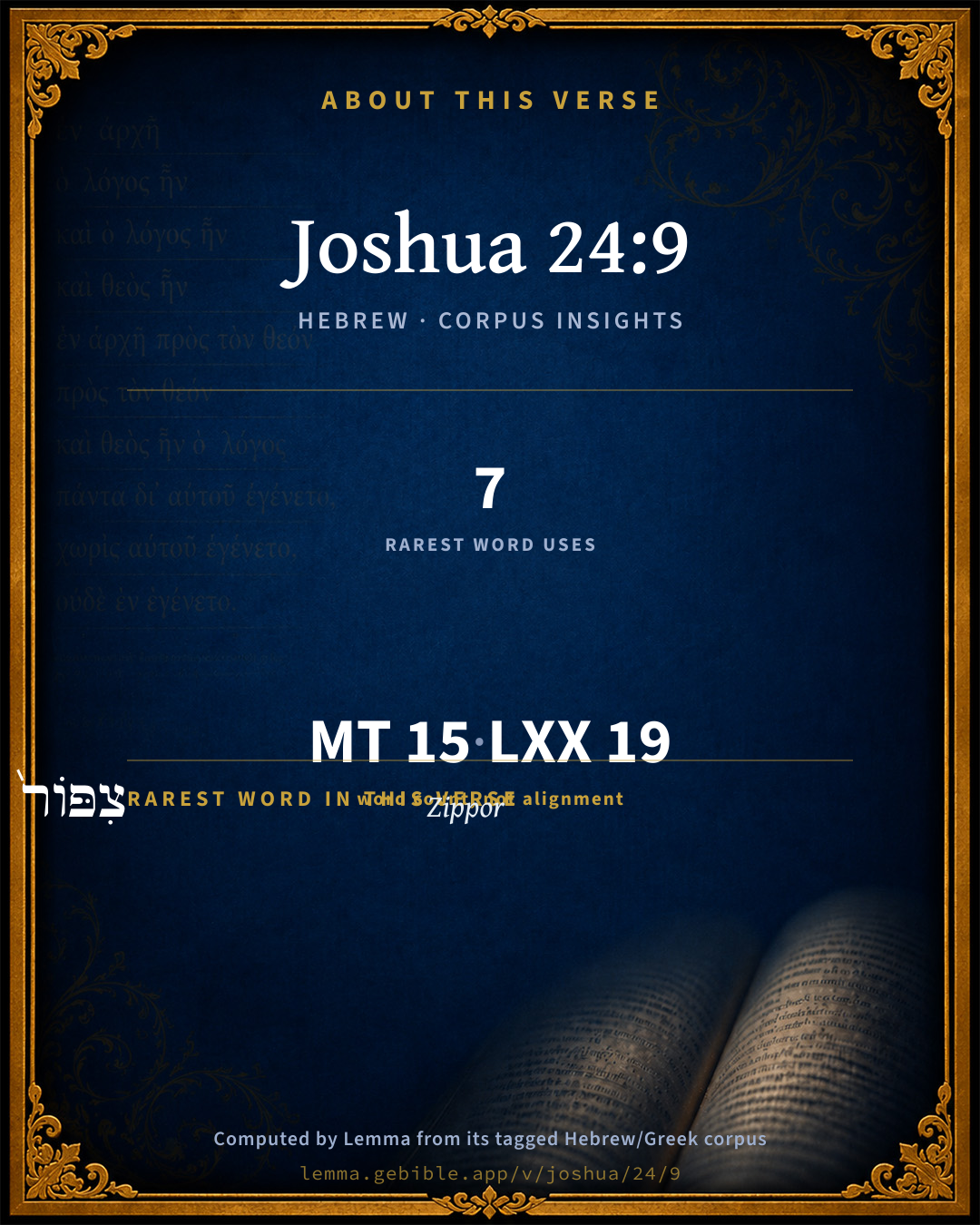
The rarest word here is צִפּוֹר֙ Zippor H6834 — appearing just 7 times in the whole Hebrew Bible.

Shared distinctive vocabulary

צִפּוֹר֙ Zippor H6834 occurs in 7 verses of the Hebrew Bible. Also found in:

Grammatical profile

  • 5 verbs
  • 9 nouns
  • 1 particle

Verb forms

  • וַיָּ֨קָם Qal · Sequential Imperfect
  • וַיִּלָּ֖חֶם Niphal · Sequential Imperfect
  • וַיִּשְׁלַ֗ח Qal · Sequential Imperfect
  • וַיִּקְרָ֛א Qal · Sequential Imperfect
  • לְקַלֵּ֥ל Piel · Infinitive Construct

Repetition

A word recurs within this verse — often emphatic in Hebrew:

Hebrew & Septuagint length

In English translation the verse runs 27 words from the Hebrew and 23 from the Septuagint (LXX English) — closely comparable.

A rough comparison of the two English renderings, which tokenize alike — not a word-level alignment.

Word counts can differ between the Hebrew and the Greek without any difference in meaning — e.g. the Hebrew direct-object marker אֵת has no separate Greek word, and Greek often adds the article ὁ.

In the original languages it is 15 Hebrew tokens and 19 Greek tokens — but the two are counted differently (Hebrew bundles its prefixes and suffixes into one token; the Greek is in lemma form), so that isn’t a like-for-like length.

Cross-references

5

Topical passages linked to Joshua 24:9 in the Treasury of Scripture Knowledge — connected by theme and wording, ordered by reader-vote popularity; previews shown in the World English Bible.

  • Judges 11:25 Now are you anything better than Balak the son of Zippor, king of Moab? did he ever strive against Israel, or did he ever fight against them?
  • Micah 6:5 My people, remember now what Balak king of Moab devised, And what Balaam the son of Beor answered him from Shittim to Gilgal, That you may know the righteous acts of Yahweh."
  • Numbers 22:2 Balak the son of Zippor saw all that Israel had done to the Amorites.
  • Deuteronomy 23:4–5 because they didn't meet you with bread and with water in the way, when you came forth out of Egypt, and because they hired against you Balaam the son of Beor from Pethor of Mesopotamia, to curse you.
  • Numbers 22:5–21 He sent messengers to Balaam the son of Beor, to Pethor, which is by the River, to the land of the children of his people, to call him, saying, Behold, there is a people come out from Egypt: behold, they cover the surface of the earth, and they abide over against me.

Cross-references courtesy of OpenBible.info (CC BY 4.0).

Hebrew and Greek witnesses Masoretic Hebrew ↔ Greek Septuagint

The same verse in the two great witnesses to the Old Testament, shown verse-for-verse.

These are two independent witnesses, not word-aligned to each other, and the Septuagint is shown in lemma (dictionary) form.

Hebrew Joshua 24:9 Masoretic · Westminster Leningrad Codex

וַיָּ֨קָם בָּלָ֤ק בֶּן צִפּוֹר֙ מֶ֣לֶךְ מוֹאָ֔ב וַיִּלָּ֖חֶם בְּיִשְׂרָאֵ֑ל וַיִּשְׁלַ֗ח וַיִּקְרָ֛א לְבִלְעָ֥ם בֶּן בְּע֖וֹר לְקַלֵּ֥ל אֶתְכֶֽם

Then Balak the son of Zippor, king of Moab, arose and fought against Israel: and he sent and called Balaam the son of Beor to curse you;

World English Bible · Public Domain

Greek LXX Joshua 24:9 Septuagint · lemma form

καί ἀναἵστημι βαλακ ὁ ὁ σεπφωρ βασιλεύς μωαβ καί παρατάσσω ὁ ἰσραήλ καί ἀποστέλλω καλέω ὁ βαλααμ ἀράομαι σύ

And Balac, king of Moab, son of Sepphor, rose up, and made war against Israel, and sent and called Balaam to curse us.

LXX2012 (modern English Septuagint) · Public Domain

Hebrew: Westminster Leningrad Codex (CC BY 4.0). Greek: Septuagint (public domain); English from LXX2012 (modern English Septuagint) (Public Domain). How the Septuagint differs from the Hebrew →

Targum (Aramaic paraphrase)

1

The Targum is the ancient Jewish Aramaic paraphrase of the Hebrew Scriptures — an interpretive translation, not the Hebrew text itself. Onkelos (literal) and Pseudo-Jonathan (expansive) render the Torah, and Jonathan the Prophets. Coverage is partial: where no permissively-licensed English translation exists for a verse, only the Aramaic is shown. This is verse-level text, not a word-by-word alignment to the Hebrew.

  1. Targum Jonathan Prophets (Joshua–Malachi)
    וְקָם בָּלָק בַּר צִפּוֹר מַלְכָּא דְמוֹאָב וְאַגִיחַ קְרָבָא בְּיִשְׂרָאֵל וּשְׁלַח וּקְרָא לְבִלְעָם בַּר בְּעוֹר לְמֵילַט יַתְכוֹן:

    (no public-domain English translation for this verse)

    Targum Jonathan — Aramaic: “Mikraot Gedolot” (public domain). English: “Sefaria Community Translation” (CC0 1.0 (public-domain dedication)); “London "Chaldee Paraphrase," 1871” (public domain). Text via Sefaria.

Commentary

Notes on Joshua 24:9 from classic Christian and Jewish commentators (each source and its license shown beneath its notes). The classic Christian expositions comment on the surrounding passage and are grouped to its opening verse, so a note may address several verses; the Jewish commentaries on the Tanakh (Rashi and others) are per-verse, so they appear only where the commentator wrote on this verse.

Lemma curates 59 commentaries, every one of them public domain or Creative Commons licensed, each selected and text-cleaned for this edition rather than reprinted as found. About our sources →

Trapp's Complete Commentary

John Trapp

Jos 24:9 Then Balak the son of Zippor, king of Moab, arose and warred against Israel, and sent and called Balaam the son of Beor to curse you:

Ver. 9. Then Balak … arose and warred against Israel.] He did not actually war against them. {Jdg 11:25} Sed fieri dicitur quod tentatur aut intenditur, saith Ribera upon Amo 9:5. He did not, because he durst not. Howbeit, because he intended, if he could have compassed it, to fight with Israel, and prepared for that purpose, it is spoken of as a done thing. So Haman is said to have "laid his hands upon the Jews," because he attempted it; {Est 8:7} and the Jews to have stoned Christ, because they could have found in their hearts to have done it. {Joh 10:31-33}

“Qui, quid non potuit, non facit, ille facit.”

John Trapp, A Commentary or Exposition upon All the Books of the Old and New Testament (1647–1656) — public domain. Text from a community e-Sword module.

Joseph Benson's Commentary

Jos 24:9-10. Balak warred against Israel — Not indeed by open force, but by crafty counsels, warlike stratagems, and wicked devices. I would not hearken unto Balaam — It appears by this that Balaam had a great inclination to do what Balak desired, and that he asked leave of God to curse Israel; and therefore it is not strange that God, who permitted him simply to go, was highly angry with him for going with so wicked an intent, Num 22:22; Num 22:32. So I delivered you — From Balak’s malicious designs against you.

Joseph Benson's Commentary on the Old and New Testaments (1811–1818) — public domain. Text from a community e-Sword module.

Tyndale Open Study Notes

Tyndale Open Resources

24:9-10 See Num 22–25; 31:1-54.

Tyndale Open Study Notes — © Tyndale Open Resources, licensed CC BY-SA 4.0. Text via the HelloAO Bible API.

Adam Clarke's Commentary

Verse 9. Then Balak - arose and warred against Israel] This circumstance is not related in Nu 22:1-41, nor does it appear in that history that the Moabites attacked the Israelites; and probably the warring here mentioned means no more than his attempts to destroy them by the curses of Balaam, and the wiles of the Midianitish women.

Adam Clarke's Commentary on the Bible (1810–1826) — public domain. Text from a community e-Sword/MySword module.

Ellicott's Commentary for English Readers

(9) Warred against Israel.—The sending for Balaam was a distinct act of hostility. Whether Balak himself ever led an army against Israel we are not informed. In the war with the Midianites, Balaam was slain; and there may have been Moabites allied and acting with the Midianites in the war in Numbers 31.

A Bible Commentary for English Readers, edited by Charles John Ellicott (1878–1897) — public domain. Text from a community e-Sword module.

The Cambridge Bible for Schools and Colleges

gen. ed. J. J. S. Perowne

9. Then Balak the son of Zippor] He is also mentioned in Jdg_11:25; Mic_6:5; Rev_2:14. The Israelites were at this time encamped in the plains of Shittim, “the meadow of the Acacias.”

and warred against Israel] In conjunction with the Midianites (Num_22:1 ss).

sent and called Balaam] (Num_22:5) from Pethor, far away from the encampment of the Israelites, beyond the Euphrates, among the mountains of the east, whence his fame had spread, across the Assyrian desert, to the shores of the Dead Sea. “As warrior chief (by that combination of soldier and prophet already seen in Moses himself) he ranked with the five kings of Midian” (Num_31:8).

to curse you] For he was regarded throughout the whole East as a Prophet, whose blessing or whose curse was irresistible. Balak, who lacked the courage to meet the Israelites in arms, thought to lay upon them the powerful ban of the mighty seer. “Even at the present day the pagan Orientals, in their wars, have always their magicians with them to curse their enemies, and to mutter incantations for their ruin. In our own war with the Burmese, the generals of the natives had several magicians with them, who were much engaged in cursing our troops.” Kitto’s Bible Illustr. ii. 214.

The Cambridge Bible for Schools and Colleges (gen. ed. J. J. S. Perowne; Cambridge University Press, 1878–1918) — public domain. Text from a community e-Sword module.

John Gill's Exposition

Then Balak the son of Zippor, the king of Moab, arose,.... Being alarmed with what Israel had done to the two kings of the Amorites, and by their near approach to the borders of his kingdom:

and warred against Israel; he fully designed it, and purpose is put for action, as Kimchi observes; he prepared for it, proclaimed war, and commenced it, though he did not come to a battle, he made use of stratagems and wiles, and magical arts, to hurt them, and sent for Balaam to curse them, that they both together might smite the Israelites, and drive them out of the land, Num 22:6; so his fighting is interpreted by the next clause:

and sent and called Balaam the son of Beor to curse you; by which means he hoped to prevail in battle, and get the victory over them; but not being able to bring this about, durst not engage in battle with them.

John Gill's Exposition of the Whole Bible (1746–1763) — public domain (CC PDM 1.0). Text via the HelloAO Bible API.

Haydock's Catholic Bible Commentary

Fought, not perhaps with the sword, but by endeavouring to get Israel cursed, that so he might be unable to make any resistance. He had the will to fight, and in this sense princes are said to be at war, though they never come to an engagement, 3 Kings xiv. 38. (Calmet) --- Balac shut his gates against Israel. (St. Augustine, q. 26.)

George Leo Haydock (1774–1849), Haydock's Catholic Family Bible and Commentary, 1859 edition — public domain. Excludes Psalms (Douay-Rheims chapter numbering differs from Protestant) and Deuterocanonical books (Catholic canon only).

Matthew Poole's English Annotations

Balak warred against Israel.

Quest. How is this true, when

Balak did never fight against Israel, Jdg 11:25?

Answ. One prince may commence a war against another, though he never come to a battle, nor strike one stroke; so Balak warred, though not by open force, yet by crafty counsel and warlike stratagems, by magical arts, by wicked devices, by making bate betwixt them and God their confederate; or by warlike preparations, in case Balaam’s charms had succeeded, as may be gathered from Num 22:11; or at least by design or intention; things being oft said to be done both in Scripture and other authors which were only designed or intended, as here. Jos 24:11; Gen 37:21; Eze 24:13; Mat 5:28; Joh 10:32,33. And the old lawyers note,

That he is rightly called a thief or an adulterer, & c., who wanted nothing but occasion to be so.

Matthew Poole's English Annotations on the Holy Bible (1683–1685) — public domain. Text from a community e-Sword/MySword module.

Whedon's Commentary on the Bible

Daniel D. Whedon

9. Balak, king of the Moabites, wished to injure and destroy Israel, but there is no account of an actual attack by him. Numbers 23, 24; Jdg_11:25.

Daniel D. Whedon (gen. ed.), Commentary on the Old and New Testaments (1874–1909) — public domain. Text from a community e-Sword module.

The Pulpit Commentary

Then Balak, son of Zippor. We have here the chronological order, as well as the exact historical detail, of the events carefully preserved. Warred against Israel. The nature of the war is indicated by the rest of the narrative, and this tallies completely with that given in the Book of Numbers. Balak would have fought if he dared, but as he feared to employ temporal weapons he essayed to try spiritual ones in their stead. But even these were turned against him. The curse of God"s prophet was miraculously turned into a blessing.

The Pulpit Commentary (1880–1919), ed. H.D.M. Spence-Jones & Joseph S. Exell — public domain. Text from a community e-Sword module.

John Wesley's Explanatory Notes

Balak warred - Balak warred, tho' not by open force, yet by crafty counsel and warlike stratagems, by wicked devices.

John Wesley, Explanatory Notes Upon the Whole Bible (1754–1765) — public domain. Text via the GEBible commentary corpus.

unfoldingWord translationNotes

Door43 World Missions Community

General Information:

Joshua continues quoting what Yahweh said about his dealings with his people.

Balak ... Zippor

men's names (See: How to Translate Names)

you

The word "you" is plural throughout this speech and refers to the entire nation of Israel. (See: Forms of You)

rescued you out of his hand

Here "hand" refers to power. AT: "enabled you to overcome him" (See: Metonymy)

translationWords

king

Moab

Balaam

curse

bless

unfoldingWord translationNotes — © Distant Shores Media and the Door43 World Missions Community, licensed CC BY-SA 4.0. Source: git.door43.org/Door43/en_tn.

Lesson kit

Teaching starters — assembled from the data on this page, not authored interpretation. Every prompt links to the verse data it draws on. Edit before teaching.

Joshua, in the Historical, opens this verse with 15 words (14 distinct Hebrew lemmas). Its most distinctive word is Tsippôwr (“Zippor”). A historical commentator’s framing appears above. Read the whole chapter for the surrounding context.

Discussion questions

  1. How does “Zippor” (Tsippôwr) shape what this verse is saying?
  2. How does Numbers 22:2, which shares the word «Zippor», read alongside this verse?
  3. What does the repetition of “son” (2× in this one verse) do in this verse?
  4. The translations on this page render this verse differently — a whole-verse word diff, not a word-by-word alignment. What might account for the different wordings?
  5. «וַיָּ֨קָם» is a Qal Sequential Imperfect verb. How does that grammatical form shape the action described?
  6. Compare how Trapp's Complete Commentary and Joseph Benson's Commentary read this verse. Where do they agree or differ?

Things to notice

Reading settings

Reading text

Shown beneath each verse's original-language words.

Old Testament
Old Testament edition

Read the OT as the Masoretic Hebrew (MT) or the Greek Septuagint (LXX).

English shown for the Greek Septuagint (in the Hebrew ↔ Greek comparison).

Comparing translations? Open the Compare panel on any verse page to stack up to four side by side.