Numbers 26:63

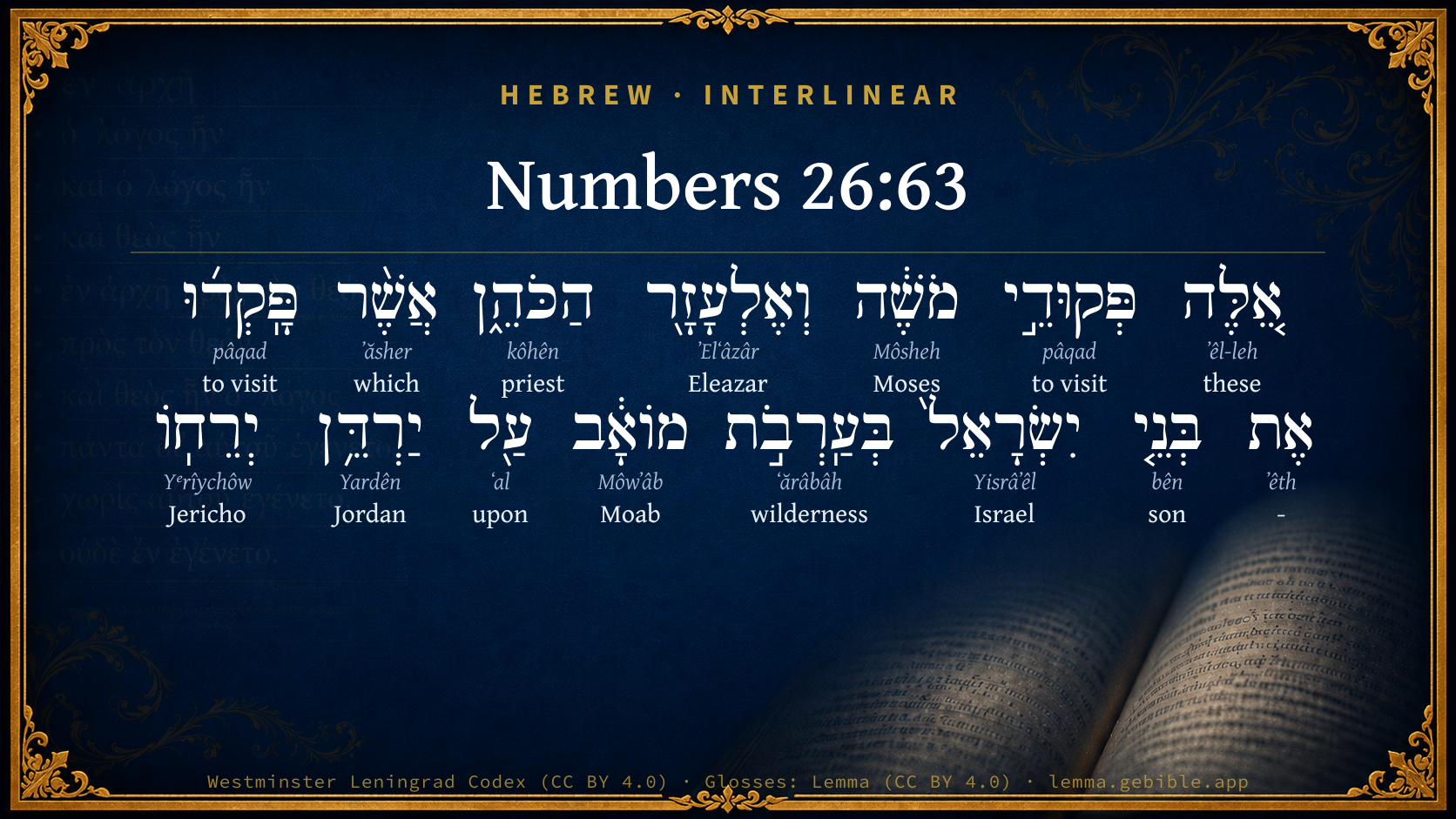
Hebrew (Westminster Leningrad Codex) Numbers 26:63 appears in the Hebrew Old Testament. The text above is from the Westminster Leningrad Codex. Each word links to its Strong’s number, a concise gloss, and parsing drawn from the Open Scriptures Hebrew Bible morphology. Click any word for its full Brown-Driver-Briggs (BDB) entry.
Download image
Cite this verse

Numbers 26:63 (World English Bible). Public Domain. Lemma interlinear Bible study tool, https://lemma.gebible.app/v/numbers/26/63.

Show BibTeX & RIS
BibTeX
RIS
English Translation
These are those who were numbered by Moses and Eleazar the priest, who numbered the children of Israel in the plains of Moab by the Jordan at Jericho.
World English Bible · Public Domain
Download a study sheet

One document with this verse’s original text, its word-by-word gloss line, the meaning frame, cross-references with their text, attributed commentary, and full source and license credits — printable, and it pastes into notes with its structure intact.

This verse Autodidact and up

Study sheet (.html) Plain text (.txt)

A passage Seminary Student

Up to 50 verses in one chapter. A passage sheet keeps up to 6 commentary sources and 12 cross-references per verse, in the order this page ranks them, and says so on the sheet whenever that leaves anything out. Ask for a single verse and you get the Autodidact verse sheet above.

Everything on this page stays free to read, with no account — the sheet is a download of what is already on screen, not access to it.

Want to remove ads? Support Godless Engineer
Compare translations 3

The same verse in 3 English versions, stacked beneath the original-language interlinear above. Click any original word for its lexicon entry.

Each is an independent rendering of the whole verse — the interlinear is not word-aligned to these translations.

Highlighted words mark where these versions differ — a whole-verse word diff, not a word-by-word alignment.

  • World English Bible Public Domain
    These are those who were numbered by Moses and Eleazar the priest, who numbered the children of Israel in the plains of Moab by the Jordan at Jericho.
  • King James Version Public Domain
    These are they that were numbered by Moses and Eleazar the priest, who numbered the children of Israel in the plains of Moab by Jordan near Jericho.
  • unfoldingWord Literal Text CC BY-SA 4.0
    These are the counted ones of Moses and Eleazar the priest when they counted the sons of Israel in the plains of Moab beside the Jordan at Jericho.

unfoldingWord Literal Text — © unfoldingWord, licensed CC BY-SA 4.0. Word-aligned USFM3 via Door43 (git.door43.org/unfoldingWord/en_ult).

Versions to compare (up to 4)

3 of 4 selected

Show all 18 translations

Every available English version of this verse, each an independent rendering of the whole verse.

  • World English Bible Public Domain
    These are those who were numbered by Moses and Eleazar the priest, who numbered the children of Israel in the plains of Moab by the Jordan at Jericho.
  • Berean Standard Bible Public Domain
    These were the ones numbered by Moses and Eleazar the priest when they counted the Israelites on the plains of Moab by the Jordan, across from Jericho.
  • Majority Standard Bible Public Domain
    These were the ones numbered by Moses and Eleazar the priest when they counted the Israelites on the plains of Moab by the Jordan, across from Jericho.
  • King James Version Public Domain
    These are they that were numbered by Moses and Eleazar the priest, who numbered the children of Israel in the plains of Moab by Jordan near Jericho.
  • American Standard Version (1901) Public Domain
    These are they that were numbered by Moses and Eleazar the priest, who numbered the children of Israel in the plains of Moab by the Jordan at Jericho.
  • Revised Version (1885) Public Domain
    These are they that were numbered by Moses and Eleazar the priest; who numbered the children of Israel in the plains of Moab by the Jordan at Jericho.
  • Geneva Bible (1599) Public Domain
    These are the nombers of Moses and Eleazar the Priest which nombred the children of Israel in the plaine of Moab, neere Iorden, towarde Iericho.
  • Douay-Rheims (1899) Public Domain
    This is the number of the children of Israel, that were enrolled by Moses and Eleazar the priest, in the plains of Moab upon the Jordan, over against Jericho.
  • Young's Literal Translation Public Domain
    These `are' those numbered by Moses and Eleazar the priest, who have numbered the sons of Israel in the plains of Moab, by Jordan, `near' Jericho;
  • Literal Standard Version CC BY-SA 4.0
    These [are] those numbered by Moses and Eleazar the priest, who have numbered the sons of Israel in the plains of Moab by the Jordan, [near] Jericho;
  • Unlocked Literal Bible CC BY-SA 4.0
    These are the ones who were counted by Moses and Eleazar the priest. They counted the people of Israel in the plains of Moab by the Jordan at Jericho.
  • unfoldingWord Literal Text CC BY-SA 4.0
    These are the counted ones of Moses and Eleazar the priest when they counted the sons of Israel in the plains of Moab beside the Jordan at Jericho.
  • Darby Bible Public Domain
    These are they that were numbered by Moses and Eleazar the priest, who numbered the children of Israel in the plains of Moab, by the Jordan of Jericho.
  • World Messianic Bible Public Domain
    These are those who were counted by Moses and Eleazar the priest, who counted the children of Israel in the plains of Moab by the Jordan at Jericho.
  • Webster's Bible Public Domain
    These are they that were numbered by Moses and Eleazar the priest, who numbered the children of Israel in the plains of Moab by Jordan near Jericho.
  • Free Bible Version CC BY-SA 4.0
    This is the record of those who were censused by Moses and Eleazar the priest when they counted the Israelites on the plains of Moab beside the Jordan opposite Jericho.
  • Bible in Basic English Public Domain
    All these were numbered by Moses and Eleazar the priest when the children of Israel were numbered in the lowlands of Moab by the Jordan at Jericho.
  • JPS Tanakh (1917) Public Domain
    These are they that were numbered by Moses and Eleazar the priest, who numbered the children of Israel in the plains of Moab by the Jordan at Jericho.

Literal Standard Version (2020), Covenant Press — licensed CC BY-SA 4.0. Text via the HelloAO Bible API (eBible.org). Unlocked Literal Bible (unfoldingWord) — licensed CC BY-SA 4.0. Text via the HelloAO Bible API (eBible.org). unfoldingWord Literal Text — © unfoldingWord, licensed CC BY-SA 4.0. Word-aligned USFM3 via Door43 (git.door43.org/unfoldingWord/en_ult). Free Bible Version, Dr. Jonathan Gallagher — licensed CC BY-SA 4.0. Text via the HelloAO Bible API (eBible.org).

Word by word

More ways to search: Search by grammar → Find every occurrence → Compare this word →

Practice this passage: Drill this verse → Learn its vocabulary →

יְרֵחֽוֹ
Yᵉrîychôw
H3405
“Jericho”
Noun, Proper
Part of Speech
Noun
Type
Proper
Full BDB Definition

Origin: perhaps from H3394

TWOT: 915

Jericho = "its moon" - a city 5 miles (8 kilometers) west of the Jordan and 7 miles (11.5 kilometers) north of the Dead Sea and the first city conquered by the Israelites upon entering the promised land of Canaan
  1. אֵ֚לֶּה ʼêl-leh H428 “these” Pronoun, Demonstrative, Common, Plural
  2. פְּקוּדֵ֣י pâqad H6485 “visited” Verb, Qal, Participle Passive, Masculine, Plural, Construct
  3. מֹשֶׁ֔ה Môsheh H4872 “Moses” Noun, Proper
  4. וְאֶלְעָזָ֖ר ʼElʻâzâr H499 “and · Eleazar” Conjunction + Noun, Proper
  5. הַכֹּהֵ֑ן kôhên H3548 “the · priest” Particle, Definite Article + Noun, Common, Masculine, Singular, Absolute
  6. אֲשֶׁ֨ר ʼăsher H834 “which” Particle, Relative
  7. פָּֽקְד֜וּ pâqad H6485 “to visit” Verb, Qal, Perfect, 3rd Person, Common, Plural
  8. אֶת ʼêth H853 “-” Particle, Direct Object
  9. בְּנֵ֤י bên H1121 “sons of” Noun, Common, Masculine, Plural, Construct
  10. יִשְׂרָאֵל֙ Yisrâʼêl H3478 “Israel” Noun, Proper
  11. בְּעַֽרְבֹ֣ת ʻărâbâh H6160 “in/at · wildernesses of” Preposition + Noun, Common, Feminine, Plural, Construct
  12. מוֹאָ֔ב Môwʼâb H4124 “Moab” Noun, Proper
  13. עַ֖ל ʻal H5921 “upon” Preposition
  14. יַרְדֵּ֥ן Yardên H3383 “Jordan” Noun, Proper

About this verse

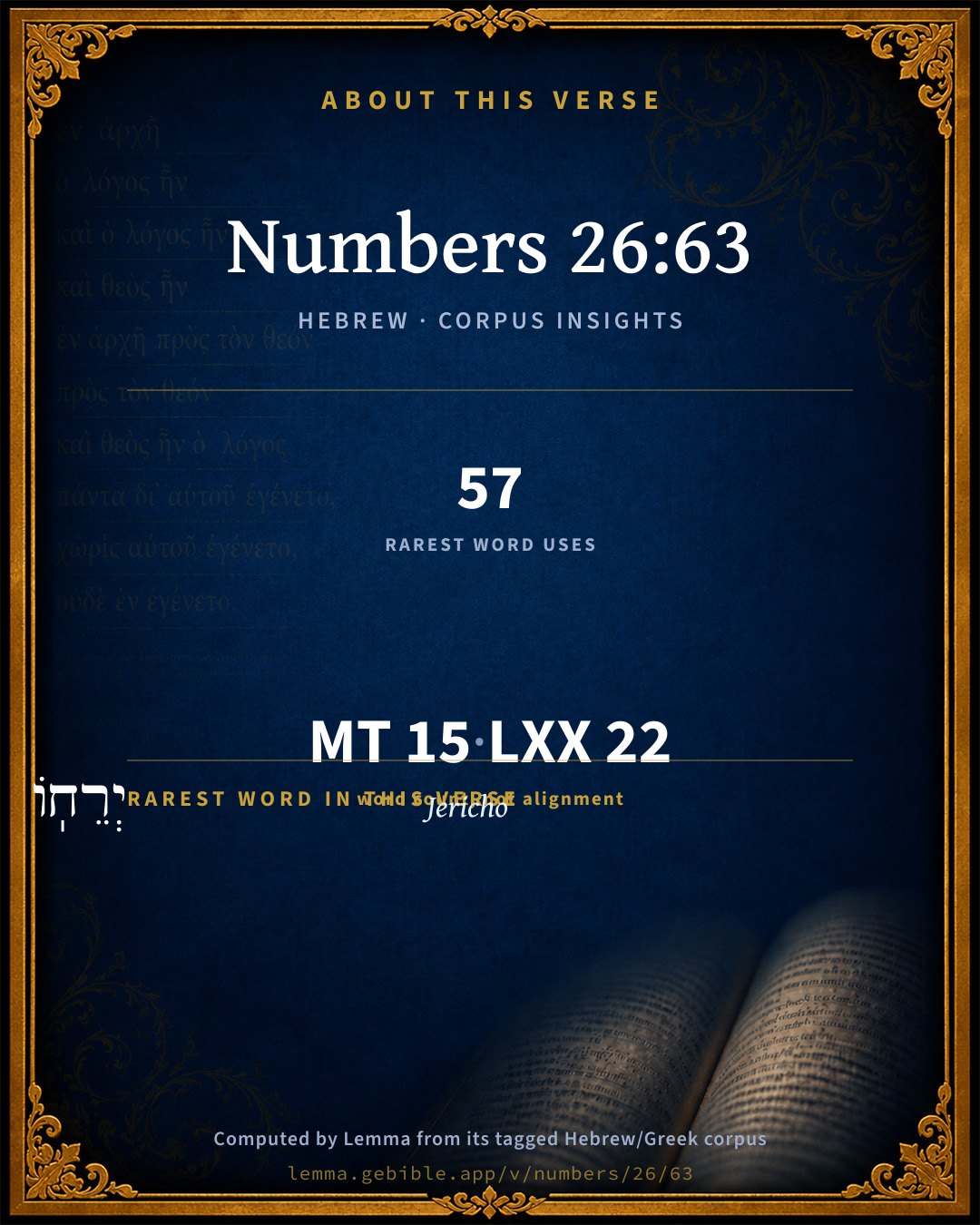
These counts appear in no published source. They are computed here, from the morphology-tagged text and Lemma’s own curated glosses. What Lemma adds →

15
words
14
distinct lemmas
Pentateuch
section

Shared distinctive vocabulary

יְרֵחֽוֹ Jericho H3405 occurs in 53 verses of the Hebrew Bible. Also found in:

Grammatical profile

  • 2 verbs
  • 9 nouns
  • 1 pronoun
  • 1 preposition
  • 2 particles

Verb forms

  • פְּקוּדֵ֣י Qal · Participle Passive
  • פָּֽקְד֜וּ Qal · Perfect

Repetition

A word recurs within this verse — often emphatic in Hebrew:

  • פְּקוּדֵ֣י to visit H6485 ×2

Hebrew & Septuagint length

In English translation the verse runs 28 words from the Hebrew and 25 from the Septuagint (LXX English) — closely comparable.

A rough comparison of the two English renderings, which tokenize alike — not a word-level alignment.

Word counts can differ between the Hebrew and the Greek without any difference in meaning — e.g. the Hebrew direct-object marker אֵת has no separate Greek word, and Greek often adds the article ὁ.

In the original languages it is 15 Hebrew tokens and 22 Greek tokens — but the two are counted differently (Hebrew bundles its prefixes and suffixes into one token; the Greek is in lemma form), so that isn’t a like-for-like length.

Cross-references

1

Topical passages linked to Numbers 26:63 in the Treasury of Scripture Knowledge — connected by theme and wording, ordered by reader-vote popularity; previews shown in the World English Bible.

  • Numbers 26:3 Moses and Eleazar the priest spoke with them in the plains of Moab by the Jordan at Jericho, saying,

Cross-references courtesy of OpenBible.info (CC BY 4.0).

Hebrew and Greek witnesses Masoretic Hebrew ↔ Greek Septuagint

The same verse in the two great witnesses to the Old Testament, shown verse-for-verse.

These are two independent witnesses, not word-aligned to each other, and the Septuagint is shown in lemma (dictionary) form.

Hebrew Numbers 26:63 Masoretic · Westminster Leningrad Codex

אֵ֚לֶּה פְּקוּדֵ֣י מֹשֶׁ֔ה וְאֶלְעָזָ֖ר הַכֹּהֵ֑ן אֲשֶׁ֨ר פָּֽקְד֜וּ אֶת בְּנֵ֤י יִשְׂרָאֵל֙ בְּעַֽרְבֹ֣ת מוֹאָ֔ב עַ֖ל יַרְדֵּ֥ן יְרֵחֽוֹ

These are those who were numbered by Moses and Eleazar the priest, who numbered the children of Israel in the plains of Moab by the Jordan at Jericho.

World English Bible · Public Domain

Greek LXX Numbers 26:63 Septuagint · lemma form

καί οὗτος ὁ ἐπίσκεψις μωυσῆς καί ελεαζαρ ὁ ἱερεύς ὅς ἐπισκέπτω ὁ υἱός ἰσραήλ ἐν ἀραβώθ μωαβ ἐπί ὁ ἰορδάνης κατά ιεριχω

And this is the numbering of Moses and Eleazar the priest, who numbered the children of Israel in Araboth of Moab, at Jordan by Jericho.

LXX2012 (modern English Septuagint) · Public Domain

Hebrew: Westminster Leningrad Codex (CC BY 4.0). Greek: Septuagint (public domain); English from LXX2012 (modern English Septuagint) (Public Domain). How the Septuagint differs from the Hebrew →

Targum (Aramaic paraphrase)

2

The Targum is the ancient Jewish Aramaic paraphrase of the Hebrew Scriptures — an interpretive translation, not the Hebrew text itself. Onkelos (literal) and Pseudo-Jonathan (expansive) render the Torah, and Jonathan the Prophets. Coverage is partial: where no permissively-licensed English translation exists for a verse, only the Aramaic is shown. This is verse-level text, not a word-by-word alignment to the Hebrew.

  1. Targum Onkelos Torah (Genesis–Deuteronomy)
    אִלֵין מִנְיָנֵי משֶׁה וְאֶלְעָזָר כַּהֲנָא דִי מְנוֹ יַת בְּנֵי יִשְׂרָאֵל בְּמֵישְׁרַיָא דְמוֹאָב עַל יַרְדְנָא דִירֵיחוֹ

    (no public-domain English translation for this verse)

    Targum Onkelos — Aramaic: “Onkelos Genesis” (public domain); “Onkelos Exodus” (public domain); “Onkelos Leviticus” (public domain); “Onkelos Numbers” (public domain); “Onkelos Deuteronomy” (public domain). English: “Sefaria Community Translation” (CC0 1.0 (public-domain dedication)); “J.W. Etheridge. The Targums of Onkelos and Jonathan Ben Uzziel on the Pentateuch. London: Longmans, Green, 1862” (public domain). Text via Sefaria.

  2. Targum Pseudo-Jonathan Torah (Genesis–Deuteronomy)
    אִלֵין סְכוּמֵי משֶׁה וְאֶלְעָזָר כַּהֲנָא דִי סְכָמוּן יַת בְּנֵי יִשְרָאֵל בְּמֵישְׁרַיָא דְמוֹאָב עַל יַרְדְנָא דִירֵיחוֹ

    These are the numbers when Mosheh and Elazar the priest numbered the sons of Israel in the plains of Moab, by Jordan, (over against) Jericho.

    Targum Pseudo-Jonathan — Aramaic: “Targum Jonathan on Genesis” (public domain); “Targum Jonathan on Exodus” (public domain); “Targum Jonathan on Leviticus” (public domain); “Targum Jonathan on Numbers” (public domain); “Targum Jonathan on Deuteronomy” (public domain). English: “The Targum of Jonathan ben Uzziel, trans. J. W. Etheridge, London, 1862” (public domain). Text via Sefaria.

Commentary

Notes on Numbers 26:63 from classic Christian and Jewish commentators (each source and its license shown beneath its notes). The classic Christian expositions comment on the surrounding passage and are grouped to its opening verse, so a note may address several verses; the Jewish commentaries on the Tanakh (Rashi and others) are per-verse, so they appear only where the commentator wrote on this verse.

Lemma curates 59 commentaries, every one of them public domain or Creative Commons licensed, each selected and text-cleaned for this edition rather than reprinted as found. About our sources →

The Biblical Illustrator

Joseph S. Exell

Num_26:63-65

There was not left a man of them, save Caleb the son of Jephunneh, and Joshua the son of Nun

The certainty of the fulfilment of Gods threatened judgments and promised mercies

I.

We are here furnished with a confirmation of the fact that God will fulfil his threatenings against sinners.

1. We may conceive them to have counted upon their numerical strength. This has often been appealed to as a security against the punishment of crime. Nor can it be denied that, according as iniquity abounds in a community, it is the more rarely visited with its merited penalty. It is found, in such circumstances, not to be convenient to institute inquiry; and vice, with the colouring which the spirit of the age may have given to it, assumes not unfrequently the name of virtue. But it is far otherwise with Him whose power, holiness, and justice are infinite.

2. It is not improbable that, as a ground of security against threatened judgment, the Israelites in the wilderness counted on their privileges. On this principle many a sinner reasons to his own destruction; forgetting that the higher his privileges, the greater the punishment they involve, if unimproved. The execution of the sentence of death upon the Israelites was the more solemn, because executed amidst the enjoyment of the means of grace. They died, the monuments of Divine wrath--while on every side they were surrounded with privileges. They died, in that camp, which was the camp of the living God. They died, within sight of the Lords tabernacle, and of the ark of the Lords covenant. They died, while the manna from heaven was falling around them, and the stream from the smitten rock flowing before their eyes. They died, while the glory of the Lord was in their view--while the pillar in which the Lord Himself dwelt was over their head--while, as a cloud to refresh them, it was over them by day; and as a fire to give them light, was over them by night. These their privileges did not preserve them; and neither will yours preserve you.

3. The Israelites in the wilderness may have been tempted to infer that the Lord would not execute His threatened vengeance against them, because all were not at one and the same time visited with punishment. To some of them a respite of nearly forty years was granted. But, when apparently within reach of the Land of Promise--when its hills and mountains were in view before their eyes--when they had only to march forward one other stage and to cross the Jordan, in order to obtain possession of it--the last of the doomed generation died, and their burial there made it manifest that Gods threatenings are sure.

II. But in our text we are furnished with an impressive illustration of the fact, that as God will fulfil His threatenings against sinners, so also His promises in favour of His own people.

1. This, in the case of Caleb and Joshua, was made manifest, notwithstanding the crowd of the ungodly with which they were mingled. But, the Lord knoweth them that are His. He loves them, as His chosen, with an everlasting love. They are sealed with the Holy Spirit of promise, which is the earnest of their inheritance, until the redemption of the purchased possession. Wherever thy lot may be cast, it is His sun that shines upon thy head; it is His stars that give thee light; it is His air that thou breathest; it is His food with which thou art supplied. Not a sparrow falleth to the ground without Him; and the hairs of thy head are all numbered.

2. in the case of Caleb and Joshua, we are furnished with a confirmation of the truth of Gods gracious promises to His people notwithstanding the dangers to which they are exposed.

3. In the instance referred to in our text we behold the fulfilment of Gods gracious promises to His people, in opposition to every sentiment of distrust arising from the length and intricacy of their path. (T. Doig, M. A.)

The faithfulness of God

I. The faithfulness of God to His threatenings. The judgment which God pronounced thirty-eight years previous He has now completely fulfilled (cf. Num_14:11-39)

.

1. The immense number of the condemned does not avail for the escape of any one of them. Sentence was passed upon upwards of six hundred thousand men; and there was not left a man of them. Though hand join in hand, &c (Pro_11:21).

2. The lapse of time before the complete execution of the sentence does not avail for the escape of any one. Thirty-eight years passed away before the judgment pronounced was fully carried out; but ultimately not one upon whom it was passed escaped.

II. The faithfulness of God to His purposes.

III. The faithfulness of God to His promises. He promised to spare Caleb and Joshua, and to bring them unto the promised land (Num_14:23-30); and He spared them, and in due season brought them into that land. (W. Jones.)

The census of Israel

Thirty-eight years had passed since the first numbering at Sinai, and the people had come to the borders of the promised land. The time had come for another census. The wisdom which commanded the counting of Israel at the beginning of the wilderness journey, also determined to count them at the end of it. This would show that God did not value them less than in former years; it would afford proof that His word of judgment had been fulfilled to them; and, moreover, it would marshal them for the grand enterprise of conquering the land of Canaan. The numbering on this occasion was not of the women and children or the infirm; for the order ran thus (Num_26:2). If the numbers of our Churches were taken in this fashion, would they not sadly shrink? We have many sick among us that need to be carried about, and nursed, and doctored. Half the strength of the Church goes in ambulance service towards the weak and wounded. Another diminution of power is occasioned by the vast numbers of undeveloped believers, to whom the apostle would have said (Heb_5:12). To revise the Church rolls so as to leave none but vigorous soldiers on the muster-roll would make us break our hearts over our statistics. May the Lord send us, for this evil, health and cure! When the second census was taken, it was found that the people were nearly of the same number as at the first. Had it not been for the punishment so justly inflicted upon them, they must have largely increased; but now they had somewhat diminished. It is of God to multiply a nation, or a Church. We may not expect any advance in our numbers if we grieve the Spirit of God, and if by our unbelief we drive Him to declare that we shall not prosper.

I. First, observe the notable change wrought among the people by death (Num_26:64). The entire mass of the nation had been changed.

1. Such changes strike us as most memorable. In the course of forty years, what changes take place in every community, in every Church, in every family! The march of the generations is not a procession passing before our eyes, while we sit, like spectators, at the window; but we are in the procession ourselves, and we, too, are passing down the streets of time, and shall disappear in our turn.

2. This change was universal throughout the whole camp. There was not left a man of them. Thus is it among ourselves: no offices can be permanently held by the same men: they are not suffered to continue by reason of death. No position, however lofty or lowly, can retain its old possessor. It is not only the cedars that fall, but the fir-trees feel the axe. There is no discharge in that war. That same scythe which cuts down the towering flower among the grass, also sweeps down whole regiments of green blades.

3. The change is inevitable. We must soon quit our tents for the last battle. When the conscript number shall be drawn we may escape this year, and next; but the lot will fall upon us in due time. There is no leaping from the net of mortality wherein, like a shoal of fish, we are all enclosed.

4. All this change was still under the Divine control. Stern though the work may be, Gods great and tender heart rules the ravages of death.

5. The change was beneficial. It was desirable that there should be a people trained in a better school, with a nobler spirit, fit to take possession of the promised land. The change was working rightly: the Divine purpose was being fulfilled. The incoming of new blood into the social frame is good in a thousand ways; it is well that we should make room for others who may serve our Master better.

6. These changes are most instructive. If we are now serving God, let us do so with intense earnestness, since only for a little while shall we have the opportunity to do so among men.

II. The perpetuity of the people of God. The nation is living, though a nation has died. It is the same chosen seed of Abraham with whom Jehovah is in covenant. God has a Church in the world, and He will have a Church in the world till time shall be no more. The gates of hell and the jaws of death shall not prevail against the Church, though each one of its members must depart out of this world in his turn.

1. Mark well, that the Church in the wilderness lives on. Everything has changed, and yet nothing has altered. Although the men who bear the ark of the covenant of the Lord wear other names, yet they fulfil the same office. The music of the sanctuary rises and falls, but the strain goes on. The hallelujah never ceases, nor is there a pause in the perpetual chorus, His mercy endureth for ever.

2. The gaps were filled up by appointed successors. As one warrior died another man stepped into his place, even as one wave dying on the shore is pursued by another. God buries His workmen, but His work lives.

3. At this second numbering the people stood ready for greater work than they had ever done before.

4. It was Israels joy that Gods love was not withdrawn from the nation.

III. The unchangeableness of the word of God.

IV. The abiding necessity of faith.

1. No man is, was, or ever shall be saved without faith.

2. No privilege can supply the lack of faith. (C. H. Spurgeon.)

.

The Biblical Illustrator, edited by Joseph S. Exell (c. 1880s–1900s) — public domain. Text from a community e-Sword module.

Whedon's Commentary on the Bible

Daniel D. Whedon

THE EXECUTION OF ISRAEL’S PENAL EXCLUSION FROM CANAAN NOTED, Num_26:63-65.

64, 65. There was not a man… whom Moses… numbered — That only two out of 603,550 should be alive at the end of only thirty-nine years is unnatural, and that these should be the very two expressly designated beforehand is plainly supernatural. Chap. xiv, notes. No nation was ever better prepared for aggression and conquest. All imbecility and senility had been sifted out; only vigour and enthusiasm was left in the nation, which had but two men above sixty years and an army of 601,730 soldiers between twenty and sixty.

Daniel D. Whedon (gen. ed.), Commentary on the Old and New Testaments (1874–1909) — public domain. Text from a community e-Sword module.

Tyndale Open Study Notes

Tyndale Open Resources

26:63-65 The registration figures represent an entirely new generation of Hebrews, for everyone who came out of Egypt died in the wilderness except Caleb and Joshua. Joshua inherited Moses’ position as the leader of Israel (27:12-23; see “Joshua” Profile), and Caleb later played an important role as well (see “Caleb” Profile). Numbers 26 documents Israel’s transition from a generation under God’s condemnation (ch 14) to a people with a future, as predicted by Balaam’s four prophecies (chs 23–24).

Tyndale Open Study Notes — © Tyndale Open Resources, licensed CC BY-SA 4.0. Text via the HelloAO Bible API.

Matthew Henry's Commentary

That which is observable in this conclusion of the account is the execution of the sentence passed upon the murmurers (Num 14:29), that not one of those who were numbered from twenty years old and upwards (and that the Levites were not, but either from a month old or from thirty years old to fifty) should enter Canaan, except Caleb and Joshua. In the muster now made particular directions, no doubt, were given to those of each tribe that were employed in taking the account, to compare these rolls with the former, and to observe whether there were any now left of those that were numbered at Mount Sinai, and it appeared that there was not one man numbered now that was numbered then except Caleb and Joshua, Num 26:64, Num 26:65. Herein appeared, 1. The righteousness of God, and his faithfulness to his threatenings, when once the decree has gone forth. He swore in his wrath, and what he had sworn he performed. Better all those carcasses, had they been ten times as many, should fall to the ground, than the word of God. Though the rising generation was mixed with the, and many of the guilty and condemned criminals long survived the sentence, even to the last year of the forty, yet they were cut off by some means or other before this muster was made. Those whom God has condemned cannot escape either by losing themselves in a crowd or by the delay of execution. 2. The goodness of God to this people, notwithstanding their provocations. Though that murmuring race was cut off, yet God raised up another generation, which was as numerous as they, that, though they perished, yet the name of Israel might not be cut off, lest the inheritance of the promise should be lost for want of heirs. And, though the number fell a little short what it was at Mount Sinai, yet those now numbered had this advantage, that they were all middle-aged men, between twenty and sixty, in the prime of their time for service; and during the thirty-eight years of their wandering and wasting in the wilderness they had an opportunity of acquainting themselves with the laws and ordinances of God, having no business, civil or military, to divert them from those sacred studies, and having Moses and Aaron to instruct them, and God's good Spirit, Neh 9:20. 3. The truth of God, in performing his promise made to Caleb and Joshua. They were to be preserved from falling in this common ruin, and they were so. The arrows of death, though they fly in the dark, do not fly at random, even when they fly thickest, but are directed to the mark intended, and no other. All that are written among the living shall have their lives given them for a prey, in the most dangerous times. Thousands may fall on their right hand, and ten thousands on their left, but they shall escape.

Matthew Henry's Commentary on the Whole Bible (1708–1710) — public domain (CC PDM 1.0). Text via the HelloAO Bible API.

The Cambridge Bible for Schools and Colleges

gen. ed. J. J. S. Perowne

63–65. An editorial conclusion to the census. Not a man was reckoned who had been alive at the first census, with the exception of Caleb and Joshua.

The Cambridge Bible for Schools and Colleges (gen. ed. J. J. S. Perowne; Cambridge University Press, 1878–1918) — public domain. Text from a community e-Sword module.

Keil & Delitzsch

C. F. Keil & F. Delitzsch

Concluding formula with the remark in Num 26:65, that the penal sentence which God had pronounced in Num 14:29 and Num 14:38 upon the generation which came out of Egypt, had been completely carried out.

Keil & Delitzsch — Biblical Commentary on the Old Testament (1861–1891) — public domain (CC PDM 1.0). Text via the HelloAO Bible API. (Old Testament only.)

unfoldingWord translationNotes

Door43 World Missions Community

who were counted by Moses and Eleazar the priest

This can be stated in active form. AT: "whom Moses and Eleazar the priest counted" (See: Active or Passive)

there was no man

"there were no men"

who had been counted by Moses and Aaron the priest

This can be stated in active form. AT: "whom Moses and Aaron the priest had counted" (See: Active or Passive)

when the descendants of Israel were counted

This can be stated in active form. AT: "when they counted the descendants of Israel" (See: Active or Passive)

translationWords

Moses

priest

Moab

Jordan River

Jericho

desert

Sinai

unfoldingWord translationNotes — © Distant Shores Media and the Door43 World Missions Community, licensed CC BY-SA 4.0. Source: git.door43.org/Door43/en_tn.

Ramban (Nachmanides)

Rabbi Moshe ben Nachman (Ramban / Nachmanides)

THESE ARE THEY THAT WERE NUMBERED BY MOSES AND ELEAZAR. [This phrase refers] to they that were numbered of the children of Israel [mentioned further on in this verse], but does not refer to they that were numbered of the Levites [Verse 57], because of them it could not be said [as is said in the following verse]: But among them there was not a man [of them that were numbered by Moses and Aaron the priest in the wilderness of Sinai], since that decree [that they must perish in the wilderness] did not apply to the tribe of Levi, as our Rabbis have said. And a proof [of this is] Eleazar, and also Phinehas [who were born in Egypt and yet are both mentioned here, and came into the Land].

Ramban (Nachmanides) on the Tanakh — English translation: “Commentary on the Torah by Ramban (Nachmanides). Translated and annotated by Charles B. Chavel. New York, Shilo Pub. House, 1971-1976” (CC BY 4.0). Text via Sefaria.

Lesson kit

Teaching starters — assembled from the data on this page, not authored interpretation. Every prompt links to the verse data it draws on. Edit before teaching.

Numbers, in the Pentateuch, opens this verse with 15 words (14 distinct Hebrew lemmas). Its most distinctive word is Yᵉrîychôw (“Jericho”). A historical commentator’s framing appears above. Read the whole chapter for the surrounding context.

Discussion questions

  1. What does “Jericho” (Yᵉrîychôw) contribute to the verse as a whole?
  2. How does Numbers 22:1, which shares the word «Jericho», read alongside this verse?
  3. What does the repetition of “to visit” (2× in this one verse) do in this verse?
  4. These translations render this verse differently; the difference is in the English rendering, not the original. What questions does that raise?
  5. «פְּקוּדֵ֣י» is a Qal Participle Passive verb. How does that grammatical form shape the action described?
  6. Compare how The Biblical Illustrator and Whedon's Commentary on the Bible read this verse. Where do they agree or differ?

Things to notice

Reading settings

Reading text

Shown beneath each verse's original-language words.

Old Testament
Old Testament edition

Read the OT as the Masoretic Hebrew (MT) or the Greek Septuagint (LXX).

English shown for the Greek Septuagint (in the Hebrew ↔ Greek comparison).

Comparing translations? Open the Compare panel on any verse page to stack up to four side by side.