
Isaiah 11:14

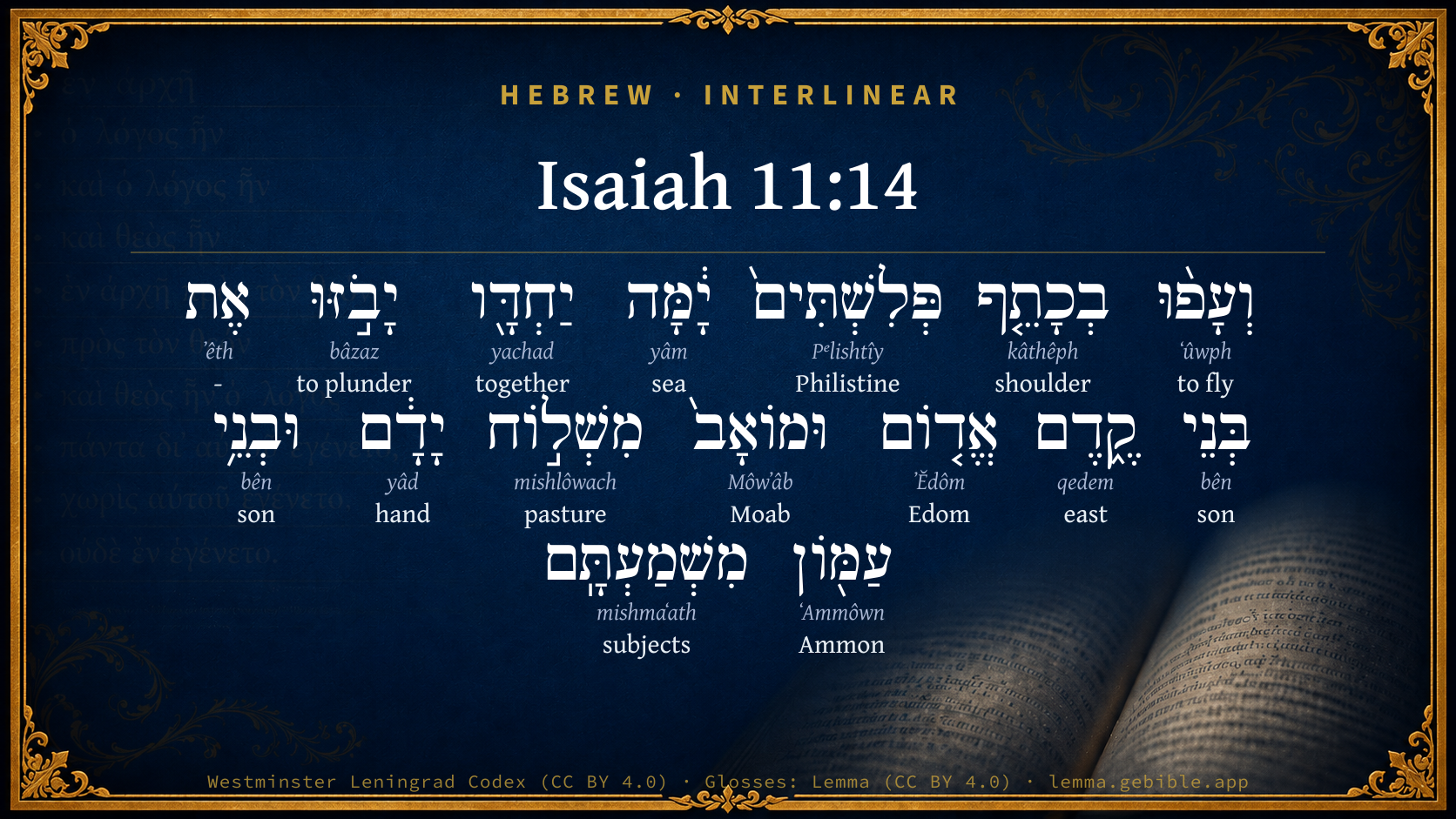
Hebrew (Westminster Leningrad Codex) Isaiah 11:14 appears in the Hebrew Old Testament. The text above is from the Westminster Leningrad Codex. Each word links to its Strong’s number, a concise gloss, and parsing drawn from the Open Scriptures Hebrew Bible morphology. Click any word for its full Brown-Driver-Briggs (BDB) entry.
Download image
Cite this verse

Isaiah 11:14 (World English Bible). Public Domain. Lemma interlinear Bible study tool, https://lemma.gebible.app/v/isaiah/11/14.

Show BibTeX & RIS
BibTeX
RIS
English Translation
They shall fly down on the shoulder of the Philistines on the west; together shall they despoil the children of the east: they shall put forth their hand on Edom and Moab; and the children of Ammon shall obey them.
World English Bible · Public Domain
Download a study sheet

One document with this verse’s original text, its word-by-word gloss line, the meaning frame, cross-references with their text, attributed commentary, and full source and license credits — printable, and it pastes into notes with its structure intact.

This verse Autodidact and up

Study sheet (.html) Plain text (.txt)

A passage Seminary Student

Up to 50 verses in one chapter. A passage sheet keeps up to 6 commentary sources and 12 cross-references per verse, in the order this page ranks them, and says so on the sheet whenever that leaves anything out. Ask for a single verse and you get the Autodidact verse sheet above.

Everything on this page stays free to read, with no account — the sheet is a download of what is already on screen, not access to it.

Want to remove ads? Support Godless Engineer
Compare translations 3

The same verse in 3 English versions, stacked beneath the original-language interlinear above. Click any original word for its lexicon entry.

Each is an independent rendering of the whole verse — the interlinear is not word-aligned to these translations.

Highlighted words mark where these versions differ — a whole-verse word diff, not a word-by-word alignment.

  • World English Bible Public Domain
    They shall fly down on the shoulder of the Philistines on the west; together shall they despoil the children of the east: they shall put forth their hand on Edom and Moab; and the children of Ammon shall obey them.
  • King James Version Public Domain
    But they shall fly upon the shoulders of the Philistines toward the west; they shall spoil them of the east together: they shall lay their hand upon Edom and Moab; and the children of Ammon shall obey them.
  • unfoldingWord Literal Text CC BY-SA 4.0
    And they will fly on the shoulder of the Philistines seaward; together they will plunder the sons of the east. Edom and Moab the sending forth of their hand, and the sons of Ammon their listener.

unfoldingWord Literal Text — © unfoldingWord, licensed CC BY-SA 4.0. Word-aligned USFM3 via Door43 (git.door43.org/unfoldingWord/en_ult).

Versions to compare (up to 4)

3 of 4 selected

Show all 18 translations

Every available English version of this verse, each an independent rendering of the whole verse.

  • World English Bible Public Domain
    They shall fly down on the shoulder of the Philistines on the west; together shall they despoil the children of the east: they shall put forth their hand on Edom and Moab; and the children of Ammon shall obey them.
  • Berean Standard Bible Public Domain
    They will swoop down on the slopes of the Philistines to the west; together they will plunder the sons of the east. They will lay their hands on Edom and Moab, and the Ammonites will be subject to them.
  • Majority Standard Bible Public Domain
    They will swoop down on the slopes of the Philistines to the west; together they will plunder the sons of the east. They will lay their hands on Edom and Moab, and the Ammonites will be subject to them.
  • King James Version Public Domain
    But they shall fly upon the shoulders of the Philistines toward the west; they shall spoil them of the east together: they shall lay their hand upon Edom and Moab; and the children of Ammon shall obey them.
  • American Standard Version (1901) Public Domain
    And they shall fly down upon the shoulder of the Philistines on the west; together shall they despoil the children of the east: they shall put forth their hand upon Edom and Moab; and the children of Ammon shall obey them.
  • Revised Version (1885) Public Domain
    And they shall fly down upon the shoulder of the Philistines on the west; together shall they spoil the children of the east: they shall put forth their hand upon Edom and Moab; and the children of Ammon shall obey them.
  • Geneva Bible (1599) Public Domain
    But they shall flee vpon the shoulders of the Philistims toward the West: they shall spoyle them of the East together: Edom and Moab shall be the stretching out of their hands, and the children of Ammon in their obedience.
  • Douay-Rheims (1899) Public Domain
    But they shall fly upon the shoulders of the Philistines by the sea, they together shall spoil the children of the east: Edom, and Moab shall be under the rule of their hand, and the children of Ammon shall be obedient.
  • Young's Literal Translation Public Domain
    And they have flown on the shoulder of the Philistines westward, Together they spoil the sons of the east, Edom and Moab sending forth their hand, And sons of Ammon obeying them.
  • Literal Standard Version CC BY-SA 4.0
    And they have flown on the shoulder of the Philistines westward, || Together they spoil the sons of the east, || Edom and Moab sending forth their hand, || And sons of Ammon obeying them.
  • Unlocked Literal Bible CC BY-SA 4.0
    Instead they will swoop down on the Philistine hills on the west, and together they will plunder the people of the east. They will attack Edom and Moab, and the people of Ammon will obey them.
  • unfoldingWord Literal Text CC BY-SA 4.0
    And they will fly on the shoulder of the Philistines seaward; together they will plunder the sons of the east. Edom and Moab the sending forth of their hand, and the sons of Ammon their listener.
  • Darby Bible Public Domain
    but they shall fly upon the shoulder of the Philistines towards the west; together shall they spoil the sons of the east; they shall lay their hand upon Edom and Moab, and the children of Ammon shall obey them.
  • World Messianic Bible Public Domain
    They will fly down on the shoulders of the Philistines on the west. Together they will plunder the children of the east. They will extend their power over Edom and Moab, and the children of Ammon will obey them.
  • Webster's Bible Public Domain
    But they shall fly upon the shoulders of the Philistines towards the west; they shall spoil them of the east together: they shall lay their hand upon Edom and Moab; and the children of Ammon shall obey them.
  • Free Bible Version CC BY-SA 4.0
    Together they will fly downhill to attack the Philistines to the west; they will plunder the people of the east. They will defeat Edom and Moab, and the Ammonites will become their subjects.
  • Bible in Basic English Public Domain
    And they will be united in attacking the Philistines on the west, and together they will take the goods of the children of the east: their hand will be on Edom and Moab; and the children of Ammon will be under their rule.
  • JPS Tanakh (1917) Public Domain
    And they shall fly down upon the shoulder of the Philistines on the west; together shall they spoil the children of the east; they shall put forth their hand upon Edom and Moab; and the children of Ammon shall obey them.

Literal Standard Version (2020), Covenant Press — licensed CC BY-SA 4.0. Text via the HelloAO Bible API (eBible.org). Unlocked Literal Bible (unfoldingWord) — licensed CC BY-SA 4.0. Text via the HelloAO Bible API (eBible.org). unfoldingWord Literal Text — © unfoldingWord, licensed CC BY-SA 4.0. Word-aligned USFM3 via Door43 (git.door43.org/unfoldingWord/en_ult). Free Bible Version, Dr. Jonathan Gallagher — licensed CC BY-SA 4.0. Text via the HelloAO Bible API (eBible.org).

Word by word

More ways to search: Search by grammar → Find every occurrence → Compare this word →

Practice this passage: Drill this verse → Learn its vocabulary →

מִשְׁמַעְתָּֽם
mishmaʻath
H4928
“subjects · their”
Noun, Common, Feminine, Singular, Construct + Suffix, Personal, 3rd Person, Masculine, Plural
Part of Speech
Noun
Type
Common
Gender
Feminine
Number
Singular
State
Construct
Full BDB Definition

Origin: from H4926

TWOT: 2412g

subjects, body of subjects, bodyguard, listeners, obedient ones - bodyguard - subjects
  1. וְעָפ֨וּ ʻûwph H5774 “and · to fly” Conjunction + Verb, Qal, Sequential Perfect, 3rd Person, Common, Plural
  2. בְכָתֵ֤ף kâthêph H3802 “in/at · shoulder” Preposition + Noun, Common, Feminine, Singular, Absolute
  3. פְּלִשְׁתִּים֙ Pᵉlishtîy H6430 “Philistines” Noun, Gentilic, Masculine, Plural, Absolute
  4. יָ֔מָּה yâm H3220 “sea · toward” Noun, Common, Masculine, Singular, Absolute + Suffix, Demonstrative
  5. יַחְדָּ֖ו yachad H3162 “together” Adverb
  6. יָבֹ֣זּוּ bâzaz H962 “to plunder” Verb, Qal, Imperfect, 3rd Person, Masculine, Plural
  7. אֶת ʼêth H853 “-” Particle, Direct Object
  8. בְּנֵי bên H1121 “sons of” Noun, Common, Masculine, Plural, Construct
  9. קֶ֑דֶם qedem H6924 “east” Noun, Common, Masculine, Singular, Absolute
  10. אֱד֤וֹם ʼĔdôm H123 “Edom” Noun, Proper
  11. וּמוֹאָב֙ Môwʼâb H4124 “and · Moab” Conjunction + Noun, Proper
  12. מִשְׁל֣וֹח mishlôwach H4916 “pasture of” Noun, Common, Masculine, Singular, Construct
  13. יָדָ֔ם yâd H3027 “hand · their” Noun, Common, Both, Singular, Construct + Suffix, Personal, 3rd Person, Masculine, Plural
  14. וּבְנֵ֥י bên H1121 “and · sons of” Conjunction + Noun, Common, Masculine, Plural, Construct
  15. עַמּ֖וֹן ʻAmmôwn H5983 “Ammon” Noun, Proper

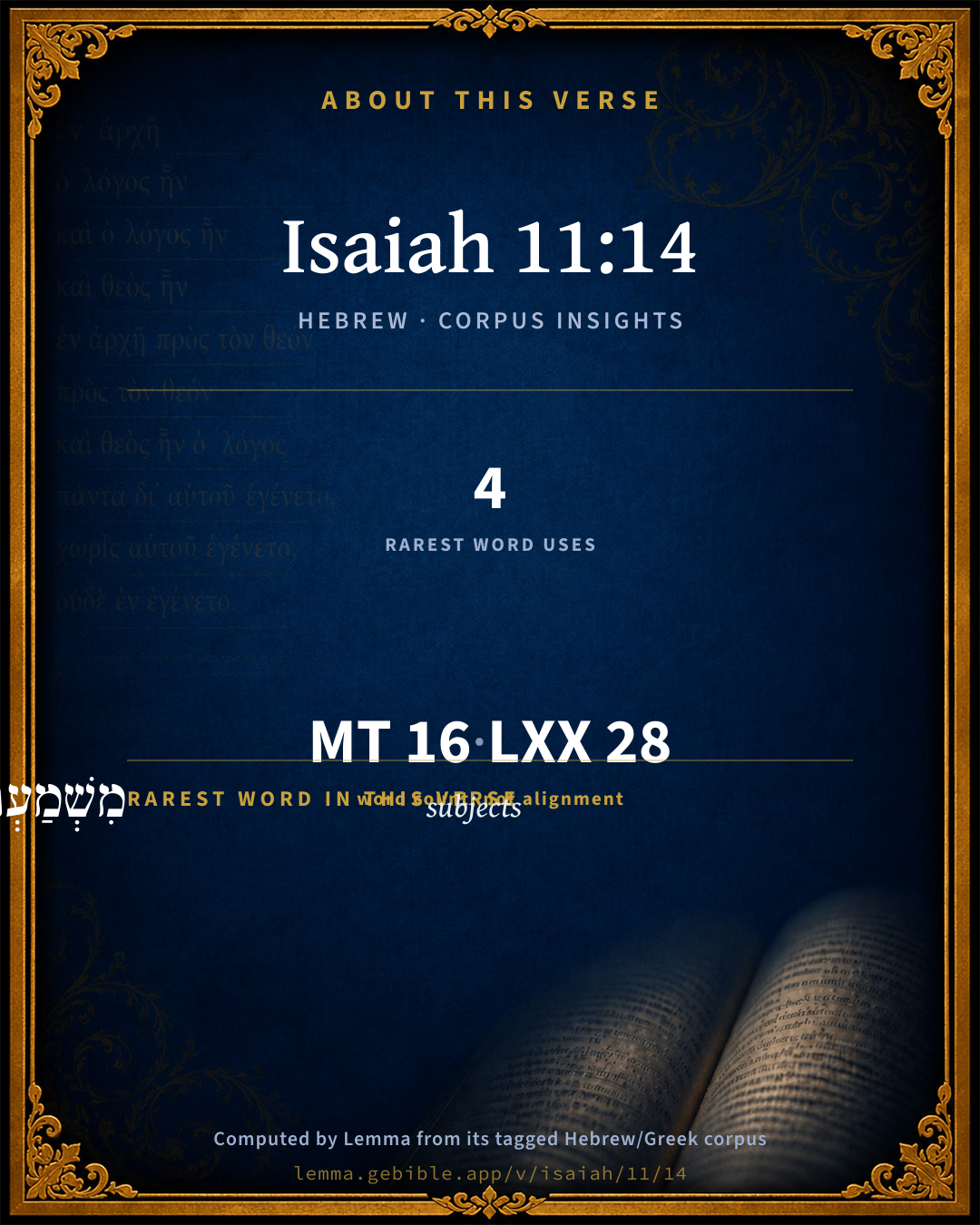
About this verse

These counts appear in no published source. They are computed here, from the morphology-tagged text and Lemma’s own curated glosses. What Lemma adds →

16
words
15
distinct lemmas
Prophets
section

Notable vocabulary

The rarest word here is מִשְׁמַעְתָּֽם subjects H4928 — appearing just 4 times in the whole Hebrew Bible.

Shared distinctive vocabulary

מִשְׁמַעְתָּֽם subjects H4928 occurs in 4 verses of the Hebrew Bible. Also found in:

Grammatical profile

  • 2 verbs
  • 12 nouns
  • 1 adverb
  • 1 particle

Verb forms

  • וְעָפ֨וּ Qal · Sequential Perfect
  • יָבֹ֣זּוּ Qal · Imperfect

Repetition

A word recurs within this verse — often emphatic in Hebrew:

  • בְּנֵי son H1121 ×2

Hebrew & Septuagint length

In English translation the verse runs 40 words from the Hebrew and 46 from the Septuagint (LXX English) — closely comparable.

A rough comparison of the two English renderings, which tokenize alike — not a word-level alignment.

Word counts can differ between the Hebrew and the Greek without any difference in meaning — e.g. the Hebrew direct-object marker אֵת has no separate Greek word, and Greek often adds the article ὁ.

In the original languages it is 16 Hebrew tokens and 28 Greek tokens — but the two are counted differently (Hebrew bundles its prefixes and suffixes into one token; the Greek is in lemma form), so that isn’t a like-for-like length.

Cross-references

17

Topical passages linked to Isaiah 11:14 in the Treasury of Scripture Knowledge — connected by theme and wording, ordered by reader-vote popularity; previews shown in the World English Bible.

  • Joel 3:19 Egypt will be a desolation, And Edom will be a desolate wilderness, For the violence done to the children of Judah, Because they have shed innocent blood in their land.
  • Isaiah 25:10 For in this mountain will the hand of Yahweh rest; and Moab shall be trodden down in his place, even as straw is trodden down in the water of the dung-hill.
  • Jeremiah 49:28 Of Kedar, and of the kingdoms of Hazor, which Nebuchadrezzar king of Babylon struck. Thus says Yahweh: Arise you, go up to Kedar, and destroy the children of the east.
  • Daniel 11:41 He shall enter also into the glorious land, and many [countries] shall be overthrown; but these shall be delivered out of his hand: Edom, and Moab, and the chief of the children of Ammon.
  • Amos 9:12 that they may possess the remnant of Edom, and all the nations who are called by my name," says Yahweh who does this.
  • Matthew 8:11 I tell you that many will come from the east and the west, and will sit down with Abraham, Isaac, and Jacob in the Kingdom of Heaven,
  • Numbers 24:17 I see him, but not now; I see him, but not near: There shall come forth a star out of Jacob, A scepter shall rise out of Israel, Shall strike through the corners of Moab, Break down all the sons of tumult.
  • Isaiah 16:14 But now Yahweh has spoken, saying, Within three years, as the years of a hireling, the glory of Moab shall be brought into contempt, with all his great multitude; and the remnant shall be very small and of no account.
  • Isaiah 33:1 Woe to you who destroy, and you weren't destroyed; and deal treacherously, and they didn't deal treacherously with you! When you have ceased to destroy, you shall be destroyed; and when you have made an end of dealing treacherously, they shall deal treacherously with you.
  • Isaiah 34:5–6 For my sword has drunk its fill in the sky: behold, it shall come down on Edom, and on the people of my curse, to judgment.
  • Isaiah 59:19 So shall they fear the name of Yahweh from the west, and his glory from the rising of the sun; for he will come as a rushing stream, which the breath of Yahweh drives.
  • Isaiah 60:14 The sons of those who afflicted you shall come bending to you; and all those who despised you shall bow themselves down at the soles of your feet; and they shall call you The city of Yahweh, The Zion of the Holy One of Israel.
  • Isaiah 66:19–20 I will set a sign among them, and I will send such as escape of them to the nations, to Tarshish, Pul, and Lud, who draw the bow, to Tubal and Javan, to the isles afar off, who have not heard my fame, neither have seen my glory; and they shall declare my glory among the nations.
  • Ezekiel 38:1–23 The word of Yahweh came to me, saying,
  • Obadiah 1:18–19 The house of Jacob will be a fire, the house of Joseph a flame, and the house of Esau for stubble. They will burn among them, and devour them. There will not be any remaining to the house of Esau." Indeed, Yahweh has spoken.
  • Zephaniah 2:5 Woe to the inhabitants of the sea coast, the nation of the Cherethites! The word of Yahweh is against you, Canaan, the land of the Philistines. I will destroy you, that there will be no inhabitant.
  • Zechariah 9:5–7 Ashkelon will see it, and fear; Gaza also, and will writhe in agony; As will Ekron, for her expectation will be disappointed; And the king will perish from Gaza, And Ashkelon will not be inhabited.

Cross-references courtesy of OpenBible.info (CC BY 4.0).

Hebrew and Greek witnesses Masoretic Hebrew ↔ Greek Septuagint

The same verse in the two great witnesses to the Old Testament, shown verse-for-verse.

These are two independent witnesses, not word-aligned to each other, and the Septuagint is shown in lemma (dictionary) form.

Hebrew Isaiah 11:14 Masoretic · Westminster Leningrad Codex

וְעָפ֨וּ בְכָתֵ֤ף פְּלִשְׁתִּים֙ יָ֔מָּה יַחְדָּ֖ו יָבֹ֣זּוּ אֶת בְּנֵי קֶ֑דֶם אֱד֤וֹם וּמוֹאָב֙ מִשְׁל֣וֹח יָדָ֔ם וּבְנֵ֥י עַמּ֖וֹן מִשְׁמַעְתָּֽם

They shall fly down on the shoulder of the Philistines on the west; together shall they despoil the children of the east: they shall put forth their hand on Edom and Moab; and the children of Ammon shall obey them.

World English Bible · Public Domain

Greek LXX Isaiah 11:14 Septuagint · lemma form

καί πέτομαι ἐν πλοῖον ἀλλόφυλος θάλασσα ἅμα προνομεύω καί ὁ ἀπό ἥλιος ἀνατολή καί ιδουμαία καί ἐπί μωαβ πρῶτον ὁ χείρ ἐπιβάλλω ὁ δέ υἱός αμμων πρῶτος ὑποἀκούω

And they shall fly in the ships of the Philistines: they shall at the same time spoil the sea, and them that come from the east, and Idumea: and they shall lay their hands on Moab first; but the children of Ammon shall first obey them.

LXX2012 (modern English Septuagint) · Public Domain

On this verse, Ellicott's Commentary for English Readers discusses the Septuagint’s reading. Read the note in Commentary ↓

Hebrew: Westminster Leningrad Codex (CC BY 4.0). Greek: Septuagint (public domain); English from LXX2012 (modern English Septuagint) (Public Domain). How the Septuagint differs from the Hebrew →

Targum (Aramaic paraphrase)

1

The Targum is the ancient Jewish Aramaic paraphrase of the Hebrew Scriptures — an interpretive translation, not the Hebrew text itself. Onkelos (literal) and Pseudo-Jonathan (expansive) render the Torah, and Jonathan the Prophets. Coverage is partial: where no permissively-licensed English translation exists for a verse, only the Aramaic is shown. This is verse-level text, not a word-by-word alignment to the Hebrew.

  1. Targum Jonathan Prophets (Joshua–Malachi)
    וְיִתְחַבְּרוּן כְּתָף חָד לְמִמְחֵי פְּלִשְׁתָּאֵי דִי בְּמַעֲרָבָא כַּחֲדָא יְבוֹזוּן יַת בְּנֵי מַדִינְחָא בֶּאֱדוֹם וּמוֹאָב יוֹשִׁיטוּן יְדֵיהוֹן וּבְנֵי עַמוֹן יִשְׁתְּמָעוּן לְהוֹן:

    They shall be united in one mind to smite the Philistines towards the west: they shall spoil the children of the east. Against Edom and Moab they shall stretch out their hands, and the children of Ammon shall obey them.

    Targum Jonathan — Aramaic: “Mikraot Gedolot” (public domain). English: “Sefaria Community Translation” (CC0 1.0 (public-domain dedication)); “London "Chaldee Paraphrase," 1871” (public domain). Text via Sefaria.

Commentary

Notes on Isaiah 11:14 from classic Christian and Jewish commentators (each source and its license shown beneath its notes). The classic Christian expositions comment on the surrounding passage and are grouped to its opening verse, so a note may address several verses; the Jewish commentaries on the Tanakh (Rashi and others) are per-verse, so they appear only where the commentator wrote on this verse.

Lemma curates 59 commentaries, every one of them public domain or Creative Commons licensed, each selected and text-cleaned for this edition rather than reprinted as found. About our sources →

Trapp's Complete Commentary

John Trapp

Isa 11:14 But they shall fly upon the shoulders of the Philistines toward the west; they shall spoil them of the east together: they shall lay their hand upon Edom and Moab; and the children of Ammon shall obey them.

Ver. 14. But they shall flee upon the shoulders.] A metaphor from conquerors who pursue their enemies, and fall upon the bones of them, as we say. The meaning is, the Gentiles shall be converted to the Christian faith by the Jews - viz., by the apostles and other preachers of the gospel. See Gen 49:8. Thus Philip was found at Azotus, or Ashdod; {Act 8:40} Peter at Joppa {Act 10:5} At Gaza and Askelon were many flourishing churches in the times of Athanasius and Chrysostom, saith Adrichomius. Brittannorum inaccessa Romanis loca, Christo patuerunt. {a} Inaccessible places of the Britains to the Romans were made open by Christ.

{a} Tertullian.

John Trapp, A Commentary or Exposition upon All the Books of the Old and New Testament (1647–1656) — public domain. Text from a community e-Sword module.

Tyndale Open Study Notes

Tyndale Open Resources

11:14 Philistia to the west: The Philistines were Israel’s historic enemy. • The nations to the east included the Edomites, Moabites, and Ammonites. All foes would be vanquished.

Tyndale Open Study Notes — © Tyndale Open Resources, licensed CC BY-SA 4.0. Text via the HelloAO Bible API.

Jamieson, Fausset & Brown

Robert Jamieson, A. R. Fausset & David Brown

With united forces they shall subdue their foes (Amo 9:12).

fly--as a bird of prey (Hab 1:8).

upon the shoulders--This expresses an attack made unexpectedly on one from behind. The image is the more apt, as the Hebrew for "shoulders" in Num 34:11 is used also of a maritime coast ("side of the sea": Hebrew, "shoulder of the sea," Margin). They shall make a sudden victorious descent upon their borders southwest of Judea.

them of the east--Hebrew, "children of the East," the Arabs, who, always hostile, are not to be reduced under regular government, but are only to be despoiled (Jer 49:28-29).

lay . . . hand upon--take possession of (Dan 11:42).

Edom--south of Judah, from the Dead Sea to the Red Sea; "Moab"--east of Jordan and the Dead Sea.

Ammon--east of Judea, north of Moab, between the Arnon and Jabbok.

Jamieson, Fausset & Brown — Commentary Critical and Explanatory on the Whole Bible (1871) — public domain (CC PDM 1.0). Text via the HelloAO Bible API.

Ellicott's Commentary for English Readers

(14) They shall fly upon the shoulders of the Philistines . . .—The English version is ambiguous, and half suggests the thought that the Philistines should bear the returning Israelites as on their shoulders; so the LXX. gives, “And they shall speed their wings in the ships of the aliens.” What is meant, however, is that the returning exiles shall swoop down, as a bird of prey after its flight, “upon the shoulder of the Philistines,” that name being applied (as in Eze_25:9; Jos_15:10) to the shape of the seaward- sloping country occupied by that people. From this victorious onset in the West, they are to pass on to “the children of the East,” the generic name for the nomadic tribes that are found associated with the Midianites and Amalekites (Jdg_6:3; Jdg_6:33; Jdg_7:12), and in Isa_2:6, with the Philistines themselves, and then to complete their triumph by avenging themselves on their old enemies of Edom, and Moab, and Ammon. The whole verse is singularly characteristic of what has been already spoken of as the limitation of prophetic knowledge. The seer has had revealed to him the glory of the Messianic kingdom as a restored Eden, full of the knowledge of Jehovah, the Gentiles seeking light and salvation from it. Suddenly he blends this with anticipations that belong to the feelings and complications of his own time. He sees Philistines, Moabites, Ammonites, in that far future. They will be then, as they were in his own times, the persistent foes of Israel (comp. Zep_2:7-9), but will be, at last, subdued.

A Bible Commentary for English Readers, edited by Charles John Ellicott (1878–1897) — public domain. Text from a community e-Sword module.

The Cambridge Bible for Schools and Colleges

gen. ed. J. J. S. Perowne

14. they shall fly] or swoop, as a bird of prey (Hab_1:8). The country of the Philistines is compared to a shoulder falling down towards the sea (cf. Num_34:11; Jos_15:11; Jos_18:12).

them of the east] lit. the children of the East (as R.V.), a name for the Arabs of the Eastern desert.

they shall lay … obey them] The Hebrew construction is peculiar. Lit. “Edom and Moab shall be the forth-putting of their hand, and the children of Ammon their obedience.”

The Cambridge Bible for Schools and Colleges (gen. ed. J. J. S. Perowne; Cambridge University Press, 1878–1918) — public domain. Text from a community e-Sword module.

John Gill's Exposition

But they shall flee upon the shoulders of the Philistines towards the west,.... That is, Ephraim and Judah, who shall not only agree among themselves, but cheerfully join together against the common enemy: "they shall flee with the shoulder", as some render the words; with joint consent, as the phrase is used in Hos 6:9, Zep 3:9 and so the Targum,

"and they shall be joined together in one shoulder, to smite the Philistines;''

the Septuagint version is, "they shall flee in the ships of strangers"; and so Abarbinel interprets it of the ships of the Philistines, Genoese, and Venetians, that shall bring the Israelites from the west to the east, and carry them in ships by sea. The Philistines were the sworn enemies of the Israelites, and lay to the west of the land of Israel, and when the Gospel was sent into all the world, it began to be preached in the parts of Palestine, whereby many were converted, and embraced it, as foretold they should, Psa 87:4 and flying upon their shoulders, as it denotes the conquest of them, and their subjection to the Gospel, so the swiftness of the apostles in carrying it to them, when they had a commission to do it, who were all of them Jews, of one tribe or another; and these may also design the enemies of the people of God now, the antichristian states, some of which will fall off from Popery, receive the Gospel, hate the whore, eat her flesh, and burn her with fire; which will be brought about by the preaching of the Gospel by its ministers, who will fly in the midst of heaven, and upon the shoulders of the Romish antichrist, and proclaim the fall of Babylon, and call upon, the Lord's people to come out of it, Rev 14:6,

they shall spoil them of the east together; the Syrians and Arabians, who lay east of Judea; perhaps the Turks are meant, and the destruction of the Ottoman empire, whereby way will be made for the kings and kingdoms of the east to know, receive, and profess the Gospel of Christ, Rev 16:12.

they shall lay their hand upon Edom and Moab; or "there shall be a sending out of their hand"; that is, they shall stretch out their hand, and lay hold on these people, and bring them into subjection to them; which is to be understood of the sending out of the Gospel, by the hands of the ministers of it, into those countries where the Moabites and Edomites formerly dwelt; and thereby bringing them into subjection to Christ and his churches:

and the children of Ammon shall obey them; that have the rule in the house of God, submitting to the laws and ordinances of Christ.

John Gill's Exposition of the Whole Bible (1746–1763) — public domain (CC PDM 1.0). Text via the HelloAO Bible API.

Albert Barnes' Notes on the Bible

But they shall fly - The design of this verse is, to show the rapid and certain spiritual conquests which would result from the conversion of the scattered Jewish people. The Jews understood this literally, as referring to the conquests over their enemies. But if the exposition which has been given of this chapter thus far is correct, the passage is to be interpreted as a figurative description of the triumph of the people of God under the Messiah. The “time” to which it refers, is that which shall succeed the conversion of the scattered Jews. The “effect” of the gospel is represented under an image which, to Jews, would be most striking - that of conquest over the neighboring nations with whom they had been continually at war. Philistia, Edom, Moab, and Ammon, had been always the enemies of Judea; and to the Jews, no figurative representation could be more striking than that, “after” the union of Judah and Ephraim, they should proceed in rapid and certain conquest to subdue their ancient and formidable enemies. The meaning of the phrase ‘they shall fly,’ is, they shall hasten with a rapid motion, like a bird. They shall do it quickly, without delay, as an eagle hastens to its prey. It indicates their “suddenly” engaging in this, and the celerity and certainty of their movements. As the united powers of Judah and Ephraim would naturally make a sudden descent on Philistia, so the Jews, united under the Messiah, would go to the rapid and certain conversion of those who had been the enemies of the cross.

Upon the shoulders - בכתף bekâthêph. There has been a great variety in the interpretation of this passage; and it is evident that our translation does not express a very clear idea. The Septuagint renders it, ‘And they shall fly in the ships of foreigners, and they shall plunder the sea.’ The Chaldee, ‘And they shall be joined with one shoulder, that is, they shall be “united” shoulder to shoulder, that they may smite the Philistines who are in the west.’ The Syriac, ‘But they shall “plow” the Philistines;’ that is, they shall subdue them, and cultivate their land. The word rendered, ‘shoulder,’ means, properly, “the shoulder,” as of a man or beast Isa 46:7; Isa 49:22; Num 7:9; Job 31:22; Eze 24:4; the undersetters or shoulders to support the lavers 1Ki 7:30; a corner or side of a building Exo 38:14; and is applied to “the side” of anything, as the side of a building, the border of a country, a city, or sea (1Ki 6:8; 1Ki 7:39; Num 34:11; Jos 15:8, Jos 15:10-11, ...) Here it seems to mean, not that the Jews would be borne “upon” the shoulder of the Philistines, but that they would make a sudden and rapid descent “upon their borders:” they would invade their territory, and carry their conquest ‘toward the west.’ The construction is, therefore, ‘they shall make a rapid descent on the borders of the Philistines,’ or, in other words, the spiritual conquest over the enemies of the church of God shall be certain and rapid.

The Philistines - Philistia was situated on the southwestern side of the land of Canaan. The Philistines were therefore adjacent to the Jews, and were often involved in war with them. They were among the most constant and formidable enemies which the Jews had.

Toward the west - This does not mean that they should be borne on the shoulders of the Philistines to the west; but that they should make a sudden and rapid descent on the Philistines, who “were” west of them. It stands opposed to the nations immediately mentioned as lying “east” of the land of Judea.

They shall spoil - They shall plunder; or, they shall take them, and their towns and property, as the spoil of war. That is, they shall vanquish them, and make them subject to them. According to the interpretation which has been pursued in this chapter, it means, that the enemies of God shall be subdued, and brought to the knowledge of the truth, in a rapid and decisive manner. The language is that which is drawn from the idea of conquest; the idea is that of a rapid and far-spreading conversion among the nations, to the gospel.

Them of the east - Hebrew, ‘The sons of the east; that is, the nations east of Judea.

They shall lay their hand - Hebrew, ‘Edom and Moab shall be the laying on of their hand;’ that is, they shall lay their hand on those nations for conquest and spoil; they shall subdue them.

Edom - Idumea; the country settled by the descendants of Esau - a country that was south of Judea, and extended from the Dead Sea to the Elanitic gulf of the Red Sea. They were an independent people until the time of David, and were reduced to subjection by him, but they afterward revolted and became again independent. They were often engaged in wars with the Jews, and their conquest was an object that was deemed by the Jews to be very desirable (see the notes at Isa. 34.)

And Moab - The country of the Moabites was east of the river Jordan, on both sides of the river Arnon, and adjoining the Dead Sea. Their capital was on the river Arnon. They also were often involved in wars with the Jews (compare Deu 23:3; see the notes at Isa 15:1-9; Isa 16:1-14.)

And the children of Ammon - The Ammonites, the descendants of Ammon, a son of Lot. Their country lay southeast of Judea Deu 2:19-21. Their territory extended from the river Arnon north to the river Jabbok, and from the Jordan far into Arabia. It was directly north of Moab, They were often engaged, in alliance with the Moabites, in waging war against the Jews.

Shall obey them - Hebrew, ‘Shall be their obedience.’ All these descriptions are similar. They are not to be interpreted literally, but are designed to denote the rapid triumphs of the truth of God after the conversion of the Jews; and the sense is, that the conquests of the gospel will be as sudden, as great, and as striking over its enemies, as would have been the complete subjugation of Philistia, Moab, Ammon, and Edom, to the victorious army of the Jews.

Albert Barnes' Notes on the Bible (1834–1885) — public domain. Text from a community e-Sword/MySword module.

Haydock's Catholic Bible Commentary

Shoulders. Or confines, Ezechiel xxv. 9. Ezechias and the Machabees attacked the Philistines. (Calmet) --- Septuagint, "and they shall fly on the ships of the strangers; they shall plunder the sea together, and those on the east, and Idumea." (Haydock) --- East. Ammonites, &c., often defeated by the Machabees, and probably by Ezechias.

George Leo Haydock (1774–1849), Haydock's Catholic Family Bible and Commentary, 1859 edition — public domain. Excludes Psalms (Douay-Rheims chapter numbering differs from Protestant) and Deuterocanonical books (Catholic canon only).

Matthew Poole's English Annotations

Shall fly upon the shoulders; either it is a metaphor from birds and beasts of prey, which commonly fasten upon the shoulders of cattle; or from wrestlers, who endeavour to catch hold of their adversaries’ shoulders, that they may throw them down. Or, shoulder is put for a side, as Num 34:11; Jos 15:8,10, or for part or quarter of a country, as Deu 33:12.

They shall spoil them; they shall subdue them; which is to be understood of the spiritual victory which the Jewish Messiah shall obtain by his apostles and ministers over all nations, in bringing them to the obedience of his gospel. For it is the manner of the prophets to speak of the spiritual things of the gospel under such corporal representations.

Matthew Poole's English Annotations on the Holy Bible (1683–1685) — public domain. Text from a community e-Sword/MySword module.

Whedon's Commentary on the Bible

Daniel D. Whedon

14. But, fourthly, how about Israel and unbrotherly tribes and nomads around?

But they — Undivided Ephraim and Judah, now one under Messiah.

Shall fly — From the land of exile, or even from Central Zion, whither in spiritual union they have in figure betaken themselves.

Upon the shoulders of the Philistines toward the west — “Shoulders” — either hills fronting the Philistine plain, or frontier regions from Zion as the starting-point for activity seaward.

Spoil them of the east — Symbolical words taken from David’s conquests over Ishmaelites, Midianites, etc.; and the same symbols apply as over Edom, Moab, and Ammon. Spiritual conquests alone are intended. 2Sa_8:11. The prophet figures here the supremacy of the future spiritually united Israel and Judah over all its old enemies. As to geographical notes, Edom lay south of Judah, between the Dead and the Red seas; Moab, east of the Dead Sea and lower Jordan; Ammon, east of Judea, between the Jabbok and the Arnon, and Philistia in the southwest, on the Mediterranean.

Daniel D. Whedon (gen. ed.), Commentary on the Old and New Testaments (1874–1909) — public domain. Text from a community e-Sword module.

The Pulpit Commentary

Vers. 14-16. THE UNITED CHURCH SHALL TRIUMPH OVER ITS ENEMIES. PHYSICAL OBSTACLES TO ITS UNION GOD WILL REMOVE. Israel"s most persistent enemies had been the border-nations of the Philistines, the Edomites, the Arabs, Moab and Ammon. These are now taken as types of the enemies of the Church, and victory over them is promised (ver. 14). A further promise is made that physical difficulties shall not prevent the return of the Jewish exiles from distant countries (vers. 15, 16).

They shall fly upon the shoulders of the philistines. It is not to be supposed that actual war is intended. The subjects of the Prince of Peace will not draw the sword. But the Church will for many centuries be confronted by enemies, and must contend with them with legitimate weapons. It is this warfare of which Isaiah now speaks. The united Church will be strong enough to assail her enemies on all sides, and will "swoop" upon the border country of the Philistines like a bird of prey. They shall spoil them of the east; or, the Bent Kedem. The phrase is commonly used in an ethnic sense of the nomadic Arabs inhabiting the deserts east of Jordan, beyond the Ammonite and Moabite country, from whose raids Palestine frequently suffered. (see Jer_49:28, 29 Eze_25:4, Eze_25:10)

The Church"s triumph over its enemies.

The Church of God will always have its enemies, both internal and external, and its external enemies will from time to time gather their hosts, and unite themselves together, and threaten it with destruction. Great was Israel"s peril, and great her fear, when her enemies "consulted together with one consent, and were confederate against her: the tabernacles of Edom, and the Ishmaelites; of Moab, and the Hagarenes; Gebal, and Ammon, and Amalek; the Philistines with the inhabitants of Tyre; Asshur also joining them, and helping the children of Lot". (Psa_83:5-8) Yet the danger passed, the confederacy failed, the various nations were "confounded and troubled; they were put to shame and perished". (Psa_83:17) So it is with the Church. Our Lord has promised that "the gates of hell shall not prevail against it"; (Mat_16:18) and consequently its enemies labor in vain to effect its destruction. The Church may have confidence

I SINCE CHRIST IS HER HEAD. She is "his Church," "built by him," "upon a Rock," i.e. himself; purchased by him with his own blood; loved and cherished and purified by him, that she may be presented to him "without spot, or wrinkle, or any such thing his city, his body, his bride.

II SINCE SHE HAS A SURE WORD OF PROMISE.

1. In the statement, "Lo, I am with you always, even unto the end of the world". (Mat_28:20)

2. In the passage concerning the gates of hell.

3. In the clear declarations of the apocalyptic vision, which show her ultimate triumph.

III SINCE SHE HAS PASSED THROUGH PERILS AS GREAT AS ANY THAT CAN HEREAFTER ASSAIL HER.

1. The peril of the imperial persecutions (Nero, Diocletian, Galerius, Julian).

2. The peril of the barbarian invasions (Goths, Huns, Vandals, etc.).

3. The peril of Mohammedanism.

4. The peril of the dark ages.

5. The peril involved in unlimited private judgment.

6. The peril of the French Revolution. Half a score of times has she seemed on the point of succumbing; bat each time that she is struck to the ground, she rises, like Antares, refreshed and reinvigorated.

The Pulpit Commentary (1880–1919), ed. H.D.M. Spence-Jones & Joseph S. Exell — public domain. Text from a community e-Sword module.

John Wesley's Explanatory Notes

Fly - It is a metaphor from birds and beasts of prey. Spoil - They shall subdue them, which is to be understood of the spiritual victory which the Messiah shall obtain by his apostles and ministers over all nations.

John Wesley, Explanatory Notes Upon the Whole Bible (1754–1765) — public domain. Text via the GEBible commentary corpus.

Keil & Delitzsch

C. F. Keil & F. Delitzsch

A fourth question has reference to the relation between this Israel of the future and the surrounding nations, such as the warlike Philistines, the predatory nomad tribes of the East, the unbrotherly Edomites, the boasting Moabites, and the cruel Ammonites. Will they not disturb and weaken the new Israel, as they did the old? "And they fly upon the shoulder of the Philistines seawards; unitedly they plunder the sons of the East: they seize upon Edom and Moab, and the sons of Ammon are subject to them." Câthēph (shoulder) was the peculiar name of the coast-land of Philistia which sloped off towards the sea (Jos 15:11); but here it is used with an implied allusion to this, to signify the shoulder of the Philistian nation (becâthēph = becĕthĕph; for the cause see at Isa 5:2), upon which Israel plunges down like an eagle from the height of its mountain-land. The "object of the stretching out of their hand" is equivalent to the object of their grasp. And whenever any one of the surrounding nations mentioned should attack Israel, the whole people would make common cause, and act together. How does this warlike prospect square, however, with the previous promise of paradisaical peace, and the end of all warfare which this promise presupposes (cf., Isa 2:4)? This is a contradiction, the solution of which is to be found in the fact that we have only figures here, and figures drawn from the existing relations and warlike engagements of the nation, in which the prophet pictures that supremacy of the future united Israel over surrounding nations, which is to be maintained by spiritual weapons.

Keil & Delitzsch — Biblical Commentary on the Old Testament (1861–1891) — public domain (CC PDM 1.0). Text via the HelloAO Bible API. (Old Testament only.)

J. A. Alexander on Isaiah

Joseph Addison Alexander

Instead of assailing or annoying one another, they are represented as making common cause against a common enemy. “And they (Ephraim and Judah, undivided Israel) shall fly (like a bird of prey) upon the shoulder of the Philistines towards the sea (or westward); together they shall spoil the sons of the east (the Arabians and perhaps the Syrians); Edom and Joab the stretching out of their hand (i.e., the object of that action) and the children of Ammon their obedience (i.e., their subjects).” All the names are those of neighboring nations with whom the Hebrews were accustomed to wage war. Edom, Moab, and Ammon, may be specially named for an additional reason, viz. that they were nearly related to Israel, and yet among his most inveterate enemies. The Jews explain this as a literal prediction having respect to the countries formerly possessed by the races here enumerated. Most Christian writers understand it spiritually of the conquests to be achieved by the true religion, and suppose the nations here named to be simply put for enemies in general, or for the heathen world; this method of description being rendered more emphatic by the historical associations which the names awaken. ‘To fly upon’ means here to fly at, or to pounce upon, the figure being that of an eagle or other bird of prey.

Joseph Addison Alexander, The Prophecies of Isaiah (1846–1847; New York: Scribner, 1870–1878) — public domain. Text from a community e-Sword module.

unfoldingWord translationNotes

Door43 World Missions Community

they will swoop down on the Philistine hills

The people of Israel and Judah are pictured as if they were birds that fly down quickly to attack a person or animal. AT: "they will go quickly to the Philistine hills to attack the people there" (See: Metaphor)

the gulf of the Sea of Egypt

A "gulf" is a large area of water that land partly surrounds.

With his scorching wind he will wave his hand over the Euphrates River

Waving his hand over something represents his power to change it. AT: "By his power he will cause a scorching wind to blow on the Euphrates River" (See: Metaphor)

his scorching wind

This is a strong or hot wind that causes some of the water in rivers to dry up.

so it can be crossed over in sandals

"so that people can cross over it even while wearing their sandals"

translationWords

Philistines

Edom

Moab

Ammon

obey

Yahweh

Egypt

hand

Euphrates River

sandal

unfoldingWord translationNotes — © Distant Shores Media and the Door43 World Missions Community, licensed CC BY-SA 4.0. Source: git.door43.org/Door43/en_tn.

Rashi

Rabbi Shlomo Yitzchaki (Rashi)

And they shall fly of one accord against the Philistines in the west Heb. בְכָתֵף. Israel will fly and run of one accord against the Philistines who are in the west of Eretz Israel and conquer their land. [כָּתֵף, lit. a shoulder, is used in this case to denote unity. The word שֶׁכֶם, also lit. a shoulder, is used in a similar sense.] Comp. (Hoshea 6:9) “They murder on the way in unison (שֶׁכְמָה)”; (Zeph. 3:9) “One accord (שְׁכֶם אֶחָד).” And so did Jonathan render it: And they shall join in one accord to smite the Philistines who are in the west.

and the children of Ammon shall obey them As the Targum states: Will hearken to them. They will accept their commandments over them.

Rashi on the Tanakh — English translations: “The Judaica Press complete Tanach with Rashi, translated by A. J. Rosenberg” (CC BY 4.0); “Pentateuch with Rashi's commentary by M. Rosenbaum and A.M. Silbermann, 1929-1934” (public domain); “The Metsudah Tanach series, Lakewood, N.J” (CC BY 4.0); and “The Book of Joshua, Metsudah Publications, 1997” (CC BY 4.0). Text via Sefaria.

Ibn Ezra

Rabbi Abraham ibn Ezra

ועפו According to some, And they will spread; comp. מגלה עׁפה A roll that was spread (Zach. 5:1). According to R. Moses Hakkohen it is hapax legomenon, and means they will rest. פלשתים Supply מקום or ארץ The place, or the land of the Philistines.

Toward the west. The Philistines dwelt in the west of Palestine.

Them of the east. The Syrians.

They shall lay their hand upon Edom and Moab, in order to spoil them.

משמעתם. Supply יסורו אל or יסורו תחת Will come under their supremacy.

Ibn Ezra on the Tanakh — English translations: “Sefaria Community Translation” (CC0 1.0 (public-domain dedication)); “Yalkut, Sifsei Chachomim Chumash, Metsudah Publications, 2009” (CC BY 4.0); and “Commentary of Ibn Ezra on Isaiah - trans. by M. Friedlander, 1873” (public domain). Text via Sefaria.

Lesson kit

Teaching starters — assembled from the data on this page, not authored interpretation. Every prompt links to the verse data it draws on. Edit before teaching.

Isaiah, in the Prophets, opens this verse with 16 words (15 distinct Hebrew lemmas). Its most distinctive word is mishmaʻath (“subjects”). A historical commentator’s framing appears above. Read the whole chapter for the surrounding context.

Discussion questions

  1. What does “subjects” (mishmaʻath) contribute to the verse as a whole?
  2. 1 Samuel 22:14 shares the word «subjects» with this verse. How do the two illuminate each other?
  3. “son” occurs 2× in this one verse. What is the effect of the repetition?
  4. The translations on this page render this verse differently — a whole-verse word diff, not a word-by-word alignment. What might account for the different wordings?
  5. The verb «וְעָפ֨וּ» is Qal Sequential Perfect. How does its form color the action?
  6. Reading how Trapp's Complete Commentary and Tyndale Open Study Notes read this verse, where do the two commentators agree and where do they part?

Things to notice

Reading settings

Reading text

Shown beneath each verse's original-language words.

Old Testament
Old Testament edition

Read the OT as the Masoretic Hebrew (MT) or the Greek Septuagint (LXX).

English shown for the Greek Septuagint (in the Hebrew ↔ Greek comparison).

Comparing translations? Open the Compare panel on any verse page to stack up to four side by side.