
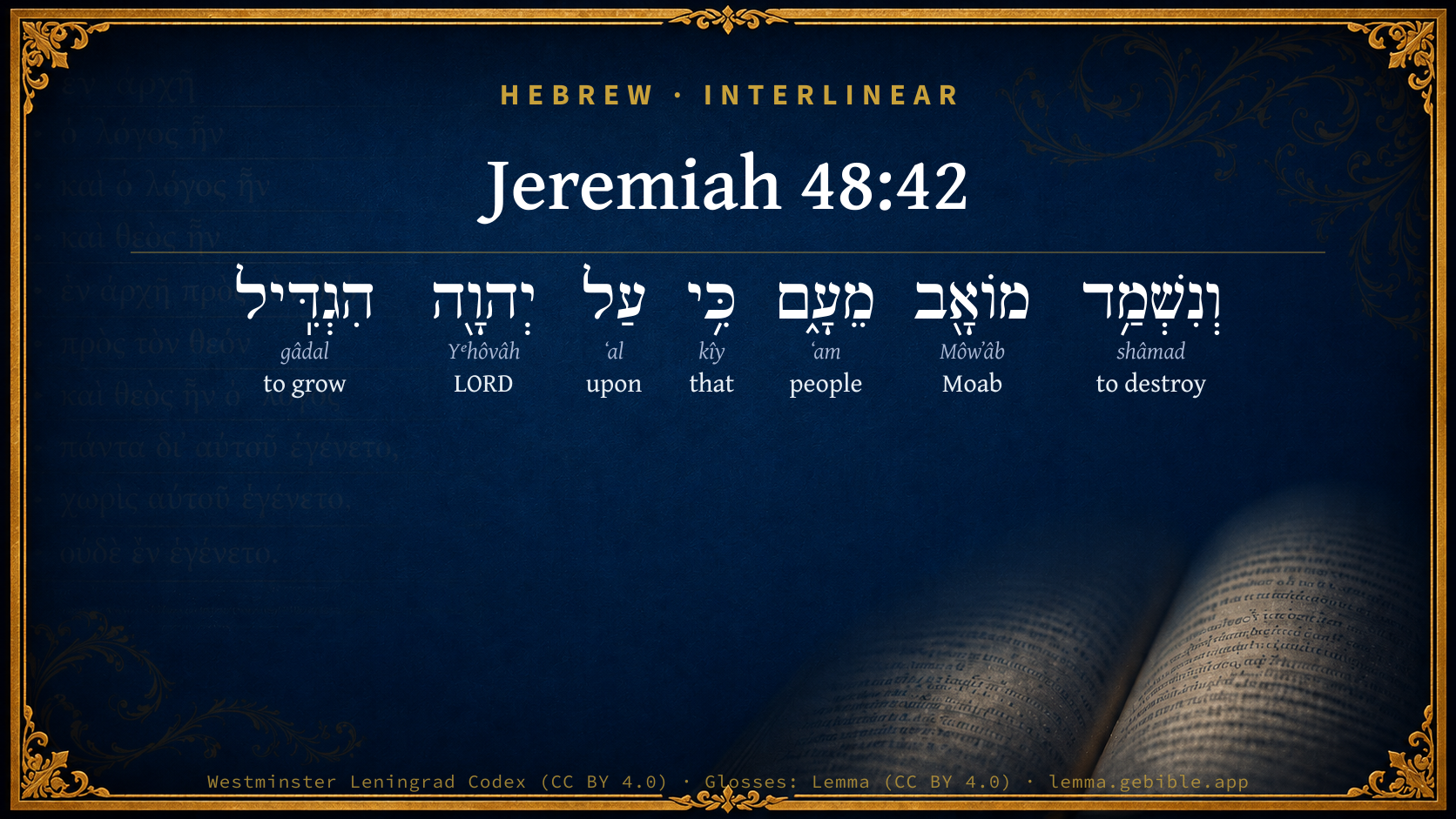
Jeremiah 48:42

Hebrew (Westminster Leningrad Codex) Jeremiah 48:42 appears in the Hebrew Old Testament. The text above is from the Westminster Leningrad Codex. Each word links to its Strong’s number, a concise gloss, and parsing drawn from the Open Scriptures Hebrew Bible morphology. Click any word for its full Brown-Driver-Briggs (BDB) entry.
Download image
Cite this verse

Jeremiah 48:42 (World English Bible). Public Domain. Lemma interlinear Bible study tool, https://lemma.gebible.app/v/jeremiah/48/42.

Show BibTeX & RIS
BibTeX
RIS
English Translation
Moab shall be destroyed from being a people, because he has magnified himself against Yahweh.
World English Bible · Public Domain
Download a study sheet

One document with this verse’s original text, its word-by-word gloss line, the meaning frame, cross-references with their text, attributed commentary, and full source and license credits — printable, and it pastes into notes with its structure intact.

This verse Autodidact and up

Study sheet (.html) Plain text (.txt)

A passage Seminary Student

Up to 50 verses in one chapter. A passage sheet keeps up to 6 commentary sources and 12 cross-references per verse, in the order this page ranks them, and says so on the sheet whenever that leaves anything out. Ask for a single verse and you get the Autodidact verse sheet above.

Everything on this page stays free to read, with no account — the sheet is a download of what is already on screen, not access to it.

Want to remove ads? Support Godless Engineer
Compare translations 3

The same verse in 3 English versions, stacked beneath the original-language interlinear above. Click any original word for its lexicon entry.

Each is an independent rendering of the whole verse — the interlinear is not word-aligned to these translations.

Highlighted words mark where these versions differ — a whole-verse word diff, not a word-by-word alignment.

  • World English Bible Public Domain
    Moab shall be destroyed from being a people, because he has magnified himself against Yahweh.
  • King James Version Public Domain
    And Moab shall be destroyed from being a people, because he hath magnified himself against the LORD.
  • unfoldingWord Literal Text CC BY-SA 4.0
    So Moab will be destroyed and be no longer a people, because he made himself to be great against Yahweh.

unfoldingWord Literal Text — © unfoldingWord, licensed CC BY-SA 4.0. Word-aligned USFM3 via Door43 (git.door43.org/unfoldingWord/en_ult).

Versions to compare (up to 4)

3 of 4 selected

Show all 18 translations

Every available English version of this verse, each an independent rendering of the whole verse.

  • World English Bible Public Domain
    Moab shall be destroyed from being a people, because he has magnified himself against Yahweh.
  • Berean Standard Bible Public Domain
    Moab will be destroyed as a nation because he vaunted himself against the LORD.
  • Majority Standard Bible Public Domain
    Moab will be destroyed as a nation because he vaunted himself against the LORD.
  • King James Version Public Domain
    And Moab shall be destroyed from being a people, because he hath magnified himself against the LORD.
  • American Standard Version (1901) Public Domain
    And Moab shall be destroyed from being a people, because he hath magnified himself against Jehovah.
  • Revised Version (1885) Public Domain
    And Moab shall be destroyed from being a people, because he hath magnified himself against the LORD.
  • Geneva Bible (1599) Public Domain
    And Moab shall be destroyed from being a people, because he hath set vp himselfe against the Lord.
  • Douay-Rheims (1899) Public Domain
    And Moab shall cease to be a people: because he hath gloried against the Lord.
  • Young's Literal Translation Public Domain
    And Moab hath been destroyed from `being' a people, For against Jehovah he exerted himself.
  • Literal Standard Version CC BY-SA 4.0
    And Moab has been destroyed from [being] a people, || For he exerted himself against YHWH.
  • Unlocked Literal Bible CC BY-SA 4.0
    So Moab will be destroyed and be no longer a people, because he made himself to be great against Yahweh.
  • unfoldingWord Literal Text CC BY-SA 4.0
    So Moab will be destroyed and be no longer a people, because he made himself to be great against Yahweh.
  • Darby Bible Public Domain
    And Moab shall be destroyed from being a people, because he hath magnified himself against Jehovah.
  • World Messianic Bible Public Domain
    Moab will be destroyed from being a people, because he has magnified himself against the LORD.
  • Webster's Bible Public Domain
    And Moab shall be destroyed from being a people, because he hath magnified himself against the LORD.
  • Free Bible Version CC BY-SA 4.0
    Moab will cease to exist as a nation because they defied the Lord.
  • Bible in Basic English Public Domain
    And Moab will come to an end as a people, because he has been lifting himself up against the Lord.
  • JPS Tanakh (1917) Public Domain
    And Moab shall be destroyed from being a people, because he hath magnified himself against the LORD.

Literal Standard Version (2020), Covenant Press — licensed CC BY-SA 4.0. Text via the HelloAO Bible API (eBible.org). Unlocked Literal Bible (unfoldingWord) — licensed CC BY-SA 4.0. Text via the HelloAO Bible API (eBible.org). unfoldingWord Literal Text — © unfoldingWord, licensed CC BY-SA 4.0. Word-aligned USFM3 via Door43 (git.door43.org/unfoldingWord/en_ult). Free Bible Version, Dr. Jonathan Gallagher — licensed CC BY-SA 4.0. Text via the HelloAO Bible API (eBible.org).

Word by word

More ways to search: Search by grammar → Find every occurrence → Compare this word →

Practice this passage: Drill this verse → Learn its vocabulary →

וְנִשְׁמַ֥ד
shâmad
H8045
“and · to destroy”
Conjunction + Verb, Niphal, Sequential Perfect, 3rd Person, Masculine, Singular
Part of Speech
Conjunction + Verb
Stem
Niphal
Form
Sequential Perfect
Person
3rd Person
Gender
Masculine
Number
Singular
Full BDB Definition

Origin: a primitive root

TWOT: 2406

to destroy, exterminate, be destroyed, be exterminated - (Niphal) - to be annihilated, be exterminated - to be destroyed, be devastated - (Hiphil) - to annihilate, exterminate - to destroy
  1. מוֹאָ֖ב Môwʼâb H4124 “Moab” Noun, Proper
  2. מֵעָ֑ם ʻam H5971 “from · people” Preposition + Noun, Common, Masculine, Singular, Absolute
  3. כִּ֥י kîy H3588 “that” Conjunction
  4. עַל ʻal H5921 “upon” Preposition
  5. יְהוָ֖ה Yᵉhôvâh H3068 “LORD” Noun, Proper
  6. הִגְדִּֽיל gâdal H1431 “to grow” Verb, Hiphil, Perfect, 3rd Person, Masculine, Singular

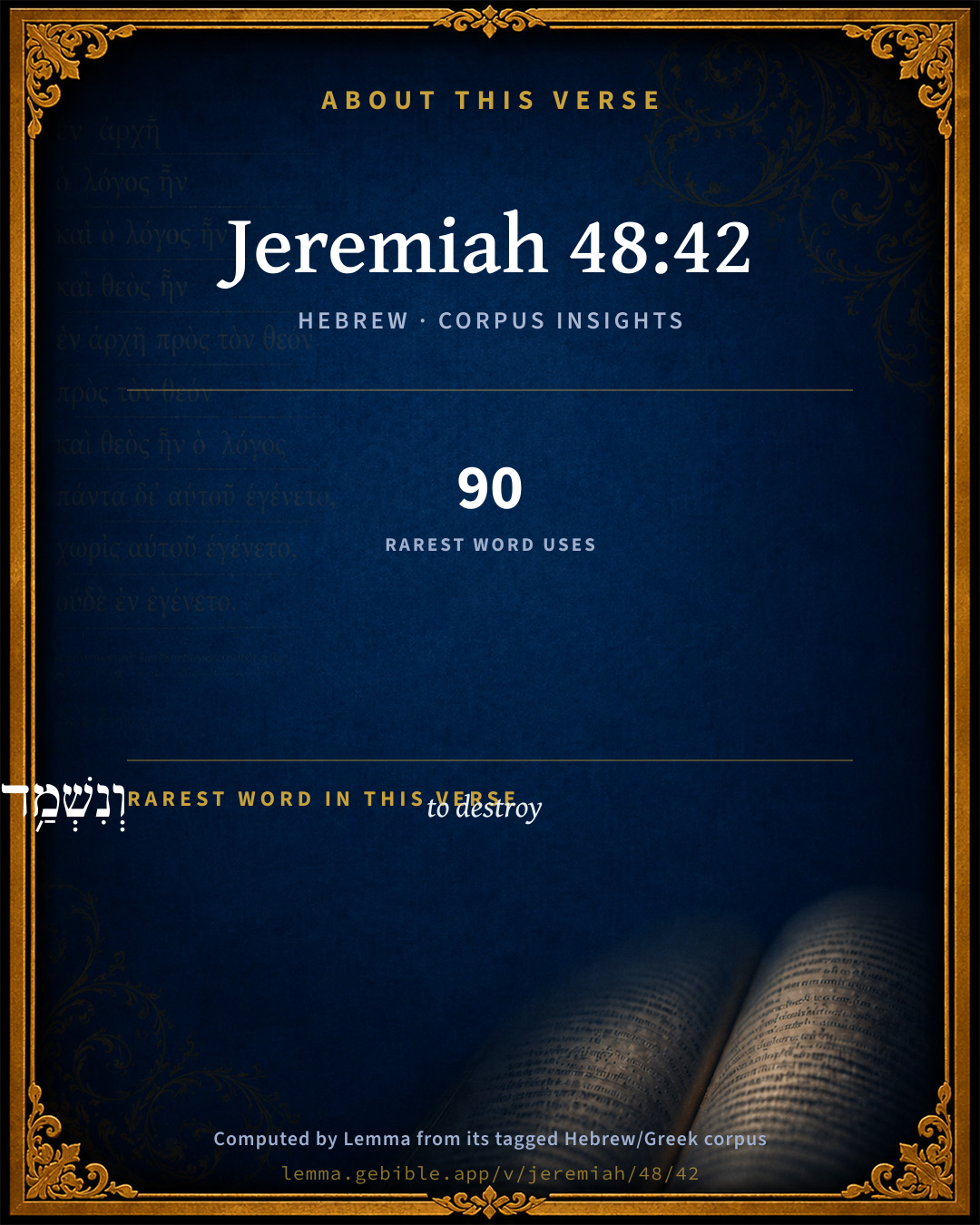
About this verse

These counts appear in no published source. They are computed here, from the morphology-tagged text and Lemma’s own curated glosses. What Lemma adds →

7
words
7
distinct lemmas
Prophets
section

Grammatical profile

  • 2 verbs
  • 3 nouns
  • 1 preposition
  • 1 conjunction

Verb forms

  • וְנִשְׁמַ֥ד Niphal · Sequential Perfect
  • הִגְדִּֽיל Hiphil · Perfect

Cross-references

12

Topical passages linked to Jeremiah 48:42 in the Treasury of Scripture Knowledge — connected by theme and wording, ordered by reader-vote popularity; previews shown in the World English Bible.

  • Jeremiah 48:2 The praise of Moab is no more; in Heshbon they have devised evil against her: Come, and let us cut her off from being a nation. You also, Madmen, shall be brought to silence: the sword shall pursue you.
  • Isaiah 7:8 For the head of Syria is Damascus, and the head of Damascus is Rezin; and within sixty-five years Ephraim shall be broken in pieces, so that it shall not be a people;
  • Isaiah 37:23 Whom have you defied and blasphemed? and against whom have you exalted your voice and lifted up your eyes on high? [even] against the Holy One of Israel.
  • Esther 3:8–13 Haman said to king Ahasuerus, There is a certain people scattered abroad and dispersed among the peoples in all the provinces of your kingdom; and their laws are diverse from [those of] every people; neither keep they the king's laws: therefore it is not for the king's profit to allow them.
  • Psalms 83:4–8 "Come," they say, "and let's destroy them as a nation, That the name of Israel may be remembered no more."
  • Proverbs 16:18 Pride goes before destruction, And a haughty spirit before a fall.
  • Jeremiah 30:11 For I am with you, says Yahweh, to save you: for I will make a full end of all the nations where I have scattered you, but I will not make a full end of you; but I will correct you in measure, and will in no way leave you unpunished.
  • Jeremiah 48:26–30 Make you him drunken; for he magnified himself against Yahweh: and Moab shall wallow in his vomit, and he also shall be in derision.
  • Daniel 11:36 The king shall do according to his will; and he shall exalt himself, and magnify himself above every god, and shall speak marvelous things against the God of gods; and he shall prosper until the indignation be accomplished; for that which is determined shall be done.
  • Matthew 7:2 For with whatever judgment you judge, you will be judged; and with whatever measure you measure, it will be measured to you.
  • 2 Thessalonians 2:4 he who opposes and exalts himself against all that is called God or that is worshiped; so that he sits as God in the temple of God, setting himself up as God.
  • Revelation 13:6 He opened his mouth for blasphemy against God, to blaspheme his name, and his dwelling, those who dwell in heaven.

Cross-references courtesy of OpenBible.info (CC BY 4.0).

Hebrew and Greek witnesses Masoretic Hebrew ↔ Greek Septuagint

The same verse in the two great witnesses to the Old Testament, shown verse-for-verse.

These are two independent witnesses, not word-aligned to each other, and the Septuagint is shown in lemma (dictionary) form.

Hebrew Jeremiah 48:42 Masoretic · Westminster Leningrad Codex

וְנִשְׁמַ֥ד מוֹאָ֖ב מֵעָ֑ם כִּ֥י עַל יְהוָ֖ה הִגְדִּֽיל

Moab shall be destroyed from being a people, because he has magnified himself against Yahweh.

World English Bible · Public Domain

Greek LXX Structure differs

In the Septuagint, Jeremiah is about an eighth shorter than the Hebrew and arranges its material differently — the Oracles Against the Nations (Hebrew chapters 46–51) appear in the middle of the Greek book, after 25:13. Because the chapter and verse boundaries do not line up, a verse-for-verse comparison with the Hebrew is not shown.

A verse-for-verse comparison isn’t shown here because the chapters and verses don’t line up. Switch to the LXX edition with the MT / LXX toggle above to read the Greek directly.

Hebrew: Westminster Leningrad Codex (CC BY 4.0). Greek: Septuagint (public domain); English from a public-domain English Septuagint. How the Septuagint differs from the Hebrew →

Targum (Aramaic paraphrase)

1

The Targum is the ancient Jewish Aramaic paraphrase of the Hebrew Scriptures — an interpretive translation, not the Hebrew text itself. Onkelos (literal) and Pseudo-Jonathan (expansive) render the Torah, and Jonathan the Prophets. Coverage is partial: where no permissively-licensed English translation exists for a verse, only the Aramaic is shown. This is verse-level text, not a word-by-word alignment to the Hebrew.

  1. Targum Jonathan Prophets (Joshua–Malachi)
    וְיִשְׁתֵּצוּן מוֹאֲבָאֵי מִלְמֶהֱוֵי עַם אֲרֵי עַל עַמֵיהּ דַייָ אִתְרָבְרָב:

    (no public-domain English translation for this verse)

    Targum Jonathan — Aramaic: “Mikraot Gedolot” (public domain). English: “Sefaria Community Translation” (CC0 1.0 (public-domain dedication)); “London "Chaldee Paraphrase," 1871” (public domain). Text via Sefaria.

Commentary

Notes on Jeremiah 48:42 from classic Christian and Jewish commentators (each source and its license shown beneath its notes). The classic Christian expositions comment on the surrounding passage and are grouped to its opening verse, so a note may address several verses; the Jewish commentaries on the Tanakh (Rashi and others) are per-verse, so they appear only where the commentator wrote on this verse.

Lemma curates 59 commentaries, every one of them public domain or Creative Commons licensed, each selected and text-cleaned for this edition rather than reprinted as found. About our sources →

Trapp's Complete Commentary

John Trapp

Jer 48:42 And Moab shall be destroyed from [being] a people, because he hath magnified [himself] against the LORD.

Ver. 42. Because he hath magnified himself against the Lord,] i.e., Against his people, who are as the apple of his eye.

John Trapp, A Commentary or Exposition upon All the Books of the Old and New Testament (1647–1656) — public domain. Text from a community e-Sword module.

Jamieson, Fausset & Brown

Robert Jamieson, A. R. Fausset & David Brown

(See on Jer 48:26).

Jamieson, Fausset & Brown — Commentary Critical and Explanatory on the Whole Bible (1871) — public domain (CC PDM 1.0). Text via the HelloAO Bible API.

Adam Clarke's Commentary

Verse 42. Moab shall be destroyed from being a people] They shall not have a king or civil governor: and I doubt whether there be any evidence that they were ever reinstated in their national character. They were captivated by the Chaldeans; and probably many returned with the Jews on the edict of Cyrus: but as to their being an independent nation after this, where is the positive proof?

Adam Clarke's Commentary on the Bible (1810–1826) — public domain. Text from a community e-Sword/MySword module.

John Calvin's Commentaries

He repeats what we have before observed, that the calamity of Moab would be a just reward for his pride and indeed his sacrilege. The Prophet then says that though God’s vengeance might seem extremely grievous, yet it was most just, because the Moabites had not only been cruel against their neighbors, but also reproachful against God. Here, then, he condemns them first for cruelty, and then for their impious pride, because they exalted themselves against God

But we must bear in mind the reason noticed before; for the Moabites did not openly boast that they were equal or superior to God, but when they raised their crests against God’s people, they became contumelious against God himself, who had promised to be the protector and the Father of his people. As then the Moabites thus despised the protection and promise of God, they are here justly condemned by the Prophet, that they exalted themselves against God And this ought to be carefully noticed, so that we may not do any wrong to the godly, for God will at length show that he is injured in their persons. And then also no common consolation may be hence derived, that all who molest us are carrying on war against God, and that all who injure us act sacrilegiously towards him. For the Prophet has before explained how the Moabites gloried against God, even because they regarded the children of Israel with derision. It follows, —

John Calvin's Commentaries (1540-1563) — public domain. Text from the Calvin Translation Society English edition (1840s-50s) via the Christian Classics Ethereal Library (ccel.org). Calvin's coverage is partial (roughly two-thirds of the Bible); uncommented books and verses are honest gaps, never fabricated. The 19th-century editor's footnotes and remarks are omitted so the notes are faithfully Calvin's own voice.

Ellicott's Commentary for English Readers

(42) Moab shall be destroyed . . .—What is predicted is not annihilation (see Jer_48:47), but the loss of national independence. And the cause of this punishment is once more asserted. With Moab, as with other nations, it was her self-exalting pride that called for chastisement.

A Bible Commentary for English Readers, edited by Charles John Ellicott (1878–1897) — public domain. Text from a community e-Sword module.

John Gill's Exposition

Fear, and the pit, and the snare, shall be upon thee,.... A proverbial expression, showing, that if they escaped one danger, or sore judgment, they should fall into another and greater: the words seem to be taken from Isa 24:17; See Gill on Isa 24:17;

O inhabitant of Moab, saith the Lord; what in the prophecy of Isaiah is said of the inhabitants of the earth in general, is here applied to the inhabitants of Moab in particular.

John Gill's Exposition of the Whole Bible (1746–1763) — public domain (CC PDM 1.0). Text via the HelloAO Bible API.

Haydock's Catholic Bible Commentary

Cease for a time, till he regain his liberty under Cyrus, ver. 47.

George Leo Haydock (1774–1849), Haydock's Catholic Family Bible and Commentary, 1859 edition — public domain. Excludes Psalms (Douay-Rheims chapter numbering differs from Protestant) and Deuterocanonical books (Catholic canon only).

Matthew Poole's English Annotations

That is, for a time; see Jer 48:47; or being such a people as it hath been, so full of splendour and glory. The reason given is the same with that Jer 48:26.

Matthew Poole's English Annotations on the Holy Bible (1683–1685) — public domain. Text from a community e-Sword/MySword module.

unfoldingWord translationNotes

Door43 World Missions Community

So Moab will be destroyed

This can be stated in active form. AT: "So the enemy will destroy the people of Moab" (See: Active or Passive)

Terror and the pit, and a trap are coming on you

Here "coming on you" is an idiom that means "to experience" something. AT: "You will experience the terror, the pit, and a trap" or "You will be terrified, and you will fall into pits and traps" (See: Idiom)

inhabitant of Moab

Here "inhabitant" means inhabitants in general. AT: "inhabitants of Moab" or "people of Moab" (See: Generic Noun Phrases)

this is Yahweh's declaration

Yahweh speaks of himself by name to express the certainty of what he is declaring. See how you translated this in Jeremiah 1:8. AT: "this is what Yahweh has declared" or "this is what I, Yahweh, have declared" (See: First, Second, or Third Person)

fall into the pit ... caught in the trap

Here "the pit" and "the trap" represent all the different bad things that will happen to the people. People will run away to escape one bad thing but they will just experience another bad thing. (See: Synecdoche)

in the year of

Here, "year" could be translated as "time" or "season" or "time period."

translationWords

arrogant

Yahweh

terror

pit

declare

year

avenge

unfoldingWord translationNotes — © Distant Shores Media and the Door43 World Missions Community, licensed CC BY-SA 4.0. Source: git.door43.org/Door43/en_tn.

Lesson kit

Teaching starters — assembled from the data on this page, not authored interpretation. Every prompt links to the verse data it draws on. Edit before teaching.

Jeremiah, in the Prophets, opens this verse with 7 words (7 distinct Hebrew lemmas). Its most distinctive word is shâmad (“to destroy”). A historical commentator’s framing appears above. Read the whole chapter for the surrounding context.

Discussion questions

  1. The word shâmad carries the sense “to destroy.” How does it shape the verse?
  2. How does Jeremiah 48:2, which shares this passage’s theme, read alongside this verse?
  3. These translations render this verse differently. What is at stake in choosing one wording over another?
  4. «וְנִשְׁמַ֥ד» is a Niphal Sequential Perfect verb. How does that grammatical form shape the action described?
  5. Compare how Trapp's Complete Commentary and Jamieson, Fausset & Brown read this verse. Where do they agree or differ?

Things to notice

Reading settings

Reading text

Shown beneath each verse's original-language words.

Old Testament
Old Testament edition

Read the OT as the Masoretic Hebrew (MT) or the Greek Septuagint (LXX).

English shown for the Greek Septuagint (in the Hebrew ↔ Greek comparison).

Comparing translations? Open the Compare panel on any verse page to stack up to four side by side.