
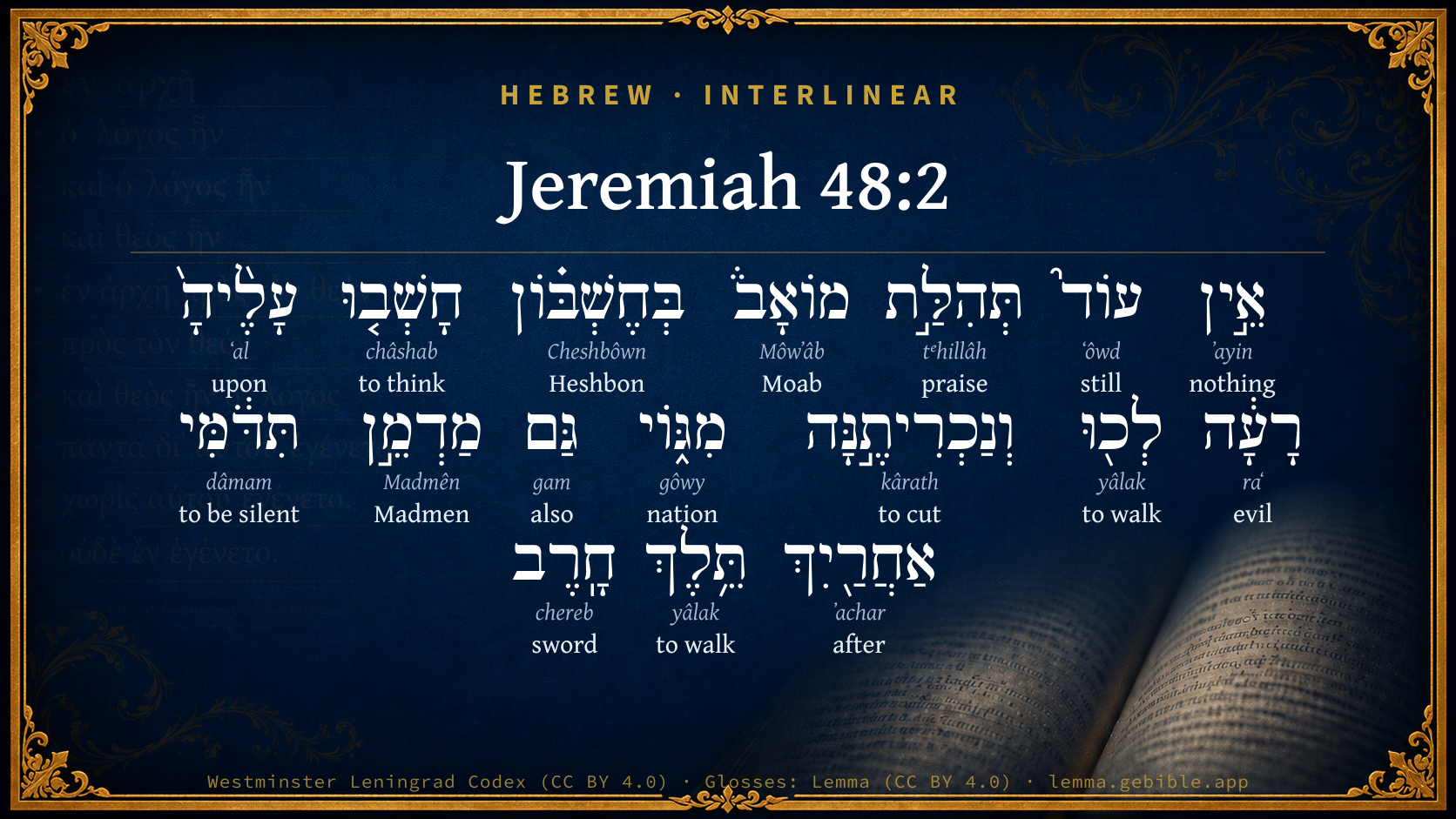
Jeremiah 48:2

Hebrew (Westminster Leningrad Codex) Jeremiah 48:2 appears in the Hebrew Old Testament. The text above is from the Westminster Leningrad Codex. Each word links to its Strong’s number, a concise gloss, and parsing drawn from the Open Scriptures Hebrew Bible morphology. Click any word for its full Brown-Driver-Briggs (BDB) entry.
Download image
Cite this verse

Jeremiah 48:2 (World English Bible). Public Domain. Lemma interlinear Bible study tool, https://lemma.gebible.app/v/jeremiah/48/2.

Show BibTeX & RIS
BibTeX
RIS
English Translation
The praise of Moab is no more; in Heshbon they have devised evil against her: Come, and let us cut her off from being a nation. You also, Madmen, shall be brought to silence: the sword shall pursue you.
World English Bible · Public Domain
Highlights
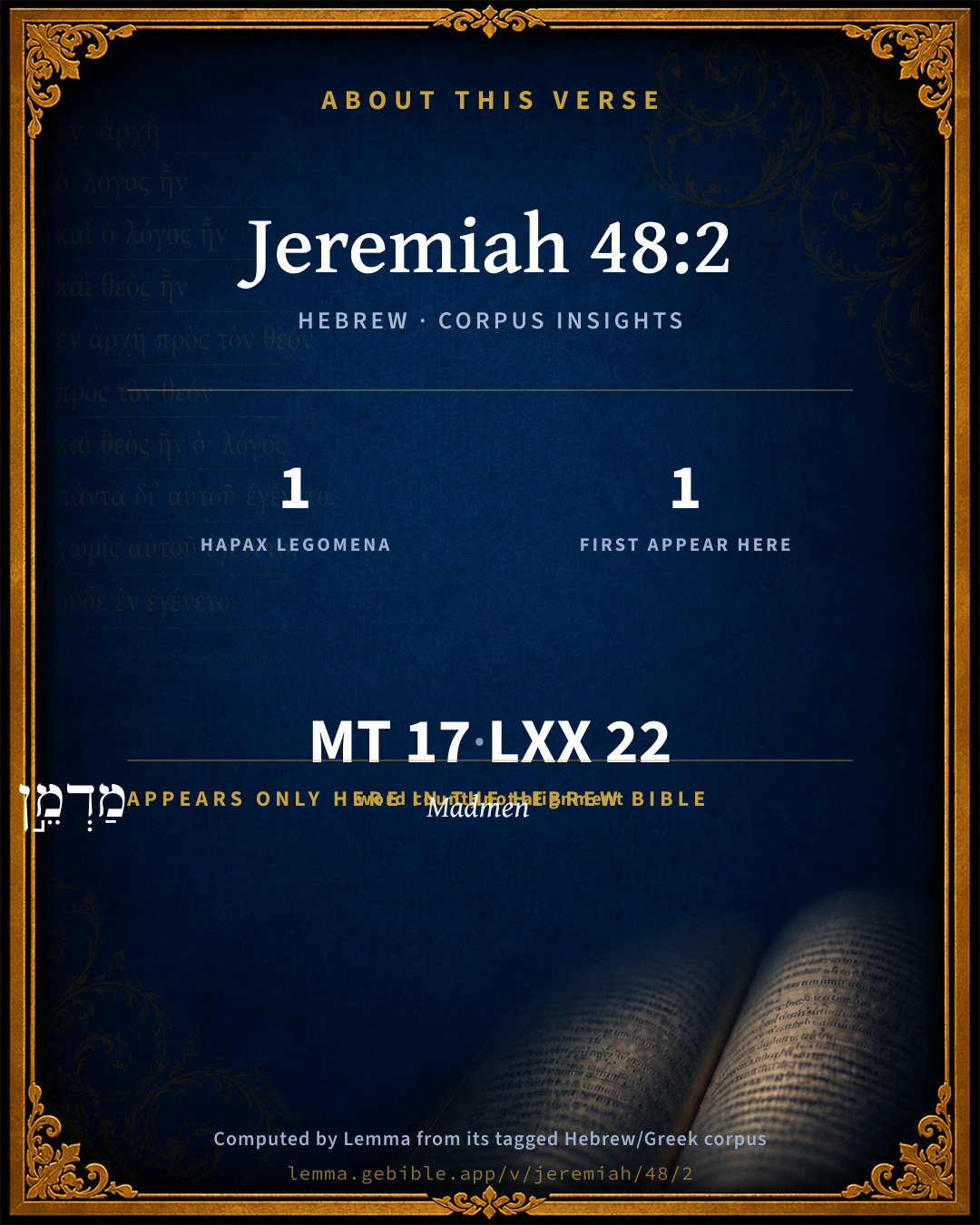
  • 1 hapax legomenon — only here in the Hebrew Bible
  • 1 first appearance in the Hebrew Bible
Full analysis ↓
Download a study sheet

One document with this verse’s original text, its word-by-word gloss line, the meaning frame, cross-references with their text, attributed commentary, and full source and license credits — printable, and it pastes into notes with its structure intact.

This verse Autodidact and up

Study sheet (.html) Plain text (.txt)

A passage Seminary Student

Up to 50 verses in one chapter. A passage sheet keeps up to 6 commentary sources and 12 cross-references per verse, in the order this page ranks them, and says so on the sheet whenever that leaves anything out. Ask for a single verse and you get the Autodidact verse sheet above.

Everything on this page stays free to read, with no account — the sheet is a download of what is already on screen, not access to it.

Want to remove ads? Support Godless Engineer
Compare translations 3

The same verse in 3 English versions, stacked beneath the original-language interlinear above. Click any original word for its lexicon entry.

Each is an independent rendering of the whole verse — the interlinear is not word-aligned to these translations.

Highlighted words mark where these versions differ — a whole-verse word diff, not a word-by-word alignment.

  • World English Bible Public Domain
    The praise of Moab is no more; in Heshbon they have devised evil against her: Come, and let us cut her off from being a nation. You also, Madmen, shall be brought to silence: the sword shall pursue you.
  • King James Version Public Domain
    There shall be no more praise of Moab: in Heshbon they have devised evil against it; come, and let us cut it off from being a nation. Also thou shalt be cut down, O Madmen; the sword shall pursue thee.
  • unfoldingWord Literal Text CC BY-SA 4.0
    The honor of Moab is no more. Their enemies in Heshbon plotted disaster against her. They said, ‘Come and let us destroy her as a nation. Madmen will also perish—a sword will go after you.’

unfoldingWord Literal Text — © unfoldingWord, licensed CC BY-SA 4.0. Word-aligned USFM3 via Door43 (git.door43.org/unfoldingWord/en_ult).

Versions to compare (up to 4)

3 of 4 selected

Show all 18 translations

Every available English version of this verse, each an independent rendering of the whole verse.

  • World English Bible Public Domain
    The praise of Moab is no more; in Heshbon they have devised evil against her: Come, and let us cut her off from being a nation. You also, Madmen, shall be brought to silence: the sword shall pursue you.
  • Berean Standard Bible Public Domain
    There is no longer praise for Moab; in Heshbon they devise evil against her: ‘Come, let us cut her off from nationhood.’ You too, O people of Madmen, will be silenced; the sword will pursue you.
  • Majority Standard Bible Public Domain
    There is no longer praise for Moab; in Heshbon they devise evil against her: ‘Come, let us cut her off from nationhood.’ You too, O people of Madmen, will be silenced; the sword will pursue you.
  • King James Version Public Domain
    There shall be no more praise of Moab: in Heshbon they have devised evil against it; come, and let us cut it off from being a nation. Also thou shalt be cut down, O Madmen; the sword shall pursue thee.
  • American Standard Version (1901) Public Domain
    The praise of Moab is no more; in Heshbon they have devised evil against her: Come, and let us cut her off from being a nation. Thou also, O Madmen, shalt be brought to silence: the sword shall pursue thee.
  • Revised Version (1885) Public Domain
    The praise of Moab is no more; in Heshbon they have devised evil against her, Come, and let us cut her off from being a nation. Thou also, O Madmen, shalt be brought to silence; the sword shall pursue thee.
  • Geneva Bible (1599) Public Domain
    Moab shall boast no more of Heshbon: for they haue deuised euill against it. Come, and let vs destroy it, that it be no more a nation: also thou shalt be destroyed, O Madmen, and the sworde shall pursue thee.
  • Douay-Rheims (1899) Public Domain
    There is no more rejoicing in Moab over Hesebon: they have devised evil. Come, and let us cut it off from being a nation. Therefore shalt thou in silence hold thy peace, and the sword shall follow thee.
  • Young's Literal Translation Public Domain
    There is no more praise of Moab, In Heshbon they devised against it evil: Come, and we cut it off from `being' a nation, Also, O Madmen, thou art cut off, After thee goeth a sword.
  • Literal Standard Version CC BY-SA 4.0
    There is no longer praise of Moab, || In Heshbon they devised evil against her: Come, and we cut it off from [being] a nation, || Also, O Madmen, you are cut off, || A sword goes after you.
  • Unlocked Literal Bible CC BY-SA 4.0
    The honor of Moab is no more. Their enemies in Heshbon plotted disaster against her. They said, 'Come and let us destroy her as a nation. Madmen will also perish—a sword will go after you.'
  • unfoldingWord Literal Text CC BY-SA 4.0
    The honor of Moab is no more. Their enemies in Heshbon plotted disaster against her. They said, ‘Come and let us destroy her as a nation. Madmen will also perish—a sword will go after you.’
  • Darby Bible Public Domain
    Moab's praise is no more; in Heshbon they have devised evil against her: Come, and let us cut her off from [being] a nation. Thou also, O Madmen, shalt be cut down; the sword shall pursue thee.
  • World Messianic Bible Public Domain
    The praise of Moab is no more. In Heshbon they have devised evil against her: ‘Come! Let’s cut her off from being a nation.’ You also, Madmen, will be brought to silence. The sword will pursue you.
  • Webster's Bible Public Domain
    There shall be no more praise of Moab: in Heshbon they have devised evil against it; come, and let us cut it off from being a nation. Also thou shalt be cut down, O Madmen; the sword shall pursue thee.
  • Free Bible Version CC BY-SA 4.0
    No one praises Moab anymore. People in Heshbon are plotting, “We will destroy Moab as a nation. People of the town of Madmen, we will silence you too—you will be attacked by swords and chased down.”
  • Bible in Basic English Public Domain
    The praise of Moab has come to an end; as for Heshbon, evil has been designed against her; come, let us put an end to her as a nation. But your mouth will be shut, O Madmen; the sword will go after you.
  • JPS Tanakh (1917) Public Domain
    The praise of Moab is no more; in Heshbon they have devised evil against her: 'Come, and let us cut her off from being a nation.' Thou also, O Madmen, shalt be brought to silence; the sword shall pursue thee.

Literal Standard Version (2020), Covenant Press — licensed CC BY-SA 4.0. Text via the HelloAO Bible API (eBible.org). Unlocked Literal Bible (unfoldingWord) — licensed CC BY-SA 4.0. Text via the HelloAO Bible API (eBible.org). unfoldingWord Literal Text — © unfoldingWord, licensed CC BY-SA 4.0. Word-aligned USFM3 via Door43 (git.door43.org/unfoldingWord/en_ult). Free Bible Version, Dr. Jonathan Gallagher — licensed CC BY-SA 4.0. Text via the HelloAO Bible API (eBible.org).

Word by word

More ways to search: Search by grammar → Find every occurrence → Compare this word →

Practice this passage: Drill this verse → Learn its vocabulary →

מַדְמֵ֣ן
Madmên
H4086
“Madmen”
Noun, Proper
Part of Speech
Noun
Type
Proper
Full BDB Definition

Origin: from the same as H1828

TWOT: None

Madmen = "dunghill" - a place in Moab threatened with destruction in the denunciations of Jeremiah
  1. אֵ֣ין ʼayin H369 “nothing” Particle, Negative
  2. עוֹד֮ ʻôwd H5750 “still” Adverb
  3. תְּהִלַּ֣ת tᵉhillâh H8416 “praise of” Noun, Common, Feminine, Singular, Construct
  4. מוֹאָב֒ Môwʼâb H4124 “Moab” Noun, Proper
  5. בְּחֶשְׁבּ֗וֹן Cheshbôwn H2809 “in/at · Heshbon” Preposition + Noun, Proper
  6. חָשְׁב֤וּ châshab H2803 “to think” Verb, Qal, Perfect, 3rd Person, Common, Plural
  7. עָלֶ֨יהָ֙ ʻal H5921 “upon · her” Preposition + Suffix, Personal, 3rd Person, Feminine, Singular
  8. רָעָ֔ה raʻ H7451 “evil” Noun, Common, Feminine, Singular, Absolute
  9. לְכ֖וּ yâlak H3212 “walk” Verb, Qal, Imperative, 2nd Person, Masculine, Plural
  10. וְנַכְרִיתֶ֣נָּה kârath H3772 “and · to cut · her” Conjunction + Verb, Hiphil, Cohortative, 1st Person, Common, Plural + Suffix, Personal, 3rd Person, Feminine, Singular
  11. מִגּ֑וֹי gôwy H1471 “from · nation” Preposition + Noun, Common, Masculine, Singular, Absolute
  12. גַּם gam H1571 “also” Particle, Accusative
  13. תִּדֹּ֔מִּי dâmam H1826 “to be silent” Verb, Qal, Imperfect, 2nd Person, Feminine, Singular
  14. אַחֲרַ֖יִךְ ʼachar H310 “after · you” Preposition + Suffix, Personal, 2nd Person, Feminine, Singular
  15. תֵּ֥לֶךְ yâlak H3212 “to walk” Verb, Qal, Imperfect, 3rd Person, Feminine, Singular
  16. חָֽרֶב chereb H2719 “sword” Noun, Common, Feminine, Singular, Absolute

About this verse

These counts appear in no published source. They are computed here, from the morphology-tagged text and Lemma’s own curated glosses. What Lemma adds →

17
words
16
distinct lemmas
Prophets
section

Notable vocabulary

1 hapax legomenon — a word that appears only here in the entire Hebrew Bible:

  • מַדְמֵ֣ן Madmen H4086

First appearance in Scripture

This word makes its first canonical appearance in the Hebrew Bible here:

  • מַדְמֵ֣ן Madmen H4086

Shared distinctive vocabulary

תִּדֹּ֔מִּי to be silent H1826 occurs in 29 verses of the Hebrew Bible. Also found in:

Grammatical profile

  • 5 verbs
  • 7 nouns
  • 2 prepositions
  • 1 adverb
  • 2 particles

Verb forms

  • חָשְׁב֤וּ Qal · Perfect
  • לְכ֖וּ Qal · Imperative
  • וְנַכְרִיתֶ֣נָּה Hiphil · Cohortative
  • תִּדֹּ֔מִּי Qal · Imperfect
  • תֵּ֥לֶךְ Qal · Imperfect

Repetition

A word recurs within this verse — often emphatic in Hebrew:

  • לְכ֖וּ to walk H3212 ×2

Hebrew & Septuagint length

In the original languages it is 17 Hebrew tokens and 22 Greek tokens — but the two are counted differently (Hebrew bundles its prefixes and suffixes into one token; the Greek is in lemma form), so that isn’t a like-for-like length.

Cross-references

19

Topical passages linked to Jeremiah 48:2 in the Treasury of Scripture Knowledge — connected by theme and wording, ordered by reader-vote popularity; previews shown in the World English Bible.

  • Numbers 32:37 The children of Reuben built Heshbon, and Elealeh, and Kiriathaim,
  • Isaiah 16:14 But now Yahweh has spoken, saying, Within three years, as the years of a hireling, the glory of Moab shall be brought into contempt, with all his great multitude; and the remnant shall be very small and of no account.
  • Jeremiah 31:36 If these ordinances depart from before me, says Yahweh, then the seed of Israel also shall cease from being a nation before me forever.
  • Numbers 21:25–30 Israel took all these cities: and Israel lived in all the cities of the Amorites, in Heshbon, and in all the towns of it.
  • Esther 3:8–14 Haman said to king Ahasuerus, There is a certain people scattered abroad and dispersed among the peoples in all the provinces of your kingdom; and their laws are diverse from [those of] every people; neither keep they the king's laws: therefore it is not for the king's profit to allow them.
  • Psalms 83:4–8 "Come," they say, "and let's destroy them as a nation, That the name of Israel may be remembered no more."
  • Isaiah 15:1 The burden of Moab. For in a night Ar of Moab is laid waste, [and] brought to nothing; for in a night Kir of Moab is laid waste, [and] brought to nothing.
  • Isaiah 15:5 My heart cries out for Moab; her nobles [flee] to Zoar, to Eglath Shelishiyah: for by the ascent of Luhith with weeping they go up; for in the way of Horonaim they raise up a cry of destruction.
  • Isaiah 16:8–9 For the fields of Heshbon languish, [and] the vine of Sibmah; the lords of the nations have broken down the choice branches of it, which reached even to Jazer, which wandered into the wilderness; its shoots were spread abroad, they passed over the sea.
  • Isaiah 25:10 For in this mountain will the hand of Yahweh rest; and Moab shall be trodden down in his place, even as straw is trodden down in the water of the dung-hill.
  • Jeremiah 25:15 For thus says Yahweh, the God of Israel, to me: take this cup of the wine of wrath at my hand, and cause all the nations, to whom I send you, to drink it.
  • Jeremiah 25:17 Then took I the cup at Yahweh's hand, and made all the nations to drink, to whom Yahweh had sent me:
  • Jeremiah 33:24 Don't you consider what this people has spoken, saying, The two families which Yahweh did choose, he has cast them off? thus do they despise my people, that they should be no more a nation before them.
  • Jeremiah 46:28 Don't be afraid you, O Jacob my servant, says Yahweh; for I am with you: for I will make a full end of all the nations where I have driven you; but I will not make a full end of you, but I will correct you in measure, and will in no way leave you unpunished.
  • Jeremiah 48:17 All you who are round about him, bemoan him, and all you who know his name; say, How is the strong staff broken, the beautiful rod!
  • Jeremiah 48:34–35 From the cry of Heshbon even to Elealeh, even to Jahaz have they uttered their voice, from Zoar even to Horonaim, to Eglath Shelishiyah: for the waters of Nimrim also shall become desolate.
  • Jeremiah 48:42 Moab shall be destroyed from being a people, because he has magnified himself against Yahweh.
  • Jeremiah 48:45 Those who fled stand without strength under the shadow of Heshbon; for a fire is gone forth out of Heshbon, and a flame from the midst of Sihon, and has devoured the corner of Moab, and the crown of the head of the tumultuous ones.
  • Jeremiah 49:3 Wail, Heshbon, for Ai is laid waste; cry, you daughters of Rabbah, gird you with sackcloth: lament, and run back and forth among the fences; for Malcam shall go into captivity, his priests and his princes together.

Cross-references courtesy of OpenBible.info (CC BY 4.0).

Hebrew and Greek witnesses Masoretic Hebrew ↔ Greek Septuagint

The same verse in the two great witnesses to the Old Testament, shown verse-for-verse.

These are two independent witnesses, not word-aligned to each other, and the Septuagint is shown in lemma (dictionary) form.

Hebrew Jeremiah 48:2 Masoretic · Westminster Leningrad Codex

אֵ֣ין עוֹד֮ תְּהִלַּ֣ת מוֹאָב֒ בְּחֶשְׁבּ֗וֹן חָשְׁב֤וּ עָלֶ֨יהָ֙ רָעָ֔ה לְכ֖וּ וְנַכְרִיתֶ֣נָּה מִגּ֑וֹי גַּם מַדְמֵ֣ן תִּדֹּ֔מִּי אַחֲרַ֖יִךְ תֵּ֥לֶךְ חָֽרֶב

The praise of Moab is no more; in Heshbon they have devised evil against her: Come, and let us cut her off from being a nation. You also, Madmen, shall be brought to silence: the sword shall pursue you.

World English Bible · Public Domain

Greek LXX Structure differs

In the Septuagint, Jeremiah is about an eighth shorter than the Hebrew and arranges its material differently — the Oracles Against the Nations (Hebrew chapters 46–51) appear in the middle of the Greek book, after 25:13. Because the chapter and verse boundaries do not line up, a verse-for-verse comparison with the Hebrew is not shown.

A verse-for-verse comparison isn’t shown here because the chapters and verses don’t line up. Switch to the LXX edition with the MT / LXX toggle above to read the Greek directly.

On this verse, Ellicott's Commentary for English Readers discusses the Septuagint’s reading. Read the note in Commentary ↓

Hebrew: Westminster Leningrad Codex (CC BY 4.0). Greek: Septuagint (public domain); English from a public-domain English Septuagint. How the Septuagint differs from the Hebrew →

Targum (Aramaic paraphrase)

1

The Targum is the ancient Jewish Aramaic paraphrase of the Hebrew Scriptures — an interpretive translation, not the Hebrew text itself. Onkelos (literal) and Pseudo-Jonathan (expansive) render the Torah, and Jonathan the Prophets. Coverage is partial: where no permissively-licensed English translation exists for a verse, only the Aramaic is shown. This is verse-level text, not a word-by-word alignment to the Hebrew.

  1. Targum Jonathan Prophets (Joshua–Malachi)
    לֵית עוֹד תּוּשְׁבְּחָא לְמוֹאָב בְּחֶשְׁבּוֹן חֲשִׁיבוּ עֲלָהּ בִּישָׁא אֲתוֹ וּנְשֵׁיצִינָא מִלְמֶהֱוֵי עַמָא אַף מַדְמַן תִּתַּבָּרִין בַּתְרָךְ יְהָכוּן קְטוֹלֵי חַרְבָּא:

    (no public-domain English translation for this verse)

    Targum Jonathan — Aramaic: “Mikraot Gedolot” (public domain). English: “Sefaria Community Translation” (CC0 1.0 (public-domain dedication)); “London "Chaldee Paraphrase," 1871” (public domain). Text via Sefaria.

Commentary

Notes on Jeremiah 48:2 from classic Christian and Jewish commentators (each source and its license shown beneath its notes). The classic Christian expositions comment on the surrounding passage and are grouped to its opening verse, so a note may address several verses; the Jewish commentaries on the Tanakh (Rashi and others) are per-verse, so they appear only where the commentator wrote on this verse.

Lemma curates 59 commentaries, every one of them public domain or Creative Commons licensed, each selected and text-cleaned for this edition rather than reprinted as found. About our sources →

Trapp's Complete Commentary

John Trapp

Jer 48:2 [There shall be] no more praise of Moab: in Heshbon they have devised evil against it; come, and let us cut it off from [being] a nation. Also thou shalt be cut down, O Madmen; the sword shall pursue thee.

Ver. 2. There shall be no more praise of Moab.] This may be taken either of a city so called, {a} or of the whole country, as now Muscovia is oft put for all Russia.

In Heshbon they have devised evil against it.] Or better thus, De Heshbone, &c. As concerning Heshbon, they, the Chaldees, have devised evil against it. There is an elegant allusion in the original to the names of the places both in Heshben and in Madmen. {b}

{a} Ariopolis dicta.

{b} Alludit fere propheta ad singularum civitatum nomina. - Jun.

John Trapp, A Commentary or Exposition upon All the Books of the Old and New Testament (1647–1656) — public domain. Text from a community e-Sword module.

Joseph Benson's Commentary

Jer 48:2-6. There shall be no more praise of Moab — The glory of Moab shall be contemned, as Isaiah speaks, Isa 16:14. Every thing for which it was famous shall be destroyed. In Heshbon they have devised evil against it — Heshbon was the capital city of the Moabites: when the Chaldeans made themselves masters of Heshbon, a place of great importance, they consulted how to carry on their conquests over the rest of the country. Thou shalt be cut down, or, brought to silence, Isa 15:1. O Madmen — A city in Moab. Her little ones have caused a cry to be heard — Or, sent forth a cry. Both small and great were involved in this calamity, but the word צעיר, signifies great as well as little: and the Chaldee paraphrast renders it here lords; which seems to be the sense in which it is used. For in the going up, &c. — The ascent of Luhith is in tears, and their weeping is increased, because, in the descent of Horonaim, the enemies have heard the cry of the sufferers: see Isa 15:5. Flee, &c., and be like the heath — Resort to the most solitary places, and continue in obscurity where no enemy can find you out.

Joseph Benson's Commentary on the Old and New Testaments (1811–1818) — public domain. Text from a community e-Sword module.

Tyndale Open Study Notes

Tyndale Open Resources

48:2 Heshbon was located between the Jabbok and Arnon rivers, east of the Dead Sea. • Madmen was apparently another name for Dibon, a town near Heshbon; it would also be destroyed.

Tyndale Open Study Notes — © Tyndale Open Resources, licensed CC BY-SA 4.0. Text via the HelloAO Bible API.

Geneva Bible (1599)

Geneva Bible translators

Thus shall the Babylonians encourage one another.

Read Isa. 25:10.

Geneva Bible (1599) marginal notes — public domain. Text via Bolls.life.

Jamieson, Fausset & Brown

Robert Jamieson, A. R. Fausset & David Brown

no more praise-- (Isa 16:14).

in Heshbon--The foe having taken Heshbon, the chief city of Moab (Jer 48:45), in it devise evil against Moab ("it") saying, Come," &c. Heshbon was midway between the rivers Arnon and Jabbok; it was the residence of Sihon, king of the Amorites, and afterwards a Levitical city in Gad (Num 21:26). There is a play on words in the Hebrew, "Heshbon, Hashbu." Heshbon means a place of devising or counsel. The city, heretofore called the seat of counsel, shall find other counsellors, namely, those who devise its destruction.

thou shall be cut down . . . Madmen--rather, by a play on words on the meaning of madmen ("silence"), Thou shalt be brought to silence, so as well to deserve thy name (Isa 15:1). Thou shalt not dare to utter a sound.

Jamieson, Fausset & Brown — Commentary Critical and Explanatory on the Whole Bible (1871) — public domain (CC PDM 1.0). Text via the HelloAO Bible API.

Adam Clarke's Commentary

Verse 2. No more praise of Moab] "The glory of Moab, that it had never been conquered," (Dahler,) is now at an end. Dr. Blayney translates: -

"Moab shall have no more glorying in Heshbon;

They have devised evil against her (saying.)"

And this most certainly is the best translation of the original. He has marked also a double paronomasia in this and the next verse, a figure in which the prophets delight; בחשבון חשבו becheshbon chashebu, "in Cheshbon they have devised," and מדמן תדמי madmen tiddommi, "Madmena, thou shalt be dumb."

Adam Clarke's Commentary on the Bible (1810–1826) — public domain. Text from a community e-Sword/MySword module.

John Calvin's Commentaries

The Prophet, as before, does not speak in an ordinary way, but declares in lofty terms what God had committed to him, in order that he might terrify the Moabites; not indeed that they heard his threatenings, but it was necessary that he should denounce vengeance in this vehement manner, that the Jews might know that the cruelty and pride of the Moabites, hereafter mentioned, would not go unpunished.

Hence he says, No more shall be the praise or the boasting of Moab over Heshbon We may learn from this place and from others, that Heshbon had been taken from the Moabites; for it was occupied by God’s people, because the Moabites had lost it, as Moses relates in Numbers 21:30, and in Deuteronomy 2:26, etc. But (as things change) when the Moabites became strong, they took away this city from the Israelites. Hence the Prophet says, that there would be no more boasting that they possessed that city; for he adds, They have thought, or devised, etc. There is here a striking allusion, for חשבון, chesbon, is derived from חשב, chesheb, to devise or to consult, as though it were a place of consultation or devisings. The Prophet then says, that as to Heshbon they consulted against it, חשבו עליה cheshbu olie He uses the root from which the name of the city is derived. Heshbon, then, hitherto called the place of consultation, was to have and find other counselors, even those who would contrive ruin for it. Come ye; the Prophet refers here to the counsel taken by the Chaldeans, Come ye, and let us cut her off from being a nation He then joins another city, And thou, Madmen, shalt be cut off, for a sword shall go after thee, or pursue thee, as though the city itself was fleeing from the sword; not that cities move from one place to another; but when the citizens deliberate how they may drive away their enemies and resist their attacks, — when they seek aid here and there, — when they set up their own remedies, they are said to flee. But the Prophet says, “Thou shalt gain nothing by fleeing, for the sword shall pursue thee.” It follows, —

John Calvin's Commentaries (1540-1563) — public domain. Text from the Calvin Translation Society English edition (1840s-50s) via the Christian Classics Ethereal Library (ccel.org). Calvin's coverage is partial (roughly two-thirds of the Bible); uncommented books and verses are honest gaps, never fabricated. The 19th-century editor's footnotes and remarks are omitted so the notes are faithfully Calvin's own voice.

Ellicott's Commentary for English Readers

(2) There shall be no more praise of Moab.—The self-glorifying boasts of Moab (of which the Moabite Inscription discovered at Dibân in 1868 is a conspicuous instance, see Ginsburg’s Moabite Stone and Records of the Past, xi. p. 163) seem to have been almost proverbial (Jer_48:29; Isa_16:6). Heshbon (the city is perhaps chosen on account of the similarity of sound with the word for “devise “) was on the Ammonite or northern frontier of Moab (Jer_49:3), and is represented therefore as the scene of the plans and hopes of the invading Chaldæans. The site of Madmen is unknown, but the cognate form Madmenah is translated “dunghill” in Isa_25:10, and may have been chosen by each prophet on account of its ignominious meaning. The name appears as belonging to a town in Benjamin (Isa_10:31) and in Judah (Jos_15:31). Here again there is an obvious assonance or paronomasia, the verb “thou shalt be cut down,” or better, thou shalt be brought to silence, reproducing the chief consonants of the noun. The LXX., Vulgate, and Syriac, indeed, take the words with this meaning, “In silence thou shalt be made silent,” but are probably wrong in doing so. If we take the word in somewhat of the same sense as in Isaiah, the words may point to the place being filled with the mouldering carcases of the silent dead.

A Bible Commentary for English Readers, edited by Charles John Ellicott (1878–1897) — public domain. Text from a community e-Sword module.

The Cambridge Bible for Schools and Colleges

gen. ed. J. J. S. Perowne

2. in Heshbon they have devised] There is a play on the two Hebrew words thus rendered (b’Ḥeshbon ḥash’bu) which might be represented in English by in Devizes they have devised. Heshbon, one of the chief cities of Moab, lay to the N. E. of the Dead Sea, and was considered the N. boundary of Moab till Reuben, on entering Palestine, claimed the territory between it and the Arnon which enters the Dead Sea about the middle of its E. side. Of the cities assigned (Jos_13:15 ff.) to Reuben many are here mentioned as occupied by Moab. Hence the constant hostility between Moab and Israel (Jdg_3:12 ff.; 1Sa_14:47, etc.).

O Madmen, shalt be brought to silence] Here again there is a play on the sound in the Hebrew which is, Madmên, tiddômmi. But perhaps we should read with the LXX and Syr. thou (i.e. Moab) shalt be utterly brought to silence.

The Cambridge Bible for Schools and Colleges (gen. ed. J. J. S. Perowne; Cambridge University Press, 1878–1918) — public domain. Text from a community e-Sword module.

John Gill's Exposition

There shall be no more praise of Moab,.... It shall be no more commended for a rich, populous, and fruitful country, being now laid waste; though the next phrase,

in Heshbon, or "concerning Heshbon" (b), should be read in connection with this; and then the sense is, there shall be none any more in Heshbon to praise the country of Moab, what a fine and fertile country it is, since that city will be destroyed also; or there will be no more a Moabite to boast of his being an inhabitant in Heshbon, such an utter destruction will be made of it; or there will be no more boasting of Moab, or of any Moabite concerning Heshbon, what a famous, opulent, or strong city that is, since it is no more. Of this city See Gill on Isa 15:4;

they have devised evil against it; that is, the Chaldeans devised evil against Heshbon, to besiege it, take and destroy it: there is in the expression a beautiful allusion to the name of the city of Heshbon, which has its name from a word that signifies to devise and consult (c);

come, and let us cut it off from being a nation: this is what the Babylonians consulted together against Heshbon; and not only against that, a principal city; but against the whole country of Moab, to make such an entire desolation of it, that it should be no more a nation: that which the Moabites with others devised against the people of Israel is now devised against them; a just retaliation this; see Psa 83:4;

also thou shalt be cut down, O Madmen; or utterly destroyed: it may be rendered, "shall become silent" (d); the voice of man shall not be heard in it, especially the voice of praise, of boasting, and rejoicing: there is in this clause also an elegant allusion to the name of the place, which comes from a root that signifies to "cut down", or "be silent" (e). This is thought by Grotius to be the Madiama of Ptolemy (f):

the sword shall pursue thee; after it has destroyed other cities, it should come in great haste and with great force to Madmen; or it should pursue after the inhabitants, of it, that should make their escape, or attempt to do so. The Targum is,

"after thee shall go out those that slay with the sword.''

(b) "nulla amplius gloriatio Moab in Chesbon", Calvin; "non ultra laus, Moab in Chesbon", Montanus; to the same purpose Vatablus. (c) a "cogitavit", "excogitavit". (d) "silebis", Montanus; so R. Judah in Ben Melech; "ad silentium redigeris"; so some in Vatablus. (e) . (f) Geograph. l. 6. c. 7.

John Gill's Exposition of the Whole Bible (1746–1763) — public domain (CC PDM 1.0). Text via the HelloAO Bible API.

Albert Barnes' Notes on the Bible

No more praise of Moab - literally, “The glory of Moab is no more,” i. e., Moab has no more cause for boasting.

Heshbon - This town now belonged to the Ammonites Jer 49:3 but was on the border. The enemy encamped there arranges the plan of his campaign against Moab.

In the original there is a play of words upon the names Heshbon and Madmen.

Albert Barnes' Notes on the Bible (1834–1885) — public domain. Text from a community e-Sword/MySword module.

Haydock's Catholic Bible Commentary

Hesebon, at the foot of Phasga, and one of the strongest cities. --- Shalt. Hebrew, "shall Medemena hold her peace." (Calmet) --- "Thou shalt be cut down, O madmen." (Haydock) --- It signifies "silence." Thou silent city, thou shalt be reduced to a mournful silence or destruction.

George Leo Haydock (1774–1849), Haydock's Catholic Family Bible and Commentary, 1859 edition — public domain. Excludes Psalms (Douay-Rheims chapter numbering differs from Protestant) and Deuterocanonical books (Catholic canon only).

Matthew Poole's English Annotations

Heshbon was formerly the city of Sihon, Num 21:26; it became afterward one of the principal cities of the Moabites, as appeareth from Isa 15:4; which maketh the learned author of our English Annotations think our translation not so good; for why should they devise evil in Heshbon against Moab, unless the enemies sat there in council, when they had taken it, against the other parts of the country? But possibly the sense is, they shall no more in Heshbon magnify Moab, or Moab shall no more glory of Heshbon, for the enemies had contrived the ruin of it.

Madmen was another city in the country of Moab. Some think the same with Ptolemy’s Madiama. To that city also the prophet threateneth ruin and destruction by the sword.

Matthew Poole's English Annotations on the Holy Bible (1683–1685) — public domain. Text from a community e-Sword/MySword module.

Whedon's Commentary on the Bible

Daniel D. Whedon

2. No more praise of Moab — Literally, the boasting of Moab is gone.

In Heshbon they have devised evil — Heshbon was the chief city on the border, about ten Roman miles east of the Jordan, opposite Jericho. “Heshbon” literally means devising. Hence there is here a play upon the word. In the following clause, also, there is a similar play on the term.

Daniel D. Whedon (gen. ed.), Commentary on the Old and New Testaments (1874–1909) — public domain. Text from a community e-Sword module.

The Pulpit Commentary

There shall be no more praise of Moab; rather, Moab"s glory (or, glorying) is no more (comp. ver. 29). In Heshbon they have devised evil, etc. There is a word play in the Hebrew, which may be reproduced thus: "In Plot-house they plot evil against it" (so J. F. Smith"s Ewald). Against it (literally, her) means "against Moab." Heshbon was at the time an Ammonitish town; (it had in days gone by been Amoritish, Num_21:26) see Jer_49:3; but was on the border of Moab. O Madmen. There seems to be again a word play, which has been to some extent reproduced thus: "Thou shalt become still, O Still house." The name Madmen does not occur again, though an allusion to it has been fancied in Isa_25:10, where the Hebrew for "dunghill" is madmenah.

HOMILIES BY D. YOUNG Ver. 2. The departed praise of Moab.

I NOT FOR WANT OF DISPOSITION TO PRAISE. If the things had still remained which people had been in the habit of praising, they would have gone on praising. But the God of righteousness takes them away, and then there is necessary silence. Instead of praise there is humiliation, astonishment at a change so complete, but no insight into the hollowness and instability of that which had been praised. If it had all come back again, it would have been praised as much as ever. Thus we see

II A THING MAY BE PRAISED WITHOUT BEING PRAISEWORTHY. This can easily be understood from the experience of many who once praised things to which they are now indifferent, which they may even utterly condemn. Why this change? It may be to some extent from change in the things, but it more frequently comes from growth and increase of light and the reception of higher principles. We have ever to be on ore: guard against what is merely popular. Not in a cynical way, as if we grudged any one success, but recollecting what power belongs to fashion and to the love of pleasure. Let our effort be to discern, measure, and profit by intrinsic excellence.

III THINGS NOT PRAISEWORTHY MAY GET THE HIGHEST PRAISE. Mere cleverness and astuteness, the exercise of power irrespective of ends, visible and material success on a large scale, these attract the laudations of inconsiderate men. This is just what we may expect. If things the most praiseworthy, fullest of virtue and blessing, are yet neglected by the eyes of those who have opportunity to see them, then it is little wonder that the things most approved by the common multitude are those which God has branded as utterly bad. What changes need to be effected in human judgments, that we may be willing to burn what we adored and adore what we would have burned!

IV GOD GIVES FRESH TOPICS OF PRAISE IF THERE BE A DISPOSITION TO CONSIDER THEM. Those whose tongues had been full of the praises of Moab needed not to be silent. The very overthrow of Moab would be a signal for praise and congratulation among the good. When the unhallowed praises of men are silenced by destruction of the things they praised, then angels begin to sing. And they who praise low, earthly things may have their thoughts introduced to heavenly ones, and then they will discover what man was made to praise. How the words that are exaggerated and altogether disproportioned when applied to the works of men, have in them an exquisite fitness when we speak of the works of God or of Christ, or of men properly engaged in Christian service! Y.

The Pulpit Commentary (1880–1919), ed. H.D.M. Spence-Jones & Joseph S. Exell — public domain. Text from a community e-Sword module.

John Wesley's Explanatory Notes

Heshbon - Heshbon was one of the principal cities of the Moabites. Probably the enemies sat there in counsel, when they had taken it, against the other parts of the country.

John Wesley, Explanatory Notes Upon the Whole Bible (1754–1765) — public domain. Text via the GEBible commentary corpus.

Rashi

Rabbi Shlomo Yitzchaki (Rashi)

in Heshbon...Madmen These are place names, and according to their names he mentions their retribution.

you shall be a waste Heb. תִּדֹּמִי.

Rashi on the Tanakh — English translations: “The Judaica Press complete Tanach with Rashi, translated by A. J. Rosenberg” (CC BY 4.0); “Pentateuch with Rashi's commentary by M. Rosenbaum and A.M. Silbermann, 1929-1934” (public domain); “The Metsudah Tanach series, Lakewood, N.J” (CC BY 4.0); and “The Book of Joshua, Metsudah Publications, 1997” (CC BY 4.0). Text via Sefaria.

Lesson kit

Teaching starters — assembled from the data on this page, not authored interpretation. Every prompt links to the verse data it draws on. Edit before teaching.

Jeremiah, in the Prophets, opens this verse with 17 words (16 distinct Hebrew lemmas). Its most distinctive word is Madmên (“Madmen”). A historical commentator’s framing appears above. Read the whole chapter for the surrounding context.

Discussion questions

  1. How does “Madmen” (Madmên) shape what this verse is saying?
  2. 1 word here appears nowhere else in the Hebrew Bible. Why might the author reach for such rare wording?
  3. This is the first place “Madmen” appears in Scripture (first appears here). What does its debut here establish?
  4. How does Exodus 15:16, which shares the word «to be silent», read alongside this verse?
  5. What does the repetition of “to walk” (2× in this one verse) do in this verse?
  6. The translations on this page render this verse differently — a whole-verse word diff, not a word-by-word alignment. What might account for the different wordings?
  7. «חָשְׁב֤וּ» is a Qal Perfect verb. How does that grammatical form shape the action described?
  8. Compare how Trapp's Complete Commentary and Joseph Benson's Commentary read this verse. Where do they agree or differ?

Things to notice

  • 1 word in this verse appears nowhere else in the Hebrew Bible.
  • 1 word makes its first canonical appearance in Scripture here.
  • This verse counts 17 Hebrew ↔ 22 Greek words.
  • These translations choose different wording for 25 words in this verse.
  • “to walk” occurs 2× in this single verse.

Reading settings

Reading text

Shown beneath each verse's original-language words.

Old Testament
Old Testament edition

Read the OT as the Masoretic Hebrew (MT) or the Greek Septuagint (LXX).

English shown for the Greek Septuagint (in the Hebrew ↔ Greek comparison).

Comparing translations? Open the Compare panel on any verse page to stack up to four side by side.