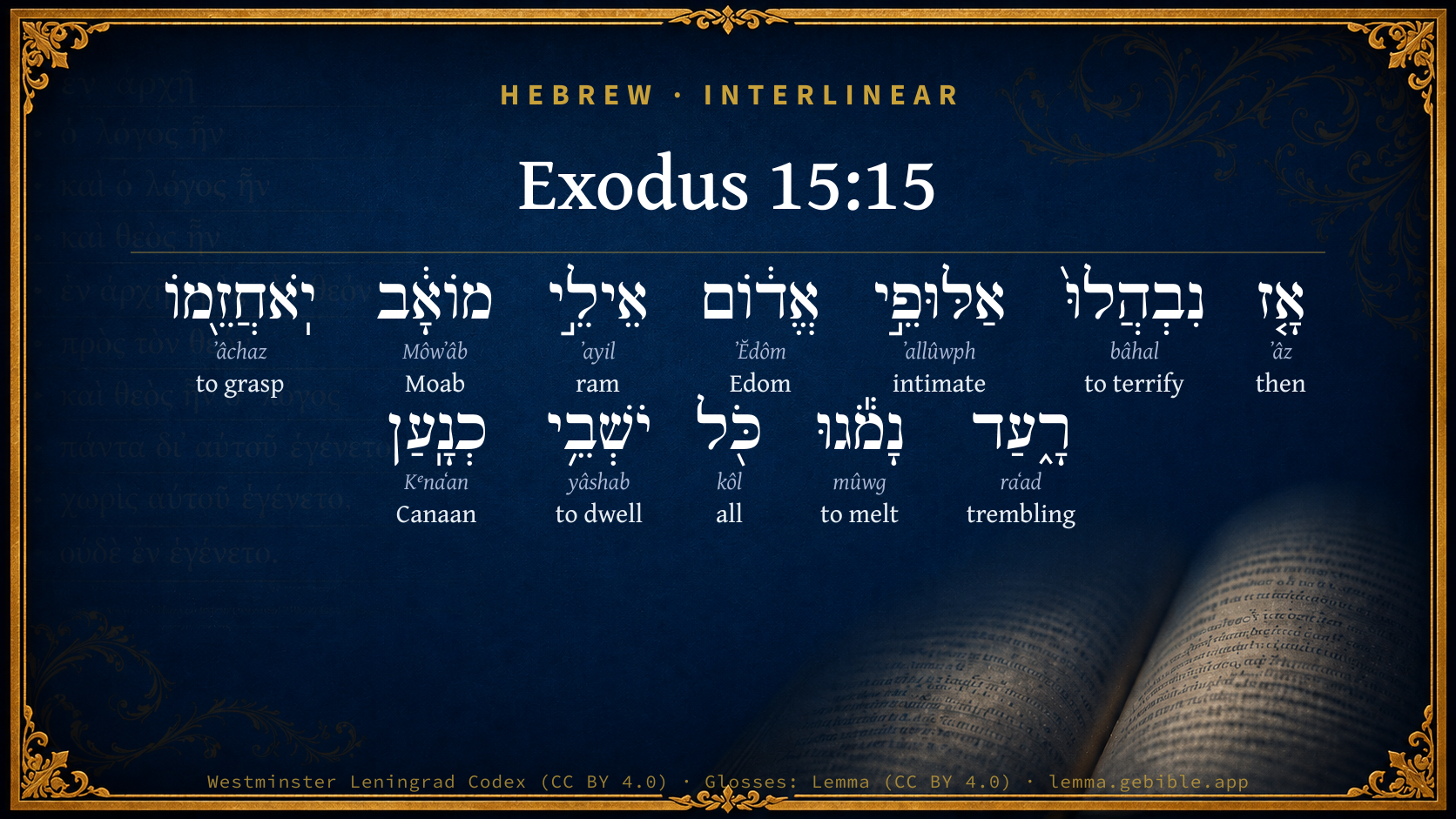
Exodus 15:15

Hebrew (Westminster Leningrad Codex) Exodus 15:15 appears in the Hebrew Old Testament. The text above is from the Westminster Leningrad Codex. Each word links to its Strong’s number, a concise gloss, and parsing drawn from the Open Scriptures Hebrew Bible morphology. Click any word for its full Brown-Driver-Briggs (BDB) entry.
Download image
Cite this verse

Exodus 15:15 (World English Bible). Public Domain. Lemma interlinear Bible study tool, https://lemma.gebible.app/v/exodus/15/15.

Show BibTeX & RIS
BibTeX
RIS
English Translation
Then the chiefs of Edom were dismayed. Trembling takes hold of the mighty men of Moab. All the inhabitants of Canaan are melted away.
World English Bible · Public Domain
Highlights
  • 2 first appearances in the Hebrew Bible
Full analysis ↓
Download a study sheet

One document with this verse’s original text, its word-by-word gloss line, the meaning frame, cross-references with their text, attributed commentary, and full source and license credits — printable, and it pastes into notes with its structure intact.

This verse Autodidact and up

Study sheet (.html) Plain text (.txt)

A passage Seminary Student

Up to 50 verses in one chapter. A passage sheet keeps up to 6 commentary sources and 12 cross-references per verse, in the order this page ranks them, and says so on the sheet whenever that leaves anything out. Ask for a single verse and you get the Autodidact verse sheet above.

Everything on this page stays free to read, with no account — the sheet is a download of what is already on screen, not access to it.

Want to remove ads? Support Godless Engineer
Compare translations 3

The same verse in 3 English versions, stacked beneath the original-language interlinear above. Click any original word for its lexicon entry.

Each is an independent rendering of the whole verse — the interlinear is not word-aligned to these translations.

Highlighted words mark where these versions differ — a whole-verse word diff, not a word-by-word alignment.

  • World English Bible Public Domain
    Then the chiefs of Edom were dismayed. Trembling takes hold of the mighty men of Moab. All the inhabitants of Canaan are melted away.
  • King James Version Public Domain
    Then the dukes of Edom shall be amazed; the mighty men of Moab, trembling shall take hold upon them; all the inhabitants of Canaan shall melt away.
  • unfoldingWord Literal Text CC BY-SA 4.0
    Then the chiefs of Edom panicked; trembling seizes the leaders of Moab; all the inhabitants of Canaan melted away.

unfoldingWord Literal Text — © unfoldingWord, licensed CC BY-SA 4.0. Word-aligned USFM3 via Door43 (git.door43.org/unfoldingWord/en_ult).

Versions to compare (up to 4)

3 of 4 selected

Show all 18 translations

Every available English version of this verse, each an independent rendering of the whole verse.

  • World English Bible Public Domain
    Then the chiefs of Edom were dismayed. Trembling takes hold of the mighty men of Moab. All the inhabitants of Canaan are melted away.
  • Berean Standard Bible Public Domain
    Then the chiefs of Edom will be dismayed; trembling will seize the leaders of Moab; those who dwell in Canaan will melt away,
  • Majority Standard Bible Public Domain
    Then the chiefs of Edom will be dismayed; trembling will seize the leaders of Moab; those who dwell in Canaan will melt away,
  • King James Version Public Domain
    Then the dukes of Edom shall be amazed; the mighty men of Moab, trembling shall take hold upon them; all the inhabitants of Canaan shall melt away.
  • American Standard Version (1901) Public Domain
    Then were the chiefs of Edom dismayed; The mighty men of Moab, trembling taketh hold upon them: All the inhabitants of Canaan are melted away.
  • Revised Version (1885) Public Domain
    Then were the dukes of Edom amazed; The mighty men of Moab, trembling taketh hold upon them: All the inhabitants of Canaan are melted away.
  • Geneva Bible (1599) Public Domain
    Then the dukes of Edom shalbe amased, and trembling shall come vpon the great men of Moab: all the inhabitantes of Canaan shall waxe faint hearted.
  • Douay-Rheims (1899) Public Domain
    Then were the princes of Edom troubled, trembling seized on the stout men of Moab: all the inhabitants of Chanaan became stiff.
  • Young's Literal Translation Public Domain
    Then have chiefs of Edom been troubled: Mighty ones of Moab -- Trembling doth seize them! Melted have all inhabitants of Canaan!
  • Literal Standard Version CC BY-SA 4.0
    Then chiefs of Edom have been troubled; Mighty ones of Moab—Trembling seizes them! All inhabitants of Canaan have melted!
  • Unlocked Literal Bible CC BY-SA 4.0
    Then the chiefs of Edom will fear; the soldiers of Moab will shake; all the inhabitants of Canaan will melt away.
  • unfoldingWord Literal Text CC BY-SA 4.0
    Then the chiefs of Edom panicked; trembling seizes the leaders of Moab; all the inhabitants of Canaan melted away.
  • Darby Bible Public Domain
    Then the princes of Edom were amazed; The mighty men of Moab, trembling hath seized them; All the inhabitants of Canaan melted away.
  • World Messianic Bible Public Domain
    Then the chiefs of Edom were dismayed. Trembling takes hold of the mighty men of Moab. All the inhabitants of Canaan have melted away.
  • Webster's Bible Public Domain
    Then the dukes of Edom shall be amazed; the mighty men of Moab, trembling shall take hold upon them; all the inhabitants of Canaan shall melt away.
  • Free Bible Version CC BY-SA 4.0
    The Edomite chiefs will be terrified. The Moabite leaders will tremble. The people living in Canaan will melt away in panic.
  • Bible in Basic English Public Domain
    The chiefs of Edom were troubled in heart; the strong men of Moab were in the grip of fear: all the people of Canaan became like water.
  • JPS Tanakh (1917) Public Domain
    Then were the chiefs of Edom affrighted; the mighty men of Moab, trembling taketh hold upon them; all the inhabitants of Canaan are melted away.

Literal Standard Version (2020), Covenant Press — licensed CC BY-SA 4.0. Text via the HelloAO Bible API (eBible.org). Unlocked Literal Bible (unfoldingWord) — licensed CC BY-SA 4.0. Text via the HelloAO Bible API (eBible.org). unfoldingWord Literal Text — © unfoldingWord, licensed CC BY-SA 4.0. Word-aligned USFM3 via Door43 (git.door43.org/unfoldingWord/en_ult). Free Bible Version, Dr. Jonathan Gallagher — licensed CC BY-SA 4.0. Text via the HelloAO Bible API (eBible.org).

Word by word

More ways to search: Search by grammar → Find every occurrence → Compare this word →

Practice this passage: Drill this verse → Learn its vocabulary →

About this verse

These counts appear in no published source. They are computed here, from the morphology-tagged text and Lemma’s own curated glosses. What Lemma adds →

12
words
12
distinct lemmas
Pentateuch
section

Notable vocabulary

The rarest word here is רָ֑עַד trembling H7461 — appearing just 6 times in the whole Hebrew Bible.

First appearance in Scripture

These words make their first canonical appearance in the Hebrew Bible here:

  • רָ֑עַד trembling H7461
  • נָמֹ֕גוּ to melt H4127

Shared distinctive vocabulary

רָ֑עַד trembling H7461 occurs in 6 verses of the Hebrew Bible. Also found in:

Grammatical profile

  • 4 verbs
  • 7 nouns
  • 1 adverb

Verb forms

  • נִבְהֲלוּ֙ Niphal · Perfect
  • יֹֽאחֲזֵ֖מוֹ Qal · Imperfect
  • נָמֹ֕גוּ Niphal · Perfect
  • יֹשְׁבֵ֥י Qal · Participle Active

Hebrew & Septuagint length

In English translation the verse runs 24 words from the Hebrew and 24 from the Septuagint (LXX English) — the same length.

A rough comparison of the two English renderings, which tokenize alike — not a word-level alignment.

Word counts can differ between the Hebrew and the Greek without any difference in meaning — e.g. the Hebrew direct-object marker אֵת has no separate Greek word, and Greek often adds the article ὁ.

In the original languages it is 12 Hebrew tokens and 15 Greek tokens — but the two are counted differently (Hebrew bundles its prefixes and suffixes into one token; the Greek is in lemma form), so that isn’t a like-for-like length.

Cross-references

20

Topical passages linked to Exodus 15:15 in the Treasury of Scripture Knowledge — connected by theme and wording, ordered by reader-vote popularity; previews shown in the World English Bible.

  • Joshua 5:1 It happened, when all the kings of the Amorites, who were beyond the Jordan westward, and all the kings of the Canaanites, who were by the sea, heard how that Yahweh had dried up the waters of the Jordan from before the children of Israel, until we were passed over, that their heart melted, neither was there spirit in them any more, because of the children of Israel.
  • Joshua 2:9 and she said to the men, I know that Yahweh has given you the land, and that the fear of you is fallen on us, and that all the inhabitants of the land melt away before you.
  • Joshua 2:11 As soon as we had heard it, our hearts did melt, neither did there remain any more spirit in any man, because of you: for Yahweh your God, he is God in heaven above, and on earth beneath.
  • Genesis 36:40 These are the names of the chiefs who came from Esau, according to their families, after their places, and by their names: chief Timna, chief Alvah, chief Jetheth,
  • Deuteronomy 2:4 Command you the people, saying, You are to pass through the border of your brothers the children of Esau, who dwell in Seir; and they will be afraid of you: take good heed to yourselves therefore;
  • Psalms 68:2 As smoke is driven away, So drive them away. As wax melts before the fire, So let the wicked perish at the presence of God.
  • Numbers 20:14–21 Moses sent messengers from Kadesh to the king of Edom, Thus says your brother Israel, You know all the travail that has happened to us:
  • Numbers 22:3–5 Moab was sore afraid of the people, because they were many: and Moab was distressed because of the children of Israel.
  • Deuteronomy 20:8 The officers shall speak further to the people, and they shall say, What man is there who is fearful and faint-hearted? let him go and return to his house, lest his brother's heart melt as his heart.
  • Joshua 2:24 They said to Joshua, Truly Yahweh has delivered into our hands all the land; and moreover all the inhabitants of the land do melt away before us.
  • Joshua 14:8 Nevertheless my brothers who went up with me made the heart of the people melt; but I wholly followed Yahweh my God.
  • 1 Samuel 14:16 The watchmen of Saul in Gibeah of Benjamin looked; and, behold, the multitude melted away, and they went [here] and there.
  • 2 Samuel 17:10 Even he who is valiant, whose heart is as the heart of a lion, will utterly melt; for all Israel knows that your father is a mighty man, and those who are with him are valiant men.
  • 1 Chronicles 1:51–54 Hadad died. The chiefs of Edom were: chief Timna, chief Aliah, chief Jetheth,
  • Isaiah 13:7 Therefore shall all hands be feeble, and every heart of man shall melt:
  • Isaiah 19:1 The burden of Egypt. Behold, Yahweh rides on a swift cloud, and comes to Egypt: and the idols of Egypt shall tremble at his presence; and the heart of Egypt shall melt in the midst of it.
  • Ezekiel 21:7 It shall be, when they tell you, Why do you sigh? that you shall say, Because of the news, for it comes; and every heart shall melt, and all hands shall be feeble, and every spirit shall faint, and all knees shall be weak as water: behold, it comes, and it shall be done, says the Lord Yahweh.
  • Nahum 2:10 She is empty, void, and waste. The heart melts, the knees knock together, their bodies and faces have grown pale.
  • Habakkuk 3:7 I saw the tents of Cushan in affliction. The dwellings of the land of Midian trembled.
  • Genesis 36:15 These are the chiefs of the sons of Esau: the sons of Eliphaz the firstborn of Esau: chief Teman, chief Omar, chief Zepho, chief Kenaz,

Cross-references courtesy of OpenBible.info (CC BY 4.0).

Hebrew and Greek witnesses Masoretic Hebrew ↔ Greek Septuagint

The same verse in the two great witnesses to the Old Testament, shown verse-for-verse.

These are two independent witnesses, not word-aligned to each other, and the Septuagint is shown in lemma (dictionary) form.

Hebrew Exodus 15:15 Masoretic · Westminster Leningrad Codex

אָ֤ז נִבְהֲלוּ֙ אַלּוּפֵ֣י אֱד֔וֹם אֵילֵ֣י מוֹאָ֔ב יֹֽאחֲזֵ֖מוֹ רָ֑עַד נָמֹ֕גוּ כֹּ֖ל יֹשְׁבֵ֥י כְנָֽעַן

Then the chiefs of Edom were dismayed. Trembling takes hold of the mighty men of Moab. All the inhabitants of Canaan are melted away.

World English Bible · Public Domain

Greek LXX Exodus 15:15 Septuagint · lemma form

τότε σπεύδω ἡγεμών εδωμ καί ἄρχων μωάβιτος λαμβάνω αὐτός τρόμος τήκω πᾶς ὁ καταοἰκέω χανααν

Then the princes of Edom, and the chiefs of the Moabites hasted; trembling took hold upon them, all the inhabitants of Chanaan melted away.

LXX2012 (modern English Septuagint) · Public Domain

On this verse, The Cambridge Bible for Schools and Colleges discusses the Septuagint’s reading. Read the note in Commentary ↓

Hebrew: Westminster Leningrad Codex (CC BY 4.0). Greek: Septuagint (public domain); English from LXX2012 (modern English Septuagint) (Public Domain). How the Septuagint differs from the Hebrew →

Targum (Aramaic paraphrase)

2

The Targum is the ancient Jewish Aramaic paraphrase of the Hebrew Scriptures — an interpretive translation, not the Hebrew text itself. Onkelos (literal) and Pseudo-Jonathan (expansive) render the Torah, and Jonathan the Prophets. Coverage is partial: where no permissively-licensed English translation exists for a verse, only the Aramaic is shown. This is verse-level text, not a word-by-word alignment to the Hebrew.

  1. Targum Onkelos Torah (Genesis–Deuteronomy)
    בְּכֵן אִתְבְּהִילוּ רַבְרְבֵי אֱדוֹם תַּקִיפֵי מוֹאָב אֲחַדָתְנוּן רְתֵיתָא אִתְבָּרוּ כֹּל דַהֲווֹ יָתְבִין בִּכְנָעַן:

    (no public-domain English translation for this verse)

    Targum Onkelos — Aramaic: “Onkelos Genesis” (public domain); “Onkelos Exodus” (public domain); “Onkelos Leviticus” (public domain); “Onkelos Numbers” (public domain); “Onkelos Deuteronomy” (public domain). English: “Sefaria Community Translation” (CC0 1.0 (public-domain dedication)); “J.W. Etheridge. The Targums of Onkelos and Jonathan Ben Uzziel on the Pentateuch. London: Longmans, Green, 1862” (public domain). Text via Sefaria.

  2. Targum Pseudo-Jonathan Torah (Genesis–Deuteronomy)
    הָא בְּכֵן אִתְבַּהֲלוּן רַבְרְבָנֵי אֱדוֹמָאֵי תַּקִּיפֵי מוֹאֲבָאָה אֲחָדַת יַתְהוֹן רְתִיתָא אִתְמְסֵי לִבְּהוֹן בְּגַוֵּיהוֹן כָּל עַמּוּדֵי דַּיְירֵי אַרְעֲהוֹן דִּכְנַעֲנָאֵי

    Behold, then will the princes of the Edomaee be confounded, the strong ones of Moaba will be seized with fear, their heart within them will melt away, even all the pillars of the inhabitants of the Kenaanian land.

    Targum Pseudo-Jonathan — Aramaic: “Targum Jonathan on Genesis” (public domain); “Targum Jonathan on Exodus” (public domain); “Targum Jonathan on Leviticus” (public domain); “Targum Jonathan on Numbers” (public domain); “Targum Jonathan on Deuteronomy” (public domain). English: “The Targum of Jonathan ben Uzziel, trans. J. W. Etheridge, London, 1862” (public domain). Text via Sefaria.

Commentary

Notes on Exodus 15:15 from classic Christian and Jewish commentators (each source and its license shown beneath its notes). The classic Christian expositions comment on the surrounding passage and are grouped to its opening verse, so a note may address several verses; the Jewish commentaries on the Tanakh (Rashi and others) are per-verse, so they appear only where the commentator wrote on this verse.

Lemma curates 59 commentaries, every one of them public domain or Creative Commons licensed, each selected and text-cleaned for this edition rather than reprinted as found. About our sources →

Trapp's Complete Commentary

John Trapp

Exo 15:15 Then the dukes of Edom shall be amazed; the mighty men of Moab, trembling shall take hold upon them; all the inhabitants of Canaan shall melt away.

Ver. 15. Then the dukes of Edom.] See Deu 2:4.

The mighty men.] See it fulfilled, Num 22:3.

Shall melt.] So they did. {Jos 2:9-11}

John Trapp, A Commentary or Exposition upon All the Books of the Old and New Testament (1647–1656) — public domain. Text from a community e-Sword module.

Adam Clarke's Commentary

Verse 15. The dukes of Edom] Idumea was governed at this time by those called אלפים alluphim, heads, chiefs, or captains. See Clarke on Ge 36:15.

Adam Clarke's Commentary on the Bible (1810–1826) — public domain. Text from a community e-Sword/MySword module.

Ellicott's Commentary for English Readers

(15) The dukes of Edom.—Comp. Gen_36:15, where the same title is found. Apparently in the course of the thirty-eight years between the Exodus and the approach to. Canaan, the oligarchy of “dukes” had been replaced by a monarchy. (See Num_20:14.) The fear of Israel had also passed away; and the Edomites “came out against Moses with much people, and with a strong hand,” laying a foundation for that prolonged hatred of which we have traces in 2Sa_8:14; 1Ki_11:14-22; 2Ki_8:20-22; 2Ch_20:16; Psa_137:7, &c.

The mighty men of Moab.—On the terror of the Moabites, when Israel approached their borders, see Num_22:3-4. The efforts made by Balak to procure Balaam’s curse upon them were indications of the alarm felt.

All the inhabitants of Canaan shall melt away.—Compare Jos_2:11 : “As soon as we had heard these things, our hearts did melt;” and Exo_5:1 : “It came to pass . . . when all the kings of the Canaanites heard that the Lord had dried up the waters of Jordan, that their hearts melted, neither was there any spirit in them any more.”

A Bible Commentary for English Readers, edited by Charles John Ellicott (1878–1897) — public domain. Text from a community e-Sword module.

The Cambridge Bible for Schools and Colleges

gen. ed. J. J. S. Perowne

15.Then were the chiefs of Edom dismayed;

The mighty men of Moab, trembling took hold upon them;

All the inhabitants of Canaan melted away (in fear).

Then] when they heard the tidings of the great disaster to the Egyptians. The terror thus inspired into them continued till Israel had passed by them and entered Canaan (v. 16). The Israelites did, 40 years afterwards, pass round Edom and Moab on the S. and E. of the Dead Sea: see Num_20:21; Num_21:4; Num_21:13; Deu_2:1-9; Deu_2:18.

chiefs] Properly, clan-chiefs, or heads of clans (from ’eleph, a family or clan, Jdg_6:15, 1Sa_10:19, Mic_5:2); a word used specially of the clan-chiefs of Edom (see Gen_36:15-19; Gen_36:21; Gen_36:29-30; Gen_36:40-43 [= 1Ch_1:51-54]), and rare besides (Zec_9:7; Zec_12:5-6, only). In EVV., here and in Genesis 36, ‘duke’ represents the Lat. dux (which in its turn is based upon the ἡγεμών of the LXX.), and means simply leader.

dismayed] as Psa_48:5, for the same Heb. ‘Amazed’ (AS. amasian, to perplex; connected with maze) meant formerly bewildered (cf. ‘to be in a maze’) or confounded by any strong emotion, especially by fear (cf. Jdg_20:41, for the same word as here; Job_32:15 for חתו; and ‘amazement’ for πτόησις in 1Pe_3:6, RV. ‘terror’: also ‘amazing,’ i.e. bewildering, ‘thunder’ in Shakespeare, Richard II. i. 3. 81); but now it suggests a wrong meaning (‘astonished’).

mighty men] The same rare word recurs 2Ki_24:15, Eze_17:13; Eze_31:11; Eze_31:14; Eze_32:21 (‘strong’). It seems to be identical with the Heb. word for ‘ram’: if this is really the case, it must have come to be used figuratively for leader; cf. the similar use of ‘he-goats’ in Isa_14:9 (see RVm.).

trembling (רעד) took hold upon them] Cf. Psa_48:6 (רעדה,—both rare words).

melted away] fig. for, were incapacitated and helpless through terror and despair. Cf. Jos_2:9 b, 24b, (reminiscences of the present passage), Isa_14:31, Nah_2:6 (EVV. ‘is dissolved,’ to be understood in its old fig. sense of relaxed, enfeebled: the Heb. word is the same as here).

The Cambridge Bible for Schools and Colleges (gen. ed. J. J. S. Perowne; Cambridge University Press, 1878–1918) — public domain. Text from a community e-Sword module.

John Gill's Exposition

Then the dukes of Edom shall be amazed, Of which there were many, see Gen 36:15 the land being first governed by dukes, as perhaps it was at this time, though in some few years after it had a king, Num 20:14 now these, when they heard of the wonderful things that were done for Israel in Egypt, at the Red sea, and in the wilderness, were astonished and surprised, and filled with fear and dread, see Deu 2:4,

the mighty men of Moab, trembling shall take hold upon them: as did on Balak the king of Moab, and his people, Num 22:2, where may be observed a literal accomplishment of this prophecy:

all the inhabitants of Canaan shall melt away; as their hearts did, through fear, when they heard what God did for Israel against the Egyptians and the Amorites, and understood that they were upon the march to their land to invade it and dispossess them of it: see the fulfilment of this prediction in Jos 2:9 thus when Babylon shall be destroyed, as Pharaoh and his host were, and the people of God saved out of the midst of her, as Israel was, the kings of the earth will stand afar off for fear of her torment, and bewail and lament for her, Rev 18:9.

John Gill's Exposition of the Whole Bible (1746–1763) — public domain (CC PDM 1.0). Text via the HelloAO Bible API.

Haydock's Catholic Bible Commentary

Stiff, with consternation. See Josue ix. 9. The nations of Chanaan found auxiliaries even among the near relations of the Hebrews, the children of Esau, (who were not governed by princes, Alphim, as Genesis xxxvi.) and of Lot. We easily forget our relations, when our interest is at stake! Hebrew, instead of being stiff, says, they "melted away." Both words insinuate, that their heart was under such a violent struggle, that they could perform no duty.

George Leo Haydock (1774–1849), Haydock's Catholic Family Bible and Commentary, 1859 edition — public domain. Excludes Psalms (Douay-Rheims chapter numbering differs from Protestant) and Deuterocanonical books (Catholic canon only).

The Pulpit Commentary

The Dukes of Edom. Compare Gen_36:15. By the time that the Israelitesapproached the borders of Edom, the dukes had given place to kings, (Num_20:14) and everything like abject fear of Israel had passed sway. The Edomites "came out against Moses with much people and with a strong hand," and refused to allow the Israelites passage through their borders (ib, vers. 20, 21). The mighty men of Moab. The alarm of the Moabites was indicated by Balak"s efforts to induce Balaam to curse the Israelites (Numbers 22-24.). By their "mighty men" some understood men of unusual strength and stature (Cook); but the expression, which is very frequent both in the prophetical and the historical books, seems to be a mere periphrasis for "warriors." All the inhabitants of Canaan shall melt away. This prophecy received a remarkable accomplishment when "it came to pass that all the kings of the Cannanites heard that the Lord had dried up the waters of Jordan from before the children of Israel, and their heart melted, neither was their spirit in them any more". (Jos_5:1)

The Pulpit Commentary (1880–1919), ed. H.D.M. Spence-Jones & Joseph S. Exell — public domain. Text from a community e-Sword module.

Rashi

Rabbi Shlomo Yitzchaki (Rashi)

אלופי אדום אילי מואב [THEN WERE PERTURBED] THE CHIEFTAINS OF EDOM, THE MIGHTY MEN OF MOAB — But surely they had no cause to fear anything because they (the Israelites) were not marching against them! But the explanation is, that they were perturbed by annoyance, because they were annoyed and distressed by the glory that Israel had achieved (cf. Yalkut Shimoni on Torah 251:11).

נמגו means THEY MELTED — just as, (Psalms 65:11) “Thou makest it soft (תמגגנה) with showers”. They said, “They are marching against us to destroy us and to take possession of our land” (therefore they melted away from fear, and were not merely perturbed in mind) (Mekhilta).

Rashi on the Tanakh — English translations: “The Judaica Press complete Tanach with Rashi, translated by A. J. Rosenberg” (CC BY 4.0); “Pentateuch with Rashi's commentary by M. Rosenbaum and A.M. Silbermann, 1929-1934” (public domain); “The Metsudah Tanach series, Lakewood, N.J” (CC BY 4.0); and “The Book of Joshua, Metsudah Publications, 1997” (CC BY 4.0). Text via Sefaria.

Lesson kit

Teaching starters — assembled from the data on this page, not authored interpretation. Every prompt links to the verse data it draws on. Edit before teaching.

Exodus, in the Pentateuch, opens this verse with 12 words (12 distinct Hebrew lemmas). Its most distinctive word is raʻad (“trembling”). A historical commentator’s framing appears above. Read the whole chapter for the surrounding context.

Discussion questions

  1. How does “trembling” (raʻad) shape what this verse is saying?
  2. 2 words here appear for the first time in Scripture. What is being introduced at this debut?
  3. Job 4:14 shares the word «trembling» with this verse. How do the two illuminate each other?
  4. These translations render this verse differently. What is at stake in choosing one wording over another?
  5. The verb «נִבְהֲלוּ֙» is Niphal Perfect. How does its form color the action?
  6. Reading how Trapp's Complete Commentary and Adam Clarke's Commentary read this verse, where do the two commentators agree and where do they part?

Things to notice

Reading settings

Reading text

Shown beneath each verse's original-language words.

Old Testament
Old Testament edition

Read the OT as the Masoretic Hebrew (MT) or the Greek Septuagint (LXX).

English shown for the Greek Septuagint (in the Hebrew ↔ Greek comparison).

Comparing translations? Open the Compare panel on any verse page to stack up to four side by side.