
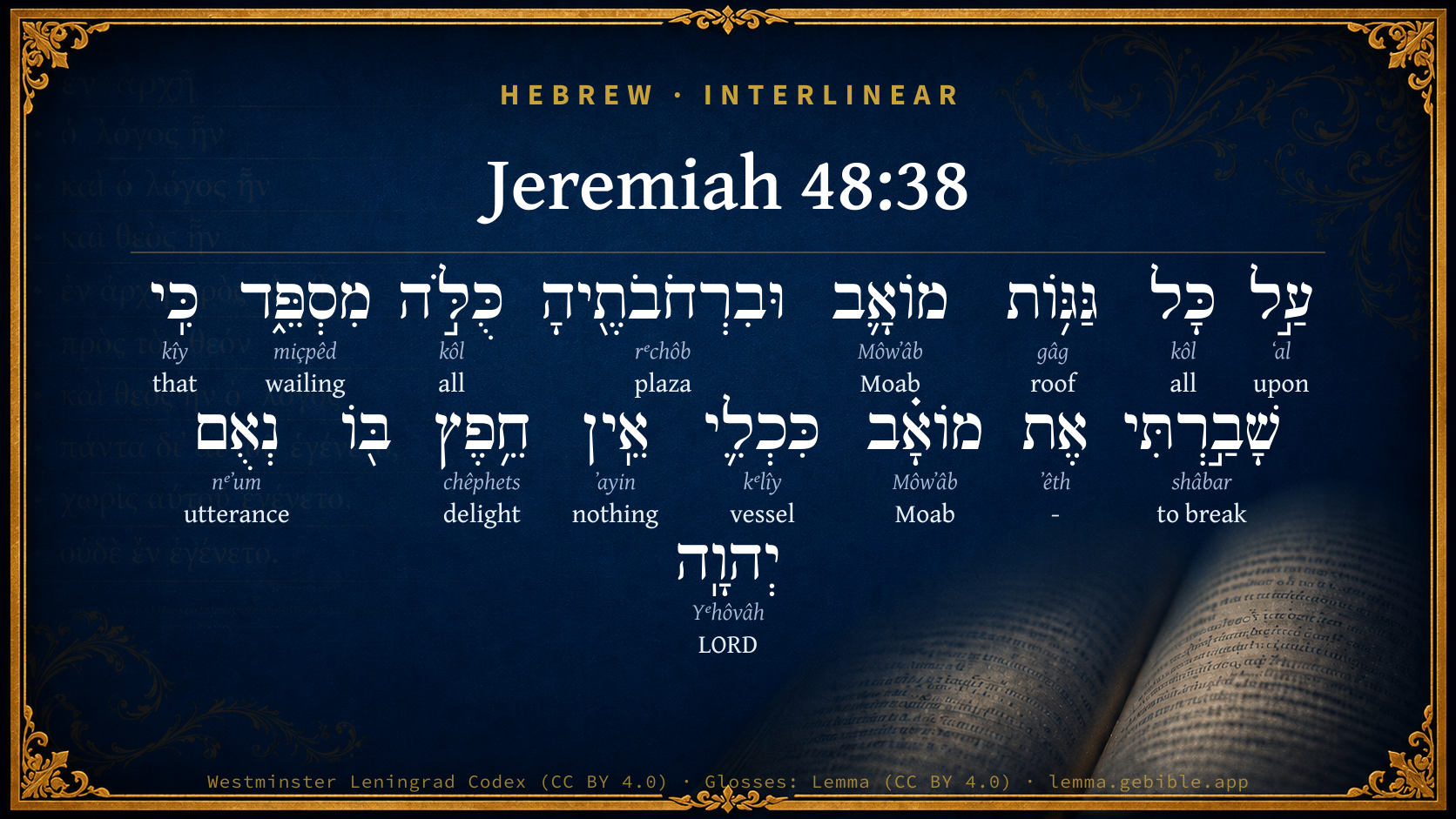
Jeremiah 48:38

Hebrew (Westminster Leningrad Codex) Jeremiah 48:38 appears in the Hebrew Old Testament. The text above is from the Westminster Leningrad Codex. Each word links to its Strong’s number, a concise gloss, and parsing drawn from the Open Scriptures Hebrew Bible morphology. Click any word for its full Brown-Driver-Briggs (BDB) entry.
Download image
Cite this verse

Jeremiah 48:38 (World English Bible). Public Domain. Lemma interlinear Bible study tool, https://lemma.gebible.app/v/jeremiah/48/38.

Show BibTeX & RIS
BibTeX
RIS
English Translation
On all the housetops of Moab and in the streets of it there is lamentation every where; for I have broken Moab like a vessel in which none delights, says Yahweh.
World English Bible · Public Domain
Download a study sheet

One document with this verse’s original text, its word-by-word gloss line, the meaning frame, cross-references with their text, attributed commentary, and full source and license credits — printable, and it pastes into notes with its structure intact.

This verse Autodidact and up

Study sheet (.html) Plain text (.txt)

A passage Seminary Student

Up to 50 verses in one chapter. A passage sheet keeps up to 6 commentary sources and 12 cross-references per verse, in the order this page ranks them, and says so on the sheet whenever that leaves anything out. Ask for a single verse and you get the Autodidact verse sheet above.

Everything on this page stays free to read, with no account — the sheet is a download of what is already on screen, not access to it.

Want to remove ads? Support Godless Engineer
Compare translations 3

The same verse in 3 English versions, stacked beneath the original-language interlinear above. Click any original word for its lexicon entry.

Each is an independent rendering of the whole verse — the interlinear is not word-aligned to these translations.

Highlighted words mark where these versions differ — a whole-verse word diff, not a word-by-word alignment.

  • World English Bible Public Domain
    On all the housetops of Moab and in the streets of it there is lamentation every where; for I have broken Moab like a vessel in which none delights, says Yahweh.
  • King James Version Public Domain
    There shall be lamentation generally upon all the housetops of Moab, and in the streets thereof: for I have broken Moab like a vessel wherein is no pleasure, saith the LORD.
  • unfoldingWord Literal Text CC BY-SA 4.0
    There is mourning everywhere, on every flat roof of Moab and in Moab’s plazas. For I have destroyed Moab like pots that no one wants—this is Yahweh’s declaration.

unfoldingWord Literal Text — © unfoldingWord, licensed CC BY-SA 4.0. Word-aligned USFM3 via Door43 (git.door43.org/unfoldingWord/en_ult).

Versions to compare (up to 4)

3 of 4 selected

Show all 18 translations

Every available English version of this verse, each an independent rendering of the whole verse.

  • World English Bible Public Domain
    On all the housetops of Moab and in the streets of it there is lamentation every where; for I have broken Moab like a vessel in which none delights, says Yahweh.
  • Berean Standard Bible Public Domain
    On all the rooftops of Moab and in the public squares, everyone is mourning; for I have shattered Moab like an unwanted jar,” declares the LORD.
  • Majority Standard Bible Public Domain
    On all the rooftops of Moab and in the public squares, everyone is mourning; for I have shattered Moab like an unwanted jar,” declares the LORD.
  • King James Version Public Domain
    There shall be lamentation generally upon all the housetops of Moab, and in the streets thereof: for I have broken Moab like a vessel wherein is no pleasure, saith the LORD.
  • American Standard Version (1901) Public Domain
    On all the housetops of Moab and in the streets thereof there is lamentation every where; for I have broken Moab like a vessel wherein none delighteth, saith Jehovah.
  • Revised Version (1885) Public Domain
    On all the housetops of Moab and in the streets thereof there is lamentation every where: for I have broken Moab like a vessel wherein is no pleasure, saith the LORD.
  • Geneva Bible (1599) Public Domain
    And mourning shall be vpon all the house toppes of Moab and in all the streetes thereof: for I haue broken Moab like a vessell wherein is no pleasure, sayeth the Lord.
  • Douay-Rheims (1899) Public Domain
    Upon all the housetops of Moab, and in the streets thereof general mourning: because I have broken Moab as an useless vessel, saith the Lord.
  • Young's Literal Translation Public Domain
    On all roofs of Moab, and in her broad-places, All of it -- `is' lamentation, For I have broken Moab as a vessel in which there is no pleasure, An affirmation of Jehovah.
  • Literal Standard Version CC BY-SA 4.0
    On all roofs of Moab, and in her broad-places, || All of it—lamentation, || For I have broken Moab as a vessel in which there is no pleasure,” || A declaration of YHWH.
  • Unlocked Literal Bible CC BY-SA 4.0
    There is mourning everywhere, on every flat roof of Moab and in Moab's plazas. For I have destroyed Moab like pots that no one wants—this is Yahweh's declaration.
  • unfoldingWord Literal Text CC BY-SA 4.0
    There is mourning everywhere, on every flat roof of Moab and in Moab’s plazas. For I have destroyed Moab like pots that no one wants—this is Yahweh’s declaration.
  • Darby Bible Public Domain
    It is wholly lamentation upon all the housetops of Moab, and in the public places thereof; for I have broken Moab, like a vessel wherein is no pleasure, saith Jehovah.
  • World Messianic Bible Public Domain
    On all the housetops of Moab, and in its streets, there is lamentation everywhere; for I have broken Moab like a vessel in which no one delights,” says the LORD.
  • Webster's Bible Public Domain
    There shall be lamentation generally upon all the house-tops of Moab, and in its streets: for I have broken Moab like a vessel in which is no pleasure, saith the LORD.
  • Free Bible Version CC BY-SA 4.0
    Everyone is mourning on all the flat roofs and streets of Moab, because I have smashed the country like a jar nobody wants, declares the Lord.
  • Bible in Basic English Public Domain
    On all the house-tops of Moab and in its streets there is weeping everywhere; for Moab has been broken like a vessel in which there is no pleasure, says the Lord.
  • JPS Tanakh (1917) Public Domain
    On all the housetops of Moab and in the broad places thereof there is lamentation every where; for I have broken Moab like a vessel wherein is no pleasure, saith the LORD.

Literal Standard Version (2020), Covenant Press — licensed CC BY-SA 4.0. Text via the HelloAO Bible API (eBible.org). Unlocked Literal Bible (unfoldingWord) — licensed CC BY-SA 4.0. Text via the HelloAO Bible API (eBible.org). unfoldingWord Literal Text — © unfoldingWord, licensed CC BY-SA 4.0. Word-aligned USFM3 via Door43 (git.door43.org/unfoldingWord/en_ult). Free Bible Version, Dr. Jonathan Gallagher — licensed CC BY-SA 4.0. Text via the HelloAO Bible API (eBible.org).

Word by word

More ways to search: Search by grammar → Find every occurrence → Compare this word →

Practice this passage: Drill this verse → Learn its vocabulary →

מִסְפֵּ֑ד
miçpêd
H4553
“wailing”
Noun, Common, Masculine, Singular, Absolute
Part of Speech
Noun
Type
Common
Gender
Masculine
Number
Singular
State
Absolute
Full BDB Definition

Origin: from H5594

TWOT: 1530a

wailing
  1. עַ֣ל ʻal H5921 “upon” Preposition
  2. כָּל kôl H3605 “all of” Noun, Common, Masculine, Singular, Construct
  3. גַּגּ֥וֹת gâg H1406 “roofs of” Noun, Common, Masculine, Plural, Construct
  4. מוֹאָ֛ב Môwʼâb H4124 “Moab” Noun, Proper
  5. וּבִרְחֹבֹתֶ֖יהָ rᵉchôb H7339 “and · in/at · plazas · her” Conjunction + Preposition + Noun, Common, Feminine, Plural, Construct + Suffix, Personal, 3rd Person, Feminine, Singular
  6. כֻּלֹּ֣ה kôl H3605 “all · her” Noun, Common, Masculine, Singular, Construct + Suffix, Personal, 3rd Person, Feminine, Singular
  7. כִּֽי kîy H3588 “that” Conjunction
  8. שָׁבַ֣רְתִּי shâbar H7665 “to break” Verb, Qal, Perfect, 1st Person, Common, Singular
  9. אֶת ʼêth H853 “-” Particle, Direct Object
  10. מוֹאָ֗ב Môwʼâb H4124 “Moab” Noun, Proper
  11. כִּכְלִ֛י kᵉlîy H3627 “like/as · vessel” Preposition + Noun, Common, Masculine, Singular, Absolute
  12. אֵֽין ʼayin H369 “nothing” Particle, Negative
  13. חֵ֥פֶץ chêphets H2656 “delight” Noun, Common, Masculine, Singular, Absolute
  14. נְאֻם nᵉʼum H5002 “utterance of” Noun, Common, Masculine, Singular, Construct
  15. יְהוָֽה Yᵉhôvâh H3068 “LORD” Noun, Proper

About this verse

These counts appear in no published source. They are computed here, from the morphology-tagged text and Lemma’s own curated glosses. What Lemma adds →

17
words
14
distinct lemmas
Prophets
section

Notable vocabulary

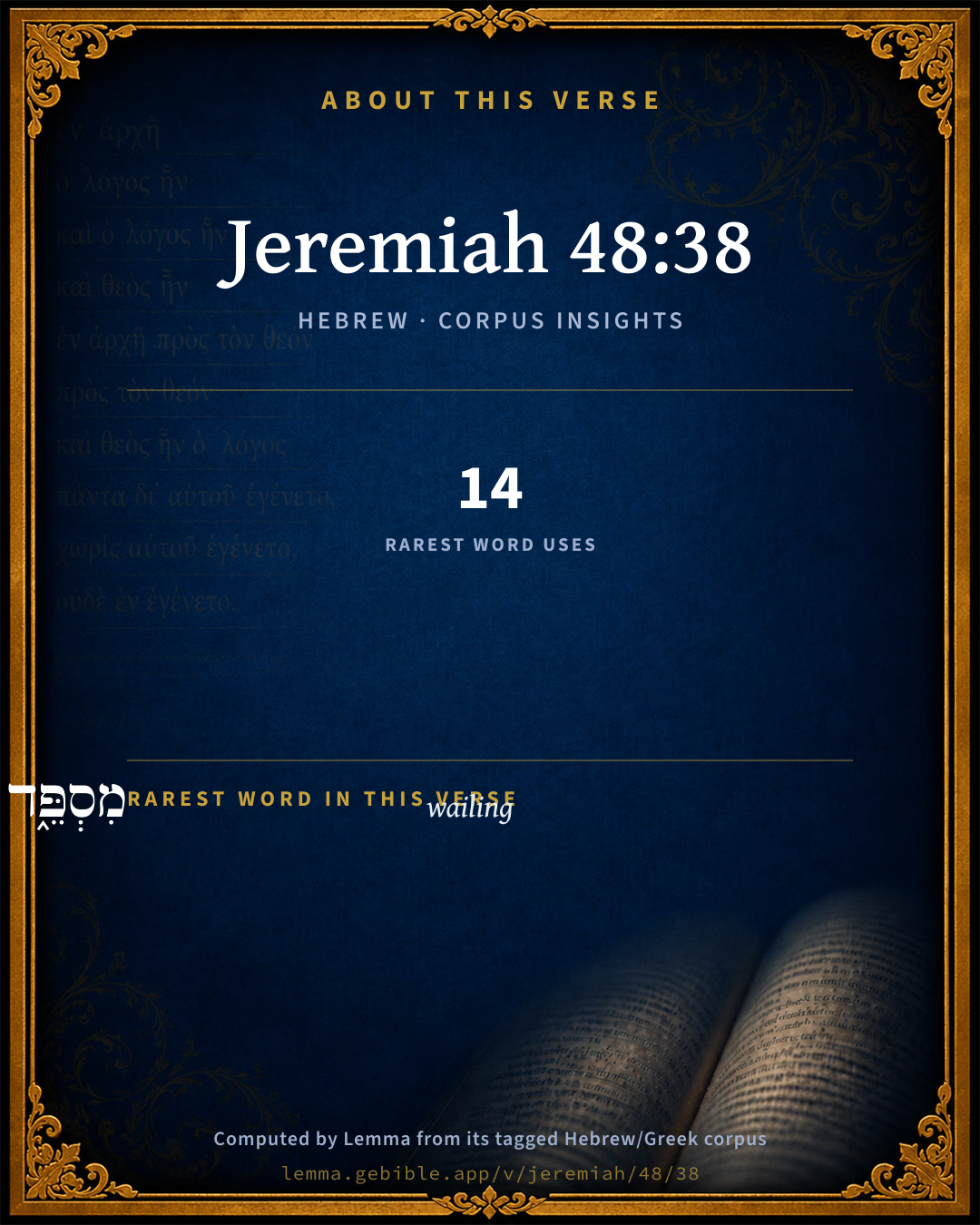
The rarest word here is מִסְפֵּ֑ד wailing H4553 — appearing just 14 times in the whole Hebrew Bible.

Shared distinctive vocabulary

מִסְפֵּ֑ד wailing H4553 occurs in 12 verses of the Hebrew Bible. Also found in:

Grammatical profile

  • 1 verb
  • 11 nouns
  • 2 prepositions
  • 1 conjunction
  • 2 particles

Verb forms

  • שָׁבַ֣רְתִּי Qal · Perfect

Repetition

Words recur within this verse — often emphatic in Hebrew:

  • כָּל all H3605 ×2
  • מוֹאָ֛ב Moab H4124 ×2

Cross-references

10

Topical passages linked to Jeremiah 48:38 in the Treasury of Scripture Knowledge — connected by theme and wording, ordered by reader-vote popularity; previews shown in the World English Bible.

  • Jeremiah 22:28 Is this man Coniah a despised broken vessel? is he a vessel in which none delights? why are they cast out, he and his seed, and are cast into the land which they don't know?
  • Isaiah 22:1 The burden of the valley of vision. What ails you now, that you are wholly gone up to the housetops?
  • Jeremiah 25:34 Wail, you shepherds, and cry; and wallow [in ashes], you principal of the flock; for the days of your slaughter and of your dispersions are fully come, and you shall fall like a goodly vessel.
  • Psalms 2:9 You shall break them with a rod of iron. You shall dash them in pieces like a potter's vessel."
  • Isaiah 15:3 In their streets they gird themselves with sackcloth; on their housetops, and in their broad places, everyone wails, weeping abundantly.
  • Isaiah 30:14 He shall break it as a potter's vessel is broken, breaking it in pieces without sparing; so that there shall not be found among the pieces of it a broken piece with which to take fire from the hearth, or to dip up water out of the cistern."
  • Hosea 8:8 Israel is swallowed up. Now they are among the nations like a worthless thing.
  • Romans 9:21–22 Or hasn't the potter a right over the clay, from the same lump to make one part a vessel for honor, and another for dishonor?
  • 2 Timothy 2:20–21 Now in a great house there are not only vessels of gold and of silver, but also of wood and of clay. Some are for honor, and some for dishonor.
  • Revelation 2:27 He will rule them with a rod of iron, shattering them like clay pots; as I also have received of my Father:

Cross-references courtesy of OpenBible.info (CC BY 4.0).

Hebrew and Greek witnesses Masoretic Hebrew ↔ Greek Septuagint

The same verse in the two great witnesses to the Old Testament, shown verse-for-verse.

These are two independent witnesses, not word-aligned to each other, and the Septuagint is shown in lemma (dictionary) form.

Hebrew Jeremiah 48:38 Masoretic · Westminster Leningrad Codex

עַ֣ל כָּל גַּגּ֥וֹת מוֹאָ֛ב וּבִרְחֹבֹתֶ֖יהָ כֻּלֹּ֣ה מִסְפֵּ֑ד כִּֽי שָׁבַ֣רְתִּי אֶת מוֹאָ֗ב כִּכְלִ֛י אֵֽין חֵ֥פֶץ בּ֖וֹ נְאֻם יְהוָֽה

On all the housetops of Moab and in the streets of it there is lamentation every where; for I have broken Moab like a vessel in which none delights, says Yahweh.

World English Bible · Public Domain

Greek LXX Structure differs

In the Septuagint, Jeremiah is about an eighth shorter than the Hebrew and arranges its material differently — the Oracles Against the Nations (Hebrew chapters 46–51) appear in the middle of the Greek book, after 25:13. Because the chapter and verse boundaries do not line up, a verse-for-verse comparison with the Hebrew is not shown.

A verse-for-verse comparison isn’t shown here because the chapters and verses don’t line up. Switch to the LXX edition with the MT / LXX toggle above to read the Greek directly.

Hebrew: Westminster Leningrad Codex (CC BY 4.0). Greek: Septuagint (public domain); English from a public-domain English Septuagint. How the Septuagint differs from the Hebrew →

Targum (Aramaic paraphrase)

1

The Targum is the ancient Jewish Aramaic paraphrase of the Hebrew Scriptures — an interpretive translation, not the Hebrew text itself. Onkelos (literal) and Pseudo-Jonathan (expansive) render the Torah, and Jonathan the Prophets. Coverage is partial: where no permissively-licensed English translation exists for a verse, only the Aramaic is shown. This is verse-level text, not a word-by-word alignment to the Hebrew.

  1. Targum Jonathan Prophets (Joshua–Malachi)
    עַל כָּל אֱגָרֵיהוֹן דְמוֹאֲבָאֵי וּבִרְחוֹבֵיהוֹן כּוּלְהוֹן עָבְדִין מִסְפֵּדָא אֲרֵי תְבָרֵית יַת מַלְכוּת מוֹאָב כְּמָנָא דְלֵית צְרוֹךְ בֵּיהּ אֲמַר יְיָ:

    (no public-domain English translation for this verse)

    Targum Jonathan — Aramaic: “Mikraot Gedolot” (public domain). English: “Sefaria Community Translation” (CC0 1.0 (public-domain dedication)); “London "Chaldee Paraphrase," 1871” (public domain). Text via Sefaria.

Commentary

Notes on Jeremiah 48:38 from classic Christian and Jewish commentators (each source and its license shown beneath its notes). The classic Christian expositions comment on the surrounding passage and are grouped to its opening verse, so a note may address several verses; the Jewish commentaries on the Tanakh (Rashi and others) are per-verse, so they appear only where the commentator wrote on this verse.

Lemma curates 59 commentaries, every one of them public domain or Creative Commons licensed, each selected and text-cleaned for this edition rather than reprinted as found. About our sources →

Trapp's Complete Commentary

John Trapp

Jer 48:38 [There shall be] lamentation generally upon all the housetops of Moab, and in the streets thereof: for I have broken Moab like a vessel wherein [is] no pleasure, saith the LORD.

Ver. 38. There shall be lamentation.] See Isa 15:3.

Like a vessel wherein is no pleasure.] See Jer 22:28.

John Trapp, A Commentary or Exposition upon All the Books of the Old and New Testament (1647–1656) — public domain. Text from a community e-Sword module.

Jamieson, Fausset & Brown

Robert Jamieson, A. R. Fausset & David Brown

vessel . . . no pleasure--(See Jer 22:28); a vessel cast aside by the potter as refuse, not answering his design.

Jamieson, Fausset & Brown — Commentary Critical and Explanatory on the Whole Bible (1871) — public domain (CC PDM 1.0). Text via the HelloAO Bible API.

John Calvin's Commentaries

The Prophet at the beginning of the verse continues the same subject, that the Moabites would weep and lament throughout all their houses and in all their streets The reason is added in the second clause, because God would bring a severe judgment on that nation.

By saying that there would be lamentation on all the roofs, he refers to what was customary at that time, for they had their walks on the roofs or tops of their houses. Then he says, that the Moabites, in order to be more seen and to excite pity, would ascend on the roofs, and cry, howl, and lament there. But we must observe what is added, that the calamity would come from God; for it would not have been sufficient to foretell adversity, except this was added, that God ascended his tribunal to execute his judgments when he thus chastised the people. He also compares the people of Moab to a despised vessel, in order to make a distinction between God’s children and aliens; for God does also chastise his own people when they sin, but he ceases not to love them and to regard them as precious. Now he says that Moab would be a vessel despised and rejected. It now follows, —

John Calvin's Commentaries (1540-1563) — public domain. Text from the Calvin Translation Society English edition (1840s-50s) via the Christian Classics Ethereal Library (ccel.org). Calvin's coverage is partial (roughly two-thirds of the Bible); uncommented books and verses are honest gaps, never fabricated. The 19th-century editor's footnotes and remarks are omitted so the notes are faithfully Calvin's own voice.

Ellicott's Commentary for English Readers

(38) Upon all the housetops of Moab.—The flat roof of Eastern houses was the natural gathering place of men in a time of panic and distress, as it was, in a time of peace, for prayer or meditation, or even for festive meetings. So in Isa_22:1, the city described as “the valley of vision” (Samaria or Jerusalem) is represented as “gone up to the house tops.”

I have broken Moab like a vessel wherein is no pleasure.—The image is one with which the prophet had made men familiar by his symbolic act in Jer_19:10. So Coniah was “a vessel wherein is no pleasure” (Jer_22:28).

A Bible Commentary for English Readers, edited by Charles John Ellicott (1878–1897) — public domain. Text from a community e-Sword module.

The Cambridge Bible for Schools and Colleges

gen. ed. J. J. S. Perowne

38. vessel, etc.] See on Jer_22:28.

The Cambridge Bible for Schools and Colleges (gen. ed. J. J. S. Perowne; Cambridge University Press, 1878–1918) — public domain. Text from a community e-Sword module.

John Gill's Exposition

They shall howl, saying, how is it broken down?.... Or, "how is it broken" or "thrown into consternation (p)? they howl"; that is, they howl out these words, or, while they are howling, say, how is Kirheres or Moab broken all to pieces; their strength, power, and glory; their cities, and their mighty men; and are in the utmost fright and confusion? Jarchi takes it to be an imperative, and paraphrases it,

"howl ye over her (q), and say, how is it broken!''

Kimchi says it may be taken either as in the past or in the imperative;

how hath Moab turned the back with shame? not being able to look their enemies in the face, but obliged to flee before them;

so shall Moab be a derision and a dismaying to all them about him; a derision to some, to their enemies, as Israel had been to them, and so they are paid in their own coin; and a consternation to others, their friends, who would fear sharing the same fate, at the hands of the Chaldeans.

(p) "quomodo consternata est", Piscator, Schmidt. (q) "ululate", Munster, Piscator; "ejulate", Junius & Tremellius.

John Gill's Exposition of the Whole Bible (1746–1763) — public domain (CC PDM 1.0). Text via the HelloAO Bible API.

Albert Barnes' Notes on the Bible

Generally - Rather, entirely.

Albert Barnes' Notes on the Bible (1834–1885) — public domain. Text from a community e-Sword/MySword module.

Matthew Poole's English Annotations

We met with the same phrase applied to Coniah, Jer 22:28. The meaning is, I have broken Moab all to pieces, as people use to do vessels they care not for; they never go about to mend such a vessel, but dash it in pieces against some stones or walls.

Matthew Poole's English Annotations on the Holy Bible (1683–1685) — public domain. Text from a community e-Sword/MySword module.

The Pulpit Commentary

Lamentation generally; literally, all of it is lamentation; i.e. nothing else is to be heard. Like a vessel, etc. For this figure, see on Jer_22:28 (Jeremiah repeats himself).

The broken vessel

I NOT BROKEN BY ACCIDENT. A vessel broken by accident would not have furnished the proper figure. Lives that are as real serviceable vessels in the hand of God never do get broken by accident. Earthen vessels though they often be, there is a providence and a watchfulness which preserves them till their work is done. They are kept through days of persecution; they are restored from sickness; they live on into a good old age, while men apparently stronger and of greater physical resource are stricken down. And when there seems sometimes a premature and unaccountable breaking, yet it is really to be regarded in another light, namely, as a change to higher and fuller service.

II NOT BROKEN BY CAPRICE. That which is not broken accidentally must have been broken purposely. And if purposely, either with a reason or through mere recklessness. Men too often destroy things in a reckless, thoughtless way, from the first unconsidered impulse that comes into the mind. It is an action in which is expressed, by a sort of bravado, the sentiment that a man may do what he likes with his own. But God would ever have us feel that, though he has made the world and all that therein is, his disposition of these works is regulated by fixed laws, and our disposition of things under our control should be regulated in the same way. Never let it be said of us that we have destroyed or injured anything without sufficient reason. We should not even pull a flower to pieces through mere thoughtlessness, mere vacuity of mind.

III BROKEN FOR A SUFFICIENT REASON. Moab is a vessel in which there is no pleasure. It is of no real use to God. Whether we shall be vessels of use to God or not depends upon whether we put ourselves as clay into his hands as Potter. Moab was a nation which had loved to shape its own life, to hew its own designs. And just in proportion as it persevered in this path did it become useless to God. Appearance is only a small thing. The first consideration is use. The commonest earthenware pitcher, if without a flaw, is worth more than a cracked golden pitcher that will hold no water worth more, that is, as a pitcher. Gold is a rare, glittering, fascinating thing compared with common earth, but after all it is the common earth out of which vessels are made for daily use. The real value of a human life depends upon what God gets out of it. Y.

The Pulpit Commentary (1880–1919), ed. H.D.M. Spence-Jones & Joseph S. Exell — public domain. Text from a community e-Sword module.

unfoldingWord translationNotes

Door43 World Missions Community

There is mourning everywhere

The abstract noun "mourning" can be stated as a verb. AT: "There are people mourning everywhere" (See: Abstract Nouns)

every flat roof

"every housetop"

plazas

open public areas, such as open marketplaces

For I have destroyed

The word "I" refers to Yahweh

this is Yahweh's declaration

Yahweh speaks of himself by name to express the certainty of what he is declaring. See how you translated this in Jeremiah 1:8. AT: "this is what Yahweh has declared" or "this is what I, Yahweh, have declared" (See: First, Second, or Third Person)

How it has been shattered! How they howl in their lamenting!

Here "How" begins exclamations. The phrase "has been shattered" can be stated in active form. AT: "I have completely shattered them! They shout loudly and weep!" (See: Exclamations and Active or Passive)

howl

a sad and loud cry that a person makes when he is in pain

Moab turns its back in shame

Here Moab represents the people. To turn one's back is a sign of feeling ashamed. AT: "The people of Moab turn their backs in shame" or "The people of Moab are ashamed and will not show their faces" (See: Metonymy and Symbolic Action)

So Moab will become an object of derision and a terror to all those who are around him

This can be restated to remove the abstract nouns "derision" and "terror." AT: "So all the people nearby will be terrified at what happened to the people of Moab and they will mock them" (See: Abstract Nouns)

translationWords

mourn

terror

unfoldingWord translationNotes — © Distant Shores Media and the Door43 World Missions Community, licensed CC BY-SA 4.0. Source: git.door43.org/Door43/en_tn.

Lesson kit

Teaching starters — assembled from the data on this page, not authored interpretation. Every prompt links to the verse data it draws on. Edit before teaching.

Jeremiah, in the Prophets, opens this verse with 17 words (14 distinct Hebrew lemmas). Its most distinctive word is miçpêd (“wailing”). A historical commentator’s framing appears above. Read the whole chapter for the surrounding context.

Discussion questions

  1. How does “wailing” (miçpêd) shape what this verse is saying?
  2. Genesis 50:10 shares the word «wailing» with this verse. How do the two illuminate each other?
  3. “all” occurs 2× in this one verse. What is the effect of the repetition?
  4. The translations on this page render this verse differently — a whole-verse word diff, not a word-by-word alignment. What might account for the different wordings?
  5. The verb «שָׁבַ֣רְתִּי» is Qal Perfect. How does its form color the action?
  6. Reading how Trapp's Complete Commentary and Jamieson, Fausset & Brown read this verse, where do the two commentators agree and where do they part?

Things to notice

Reading settings

Reading text

Shown beneath each verse's original-language words.

Old Testament
Old Testament edition

Read the OT as the Masoretic Hebrew (MT) or the Greek Septuagint (LXX).

English shown for the Greek Septuagint (in the Hebrew ↔ Greek comparison).

Comparing translations? Open the Compare panel on any verse page to stack up to four side by side.