
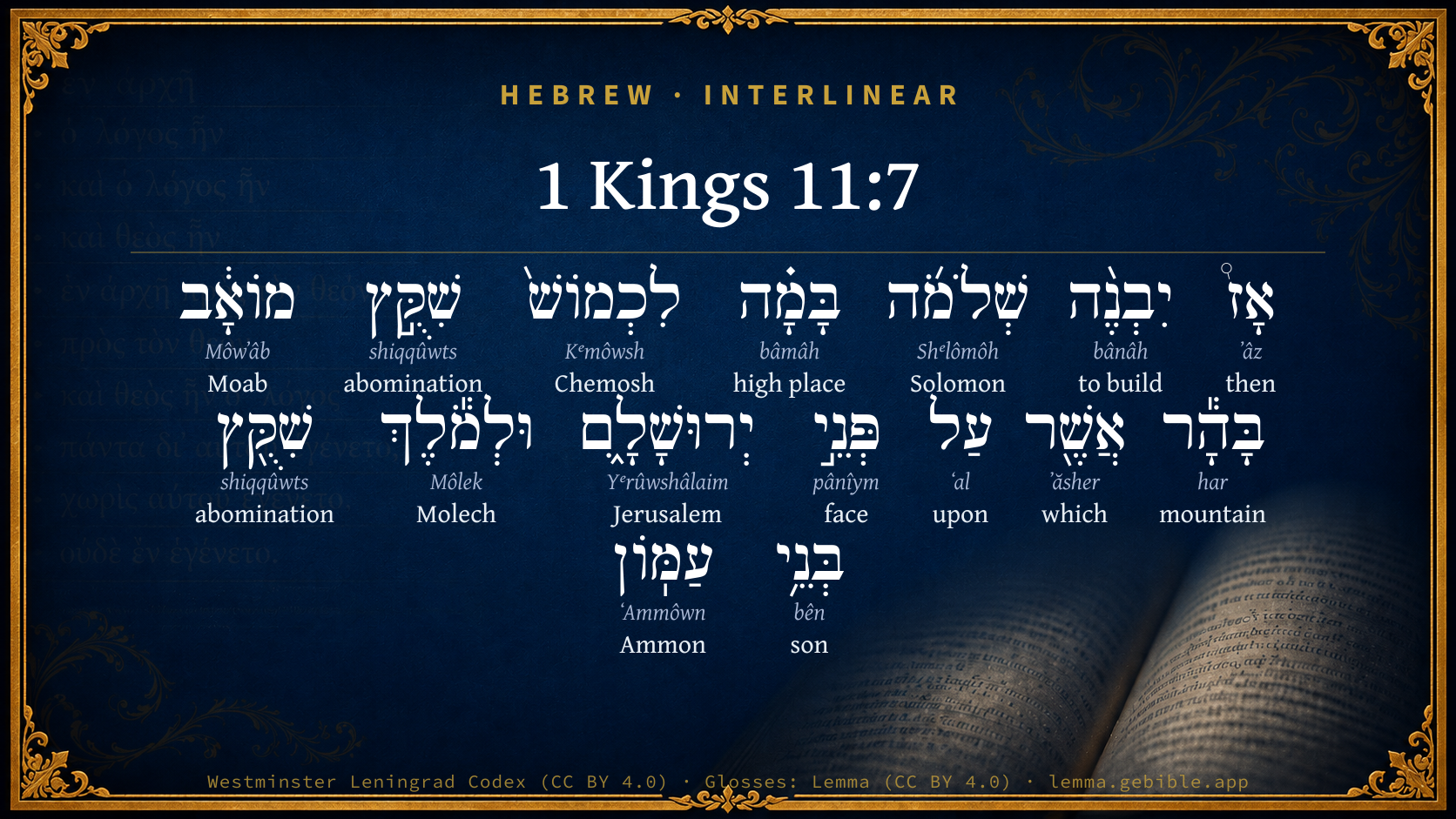
1 Kings 11:7

Hebrew (Westminster Leningrad Codex) 1 Kings 11:7 appears in the Hebrew Old Testament. The text above is from the Westminster Leningrad Codex. Each word links to its Strong’s number, a concise gloss, and parsing drawn from the Open Scriptures Hebrew Bible morphology. Click any word for its full Brown-Driver-Briggs (BDB) entry.
Download image
Cite this verse

1 Kings 11:7 (World English Bible). Public Domain. Lemma interlinear Bible study tool, https://lemma.gebible.app/v/1-kings/11/7.

Show BibTeX & RIS
BibTeX
RIS
English Translation
Then did Solomon build a high place for Chemosh the abomination of Moab, on the mountain that is before Jerusalem, and for Molech the abomination of the children of Ammon.
World English Bible · Public Domain
Download a study sheet

One document with this verse’s original text, its word-by-word gloss line, the meaning frame, cross-references with their text, attributed commentary, and full source and license credits — printable, and it pastes into notes with its structure intact.

This verse Autodidact and up

Study sheet (.html) Plain text (.txt)

A passage Seminary Student

Up to 50 verses in one chapter. A passage sheet keeps up to 6 commentary sources and 12 cross-references per verse, in the order this page ranks them, and says so on the sheet whenever that leaves anything out. Ask for a single verse and you get the Autodidact verse sheet above.

Everything on this page stays free to read, with no account — the sheet is a download of what is already on screen, not access to it.

Want to remove ads? Support Godless Engineer
Compare translations 3

The same verse in 3 English versions, stacked beneath the original-language interlinear above. Click any original word for its lexicon entry.

Each is an independent rendering of the whole verse — the interlinear is not word-aligned to these translations.

Highlighted words mark where these versions differ — a whole-verse word diff, not a word-by-word alignment.

  • World English Bible Public Domain
    Then did Solomon build a high place for Chemosh the abomination of Moab, on the mountain that is before Jerusalem, and for Molech the abomination of the children of Ammon.
  • King James Version Public Domain
    Then did Solomon build an high place for Chemosh, the abomination of Moab, in the hill that is before Jerusalem, and for Molech, the abomination of the children of Ammon.
  • unfoldingWord Literal Text CC BY-SA 4.0
    Then Solomon built a high place for Chemosh, the abomination of Moab, on the hill that on the face of Jerusalem, and for Molech, the abomination of the sons of Ammon.

unfoldingWord Literal Text — © unfoldingWord, licensed CC BY-SA 4.0. Word-aligned USFM3 via Door43 (git.door43.org/unfoldingWord/en_ult).

Versions to compare (up to 4)

3 of 4 selected

Show all 18 translations

Every available English version of this verse, each an independent rendering of the whole verse.

  • World English Bible Public Domain
    Then did Solomon build a high place for Chemosh the abomination of Moab, on the mountain that is before Jerusalem, and for Molech the abomination of the children of Ammon.
  • Berean Standard Bible Public Domain
    At that time on a hill east of Jerusalem, Solomon built a high place for Chemosh the abomination of Moab and for Molech the abomination of the Ammonites.
  • Majority Standard Bible Public Domain
    At that time on a hill east of Jerusalem, Solomon built a high place for Chemosh the abomination of Moab and for Molech the abomination of the Ammonites.
  • King James Version Public Domain
    Then did Solomon build an high place for Chemosh, the abomination of Moab, in the hill that is before Jerusalem, and for Molech, the abomination of the children of Ammon.
  • American Standard Version (1901) Public Domain
    Then did Solomon build a high place for Chemosh the abomination of Moab, in the mount that is before Jerusalem, and for Molech the abomination of the children of Ammon.
  • Revised Version (1885) Public Domain
    Then did Solomon build an high place for Chemosh the abomination of Moab, in the mount that is before Jerusalem, and for Molech the abomination of the children of Ammon.
  • Geneva Bible (1599) Public Domain
    Then did Salomon build an hie place for Chemosh the abomination of Moab, in the mountaine that is ouer against Ierusalem, and vnto Molech the abomination of the children of Ammon.
  • Douay-Rheims (1899) Public Domain
    Then Solomon built a temple for Chamos the idol of Moab, on the hill that is over against Jerusalem, and for Moloch the idol of the children of Ammon.
  • Young's Literal Translation Public Domain
    Then doth Solomon build a high place for Chemosh the abomination of Moab, in the hill that `is' on the front of Jerusalem, and for Molech the abomination of the sons of Ammon;
  • Literal Standard Version CC BY-SA 4.0
    Then Solomon builds a high place for Chemosh the abomination of Moab, in the hill that [is] on the front of Jerusalem, and for Molech the abomination of the sons of Ammon;
  • Unlocked Literal Bible CC BY-SA 4.0
    Then Solomon built a high place for Chemosh, the disgusting idol of Moab, on a hill east of Jerusalem, and also for Molech, the disgusting idol of the people of Ammon.
  • unfoldingWord Literal Text CC BY-SA 4.0
    Then Solomon built a high place for Chemosh, the abomination of Moab, on the hill that on the face of Jerusalem, and for Molech, the abomination of the sons of Ammon.
  • Darby Bible Public Domain
    Then did Solomon build a high place for Chemosh the abomination of the Moabites, on the hill that is before Jerusalem, and for Molech the abomination of the children of Ammon.
  • World Messianic Bible Public Domain
    Then Solomon built a high place for Chemosh the abomination of Moab, on the mountain that is before Jerusalem, and for Molech the abomination of the children of Ammon.
  • Webster's Bible Public Domain
    Then Solomon built a high place for Chemosh, the abomination of Moab, in the hill that is before Jerusalem, and for Molech, the abomination of the children of Ammon.
  • Free Bible Version CC BY-SA 4.0
    It was then that Solomon built a high place of worship for Chemosh, the vile god of the people of Moab, and for Molech, the vile god of the Ammonites, on a hill east of Jerusalem.
  • Bible in Basic English Public Domain
    Then Solomon put up a high place for Chemosh, the disgusting god of Moab, in the mountain before Jerusalem, and for Molech, the disgusting god worshipped by the children of Ammon.
  • JPS Tanakh (1917) Public Domain
    Then did Solomon build a high place for Chemosh the detestation of Moab, in the mount that is before Jerusalem, and for Molech the detestation of the children of Ammon.

Literal Standard Version (2020), Covenant Press — licensed CC BY-SA 4.0. Text via the HelloAO Bible API (eBible.org). Unlocked Literal Bible (unfoldingWord) — licensed CC BY-SA 4.0. Text via the HelloAO Bible API (eBible.org). unfoldingWord Literal Text — © unfoldingWord, licensed CC BY-SA 4.0. Word-aligned USFM3 via Door43 (git.door43.org/unfoldingWord/en_ult). Free Bible Version, Dr. Jonathan Gallagher — licensed CC BY-SA 4.0. Text via the HelloAO Bible API (eBible.org).

Word by word

More ways to search: Search by grammar → Find every occurrence → Compare this word →

Practice this passage: Drill this verse → Learn its vocabulary →

לִכְמוֹשׁ֙
Kᵉmôwsh
H3645
“to/for · Chemosh”
Preposition + Noun, Proper
Part of Speech
Preposition + Noun
Type
Proper
Full BDB Definition

Origin: from an unused root meaning to subdue

TWOT: None

Chemosh = "subduer" - the national deity of the Moabites and a god of the Ammonites - also identified with 'Baal-peor', 'Baal-zebub', 'Mars' and 'Saturn' - worship of this god was introduced into Jerusalem by Solomon and abolished by king Josiah of Judah
  1. אָז֩ ʼâz H227 “then” Adverb
  2. יִבְנֶ֨ה bânâh H1129 “to build” Verb, Qal, Imperfect, 3rd Person, Masculine, Singular
  3. שְׁלֹמֹ֜ה Shᵉlômôh H8010 “Solomon” Noun, Proper
  4. בָּמָ֗ה bâmâh H1116 “high place” Noun, Common, Feminine, Singular, Absolute
  5. שִׁקֻּ֣ץ shiqqûwts H8251 “abomination of” Noun, Common, Masculine, Singular, Construct
  6. מוֹאָ֔ב Môwʼâb H4124 “Moab” Noun, Proper
  7. בָּהָ֕ר har H2022 “in/at the · mountain” Preposition, Determined + Noun, Common, Masculine, Singular, Absolute
  8. אֲשֶׁ֖ר ʼăsher H834 “which” Particle, Relative
  9. עַל ʻal H5921 “upon” Preposition
  10. פְּנֵ֣י pânîym H6440 “face(s) of” Noun, Common, Both, Plural, Construct
  11. יְרוּשָׁלִָ֑ם Yᵉrûwshâlaim H3389 “Jerusalem” Noun, Proper
  12. וּלְמֹ֕לֶךְ Môlek H4432 “and · to/for · Molech” Conjunction + Preposition + Noun, Proper
  13. שִׁקֻּ֖ץ shiqqûwts H8251 “abomination of” Noun, Common, Masculine, Singular, Construct
  14. בְּנֵ֥י bên H1121 “sons of” Noun, Common, Masculine, Plural, Construct
  15. עַמּֽוֹן ʻAmmôwn H5983 “Ammon” Noun, Proper

About this verse

These counts appear in no published source. They are computed here, from the morphology-tagged text and Lemma’s own curated glosses. What Lemma adds →

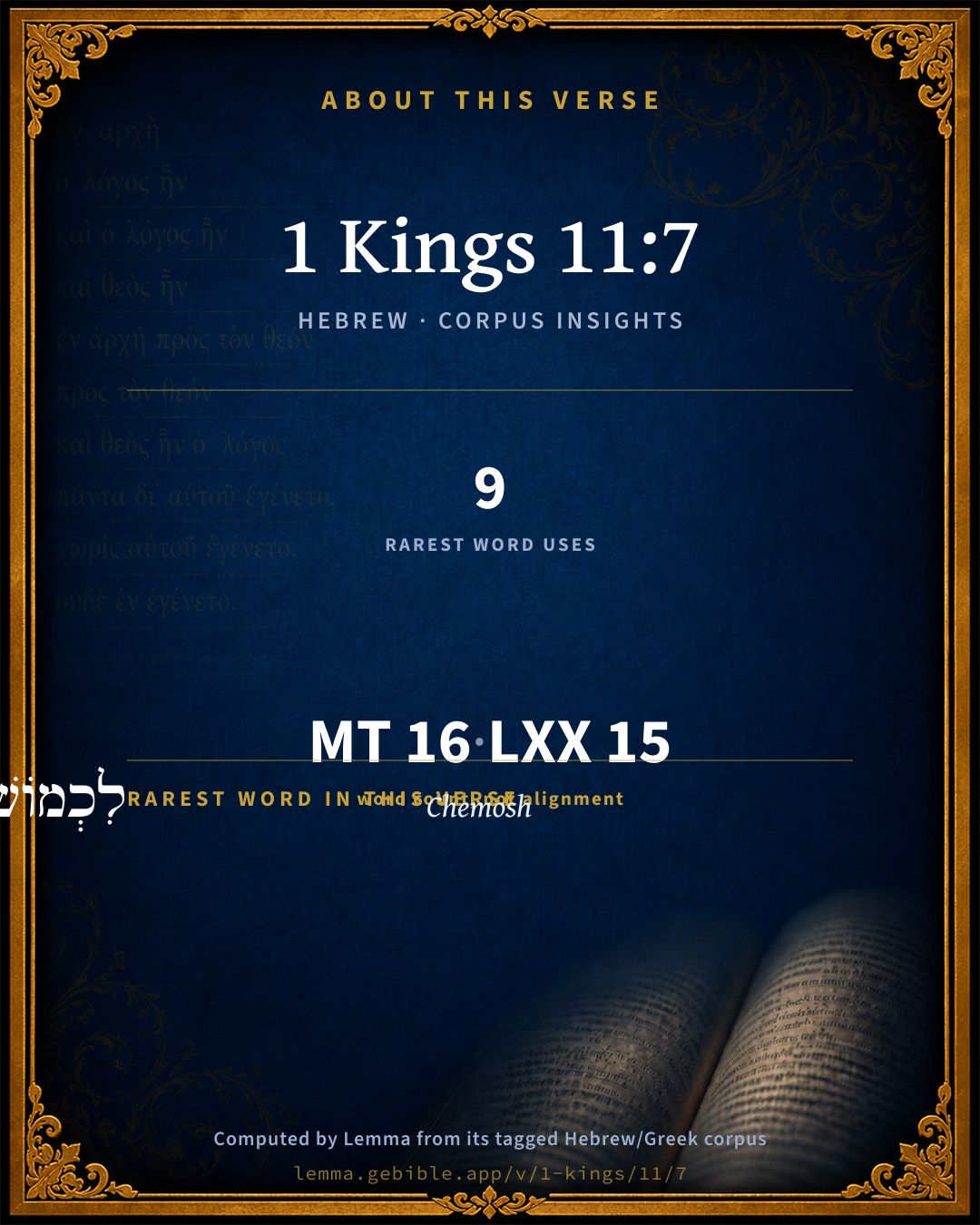
16
words
15
distinct lemmas
Historical
section

Notable vocabulary

The rarest word here is לִכְמוֹשׁ֙ Chemosh H3645 — appearing just 9 times in the whole Hebrew Bible.

Shared distinctive vocabulary

לִכְמוֹשׁ֙ Chemosh H3645 occurs in 8 verses of the Hebrew Bible. Also found in:

Grammatical profile

  • 1 verb
  • 12 nouns
  • 1 preposition
  • 1 adverb
  • 1 particle

Verb forms

  • יִבְנֶ֨ה Qal · Imperfect

Repetition

A word recurs within this verse — often emphatic in Hebrew:

  • שִׁקֻּ֣ץ abomination H8251 ×2

Hebrew & Septuagint length

In the original languages it is 16 Hebrew tokens and 15 Greek tokens — but the two are counted differently (Hebrew bundles its prefixes and suffixes into one token; the Greek is in lemma form), so that isn’t a like-for-like length.

Cross-references

26

Topical passages linked to 1 Kings 11:7 in the Treasury of Scripture Knowledge — connected by theme and wording, ordered by reader-vote popularity; previews shown in the World English Bible.

  • Numbers 21:29 Woe to you, Moab! You are undone, people of Chemosh: He has given his sons as fugitives, His daughters into captivity, To Sihon king of the Amorites.
  • Judges 11:24 Won't you possess that which Chemosh your god gives you to possess? So whoever Yahweh our God has dispossessed from before us, them will we possess.
  • Acts 7:43 You took up the tent of Moloch, The star of your god Rephan, The figures which you made to worship. I will carry you away beyond Babylon.'
  • Genesis 33:2 He put the handmaids and their children in front, Leah and her children after, and Rachel and Joseph at the rear.
  • Leviticus 20:2–5 "Moreover, you shall tell the children of Israel, 'Anyone of the children of Israel, or of the strangers who live as foreigners in Israel, who gives any of his seed to Molech; he shall surely be put to death. The people of the land shall stone him with stones.
  • Leviticus 26:30 I will destroy your high places, and cut down your incense altars, and cast your dead bodies upon the bodies of your idols; and my soul will abhor you.
  • Numbers 33:52 then you shall drive out all the inhabitants of the land from before you, and destroy all their figured [stones], and destroy all their molten images, and demolish all their high places:
  • Deuteronomy 13:14 then shall you inquire, and make search, and ask diligently; and, behold, if it be truth, and the thing certain, that such abomination is done in the midst of you,
  • Deuteronomy 17:3–4 and has gone and served other gods, and worshiped them, or the sun, or the moon, or any of the host of the sky, which I have not commanded;
  • Deuteronomy 27:15 Cursed be the man who makes an engraved or molten image, an abomination to Yahweh, the work of the hands of the craftsman, and sets it up in secret. All the people shall answer and say, Amen.
  • 2 Samuel 15:30 David went up by the ascent of the [Mount of] Olives, and wept as he went up; and he had his head covered, and went barefoot: and all the people who were with him covered every man his head, and they went up, weeping as they went up.
  • 2 Kings 21:2–3 He did that which was evil in the sight of Yahweh, after the abominations of the nations whom Yahweh cast out before the children of Israel.
  • 2 Kings 23:10 He defiled Topheth, which is in the valley of the children of Hinnom, that no man might make his son or his daughter to pass through the fire to Molech.
  • 2 Kings 23:13–14 The high places that were before Jerusalem, which were on the right hand of the mountain of corruption, which Solomon the king of Israel had built for Ashtoreth the abomination of the Sidonians, and for Chemosh the abomination of Moab, and for Milcom the abomination of the children of Ammon, did the king defile.
  • Psalms 78:58 For they provoked him to anger with their high places, And moved him to jealousy with their engraved images.
  • Isaiah 44:19 None calls to mind, neither is there knowledge nor understanding to say, I have burned part of it in the fire; yes, also I have baked bread on the coals of it; I have roasted flesh and eaten it: and shall I make the residue of it an abomination? shall I fall down to the stock of a tree?
  • Jeremiah 48:13 Moab shall be ashamed of Chemosh, as the house of Israel was ashamed of Bethel their confidence.
  • Ezekiel 18:12 has wronged the poor and needy, has taken by robbery, has not restored the pledge, and has lifted up his eyes to the idols, has committed abomination,
  • Ezekiel 20:28–29 For when I had brought them into the land, which I swore to give to them, then they saw every high hill, and every thick tree, and they offered there their sacrifices, and there they presented the provocation of their offering; there also they made their sweet savor, and they poured out there their drink-offerings.
  • Daniel 11:31 Forces shall stand on his part, and they shall profane the sanctuary, even the fortress, and shall take away the continual [burnt offering], and they shall set up the abomination that makes desolate.
  • Daniel 12:11 From the time that the continual [burnt offering] shall be taken away, and the abomination that makes desolate set up, there shall be one thousand two hundred ninety days.
  • Zechariah 14:4 His feet will stand in that day on the Mount of Olives, which is before Jerusalem on the east; and the Mount of Olives will be split in two, from east to west, making a very great valley. Half of the mountain will move toward the north, and half of it toward the south.
  • Matthew 26:30 When they had sung a hymn, they went out to the Mount of Olives.
  • Acts 1:9 When he had said these things, as they were looking, he was taken up, and a cloud received him out of their sight.
  • Acts 1:12 Then they returned to Jerusalem from the mountain called Olivet, which is near Jerusalem, a Sabbath day's journey away.
  • Revelation 17:4–5 The woman was dressed in purple and scarlet, and decked with gold and precious stones and pearls, having in her hand a golden cup full of abominations and the impurities of the sexual immorality of the earth.

Cross-references courtesy of OpenBible.info (CC BY 4.0).

Hebrew and Greek witnesses Masoretic Hebrew ↔ Greek Septuagint

The same verse in the two great witnesses to the Old Testament, shown verse-for-verse.

These are two independent witnesses, not word-aligned to each other, and the Septuagint is shown in lemma (dictionary) form.

Hebrew 1 Kings 11:7 Masoretic · Westminster Leningrad Codex

אָז֩ יִבְנֶ֨ה שְׁלֹמֹ֜ה בָּמָ֗ה לִכְמוֹשׁ֙ שִׁקֻּ֣ץ מוֹאָ֔ב בָּהָ֕ר אֲשֶׁ֖ר עַל פְּנֵ֣י יְרוּשָׁלִָ֑ם וּלְמֹ֕לֶךְ שִׁקֻּ֖ץ בְּנֵ֥י עַמּֽוֹן

Then did Solomon build a high place for Chemosh the abomination of Moab, on the mountain that is before Jerusalem, and for Molech the abomination of the children of Ammon.

World English Bible · Public Domain

Greek LXX 1 Kings 11:7 Septuagint · lemma form

καί οὕτως ποιέω πᾶς ὁ γυνή αὐτός ὁ ἀλλότριος θυμιάζω καί θύω ὁ εἴδωλον αὐτός

No English rendering of this Greek verse — the small residue in the structurally divergent books.

On this verse, The Cambridge Bible for Schools and Colleges discusses the Septuagint’s reading. Read the note in Commentary ↓

Hebrew: Westminster Leningrad Codex (CC BY 4.0). Greek: Septuagint (public domain); English from a public-domain English Septuagint. How the Septuagint differs from the Hebrew →

Targum (Aramaic paraphrase)

1

The Targum is the ancient Jewish Aramaic paraphrase of the Hebrew Scriptures — an interpretive translation, not the Hebrew text itself. Onkelos (literal) and Pseudo-Jonathan (expansive) render the Torah, and Jonathan the Prophets. Coverage is partial: where no permissively-licensed English translation exists for a verse, only the Aramaic is shown. This is verse-level text, not a word-by-word alignment to the Hebrew.

  1. Targum Jonathan Prophets (Joshua–Malachi)
    בְּכֵן בְּנָא שְׁלֹמֹה בָּמָתָא לִכְמוֹשׁ שִׁקוּץ מוֹאָב בְּטוּרָא דִי עַל אַפֵּי יְרוּשְׁלֵם וּלְמוֹלֶךְ שִׁקוּץ בְּנֵי עַמוֹן:

    (no public-domain English translation for this verse)

    Targum Jonathan — Aramaic: “Mikraot Gedolot” (public domain). English: “Sefaria Community Translation” (CC0 1.0 (public-domain dedication)); “London "Chaldee Paraphrase," 1871” (public domain). Text via Sefaria.

Commentary

Notes on 1 Kings 11:7 from classic Christian and Jewish commentators (each source and its license shown beneath its notes). The classic Christian expositions comment on the surrounding passage and are grouped to its opening verse, so a note may address several verses; the Jewish commentaries on the Tanakh (Rashi and others) are per-verse, so they appear only where the commentator wrote on this verse.

Lemma curates 59 commentaries, every one of them public domain or Creative Commons licensed, each selected and text-cleaned for this edition rather than reprinted as found. About our sources →

Trapp's Complete Commentary

John Trapp

1Ki 11:7 Then did Solomon build an high place for Chemosh, the abomination of Moab, in the hill that [is] before Jerusalem, and for Molech, the abomination of the children of Ammon.

Ver. 7. For Chemosh.] Unde Kωμος et Comessatio. Some take it to be Bacchus, others Pluto.

In the hill that is before Jerusalem.] Even in Mount Olivet - called for that cause, the "mount of corruption" and of "scandal" {2Ki 23:13} - in the very face of God’s house; so that God never looked out of the sanctuary, but he saw that vile hill of abominations.

John Trapp, A Commentary or Exposition upon All the Books of the Old and New Testament (1647–1656) — public domain. Text from a community e-Sword module.

The Biblical Illustrator

Joseph S. Exell

1Ki_11:7-8

Then did Solomon build an high place for Chemosh.

Solomon and toleration

1. Proverbs, it has been said, are the wisdom of many and the wit of one, at least they are most often trustworthy exponents of a uniform experience. And there is a proverb which tells us that no one ever became thoroughly bad all at once. And so it was with Solomon; as the stream of his career sweeps by us in Holy Scripture, windows, as it were, are opened for us through which we gaze out on that sunny flood, so full of promise, carrying on its bosom such rich opportunities and varied treasures, and we note that as it gets wider it loses its pure beauty, as it gets deeper it parts with its simplicity. Here and there these glimpses into his life prepare us for a catastrophe. It requires a vast store of wisdom to keep a man unspoiled amidst popular applause. The power of wealth with all its opportunities may very easily sweep away the calmer dictates of a higher reason. Solomon is the liberal patron of error. He is not an idolater; it would not be fair to call him that. But as he would tell us, he is no bigot, that the Zidonians and Moabites were sincere in what they believed and practised. That his first duty was to the empire, and to consolidate the acquisitions which he had made. After all, there is an element of truth underlying all religions--All worships are true. Take care, Solomon! The next step is only too easily taken,. which goes on to proclaim, All worships are false. I suppose there is no chapter in Church history which we look back upon with such unfeigned horror and humiliation as that which deals with religious persecution. We never shall forget the fires of Smithfield, or look with anything but disapproval at the stern and repressive violence of the Puritan Rebellion. At the same time it must be remembered that there is one thing which, if less repulsive, may be equally deadly in Gods sight. Toleration, which springs from a real respect for our neighbours convictions, is one thing; indifference, which does not feel strongly enough to oppose, is another. At the present moment we are oddly enough confronted with these two developments combining in their efforts to weaken religion.

2. But Solomon does not stop at undenominationalism. No one does. It is an impossible position. He settles down a step further into aestheticism--the worship of the beautiful, the luxurious, the fascinating. A protest against Ritualism is, no doubt, an excellent thing in which every intelligent Churchman should join, if we mean by the term a religion which consists of mere rites and ceremonies, void of real significance, subversive of the sterner realities of religious truth. There is always a tendency, in view of the extreme difficulty of religion, to put up with something easy, in which the heart and the intellect, and the better part of man, need of necessity have no share. Some people think they can saunter into heaven on a ceremony; or be wafted there on the wings of music; or be carried there on a text of the Bible; or be admitted without any trouble, if they sufficiently protest against somebody else. But the very essence of religion is intense personal exertion and personal devotion, and religion has always had to pay the penalty of this difficulty, which belongs to all true excellence, in the various shifts and substitutes invented by indolent humanity. Ritual, music, the accessories of Divine service, are utterly abhorrent unless they mean something. Solomon was not spreading religion when he erected his numerous shrines for the manifold superstitions of the East, and their attractive rites. He was degrading it, he was vitiating the religious instinct and depraving the religious sense. Do let us remember, dear brethren, that all the beauty, all the magnificence of the services of the Church, are for the honour and glory of God, and that if we fail to honour Him, fail to find Him, fail to worship Him, they only add to our own condemnation.

3. But the worship of aestheticism has no finality about it. It is a religion of butterflies after all, who flit from flower to flower, who expand in the sunshine and die in the frost, who are here to-day and are gone to-morrow. Ephemeral, creatures of a day! Do not suppose it, for one moment, if any of you have given up vital belief, if you have teased to believe in God, that you will be able to go on finding religious satisfaction in beautiful sounds, and artistic sights; you will either get better, or you will get worse--and it is terribly easy to get worse. The end of Solomons career is not encouraging; the best you can say of it is, that it is shrouded in gloom. It was an easy step from a worship of the beautiful to the nature-worship so-called, which was the distinguishing feature of so many of the cults which he imported to Jerusalem. There is a seamy side to many a renaissance, so-called, and there is a seamy side to much which is dignified now by the name of the love of the beautiful. Nature-worship in its simplest form, and apparently its least harmful form, takes the shape of the worship of what we take to be our own nature. It is startling to find how intensely people dislike anything in religion which is stern, or causes them trouble, or appeals to self-denial. This appears in all manner of little ways. Solomon erects his nature-shrine for the pent up denizen of the city, at some little distance outside, and tells him that it is far better for him to go and worship God in the green fields, and among the hedgerows, or even on the river, than to shut himself up in a musty church in Jerusalem. He will tell him that the Sabbath was made for man, and that to fill his lungs with pure air, and to scent the flowers and be cheerful, is the best worship which God seeks from him. And the worshipper of nature comes back with a tired body, a dissatisfied mind, and a starved soul, and believes that he has spent a happy Sunday. There, in the old temple at Jerusalem, are the double sacrifices and the long round of services, because those who have studied the mind of God believe that He requires on His day a certain proportion of our time, not the smallest contribution which a Christian can make, at the earliest possible hour in the morning, or the latest moment at night. And if they ask for happiness and enjoyment, they remember how Mary says, He fills the hungry with good things, or how the Psalmist says that God never fails them that seek Him. But Solomon turns his back, his wisdom departs from him, and he seeks for other gods. He is indifferent, and he calls it toleration. He is intolerant, and he calls it religion. He dishonours the Church, and he thinks that he does God service. He becomes aesthetic, he is lingering now in the courts of the temple, he has turned his back on her realities, he is like a man who just stays a little longer to hear the anthem. He has turned his back, he is gone, he is worshipping nature, in all the downward gradations of that terrible cult. Wise Solomon! who began with building the temple, goes on by tolerating error, to become a besotted voluptuary, and to insult God. It is the history of many a soul, who has forgotten the lesson of his youth, who is false to his tradition, and falls below his own standard. Seest thou a man wise in his own conceits? There is more hope of a fool, than of him. (W. C. E. Newbolt, M. A.)

The half-and-half man

Up to a certain point, being a true Christian is a terrible thing. The advantage lies in carrying it far beyond that point where fruit is to be reaped. As long as the nights are long and the days are short we have the stern certainties of winter; as long as the days are long and the nights are short we have the sweet, precious, genial hours of summer; but when the days and the nights are just about alike, and the equinox comes on, and light and dark strive for the mastery, that is the time for storms to rage. And so, in Christian experience, so long as the night is longest, you have the peace of darkness; and when the day is longest, you have the peace of light; but when the night and the day are of about the same length, and they strive to see which shall rule, that is the time for storms. The hardest way to live is to be half a Christian and half a sinner. The easiest way to live is to be wholly a sinner or wholly a Christian. Harmonise on one side or the other, if you want quiet. Take the middle ground, if you want perpetual gales. (H. W. Beecher.)

The Biblical Illustrator, edited by Joseph S. Exell (c. 1880s–1900s) — public domain. Text from a community e-Sword module.

Tyndale Open Study Notes

Tyndale Open Resources

11:7 The Moabite god Chemosh is mentioned on the Mesha Stela (Moabite Stone) detailing the Moabite-Israelite conflict (see 2 Kgs 3).

Tyndale Open Study Notes — © Tyndale Open Resources, licensed CC BY-SA 4.0. Text via the HelloAO Bible API.

Geneva Bible (1599)

Geneva Bible translators

Thus the Scripture termeth whatsoever man doth reverence and serve as God.

Geneva Bible (1599) marginal notes — public domain. Text via Bolls.life.

Adam Clarke's Commentary

Verse 7. The hill that is before Jerusalem] This was the Mount of Olives.

Adam Clarke's Commentary on the Bible (1810–1826) — public domain. Text from a community e-Sword/MySword module.

Ellicott's Commentary for English Readers

(7) On the hill that is before Jerusalem.—evidently on the Mount of Olives (part of which still traditionally bears the name of the “Mount of Offence”), facing and rivalling the Temple on Mount Moriah. Tophet, the place of actual sacrifice to Molech, was “in the valley of the son of Hinnom” (2Ki_23:10; Jer_7:31), which (see Jer_19:2) was east or south-east. of the city, and would lie not far from the foot of the mountain.

A Bible Commentary for English Readers, edited by Charles John Ellicott (1878–1897) — public domain. Text from a community e-Sword module.

The Cambridge Bible for Schools and Colleges

gen. ed. J. J. S. Perowne

7. a high place] That ‘high places’ were not abolished in Solomon’s time we can see from 1Ki_3:2-3, where see notes. The idea was that on a lofty height the worshipper drew nearer to his god, and so was able to offer a more acceptable sacrifice. Hence the erection of altars on the tops of hills, and these were frequently accompanied with some house or shrine for the image of the god, and hence we read of the ‘houses of the high places.’ Cf. 1Ki_12:31; 1Ki_13:32; 2Ki_17:29; 2Ki_17:32; 2Ki_23:19. This form of worshipping was so firmly rooted among the Israelites that we read of it constantly down to the reign of Josiah, by whom at length it appears to have been put down (2Ki_23:19).

for Chemosh, the abomination of Moab] Chemosh, though generally called the national god of the Moabites, is said (Jdg_11:24) to have been also the god of the Ammonites. He is first mentioned in Num_21:29. The worship now introduced into Jerusalem by Solomon was put down by Josiah (2Ki_23:13). There is nothing in any of the Biblical notices to guide us to an opinion either about the meaning of the name or the nature of the worship offered to Chemosh. An ancient Jewish tradition relates that Chemosh was worshipped under the form of a black star, hence some have identified him with Saturn. But this is no more than conjecture. Milton alludes to the identification of Chemosh with Baal-peor:

‘Peor his other name, when he enticed

Israel in Sittim on their march from Nile.’

Par. L. I. 412.

in the hill that is before Jerusalem] The hill facing Jerusalem is the mount of Olives. It is described in Eze_11:23 as ‘the mountain which is on the east side of the city,’ and in Zec_14:4 as ‘the mount of Olives, which is before Jerusalem on the east.’ The LXX. (Vat.) has omitted any mention of ‘the hill before Jerusalem.’ Milton alludes to the position of these idolatrous erections:

‘the wisest heart

Of Solomon he led by fraud to build

His temple right against the temple of God

On that opprobrious hill.’

Par. L. I. 400.

The last words allude to a name given to this height in consequence of these buildings, ‘Mons offensionis.’ This name is said (Dictionary of Bible, 11. 627) to be of late origin. But the words occur in the Vulgate (2Ki_23:13) ‘ad dexteram partem montis offensionis.’

and for Molech] See above on Milcom in 1Ki_11:5. The LXX. translates the proper name, and reads καὶ τῷ βασιλεῖ. Milton also reminds us that the word could be translated:

‘First Moloch, horrid king, besmeared with blood

Of human sacrifice, and parents’ tears

Though for the noise of drums and timbrels loud

Their children’s cries unheard.’

The allusion in the last words is to the name ‘Tophet,’ as the valley of the son of Hinnom was called where the Moloch-worship went on. This was thought by some to be derived from the Hebrew word תף (toph) a timbrel. Hence the tradition of drums beaten to drown the cries of the suffering children. There is no warrant for the derivation, nor probably for the tradition. On the whole subject, see Selden, de Dis Syris, p. 172.

The Cambridge Bible for Schools and Colleges (gen. ed. J. J. S. Perowne; Cambridge University Press, 1878–1918) — public domain. Text from a community e-Sword module.

John Gill's Exposition

Then did Solomon build an high place for Chemosh, the abomination of Mesh,.... Of this idol see Gill on Jer 48:7, an high place for which he ordered to be built, or at least suffered it to be built, at the instigation of his Moabitish woman or women, Kg1 11:1, this was built in the hill that is before Jerusalem; on the mount of Olives, as Jarchi, called from hence afterwards the mount of corruption, Kg2 23:15 and for Molech, the abomination of the children of Ammon, Kg1 11:5.

.

1 Kings 11:8

kg1 11:8

kg1 11:8

kg1 11:8And likewise did he for all his strange wives,.... That is, built high places for their idols, or suffered them to be built; for when he had done it for one, he could not refuse it to another, without greatly disobliging them; even for as many of them,

which burnt incense, and sacrificed unto their gods; the gods of the countries from whence they came, and in the worship of which they had been brought up: this shows that the best and wisest of men, when left to themselves, may do the worst and most foolish of all things; as nothing can be more so than the worship of such wretched deities.

John Gill's Exposition of the Whole Bible (1746–1763) — public domain (CC PDM 1.0). Text via the HelloAO Bible API.

Albert Barnes' Notes on the Bible

Chemosh (Num 21:29 note), seems to have been widely worshipped in Western Asia. His name occurs frequently on the “Moabite-Stone.” Car-Chemish, “the fort of Chemosh,” a great city of the northern Hittites, must have been under his protection. In Babylon he seems to have been known as Chomus-belus, or Chemosh-Bel.

The hill - Olivet. At present the most southern summit only (the “Mons Offensionis”) is pointed out as having been desecrated by the idol sanctuaries: but the early Eastern travelers tell us that in their time the most northern suburb was believed to have been the site of the high p ace of Chemosh, the southern one that of Moloch only.

Albert Barnes' Notes on the Bible (1834–1885) — public domain. Text from a community e-Sword/MySword module.

Haydock's Catholic Bible Commentary

Chamos. Bacchus or Priapus, called Greek: Komos, by the Greeks, as he presided over "feasting." His worship was most shameful, and therefore performed in the night. The temples erected by Solomon, were not entirely demolished till the reign of Josias. (Tirinus) --- Hill. Hebrew, "Then Solomon erected a high place (temple, altar, or grove) to Chamos, the abomination of Moad, on the, &c., hill;" it is supposed of olives, (Haydock) to the east of Jerusalem, which was hence called, the mount of offence, 4 Kings xxiii. 13. (Calmet) --- Yet no place was consecrated to idols within the city. (Menochius) --- The idols of Egypt are not specified, though the daughter of Pharao would, probably, interest herself in their favour. The Jews were more prone to those of Chanaan. We find, however, that they were addicted to the worship of Adonis, who was highly revered in Egypt; (Ezechiel viii. 14.; Calmet) and the golden calves were an imitation of Apis. (Haydock) --- Six temples were probably built, as wives of so many different nations are specified, ver. 1. (Abulensis) (Salien)

George Leo Haydock (1774–1849), Haydock's Catholic Family Bible and Commentary, 1859 edition — public domain. Excludes Psalms (Douay-Rheims chapter numbering differs from Protestant) and Deuterocanonical books (Catholic canon only).

Matthew Poole's English Annotations

Then did Solomon build, i. e. suffer to be built, or gave money for it.

A high place, i.e. an altar upon the high place, as the manner of the heathens was: See Poole "Num 22:41" See Poole "Num 23:1".

In the hill that is before Jerusalem, i.e. in the Mount of Olives, which was nigh unto Jerusalem, 2Sa 15:30, and from this act was called the mount of corruption, 2Ki 23:13; idolatry being often called and esteemed a corruption.

Matthew Poole's English Annotations on the Holy Bible (1683–1685) — public domain. Text from a community e-Sword/MySword module.

Whedon's Commentary on the Bible

Daniel D. Whedon

7. Chemosh — The national god of the Moabites; worshipped also by the Ammonites, probably with abominable practices similar to those used in the worship of Molech. See on Jdg_11:24; Num_21:29.

The hill that is before Jerusalem — That is, the hill now known as the Mount of Olives. On its three most conspicuous eminences it is probable that the idol altars were erected, and not, as some will have it, on the southern slope, now known as the “Mount of Offence.”

Daniel D. Whedon (gen. ed.), Commentary on the Old and New Testaments (1874–1909) — public domain. Text from a community e-Sword module.

The Pulpit Commentary

Then did Solomon build a high place (see on 1Ki_3:2) for Chemosh, the abomination of Moab The meaning of "Chemosh" is uncertain. Gesenius suggests "Vanquisher Chemosh was the god of war. The mention of Ashtar-Chemosh on the Moabite stone "connects the Moabite religion with the Phoenician," where Ashtar is the masculine form of Astarte, and suggests that "Chemosh was connected with the androgynous deities of Phoenicia". (Speaker"s Comm. on Num_21:29) It is probable, in fact, that Chemosh, Baal, Ashtoreth, Molech, etc., were originally so many names of the one supreme God, worshipped under different attributes, and with various rites in different countries, in the hill that is before Jerusalem see 2Ki_23:13. The hill is of course the mount of Olives. The altar would seem to have stood on the south peak, which is now known, as it has been for centuries past, as the Mons Scandali, or the Mons Offensionis (the Vulg. rendering of 2Ki_1:8) See Robinson, 1:565, 566, and for Molech, the abomination of the children of Ammon. Ewald sees in these altars a wise religious tolerance ("Hist. Israel," 3. pp. 297, 298).

The Pulpit Commentary (1880–1919), ed. H.D.M. Spence-Jones & Joseph S. Exell — public domain. Text from a community e-Sword module.

John Wesley's Explanatory Notes

An high place - That is, an altar upon the high place, as the manner of the Heathens was. The hill - In the mount of olives, which was nigh unto Jerusalem, 2 Sam. xv, 30, and from this act was called the mount of corruption, 2 Kings xxiii, 13. As it were, to confront the temple.

John Wesley, Explanatory Notes Upon the Whole Bible (1754–1765) — public domain. Text via the GEBible commentary corpus.

unfoldingWord translationNotes

Door43 World Missions Community

Chemosh ... Molech

These are the names of false gods. (See: How to Translate Names)

sacrificed to their gods at them

Here the words "at them" refer to the shrines that Solomon built.

translationWords

Solomon

high place

Moab

Jerusalem

Molech

Ammon

alien

incense

sacrifice

false god

unfoldingWord translationNotes — © Distant Shores Media and the Door43 World Missions Community, licensed CC BY-SA 4.0. Source: git.door43.org/Door43/en_tn.

Rashi

Rabbi Shlomo Yitzchaki (Rashi)

Then Shlomo built a Bomoh [altar]. Our Rabbis said, that because he did not protest against his wives, it is called by his name.

On the mountain opposite Yerusholayim. The Mount of Olives.

Rashi on the Tanakh — English translations: “The Judaica Press complete Tanach with Rashi, translated by A. J. Rosenberg” (CC BY 4.0); “Pentateuch with Rashi's commentary by M. Rosenbaum and A.M. Silbermann, 1929-1934” (public domain); “The Metsudah Tanach series, Lakewood, N.J” (CC BY 4.0); and “The Book of Joshua, Metsudah Publications, 1997” (CC BY 4.0). Text via Sefaria.

Lesson kit

Teaching starters — assembled from the data on this page, not authored interpretation. Every prompt links to the verse data it draws on. Edit before teaching.

1 Kings, in the Historical, opens this verse with 16 words (15 distinct Hebrew lemmas). Its most distinctive word is Kᵉmôwsh (“Chemosh”). A historical commentator’s framing appears above. Read the whole chapter for the surrounding context.

Discussion questions

  1. What does “Chemosh” (Kᵉmôwsh) contribute to the verse as a whole?
  2. Numbers 21:29 shares the word «Chemosh» with this verse. How do the two illuminate each other?
  3. “abomination” occurs 2× in this one verse. What is the effect of the repetition?
  4. The translations on this page render this verse differently — a whole-verse word diff, not a word-by-word alignment. What might account for the different wordings?
  5. The verb «יִבְנֶ֨ה» is Qal Imperfect. How does its form color the action?
  6. Reading how Trapp's Complete Commentary and The Biblical Illustrator read this verse, where do the two commentators agree and where do they part?

Things to notice

Reading settings

Reading text

Shown beneath each verse's original-language words.

Old Testament
Old Testament edition

Read the OT as the Masoretic Hebrew (MT) or the Greek Septuagint (LXX).

English shown for the Greek Septuagint (in the Hebrew ↔ Greek comparison).

Comparing translations? Open the Compare panel on any verse page to stack up to four side by side.