Numbers 21:29

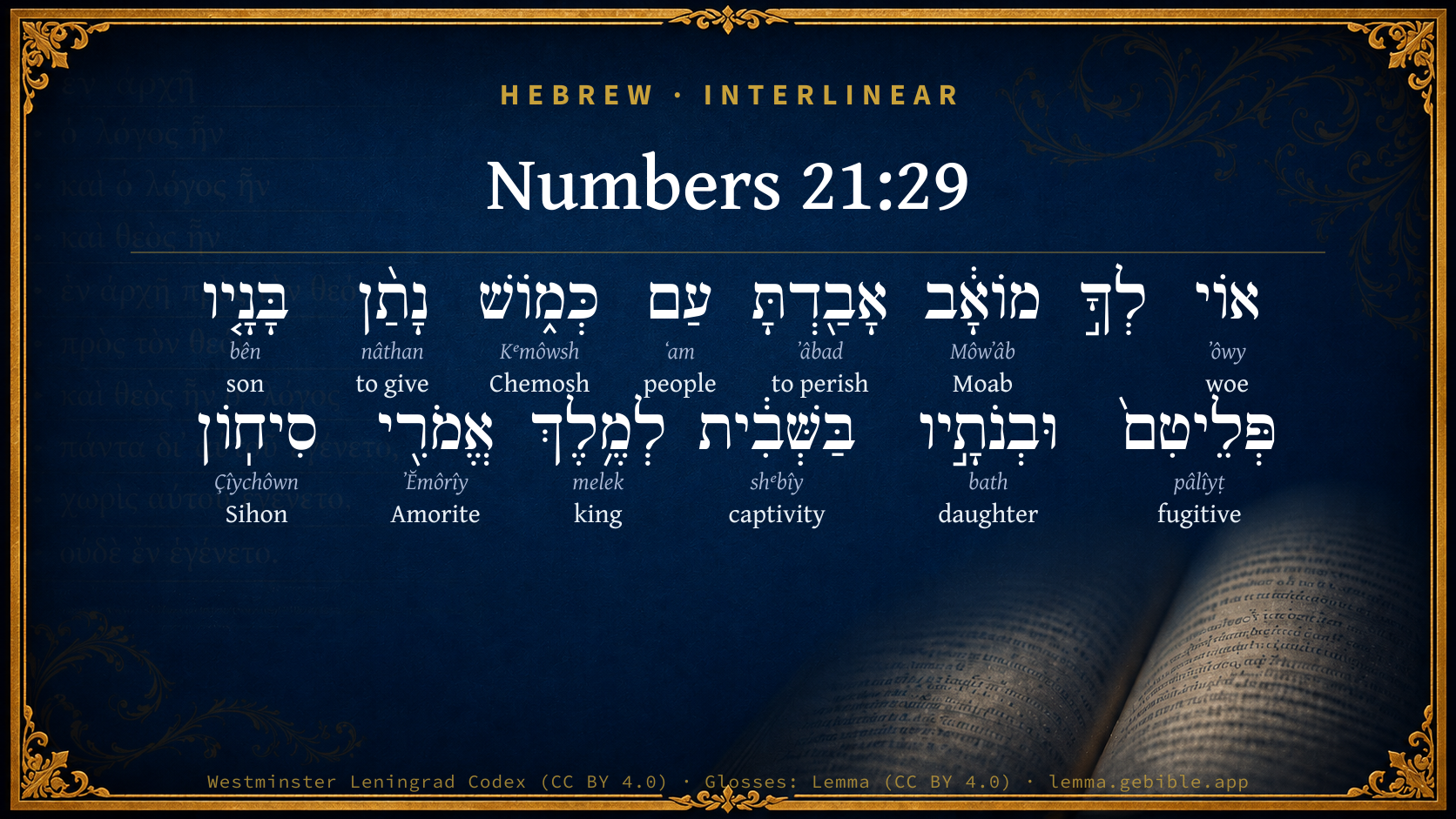
Hebrew (Westminster Leningrad Codex) Numbers 21:29 appears in the Hebrew Old Testament. The text above is from the Westminster Leningrad Codex. Each word links to its Strong’s number, a concise gloss, and parsing drawn from the Open Scriptures Hebrew Bible morphology. Click any word for its full Brown-Driver-Briggs (BDB) entry.
Download image
Cite this verse

Numbers 21:29 (World English Bible). Public Domain. Lemma interlinear Bible study tool, https://lemma.gebible.app/v/numbers/21/29.

Show BibTeX & RIS
BibTeX
RIS
English Translation
Woe to you, Moab! You are undone, people of Chemosh: He has given his sons as fugitives, His daughters into captivity, To Sihon king of the Amorites.
World English Bible · Public Domain
Highlights
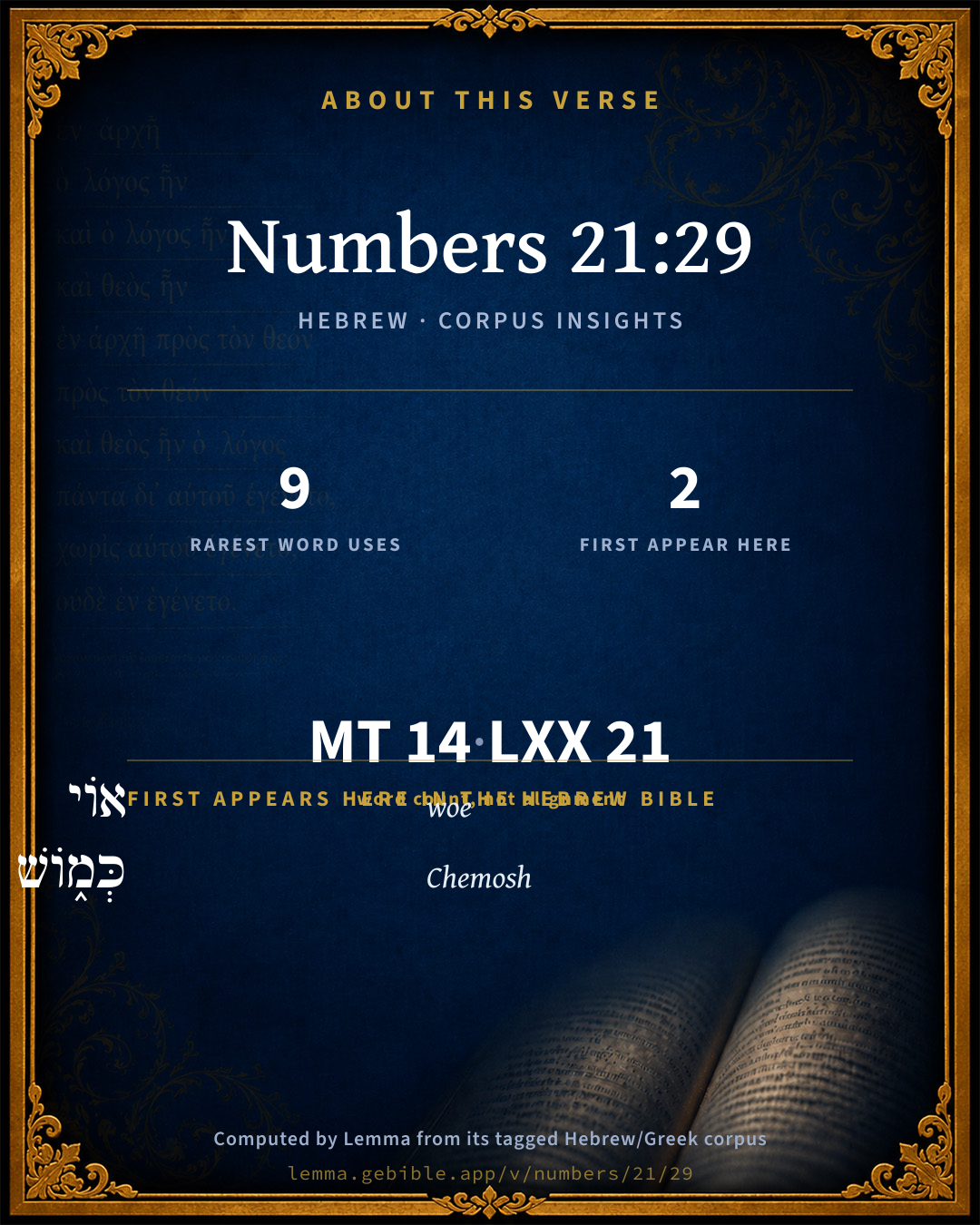
  • 2 first appearances in the Hebrew Bible
Full analysis ↓
Download a study sheet

One document with this verse’s original text, its word-by-word gloss line, the meaning frame, cross-references with their text, attributed commentary, and full source and license credits — printable, and it pastes into notes with its structure intact.

This verse Autodidact and up

Study sheet (.html) Plain text (.txt)

A passage Seminary Student

Up to 50 verses in one chapter. A passage sheet keeps up to 6 commentary sources and 12 cross-references per verse, in the order this page ranks them, and says so on the sheet whenever that leaves anything out. Ask for a single verse and you get the Autodidact verse sheet above.

Everything on this page stays free to read, with no account — the sheet is a download of what is already on screen, not access to it.

Want to remove ads? Support Godless Engineer
Compare translations 3

The same verse in 3 English versions, stacked beneath the original-language interlinear above. Click any original word for its lexicon entry.

Each is an independent rendering of the whole verse — the interlinear is not word-aligned to these translations.

Highlighted words mark where these versions differ — a whole-verse word diff, not a word-by-word alignment.

  • World English Bible Public Domain
    Woe to you, Moab! You are undone, people of Chemosh: He has given his sons as fugitives, His daughters into captivity, To Sihon king of the Amorites.
  • King James Version Public Domain
    Woe to thee, Moab! thou art undone, O people of Chemosh: he hath given his sons that escaped, and his daughters, into captivity unto Sihon king of the Amorites.
  • unfoldingWord Literal Text CC BY-SA 4.0
    Woe to you, Moab! You have perished, people of Chemosh! He has given his sons fugitives and his daughters into captivity, to Sihon, king of the Amorite.

unfoldingWord Literal Text — © unfoldingWord, licensed CC BY-SA 4.0. Word-aligned USFM3 via Door43 (git.door43.org/unfoldingWord/en_ult).

Versions to compare (up to 4)

3 of 4 selected

Show all 18 translations

Every available English version of this verse, each an independent rendering of the whole verse.

  • World English Bible Public Domain
    Woe to you, Moab! You are undone, people of Chemosh: He has given his sons as fugitives, His daughters into captivity, To Sihon king of the Amorites.
  • Berean Standard Bible Public Domain
    Woe to you, O Moab! You are destroyed, O people of Chemosh! He gave up his sons as refugees, and his daughters into captivity to Sihon king of the Amorites.
  • Majority Standard Bible Public Domain
    Woe to you, O Moab! You are destroyed, O people of Chemosh! He gave up his sons as refugees, and his daughters into captivity to Sihon king of the Amorites.
  • King James Version Public Domain
    Woe to thee, Moab! thou art undone, O people of Chemosh: he hath given his sons that escaped, and his daughters, into captivity unto Sihon king of the Amorites.
  • American Standard Version (1901) Public Domain
    Woe to thee, Moab! Thou art undone, O people of Chemosh: He hath given his sons as fugitives, And his daughters into captivity, Unto Sihon king of the Amorites.
  • Revised Version (1885) Public Domain
    Woe to thee, Moab! Thou art undone, O people of Chemosh: He hath given his sons as fugitives, And his daughters into captivity, Unto Sihon king of the Amorites.
  • Geneva Bible (1599) Public Domain
    Wo be to thee, Moab: O people of Chemosh, thou art vndone: he hath suffered his sonnes to be pursued, and his daughters to be in captiuitie to Sihon the king of the Amorites.
  • Douay-Rheims (1899) Public Domain
    Woe to thee Moab: thou art undone, O people of Chamos. He hath given his sons to flight, and his daughters into captivity to Sehon the king of the Amorrhites.
  • Young's Literal Translation Public Domain
    Wo to thee, O Moab, Thou hast perished, O people of Chemosh, He hath given his sons who escape -- Also his daughters -- Into captivity, to a king of the Amorite -- Sihon!
  • Literal Standard Version CC BY-SA 4.0
    Woe to you, O Moab, || You have perished, O people of Chemosh! He has given his sons [as] fugitives, || And his daughters into captivity, || To Sihon king of the Amorite!
  • Unlocked Literal Bible CC BY-SA 4.0
    Woe to you, Moab! You have perished, people of Chemosh. He has made his sons to be fugitives and his daughters to be prisoners of Sihon king of the Amorites.
  • unfoldingWord Literal Text CC BY-SA 4.0
    Woe to you, Moab! You have perished, people of Chemosh! He has given his sons fugitives and his daughters into captivity, to Sihon, king of the Amorite.
  • Darby Bible Public Domain
    Woe to thee, Moab! thou art undone, people of Chemosh: He gave his sons that had escaped, and his daughters into captivity to Sihon the king of the Amorites.
  • World Messianic Bible Public Domain
    Woe to you, Moab! You are undone, people of Chemosh! He has given his sons as fugitives, and his daughters into captivity, to Sihon king of the Amorites.
  • Webster's Bible Public Domain
    Woe to thee, Moab! thou art undone, O people of Chemosh: he hath given his sons that escaped, and his daughters, into captivity to Sihon king of the Amorites.
  • Free Bible Version CC BY-SA 4.0
    What a disaster you face, Moab! You are all going to die, people of Chemosh! You handed over your sons as exiles and your daughters as prisoners to Sihon, king of the Amorites.
  • Bible in Basic English Public Domain
    Sorrow is yours, O Moab! Destruction is your fate, O people of Chemosh: his sons have gone in flight, and his daughters are prisoners, in the hands of Sihon, king of the Amorites.
  • JPS Tanakh (1917) Public Domain
    Woe to thee, Moab! thou art undone, O people of Chemosh; he hath given his sons as fugitives, and his daughters into captivity, unto Sihon king of the Amorites.

Literal Standard Version (2020), Covenant Press — licensed CC BY-SA 4.0. Text via the HelloAO Bible API (eBible.org). Unlocked Literal Bible (unfoldingWord) — licensed CC BY-SA 4.0. Text via the HelloAO Bible API (eBible.org). unfoldingWord Literal Text — © unfoldingWord, licensed CC BY-SA 4.0. Word-aligned USFM3 via Door43 (git.door43.org/unfoldingWord/en_ult). Free Bible Version, Dr. Jonathan Gallagher — licensed CC BY-SA 4.0. Text via the HelloAO Bible API (eBible.org).

Word by word

More ways to search: Search by grammar → Find every occurrence → Compare this word →

Practice this passage: Drill this verse → Learn its vocabulary →

כְּמ֑וֹשׁ
Kᵉmôwsh
H3645
“Chemosh”
Noun, Proper
Part of Speech
Noun
Type
Proper
Full BDB Definition

Origin: from an unused root meaning to subdue

TWOT: None

Chemosh = "subduer" - the national deity of the Moabites and a god of the Ammonites - also identified with 'Baal-peor', 'Baal-zebub', 'Mars' and 'Saturn' - worship of this god was introduced into Jerusalem by Solomon and abolished by king Josiah of Judah
  1. אוֹי ʼôwy H188 “woe” Particle, Interjection
  2. מוֹאָ֔ב Môwʼâb H4124 “Moab” Noun, Proper
  3. אָבַ֖דְתָּ ʼâbad H6 “to perish” Verb, Qal, Perfect, 2nd Person, Masculine, Singular
  4. עַם ʻam H5971 “people of” Noun, Common, Masculine, Singular, Construct
  5. נָתַ֨ן nâthan H5414 “to give” Verb, Qal, Perfect, 3rd Person, Masculine, Singular
  6. בָּנָ֤יו bên H1121 “sons · his” Noun, Common, Masculine, Plural, Construct + Suffix, Personal, 3rd Person, Masculine, Singular
  7. פְּלֵיטִם֙ pâlîyṭ H6412 “fugitives” Noun, Common, Masculine, Plural, Absolute
  8. וּבְנֹתָ֣יו bath H1323 “and · daughters · his” Conjunction + Noun, Common, Feminine, Plural, Construct + Suffix, Personal, 3rd Person, Masculine, Singular
  9. בַּשְּׁבִ֔ית shᵉbîy H7628 “in/at the · captivity” Preposition, Determined + Noun, Common, Both, Singular, Absolute
  10. לְמֶ֥לֶךְ melek H4428 “to/for · king of” Preposition + Noun, Common, Masculine, Singular, Construct
  11. אֱמֹרִ֖י ʼĔmôrîy H567 “Amorite” Noun, Gentilic, Masculine, Singular, Absolute
  12. סִיחֽוֹן Çîychôwn H5511 “Sihon” Noun, Proper

About this verse

These counts appear in no published source. They are computed here, from the morphology-tagged text and Lemma’s own curated glosses. What Lemma adds →

14
words
13
distinct lemmas
Pentateuch
section

Notable vocabulary

The rarest word here is כְּמ֑וֹשׁ Chemosh H3645 — appearing just 9 times in the whole Hebrew Bible.

First appearance in Scripture

These words make their first canonical appearance in the Hebrew Bible here:

  • אוֹי woe H188
  • כְּמ֑וֹשׁ Chemosh H3645

Shared distinctive vocabulary

כְּמ֑וֹשׁ Chemosh H3645 occurs in 8 verses of the Hebrew Bible. Also found in:

Grammatical profile

  • 2 verbs
  • 10 nouns
  • 1 preposition
  • 1 particle

Verb forms

  • אָבַ֖דְתָּ Qal · Perfect
  • נָתַ֨ן Qal · Perfect

Hebrew & Septuagint length

In English translation the verse runs 27 words from the Hebrew and 28 from the Septuagint (LXX English) — closely comparable.

A rough comparison of the two English renderings, which tokenize alike — not a word-level alignment.

Word counts can differ between the Hebrew and the Greek without any difference in meaning — e.g. the Hebrew direct-object marker אֵת has no separate Greek word, and Greek often adds the article ὁ.

In the original languages it is 14 Hebrew tokens and 21 Greek tokens — but the two are counted differently (Hebrew bundles its prefixes and suffixes into one token; the Greek is in lemma form), so that isn’t a like-for-like length.

Cross-references

10

Topical passages linked to Numbers 21:29 in the Treasury of Scripture Knowledge — connected by theme and wording, ordered by reader-vote popularity; previews shown in the World English Bible.

  • Judges 11:24 Won't you possess that which Chemosh your god gives you to possess? So whoever Yahweh our God has dispossessed from before us, them will we possess.
  • 2 Kings 23:13 The high places that were before Jerusalem, which were on the right hand of the mountain of corruption, which Solomon the king of Israel had built for Ashtoreth the abomination of the Sidonians, and for Chemosh the abomination of Moab, and for Milcom the abomination of the children of Ammon, did the king defile.
  • Jeremiah 48:46 Woe to you, O Moab! the people of Chemosh is undone; for your sons are taken away captive, and your daughters into captivity.
  • 1 Kings 11:7 Then did Solomon build a high place for Chemosh the abomination of Moab, on the mountain that is before Jerusalem, and for Molech the abomination of the children of Ammon.
  • 1 Kings 11:33 because that they have forsaken me, and have worshiped Ashtoreth the goddess of the Sidonians, Chemosh the god of Moab, and Milcom the god of the children of Ammon; and they have not walked in my ways, to do that which is right in my eyes, and [to keep] my statutes and my ordinances, as did David his father.
  • Jeremiah 48:7 For, because you have trusted in your works and in your treasures, you also shall be taken: and Chemosh shall go forth into captivity, his priests and his princes together.
  • Isaiah 15:5 My heart cries out for Moab; her nobles [flee] to Zoar, to Eglath Shelishiyah: for by the ascent of Luhith with weeping they go up; for in the way of Horonaim they raise up a cry of destruction.
  • Isaiah 16:2 For it shall be that, as wandering birds, as a scattered nest, so shall the daughters of Moab be at the fords of the Arnon.
  • Jeremiah 48:13 Moab shall be ashamed of Chemosh, as the house of Israel was ashamed of Bethel their confidence.
  • 1 Corinthians 8:4–5 Therefore concerning the eating of things sacrificed to idols, we know that no idol is anything in the world, and that there is no other God but one.

Cross-references courtesy of OpenBible.info (CC BY 4.0).

Hebrew and Greek witnesses Masoretic Hebrew ↔ Greek Septuagint

The same verse in the two great witnesses to the Old Testament, shown verse-for-verse.

These are two independent witnesses, not word-aligned to each other, and the Septuagint is shown in lemma (dictionary) form.

Hebrew Numbers 21:29 Masoretic · Westminster Leningrad Codex

אוֹי לְךָ֣ מוֹאָ֔ב אָבַ֖דְתָּ עַם כְּמ֑וֹשׁ נָתַ֨ן בָּנָ֤יו פְּלֵיטִם֙ וּבְנֹתָ֣יו בַּשְּׁבִ֔ית לְמֶ֥לֶךְ אֱמֹרִ֖י סִיחֽוֹן

Woe to you, Moab! You are undone, people of Chemosh: He has given his sons as fugitives, His daughters into captivity, To Sihon king of the Amorites.

World English Bible · Public Domain

Greek LXX Numbers 21:29 Septuagint · lemma form

οὐαί σύ μωαβ ἀποὀλλύω λαός χαμως ἀποδίδωμι ὁ υἱός αὐτός διασώζω καί ὁ θυγάτηρ αὐτός αἰχμάλωτος ὁ βασιλεύς ὁ ἀμορραῖος σηων

Woe to you, Moab; you are lost, you people of Chamos: their sons are sold for preservation, and their daughters are captives to Seon king of the Amorites.

LXX2012 (modern English Septuagint) · Public Domain

Hebrew: Westminster Leningrad Codex (CC BY 4.0). Greek: Septuagint (public domain); English from LXX2012 (modern English Septuagint) (Public Domain). How the Septuagint differs from the Hebrew →

Targum (Aramaic paraphrase)

2

The Targum is the ancient Jewish Aramaic paraphrase of the Hebrew Scriptures — an interpretive translation, not the Hebrew text itself. Onkelos (literal) and Pseudo-Jonathan (expansive) render the Torah, and Jonathan the Prophets. Coverage is partial: where no permissively-licensed English translation exists for a verse, only the Aramaic is shown. This is verse-level text, not a word-by-word alignment to the Hebrew.

  1. Targum Onkelos Torah (Genesis–Deuteronomy)
    וַי לְכוֹן מוֹאֲבָאֵי אֲבַדְתּוּן עַמָא דְפָלְחִין לִכְמוֹשׁ מְסַר בְּנוֹהִי צִירִין וּבְנָתֵיהּ בְּשִׁבְיָא לְמַלְכָּא דֶאֱמוֹרָאָה סִיחוֹן

    (no public-domain English translation for this verse)

    Targum Onkelos — Aramaic: “Onkelos Genesis” (public domain); “Onkelos Exodus” (public domain); “Onkelos Leviticus” (public domain); “Onkelos Numbers” (public domain); “Onkelos Deuteronomy” (public domain). English: “Sefaria Community Translation” (CC0 1.0 (public-domain dedication)); “J.W. Etheridge. The Targums of Onkelos and Jonathan Ben Uzziel on the Pentateuch. London: Longmans, Green, 1862” (public domain). Text via Sefaria.

  2. Targum Pseudo-Jonathan Torah (Genesis–Deuteronomy)
    יְיָא לְכוֹן סַנְאֵי צַדִיקַיָא אֲבַדְתּוּן עַמָא דִכְמִישׁ מִדְסֵינַת פִּתְגָמֵי אוֹרַיְיתָא לֵית לְהוֹן תַּקַנְתָּא עַד דְיֵיצְרְכוֹן לְמִגְלֵי לַאֲתַר דְיִלְפוּן אוֹרַיְיתָא וּבְנֵיהוֹן וּבְנַתְהוֹן מִתְרַחֲקָן בְּשִׁבְיַית חַרְבָּא כָּל קֳבֵל מִתְמָלְכִין בְּמוֹלְכָנָא דְאוֹרַיְיתָא אֱמוֹרָאִין וּמְשִיחִין בְּאוֹרַיְיתָא

    Woe to you, ye haters of the just! ye have perished, ye people of Kemosh, haters of the words of the law, in whom there is no righteousness, unless he waste you to bring you captive unto the place where they teach. the law, and their sons and daughters be removed by captivity of the sword to be near them who consult in its counsels the instructors and those anointed with the law.

    Targum Pseudo-Jonathan — Aramaic: “Targum Jonathan on Genesis” (public domain); “Targum Jonathan on Exodus” (public domain); “Targum Jonathan on Leviticus” (public domain); “Targum Jonathan on Numbers” (public domain); “Targum Jonathan on Deuteronomy” (public domain). English: “The Targum of Jonathan ben Uzziel, trans. J. W. Etheridge, London, 1862” (public domain). Text via Sefaria.

Commentary

Notes on Numbers 21:29 from classic Christian and Jewish commentators (each source and its license shown beneath its notes). The classic Christian expositions comment on the surrounding passage and are grouped to its opening verse, so a note may address several verses; the Jewish commentaries on the Tanakh (Rashi and others) are per-verse, so they appear only where the commentator wrote on this verse.

Lemma curates 59 commentaries, every one of them public domain or Creative Commons licensed, each selected and text-cleaned for this edition rather than reprinted as found. About our sources →

Albert Barnes' Notes on the Bible

Chemosh - The national God of the Moabites (compare the marginal references). The name probably means “Vanquisher,” or “Master.” The worship of Chemosh was introduced into Israel by Solomon 1Ki 11:7; 2Ki 23:13. It was no doubt to Chemosh that Mesha, king of Moab, offered up his son as a burnt-offering 2Ki 3:26-27.

In the first six lines Num 21:27-28 the poet imagines for the Amorites a song of exultation for their victories over Moab, and for the consequent glories of Heshbon, their own capital. In the next lines Num 21:29 he himself joins in this strain; which now becomes one of half-real, half-ironical compassion for the Moabites, whom their idol Chemosh was unable to save. But in the last lines Num 21:30 a startling change takes place; the new and decisive triumph of the poet’s own countrymen is abruptly introduced; and the boastings of the Arnorites fade utterly away. Of the towns Heshbon was the northernmost, and therefore, to the advancing Israelites, the last to be reached. Medeba, now Madeba, was four miles south of Heshbon (compare 1Ch 19:7, 1Ch 19:15).

Albert Barnes' Notes on the Bible (1834–1885) — public domain. Text from a community e-Sword/MySword module.

Joseph Benson's Commentary

Num 21:29. People of Chemosh — The worshippers of Chemosh; so the god of the Moabites was called. He — That is, their god, hath delivered up his own people to his and their enemies; nor could he secure even those that had escaped the sword, but suffered them to be carried into captivity. The words of this and the following verse seem to be, not a part of that triumphant song, made by some Amoritish poet, which seems to be concluded Num 21:28, but of the Israelites making their observation upon it. And here they scoff at the impotency, not only of the Moabites, but of their god also, who could not save his people from the sword of Sihon and the Amorites.

Joseph Benson's Commentary on the Old and New Testaments (1811–1818) — public domain. Text from a community e-Sword module.

Tyndale Open Study Notes

Tyndale Open Resources

21:29 From the ancient point of view, even Moab’s supreme god Chemosh suffered defeat at the hands of the Amorite conquerors, while the people of Moab became refugees and captives.

Tyndale Open Study Notes — © Tyndale Open Resources, licensed CC BY-SA 4.0. Text via the HelloAO Bible API.

Geneva Bible (1599)

Geneva Bible translators

Chemosh was the idol of the Moabites, 1 Kings 11:33, who was not able to defend his worshippers, which took the idol for their father.

Geneva Bible (1599) marginal notes — public domain. Text via Bolls.life.

Jamieson, Fausset & Brown

Robert Jamieson, A. R. Fausset & David Brown

people of Chemosh--the name of the Moabite idol (1Ki. 11:7-33; Kg2 23:13; Jer 48:46).

he--that is, their god, hath surrendered his worshippers to the victorious arms of Sihon.

Jamieson, Fausset & Brown — Commentary Critical and Explanatory on the Whole Bible (1871) — public domain (CC PDM 1.0). Text via the HelloAO Bible API.

The Cambridge Bible for Schools and Colleges

gen. ed. J. J. S. Perowne

29. The verse is still ironical; the Israelites express their pity for Moab in her destruction by the Amorites.

He hath given] He gave. Chemosh, the god of the Moabites, delivered his people into the hands of their enemies. Cf. Jer_48:13.

Unto Sihon king of the Amorites] Unto an Amorite king Sihon. The clause may be a late gloss; the expression is unusual, and the quotation in Jer_48:46 ends at the word ‘captivity.’

The Cambridge Bible for Schools and Colleges (gen. ed. J. J. S. Perowne; Cambridge University Press, 1878–1918) — public domain. Text from a community e-Sword module.

John Gill's Exposition

And they turned,.... From Jaazer, after they had taken it, and came back a little way:

and went up by the way of Bashan; which was a nearer way to Canaan, a fine country abounding with oxen and sheep, having rich pastures, and very famous for its oaks; it had its name from the mountain of Bashan in it, and has been since called Batanea; it was at this time in the hands of the Amorites, and from them it was taken by Israel, as follows: who marched this way for that purpose, or at least were so directed by the providence of God for that end:

and Og king of Bashan went out against them; who was of the race of the giants, and he himself of a gigantic stature, and was a king of the Amorites, as well as Sihon, Deu 3:8, he came out in an hostile manner against Israel, to stop them going any further:

he, and all his people: out of his many cities, a numerous army no doubt:

to the battle at Edrei; where it was fought between him and Israel. Jerom says (t) it was in his time called Adara, a famous city of Arabia, twenty four or twenty five miles from Bozra, and six from Ashtaroth Karnaim, the ancient seat of the Rephaim, or giants from whom Og sprung, Gen 14:5, and was the seat of Og now, from whence he came to Edrei or Adara, to meet and fight Israel there; see Deu 1:4.

(t) De locis Heb. fol. 87. I. & 92. M.

John Gill's Exposition of the Whole Bible (1746–1763) — public domain (CC PDM 1.0). Text via the HelloAO Bible API.

Haydock's Catholic Bible Commentary

CHAPTER XXI.

He. Chamos, the idol of Moab, is upbraided as too weak to defend his people. The pagans generally formed their judgments of the power of their gods, by the event; and, if that proved unfortunate, they were ever ready to consign the idols to the flames. Chamos was probably the sun. (Calmet) --- Some say he was Bacchus, whom the Greeks call Komas. (Menochius)

George Leo Haydock (1774–1849), Haydock's Catholic Family Bible and Commentary, 1859 edition — public domain. Excludes Psalms (Douay-Rheims chapter numbering differs from Protestant) and Deuterocanonical books (Catholic canon only).

Matthew Poole's English Annotations

Alas, poor Moab! thou couldst not save thyself from Sihon’s sword.

People of Chemosh, i.e. the worshippers of Chemosh: so the god of the Moabites was called, 1Ki 11:7,33; 2Ki 23:13; Jer 48:46.

He, i.e. their god, hath delivered up his own people to his and their enemies; he could not defend them, but suffered many of them to be killed; nor could be secure even those that had escaped the sword, but suffered them to fall into their enemies’ hands, and by them to be carried into captivity.

Unto Sihon king of the Amorites. Now the words of this and the following verse seem to be not a part of that triumphant song or poem made, as I suppose, by some Amoritish bard or poet, which seems to be concluded, Num 21:28; but of the Israelites making their observation upon it. And here they scoff at the impotency not only of the Moabites, but of their god also, who could not save his people from the sword of Sihon and the Amorites.

Matthew Poole's English Annotations on the Holy Bible (1683–1685) — public domain. Text from a community e-Sword/MySword module.

Whedon's Commentary on the Bible

Daniel D. Whedon

29. Chemosh was the chief god of the Moabites and of the Ammonites, akin to Milcom, Baal, and Moloch. He was both a war-god and a sun-god, being found in both these characters upon the coins of Areopolis, standing upon a column, with a sword in his right hand and a shield in his left, and with two blazing torches by his side. Children were sacrificed to him in times of great distress. 2Ki_3:27.

Daniel D. Whedon (gen. ed.), Commentary on the Old and New Testaments (1874–1909) — public domain. Text from a community e-Sword module.

The Pulpit Commentary

O people of Chemosh. vWmKA Chemosh was the national god of the Moabites, (1Ki_11:7 Jer_48:7) and also to some extent of the Ammonites. (Jud_1:11:24) It is generally agreed that the name is derived from the root to subdue, and thus will have substantially the same meaning as Milcom, Molech, and Baal; indeed it appears probable that there was a strong family likeness among the idolatries of Palestine, and that the various names represented different attributes of one supreme being rather than different divinities. Thus Baal and Ashtaroth (Jud_1:2:13) represented for the Zidonians the masculine and feminine elements respectively in the Divine energy. Baal himself was plural (Baalim, 1Ki_18:18) in form, and either male or female. (h baal in Hos_2:8 Rom_11:4) In the inscription on the Moabite stone a god "Ashtar-Chemosh" is mentioned, and thus Chemosh is identified with the male deity of Phoenicia (Ashtar being the masculine form of Ashtoreth), while, on the other hand, it was almost certainly the same divinity who was worshipped under another name, and with other rites, as Baal-Peor. (see on Num_25:3) On the coins of Areopolis Chemosh appears as a god of war armed, with fire-torches by his side. Human sacrifices were offered to him, (2Ki_3:26, 2Ki_3:27) as to Baal and to Moloch. He hath given his sons, i.e., Chemosh, who could not save his own votaries, nor the children of his people.

The Pulpit Commentary (1880–1919), ed. H.D.M. Spence-Jones & Joseph S. Exell — public domain. Text from a community e-Sword module.

John Wesley's Explanatory Notes

People of Chemosh - The worshippers of Chemosh: so the God of the Moabites was called. He, that is, their God, hath delivered up his own people to his and their enemies; nor could he secure even those that had escaped the sword, but suffered them to be carried into captivity. The words of this and the following verse seem to be not a part of that triumphant song made, by some Amoritish poet, which seems to be concluded, ver. 28, but of the Israelites making their observation upon it. And here they scoff at the impotency not only of the Moabites, but of their God also, who could not save his people from the sword of Sihon and the Amorites.

John Wesley, Explanatory Notes Upon the Whole Bible (1754–1765) — public domain. Text via the GEBible commentary corpus.

unfoldingWord translationNotes

Door43 World Missions Community

Moab ... people of Chemosh

These two phrases refer to the same people. (See: Parallelism)

people of Chemosh

"Chemosh" was the name of the false god whom the Moabites worshiped. AT: "the people who worship Chemosh"

He has made his sons

"He" and "his" refer to Chemosh.

we have conquered

Here "we" refers to the Israelites who defeated Sihon.

Heshbon is devastated

This can be stated in active form. AT: "We have devastated Heshbon" (See: Active or Passive)

Heshbon ... all the way to Dibon ... all the way to Nophah ... to Medeba

These are all places in Sihon's kingdom. This means the Israelites destroyed Sihon's entire nation. (See: How to Translate Names and Merism)

translationWords

woe

Moab

perish

son

prison

Amorite

devastate

unfoldingWord translationNotes — © Distant Shores Media and the Door43 World Missions Community, licensed CC BY-SA 4.0. Source: git.door43.org/Door43/en_tn.

Rashi

Rabbi Shlomo Yitzchaki (Rashi)

אוי לך מואב WOE TO THEE, MOAB — [These are not the words of the historian but those of Balaam and Beor, for] they cursed the Moabites (as they had been hired to do) so that they should be delivered into his (Sihon’s) hands (Midrash Tanchuma, Chukat 24).

כמוש CHEMOSH was the name of Moab’s god.

נתן HE HATH GIVEN [HIS SONS] — The subject of the sentence is to be supplied: HE who gave HATH GIVEN HIS SONS i.e. those of Moab,

פלטים — AS FUGITIVES — as men who flee and attempt to escape from the sword, and his daughters into captivity, etc.

Rashi on the Tanakh — English translations: “The Judaica Press complete Tanach with Rashi, translated by A. J. Rosenberg” (CC BY 4.0); “Pentateuch with Rashi's commentary by M. Rosenbaum and A.M. Silbermann, 1929-1934” (public domain); “The Metsudah Tanach series, Lakewood, N.J” (CC BY 4.0); and “The Book of Joshua, Metsudah Publications, 1997” (CC BY 4.0). Text via Sefaria.

Ramban (Nachmanides)

Rabbi Moshe ben Nachman (Ramban / Nachmanides)

WOE TO THEE, MOAB! THOU ART PERISHED, O PEOPLE OF CHEMOSH. The meaning of this is that [the people of] Moab used to worship Chemosh their deity, and build high places [i.e., altars, to him] and trust in him more than every other people, and in the time of their trouble they would say to him: ‘Arise, and save us.’ Similarly Scripture refers to [this worship of theirs] in all places, as it is written, And it shall come to pass, when it is seen that Moab hath wearied himself upon the high place, that he shall come to his sanctuary to pray; but he shall not prevail; and it is further stated [of Moab], and Chemosh shall go forth into captivity, his priests and his princes together with him; Moreover I will cause to cease in Moab, saith the Eternal, him that offereth in the high place, and him that offereth to his gods., Verse 35. Therefore those who spoke in parables said by way of mockery, that Chemosh hath given ‘his sons’ as fugitives, refugees who flee [to safety] because of the sword; and ‘his daughters’ into captivity; [these terms, “sons” and “daughters” are used] because those who believe in him are called “his sons” and “his daughters,” in the same way that they are [here] called “his people” [people of Chemosh]. Similarly [we find the expression], the daughter of a strange god. The [correct explanation is thus] not like the words of Rashi, who interpreted [the verse as follows]: “He the Giver [i.e., G-d] gave his sons [i.e., those of Moab] as fugitives from the sword.”Chemosh was also worshipped by the children of Ammon, as Jephthah said [to the king of Ammon], that which Chemosh thy god giveth thee to possess that you will possess. They also had in their country Milcom the detestation of the Ammonites. Or [it may be that] Jephthah mentioned Chemosh to the king of Ammon because of [the land] which Israel had captured from Moab, just as he [Jephthah] mentioned to them [i.e., to the Ammonites]: Balak king of Moab, meaning to say that neither Chemosh their god nor Balak their king had saved their land [Moab] from the hand of Israel. It is very fitting that we say, as our Rabbis explained, that [the reference in the term] ‘hamoshlim’ (they that speak in parables) is to Balaam and those like him, the diviners who spoke in parables about future events.

Ramban (Nachmanides) on the Tanakh — English translation: “Commentary on the Torah by Ramban (Nachmanides). Translated and annotated by Charles B. Chavel. New York, Shilo Pub. House, 1971-1976” (CC BY 4.0). Text via Sefaria.

Lesson kit

Teaching starters — assembled from the data on this page, not authored interpretation. Every prompt links to the verse data it draws on. Edit before teaching.

Numbers, in the Pentateuch, opens this verse with 14 words (13 distinct Hebrew lemmas). Its most distinctive word is Kᵉmôwsh (“Chemosh”). A historical commentator’s framing appears above. Read the whole chapter for the surrounding context.

Discussion questions

  1. What does “Chemosh” (Kᵉmôwsh) contribute to the verse as a whole?
  2. 2 words here appear for the first time in Scripture. What is being introduced at this debut?
  3. Judges 11:24 shares the word «Chemosh» with this verse. How do the two illuminate each other?
  4. These translations render this verse differently. What is at stake in choosing one wording over another?
  5. The verb «אָבַ֖דְתָּ» is Qal Perfect. How does its form color the action?
  6. Reading how Albert Barnes' Notes on the Bible and Joseph Benson's Commentary read this verse, where do the two commentators agree and where do they part?

Things to notice

Reading settings

Reading text

Shown beneath each verse's original-language words.

Old Testament
Old Testament edition

Read the OT as the Masoretic Hebrew (MT) or the Greek Septuagint (LXX).

English shown for the Greek Septuagint (in the Hebrew ↔ Greek comparison).

Comparing translations? Open the Compare panel on any verse page to stack up to four side by side.