Jeremiah 48:18

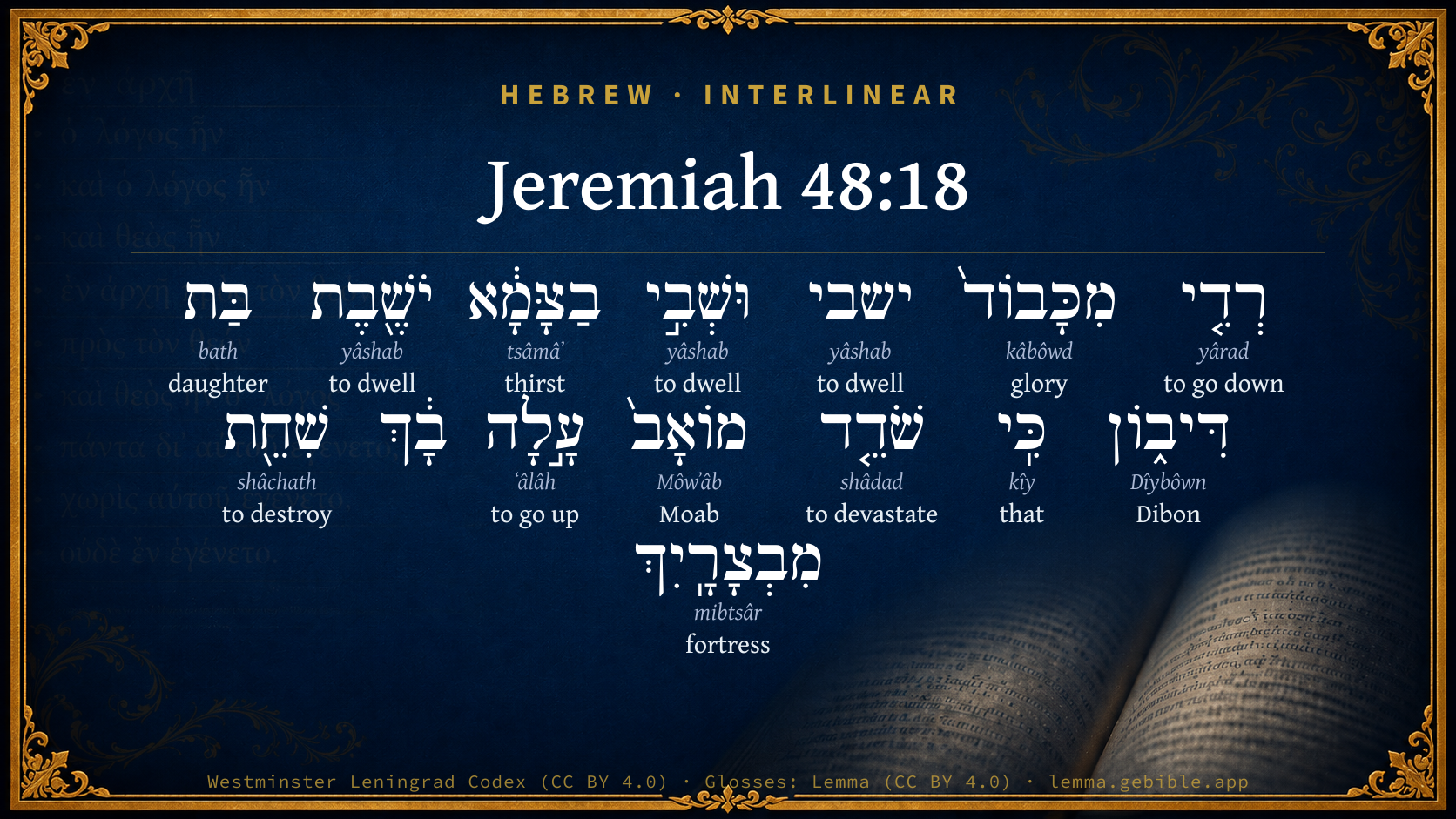
Hebrew (Westminster Leningrad Codex) Jeremiah 48:18 appears in the Hebrew Old Testament. The text above is from the Westminster Leningrad Codex. Each word links to its Strong’s number, a concise gloss, and parsing drawn from the Open Scriptures Hebrew Bible morphology. Click any word for its full Brown-Driver-Briggs (BDB) entry.
Download image
Cite this verse

Jeremiah 48:18 (World English Bible). Public Domain. Lemma interlinear Bible study tool, https://lemma.gebible.app/v/jeremiah/48/18.

Show BibTeX & RIS
BibTeX
RIS
English Translation
You daughter who dwells in Dibon, come down from your glory, and sit in thirst; for the destroyer of Moab is come up against you, he has destroyed your strongholds.
World English Bible · Public Domain
Download a study sheet

One document with this verse’s original text, its word-by-word gloss line, the meaning frame, cross-references with their text, attributed commentary, and full source and license credits — printable, and it pastes into notes with its structure intact.

This verse Autodidact and up

Study sheet (.html) Plain text (.txt)

A passage Seminary Student

Up to 50 verses in one chapter. A passage sheet keeps up to 6 commentary sources and 12 cross-references per verse, in the order this page ranks them, and says so on the sheet whenever that leaves anything out. Ask for a single verse and you get the Autodidact verse sheet above.

Everything on this page stays free to read, with no account — the sheet is a download of what is already on screen, not access to it.

Want to remove ads? Support Godless Engineer
Compare translations 3

The same verse in 3 English versions, stacked beneath the original-language interlinear above. Click any original word for its lexicon entry.

Each is an independent rendering of the whole verse — the interlinear is not word-aligned to these translations.

Highlighted words mark where these versions differ — a whole-verse word diff, not a word-by-word alignment.

  • World English Bible Public Domain
    You daughter who dwells in Dibon, come down from your glory, and sit in thirst; for the destroyer of Moab is come up against you, he has destroyed your strongholds.
  • King James Version Public Domain
    Thou daughter that dost inhabit Dibon, come down from thy glory, and sit in thirst; for the spoiler of Moab shall come upon thee, and he shall destroy thy strong holds.
  • unfoldingWord Literal Text CC BY-SA 4.0
    Come down from your honored place and sit on the dry ground, you daughter living in Dibon. For the one who will destroy Moab is attacking you, the one who will destroy your strongholds.

unfoldingWord Literal Text — © unfoldingWord, licensed CC BY-SA 4.0. Word-aligned USFM3 via Door43 (git.door43.org/unfoldingWord/en_ult).

Versions to compare (up to 4)

3 of 4 selected

Show all 18 translations

Every available English version of this verse, each an independent rendering of the whole verse.

  • World English Bible Public Domain
    You daughter who dwells in Dibon, come down from your glory, and sit in thirst; for the destroyer of Moab is come up against you, he has destroyed your strongholds.
  • Berean Standard Bible Public Domain
    Come down from your glory; sit on parched ground, O daughter dwelling in Dibon, for the destroyer of Moab has come against you; he has destroyed your fortresses.
  • Majority Standard Bible Public Domain
    Come down from your glory; sit on parched ground, O daughter dwelling in Dibon, for the destroyer of Moab has come against you; he has destroyed your fortresses.
  • King James Version Public Domain
    Thou daughter that dost inhabit Dibon, come down from thy glory, and sit in thirst; for the spoiler of Moab shall come upon thee, and he shall destroy thy strong holds.
  • American Standard Version (1901) Public Domain
    O thou daughter that dwellest in Dibon, come down from thy glory, and sit in thirst; for the destroyer of Moab is come up against thee, he hath destroyed thy strongholds.
  • Revised Version (1885) Public Domain
    O thou daughter that dwellest in Dibon, come down from thy glory, and sit in thirst; for the spoiler of Moab is come up against thee, he hath destroyed thy strong holds.
  • Geneva Bible (1599) Public Domain
    Thou daughter that doest inhabite Dibon, come downe from thy glory, and sit in thirst: for the destroyer of Moab shall come vpon thee, and he shall destroy thy strong holdes.
  • Douay-Rheims (1899) Public Domain
    Come down from thy glory, and sit in thirst, O dwelling of the daughter of Dibon: because the spoiler of Moab is come up to thee, he hath destroyed thy bulwarks.
  • Young's Literal Translation Public Domain
    Come down from honour, sit in thirst, O inhabitant, daughter of Dibon, For a spoiler of Moab hath come up to thee, He hath destroyed thy fenced places.
  • Literal Standard Version CC BY-SA 4.0
    Come down from glory, sit in thirst, || O inhabitant, daughter of Dibon, || For a spoiler of Moab has come up to you, || He has destroyed your fortifications.
  • Unlocked Literal Bible CC BY-SA 4.0
    Come down from your honored place and sit on the dry ground, you daughter living in Dibon. For the one who will destroy Moab is attacking you, the one who will destroy your strongholds.
  • unfoldingWord Literal Text CC BY-SA 4.0
    Come down from your honored place and sit on the dry ground, you daughter living in Dibon. For the one who will destroy Moab is attacking you, the one who will destroy your strongholds.
  • Darby Bible Public Domain
    Come down from [thy] glory and sit in the drought, O inhabitress, daughter of Dibon; the spoiler of Moab is come up against thee, thy strongholds hath he destroyed.
  • World Messianic Bible Public Domain
    “You daughter who dwells in Dibon, come down from your glory, and sit in thirst; for the destroyer of Moab has come up against you. He has destroyed your strongholds.
  • Webster's Bible Public Domain
    Thou daughter that dost inhabit Dibon, come down from thy glory, and sit in thirst; for the spoiler of Moab shall come upon thee, and he shall destroy thy strong holds.
  • Free Bible Version CC BY-SA 4.0
    Come down from your glory and sit on the dusty ground, you who live in Dibon, for Moab's destroyer will come and attack you, destroying your fortresses.
  • Bible in Basic English Public Domain
    Come down from your glory, O people of Dibon, and take your seat in the place of the waste; for the attacker of Moab has gone up against you, sending destruction on your strong places.
  • JPS Tanakh (1917) Public Domain
    O thou daughter that dwellest in Dibon, come down from thy glory, and sit in thirst; for the spoiler of Moab is come up against thee, he hath destroyed thy strongholds.

Literal Standard Version (2020), Covenant Press — licensed CC BY-SA 4.0. Text via the HelloAO Bible API (eBible.org). Unlocked Literal Bible (unfoldingWord) — licensed CC BY-SA 4.0. Text via the HelloAO Bible API (eBible.org). unfoldingWord Literal Text — © unfoldingWord, licensed CC BY-SA 4.0. Word-aligned USFM3 via Door43 (git.door43.org/unfoldingWord/en_ult). Free Bible Version, Dr. Jonathan Gallagher — licensed CC BY-SA 4.0. Text via the HelloAO Bible API (eBible.org).

Word by word

More ways to search: Search by grammar → Find every occurrence → Compare this word →

Practice this passage: Drill this verse → Learn its vocabulary →

דִּיב֑וֹן
Dîybôwn
H1769
“Dibon”
Noun, Proper
Part of Speech
Noun
Type
Proper
Full BDB Definition

Origin: from H1727

TWOT: None

Dibon = "wasting" - a town in Moab on the east side of the Jordan which was taken over by the Israelites and rebuilt by the children of Gad - a place in south Judah reinhabited by the men of Judah after the return from captivity
  1. רְדִ֤י yârad H3381 “go down” Verb, Qal, Imperative, 2nd Person, Feminine, Singular
  2. מִכָּבוֹד֙ kâbôwd H3519 “from · glory” Preposition + Noun, Common, Both, Singular, Absolute
  3. ישבי yâshab H3427 “dwelling” Verb, Qal, Participle Active, Masculine, Plural, Construct
  4. וּשְׁבִ֣י yâshab H3427 “and · dwell” Conjunction + Verb, Qal, Imperative, 2nd Person, Feminine, Singular
  5. בַצָּמָ֔א tsâmâʼ H6772 “in/at the · thirst” Preposition, Determined + Noun, Common, Masculine, Singular, Absolute
  6. יֹשֶׁ֖בֶת yâshab H3427 “dwelling” Verb, Qal, Participle Active, Feminine, Singular, Absolute
  7. בַּת bath H1323 “daughter of” Noun, Common, Feminine, Singular, Construct
  8. כִּֽי kîy H3588 “that” Conjunction
  9. שֹׁדֵ֤ד shâdad H7703 “devastating” Verb, Qal, Participle Active, Masculine, Singular, Construct
  10. מוֹאָב֙ Môwʼâb H4124 “Moab” Noun, Proper
  11. עָ֣לָה ʻâlâh H5927 “to go up” Verb, Qal, Perfect, 3rd Person, Masculine, Singular
  12. שִׁחֵ֖ת shâchath H7843 “to destroy” Verb, Piel, Perfect, 3rd Person, Masculine, Singular
  13. מִבְצָרָֽיִךְ mibtsâr H4013 “fortresses · your” Noun, Common, Masculine, Plural, Construct + Suffix, Personal, 2nd Person, Feminine, Singular

About this verse

These counts appear in no published source. They are computed here, from the morphology-tagged text and Lemma’s own curated glosses. What Lemma adds →

15
words
12
distinct lemmas
Prophets
section

Notable vocabulary

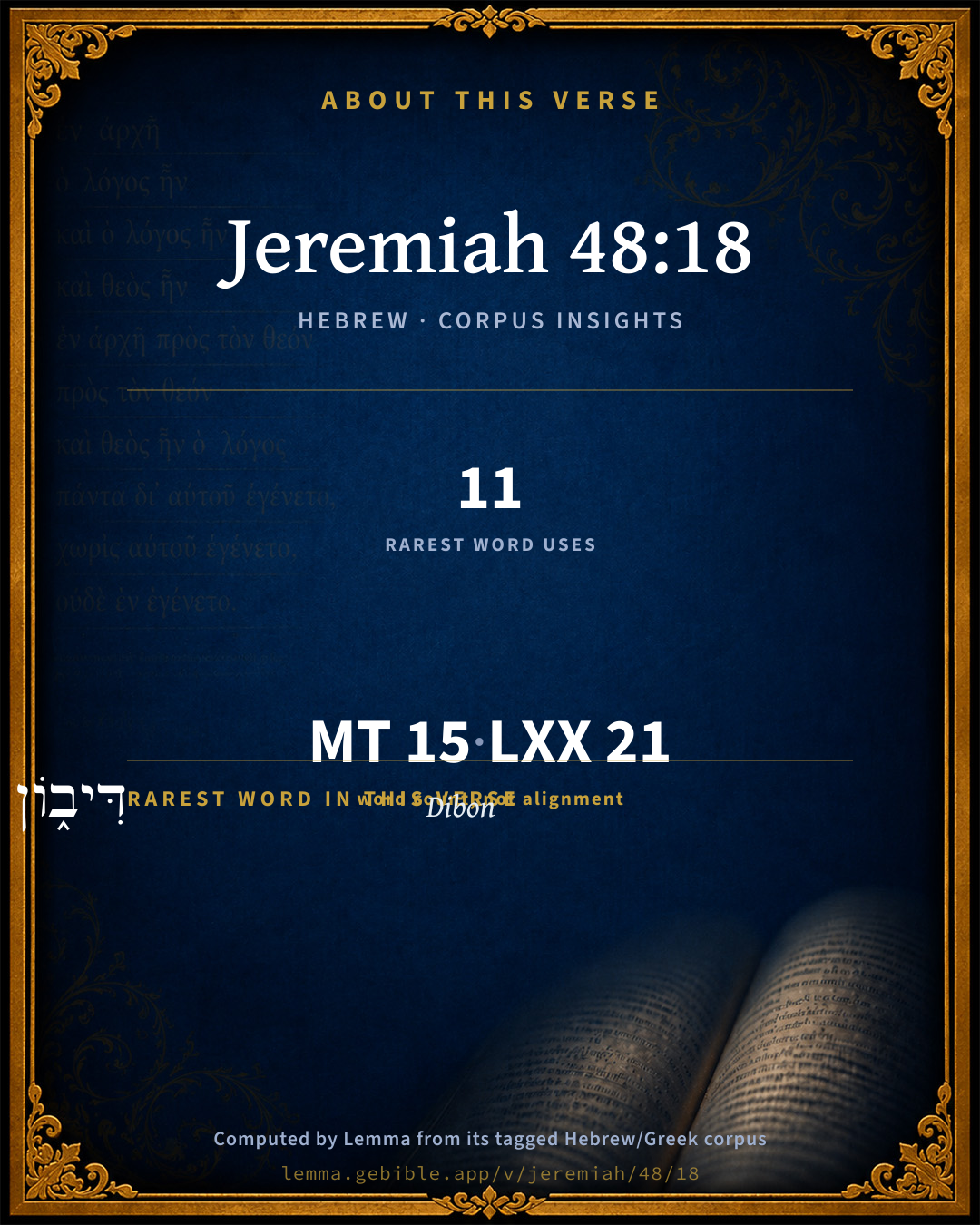
The rarest word here is דִּיב֑וֹן Dibon H1769 — appearing just 11 times in the whole Hebrew Bible.

Shared distinctive vocabulary

דִּיב֑וֹן Dibon H1769 occurs in 11 verses of the Hebrew Bible. Also found in:

Grammatical profile

  • 7 verbs
  • 6 nouns
  • 1 preposition
  • 1 conjunction

Verb forms

  • רְדִ֤י Qal · Imperative
  • ישבי Qal · Participle Active
  • וּשְׁבִ֣י Qal · Imperative
  • יֹשֶׁ֖בֶת Qal · Participle Active
  • שֹׁדֵ֤ד Qal · Participle Active
  • עָ֣לָה Qal · Perfect
  • שִׁחֵ֖ת Piel · Perfect

Repetition

A word recurs within this verse — often emphatic in Hebrew:

  • ישבי to dwell H3427 ×3

Hebrew & Septuagint length

In the original languages it is 15 Hebrew tokens and 21 Greek tokens — but the two are counted differently (Hebrew bundles its prefixes and suffixes into one token; the Greek is in lemma form), so that isn’t a like-for-like length.

Cross-references

13

Topical passages linked to Jeremiah 48:18 in the Treasury of Scripture Knowledge — connected by theme and wording, ordered by reader-vote popularity; previews shown in the World English Bible.

  • Numbers 21:30 We have shot at them; Heshbon is perished even to Dibon, We have laid waste even to Nophah, Which [reaches] to Medeba.
  • Isaiah 47:1 Come down, and sit in the dust, virgin daughter of Babylon; sit on the ground without a throne, daughter of the Chaldeans: for you shall no more be called tender and delicate.
  • Isaiah 15:2 They are gone up to Bayith, and to Dibon, to the high places, to weep: Moab wails over Nebo, and over Medeba; on all their heads is baldness, every beard is cut off.
  • Joshua 13:17 Heshbon, and all its cities that are in the plain; Dibon, and Bamoth Baal, and Beth Baal Meon,
  • Jeremiah 48:22 and on Dibon, and on Nebo, and on Beth Diblathaim,
  • Genesis 21:16 She went and sat down opposite him, a good way off, about a bow shot away. For she said, "Don't let me see the death of the child." She sat over against him, and lifted up her voice, and wept.
  • Exodus 17:3 The people were thirsty for water there; and the people murmured against Moses, and said, "Why have you brought us up out of Egypt, to kill us, our children, and our livestock with thirst?"
  • Numbers 32:3 Ataroth, and Dibon, and Jazer, and Nimrah, and Heshbon, and Elealeh, and Sebam, and Nebo, and Beon,
  • Joshua 13:9 from Aroer, that is on the edge of the valley of the Arnon, and the city that is in the middle of the valley, and all the plain of Medeba to Dibon;
  • Judges 15:18 He was very thirsty, and called on Yahweh, and said, You have given this great deliverance by the hand of your servant; and now shall I die for thirst, and fall into the hand of the uncircumcised.
  • Isaiah 5:13 Therefore my people go into captivity for lack of knowledge; Their honorable men are famished, And their multitudes are parched with thirst.
  • Jeremiah 46:18–19 As I live, says the King, whose name is Yahweh of Hosts, surely like Tabor among the mountains, and like Carmel by the sea, so shall he come.
  • Ezekiel 19:13 Now it is planted in the wilderness, in a dry and thirsty land.

Cross-references courtesy of OpenBible.info (CC BY 4.0).

Hebrew and Greek witnesses Masoretic Hebrew ↔ Greek Septuagint

The same verse in the two great witnesses to the Old Testament, shown verse-for-verse.

These are two independent witnesses, not word-aligned to each other, and the Septuagint is shown in lemma (dictionary) form.

Hebrew Jeremiah 48:18 Masoretic · Westminster Leningrad Codex

רְדִ֤י מִכָּבוֹד֙ ישבי וּשְׁבִ֣י בַצָּמָ֔א יֹשֶׁ֖בֶת בַּת דִּיב֑וֹן כִּֽי שֹׁדֵ֤ד מוֹאָב֙ עָ֣לָה בָ֔ךְ שִׁחֵ֖ת מִבְצָרָֽיִךְ

You daughter who dwells in Dibon, come down from your glory, and sit in thirst; for the destroyer of Moab is come up against you, he has destroyed your strongholds.

World English Bible · Public Domain

Greek LXX Structure differs

In the Septuagint, Jeremiah is about an eighth shorter than the Hebrew and arranges its material differently — the Oracles Against the Nations (Hebrew chapters 46–51) appear in the middle of the Greek book, after 25:13. Because the chapter and verse boundaries do not line up, a verse-for-verse comparison with the Hebrew is not shown.

A verse-for-verse comparison isn’t shown here because the chapters and verses don’t line up. Switch to the LXX edition with the MT / LXX toggle above to read the Greek directly.

Hebrew: Westminster Leningrad Codex (CC BY 4.0). Greek: Septuagint (public domain); English from a public-domain English Septuagint. How the Septuagint differs from the Hebrew →

Targum (Aramaic paraphrase)

1

The Targum is the ancient Jewish Aramaic paraphrase of the Hebrew Scriptures — an interpretive translation, not the Hebrew text itself. Onkelos (literal) and Pseudo-Jonathan (expansive) render the Torah, and Jonathan the Prophets. Coverage is partial: where no permissively-licensed English translation exists for a verse, only the Aramaic is shown. This is verse-level text, not a word-by-word alignment to the Hebrew.

  1. Targum Jonathan Prophets (Joshua–Malachi)
    חוּתִי מִיְקָרָא וְתוּבִי בְצַחְיָא מַלְכוּת כְּנִשְׁתָּא דְדִיבוֹן אֲרֵי בָזוֹזִין אֱתוֹ עַל מוֹאָב סְלִיקוּ עֲלָךְ חַבִּילוּ כְּרַכַּיִךְ:

    (no public-domain English translation for this verse)

    Targum Jonathan — Aramaic: “Mikraot Gedolot” (public domain). English: “Sefaria Community Translation” (CC0 1.0 (public-domain dedication)); “London "Chaldee Paraphrase," 1871” (public domain). Text via Sefaria.

Commentary

Notes on Jeremiah 48:18 from classic Christian and Jewish commentators (each source and its license shown beneath its notes). The classic Christian expositions comment on the surrounding passage and are grouped to its opening verse, so a note may address several verses; the Jewish commentaries on the Tanakh (Rashi and others) are per-verse, so they appear only where the commentator wrote on this verse.

Lemma curates 59 commentaries, every one of them public domain or Creative Commons licensed, each selected and text-cleaned for this edition rather than reprinted as found. About our sources →

Trapp's Complete Commentary

John Trapp

Jer 48:18 Thou daughter that dost inhabit Dibon, come down from [thy] glory, and sit in thirst; for the spoiler of Moab shall come upon thee, [and] he shall destroy thy strong holds.

Ver. 18. And sit in thirst,] i.e., In want of all things.

John Trapp, A Commentary or Exposition upon All the Books of the Old and New Testament (1647–1656) — public domain. Text from a community e-Sword module.

Joseph Benson's Commentary

Jer 48:18-25. Thou daughter that dost inhabit Dibon — Thou that art exalted in pride, and rendered effeminate through luxury: Dibon being one of the chief cities of Moab; come down from thy glory, and sit in thirst — Submit to a mean condition, wherein thou shalt feel the want of all the conveniences of life. The Hebrew language expresses a barren land, which yields no sustenance by a thirsty ground, Psa 63:2; Isa 35:7; Eze 19:13. O inhabitant of Aroer — A town in the borders of Moab; stand by the way and espy, &c. — The prophet describes the great concern and fear that were upon them, which made them hearken to every little report that was stirring. Howl and cry — There will be just cause for a general lamentation. Judgment is come upon the plain country, &c. — The inhabitants of the low grounds have suffered the punishment they deserved. The horn of Moab is cut off — The authority and power of Moab are taken away. This is a metaphorical expression, taken from horned beasts, whose power to defend themselves, and injure other creatures, lies chiefly in their horns. And his arm is broken — His strength is exhausted, the arm of man being the instrument whereby he chiefly discovers his strength.

Joseph Benson's Commentary on the Old and New Testaments (1811–1818) — public domain. Text from a community e-Sword module.

Keil & Delitzsch

C. F. Keil & F. Delitzsch

In Jer 48:18-25 is further described the downfall of this strong and glorious power. The inhabitants if Dibon are to come down from their glory and sit in misery; those of Aroer are to ask the fugitives what has happened, that they may learn that the whole table-land on to the Arnon has been taken by the enemy; and they are to howl over the calamity. The idea presented in Jer 48:18 is an imitation of that in Isa 47:1, "Come down, O daughter of Babylon, sit in the dust;" but רדי is intensified by the addition of מכּבוד, and וּשׁבי על is changed into וּשׁבי בצּמא (the Kethib ישׁבי has evidently been written by mistake for וּשׁבי, the Qeri). צמא elsewhere means "thirst;" but "sit down in the thirst" would be too strange an expression; hence צמא must here have the meaning of צמא, Isa 44:3, "the thirsty arid land:" thus it remains a question whether we should point the word צמא, or take צמא as another form of צמא, as חלב sa ,צמא fo mro is of חלב, Eze 23:19. There is no sufficient reason why Hitzig and Ewald should give the word a meaning foreign to it, from the Arabic or Syriac. Dibon lay about four miles north from the Arnon, at the foot of a mountain, in a very beautiful plain, where, under the name of Dibn, many traces of walls, and a well by the wayside, hewn out of the rock, are still to be found (Seetzen, i. S. 409f.). Hence it must have been well provided with water, even though we should be obliged to understand by "the water of Dimon" (Dibon), which Isaiah mentions (Isa 15:9), the river Arnon, which is about three miles off. The command to "sit down in an arid land" thus forms a suitable figure, representing the humiliation and devastation of Dibon. That the city was fortified, is evident from the mention of the fortifications in the last clause. ישׁבת , as in Jer 46:19. Aroer was situated on the north bank of the Arnon (Mojeb), where its ruins still remain, under the old name Arג'ir (Burckhardt, p. 372). It was a frontier town, between the kingdom of Sihon (afterwards the territory of the Israelites) and the possession of the Moabites (Deu 2:36; Deu 3:12; Deu 4:48; Jos 12:2; Jos 13:9, Jos 13:16). But after the Moabites had regained the northern portion of their original territory, it lay in the midst of the land. The fugitives here represented as passing by are endeavouring, by crossing the Arnon, to escape from the enemy advancing from the north, and subduing the country before them. נס ונמלטה means fugitives of every kind. The co-ordination of the same word or synonymous terms in the masc. and fem. serves to generalize the idea; see on Isa 3:1, and Ewald, 172, c. In נמלטה the tone is retracted through the influence of the distinctive accent; the form is participial. The question, "What has happened?" is answered in Jer 48:20. כּי חתּה, "for (= certainly) it is broken down." The Kethib הלילי וּזעקי must not be changed. Moab is addressed: with הגּידוּ is introduced the summons, addressed to individuals, to proclaim at the Arnon the calamity that has befallen the country to the north of that river.

Keil & Delitzsch — Biblical Commentary on the Old Testament (1861–1891) — public domain (CC PDM 1.0). Text via the HelloAO Bible API. (Old Testament only.)

Tyndale Open Study Notes

Tyndale Open Resources

48:18-19 Dibon and nearby Aroer were key Moabite cities.

Tyndale Open Study Notes — © Tyndale Open Resources, licensed CC BY-SA 4.0. Text via the HelloAO Bible API.

Jamieson, Fausset & Brown

Robert Jamieson, A. R. Fausset & David Brown

(Isa 47:1).

dost inhabit--now so securely settled as if in a lasting habitation.

thirst--Dibon, being situated on the Arnon, abounded in water (Isa 15:9). In sad contrast with this, and with her "glory" in general, she shall be reduced not only to shame, but to the want of the commonest necessaries ("thirst") in the arid wilderness (Jer 48:6).

Jamieson, Fausset & Brown — Commentary Critical and Explanatory on the Whole Bible (1871) — public domain (CC PDM 1.0). Text via the HelloAO Bible API.

Adam Clarke's Commentary

Verse 18. That dost inhabit Dibon] This was anciently a city of the Reubenites, afterwards inhabited by the Moabites, about two leagues north of the river Arnon, and about six to the east of the Dead Sea.-Dahler.

Adam Clarke's Commentary on the Bible (1810–1826) — public domain. Text from a community e-Sword/MySword module.

John Calvin's Commentaries

Here the Prophet turns to address the city Dibon, which was renowned among that people. The mode of speaking is well known; he calls the people of the city the daughter of Dibon; and he calls the daughter an inhabitant, because the Moabites, as it has been said, ever rested in safety and quietness in their own habitations, for no one disturbed them. It is, then, the same as though he had said, “Ye who have hitherto been in a quiet state, descend now from your glory, and dwell in thirst.” By thirst he means the want of all things. Thirst is set in opposition to glory; but it is more than if the Prophet had mentioned disgrace or poverty; for there are many who are otherwise oppressed by want, and yet find fountains or streams; but when there is no drop of water to quench thirst, it is an extreme misery.

We hence see that the Prophet exaggerates the punishment of the Moabites, when he says that the citizens of Dibon would sit in thirst, because, he says, ascended against thee has the waster, and the destroyer of thy fortresses. We may hence conclude that the city was on all sides fortified, so that it thought its defences sufficient to keep off enemies. But the Prophet derides this presumption, because the Chaldeans would come to pull down and destroy all these strongholds. It follows —

John Calvin's Commentaries (1540-1563) — public domain. Text from the Calvin Translation Society English edition (1840s-50s) via the Christian Classics Ethereal Library (ccel.org). Calvin's coverage is partial (roughly two-thirds of the Bible); uncommented books and verses are honest gaps, never fabricated. The 19th-century editor's footnotes and remarks are omitted so the notes are faithfully Calvin's own voice.

Ellicott's Commentary for English Readers

(18) Thou daughter that dost inhabit Dibon.—Dibon is mentioned among the cities of Moab in Num_21:30; Isa_15:2, and as rebuilt by the Gadites in Num_33:45. It is prominent in the Moabite Stone inscription as a royal city. In the distribution of the conquered territory it fell to the lot of Reuben (Jos_13:7; Jos_13:9), but must afterwards have been retaken by Moab. The “strongholds” indicate a fortress. In Isa_15:9 it appears under the form of Dimon, and is there described as abounding in water, the site being probably on the north bank of the Arnon. This last feature gives point to the words of the prophet here. Its waters will not save its inhabitants from the thirst which falls on those who are dragged as captives into exile.

A Bible Commentary for English Readers, edited by Charles John Ellicott (1878–1897) — public domain. Text from a community e-Sword module.

The Cambridge Bible for Schools and Colleges

gen. ed. J. J. S. Perowne

18. thou daughter that dwellest (mg. art seated) in Dibon] meaning, inhabitants of Dibon See on Jer_4:11.

Dibon] now Diban (the “Moabite stone” was found there in 1868) stands on two hills. Hence the expression “come down” in the text. It is four miles N. of the Arnon, and thirteen E. of the Dead Sea, and is described as now a dreary and featureless ruin.

sit in thirst] The words are apparently corrupt, but it is difficult to obtain a satisfactory emendation; perhaps sit in mire or filth.

The Cambridge Bible for Schools and Colleges (gen. ed. J. J. S. Perowne; Cambridge University Press, 1878–1918) — public domain. Text from a community e-Sword module.

John Gill's Exposition

O inhabitant of Aroer,.... Another city that belonged to Moab, situated on the border of it towards Ammon, near the river Arnon; See Gill on Isa 17:2;

stand by the way, and espy; get to the road side where travellers pass, and look out for them:

ask him that fleeth, and her that escapeth; whether man or woman you see fleeing, having escaped the army of the Chaldeans:

and say, what is done? by the Chaldeans; ask what cities they have taken; what progress they have made; what is done to their cities, that they flee from them? tell all the particulars of things.

John Gill's Exposition of the Whole Bible (1746–1763) — public domain (CC PDM 1.0). Text via the HelloAO Bible API.

Albert Barnes' Notes on the Bible

Sit in thirst - Jeremiah draws a picture of the conquered inhabitants, collected outside the walls, waiting for their captors to march them away to the slave mart. The enemy occupied with plundering the houses of Dibon thinks little of the hunger and thirst of his prisoners.

Strong holds - The remains of the fortifications of Dibon are still visible.

Albert Barnes' Notes on the Bible (1834–1885) — public domain. Text from a community e-Sword/MySword module.

Haydock's Catholic Bible Commentary

Thirst. Dibon was well supplied with water, Isaias xv. 9.

George Leo Haydock (1774–1849), Haydock's Catholic Family Bible and Commentary, 1859 edition — public domain. Excludes Psalms (Douay-Rheims chapter numbering differs from Protestant) and Deuterocanonical books (Catholic canon only).

Matthew Poole's English Annotations

Of this

Dibon we read Num 21:30. It was a land for cattle, Num 32:3. Both Dibon, and Aroer, and Ataroth were built by-the children of Gad, to whose lot it fell, Num 32:34, as also to the Reubenites in part, Jos 13 17. It should seem that the Moabites were now come into the possession of it, either by conquest, or upon the Assyrians taking the ten tribes.

Sit in thirst; it was a place well watered (otherwise it had not been fit for cattle); God threateneth that she should be

in thirst, that is, driven into some dry, barren countries.

For the spoiler of Moab shall come upon thee, and he shall destroy thy strong holds; for the king of Babylon, whom God had appointed to spoil all Moab, shall destroy thee also, and thy strong holds shall not secure thee.

Matthew Poole's English Annotations on the Holy Bible (1683–1685) — public domain. Text from a community e-Sword/MySword module.

Whedon's Commentary on the Bible

Daniel D. Whedon

18. Thou daughter that dost inhabit Dibon — Literally, thou that dost inhabit, daughter of Dibon. “Daughter” may be the subject or object of the verb.

Sit in thirst — In the desert-land, in contrast with her accustomed place near the Arnon in a beautiful plain, where to this day there is a well by the wayside hewn out of the rock.

Daniel D. Whedon (gen. ed.), Commentary on the Old and New Testaments (1874–1909) — public domain. Text from a community e-Sword module.

The Pulpit Commentary

Dibon; now Diban, one of the chief towns of Moab, on two adjacent hills, now covered with ruins (Tristram), in the plain of Medeba, (Jos_13:9) north of Aroer and the Amen. Here the famous Moabite Stone (on which see Dr. Ginsburg"s exhaustive monograph), with the inscription of King Mesha, (2Ki_3:4) was found, which, after having been broke up and pieced together, has now found a resting place in the Louvre. It is difficult to say to which Israelitish tribe Dibon was, strictly speaking, attached; for while in Jos_13:17 it is given to Reuben, in Num_32:34 and in the Moabite Stone (line 10) it is assigned to Gad, Apparently the Israelitish population fluctuated. Sometimes Gad was the most adventurous in Occupying Moabitish territory, sometimes Reuben. On the phrase, the daughter, etc., see note on Jer_46:19. The form of the first verse haft is modelled on Isa_47:1. Sit in thirst. The expression is unexampled, and it is possible that we should alter one of the vowel points (which constitute no part of the Massoretic text), rendering, "sit in thirsty (ground)," i.e. the dust. (comp. the parallel passage; Isa_47:1) Or there may be a less used collateral form of the Hebrew for "thirsty" (came). Canon Tristram speaks of the "waterless plain" of Diban ("Land of Moab," p. 132). Thy strongholds. It appears from the Moabite Stone that Diben was the centre of a district which was reckoned as belonging to it; so at least we may account for the phrase, "all Dibon was submissive" (line 28). Compare the phrase in Num_21:25, "Heshbon, and all the villages thereof". (comp. on Jer_49:2)

The Pulpit Commentary (1880–1919), ed. H.D.M. Spence-Jones & Joseph S. Exell — public domain. Text from a community e-Sword module.

John Wesley's Explanatory Notes

Dibon - Dibon, Aroer, and Ataroh were built by the children of Gad. It should seem the Moabites were not come into the possession of them. In thirst - It was a place well watered, but God threatens she should be in thirst, that is, driven into some dry, barren countries. The spoiler - The king of Babylon.

John Wesley, Explanatory Notes Upon the Whole Bible (1754–1765) — public domain. Text via the GEBible commentary corpus.

unfoldingWord translationNotes

Door43 World Missions Community

you daughter living in Dibon

The people of Dibon are spoken of as if they were the daughter of Dibon. AT: "you people living in Dibon" (See: Metaphor)

Dibon

This is the name of a city in Moab. (See: How to Translate Names)

the one who will destroy Moab

"the enemy army that will destroy Moab"

Aroer

This is the name of a city in Moab. (See: How to Translate Names)

Ask the ones

"Ask the people" or "Ask the men and women"

Moab has been shamed, for it has been shattered

Here "Moab" represents the people. This can be stated in active form. AT: "The people are disgraced, for the enemy army has destroyed Moab" (See: Metonymy and Active or Passive)

Howl and lament

"Cry loudly in pain and anger"

that Moab has been devastated

This can be stated in active form. AT: "that the enemy army has devastated Moab" (See: Active or Passive)

translationWords

stronghold

watch

life

lament

unfoldingWord translationNotes — © Distant Shores Media and the Door43 World Missions Community, licensed CC BY-SA 4.0. Source: git.door43.org/Door43/en_tn.

Lesson kit

Teaching starters — assembled from the data on this page, not authored interpretation. Every prompt links to the verse data it draws on. Edit before teaching.

Jeremiah, in the Prophets, opens this verse with 15 words (12 distinct Hebrew lemmas). Its most distinctive word is Dîybôwn (“Dibon”). A historical commentator’s framing appears above. Read the whole chapter for the surrounding context.

Discussion questions

  1. How does “Dibon” (Dîybôwn) shape what this verse is saying?
  2. Numbers 21:30 shares the word «Dibon» with this verse. How do the two illuminate each other?
  3. “to dwell” occurs 3× in this one verse. What is the effect of the repetition?
  4. The translations on this page render this verse differently — a whole-verse word diff, not a word-by-word alignment. What might account for the different wordings?
  5. The verb «רְדִ֤י» is Qal Imperative. How does its form color the action?
  6. Reading how Trapp's Complete Commentary and Joseph Benson's Commentary read this verse, where do the two commentators agree and where do they part?

Things to notice

Reading settings

Reading text

Shown beneath each verse's original-language words.

Old Testament
Old Testament edition

Read the OT as the Masoretic Hebrew (MT) or the Greek Septuagint (LXX).

English shown for the Greek Septuagint (in the Hebrew ↔ Greek comparison).

Comparing translations? Open the Compare panel on any verse page to stack up to four side by side.