
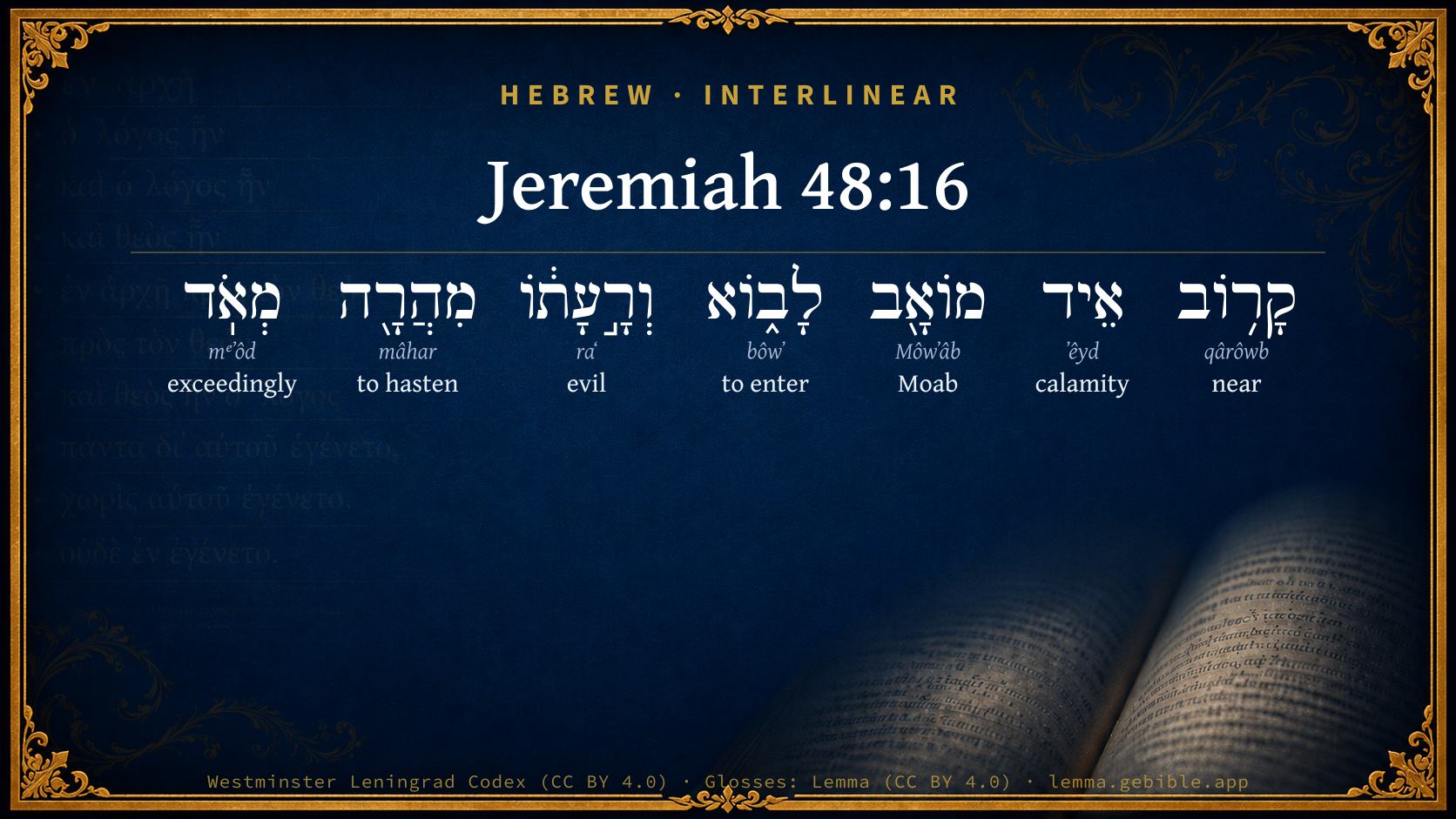
Jeremiah 48:16

Hebrew (Westminster Leningrad Codex) Jeremiah 48:16 appears in the Hebrew Old Testament. The text above is from the Westminster Leningrad Codex. Each word links to its Strong’s number, a concise gloss, and parsing drawn from the Open Scriptures Hebrew Bible morphology. Click any word for its full Brown-Driver-Briggs (BDB) entry.
Download image
Cite this verse

Jeremiah 48:16 (World English Bible). Public Domain. Lemma interlinear Bible study tool, https://lemma.gebible.app/v/jeremiah/48/16.

Show BibTeX & RIS
BibTeX
RIS
English Translation
The calamity of Moab is near to come, and his affliction hurries fast.
World English Bible · Public Domain
Download a study sheet

One document with this verse’s original text, its word-by-word gloss line, the meaning frame, cross-references with their text, attributed commentary, and full source and license credits — printable, and it pastes into notes with its structure intact.

This verse Autodidact and up

Study sheet (.html) Plain text (.txt)

A passage Seminary Student

Up to 50 verses in one chapter. A passage sheet keeps up to 6 commentary sources and 12 cross-references per verse, in the order this page ranks them, and says so on the sheet whenever that leaves anything out. Ask for a single verse and you get the Autodidact verse sheet above.

Everything on this page stays free to read, with no account — the sheet is a download of what is already on screen, not access to it.

Want to remove ads? Support Godless Engineer
Compare translations 3

The same verse in 3 English versions, stacked beneath the original-language interlinear above. Click any original word for its lexicon entry.

Each is an independent rendering of the whole verse — the interlinear is not word-aligned to these translations.

Highlighted words mark where these versions differ — a whole-verse word diff, not a word-by-word alignment.

  • World English Bible Public Domain
    The calamity of Moab is near to come, and his affliction hurries fast.
  • King James Version Public Domain
    The calamity of Moab is near to come, and his affliction hasteth fast.
  • unfoldingWord Literal Text CC BY-SA 4.0
    Moab’s disaster is soon to happen; calamity is hurrying quickly.

unfoldingWord Literal Text — © unfoldingWord, licensed CC BY-SA 4.0. Word-aligned USFM3 via Door43 (git.door43.org/unfoldingWord/en_ult).

Versions to compare (up to 4)

3 of 4 selected

Show all 18 translations

Every available English version of this verse, each an independent rendering of the whole verse.

  • World English Bible Public Domain
    The calamity of Moab is near to come, and his affliction hurries fast.
  • Berean Standard Bible Public Domain
    Moab’s calamity is at hand, and his affliction is rushing swiftly.
  • Majority Standard Bible Public Domain
    Moab’s calamity is at hand, and his affliction is rushing swiftly.
  • King James Version Public Domain
    The calamity of Moab is near to come, and his affliction hasteth fast.
  • American Standard Version (1901) Public Domain
    The calamity of Moab is near to come, and his affliction hasteth fast.
  • Revised Version (1885) Public Domain
    The calamity of Moab is near to come, and his affliction hasteth fast.
  • Geneva Bible (1599) Public Domain
    The destruction of Moab is ready to come, and his plague hasteth fast.
  • Douay-Rheims (1899) Public Domain
    The destruction of Moab is near to come: the calamity thereof shall come on exceeding swiftly.
  • Young's Literal Translation Public Domain
    Near is the calamity of Moab to come, And his affliction hath hasted exceedingly.
  • Literal Standard Version CC BY-SA 4.0
    The destruction of Moab is near to come, || And his calamity has hurried exceedingly.
  • Unlocked Literal Bible CC BY-SA 4.0
    Moab's disaster is soon to happen; calamity is hurrying quickly.
  • unfoldingWord Literal Text CC BY-SA 4.0
    Moab’s disaster is soon to happen; calamity is hurrying quickly.
  • Darby Bible Public Domain
    The calamity of Moab is near to come, and his affliction hasteth fast.
  • World Messianic Bible Public Domain
    “The calamity of Moab is near to come, and his affliction hurries fast.
  • Webster's Bible Public Domain
    The calamity of Moab is near to come, and his affliction hasteth fast.
  • Free Bible Version CC BY-SA 4.0
    Moab's doom is about to happen; destruction is rushing down on them.
  • Bible in Basic English Public Domain
    The fate of Moab is near, and trouble is coming on him very quickly.
  • JPS Tanakh (1917) Public Domain
    The calamity of Moab is near to come, and his affliction hasteth fast.

Literal Standard Version (2020), Covenant Press — licensed CC BY-SA 4.0. Text via the HelloAO Bible API (eBible.org). Unlocked Literal Bible (unfoldingWord) — licensed CC BY-SA 4.0. Text via the HelloAO Bible API (eBible.org). unfoldingWord Literal Text — © unfoldingWord, licensed CC BY-SA 4.0. Word-aligned USFM3 via Door43 (git.door43.org/unfoldingWord/en_ult). Free Bible Version, Dr. Jonathan Gallagher — licensed CC BY-SA 4.0. Text via the HelloAO Bible API (eBible.org).

Word by word

More ways to search: Search by grammar → Find every occurrence → Compare this word →

Practice this passage: Drill this verse → Learn its vocabulary →

About this verse

These counts appear in no published source. They are computed here, from the morphology-tagged text and Lemma’s own curated glosses. What Lemma adds →

7
words
7
distinct lemmas
Prophets
section

Notable vocabulary

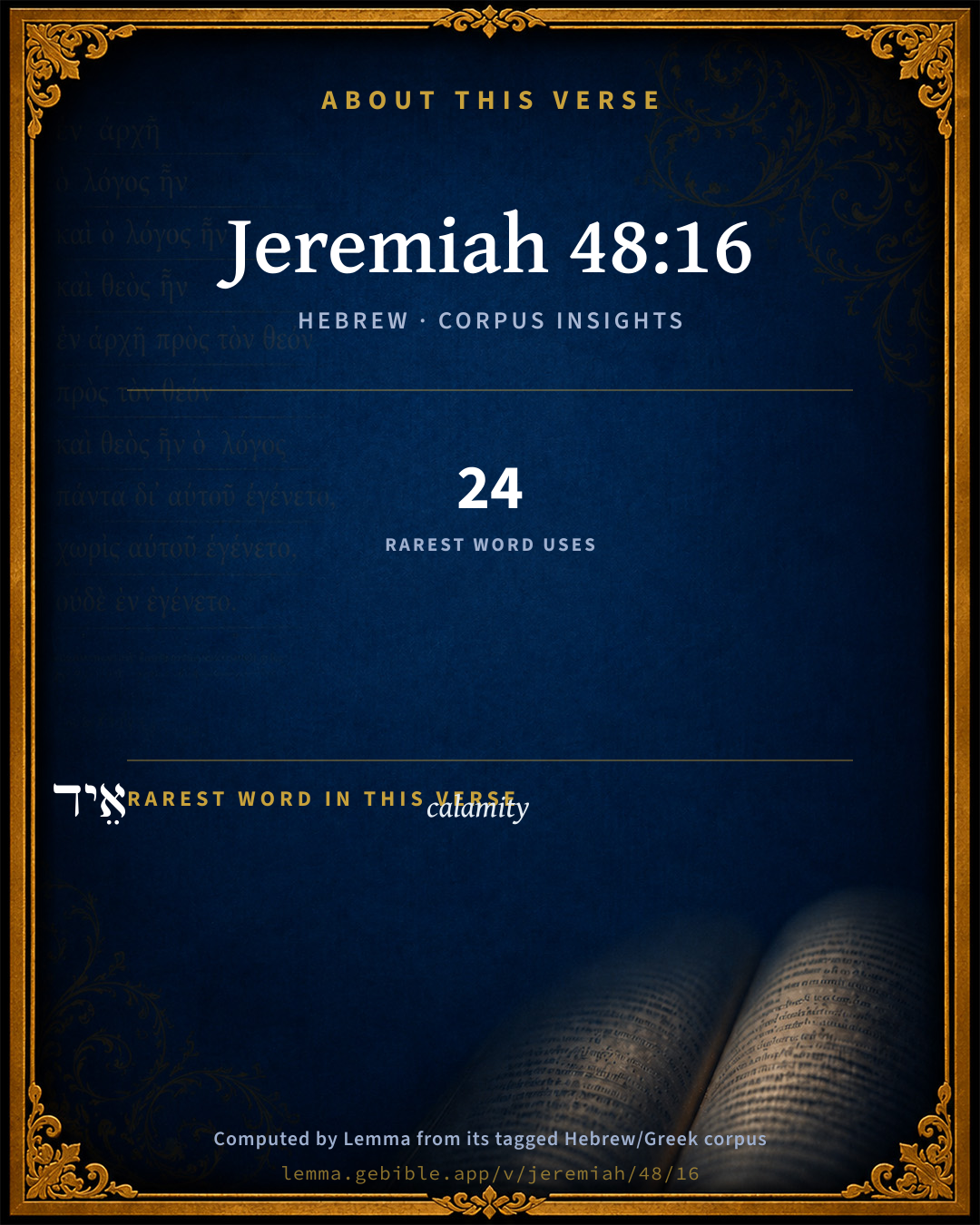
The rarest word here is אֵיד calamity H343 — appearing just 24 times in the whole Hebrew Bible.

Shared distinctive vocabulary

אֵיד calamity H343 occurs in 22 verses of the Hebrew Bible. Also found in:

Grammatical profile

  • 2 verbs
  • 3 nouns
  • 1 adjective
  • 1 adverb

Verb forms

  • לָב֑וֹא Qal · Infinitive Construct
  • מִהֲרָ֖ה Piel · Perfect

Cross-references

7

Topical passages linked to Jeremiah 48:16 in the Treasury of Scripture Knowledge — connected by theme and wording, ordered by reader-vote popularity; previews shown in the World English Bible.

  • Isaiah 13:22 Wolves shall cry in their castles, and jackals in the pleasant palaces: and her time is near to come, and her days shall not be prolonged.
  • Deuteronomy 32:35 Vengeance is mine, and recompense, At the time when their foot shall slide: For the day of their calamity is at hand, The things that are to come on them shall make haste.
  • Isaiah 16:13–14 This is the word that Yahweh spoke concerning Moab in time past.
  • Jeremiah 1:12 Then said Yahweh to me, You have well seen: for I watch over my word to perform it.
  • Ezekiel 12:23 Tell them therefore, Thus says the Lord Yahweh: I will make this proverb to cease, and they shall no more use it as a proverb in Israel; but tell them, The days are at hand, and the fulfillment of every vision.
  • Ezekiel 12:28 Therefore tell them, Thus says the Lord Yahweh: There shall none of my words be deferred any more, but the word which I shall speak shall be performed, says the Lord Yahweh.
  • 2 Peter 2:3 In covetousness they will exploit you with deceptive words: whose sentence now from of old doesn't linger, and their destruction will not slumber.

Cross-references courtesy of OpenBible.info (CC BY 4.0).

Hebrew and Greek witnesses Masoretic Hebrew ↔ Greek Septuagint

The same verse in the two great witnesses to the Old Testament, shown verse-for-verse.

These are two independent witnesses, not word-aligned to each other, and the Septuagint is shown in lemma (dictionary) form.

Hebrew Jeremiah 48:16 Masoretic · Westminster Leningrad Codex

קָר֥וֹב אֵיד מוֹאָ֖ב לָב֑וֹא וְרָ֣עָת֔וֹ מִהֲרָ֖ה מְאֹֽד

The calamity of Moab is near to come, and his affliction hurries fast.

World English Bible · Public Domain

Greek LXX Structure differs

In the Septuagint, Jeremiah is about an eighth shorter than the Hebrew and arranges its material differently — the Oracles Against the Nations (Hebrew chapters 46–51) appear in the middle of the Greek book, after 25:13. Because the chapter and verse boundaries do not line up, a verse-for-verse comparison with the Hebrew is not shown.

A verse-for-verse comparison isn’t shown here because the chapters and verses don’t line up. Switch to the LXX edition with the MT / LXX toggle above to read the Greek directly.

Hebrew: Westminster Leningrad Codex (CC BY 4.0). Greek: Septuagint (public domain); English from a public-domain English Septuagint. How the Septuagint differs from the Hebrew →

Targum (Aramaic paraphrase)

1

The Targum is the ancient Jewish Aramaic paraphrase of the Hebrew Scriptures — an interpretive translation, not the Hebrew text itself. Onkelos (literal) and Pseudo-Jonathan (expansive) render the Torah, and Jonathan the Prophets. Coverage is partial: where no permissively-licensed English translation exists for a verse, only the Aramaic is shown. This is verse-level text, not a word-by-word alignment to the Hebrew.

  1. Targum Jonathan Prophets (Joshua–Malachi)
    קָרֵיב תְּבַרְהוֹן דְמוֹאֲבָאֵי לְמֵיתֵי וּבִשְׁתְּהוֹן מוֹחַיָא לַחֲדָא:

    (no public-domain English translation for this verse)

    Targum Jonathan — Aramaic: “Mikraot Gedolot” (public domain). English: “Sefaria Community Translation” (CC0 1.0 (public-domain dedication)); “London "Chaldee Paraphrase," 1871” (public domain). Text via Sefaria.

Commentary

Notes on Jeremiah 48:16 from classic Christian and Jewish commentators (each source and its license shown beneath its notes). The classic Christian expositions comment on the surrounding passage and are grouped to its opening verse, so a note may address several verses; the Jewish commentaries on the Tanakh (Rashi and others) are per-verse, so they appear only where the commentator wrote on this verse.

Lemma curates 59 commentaries, every one of them public domain or Creative Commons licensed, each selected and text-cleaned for this edition rather than reprinted as found. About our sources →

Trapp's Complete Commentary

John Trapp

Jer 48:16 The calamity of Moab [is] near to come, and his affliction hasteth fast.

Ver. 16. The calamity of Moab is near to come.] See on Jer 48:15.

John Trapp, A Commentary or Exposition upon All the Books of the Old and New Testament (1647–1656) — public domain. Text from a community e-Sword module.

Keil & Delitzsch

C. F. Keil & F. Delitzsch

Moab's glory is departed. - Jer 48:16. "The destruction of Moab is near to come, and his trouble hastens rapidly. Jer 48:17. Bewail him, all [ye who are] round about him, and all who know his name! Say, How the rod of strength is broken, the staff of majesty! Jer 48:18. Come down from [thy] glory, and sit in the drought, [thou] inhabitants, daughter of Dibon; for the destroyer of Moab hath come up against thee, he hath destroyed thy strongholds. Jer 48:19. Stand by the way, and watch, O inhabitants of Aroer! ask him who flees, and her that has escaped; say, What has happened? Jer 48:20. Moab is ashamed, for it is broken down: howl and cry out; tell it in Arnon, that Moab is laid waste. Jer 48:21. And judgment hath come upon the country of the plain, upon Holon, and upon Jahzah, and upon Mephaath, Jer 48:22. And upon Dibon, and upon Nebo, and upon Beth-diblathaim, Jer 48:23. And upon Kirjathaim, and upon Beth-gamul, and upon Beth-meon, Jer 48:24. And upon Kerioth, and upon Bozrah, and upon all the cities of the land of Moab, those that are far off and those that are near. Jer 48:25. The horn of Moab is cut off, ad his arm is broken, saith Jahveh."

The downfall of Moab will soon begin. Jer 48:16 is an imitation of Deu 32:35; cf. Isa 13:22; Isa 56:1. The fall of the Moabite power and glory will be so terrible, that all the nations, near ad distant, will have pity on him. The summons to lament, Jer 48:17, is not a mockery, but is seriously meant, for the purpose of expressing the idea that the downfall of so mighty and glorious a power will rouse compassion. The environs of Moab are the neighbouring nations, and "those who know his name" are those who live far off, and have only heard about him. The staff, the sceptre, is the emblem of authority; cf. Eze 19:11-12, Eze 19:14, and Psa 110:2.

Keil & Delitzsch — Biblical Commentary on the Old Testament (1861–1891) — public domain (CC PDM 1.0). Text via the HelloAO Bible API. (Old Testament only.)

Jamieson, Fausset & Brown

Robert Jamieson, A. R. Fausset & David Brown

near--to the prophet's eye, though probably twenty-three years elapsed between the utterance of the prophecy in the fourth year of Jehoiakim (Kg2 24:2) and its fulfilment in the fifth year of Nebuchadnezzar.

Jamieson, Fausset & Brown — Commentary Critical and Explanatory on the Whole Bible (1871) — public domain (CC PDM 1.0). Text via the HelloAO Bible API.

John Calvin's Commentaries

Here the Prophet expresses something more, that the vengeance of which he spoke was near and hastening. It served to alleviate the sorrow of the faithful, when they understood that the Moabites would shortly be punished; for it was a grievous and bitter trial, when God severely chastened his own children, to see that the wicked were in the meantime spared. As, then, he deferred his judgments as to the wicked, that delay tended to drive the faithful to despair, at least they could not bear with sufficient patience the scourges of God.

This is the reason why the Prophet now says, Near is the destruction of the Moabites, and their calamity hastens And though God did for some time yet bear with the Moabites, so that they remained in a quiet state, and reveled in their pleasures, yet this prophecy was true; for we are to bear in mind that truth, which ought ever to be remembered as to promises and threatenings, that a thousand years are as one day with the Lord: and hence is that exhortation given by the Prophet Habakkuk,

“If the prophecy delays, wait for it; for coming it will come, and will not delay.” (Habakkuk 2:3)

And this mode of speaking occurs often in the prophets. When, therefore, God denounces punishment on the wicked and the despisers of his Law, he says, “Behold, your day hastens,” and he says this, that they might be awakened and begin to fear in due time.

But here, as I have reminded you, Jeremiah had a regard to his own people. For the faithful might have objected, and said, “What can this be? how long will God defer the punishment which he threatens to our enemies?” Hence he says, “Strengthen your minds for a little while, for God will presently stretch forth his hand and show that he is a defender who cares for you and your safety; for he will set himself against the Moabites, because they have been unfaithful and vexatious to you.” It is, then, for this reason that he says, Near is their destruction, and their vengeance hastens

We may hence learn this useful doctrine, that whenever God promises anything, we ought to receive it as a present thing, though yet hidden and even remote. There is no distance which ought to impede our faith; but we ought to regard as certain whatever God promises, and as though it were before our eyes and in our hand. And the same ought to be the case as to threatenings; whenever God denounces anything hard and grievous, it ought to touch and move us the same as though we saw his hand armed with a sword, and as though the very execution of his vengeance was exhibited before our eyes. For we know what the Scripture teaches us elsewhere,

“When the wicked shall say, Peace and security, destruction comes suddenly on them, as the pain of childbearing, which seizes a woman when she thinks nothing of it.” (1 Thessalonians 5:3)

Let us then learn to set God’s favor ever as present, and also all punishments, so that we may really fear them. It follows —

John Calvin's Commentaries (1540-1563) — public domain. Text from the Calvin Translation Society English edition (1840s-50s) via the Christian Classics Ethereal Library (ccel.org). Calvin's coverage is partial (roughly two-thirds of the Bible); uncommented books and verses are honest gaps, never fabricated. The 19th-century editor's footnotes and remarks are omitted so the notes are faithfully Calvin's own voice.

John Gill's Exposition

All ye that are about him, bemoan him,.... The neighbouring nations, such as the Ammonites, and others, are called upon to condole the sad case of Moab; all upon the borders of the country of Moab, either within them or without them:

and all ye that know his name; not only that had heard of his fame and glory, but knew in what grandeur and splendour he lived; these have a form of condolence given them:

say, how is the strong staff broken, and the beautiful rod! the mighty men of war, the staff of the nation, in which they trusted, destroyed; their fortified cities demolished; the powerful kingdom, which swayed the sceptre, and ruled in great glory, and was terrible and troublesome to others, now pulled down. The Targum is,

"how is the king broken that did evil, the oppressing ruler!''

John Gill's Exposition of the Whole Bible (1746–1763) — public domain (CC PDM 1.0). Text via the HelloAO Bible API.

Albert Barnes' Notes on the Bible

Near to come - Twenty-three years elapsed between the fourth year of Jehoiakim, when this prophecy was spoken, and its accomplishment by the invasion of Moab five years after the capture of Jerusalem. So slowly does God’s justice move onward.

Albert Barnes' Notes on the Bible (1834–1885) — public domain. Text from a community e-Sword/MySword module.

Haydock's Catholic Bible Commentary

Swiftly; about twenty-three years from the fourth of Joakim.

George Leo Haydock (1774–1849), Haydock's Catholic Family Bible and Commentary, 1859 edition — public domain. Excludes Psalms (Douay-Rheims chapter numbering differs from Protestant) and Deuterocanonical books (Catholic canon only).

Matthew Poole's English Annotations

Josephus tells us this destruction came upon the Moabites five years after the siege of Jerusalem; but if it were longer, we must consider that he who speaketh is that God to whom a thousand years is but as one day.

Matthew Poole's English Annotations on the Holy Bible (1683–1685) — public domain. Text from a community e-Sword/MySword module.

The Pulpit Commentary

The calamity of Moab, etc. The form of the verse reminds us Deu_32:35 Isa_13:22.

The Pulpit Commentary (1880–1919), ed. H.D.M. Spence-Jones & Joseph S. Exell — public domain. Text from a community e-Sword module.

John Wesley's Explanatory Notes

Is near - Josephus tells us this destruction came upon the Moabites five years after the siege of Jerusalem.

John Wesley, Explanatory Notes Upon the Whole Bible (1754–1765) — public domain. Text via the GEBible commentary corpus.

Kretzmann's Popular Commentary

Paul E. Kretzmann

Moab’s Glory Followed by its Deep Fall

v. 16. The calamity of Moab is near to come, so that destruction will soon overtake him, and his affliction hasteth fast, his misfortune coming on apace, with great speed.

v. 17. All ye that are about him, all his neighbors, bemoan him, and all ye that know his name, those living at a distance and knowing only the fame of Moab, say, How is the strong staff broken and the beautiful rod! The breaking of Moab’s scepter of beauty and splendor signifies the total overthrow of his government and rule. The admonition is addressed in a general way, to emphasize the total ruin of the former mighty people.

v. 18. Thou daughter that dost inhabit Dibon, a city some four miles north of the Arnon, come down from thy glory and sit in thirst, her surroundings becoming an arid wilderness; for the spoiler of Moab shall come upon thee, and he shall destroy thy strongholds, leveling all her proud fortifications in which she trusted.

v. 19. O inhabitant of Aroer, a city on the northern bank of the Arnon, originally belonging to Ammon, Deu 2:36; Deu 3:12, stand by the way and espy, watching, as it were, for the fugitive Moabites coming down from the north to escape the Chaldean invaders; ask him that fleeth and her that escapeth, for both men and women were seeking to save their lives by a hurried flight, and say, What is done? The answer to this question is given in the next verse.

v. 20. Moab is confounded, put to shame and confusion; for it is broken down; howl and cry! Tell ye it in Arnon, the former northern boundary between Moab and Ammon, that Moab is spoiled, the news of its destruction traveling southward with the fugitives.

v. 21. And judgment is come upon the plain country, upon the plateau; north of the Arnon, cities which had been in the possession of the tribe of Reuben for some centuries after the conquest, upon Holon, and upon Jahazah, and upon Mephaath,

v. 22. and upon Dibon, and upon Nebo, and upon Beth-diblathaim,

v. 23. and upon Kiria-thaim, and upon Beth-gamul, and upon Beth-meon,

v. 24. and upon Kerioth, probably another name for the capital of the country, and upon Bozrah, and upon all the cities of the land of Moab, far and near, most of these being situated in the region east of the Dead Sea. The fact that the judgment has struck Moab is made more specific by the enumeration of the individual cities that have been destroyed.

v. 25. The horn of Moab, emblem of strength and sovereignty, is cut off, and his arm is broken, saith the Lord, he has lost all his former great power, his mighty position is shattered. All this, as the prophet now points out, is the result of Moab’s pride.

v. 26. Make ye him drunken, so the prophet addresses all those whom the Lord has made executors of His punishment, for he magnified himself against the Lord, wherefore he must drink the cup of Jehovah’s avenging fury; Moab also shall wallow in his vomit, the consequence of his intoxication, and he also shall be in derision, an object of mockery on the part of all men. This is retribution in kind.

v. 27. For was not Israel a derision unto thee? Did Moab not make a mockery of the people of God? Was he found among thieves? for since thou spakest of him, thou skippedst for joy, or, "Had he been found among thieves that thou, as often as thou spakest of him, shookest thy head?" Moab had given every exhibition of derision and mockery over Israel, while, in truth, this nation, together with other heathen nations nearby, had been the cause of Israel’s criminal conduct.

v. 28. O ye that dwell in Moab, leave the cities, dwellings which no longer offered a sufficient shelter, and dwell in the rock, in caves of inaccessible mountain fastnesses, and be like the dove that maketh her nest in the sides of the hole’s mouth, on the walls of the yawning ravine.

v. 29. We have heard the pride of Moab (he is exceeding proud), his loftiness, and his arrogancy, and his pride, and the haughtiness of his heart, the synonymous terms being heaped to express, in a way, the unusual hatefulness of Moab’s sin.

v. 30. I know his wrath, his furious insolence, saith the Lord; but it shall not be so, his boastings are nothingness, idle talk, vain vauntings; his lies shall not so effect it, his deeds being just as vain as his words. All this causes the prophet to give expression to his sympathy for Moab, well as it had deserved its fate.

v. 31. Therefore will I howl for Moab, raise his voice in lamentation, and I will cry out for all Moab; mine heart shall mourn for the men of Kir-heres, the strongest citadel of the country, probably identical with Kir-Moab.

v. 32. O vine of Sibmah, I will weep for thee with the weeping of Jazer, or, "more than Jazer," since, because the vines of Sibmah excelled in grapes which they produced, their destruction by the enemy was a calamity; thy plants are gone over the sea, they reach even to the Sea of Jazer, to the Dead Sea and beyond, and northward to the pools of Jazer, considerably beyond Heshbon. The spoiler is fallen upon thy summer-fruits and upon thy vintage, so that this entire industry was ruined.

v. 33. And joy and gladness is taken from the plentiful field, from the fertile farm- and garden-land which has just been described, and from the land of Moab, from the entire country; and I have caused wine to fail from the wine-presses, there being no longer a supply of grapes for them; none shall tread with shouting, with the usual cry of "Hedad!" heard in the fields; their shouting shall be no shouting. Cf Isa 16:7-10.

v. 34. From the cry of Heshbon even unto Elealeh, and even unto Jahaz, have they uttered their voice, that is, throughout the entire country inhabited by the Moabites, from the northern part to the southern end of their land, the cry of distress was heard, from Zoar, in the southwest, even unto Horonaim, as an heifer of three years old, or, "to the third Eglat," one of three villages bearing the same name; for the waters also of Nimrim, copious springs with the meadow-lands belonging to them, near the southern end of the Dead Sea, shall be desolate, dried up as a result of God’s punishment.

v. 35. Moreover, I will cause to cease in Moab, saith the Lord, him that offereth in the high places and him that burneth incense to his gods, making an end of all idolaters, as He would break down their places of worship. The same fate eventually awaits all idolaters, also those who indulge in the finer forms of the sin only and consider themselves safe in their insolent behavior.

Paul E. Kretzmann, Popular Commentary of the Bible (1921–1924) — public domain. Text from a community e-Sword module.

Lesson kit

Teaching starters — assembled from the data on this page, not authored interpretation. Every prompt links to the verse data it draws on. Edit before teaching.

Jeremiah, in the Prophets, opens this verse with 7 words (7 distinct Hebrew lemmas). Its most distinctive word is ʼêyd (“calamity”). A historical commentator’s framing appears above. Read the whole chapter for the surrounding context.

Discussion questions

  1. What does “calamity” (ʼêyd) contribute to the verse as a whole?
  2. Deuteronomy 32:35 shares the word «calamity» with this verse. How do the two illuminate each other?
  3. The translations on this page render this verse differently — a whole-verse word diff, not a word-by-word alignment. What might account for the different wordings?
  4. The verb «לָב֑וֹא» is Qal Infinitive Construct. How does its form color the action?
  5. Reading how Trapp's Complete Commentary and Keil & Delitzsch read this verse, where do the two commentators agree and where do they part?

Things to notice

Reading settings

Reading text

Shown beneath each verse's original-language words.

Old Testament
Old Testament edition

Read the OT as the Masoretic Hebrew (MT) or the Greek Septuagint (LXX).

English shown for the Greek Septuagint (in the Hebrew ↔ Greek comparison).

Comparing translations? Open the Compare panel on any verse page to stack up to four side by side.