Isaiah 16:2

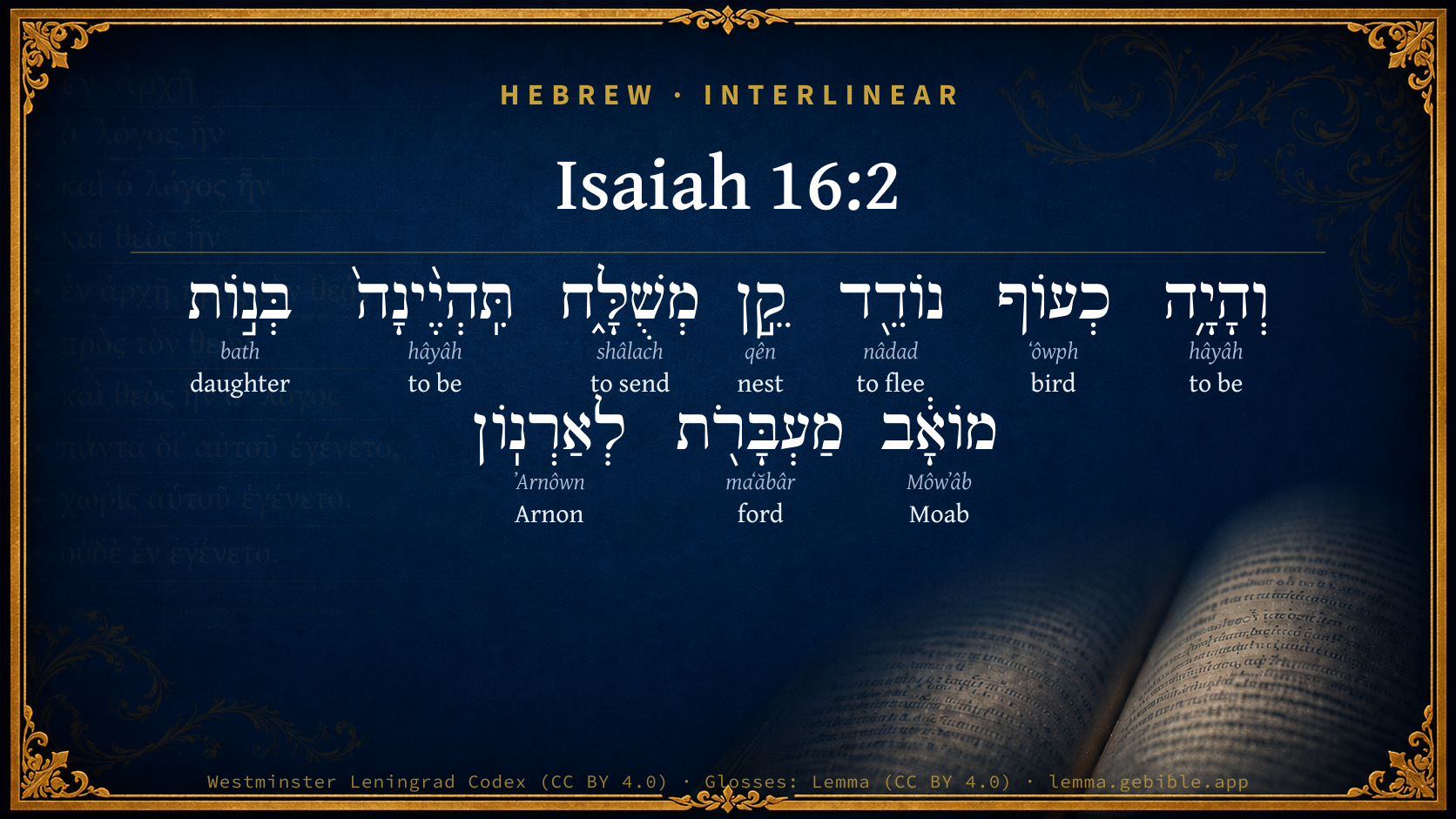
Hebrew (Westminster Leningrad Codex) Isaiah 16:2 appears in the Hebrew Old Testament. The text above is from the Westminster Leningrad Codex. Each word links to its Strong’s number, a concise gloss, and parsing drawn from the Open Scriptures Hebrew Bible morphology. Click any word for its full Brown-Driver-Briggs (BDB) entry.
Download image
Cite this verse

Isaiah 16:2 (World English Bible). Public Domain. Lemma interlinear Bible study tool, https://lemma.gebible.app/v/isaiah/16/2.

Show BibTeX & RIS
BibTeX
RIS
English Translation
For it shall be that, as wandering birds, as a scattered nest, so shall the daughters of Moab be at the fords of the Arnon.
World English Bible · Public Domain
Download a study sheet

One document with this verse’s original text, its word-by-word gloss line, the meaning frame, cross-references with their text, attributed commentary, and full source and license credits — printable, and it pastes into notes with its structure intact.

This verse Autodidact and up

Study sheet (.html) Plain text (.txt)

A passage Seminary Student

Up to 50 verses in one chapter. A passage sheet keeps up to 6 commentary sources and 12 cross-references per verse, in the order this page ranks them, and says so on the sheet whenever that leaves anything out. Ask for a single verse and you get the Autodidact verse sheet above.

Everything on this page stays free to read, with no account — the sheet is a download of what is already on screen, not access to it.

Want to remove ads? Support Godless Engineer
Compare translations 3

The same verse in 3 English versions, stacked beneath the original-language interlinear above. Click any original word for its lexicon entry.

Each is an independent rendering of the whole verse — the interlinear is not word-aligned to these translations.

Highlighted words mark where these versions differ — a whole-verse word diff, not a word-by-word alignment.

  • World English Bible Public Domain
    For it shall be that, as wandering birds, as a scattered nest, so shall the daughters of Moab be at the fords of the Arnon.
  • King James Version Public Domain
    For it shall be, that, as a wandering bird cast out of the nest, so the daughters of Moab shall be at the fords of Arnon.
  • unfoldingWord Literal Text CC BY-SA 4.0
    And it will happen, like a wandering bird scattered a nest, the daughters of Moab will be at the fords of the Arnon.

unfoldingWord Literal Text — © unfoldingWord, licensed CC BY-SA 4.0. Word-aligned USFM3 via Door43 (git.door43.org/unfoldingWord/en_ult).

Versions to compare (up to 4)

3 of 4 selected

Show all 18 translations

Every available English version of this verse, each an independent rendering of the whole verse.

  • World English Bible Public Domain
    For it shall be that, as wandering birds, as a scattered nest, so shall the daughters of Moab be at the fords of the Arnon.
  • Berean Standard Bible Public Domain
    Like fluttering birds pushed out of the nest, so are the daughters of Moab at the fords of the Arnon:
  • Majority Standard Bible Public Domain
    Like fluttering birds pushed out of the nest, so are the daughters of Moab at the fords of the Arnon:
  • King James Version Public Domain
    For it shall be, that, as a wandering bird cast out of the nest, so the daughters of Moab shall be at the fords of Arnon.
  • American Standard Version (1901) Public Domain
    For it shall be that, as wandering birds, as a scattered nest, so shall the daughters of Moab be at the fords of the Arnon.
  • Revised Version (1885) Public Domain
    For it shall be that, as wandering birds, as a scattered nest, so shall the daughters of Moab be at the fords of Arnon.
  • Geneva Bible (1599) Public Domain
    For it shall be as a birde that flieth, and a nest forsaken: the daughters of Moab shall be at the foordes of Arnon.
  • Douay-Rheims (1899) Public Domain
    And it shall come to pass, that as a bird fleeing away, and as young ones flying out of the nest, so shall the daughters of Moab be in the passage of Arnon.
  • Young's Literal Translation Public Domain
    And it hath come to pass, As a wandering bird, a nest cast out, Are daughters of Moab, `at' fords of Arnon.
  • Literal Standard Version CC BY-SA 4.0
    And it has come to pass, || As a wandering bird, cast out of a nest, || Are daughters of Moab, [at] fords of Arnon.
  • Unlocked Literal Bible CC BY-SA 4.0
    As wandering birds, as a scattered nest, so the women of Moab are at the fords of the Arnon River.
  • unfoldingWord Literal Text CC BY-SA 4.0
    And it will happen, like a wandering bird scattered a nest, the daughters of Moab will be at the fords of the Arnon.
  • Darby Bible Public Domain
    And it shall be [that] as a wandering bird, [as] a scattered nest, so shall the daughters of Moab be at the fords of the Arnon.
  • World Messianic Bible Public Domain
    For it will be that as wandering birds, as a scattered nest, so will the daughters of Moab be at the fords of the Arnon.
  • Webster's Bible Public Domain
    For it shall be, that, as a wandering bird cast out of the nest, so the daughters of Moab shall be at the fords of Arnon.
  • Free Bible Version CC BY-SA 4.0
    The Moabite women at the fords of the Arnon are like birds fluttering around when their nest is destroyed.
  • Bible in Basic English Public Domain
    For the daughters of Moab will be like wandering birds, like a place from which the young birds have gone in flight, at the ways across the Arnon.
  • JPS Tanakh (1917) Public Domain
    For it shall be that, as wandering birds, as a scattered nest, so shall the daughters of Moab be at the fords of Arnon.

Literal Standard Version (2020), Covenant Press — licensed CC BY-SA 4.0. Text via the HelloAO Bible API (eBible.org). Unlocked Literal Bible (unfoldingWord) — licensed CC BY-SA 4.0. Text via the HelloAO Bible API (eBible.org). unfoldingWord Literal Text — © unfoldingWord, licensed CC BY-SA 4.0. Word-aligned USFM3 via Door43 (git.door43.org/unfoldingWord/en_ult). Free Bible Version, Dr. Jonathan Gallagher — licensed CC BY-SA 4.0. Text via the HelloAO Bible API (eBible.org).

Word by word

More ways to search: Search by grammar → Find every occurrence → Compare this word →

Practice this passage: Drill this verse → Learn its vocabulary →

About this verse

These counts appear in no published source. They are computed here, from the morphology-tagged text and Lemma’s own curated glosses. What Lemma adds →

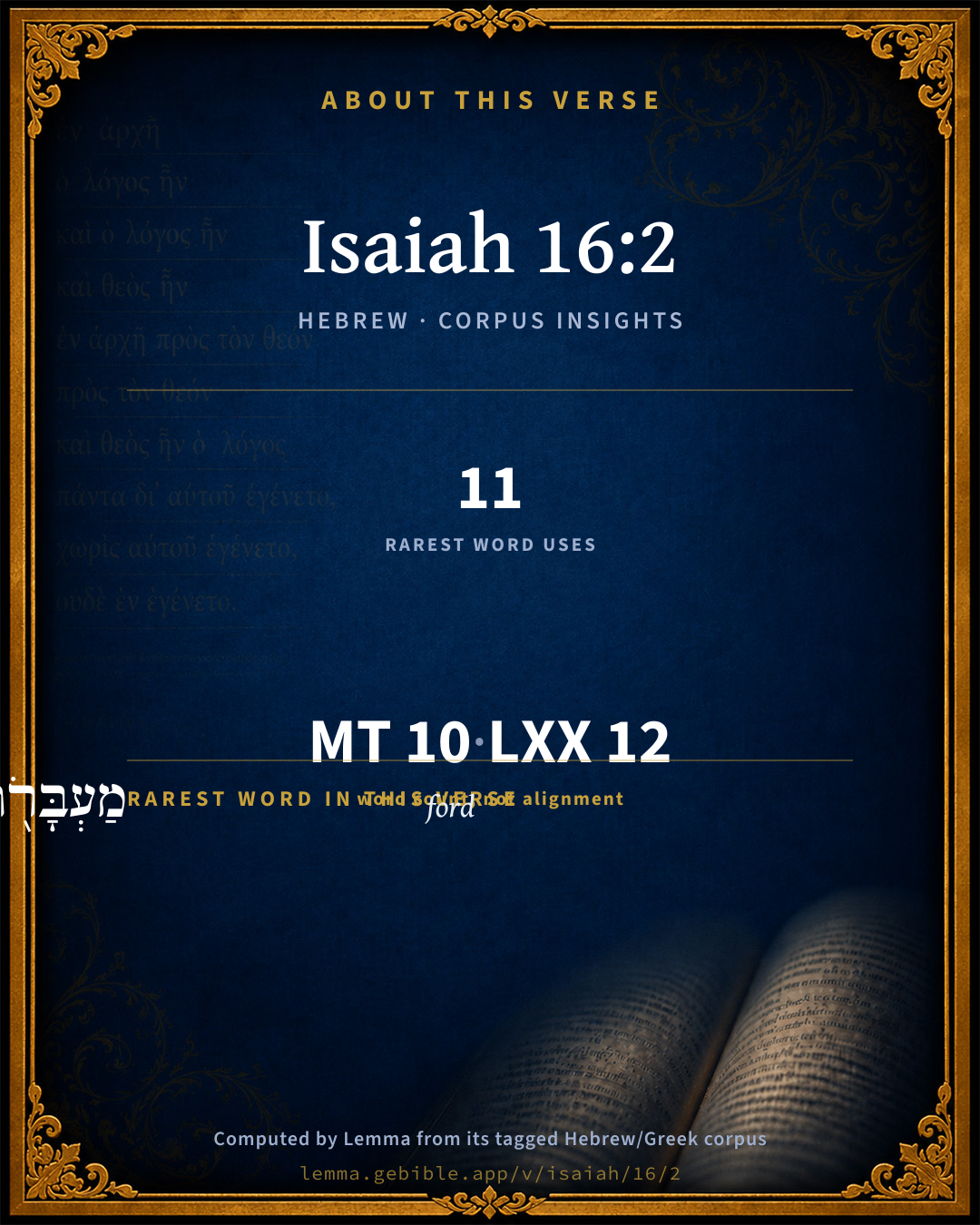
10
words
9
distinct lemmas
Prophets
section

Notable vocabulary

The rarest word here is מַעְבָּרֹ֖ת ford H4569 — appearing just 11 times in the whole Hebrew Bible.

Shared distinctive vocabulary

מַעְבָּרֹ֖ת ford H4569 occurs in 11 verses of the Hebrew Bible. Also found in:

Grammatical profile

  • 4 verbs
  • 6 nouns

Verb forms

  • וְהָיָ֥ה Qal · Sequential Perfect
  • נוֹדֵ֖ד Qal · Participle Active
  • מְשֻׁלָּ֑ח Pual · Participle Passive
  • תִּֽהְיֶ֨ינָה֙ Qal · Imperfect

Repetition

A word recurs within this verse — often emphatic in Hebrew:

  • וְהָיָ֥ה to be H1961 ×2

Hebrew & Septuagint length

In English translation the verse runs 25 words from the Hebrew and 30 from the Septuagint (LXX English) — closely comparable.

A rough comparison of the two English renderings, which tokenize alike — not a word-level alignment.

Word counts can differ between the Hebrew and the Greek without any difference in meaning — e.g. the Hebrew direct-object marker אֵת has no separate Greek word, and Greek often adds the article ὁ.

In the original languages it is 10 Hebrew tokens and 12 Greek tokens — but the two are counted differently (Hebrew bundles its prefixes and suffixes into one token; the Greek is in lemma form), so that isn’t a like-for-like length.

Cross-references

9

Topical passages linked to Isaiah 16:2 in the Treasury of Scripture Knowledge — connected by theme and wording, ordered by reader-vote popularity; previews shown in the World English Bible.

  • Proverbs 27:8 As a bird that wanders from her nest, So is a man who wanders from his home.
  • Judges 11:18 Then they went through the wilderness, and went around the land of Edom, and the land of Moab, and came by the east side of the land of Moab, and they encamped on the other side of the Arnon; but they didn't come within the border of Moab, for the Arnon was the border of Moab.
  • Numbers 21:13–15 From there they traveled, and encamped on the other side of the Arnon, which is in the wilderness, that comes out of the border of the Amorites: for the Arnon is the border of Moab, between Moab and the Amorites.
  • Deuteronomy 2:36 From Aroer, which is on the edge of the valley of the Arnon, and [from] the city that is in the valley, even to Gilead, there was not a city too high for us; Yahweh our God delivered up all before us:
  • Deuteronomy 3:8 We took the land at that time out of the hand of the two kings of the Amorites who were beyond the Jordan, from the valley of the Arnon to Mount Hermon;
  • Deuteronomy 3:12 This land we took in possession at that time: from Aroer, which is by the valley of the Arnon, and half the hill-country of Gilead, and the cities of it, gave I to the Reubenites and to the Gadites:
  • Joshua 13:16 Their border was from Aroer, that is on the edge of the valley of the Arnon, and the city that is in the middle of the valley, and all the plain by Medeba;
  • Isaiah 13:14 It shall happen, that as the chased roe, and as sheep that no man gathers, they shall turn every man to his own people, and shall flee every man to his own land.
  • Jeremiah 48:20 Moab is disappointed; for it is broken down: wail and cry; tell you it by the Arnon, that Moab is laid waste.

Cross-references courtesy of OpenBible.info (CC BY 4.0).

Hebrew and Greek witnesses Masoretic Hebrew ↔ Greek Septuagint

The same verse in the two great witnesses to the Old Testament, shown verse-for-verse.

These are two independent witnesses, not word-aligned to each other, and the Septuagint is shown in lemma (dictionary) form.

Hebrew Isaiah 16:2 Masoretic · Westminster Leningrad Codex

וְהָיָ֥ה כְעוֹף נוֹדֵ֖ד קֵ֣ן מְשֻׁלָּ֑ח תִּֽהְיֶ֨ינָה֙ בְּנ֣וֹת מוֹאָ֔ב מַעְבָּרֹ֖ת לְאַרְנֽוֹן

For it shall be that, as wandering birds, as a scattered nest, so shall the daughters of Moab be at the fords of the Arnon.

World English Bible · Public Domain

Greek LXX Isaiah 16:2 Septuagint · lemma form

εἰμί γάρ ὡς πετεινόν ἀναἵπταμαι νεοσσός ἀποαἱρέω θυγάτηρ μωαβ ἔπειτα δέ αρνων

For you shall be as a young bird taken away from a bird that has flown: even you shall be so, daughter of Moab: and then do you, O Arnon,

LXX2012 (modern English Septuagint) · Public Domain

Hebrew: Westminster Leningrad Codex (CC BY 4.0). Greek: Septuagint (public domain); English from LXX2012 (modern English Septuagint) (Public Domain). How the Septuagint differs from the Hebrew →

Targum (Aramaic paraphrase)

1

The Targum is the ancient Jewish Aramaic paraphrase of the Hebrew Scriptures — an interpretive translation, not the Hebrew text itself. Onkelos (literal) and Pseudo-Jonathan (expansive) render the Torah, and Jonathan the Prophets. Coverage is partial: where no permissively-licensed English translation exists for a verse, only the Aramaic is shown. This is verse-level text, not a word-by-word alignment to the Hebrew.

  1. Targum Jonathan Prophets (Joshua–Malachi)
    וִיהֵי כְעוֹפָא דְאַפְרָחוֹהִי מִקִנֵיהּ וִיטַלְטֵיל יִתַּפְקָן וִיהֶוְיָן בְּנַת מוֹאָב מְגִיזַן לְהוֹן לְאַרְנוֹן:

    Otherwise it shall come to pass, as a bird which men have driven away, being cast out of its nest, the daughters of Moab shall be led round about, made to Wadi Arnon.

    Targum Jonathan — Aramaic: “Mikraot Gedolot” (public domain). English: “Sefaria Community Translation” (CC0 1.0 (public-domain dedication)); “London "Chaldee Paraphrase," 1871” (public domain). Text via Sefaria.

Commentary

Notes on Isaiah 16:2 from classic Christian and Jewish commentators (each source and its license shown beneath its notes). The classic Christian expositions comment on the surrounding passage and are grouped to its opening verse, so a note may address several verses; the Jewish commentaries on the Tanakh (Rashi and others) are per-verse, so they appear only where the commentator wrote on this verse.

Lemma curates 59 commentaries, every one of them public domain or Creative Commons licensed, each selected and text-cleaned for this edition rather than reprinted as found. About our sources →

Trapp's Complete Commentary

John Trapp

Isa 16:2 For it shall be, [that], as a wandering bird cast out of the nest, [so] the daughters of Moab shall be at the fords of Arnon.

Ver. 2. For it shall be, that, as a wandering bird, &c.] Or, Otherwise it shall be that as, {a} &c., i.e., except ye do as I have advised you, {Isa 16:1} a double mischief shall befall you. (1.) Dissipation, as a wandering bird, &c.; (2.) Deportation, at the fords of Arnon, where ye shall be carried captive.

As a wandering bird.] See Pro 27:8. {See Trapp on "Pro 27:8"}

{a} Alioqui fiet. - Jun.

John Trapp, A Commentary or Exposition upon All the Books of the Old and New Testament (1647–1656) — public domain. Text from a community e-Sword module.

The Biblical Illustrator

Joseph S. Exell

Isa_16:2

As a wandering bird, cast out of the nest

The unrest of the sinner

The picture represents the distress and bewilderment of the wrong-doer.

He does not know whether to go back to the old door and knock at it in the hope that it may be opened to him again by some kindly hand, or to flee away into the land of darkness and silence. There is no peace, saith my God, to the wicked. (J. Parker, D. D.)

The Biblical Illustrator, edited by Joseph S. Exell (c. 1880s–1900s) — public domain. Text from a community e-Sword module.

Geneva Bible (1599)

Geneva Bible translators

There is no remedy, but you must flee.

Geneva Bible (1599) marginal notes — public domain. Text via Bolls.life.

Jamieson, Fausset & Brown

Robert Jamieson, A. R. Fausset & David Brown

cast out of . . . nest--rather, "as a brood cast out" (in apposition with "a wandering bird," or rather, wandering birds), namely, a brood just fledged and expelled from the nest in which they were hatched [HORSLEY]. Compare Isa 10:14; Deu 32:11.

daughters of Moab--that is, the inhabitants of Moab. So Kg2 19:21; Psa 48:11; Jer 46:11; Lam 4:22 [MAURER].

at the fords--trying to cross the boundary river of Moab, in order to escape out of the land. EWALD and MAURER make "fords" a poetical expression for "the dwellers on Arnon," answering to the parallel clause of the same sense, "daughters of Moab."

Jamieson, Fausset & Brown — Commentary Critical and Explanatory on the Whole Bible (1871) — public domain (CC PDM 1.0). Text via the HelloAO Bible API.

Ellicott's Commentary for English Readers

(2) As a wandering bird cast out of the nest.—Better as in the margin, a forsaken nest. The “daughters of Moab” either literally, the women driven from their homes, or figuratively (as in Isa_16:1) the whole population of its towns and villages, are represented as fluttering in terror, like birds whose nests are spoiled (comp. Isa_10:14), like the fledglings in the nest, on the fords of Arnon, uncertain whether to return to their old homes or to cross into a strange land. The imagery reminds us of Psa_11:1, Pro_27:8, so also of Æsch. Agam. 49-52.

A Bible Commentary for English Readers, edited by Charles John Ellicott (1878–1897) — public domain. Text from a community e-Sword module.

The Cambridge Bible for Schools and Colleges

gen. ed. J. J. S. Perowne

2. The verse gives no good sense in its present position. Not only does it obscure the connexion between Isa_16:1 and Isa_16:3, but its language of prediction reveals an affinity with Isa_15:9. It has probably been misplaced (so Duhm), and the fact that the Moabites are represented as at “the fords of Arnon,” instead of in Edom, confirms the impression that we have here an addition to the original prophecy. The images of the wandering birds and the scattered nest (render as in R.V.) remind us of Isaiah (ch. Isa_10:14, Isa_31:5). The daughters of Moab are the provincial towns of Moab, or their inhabitants (cf. Psa_48:11).

The Cambridge Bible for Schools and Colleges (gen. ed. J. J. S. Perowne; Cambridge University Press, 1878–1918) — public domain. Text from a community e-Sword module.

John Gill's Exposition

For it shall be,.... Or, "otherwise it shall be" (z); if ye do not pay this tribute:

that as a wandering bird cast out of the nest: or, "as a wandering bird, the nest sent out": that is, as a bird that has forsaken its nest, and wanders about, and its young ones are turned out of the nest, scarcely fledged, and unable to shift for themselves, but flutter about here and there, trembling and frightened, see Pro 26:2,

so the daughters of Moab shall be at the fords of Arnon: turned out of their houses, wandering up and down, not knowing where to go; unable to help themselves, and in the utmost fright and consternation, fleeing to the very borders of their land, as the fords of Arnon were, see Num 21:13.

(z) "alioqui", Junius & Tremellius, Piscator.

John Gill's Exposition of the Whole Bible (1746–1763) — public domain (CC PDM 1.0). Text via the HelloAO Bible API.

Albert Barnes' Notes on the Bible

For it shall be - It shall happen in the time of the calamity that shall come upon Moab.

As a wandering bird - (See Isa 10:14.) The same idea is presented in Pro 27:8 :

As a bird that wanders from her nest,

So is a man that wandereth from his place.

The idea here is that of a bird driven away from her nest, where the nest is destroyed, and the young fly about without any home or place of rest. So would Moab be when the inhabitants were driven from their dwellings. The reason why this is introduced seems to be, to enforce what the prophet had said in the previous verse - the duty of paying the usual tribute to the Jews, and seeking their protection. The time is coming, says the prophet, when the Moabites shall be driven from their homes, and when they will need that protection which they can obtain by paying the usual tribute to the Jews.

The daughters of Moab - The females shall be driven from their homes, and shall wander about, and endeavor to flee from the invasion which has come upon the land. By the apprehension, therefore, that their wives and daughters would be exposed to this danger, the prophet calls upon the Moabites to secure the protection of the king of Judah.

At the fords of Arnon - Arnon was the northern boundary of the land of Moab. They would endeavor to cross that river, and thus flee from the land, and escape the desolations that were coming upon it. The river Arnon, now called Mujeb, flows in a deep, frightfully wild, and rocky vale of the same name Num 21:15; Deu 2:24; Deu 3:9, in a narrow bed, and forms at this time the boundary between the provinces of Belka and Karrak (Seetzen). Bridges were not common in the times here referred to; and, indeed, permanent bridges among the ancients were things almost unknown. Hence, they selected the places where the streams were most shallow and gentle, as the usual places of crossing.

Albert Barnes' Notes on the Bible (1834–1885) — public domain. Text from a community e-Sword/MySword module.

Haydock's Catholic Bible Commentary

Arnon. They shall not be able to fly over, or to escape the conqueror.

George Leo Haydock (1774–1849), Haydock's Catholic Family Bible and Commentary, 1859 edition — public domain. Excludes Psalms (Douay-Rheims chapter numbering differs from Protestant) and Deuterocanonical books (Catholic canon only).

Matthew Poole's English Annotations

For; or, otherwise, as this particle is sometimes used; if you do not follow my advice.

As a wandering bird cast out of the nest; which knows not whither to go, nor what to do.

At the fords of Arnon; which was the border of the land of Moab, where they were, either being carried that way into captivity, or rather with design to flee out of their own land, although they knew not whither, as the foregoing metaphor showeth.

Matthew Poole's English Annotations on the Holy Bible (1683–1685) — public domain. Text from a community e-Sword/MySword module.

Whedon's Commentary on the Bible

Daniel D. Whedon

2, 3. For — Not for, but and, it shall be — If they comply, then this shall follow: that, as a wandering bird cast… nest — Moab must acquire favour from Israel or Judah right early, (Isa_16:1,) for soon she would stand a restless fugitive on the borders of the latter, and implore protection. Fugitives, here, are compared to fluttering birds, routed from their nests, and left in timid indecision.

Daughters of Moab — Usually, and especially as applied to Judah, Babylon. etc., the word “daughters” of a place are the inhabitants of the place. But here the women seem to be the suppliants. They stand at the ford of Arnon, the ancient border of Moab. Num_21:13. The exhortation to them is,

Take counsel — Apply counsel given by the prophet.

Execute judgment — Rather, decision. Decide at once to pass the stream. No delay is admissible. Flee for help to the mount in Jerusalem, Mount Zion.

Shadow as the night — Seek protection from divine wrath, such as the shadow of night is, from enemies. Let the Lord be thy shadow and pavilion, and be secure as much in noonday as in the night.

Hide the outcasts — In turn make secure the exiles from Judah in your midst. Often had Moab been such a refuge.

Bewray not — Reveal not the place of the persecuted exile.

Daniel D. Whedon (gen. ed.), Commentary on the Old and New Testaments (1874–1909) — public domain. Text from a community e-Sword module.

The Pulpit Commentary

For it shall be; rather, and it shall be. The tribute having been paid, Moab will regain some confidence. Her fluttered population will return, and collect at the fords of the Amen, ready to recross it. As a wandering bird cast out of the nest; rather, as a wandering bird (or, wandering birds)as a scattered nest" (or, "brood of nestlings"). The daughters of Moab. The population of Moab generally, as "the daughter of Zion" (ver. 1) is the population of Jerusalem generally.

The Pulpit Commentary (1880–1919), ed. H.D.M. Spence-Jones & Joseph S. Exell — public domain. Text from a community e-Sword module.

John Wesley's Explanatory Notes

Cast out - Which knows not whither to go. Arnon - Which was the border of the land of Moab, where they were, with design to flee out of their land, tho' they knew not whither.

John Wesley, Explanatory Notes Upon the Whole Bible (1754–1765) — public domain. Text via the GEBible commentary corpus.

Keil & Delitzsch

C. F. Keil & F. Delitzsch

The advice does not remain without effect, but they embrace it eagerly."And the daughters of Moab will be like birds fluttering about, a scared nest, at the fords of the Arnon." "The daughters of Moab," like "the daughters of Judah," for example, in Psa 48:12, are the inhabitants of the cities and villages of the land of Moab. They were already like birds soaring about (Pro 27:8), because of their flight from their own land; but here, as we may see from the expression תהיינה ... והיה, the simile is intended to depict the condition into which they would be thrown by the prophet's advice. The figure (cf., Isa 10:14) as well as the expression (cf., Isa 17:2) is thoroughly Isaiah's. It is a state of anxious and timid indecision, resembling the fluttering to and fro of birds, that have been driven away from their nest, and wheel anxiously round and round, without daring to return to their old home. In this way the daughters of Moab, coming out of their hiding-places, whether nearer or more remote, show themselves at the fords of the Arnon, that is to say, on the very soil of their old home, which was situated between the Arnon and Wady el-Ahsa, and which was now devastated by the hand of a foe. לארנון מעברות we should regard as in apposition to benoth Moab (the daughters of Moab), if ma‛bâroth signifies the coast-lands (like ‛ebrē in Isa 7:20), and not, as it invariably does, the fords. It is locative in its meaning, and is so accentuated.

Keil & Delitzsch — Biblical Commentary on the Old Testament (1861–1891) — public domain (CC PDM 1.0). Text via the HelloAO Bible API. (Old Testament only.)

J. A. Alexander on Isaiah

Joseph Addison Alexander

This verse assigns the ground or reason of the exhortation in the one before it. “And it shall be (or come to pass, that) like a bird wandering, (like) a nest cast out, shall be the daughters of Moab, the fords of Arnon.” The construction ‘cast out from the nest’ is inconsistent with the form of the original. Nest may be understood as a poetical term for its contents. There are three interpretations of the phrase daughters of Moab. The first gives the words the geographical sense of villages or dependent towns. (See above Isa 3:16; Isa 4:4) The second explanation makes it mean the people generally, here called ‘daughters’, as the whole population is elsewhere called daughter. The third gives the words their strict sense as denoting the female inhabitants of Moab, whose flight and sufferings are a sufficient index to the state of things. In the absence of any conclusive reason for dissenting from this strict and proper sense of the expressions, it is entitled to the preference. The Arnon is mentioned as the principal stream of Moab.

Joseph Addison Alexander, The Prophecies of Isaiah (1846–1847; New York: Scribner, 1870–1878) — public domain. Text from a community e-Sword module.

Rashi

Rabbi Shlomo Yitzchaki (Rashi)

like a wandering bird from its nest.

driven from the nest like young birds driven from their nest, who roam and wander, so shall the villages of Moab wander to the fords of the Arnon.

Rashi on the Tanakh — English translations: “The Judaica Press complete Tanach with Rashi, translated by A. J. Rosenberg” (CC BY 4.0); “Pentateuch with Rashi's commentary by M. Rosenbaum and A.M. Silbermann, 1929-1934” (public domain); “The Metsudah Tanach series, Lakewood, N.J” (CC BY 4.0); and “The Book of Joshua, Metsudah Publications, 1997” (CC BY 4.0). Text via Sefaria.

Ibn Ezra

Rabbi Abraham ibn Ezra

והיה And he shall be. The Moabite shall be.

The daughters of Moab. The villages. Comp. Num. 21:32

Ibn Ezra on the Tanakh — English translations: “Sefaria Community Translation” (CC0 1.0 (public-domain dedication)); “Yalkut, Sifsei Chachomim Chumash, Metsudah Publications, 2009” (CC BY 4.0); and “Commentary of Ibn Ezra on Isaiah - trans. by M. Friedlander, 1873” (public domain). Text via Sefaria.

Lesson kit

Teaching starters — assembled from the data on this page, not authored interpretation. Every prompt links to the verse data it draws on. Edit before teaching.

Isaiah, in the Prophets, opens this verse with 10 words (9 distinct Hebrew lemmas). Its most distinctive word is maʻăbâr (“ford”). A historical commentator’s framing appears above. Read the whole chapter for the surrounding context.

Discussion questions

  1. How does “ford” (maʻăbâr) shape what this verse is saying?
  2. Genesis 32:22 shares the word «ford» with this verse. How do the two illuminate each other?
  3. “to be” occurs 2× in this one verse. What is the effect of the repetition?
  4. The translations on this page render this verse differently — a whole-verse word diff, not a word-by-word alignment. What might account for the different wordings?
  5. The verb «וְהָיָ֥ה» is Qal Sequential Perfect. How does its form color the action?
  6. Reading how Trapp's Complete Commentary and The Biblical Illustrator read this verse, where do the two commentators agree and where do they part?

Things to notice

Reading settings

Reading text

Shown beneath each verse's original-language words.

Old Testament
Old Testament edition

Read the OT as the Masoretic Hebrew (MT) or the Greek Septuagint (LXX).

English shown for the Greek Septuagint (in the Hebrew ↔ Greek comparison).

Comparing translations? Open the Compare panel on any verse page to stack up to four side by side.