Judges 11:25

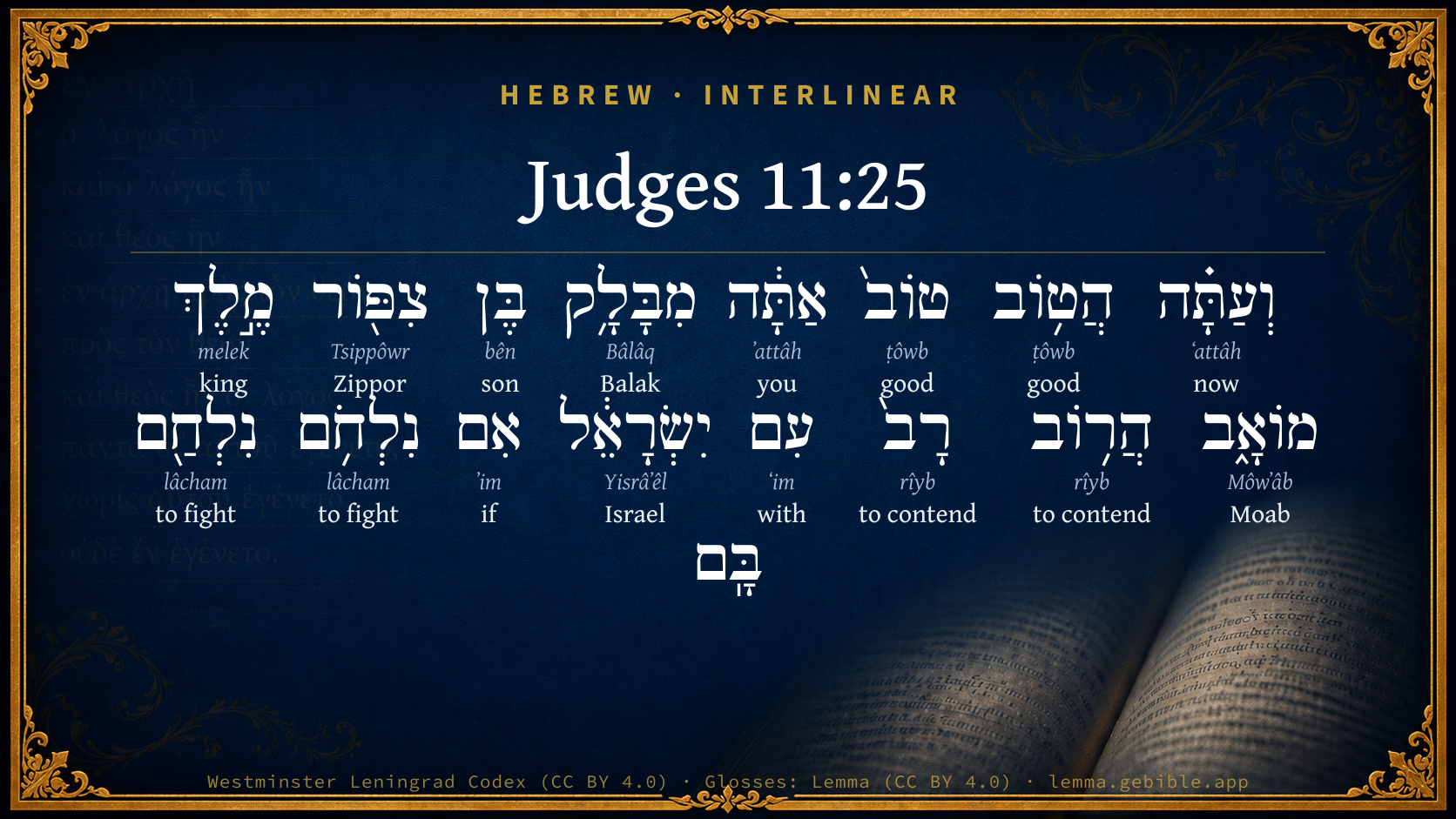
Hebrew (Westminster Leningrad Codex) Judges 11:25 appears in the Hebrew Old Testament. The text above is from the Westminster Leningrad Codex. Each word links to its Strong’s number, a concise gloss, and parsing drawn from the Open Scriptures Hebrew Bible morphology. Click any word for its full Brown-Driver-Briggs (BDB) entry.
Download image
Cite this verse

Judges 11:25 (World English Bible). Public Domain. Lemma interlinear Bible study tool, https://lemma.gebible.app/v/judges/11/25.

Show BibTeX & RIS
BibTeX
RIS
English Translation
Now are you anything better than Balak the son of Zippor, king of Moab? did he ever strive against Israel, or did he ever fight against them?
World English Bible · Public Domain
Download a study sheet

One document with this verse’s original text, its word-by-word gloss line, the meaning frame, cross-references with their text, attributed commentary, and full source and license credits — printable, and it pastes into notes with its structure intact.

This verse Autodidact and up

Study sheet (.html) Plain text (.txt)

A passage Seminary Student

Up to 50 verses in one chapter. A passage sheet keeps up to 6 commentary sources and 12 cross-references per verse, in the order this page ranks them, and says so on the sheet whenever that leaves anything out. Ask for a single verse and you get the Autodidact verse sheet above.

Everything on this page stays free to read, with no account — the sheet is a download of what is already on screen, not access to it.

Want to remove ads? Support Godless Engineer
Compare translations 3

The same verse in 3 English versions, stacked beneath the original-language interlinear above. Click any original word for its lexicon entry.

Each is an independent rendering of the whole verse — the interlinear is not word-aligned to these translations.

Highlighted words mark where these versions differ — a whole-verse word diff, not a word-by-word alignment.

  • World English Bible Public Domain
    Now are you anything better than Balak the son of Zippor, king of Moab? did he ever strive against Israel, or did he ever fight against them?
  • King James Version Public Domain
    And now art thou any thing better than Balak the son of Zippor, king of Moab? did he ever strive against Israel, or did he ever fight against them,
  • unfoldingWord Literal Text CC BY-SA 4.0
    And now, being better, are you being better than Balak, the son of Zippor, the king of Moab? Contending, did he contend with Israel, or fighting, did he fight with them?

unfoldingWord Literal Text — © unfoldingWord, licensed CC BY-SA 4.0. Word-aligned USFM3 via Door43 (git.door43.org/unfoldingWord/en_ult).

Versions to compare (up to 4)

3 of 4 selected

Show all 18 translations

Every available English version of this verse, each an independent rendering of the whole verse.

  • World English Bible Public Domain
    Now are you anything better than Balak the son of Zippor, king of Moab? did he ever strive against Israel, or did he ever fight against them?
  • Berean Standard Bible Public Domain
    Are you now so much better than Balak son of Zippor, king of Moab? Did he ever contend with Israel or fight against them?
  • Majority Standard Bible Public Domain
    Are you now so much better than Balak son of Zippor, king of Moab? Did he ever contend with Israel or fight against them?
  • King James Version Public Domain
    And now art thou any thing better than Balak the son of Zippor, king of Moab? did he ever strive against Israel, or did he ever fight against them,
  • American Standard Version (1901) Public Domain
    And now art thou anything better than Balak the son of Zippor, king of Moab? did he ever strive against Israel, or did he ever fight against them?
  • Revised Version (1885) Public Domain
    And now art thou any thing better than Balak the son of Zippor, king of Moab? did he ever strive against Israel, or did he ever fight against them?
  • Geneva Bible (1599) Public Domain
    And art thou nowe farre better then Balak the sonne of Zippor King of Moab? did he not striue with Israel and fight against them,
  • Douay-Rheims (1899) Public Domain
    Unless perhaps thou art better than Balac the son of Sephor king of Moab: or canst shew that he strove against Israel and fought against him,
  • Young's Literal Translation Public Domain
    `And now, `art' thou at all better than Balak son of Zippor, king of Moab? did he at all strive with Israel? did he at all fight against them?
  • Literal Standard Version CC BY-SA 4.0
    And now, [are] you at all better than Balak son of Zippor, king of Moab? Did he strive with Israel at all? Did he fight against them at all?
  • Unlocked Literal Bible CC BY-SA 4.0
    Now are you really better than Balak son of Zippor, king of Moab? Did he dare to have an argument with Israel? Did he ever wage war against them?
  • unfoldingWord Literal Text CC BY-SA 4.0
    And now, being better, are you being better than Balak, the son of Zippor, the king of Moab? Contending, did he contend with Israel, or fighting, did he fight with them?
  • Darby Bible Public Domain
    Now are you any better than Balak the son of Zippor, king of Moab? Did he ever strive against Israel, or did he ever go to war with them?
  • World Messianic Bible Public Domain
    Now are you anything better than Balak the son of Zippor, king of Moab? Did he ever strive against Israel, or did he ever fight against them?
  • Webster's Bible Public Domain
    And now art thou any thing better than Balak the son of Zippor king of Moab? did he ever strive against Israel, or did he ever fight against them,
  • Free Bible Version CC BY-SA 4.0
    Do you think you're so much better than Balak, son of Zippor, king of Moab? Did he ever quarrel with Israel or attack them?
  • Bible in Basic English Public Domain
    What! are you any better than Balak, the son of Zippor, king of Moab? Did he ever take up a cause against Israel or make war against them?
  • JPS Tanakh (1917) Public Domain
    And now art thou any thing better than Balak the son of Zippor, king of Moab? did he ever strive against Israel, or did he ever fight against them?

Literal Standard Version (2020), Covenant Press — licensed CC BY-SA 4.0. Text via the HelloAO Bible API (eBible.org). Unlocked Literal Bible (unfoldingWord) — licensed CC BY-SA 4.0. Text via the HelloAO Bible API (eBible.org). unfoldingWord Literal Text — © unfoldingWord, licensed CC BY-SA 4.0. Word-aligned USFM3 via Door43 (git.door43.org/unfoldingWord/en_ult). Free Bible Version, Dr. Jonathan Gallagher — licensed CC BY-SA 4.0. Text via the HelloAO Bible API (eBible.org).

Word by word

More ways to search: Search by grammar → Find every occurrence → Compare this word →

Practice this passage: Drill this verse → Learn its vocabulary →

צִפּ֖וֹר
Tsippôwr
H6834
“Zippor”
Noun, Proper
Part of Speech
Noun
Type
Proper
Full BDB Definition

Origin: the same as H6833

TWOT: None

Zippor = "sparrow" - father of Balak the king of Moab at the time of the exodus
  1. וְעַתָּ֗ה ʻattâh H6258 “and · now” Conjunction + Adverb
  2. הֲט֥וֹב ṭôwb H2896 “good” Particle, Interrogative + Adjective, Adjective, Masculine, Singular, Absolute
  3. טוֹב֙ ṭôwb H2896 “good” Adjective, Adjective, Masculine, Singular, Absolute
  4. אַתָּ֔ה ʼattâh H859 “you” Pronoun, Personal, 2nd Person, Masculine, Singular
  5. מִבָּלָ֥ק Bâlâq H1111 “from · Balak” Preposition + Noun, Proper
  6. בֶּן bên H1121 “son of” Noun, Common, Masculine, Singular, Construct
  7. מֶ֣לֶךְ melek H4428 “king of” Noun, Common, Masculine, Singular, Construct
  8. מוֹאָ֑ב Môwʼâb H4124 “Moab” Noun, Proper
  9. הֲר֥וֹב rîyb H7378 “to contend” Particle, Interrogative + Verb, Qal, Infinitive Absolute
  10. רָב֙ rîyb H7378 “to contend” Verb, Qal, Perfect, 3rd Person, Masculine, Singular
  11. עִם ʻim H5973 “with” Preposition
  12. יִשְׂרָאֵ֔ל Yisrâʼêl H3478 “Israel” Noun, Proper
  13. אִם ʼim H518 “if” Conjunction
  14. נִלְחֹ֥ם lâcham H3898 “to fight” Verb, Niphal, Infinitive Absolute
  15. נִלְחַ֖ם lâcham H3898 “to fight” Verb, Niphal, Perfect, 3rd Person, Masculine, Singular

About this verse

These counts appear in no published source. They are computed here, from the morphology-tagged text and Lemma’s own curated glosses. What Lemma adds →

17
words
13
distinct lemmas
Historical
section

Notable vocabulary

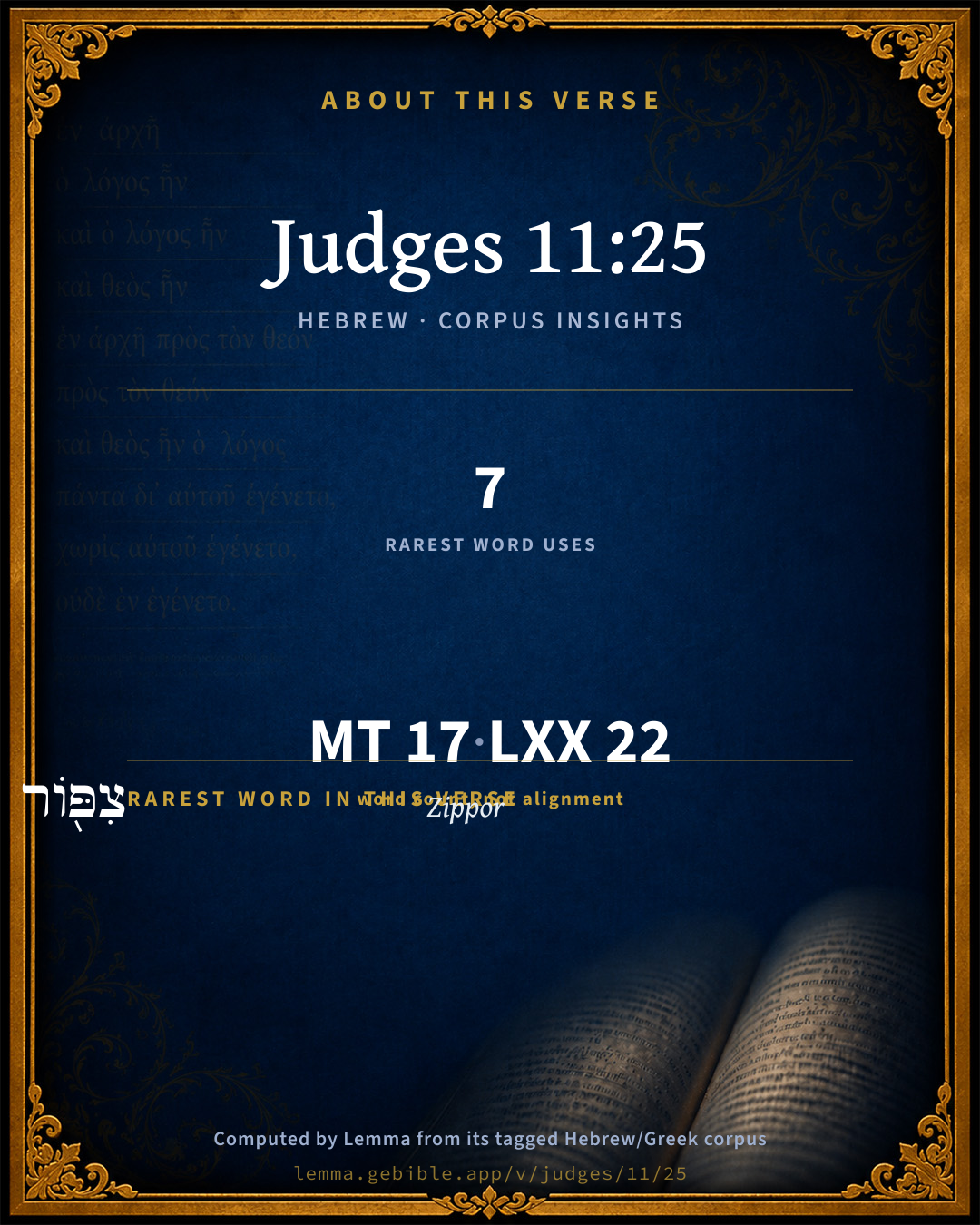
The rarest word here is צִפּ֖וֹר Zippor H6834 — appearing just 7 times in the whole Hebrew Bible.

Shared distinctive vocabulary

צִפּ֖וֹר Zippor H6834 occurs in 7 verses of the Hebrew Bible. Also found in:

Grammatical profile

  • 4 verbs
  • 6 nouns
  • 2 adjectives
  • 1 pronoun
  • 2 prepositions
  • 1 conjunction
  • 1 adverb

Verb forms

  • הֲר֥וֹב Qal · Infinitive Absolute
  • רָב֙ Qal · Perfect
  • נִלְחֹ֥ם Niphal · Infinitive Absolute
  • נִלְחַ֖ם Niphal · Perfect

Repetition

Words recur within this verse — often emphatic in Hebrew:

  • הֲט֥וֹב good H2896 ×2
  • הֲר֥וֹב to contend H7378 ×2
  • נִלְחֹ֥ם to fight H3898 ×2

Hebrew & Septuagint length

In English translation the verse runs 27 words from the Hebrew and 26 from the Septuagint (LXX English) — closely comparable.

A rough comparison of the two English renderings, which tokenize alike — not a word-level alignment.

Word counts can differ between the Hebrew and the Greek without any difference in meaning — e.g. the Hebrew direct-object marker אֵת has no separate Greek word, and Greek often adds the article ὁ.

In the original languages it is 17 Hebrew tokens and 22 Greek tokens — but the two are counted differently (Hebrew bundles its prefixes and suffixes into one token; the Greek is in lemma form), so that isn’t a like-for-like length.

Cross-references

4

Topical passages linked to Judges 11:25 in the Treasury of Scripture Knowledge — connected by theme and wording, ordered by reader-vote popularity; previews shown in the World English Bible.

  • Micah 6:5 My people, remember now what Balak king of Moab devised, And what Balaam the son of Beor answered him from Shittim to Gilgal, That you may know the righteous acts of Yahweh."
  • Joshua 24:9–10 Then Balak the son of Zippor, king of Moab, arose and fought against Israel: and he sent and called Balaam the son of Beor to curse you;
  • Deuteronomy 23:3–4 An Ammonite or a Moabite shall not enter into the assembly of Yahweh; even to the tenth generation shall none belonging to them enter into the assembly of Yahweh forever:
  • Numbers 22:2–21 Balak the son of Zippor saw all that Israel had done to the Amorites.

Cross-references courtesy of OpenBible.info (CC BY 4.0).

Hebrew and Greek witnesses Masoretic Hebrew ↔ Greek Septuagint

The same verse in the two great witnesses to the Old Testament, shown verse-for-verse.

These are two independent witnesses, not word-aligned to each other, and the Septuagint is shown in lemma (dictionary) form.

Hebrew Judges 11:25 Masoretic · Westminster Leningrad Codex

וְעַתָּ֗ה הֲט֥וֹב טוֹב֙ אַתָּ֔ה מִבָּלָ֥ק בֶּן צִפּ֖וֹר מֶ֣לֶךְ מוֹאָ֑ב הֲר֥וֹב רָב֙ עִם יִשְׂרָאֵ֔ל אִם נִלְחֹ֥ם נִלְחַ֖ם בָּֽם

Now are you anything better than Balak the son of Zippor, king of Moab? did he ever strive against Israel, or did he ever fight against them?

World English Bible · Public Domain

Greek LXX Judges 11:25 Septuagint · lemma form

καί νῦν μή ἐν ἀγαθός ἀγαθός σύ ὑπέρ βαλακ υἱός σεπφωρ βασιλεύς μωαβ μή μάχομαι μάχομαι μετά ἰσραήλ ἤ πολεμέω πολεμέω αὐτός

And now are you any better than Balac son of Sepphor, king of Moab? did he indeed fight with Israel, or indeed make war with him,

LXX2012 (modern English Septuagint) · Public Domain

Hebrew: Westminster Leningrad Codex (CC BY 4.0). Greek: Septuagint (public domain); English from LXX2012 (modern English Septuagint) (Public Domain). How the Septuagint differs from the Hebrew →

Targum (Aramaic paraphrase)

1

The Targum is the ancient Jewish Aramaic paraphrase of the Hebrew Scriptures — an interpretive translation, not the Hebrew text itself. Onkelos (literal) and Pseudo-Jonathan (expansive) render the Torah, and Jonathan the Prophets. Coverage is partial: where no permissively-licensed English translation exists for a verse, only the Aramaic is shown. This is verse-level text, not a word-by-word alignment to the Hebrew.

  1. Targum Jonathan Prophets (Joshua–Malachi)
    וּכְעַן הֲטַב טַב אַתְּ מִבָּלָק בַּר צִפּוֹר מַלְכָּא דְמוֹאָב הֲמֵידַן דַן עִם יִשְׂרָאֵל אִם קְרָבָא אַגִיחַ בְּהוֹן:

    (no public-domain English translation for this verse)

    Targum Jonathan — Aramaic: “Mikraot Gedolot” (public domain). English: “Sefaria Community Translation” (CC0 1.0 (public-domain dedication)); “London "Chaldee Paraphrase," 1871” (public domain). Text via Sefaria.

Commentary

Notes on Judges 11:25 from classic Christian and Jewish commentators (each source and its license shown beneath its notes). The classic Christian expositions comment on the surrounding passage and are grouped to its opening verse, so a note may address several verses; the Jewish commentaries on the Tanakh (Rashi and others) are per-verse, so they appear only where the commentator wrote on this verse.

Lemma curates 59 commentaries, every one of them public domain or Creative Commons licensed, each selected and text-cleaned for this edition rather than reprinted as found. About our sources →

Trapp's Complete Commentary

John Trapp

Jdg 11:25 And now [art] thou any thing better than Balak the son of Zippor, king of Moab? did he ever strive against Israel, or did he ever fight against them,

Ver. 25. And now art thou anything better than Balak?] Heb., An bonus es tu prae Balaco? … an contendendo contendit? an pugnando pugnavit? Here he pleadeth prescription: and he doth it with great intention of spirit, and contention of speech. As men must not be hot in a cold matter, so neither cold in a hot.

John Trapp, A Commentary or Exposition upon All the Books of the Old and New Testament (1647–1656) — public domain. Text from a community e-Sword module.

Joseph Benson's Commentary

Jdg 11:25. Art thou any thing better than Balak? — Art thou wiser than he? Or hast thou more right than he had? This is a third argument, that though Balak plotted against Israel, in defence of his own land, which he feared they would invade and conquer, yet he never contended with them about the restitution of those lands which Sihon took from him or his predecessors, laid no claim to them, nor ever demanded to have them restored.

Joseph Benson's Commentary on the Old and New Testaments (1811–1818) — public domain. Text from a community e-Sword module.

Ellicott's Commentary for English Readers

(25) Art thou anything better than Balak?—Literally, Are you the good, good in comparison with? It is one of the Hebrew ways of expressing the superlative. Jephthah here argues from prescriptive right, which even the contemporary king Balak had not ventured to challenge, showing, therefore, that he admitted the claim of Israel, deadly as was his hatred against them.

Did he ever fight against them?—This may seem at first sight to contradict Jos_24:9. There “Balak the son of Zippor arose and warred against Israel”; and we might infer that it was in some Moabite battle that Baalam had been slain (Num_31:8; Jos_13:22). But this would not affect Jephthah’s argument. Balak had fought against Israel out of pure hatred, not from any pretensions to claim their conquests from them.

A Bible Commentary for English Readers, edited by Charles John Ellicott (1878–1897) — public domain. Text from a community e-Sword module.

The Cambridge Bible for Schools and Colleges

gen. ed. J. J. S. Perowne

25. art thou … better than Balak] Though the king of Ammon is supposed to be addressed, the question really aims at some king of Moab: is he a better man than his predecessor Balak, who did not dare to fight Israel? The verse agrees with Numbers 22-24, where no mention is made of a war between Moab and Israel; Jos_24:9 a is probably due to an annotator.

The Cambridge Bible for Schools and Colleges (gen. ed. J. J. S. Perowne; Cambridge University Press, 1878–1918) — public domain. Text from a community e-Sword module.

John Gill's Exposition

While Israel dwelt in Heshbon and her towns,.... This was the principal city, which formerly belonged to the Moabites, and was taken from them by Sihon; who being conquered by Israel, it fell into their hands, and they inhabited it, and the towns adjacent to it, from that time to the present; see Num 21:25.

and in Aroer and her towns; another city with its villages, taken at the same time, and ever since inhabited by the Israelites, even by the tribe of Gad, who rebuilt it; it lay near the river Arnon; see Num 32:34.

and in all the cities that be along by the coasts of Arnon; which lay along by the side of that river, which divided Moab from the kingdom of the Amorites; these Israel had dwelt in three hundred years; and during this time, neither Balak king of Moab, nor any of his successors, had ever disputed Israel's title to those cities, or commenced a war with them on account of them; but they had continued in the peaceable enjoyment of them so long as three hundred years; which are thus reckoned in the Jewish chronology (z); Joshua governed Israel twenty eight years, Othniel forty, Ehud eighty, Deborah forty, Gideon forty, Abimelech three, Tola twenty three, Jair twenty two, and eighteen years Israel was oppressed by the children of Ammon, which with the six years of Jephthah make just three hundred; so that, according to this computation, there were six years short of it; but being so near, the round number is given:

why therefore did ye not recover them within that time? signifying they ought to have put in their claim sooner, and endeavoured to have recovered them long before this time, if they had any right unto them; wherefore Jephthah pleads prescription, and which in a course of time ought to take place; or otherwise the world would be full of endless contentions and controversies, and kingdoms and states would never be at peace, nor each one know and enjoy for certainty its proper domains.

(z) Seder Olam Rabba, c. 12. Vid. Jarchium & Kimchium in loc.

John Gill's Exposition of the Whole Bible (1746–1763) — public domain (CC PDM 1.0). Text via the HelloAO Bible API.

Haydock's Catholic Bible Commentary

Him. Josue (xxiv. 9,) says that Balac fought against Israel. But it was not in a pitched battle, (Calmet) at least of which we have the particulars, (Haydock) nor to recover the territory which the Israelites had taken from Sehon, but only to defend his own dominions. He collected an army, and called the soothsayer to curse Israel, Numbers xxii. 4, &c. (Calmet)

George Leo Haydock (1774–1849), Haydock's Catholic Family Bible and Commentary, 1859 edition — public domain. Excludes Psalms (Douay-Rheims chapter numbering differs from Protestant) and Deuterocanonical books (Catholic canon only).

Matthew Poole's English Annotations

Art thou better than Balak? art thou wiser than he? or hast thou more right than he had? Balak, though he plotted against Israel, in defence of his own land, which he feared they would invade and conquer, Num 22:4; yet he never contended with them about the restitution of those lands which Sihon took from him or his predecessors, after the Israelites had conquered them.

Matthew Poole's English Annotations on the Holy Bible (1683–1685) — public domain. Text from a community e-Sword/MySword module.

Whedon's Commentary on the Bible

Daniel D. Whedon

25. Better than Balak — Hast thou any better claim on these lands than Balak? The… king of Moab had even a better title to the lands than Ammon, for from him the greater part of them had been taken by the Amorites, (Num_21:26;) and the fact that he did not strive against Israel to recover his lost possessions was further evidence of the futility of Ammon’s claim.

Daniel D. Whedon (gen. ed.), Commentary on the Old and New Testaments (1874–1909) — public domain. Text from a community e-Sword module.

The Pulpit Commentary

Art thou anything better, etc. Jephthah now advances another argument to prove the justice of his cause and the unreasonableness of the Ammonite claim. If the territory in question was Moabite property, bow came it that Balak laid no claim to it? He was an enemy of the Israelites, and yet when Israel took possession of the land, and dwelt in Heshbon, its capital, and the daughter cities or villages thereof, and in Aroer and her daughter cities or villages, and in all the cities on the banks of the Amen, Balak never strove about them with Israel, or went to war to recover them a plain proof that he did not look upon them as his property. If they were his, that was the time to claim and recover them, but he had not done so.

The Pulpit Commentary (1880–1919), ed. H.D.M. Spence-Jones & Joseph S. Exell — public domain. Text from a community e-Sword module.

John Wesley's Explanatory Notes

Than Balak - Art thou wiser than he? Or hast thou more right than he had? Balak, though he plotted against Israel, in defense of his own land, which he feared they would invade and conquer, yet never contended with them about the restitution of those lands which Sihon took from him or his predecessors.

John Wesley, Explanatory Notes Upon the Whole Bible (1754–1765) — public domain. Text via the GEBible commentary corpus.

Lesson kit

Teaching starters — assembled from the data on this page, not authored interpretation. Every prompt links to the verse data it draws on. Edit before teaching.

Judges, in the Historical, opens this verse with 17 words (13 distinct Hebrew lemmas). Its most distinctive word is Tsippôwr (“Zippor”). A historical commentator’s framing appears above. Read the whole chapter for the surrounding context.

Discussion questions

  1. The word Tsippôwr carries the sense “Zippor.” How does it shape the verse?
  2. How does Numbers 22:2, which shares the word «Zippor», read alongside this verse?
  3. What does the repetition of “good” (2× in this one verse) do in this verse?
  4. The translations on this page render this verse differently — a whole-verse word diff, not a word-by-word alignment. What might account for the different wordings?
  5. «הֲר֥וֹב» is a Qal Infinitive Absolute verb. How does that grammatical form shape the action described?
  6. Compare how Trapp's Complete Commentary and Joseph Benson's Commentary read this verse. Where do they agree or differ?

Things to notice

Reading settings

Reading text

Shown beneath each verse's original-language words.

Old Testament
Old Testament edition

Read the OT as the Masoretic Hebrew (MT) or the Greek Septuagint (LXX).

English shown for the Greek Septuagint (in the Hebrew ↔ Greek comparison).

Comparing translations? Open the Compare panel on any verse page to stack up to four side by side.