Numbers 26:3

Hebrew (Westminster Leningrad Codex) Numbers 26:3 appears in the Hebrew Old Testament. The text above is from the Westminster Leningrad Codex. Each word links to its Strong’s number, a concise gloss, and parsing drawn from the Open Scriptures Hebrew Bible morphology. Click any word for its full Brown-Driver-Briggs (BDB) entry.
Download image
Cite this verse

Numbers 26:3 (World English Bible). Public Domain. Lemma interlinear Bible study tool, https://lemma.gebible.app/v/numbers/26/3.

Show BibTeX & RIS
BibTeX
RIS
English Translation
Moses and Eleazar the priest spoke with them in the plains of Moab by the Jordan at Jericho, saying,
World English Bible · Public Domain
Download a study sheet

One document with this verse’s original text, its word-by-word gloss line, the meaning frame, cross-references with their text, attributed commentary, and full source and license credits — printable, and it pastes into notes with its structure intact.

This verse Autodidact and up

Study sheet (.html) Plain text (.txt)

A passage Seminary Student

Up to 50 verses in one chapter. A passage sheet keeps up to 6 commentary sources and 12 cross-references per verse, in the order this page ranks them, and says so on the sheet whenever that leaves anything out. Ask for a single verse and you get the Autodidact verse sheet above.

Everything on this page stays free to read, with no account — the sheet is a download of what is already on screen, not access to it.

Want to remove ads? Support Godless Engineer
Compare translations 3

The same verse in 3 English versions, stacked beneath the original-language interlinear above. Click any original word for its lexicon entry.

Each is an independent rendering of the whole verse — the interlinear is not word-aligned to these translations.

Highlighted words mark where these versions differ — a whole-verse word diff, not a word-by-word alignment.

  • World English Bible Public Domain
    Moses and Eleazar the priest spoke with them in the plains of Moab by the Jordan at Jericho, saying,
  • King James Version Public Domain
    And Moses and Eleazar the priest spake with them in the plains of Moab by Jordan near Jericho, saying,
  • unfoldingWord Literal Text CC BY-SA 4.0
    And Moses and Eleazar the priest spoke with them in the plains of Moab beside the Jordan at Jericho, saying,

unfoldingWord Literal Text — © unfoldingWord, licensed CC BY-SA 4.0. Word-aligned USFM3 via Door43 (git.door43.org/unfoldingWord/en_ult).

Versions to compare (up to 4)

3 of 4 selected

Show all 18 translations

Every available English version of this verse, each an independent rendering of the whole verse.

  • World English Bible Public Domain
    Moses and Eleazar the priest spoke with them in the plains of Moab by the Jordan at Jericho, saying,
  • Berean Standard Bible Public Domain
    So on the plains of Moab by the Jordan, across from Jericho, Moses and Eleazar the priest issued the instruction,
  • Majority Standard Bible Public Domain
    So on the plains of Moab by the Jordan, across from Jericho, Moses and Eleazar the priest issued the instruction,
  • King James Version Public Domain
    And Moses and Eleazar the priest spake with them in the plains of Moab by Jordan near Jericho, saying,
  • American Standard Version (1901) Public Domain
    And Moses and Eleazar the priest spake with them in the plains of Moab by the Jordan at Jericho, saying,
  • Revised Version (1885) Public Domain
    And Moses and Eleazar the priest spake with them in the plains of Moab by the Jordan at Jericho, saying,
  • Geneva Bible (1599) Public Domain
    So Moses and Eleazar the Priest spake vnto them in the plaine of Moab, by Iorden towarde Iericho, saying,
  • Douay-Rheims (1899) Public Domain
    Moses therefore and Eleazar the priest, being in the plains of Moab upon the Jordan over against Jericho, spoke to them that were
  • Young's Literal Translation Public Domain
    And Moses speaketh -- Eleazar the priest also -- with them, in the plains of Moab, by Jordan, `near' Jericho, saying,
  • Literal Standard Version CC BY-SA 4.0
    And Moses speaks—Eleazar the priest also—with them in the plains of Moab by the Jordan, [near] Jericho, saying,
  • Unlocked Literal Bible CC BY-SA 4.0
    So Moses and Eleazar the priest spoke to them in the plains of Moab by the Jordan at Jericho and said,
  • unfoldingWord Literal Text CC BY-SA 4.0
    And Moses and Eleazar the priest spoke with them in the plains of Moab beside the Jordan at Jericho, saying,
  • Darby Bible Public Domain
    And Moses and Eleazar the priest spoke with them in the plains of Moab by the Jordan of Jericho, saying,
  • World Messianic Bible Public Domain
    Moses and Eleazar the priest spoke with them in the plains of Moab by the Jordan at Jericho, saying,
  • Webster's Bible Public Domain
    And Moses and Eleazar the priest spoke with them in the plains of Moab by Jordan near Jericho, saying,
  • Free Bible Version CC BY-SA 4.0
    There on the plains of Moab beside the Jordan opposite Jericho, Moses and Eleazar the priest gave the order,
  • Bible in Basic English Public Domain
    So Moses and Eleazar the priest gave them the order in the lowlands of Moab by Jordan at Jericho, saying,
  • JPS Tanakh (1917) Public Domain
    And Moses and Eleazar the priest spoke with them in the plains of Moab by the Jordan at Jericho, saying:

Literal Standard Version (2020), Covenant Press — licensed CC BY-SA 4.0. Text via the HelloAO Bible API (eBible.org). Unlocked Literal Bible (unfoldingWord) — licensed CC BY-SA 4.0. Text via the HelloAO Bible API (eBible.org). unfoldingWord Literal Text — © unfoldingWord, licensed CC BY-SA 4.0. Word-aligned USFM3 via Door43 (git.door43.org/unfoldingWord/en_ult). Free Bible Version, Dr. Jonathan Gallagher — licensed CC BY-SA 4.0. Text via the HelloAO Bible API (eBible.org).

Word by word

More ways to search: Search by grammar → Find every occurrence → Compare this word →

Practice this passage: Drill this verse → Learn its vocabulary →

יְרֵח֖וֹ
Yᵉrîychôw
H3405
“Jericho”
Noun, Proper
Part of Speech
Noun
Type
Proper
Full BDB Definition

Origin: perhaps from H3394

TWOT: 915

Jericho = "its moon" - a city 5 miles (8 kilometers) west of the Jordan and 7 miles (11.5 kilometers) north of the Dead Sea and the first city conquered by the Israelites upon entering the promised land of Canaan
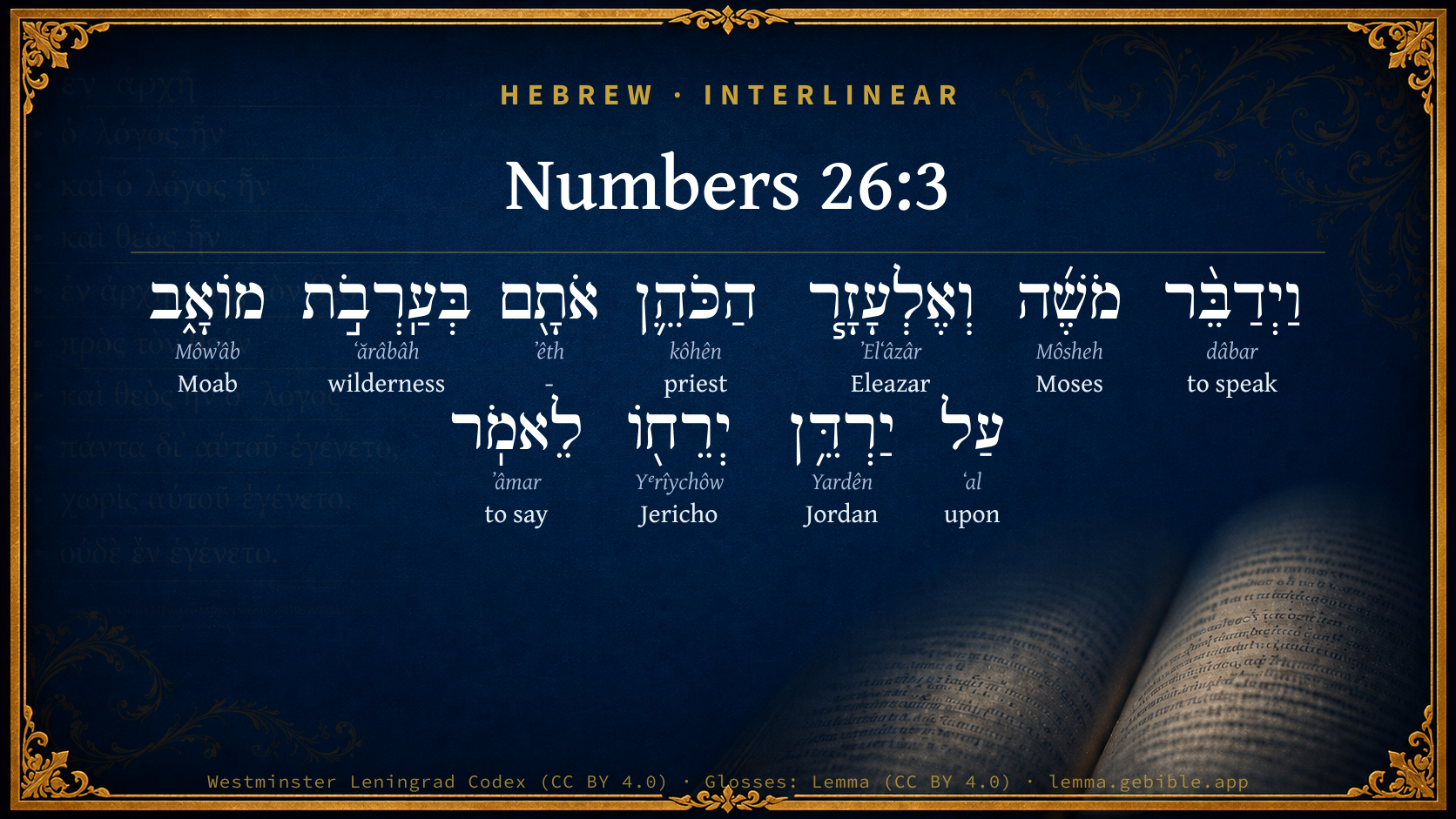
  1. וַיְדַבֵּ֨ר dâbar H1696 “and · to speak” Conjunction + Verb, Piel, Sequential Imperfect, 3rd Person, Masculine, Singular
  2. מֹשֶׁ֜ה Môsheh H4872 “Moses” Noun, Proper
  3. וְאֶלְעָזָ֧ר ʼElʻâzâr H499 “and · Eleazar” Conjunction + Noun, Proper
  4. הַכֹּהֵ֛ן kôhên H3548 “the · priest” Particle, Definite Article + Noun, Common, Masculine, Singular, Absolute
  5. אֹתָ֖ם ʼêth H853 “- · them” Particle, Direct Object + Suffix, Personal, 3rd Person, Masculine, Plural
  6. בְּעַֽרְבֹ֣ת ʻărâbâh H6160 “in/at · wildernesses of” Preposition + Noun, Common, Feminine, Plural, Construct
  7. מוֹאָ֑ב Môwʼâb H4124 “Moab” Noun, Proper
  8. עַל ʻal H5921 “upon” Preposition
  9. יַרְדֵּ֥ן Yardên H3383 “Jordan” Noun, Proper
  10. לֵאמֹֽר ʼâmar H559 “to say” Preposition + Verb, Qal, Infinitive Construct

About this verse

These counts appear in no published source. They are computed here, from the morphology-tagged text and Lemma’s own curated glosses. What Lemma adds →

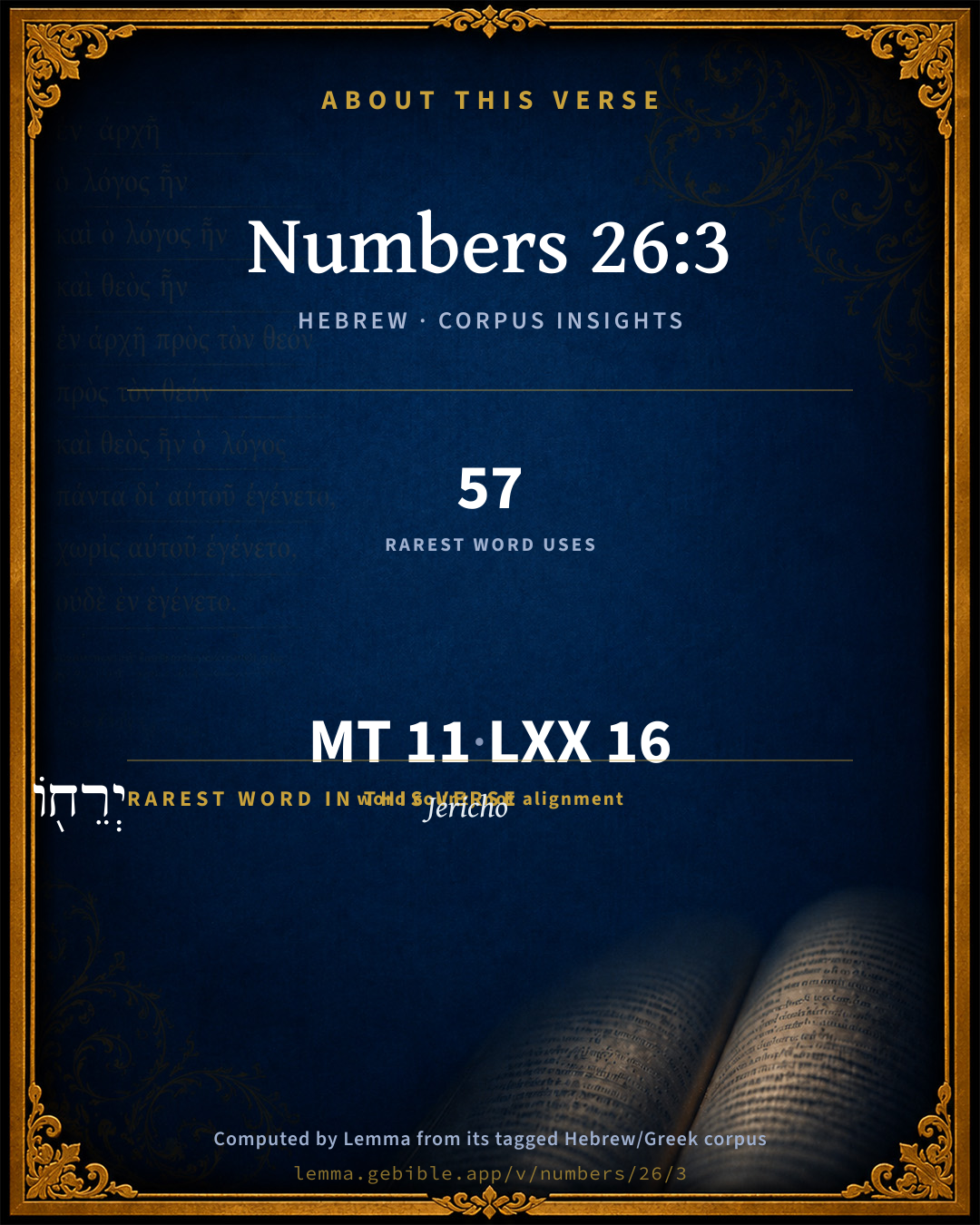
11
words
11
distinct lemmas
Pentateuch
section

Shared distinctive vocabulary

יְרֵח֖וֹ Jericho H3405 occurs in 53 verses of the Hebrew Bible. Also found in:

Grammatical profile

  • 2 verbs
  • 7 nouns
  • 1 preposition
  • 1 particle

Verb forms

  • וַיְדַבֵּ֨ר Piel · Sequential Imperfect
  • לֵאמֹֽר Qal · Infinitive Construct

Hebrew & Septuagint length

In English translation the verse runs 19 words from the Hebrew and 17 from the Septuagint (LXX English) — closely comparable.

A rough comparison of the two English renderings, which tokenize alike — not a word-level alignment.

Word counts can differ between the Hebrew and the Greek without any difference in meaning — e.g. the Hebrew direct-object marker אֵת has no separate Greek word, and Greek often adds the article ὁ.

In the original languages it is 11 Hebrew tokens and 16 Greek tokens — but the two are counted differently (Hebrew bundles its prefixes and suffixes into one token; the Greek is in lemma form), so that isn’t a like-for-like length.

Cross-references

9

Topical passages linked to Numbers 26:3 in the Treasury of Scripture Knowledge — connected by theme and wording, ordered by reader-vote popularity; previews shown in the World English Bible.

  • Numbers 22:1 The children of Israel traveled, and encamped in the plains of Moab beyond the Jordan at Jericho.
  • Numbers 33:48 They traveled from the mountains of Abarim, and encamped in the plains of Moab by the Jordan at Jericho.
  • Numbers 26:63 These are those who were numbered by Moses and Eleazar the priest, who numbered the children of Israel in the plains of Moab by the Jordan at Jericho.
  • Numbers 35:1 Yahweh spoke to Moses in the plains of Moab by the Jordan at Jericho, saying,
  • Numbers 31:12 They brought the captives, and the prey, and the spoil, to Moses, and to Eleazar the priest, and to the congregation of the children of Israel, to the camp at the plains of Moab, which are by the Jordan at Jericho.
  • Deuteronomy 4:46–49 beyond the Jordan, in the valley over against Beth Peor, in the land of Sihon king of the Amorites, who lived at Heshbon, whom Moses and the children of Israel struck, when they came forth out of Egypt.
  • Deuteronomy 34:1 Moses went up from the plains of Moab to Mount Nebo, to the top of Pisgah, that is over against Jericho. Yahweh shown him all the land of Gilead, to Dan,
  • Deuteronomy 34:6 He buried him in the valley in the land of Moab over against Beth Peor: but no man knows of his tomb to this day.
  • Deuteronomy 34:8 The children of Israel wept for Moses in the plains of Moab thirty days: so the days of weeping in the mourning for Moses were ended.

Cross-references courtesy of OpenBible.info (CC BY 4.0).

Hebrew and Greek witnesses Masoretic Hebrew ↔ Greek Septuagint

The same verse in the two great witnesses to the Old Testament, shown verse-for-verse.

These are two independent witnesses, not word-aligned to each other, and the Septuagint is shown in lemma (dictionary) form.

Hebrew Numbers 26:3 Masoretic · Westminster Leningrad Codex

וַיְדַבֵּ֨ר מֹשֶׁ֜ה וְאֶלְעָזָ֧ר הַכֹּהֵ֛ן אֹתָ֖ם בְּעַֽרְבֹ֣ת מוֹאָ֑ב עַל יַרְדֵּ֥ן יְרֵח֖וֹ לֵאמֹֽר

Moses and Eleazar the priest spoke with them in the plains of Moab by the Jordan at Jericho, saying,

World English Bible · Public Domain

Greek LXX Numbers 26:3 Septuagint · lemma form

καί λαλέω μωυσῆς καί ελεαζαρ ὁ ἱερεύς ἐν ἀραβώθ μωαβ ἐπί ὁ ἰορδάνης κατά ιεριχω λέγω

And Moses and Eleazar the priest spoke in Araboth of Moab at the Jordan by Jericho, saying,

LXX2012 (modern English Septuagint) · Public Domain

Hebrew: Westminster Leningrad Codex (CC BY 4.0). Greek: Septuagint (public domain); English from LXX2012 (modern English Septuagint) (Public Domain). How the Septuagint differs from the Hebrew →

Targum (Aramaic paraphrase)

2

The Targum is the ancient Jewish Aramaic paraphrase of the Hebrew Scriptures — an interpretive translation, not the Hebrew text itself. Onkelos (literal) and Pseudo-Jonathan (expansive) render the Torah, and Jonathan the Prophets. Coverage is partial: where no permissively-licensed English translation exists for a verse, only the Aramaic is shown. This is verse-level text, not a word-by-word alignment to the Hebrew.

  1. Targum Onkelos Torah (Genesis–Deuteronomy)
    וּמַלִיל משֶׁה וְאֶלְעָזָר כַּהֲנָא וַאֲמָרוּ לְמִמְנֵי יָתְהוֹן בְּמֵישְׁרַיָא דְמוֹאָב עַל יַרְדְנָא דִירִיחוֹ לְמֵימָר

    (no public-domain English translation for this verse)

    Targum Onkelos — Aramaic: “Onkelos Genesis” (public domain); “Onkelos Exodus” (public domain); “Onkelos Leviticus” (public domain); “Onkelos Numbers” (public domain); “Onkelos Deuteronomy” (public domain). English: “Sefaria Community Translation” (CC0 1.0 (public-domain dedication)); “J.W. Etheridge. The Targums of Onkelos and Jonathan Ben Uzziel on the Pentateuch. London: Longmans, Green, 1862” (public domain). Text via Sefaria.

  2. Targum Pseudo-Jonathan Torah (Genesis–Deuteronomy)
    וּמַלֵיל משֶׁה וְאֶלְעָזָר כַּהֲנָא עִם אֲמַרְכְּלַיָא וַאֲמַר לְמִמְנֵי יַתְהוֹן בְּמֵישְׁרַיָא דְמוֹאָב עַל יַרְדְנָא דִירֵיחוֹ לְמֵימָר

    And Mosheh and Elazar the priest spake with the leaders, and commanded that they should number them in the plain of Moab, by the Jordan (over against) Jericho, saying

    Targum Pseudo-Jonathan — Aramaic: “Targum Jonathan on Genesis” (public domain); “Targum Jonathan on Exodus” (public domain); “Targum Jonathan on Leviticus” (public domain); “Targum Jonathan on Numbers” (public domain); “Targum Jonathan on Deuteronomy” (public domain). English: “The Targum of Jonathan ben Uzziel, trans. J. W. Etheridge, London, 1862” (public domain). Text via Sefaria.

Commentary

Notes on Numbers 26:3 from classic Christian and Jewish commentators (each source and its license shown beneath its notes). The classic Christian expositions comment on the surrounding passage and are grouped to its opening verse, so a note may address several verses; the Jewish commentaries on the Tanakh (Rashi and others) are per-verse, so they appear only where the commentator wrote on this verse.

Lemma curates 59 commentaries, every one of them public domain or Creative Commons licensed, each selected and text-cleaned for this edition rather than reprinted as found. About our sources →

Geneva Bible (1599)

Geneva Bible translators

Where the river is near to Jericho.

Geneva Bible (1599) marginal notes — public domain. Text via Bolls.life.

John Gill's Exposition

And Moses and Eleazar the priest spake with them,.... With the children of Israel, with the heads of them, their chief and principal, to assist in taking the number of the people; as when they were numbered thirty years ago, when a prince out of each tribe was taken to be with Aaron and Moses in doing that business; but those princes were now all dead, and another race succeeded, who were now employed in this service; so the Targum of Jonathan says, they spoke with the rulers, and ordered them to number them:

in the plains of Moab, by Jordan, near Jericho: or of Jericho, as the same Targum, on the other side of Jordan to that on which Jericho stood; for as yet the children of Israel had not passed that river, nor entered into the land of Canaan, in which Jericho was, but they were now opposite it; See Gill on Num 22:1,

saying; as follows.

John Gill's Exposition of the Whole Bible (1746–1763) — public domain (CC PDM 1.0). Text via the HelloAO Bible API.

Matthew Poole's English Annotations

In the plains of Moab; see Num 22:1; 33:48

Matthew Poole's English Annotations on the Holy Bible (1683–1685) — public domain. Text from a community e-Sword/MySword module.

Whedon's Commentary on the Bible

Daniel D. Whedon

3. Plains of Moab — Num_22:1, note.

Jordan — Jos_1:2, note and cut.

Jericho — Jos_2:1, note.

Daniel D. Whedon (gen. ed.), Commentary on the Old and New Testaments (1874–1909) — public domain. Text from a community e-Sword module.

The Pulpit Commentary

Spake with them, i.e., no doubt with the responsible chiefs, who must have assisted in this census, as in the previous one, (Num_1:4) although the fact is not mentioned.

The Pulpit Commentary (1880–1919), ed. H.D.M. Spence-Jones & Joseph S. Exell — public domain. Text from a community e-Sword module.

unfoldingWord translationNotes

Door43 World Missions Community

spoke to them

"spoke to the Israelite leaders"

plains

A plain is a large flat area of land.

twenty years old and up

"20 years old and older" (See: Numbers)

translationWords

Moab

Jordan River

Jericho

command

Egypt

unfoldingWord translationNotes — © Distant Shores Media and the Door43 World Missions Community, licensed CC BY-SA 4.0. Source: git.door43.org/Door43/en_tn.

Rashi

Rabbi Shlomo Yitzchaki (Rashi)

וידבר משה ואלעזר הכהן אתם AND MOSES AND ELEAZAR THE PRIEST SPOKE WITH THEM — They spoke with them (אתם; cf. 5:5) regarding this: that the Omnipresent had (given command to count them.

לאמר SAYING they said to them (what they said to them was): You must be counted FROM TWENTY YEARS OLD AND UPWARDS.

Rashi on the Tanakh — English translations: “The Judaica Press complete Tanach with Rashi, translated by A. J. Rosenberg” (CC BY 4.0); “Pentateuch with Rashi's commentary by M. Rosenbaum and A.M. Silbermann, 1929-1934” (public domain); “The Metsudah Tanach series, Lakewood, N.J” (CC BY 4.0); and “The Book of Joshua, Metsudah Publications, 1997” (CC BY 4.0). Text via Sefaria.

Lesson kit

Teaching starters — assembled from the data on this page, not authored interpretation. Every prompt links to the verse data it draws on. Edit before teaching.

Numbers, in the Pentateuch, opens this verse with 11 words (11 distinct Hebrew lemmas). Its most distinctive word is Yᵉrîychôw (“Jericho”). A historical commentator’s framing appears above. Read the whole chapter for the surrounding context.

Discussion questions

  1. How does “Jericho” (Yᵉrîychôw) shape what this verse is saying?
  2. How does Numbers 22:1, which shares the word «Jericho», read alongside this verse?
  3. These translations render this verse differently; the difference is in the English rendering, not the original. What questions does that raise?
  4. «וַיְדַבֵּ֨ר» is a Piel Sequential Imperfect verb. How does that grammatical form shape the action described?
  5. Compare how Geneva Bible (1599) and John Gill's Exposition read this verse. Where do they agree or differ?

Things to notice

Reading settings

Reading text

Shown beneath each verse's original-language words.

Old Testament
Old Testament edition

Read the OT as the Masoretic Hebrew (MT) or the Greek Septuagint (LXX).

English shown for the Greek Septuagint (in the Hebrew ↔ Greek comparison).

Comparing translations? Open the Compare panel on any verse page to stack up to four side by side.