
Isaiah 16:13

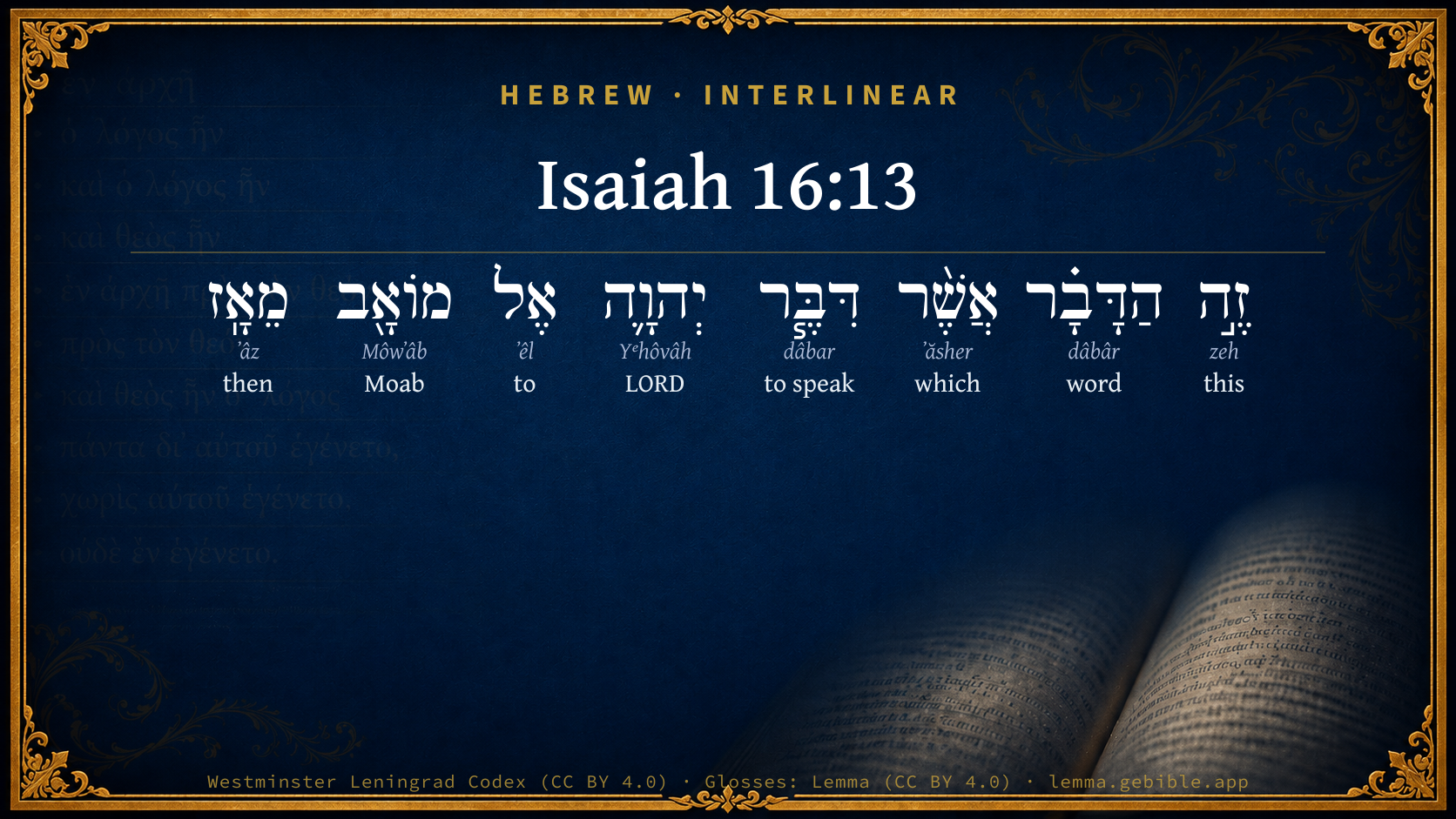
Hebrew (Westminster Leningrad Codex) Isaiah 16:13 appears in the Hebrew Old Testament. The text above is from the Westminster Leningrad Codex. Each word links to its Strong’s number, a concise gloss, and parsing drawn from the Open Scriptures Hebrew Bible morphology. Click any word for its full Brown-Driver-Briggs (BDB) entry.
Download image
Cite this verse

Isaiah 16:13 (World English Bible). Public Domain. Lemma interlinear Bible study tool, https://lemma.gebible.app/v/isaiah/16/13.

Show BibTeX & RIS
BibTeX
RIS
English Translation
This is the word that Yahweh spoke concerning Moab in time past.
World English Bible · Public Domain
Download a study sheet

One document with this verse’s original text, its word-by-word gloss line, the meaning frame, cross-references with their text, attributed commentary, and full source and license credits — printable, and it pastes into notes with its structure intact.

This verse Autodidact and up

Study sheet (.html) Plain text (.txt)

A passage Seminary Student

Up to 50 verses in one chapter. A passage sheet keeps up to 6 commentary sources and 12 cross-references per verse, in the order this page ranks them, and says so on the sheet whenever that leaves anything out. Ask for a single verse and you get the Autodidact verse sheet above.

Everything on this page stays free to read, with no account — the sheet is a download of what is already on screen, not access to it.

Want to remove ads? Support Godless Engineer
Compare translations 3

The same verse in 3 English versions, stacked beneath the original-language interlinear above. Click any original word for its lexicon entry.

Each is an independent rendering of the whole verse — the interlinear is not word-aligned to these translations.

Highlighted words mark where these versions differ — a whole-verse word diff, not a word-by-word alignment.

  • World English Bible Public Domain
    This is the word that Yahweh spoke concerning Moab in time past.
  • King James Version Public Domain
    This is the word that the LORD hath spoken concerning Moab since that time.
  • unfoldingWord Literal Text CC BY-SA 4.0
    This the word that Yahweh spoke about Moab from then.

unfoldingWord Literal Text — © unfoldingWord, licensed CC BY-SA 4.0. Word-aligned USFM3 via Door43 (git.door43.org/unfoldingWord/en_ult).

Versions to compare (up to 4)

3 of 4 selected

Show all 18 translations

Every available English version of this verse, each an independent rendering of the whole verse.

  • World English Bible Public Domain
    This is the word that Yahweh spoke concerning Moab in time past.
  • Berean Standard Bible Public Domain
    This is the message that the LORD spoke earlier concerning Moab.
  • Majority Standard Bible Public Domain
    This is the message that the LORD spoke earlier concerning Moab.
  • King James Version Public Domain
    This is the word that the LORD hath spoken concerning Moab since that time.
  • American Standard Version (1901) Public Domain
    This is the word that Jehovah spake concerning Moab in time past.
  • Revised Version (1885) Public Domain
    This is the word that the LORD spake concerning Moab in time past.
  • Geneva Bible (1599) Public Domain
    This is the word that the Lord hath spoken against Moab since that time.
  • Douay-Rheims (1899) Public Domain
    This is the word, that the Lord spoke to Moab from that time:
  • Young's Literal Translation Public Domain
    This `is' the word that Jehovah hath spoken unto Moab from that time,
  • Literal Standard Version CC BY-SA 4.0
    This [is] the word that YHWH has spoken to Moab from that time,
  • Unlocked Literal Bible CC BY-SA 4.0
    This is the word that Yahweh spoke concerning Moab previously.
  • unfoldingWord Literal Text CC BY-SA 4.0
    This the word that Yahweh spoke about Moab from then.
  • Darby Bible Public Domain
    This is the word which Jehovah hath spoken from of old concerning Moab.
  • World Messianic Bible Public Domain
    This is the word that the LORD spoke concerning Moab in time past.
  • Webster's Bible Public Domain
    This is the word that the LORD hath spoken concerning Moab since that time.
  • Free Bible Version CC BY-SA 4.0
    This is the message that the Lord has already delivered about Moab.
  • Bible in Basic English Public Domain
    This is the word which the Lord said about Moab in the past.
  • JPS Tanakh (1917) Public Domain
    This is the word that the LORD spoke concerning Moab in time past.

Literal Standard Version (2020), Covenant Press — licensed CC BY-SA 4.0. Text via the HelloAO Bible API (eBible.org). Unlocked Literal Bible (unfoldingWord) — licensed CC BY-SA 4.0. Text via the HelloAO Bible API (eBible.org). unfoldingWord Literal Text — © unfoldingWord, licensed CC BY-SA 4.0. Word-aligned USFM3 via Door43 (git.door43.org/unfoldingWord/en_ult). Free Bible Version, Dr. Jonathan Gallagher — licensed CC BY-SA 4.0. Text via the HelloAO Bible API (eBible.org).

Word by word

More ways to search: Search by grammar → Find every occurrence → Compare this word →

Practice this passage: Drill this verse → Learn its vocabulary →

About this verse

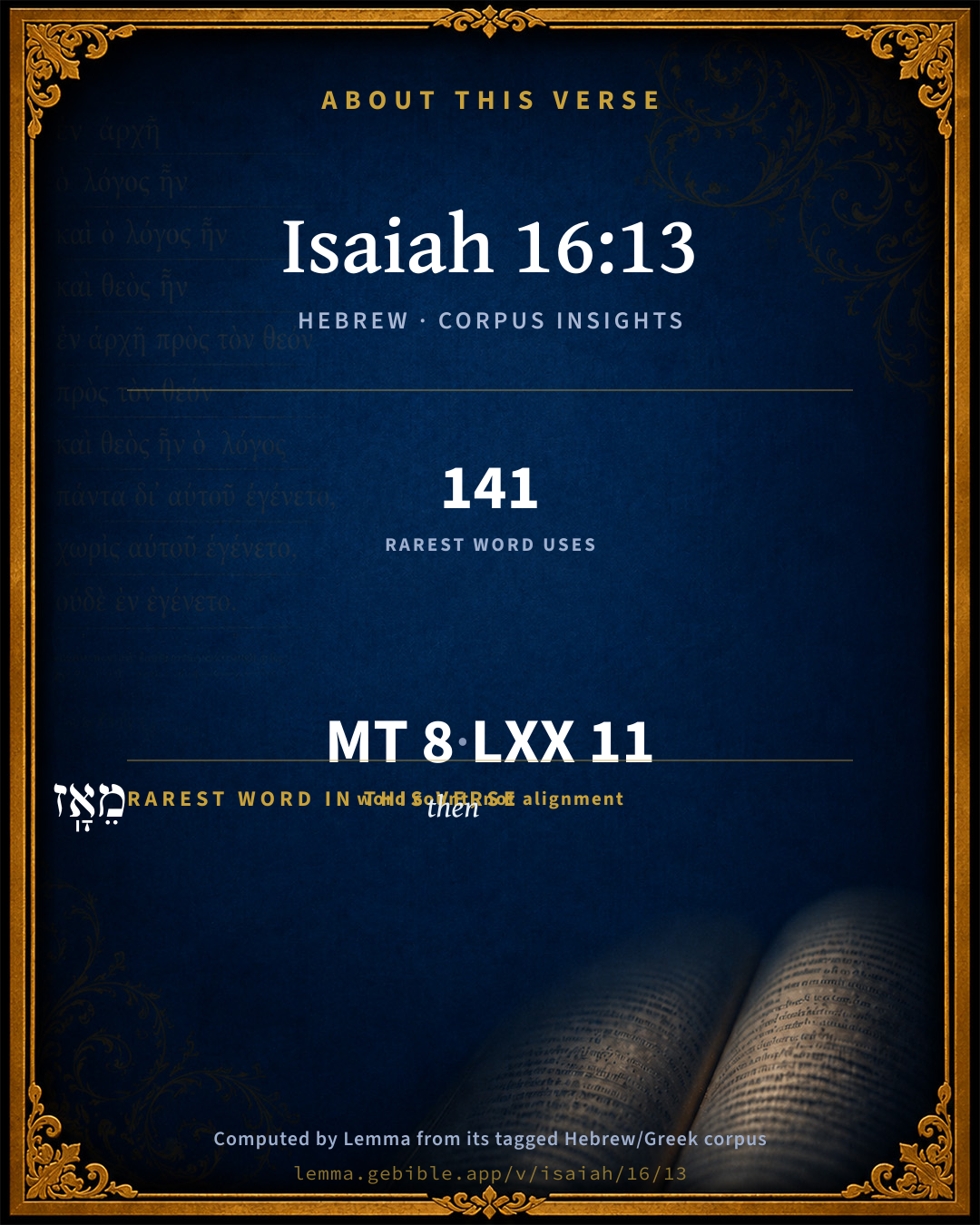
These counts appear in no published source. They are computed here, from the morphology-tagged text and Lemma’s own curated glosses. What Lemma adds →

8
words
8
distinct lemmas
Prophets
section

Grammatical profile

  • 1 verb
  • 3 nouns
  • 1 pronoun
  • 1 preposition
  • 1 adverb
  • 1 particle

Verb forms

  • דִּבֶּ֧ר Piel · Perfect

Hebrew & Septuagint length

In English translation the verse runs 12 words from the Hebrew and 13 from the Septuagint (LXX English) — closely comparable.

A rough comparison of the two English renderings, which tokenize alike — not a word-level alignment.

Word counts can differ between the Hebrew and the Greek without any difference in meaning — e.g. the Hebrew direct-object marker אֵת has no separate Greek word, and Greek often adds the article ὁ.

In the original languages it is 8 Hebrew tokens and 11 Greek tokens — but the two are counted differently (Hebrew bundles its prefixes and suffixes into one token; the Greek is in lemma form), so that isn’t a like-for-like length.

Cross-references

1

Topical passages linked to Isaiah 16:13 in the Treasury of Scripture Knowledge — connected by theme and wording, ordered by reader-vote popularity; previews shown in the World English Bible.

  • Isaiah 44:8 Don't fear, neither be afraid: haven't I declared to you of old, and shown it? You are my witnesses. Is there a God besides me? Indeed, there is not. I don't know any Rock.

Cross-references courtesy of OpenBible.info (CC BY 4.0).

Hebrew and Greek witnesses Masoretic Hebrew ↔ Greek Septuagint

The same verse in the two great witnesses to the Old Testament, shown verse-for-verse.

These are two independent witnesses, not word-aligned to each other, and the Septuagint is shown in lemma (dictionary) form.

Hebrew Isaiah 16:13 Masoretic · Westminster Leningrad Codex

זֶ֣ה הַדָּבָ֗ר אֲשֶׁ֨ר דִּבֶּ֧ר יְהוָ֛ה אֶל מוֹאָ֖ב מֵאָֽז

This is the word that Yahweh spoke concerning Moab in time past.

World English Bible · Public Domain

Greek LXX Isaiah 16:13 Septuagint · lemma form

οὗτος ὁ ῥῆμα ὅς λαλέω κύριος ἐπί μωαβ ὁπότε καί λαλέω

This is the word which the Lord spoke against Moab, when he spoke.

LXX2012 (modern English Septuagint) · Public Domain

Hebrew: Westminster Leningrad Codex (CC BY 4.0). Greek: Septuagint (public domain); English from LXX2012 (modern English Septuagint) (Public Domain). How the Septuagint differs from the Hebrew →

Targum (Aramaic paraphrase)

1

The Targum is the ancient Jewish Aramaic paraphrase of the Hebrew Scriptures — an interpretive translation, not the Hebrew text itself. Onkelos (literal) and Pseudo-Jonathan (expansive) render the Torah, and Jonathan the Prophets. Coverage is partial: where no permissively-licensed English translation exists for a verse, only the Aramaic is shown. This is verse-level text, not a word-by-word alignment to the Hebrew.

  1. Targum Jonathan Prophets (Joshua–Malachi)
    דֵין פִּתְגָמָא דִי מַלֵיל יְיָ עַל מוֹאֲבָאֵי מִבְּכֵן:

    This is the word which the Lord spake concerning the Moabites long ago:

    Targum Jonathan — Aramaic: “Mikraot Gedolot” (public domain). English: “Sefaria Community Translation” (CC0 1.0 (public-domain dedication)); “London "Chaldee Paraphrase," 1871” (public domain). Text via Sefaria.

Commentary

Notes on Isaiah 16:13 from classic Christian and Jewish commentators (each source and its license shown beneath its notes). The classic Christian expositions comment on the surrounding passage and are grouped to its opening verse, so a note may address several verses; the Jewish commentaries on the Tanakh (Rashi and others) are per-verse, so they appear only where the commentator wrote on this verse.

Lemma curates 59 commentaries, every one of them public domain or Creative Commons licensed, each selected and text-cleaned for this edition rather than reprinted as found. About our sources →

Trapp's Complete Commentary

John Trapp

Isa 16:13 This [is] the word that the LORD hath spoken concerning Moab since that time.

Ver. 13. This is the word that the Lord hath spoken.] And is therefore sure and certain; for the word of the Lord "cannot be broken" {Joh 10:35}

Since that time,] i.e., Since Balaam, hired by Balak (say the Hebrews), cursed not the Israelites as he would have done, but the Moabites, as he was made to do. Ex tunc.

John Trapp, A Commentary or Exposition upon All the Books of the Old and New Testament (1647–1656) — public domain. Text from a community e-Sword module.

Joseph Benson's Commentary

Isa 16:13-14. This is the word that the Lord hath spoken — This prophecy, hitherto related; since that time — Since the beginning of God’s revelation to me concerning Moab hitherto; or, rather, a good while ago, for so the Hebrew, מאז, meaz, signifies, Isa 44:8, and elsewhere. This judgment, says the prophet, was denounced against Moab in former times, particularly by Amos, (Amo 2:1,) and is now confirmed, and the particular time specified when it shall be accomplished. For now the Lord hath spoken — Hath made this further discovery of his mind to me; saying, Within three years — To be computed, it seems, from the time of the delivery of this prophecy; as the years of a hireling — That is, within three years precisely counted; for hirelings are very punctual in observing the time for which they are hired; and the glory of Moab shall be contemned — Their strength, and wealth, and other things in which they glory, shall be made contemptible to those who formerly admired them; with all that great multitude — With the great numbers of their people, of which they boasted. And the remnant shall be very small and feeble — Comparatively to what they were before. Vitringa is of opinion, that this prophecy was delivered at the same time with that preceding, that is, in the year when Ahaz died, at which time the Israelites, as well as the Jews, stood much in need of the kindness of the Moabites; so that it had its completion in the third year of King Hezekiah, namely, from the death of his father, which was really the fourth year of his reign, when Shalmaneser, coming against the Ephraimites, on a sudden attacked the Moabites, and plundered and destroyed their cities: see 2Ki 18:9. This is also Bishop Lowth’s opinion, as has been stated in the note on Isa 15:1. It may, however, be understood of some other great blow given to the Moabites; perhaps by Sennacherib, or by his son Esar-haddon; (in which case Isaiah must have delivered this prophecy some years later;) from which blow, notwithstanding, they in a little time recovered themselves, and flourished again, and continued so to do, till Nebuchadnezzar completed their destruction according to the prophecy of Jer 48:1, &c.

Joseph Benson's Commentary on the Old and New Testaments (1811–1818) — public domain. Text from a community e-Sword module.

Jamieson, Fausset & Brown

Robert Jamieson, A. R. Fausset & David Brown

since that time--rather, "respecting that time" [HORSLEY]. BARNES translates it, "formerly" in contrast to "but now" (Isa 16:14): heretofore former prophecies (Exo 15:15; Num 21:29) have been given as to Moab, of which Isaiah has given the substance: but now a definite and steady time also is fixed.

Jamieson, Fausset & Brown — Commentary Critical and Explanatory on the Whole Bible (1871) — public domain (CC PDM 1.0). Text via the HelloAO Bible API.

Ellicott's Commentary for English Readers

(13) Since that time.—The phrase is used of an indefinite past, like our “of yore,” or “of old time.” It is variously translated by “hitherto” (2Sa_15:34), “from the beginning” (Isa_48:3; Isa_48:5; Isa_48:7). It seems to imply that thus far Isaiah had been in part reproducing the “burden” of an older prophet, or of one given to him to deliver at an earlier date.

A Bible Commentary for English Readers, edited by Charles John Ellicott (1878–1897) — public domain. Text from a community e-Sword module.

The Cambridge Bible for Schools and Colleges

gen. ed. J. J. S. Perowne

13. since that time] Render aforetime. The expression is used both of the recent past (as in 2Sa_15:34) and of a remote or even immemorial past (as Pro_8:22; Psa_93:2). The sense here is indeterminate.

13, 14. The Epilogue. See Introductory Note.

The Cambridge Bible for Schools and Colleges (gen. ed. J. J. S. Perowne; Cambridge University Press, 1878–1918) — public domain. Text from a community e-Sword module.

John Gill's Exposition

This is the word that the Lord hath spoken concerning Moab,.... That is, this prophecy now delivered out is what comes from the Lord; it is the word of the Lord, and not of man, and so shall certainly come to pass; when this word was spoken follows:

since that time; from eternity, as some, and so refer it to the decree of God within himself; or from the time that Moab was in being, or a nation, as others; or from the time that Balak hired Balaam to curse Israel, so Jarchi; or rather from the time that the Lord made known his mind and will, concerning this matter, to the prophet Isaiah: for it should be rendered, "this is that word which the Lord spake concerning Moab then" (i); that is, at the time or year in which Ahaz died, Isa 14:28 and is observed, to distinguish it from what the prophet spoke, or was about to speak, now or from this time, concerning him, as in the next verse Isa 16:14.

(i) So Noldius, Ebr. Concord. Part. p. 473. No. 1586.

John Gill's Exposition of the Whole Bible (1746–1763) — public domain (CC PDM 1.0). Text via the HelloAO Bible API.

Albert Barnes' Notes on the Bible

This is the word - This is the substance of the “former” predictions respecting Moab. This has been the “general course” or sense of the prophecies respecting Moab, during all its history.

Since that time - Formerly; from former times. There had been a course of predictions declaring in general that Moab should be destroyed, and the prophet says here that he had expressed their general sense; or that “his” predictions accorded with them all - for they all predicted the complete overthrow of Moab. He now says Isa 16:14 that these general prophecies respecting Moab which had been of so long standing were now to be speedily accomplished. The prophecies respecting Moab, foretelling its future ruin, may be seen in Exo 15:15; Num 21:29; Num 24:17; Psa 60:8; Psa 108:9; Amo 2:2; Zep 2:9. It “may,” however, be intended here that the former portion of this prophecy had been uttered by Isaiah himself during the early part of his prophetic life. He is supposed to have prophesied some sixty or more years (“see” Introduction, Section 3); and it may be that the prophecy in the fifteenth and the previous part of the sixteenth chapter had been uttered during the early part of his life without specifying the time when it would be fulfilled; but now he says, that it would be accomplished in three years. Or it may be that some other prophet had uttered the prediction which he now repeats with additions at the close. The fact that Isaiah had done this on some occasions seems probable from the beginning of Isa. 2, which appears to be a quotation from Mic 4:1-3 (see the Analysis to Isa 15:1-9, and the notes at Isa 2:2).

Albert Barnes' Notes on the Bible (1834–1885) — public domain. Text from a community e-Sword/MySword module.

Haydock's Catholic Bible Commentary

That time. A long while ago, Psalm xcii. 2.

George Leo Haydock (1774–1849), Haydock's Catholic Family Bible and Commentary, 1859 edition — public domain. Excludes Psalms (Douay-Rheims chapter numbering differs from Protestant) and Deuterocanonical books (Catholic canon only).

Matthew Poole's English Annotations

Since the beginning of God’s revelation to me concerning Moab, and hitherto; which exposition seems to be confirmed by the following words, but now.

Matthew Poole's English Annotations on the Holy Bible (1683–1685) — public domain. Text from a community e-Sword/MySword module.

The Pulpit Commentary

This is the word, etc. The third and concluding section begins here. This prophecy, Isaiah says, is one, not now delivered for the first time, but existent previously. How long previously, he leaves quite vague.

The Pulpit Commentary (1880–1919), ed. H.D.M. Spence-Jones & Joseph S. Exell — public domain. Text from a community e-Sword module.

John Wesley's Explanatory Notes

Since - Since the beginning of God's Revelation to me concerning Moab, hitherto.

John Wesley, Explanatory Notes Upon the Whole Bible (1754–1765) — public domain. Text via the GEBible commentary corpus.

Keil & Delitzsch

C. F. Keil & F. Delitzsch

The massa is now brought to a close, and there follows an epilogue which fixes the term of the fulfilment of what is not predicted now for the first time, from the standpoint of the anticipated history. "This is the word which Jehovah spake long ago concerning Moab. And now Jehovah speaketh thus: In three years, like years of a hireling, the glory of Moab is disgraced, together with all the multitude of the great; a remnant is left, contemptibly small, not great at all." The time fixed is the same as in Isa 20:3. Of working time the hirer remits nothing, and the labourer gives nothing in. The statement as to the time, therefore, is intended to be taken exactly: three years, not more, rather under than over. Then will the old saying of God concerning Moab be fulfilled. Only a remnant, a contemptible remnant, will be left (וּשׁאר, cf., וּמשׂושׂ, Isa 8:6, in sense equivalent to ושׁאר); for every history of the nations is but the shadow of the history of Israel.

The massa in Isaiah 15:1-16:12 was a word that had already gone forth from Jehovah "long ago." This statement may be understood in three different senses. In the first place, Isaiah may mean that older prophecies had already foretold essentially the same concerning Moab. But what prophecies? We may get an answer to this question from the prophecies of Jeremiah concerning Moab in Jer 48. Jeremiah there reproduces the massa Moab of the book of Isaiah, but interweaves with it reminiscences (1.) out of the mâshal on Moab in Num 21:27-30; (2.) out of Balaam's prophecy concerning Moab in Num 24:17; (3.) out of the prophecy of Amos concerning Moab (Amo 2:1-3). And it might be to these earlier words of prophecy that Isaiah here refers (Hvernick, Drechsler, and others). But this is very improbable, as there is no ring of these earlier passages in the massa, such as we should expect if Isaiah had had them in his mind. Secondly, Isaiah might mean that Isa 15:1. contained the prophecy of an older prophet, which he merely brought to remembrance in order to connect therewith the precise tenor of its fulfilment which had been revealed to him. This is at present the prevailing view. Hitzig, in a special work on the subject (1831), as well as in his Commentary, has endeavoured to prove, on the ground of Kg2 14:25, that in all probability Jonah was the author of the oracle which Isaiah here resumes. And Knobel, Maurer, Gustav Baur, and Thenius agree with him in this; whilst De Wette, Ewald, and Umbreit regard it as, at any rate, decidedly non-Messianic. If the conjecture that Jonah was the author could but be better sustained, we should heartily rejoice in this addition to the history of the literature of the Old Testament. But all that we know of Jonah is at variance with such a conjecture. He was a prophet of the type of Elijah and Elisha, in whom the eloquence of a prophet's words was thrown altogether into the shade by the energy of a prophet's deeds. His prophecy concerning the restoration of the kingdom of Israel to its old boundaries, which was fulfilled by the victories of Jeroboam II, we cannot therefore imagine to have been so pictorial or highly poetical as the massa Moab (which would only be one part of that prophecy) really is; and the fact that he was angry at the sparing of Nineveh harmonizes very badly with its elegiac softness and its flood of tears. Moreover, it is never intimated that the conquerors to whom Moab was to succumb would belong to the kingdom of Israel; and the hypothesis is completely overthrown by the summons addressed to Moab to send tribute to Jerusalem. But the conclusion itself, that the oracle must have originated with any older prophet whatever, is drawn from very insufficient premises. No doubt it is a thing altogether unparalleled even in Isaiah, that a prophecy should assume so thoroughly the form of a kinah, or lamentation; still there are tendencies to this in Isa 22:4 (cf., Isa 21:3-4), and Isaiah was an inexhaustible master of language of every character and colour. It is true we do light upon many expressions which cannot be pointed out anywhere else in the book of Isaiah, such as baalē goyim, hedâd, yelâlâh, yâra‛, yithrâh, mâhir, mētz, nosâphoth, pekuddâh (provision, possession); and there is something peculiar in the circular movement of the prophecy, which is carried out to such an extent in the indication of reason and consequence, as well as in the perpetually returning, monotonous connection of the sentences by ci (for) and ‛al-cēn (lâcēn, therefore), the former of which is repeated twice in Isa 15:1, three times in Isa 15:8-9, and four times in succession in Isa 15:5-6. But there is probably no prophecy, especially in chapters 13-23, which does not contain expressions that the prophet uses nowhere else; and so far as the conjunctions ci and a‛ l-cēn (lâcēn), are concerned, Isaiah crowds them together in other passages as well, and here almost to monotony, as a natural consequence of the prevailing elegiac tone. Besides, even Ewald can detect the characteristics of Isaiah in Isa 16:1-6; and you have only to dissect the whole rhetorically, syntactically, and philologically, with the carefulness of a Caspari, to hear throughout the ring of Isaiah's style. And whoever has retained the impression which he brought with him from the oracle against Philistia, will be constrained to say, that not only the stamp and outward form, but also the spirit and ideas, are thoroughly Isaiah's. Hence the third possible conjecture must be the correct one. Thirdly, then, Isaiah may mean that the fate of Moab, which he has just proclaimed, was revealed to him long ago; and the addition made now is, that it will be fulfilled in exactly three years. מאז does not necessarily point to a time antecedent to that of Isaiah himself (compare Isa 44:8; Isa 48:3, Isa 48:5, Isa 48:7, with Sa2 15:34). If we assume that what Isaiah predicts down to Isa 16:12 was revealed to him in the year that Ahaz died, and that the epilogue reckons from the third or tenth year of Hezekiah, in either case the interval is long enough for the mê'âz (from of old). And we decide in favour of this. Unfortunately, we know nothing certain as to the time at which the three years commence. The question whether it was Shalmanassar, Sargon, or Sennacherib who treated the Moabites so harshly, is one that we cannot answer. In Herodotus (ii. 141), Sennacherib is called "king of the Arabians and Assyrians;" and Moab might be included in the Arabians. In any case, after the fulfilment of Isaiah's prophecy in the Assyrian times, there was still a portion left, the fulfilment of which, according to Jer 48, was reserved for the Chaldeans.

Keil & Delitzsch — Biblical Commentary on the Old Testament (1861–1891) — public domain (CC PDM 1.0). Text via the HelloAO Bible API. (Old Testament only.)

J. A. Alexander on Isaiah

Joseph Addison Alexander

“This is the word which Jehovah spake concerning Moab of old.” The reference is not to what follows but to what precedes. It may be of old applied either to a remote or a recent period, and is frequently used by Isaiah elsewhere, in reference to earlier predictions.

Joseph Addison Alexander, The Prophecies of Isaiah (1846–1847; New York: Scribner, 1870–1878) — public domain. Text from a community e-Sword module.

unfoldingWord translationNotes

Door43 World Missions Community

This is the word

"This is the message." This refers to all he said in Isa 15:1-16:12.

concerning Moab

The word "Moab" refers to the people of Moab. (See: Metonymy)

the glory of Moab will disappear

"The country of Moab will no longer be glorious"

translationWords

word

Yahweh

Moab

glory

people group

remnant

unfoldingWord translationNotes — © Distant Shores Media and the Door43 World Missions Community, licensed CC BY-SA 4.0. Source: git.door43.org/Door43/en_tn.

Rashi

Rabbi Shlomo Yitzchaki (Rashi)

This is the word the end of Moab’s destruction at the hands of Nebuchadnezzar.

that the Lord spoke concerning Moab long ago Many days before the calamity came upon it, Isaiah prophesied this about it. Alternatively, “Long ago,” denotes the time when Balak hired Balaam.

Rashi on the Tanakh — English translations: “The Judaica Press complete Tanach with Rashi, translated by A. J. Rosenberg” (CC BY 4.0); “Pentateuch with Rashi's commentary by M. Rosenbaum and A.M. Silbermann, 1929-1934” (public domain); “The Metsudah Tanach series, Lakewood, N.J” (CC BY 4.0); and “The Book of Joshua, Metsudah Publications, 1997” (CC BY 4.0). Text via Sefaria.

Ibn Ezra

Rabbi Abraham ibn Ezra

Hath spoken. His word is His decree. The expression hath spoken, is a figure taken from the custom of a king, who gives the orders to his servants. The figure is used in order to bring the idea of the divine decree nearer to our understanding.

Ibn Ezra on the Tanakh — English translations: “Sefaria Community Translation” (CC0 1.0 (public-domain dedication)); “Yalkut, Sifsei Chachomim Chumash, Metsudah Publications, 2009” (CC BY 4.0); and “Commentary of Ibn Ezra on Isaiah - trans. by M. Friedlander, 1873” (public domain). Text via Sefaria.

Lesson kit

Teaching starters — assembled from the data on this page, not authored interpretation. Every prompt links to the verse data it draws on. Edit before teaching.

Isaiah, in the Prophets, opens this verse with 8 words (8 distinct Hebrew lemmas). Its most distinctive word is ʼâz (“then”). A historical commentator’s framing appears above. Read the whole chapter for the surrounding context.

Discussion questions

  1. How does “then” (ʼâz) shape what this verse is saying?
  2. Isaiah 44:8 shares this passage’s theme. How do the two illuminate each other?
  3. The translations on this page render this verse differently — a whole-verse word diff, not a word-by-word alignment. What might account for the different wordings?
  4. The verb «דִּבֶּ֧ר» is Piel Perfect. How does its form color the action?
  5. Reading how Trapp's Complete Commentary and Joseph Benson's Commentary read this verse, where do the two commentators agree and where do they part?

Things to notice

Reading settings

Reading text

Shown beneath each verse's original-language words.

Old Testament
Old Testament edition

Read the OT as the Masoretic Hebrew (MT) or the Greek Septuagint (LXX).

English shown for the Greek Septuagint (in the Hebrew ↔ Greek comparison).

Comparing translations? Open the Compare panel on any verse page to stack up to four side by side.