
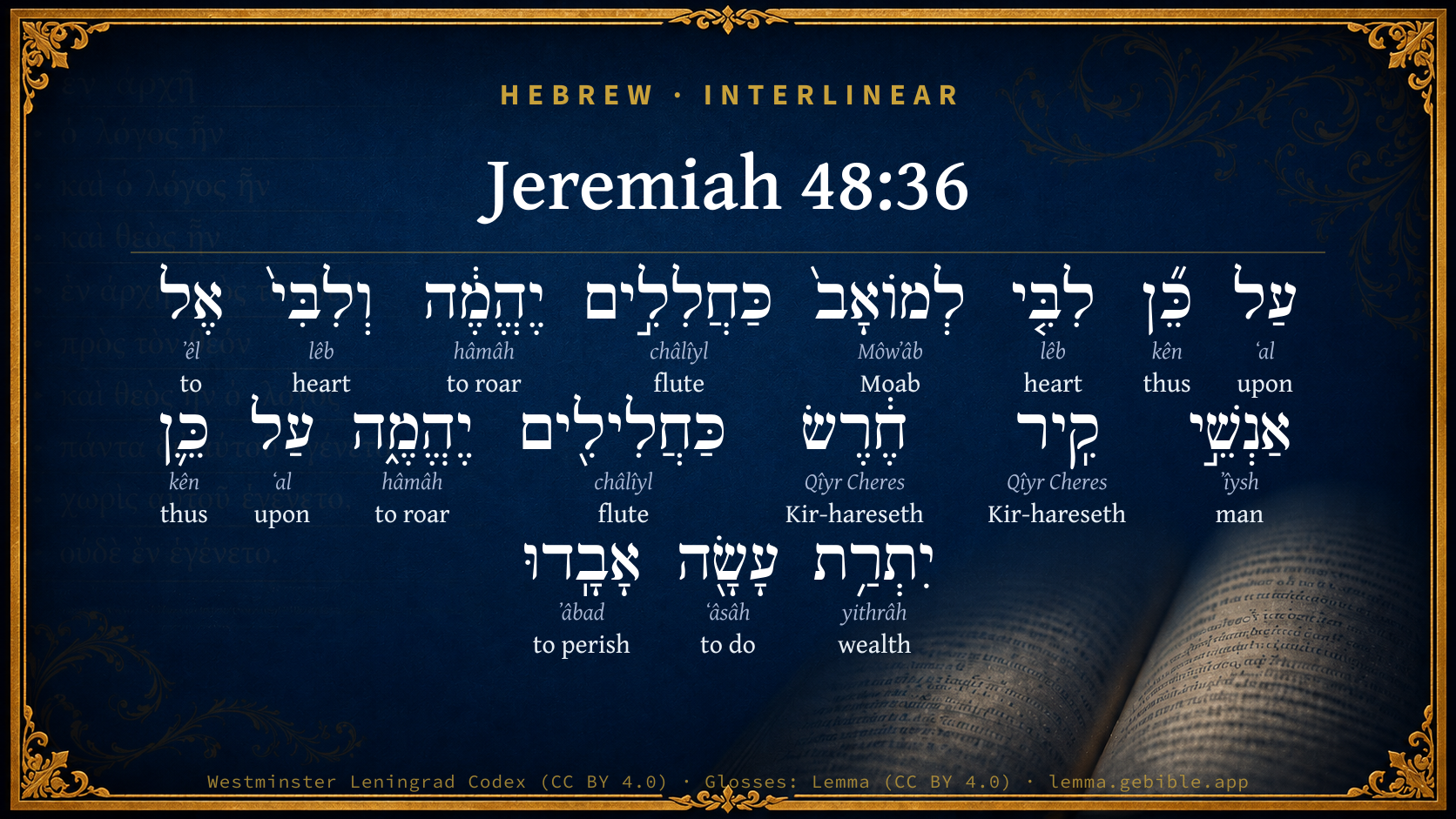
Jeremiah 48:36

Hebrew (Westminster Leningrad Codex) Jeremiah 48:36 appears in the Hebrew Old Testament. The text above is from the Westminster Leningrad Codex. Each word links to its Strong’s number, a concise gloss, and parsing drawn from the Open Scriptures Hebrew Bible morphology. Click any word for its full Brown-Driver-Briggs (BDB) entry.
Download image
Cite this verse

Jeremiah 48:36 (World English Bible). Public Domain. Lemma interlinear Bible study tool, https://lemma.gebible.app/v/jeremiah/48/36.

Show BibTeX & RIS
BibTeX
RIS
English Translation
Therefore my heart sounds for Moab like pipes, and my heart sounds like pipes for the men of Kir Heres: therefore the abundance that he has gotten is perished.
World English Bible · Public Domain
Download a study sheet

One document with this verse’s original text, its word-by-word gloss line, the meaning frame, cross-references with their text, attributed commentary, and full source and license credits — printable, and it pastes into notes with its structure intact.

This verse Autodidact and up

Study sheet (.html) Plain text (.txt)

A passage Seminary Student

Up to 50 verses in one chapter. A passage sheet keeps up to 6 commentary sources and 12 cross-references per verse, in the order this page ranks them, and says so on the sheet whenever that leaves anything out. Ask for a single verse and you get the Autodidact verse sheet above.

Everything on this page stays free to read, with no account — the sheet is a download of what is already on screen, not access to it.

Want to remove ads? Support Godless Engineer
Compare translations 3

The same verse in 3 English versions, stacked beneath the original-language interlinear above. Click any original word for its lexicon entry.

Each is an independent rendering of the whole verse — the interlinear is not word-aligned to these translations.

Highlighted words mark where these versions differ — a whole-verse word diff, not a word-by-word alignment.

  • World English Bible Public Domain
    Therefore my heart sounds for Moab like pipes, and my heart sounds like pipes for the men of Kir Heres: therefore the abundance that he has gotten is perished.
  • King James Version Public Domain
    Therefore mine heart shall sound for Moab like pipes, and mine heart shall sound like pipes for the men of Kirheres: because the riches that he hath gotten are perished.
  • unfoldingWord Literal Text CC BY-SA 4.0
    So my heart is lamenting for Moab like a flute. My heart is lamenting like flutes for the people of Kir Hareseth. The riches they gained are gone.

unfoldingWord Literal Text — © unfoldingWord, licensed CC BY-SA 4.0. Word-aligned USFM3 via Door43 (git.door43.org/unfoldingWord/en_ult).

Versions to compare (up to 4)

3 of 4 selected

Show all 18 translations

Every available English version of this verse, each an independent rendering of the whole verse.

  • World English Bible Public Domain
    Therefore my heart sounds for Moab like pipes, and my heart sounds like pipes for the men of Kir Heres: therefore the abundance that he has gotten is perished.
  • Berean Standard Bible Public Domain
    Therefore My heart laments like a flute for Moab; it laments like a flute for the men of Kir-heres, because the wealth they acquired has perished.
  • Majority Standard Bible Public Domain
    Therefore My heart laments like a flute for Moab; it laments like a flute for the men of Kir-heres, because the wealth they acquired has perished.
  • King James Version Public Domain
    Therefore mine heart shall sound for Moab like pipes, and mine heart shall sound like pipes for the men of Kirheres: because the riches that he hath gotten are perished.
  • American Standard Version (1901) Public Domain
    Therefore my heart soundeth for Moab like pipes, and my heart soundeth like pipes for the men of Kir-heres: therefore the abundance that he hath gotten is perished.
  • Revised Version (1885) Public Domain
    Therefore mine heart soundeth for Moab like pipes, and mine heart soundeth like pipes for the men of Kir-heres: therefore the abundance that he hath gotten is perished.
  • Geneva Bible (1599) Public Domain
    Therefore mine heart shall sounde for Moab like a shaume, and mine heart shall sound like a shaume for the men of Ker-heres, because the riches that he hath gotten, is perished.
  • Douay-Rheims (1899) Public Domain
    Therefore my heart shall sound for Moab like pipes: and my heart a sound like pipes for the men of the brick wall: because he hath done more than he could, therefore they have perished.
  • Young's Literal Translation Public Domain
    Therefore my heart for Moab as pipes doth sound, And my heart for men of Kir-Heres As pipes doth sound, Therefore the abundance he made did perish.
  • Literal Standard Version CC BY-SA 4.0
    Therefore My heart sounds as pipes for Moab, || And My heart sounds as pipes for men of Kir-Heres, || Therefore the abundance he made perished.
  • Unlocked Literal Bible CC BY-SA 4.0
    So my heart is lamenting for Moab like a flute. My heart is lamenting like flutes for the people of Kir Hareseth. The riches they gained are gone.
  • unfoldingWord Literal Text CC BY-SA 4.0
    So my heart is lamenting for Moab like a flute. My heart is lamenting like flutes for the people of Kir Hareseth. The riches they gained are gone.
  • Darby Bible Public Domain
    Therefore my heart shall sound for Moab like pipes, and my heart shall sound like pipes for the men of Kir-heres; because the abundance that he hath gotten is perished.
  • World Messianic Bible Public Domain
    Therefore my heart sounds for Moab like flutes, and my heart sounds like flutes for the men of Kir Heres. Therefore the abundance that he has gotten has perished.
  • Webster's Bible Public Domain
    Therefore my heart shall sound for Moab like pipes, and my heart shall sound like pipes for the men of Kirheres: because the riches that he hath gotten have perished.
  • Free Bible Version CC BY-SA 4.0
    So I mourn inside like a flute playing a sad song for Moab; like a flute playing a funeral tune for the people of Kir-heres, because they've lost everything of value that they worked for.
  • Bible in Basic English Public Domain
    So my heart is sounding for Moab like the sound of pipes, and my heart is sounding like pipes for the men of Kir-heres: for the wealth he has got for himself has come to an end.
  • JPS Tanakh (1917) Public Domain
    Therefore my heart moaneth for Moab like pipes, and my heart moaneth like pipes for the men of Kir-heres; therefore the abundance that he hath gotten is perished.

Literal Standard Version (2020), Covenant Press — licensed CC BY-SA 4.0. Text via the HelloAO Bible API (eBible.org). Unlocked Literal Bible (unfoldingWord) — licensed CC BY-SA 4.0. Text via the HelloAO Bible API (eBible.org). unfoldingWord Literal Text — © unfoldingWord, licensed CC BY-SA 4.0. Word-aligned USFM3 via Door43 (git.door43.org/unfoldingWord/en_ult). Free Bible Version, Dr. Jonathan Gallagher — licensed CC BY-SA 4.0. Text via the HelloAO Bible API (eBible.org).

Word by word

More ways to search: Search by grammar → Find every occurrence → Compare this word →

Practice this passage: Drill this verse → Learn its vocabulary →

יִתְרַ֥ת
yithrâh
H3502
“wealth of”
Noun, Common, Feminine, Singular, Construct
Part of Speech
Noun
Type
Common
Gender
Feminine
Number
Singular
State
Construct
Full BDB Definition

Origin: from H3499

TWOT: 936c

abundance, riches, wealth
  1. עַל ʻal H5921 “upon” Preposition
  2. כֵּ֞ן kên H3651 “thus” Particle, Demonstrative
  3. לִבִּ֤י lêb H3820 “heart · my” Noun, Common, Masculine, Singular, Construct + Suffix, Personal, 1st Person, Common, Singular
  4. לְמוֹאָב֙ Môwʼâb H4124 “to/for · Moab” Preposition + Noun, Proper
  5. כַּחֲלִלִ֣ים châlîyl H2485 “like/as · flutes” Preposition + Noun, Common, Masculine, Plural, Absolute
  6. יֶהֱמֶ֔ה hâmâh H1993 “to roar” Verb, Qal, Imperfect, 3rd Person, Masculine, Singular
  7. וְלִבִּי֙ lêb H3820 “and · heart · my” Conjunction + Noun, Common, Masculine, Singular, Construct + Suffix, Personal, 1st Person, Common, Singular
  8. אֶל ʼêl H413 “to” Preposition
  9. אַנְשֵׁ֣י ʼîysh H376 “men of” Noun, Common, Masculine, Plural, Construct
  10. קִֽיר Qîyr Cheres H7025 “Kir-hareseth” Noun, Proper
  11. חֶ֔רֶשׂ Qîyr Cheres H7025 “Kir-hareseth” Noun, Proper
  12. כַּחֲלִילִ֖ים châlîyl H2485 “like/as · flutes” Preposition + Noun, Common, Masculine, Plural, Absolute
  13. יֶהֱמֶ֑ה hâmâh H1993 “to roar” Verb, Qal, Imperfect, 3rd Person, Masculine, Singular
  14. עַל ʻal H5921 “upon” Preposition
  15. כֵּ֛ן kên H3651 “thus” Particle, Demonstrative
  16. עָשָׂ֖ה ʻâsâh H6213 “to do” Verb, Qal, Perfect, 3rd Person, Masculine, Singular
  17. אָבָֽדוּ ʼâbad H6 “to perish” Verb, Qal, Perfect, 3rd Person, Common, Plural

About this verse

These counts appear in no published source. They are computed here, from the morphology-tagged text and Lemma’s own curated glosses. What Lemma adds →

18
words
12
distinct lemmas
Prophets
section

Notable vocabulary

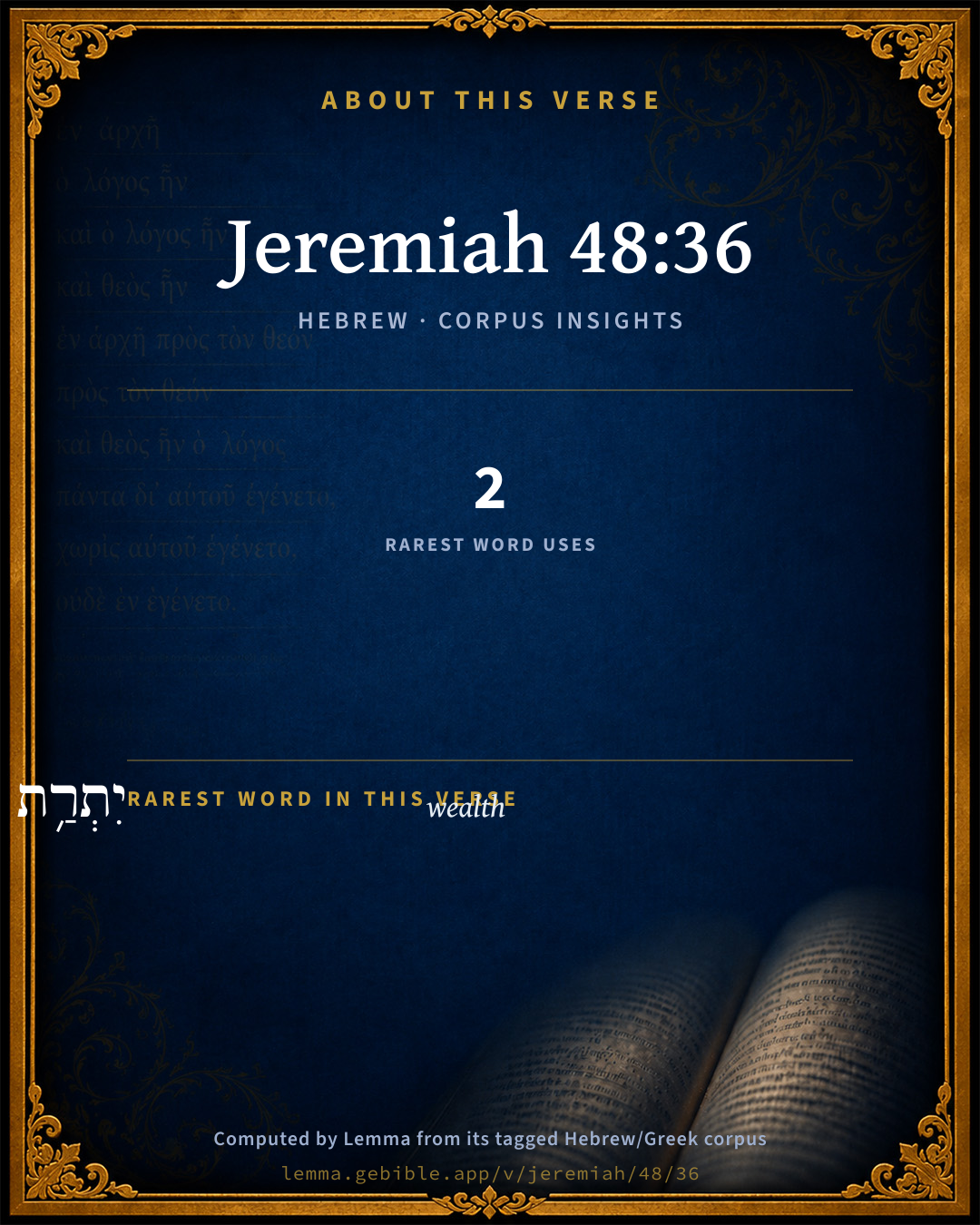
The rarest word here is יִתְרַ֥ת wealth H3502 — appearing just 2 times in the whole Hebrew Bible.

Shared distinctive vocabulary

יִתְרַ֥ת wealth H3502 occurs in 2 verses of the Hebrew Bible. Also found in:

Grammatical profile

  • 4 verbs
  • 9 nouns
  • 3 prepositions
  • 2 particles

Verb forms

  • יֶהֱמֶ֔ה Qal · Imperfect
  • יֶהֱמֶ֑ה Qal · Imperfect
  • עָשָׂ֖ה Qal · Perfect
  • אָבָֽדוּ Qal · Perfect

Repetition

Words recur within this verse — often emphatic in Hebrew:

  • עַל upon H5921 ×2
  • כֵּ֞ן thus H3651 ×2
  • לִבִּ֤י heart H3820 ×2
  • כַּחֲלִלִ֣ים flute H2485 ×2
  • יֶהֱמֶ֔ה to roar H1993 ×2
  • קִֽיר Kir-hareseth H7025 ×2

Cross-references

12

Topical passages linked to Jeremiah 48:36 in the Treasury of Scripture Knowledge — connected by theme and wording, ordered by reader-vote popularity; previews shown in the World English Bible.

  • Isaiah 15:7 Therefore the abundance they have gotten, and that which they have laid up, shall they carry away over the brook of the willows.
  • Isaiah 16:11 Why my heart sounds like a harp for Moab, and my inward parts for Kir Heres.
  • Isaiah 15:5 My heart cries out for Moab; her nobles [flee] to Zoar, to Eglath Shelishiyah: for by the ascent of Luhith with weeping they go up; for in the way of Horonaim they raise up a cry of destruction.
  • Proverbs 11:4 Riches don't profit in the day of wrath, But righteousness delivers from death.
  • Proverbs 13:22 A good man leaves an inheritance to his children's children, But the wealth of the sinner is stored for the righteous.
  • Proverbs 18:11 The rich man's wealth is his strong city, Like an unscalable wall in his own imagination.
  • Ecclesiastes 5:13–14 There is a grievous evil which I have seen under the sun: wealth kept by its owner to his harm.
  • Isaiah 63:15 Look down from heaven, and see from the habitation of your holiness and of your glory: where are your zeal and your mighty acts? the yearning of your heart and your compassion is restrained toward me.
  • Jeremiah 4:19 My anguish, my anguish! I am pained at my very heart; my heart is disquieted in me; I can't hold my peace; because you have heard, O my soul, the sound of the trumpet, the alarm of war.
  • Jeremiah 17:11 As the partridge that sits on [eggs] which she has not laid, so is he who gets riches, and not by right; in the midst of his days they shall leave him, and at his end he shall be a fool.
  • Luke 12:20–21 "But God said to him, 'You foolish one, tonight your soul is required of you. The things which you have prepared--whose will they be?'
  • James 5:2–3 Your riches are corrupted and your garments are moth-eaten.

Cross-references courtesy of OpenBible.info (CC BY 4.0).

Hebrew and Greek witnesses Masoretic Hebrew ↔ Greek Septuagint

The same verse in the two great witnesses to the Old Testament, shown verse-for-verse.

These are two independent witnesses, not word-aligned to each other, and the Septuagint is shown in lemma (dictionary) form.

Hebrew Jeremiah 48:36 Masoretic · Westminster Leningrad Codex

עַל כֵּ֞ן לִבִּ֤י לְמוֹאָב֙ כַּחֲלִלִ֣ים יֶהֱמֶ֔ה וְלִבִּי֙ אֶל אַנְשֵׁ֣י קִֽיר חֶ֔רֶשׂ כַּחֲלִילִ֖ים יֶהֱמֶ֑ה עַל כֵּ֛ן יִתְרַ֥ת עָשָׂ֖ה אָבָֽדוּ

Therefore my heart sounds for Moab like pipes, and my heart sounds like pipes for the men of Kir Heres: therefore the abundance that he has gotten is perished.

World English Bible · Public Domain

Greek LXX Structure differs

In the Septuagint, Jeremiah is about an eighth shorter than the Hebrew and arranges its material differently — the Oracles Against the Nations (Hebrew chapters 46–51) appear in the middle of the Greek book, after 25:13. Because the chapter and verse boundaries do not line up, a verse-for-verse comparison with the Hebrew is not shown.

A verse-for-verse comparison isn’t shown here because the chapters and verses don’t line up. Switch to the LXX edition with the MT / LXX toggle above to read the Greek directly.

Hebrew: Westminster Leningrad Codex (CC BY 4.0). Greek: Septuagint (public domain); English from a public-domain English Septuagint. How the Septuagint differs from the Hebrew →

Targum (Aramaic paraphrase)

1

The Targum is the ancient Jewish Aramaic paraphrase of the Hebrew Scriptures — an interpretive translation, not the Hebrew text itself. Onkelos (literal) and Pseudo-Jonathan (expansive) render the Torah, and Jonathan the Prophets. Coverage is partial: where no permissively-licensed English translation exists for a verse, only the Aramaic is shown. This is verse-level text, not a word-by-word alignment to the Hebrew.

  1. Targum Jonathan Prophets (Joshua–Malachi)
    עַל כֵּן בְּלִבְּהוֹן מוֹאָבָאֵי כְּכִינוֹרָא הָמָן וְלִבְּהוֹן עַל אֱנַשׁ כְּרַךְ תּוּקְפֵיהוֹן כִּזְמַר אֲבוּבִין דָוֵי עַל כֵּן שְׁאָר נִכְסֵיהוֹן דִקְנוֹ יִתְבַּזְזוּן:

    (no public-domain English translation for this verse)

    Targum Jonathan — Aramaic: “Mikraot Gedolot” (public domain). English: “Sefaria Community Translation” (CC0 1.0 (public-domain dedication)); “London "Chaldee Paraphrase," 1871” (public domain). Text via Sefaria.

Commentary

Notes on Jeremiah 48:36 from classic Christian and Jewish commentators (each source and its license shown beneath its notes). The classic Christian expositions comment on the surrounding passage and are grouped to its opening verse, so a note may address several verses; the Jewish commentaries on the Tanakh (Rashi and others) are per-verse, so they appear only where the commentator wrote on this verse.

Lemma curates 59 commentaries, every one of them public domain or Creative Commons licensed, each selected and text-cleaned for this edition rather than reprinted as found. About our sources →

Trapp's Complete Commentary

John Trapp

Jer 48:36 Therefore mine heart shall sound for Moab like pipes, and mine heart shall sound like pipes for the men of Kirheres: because the riches [that] he hath gotten are perished.

Ver. 36. Therefore my heart.] See Isa 15:5; Isa 16:11.

John Trapp, A Commentary or Exposition upon All the Books of the Old and New Testament (1647–1656) — public domain. Text from a community e-Sword module.

The Biblical Illustrator

Joseph S. Exell

Jer_48:36

Because the riches that he hath gotten are perished.

Riches are ever liable to perish

Prosperity is not to be deemed the greatest security. The lofty unbending cedar is more exposed to the injurious blast than the lowly shrub. The little pinnace rides safely along the shore, while the gallant ship advancing is wrecked. Those sheep which have the most wool are generally the soonest fleeced. Poverty is its own defence against robbery. Who would snake those trees upon which there is no fruit? (T. Secker.).

The Biblical Illustrator, edited by Joseph S. Exell (c. 1880s–1900s) — public domain. Text from a community e-Sword module.

Keil & Delitzsch

C. F. Keil & F. Delitzsch

Further lamentation over the fall of Moab. - Jer 48:36. "Therefore my heart sounds like pipes for Moab, and my heart sounds like pipes for the men of Kir-heres; therefore the savings which he has made are perished. Jer 48:37. For every head is baldness, and every beard is shorn; on all hands there are cuts, and on loins sackcloth. Jer 48:38. On all the roofs of Moab, and in its streets, it is all mourning; for I have broken Moab like a vessel, in which there is no pleasure, saith Jahveh."

The prophet once more lifts up his lamentation over Moab (Jer 48:36 corresponds to Jer 48:31), and gives reason for it in the picture he draws of the deep affliction of the Moabites. Jer 48:36 is an imitation of Isa 16:11; the thought presented in v. 36b accords with that found in Isa 15:7. Isaiah says, "My bowels sound (groan) like the harp," whose strings give a tremulous sound when struck with the plectrum. Instead of this, Jeremiah puts the sounding of pipes, the instruments used in dirges (Mat 9:23). Moab and Kir-heres are mentioned together, as in Jer 48:31. על־כּן, in the second clause, does not stand for כּי על־כּן, "on this account that" (Kimchi, Hitzig, Graf, etc.), but is co-ordinated with the first על־כּן. The idea is not, "Therefore my heart mourns over Moab, because the savings are perished;" but because the sentence of desolation has been passed on the whole of Moab, therefore the heart of the prophet makes lament, and therefore, too, all the property which Moab has acquired is lost. יתרה, as a collective noun, is joined with the plural verb אבדוּ. On the construction יתרת עשׂה, cf. Gesenius, 123, 3, Rem. 1; Ewald, 332, c. The proof of this is given by the deep sorrow and wailing of the whole Moabite nation, Jer 48:37. On all sides are tokens of the deepest sadness, - heads shorn bald, beards cut off, incisions on the hands, sackcloth round the loins.

Jer 48:37-38

Jer 48:37 is formed out of pieces taken from Isa 15:2-3. קרחה is a substantive, "baldness," i.e., quite bald. גּרוּעה, decurtata, instead of גּדוּעה (in Isaiah), is weaker, but more suitable for the present connection. גּדדת, i.e., cuts or scratches inflicted on the body, as signs of mourning; cf. Jer 16:6; Jer 41:5. כּלּה , "It is all wailing;" nothing is heard but wailing, for God has broken Moab in pieces like a useless vessel. On the simile employed, cf. Jer 22:28.

Keil & Delitzsch — Biblical Commentary on the Old Testament (1861–1891) — public domain (CC PDM 1.0). Text via the HelloAO Bible API. (Old Testament only.)

Geneva Bible (1599)

Geneva Bible translators

Their custom was to play on flutes or instruments, heavy and grave tunes at burials and in the time of mourning, as Matt. 9:23.

Geneva Bible (1599) marginal notes — public domain. Text via Bolls.life.

Jamieson, Fausset & Brown

Robert Jamieson, A. R. Fausset & David Brown

(See on Isa 15:7; Isa 16:11).

like pipes--a plaintive instrument, therefore used at funerals and in general mourning.

riches . . . gotten--literally, the abundance . . . that which is over and above the necessaries of life. GROTIUS translates, "They who have been left remaining shall perish"; they who have not been slain by the enemy shall perish by disease and famine.

Jamieson, Fausset & Brown — Commentary Critical and Explanatory on the Whole Bible (1871) — public domain (CC PDM 1.0). Text via the HelloAO Bible API.

John Calvin's Commentaries

Here the Prophet, as it has been before stated, does not mourn the calamity of the people of Moab, but assumes the character of others, so that the event might appear more evident, it being set as it were before our eyes; for as we have said, the wealth of the Moabites was so great at that time, that it dazzled the eyes of all. It was then difficult for the faithful to form an idea of this vengeance of God, therefore the Prophet transfers to himself the feelings of others, and relates what the Moabites would do, when God had so grievously afflicted them.

My heart, he says, shall sound like pipes Some think that mournful pipes are meant, but I know not whether or not they were instruments of this kind; and there are those who think that חללים, chellim, were bag-pipes, but what is too refined I leave. The Prophet simply means that such would be the trepidation, that the hearts of the Moabites would make a noise like pipes. He repeats the same thing in different words, that his heart would make a noise, or sound, for the men of Kir-heres, of which city we spoke yesterday.

He now adds, for the residue which they have made, or which Moab has made, for the verb is in the singular number; and then, they have perished, where also there is a change of number; but the reference is to the word “residue,” יתרת, iteret, which included hidden treasures, as we have stated. Whatever then the Moabites had gained for themselves, and whatever they thought would be always safe, the Prophet declares that it would perish. Isaiah adds, “their substance,” פקותם, pekotem, and says, that they would carry it to the willows, that is, to deserted places; as though he had said, that all the wealth of the Moabites would be scattered, as though it were, as they say, a thing forsaken. It now follows —

John Calvin's Commentaries (1540-1563) — public domain. Text from the Calvin Translation Society English edition (1840s-50s) via the Christian Classics Ethereal Library (ccel.org). Calvin's coverage is partial (roughly two-thirds of the Bible); uncommented books and verses are honest gaps, never fabricated. The 19th-century editor's footnotes and remarks are omitted so the notes are faithfully Calvin's own voice.

Ellicott's Commentary for English Readers

(36) Mine heart shall sound for Moab like pipes . . .—The words reproduce Isa_16:11. His heart becomes, as it were, musical in its groans and sighs. He cannot look on the panic-stricken and mourning city without sharing in its misery. In the baldness (Jer_7:29; Jer_16:6), the clipped beard, the cuttings (Jer_16:6; Jer_41:5), the sackcloth (Jer_4:8; Jer_6:26; Joe_1:8) we have the wonted signs of mourning for the dead. The “pipe” is chosen rather than the harp, as in Isa_16:11, because it had come to be the recognised music for funerals (so in Mat_9:23).

A Bible Commentary for English Readers, edited by Charles John Ellicott (1878–1897) — public domain. Text from a community e-Sword module.

The Cambridge Bible for Schools and Colleges

gen. ed. J. J. S. Perowne

36. soundeth for Moab like pipes] Their use was connected with funerals, so that the word is appropriate as expressing mourning. Isaiah’s word is “an harp” (Jer_16:11).

The Cambridge Bible for Schools and Colleges (gen. ed. J. J. S. Perowne; Cambridge University Press, 1878–1918) — public domain. Text from a community e-Sword module.

John Gill's Exposition

For every head shall be bald, and every beard clipped,.... Men, in times of mourning, used to pluck off the hairs of their head till they made them bald, and shaved their beards; which, as Kimchi says, were the glory of their faces; see Isa 15:2;

upon all the hands shall be cuttings: it was usual with the Heathens to make incisions in the several parts of their bodies, particularly in their hands and arms, with their nails, or with knives, in token of mourning; which are forbidden the Israelites, Deu 14:1;

and upon the loins sackcloth; this is a well known custom for mourners, to put off their clothes, and put on sackcloth; all these things are mentioned, to show how great was the mourning of Moab for the calamities of it.

John Gill's Exposition of the Whole Bible (1746–1763) — public domain (CC PDM 1.0). Text via the HelloAO Bible API.

Albert Barnes' Notes on the Bible

Like pipes - A wind instrument, used at funerals Mat 9:23.

The riches that he hath gotten - literally, “that which remains over, a superfluity.”

Albert Barnes' Notes on the Bible (1834–1885) — public domain. Text from a community e-Sword/MySword module.

Haydock's Catholic Bible Commentary

Pipes. Hebrew chalilim, (Haydock) lyre or flutes. Such were used at funerals of children; (Matthew ix. 23.) trumpets sounded for men. (Servius) --- Could; opposing the conqueror of Asia, ver. 30, 31. (Calmet) --- Protestants, "the riches that he hat gotten is perished."

George Leo Haydock (1774–1849), Haydock's Catholic Family Bible and Commentary, 1859 edition — public domain. Excludes Psalms (Douay-Rheims chapter numbering differs from Protestant) and Deuterocanonical books (Catholic canon only).

Matthew Poole's English Annotations

The prophet means such pipes as they were wont to use at funerals, and other sad occasions, to play doleful lessons upon; see Isa 15:5; because of the great change in the state of this poor people, which had got together a great deal of wealth, which is all perished.

Matthew Poole's English Annotations on the Holy Bible (1683–1685) — public domain. Text from a community e-Sword/MySword module.

Whedon's Commentary on the Bible

Daniel D. Whedon

36. Pipes — In Isaiah it is harp. Jeremiah says “pipes” for the plaintive and dirge-like quality of the music.

Daniel D. Whedon (gen. ed.), Commentary on the Old and New Testaments (1874–1909) — public domain. Text from a community e-Sword module.

The Pulpit Commentary

Ver. 36-42. The description of Moab"s lamentations continued.

Based on Isa_16:11 Isa_15:7. Like pipes. Isaiah has, "like the harp or, "lute." The pipe, or flute, was specially used at funeral ceremonies, (Mat_9:23 Luk_7:32) and therefore, perhaps, seemed to Jeremiah more appropriate. Because the riches, etc. This is, no doubt, what we should have expected, but this is not what Jeremiah wrote; "because" should rather be therefore. Jeremiah simply transferred a clause (substantially at least) from his original, Isa_15:7, but into a context where it stands rather less naturally. The meaning of the words in Isaiah is that, the desolation being so great, the Moabites shall carry away as much of their goods as they can. In this new context, however, we can only explain this unexpected "therefore" by referring to a habit of the Israelitish mind by which that which contributed to a result was regarded as worked purposely for that result. Good instances of this habit are Gen_18:5 Psa_45:3 Psa_51:6; comp. Winer"s "New Testament Grammar" (Clark), pp. 573, 574, especially note 1 on p. 574, though the idiom also occurs in Old Testament passages in which the religious view of life is hardly traceable.

The Pulpit Commentary (1880–1919), ed. H.D.M. Spence-Jones & Joseph S. Exell — public domain. Text from a community e-Sword module.

John Wesley's Explanatory Notes

Pipes - The prophet means such pipes as they were wont to use at funerals, and other sad occasions.

John Wesley, Explanatory Notes Upon the Whole Bible (1754–1765) — public domain. Text via the GEBible commentary corpus.

Kretzmann's Popular Commentary

Paul E. Kretzmann

Lamentation over Moab

v. 36. Therefore mine heart shall sound for Moab like pipes, sighing with the wailing sound of the flute, and mine heart shall sound like pipes for the men of Kir-heres, the chief stronghold of Moab, because the riches that he hath gotten are perished, literally, "because the remnant that they had gained, perished. " Because the judgment of destruction had struck Moab, therefore his heart was wailing so bitterly, and therefore also the wealth of Moab was lost.

v. 37. For every head shall be bald, shaved as a sign of deep grief, and every beard clipped, another evidence of mourning; upon all the hands shall be cuttings, incisions such as the heathen made in deep sorrow, and upon the loins sackcloth, the whole nation lamenting on account of the great losses which had come upon the entire land.

v. 38. There shall be lamentation generally, nothing but wailing, upon all the housetops of Moab, and in the streets thereof, both at home and abroad; for I have broken Moab like a vessel wherein is no pleasure, saith the Lord, like a worthless vase which is cast aside without so much as a backward glance.

v. 39. They shall howl, literally, "How is it broken!" saying, How is it broken down! How hath Moab turned the back with shame! no longer proud and insolent, but utterly broken in spirit. So shall Moab be a derision and a dismaying to all them about him, an object of scorn, mockery, and horror.

v. 40. For thus saith the Lord, Behold, he, namely, Nebuzar-adan, the captain of Nebuchadnezzar, shall fly as an eagle and shall spread his wings over Moab, to pounce upon them as a welcome prey, to tear them to pieces.

v. 41. Kerioth, Cf v. 24, is taken, and the strongholds are surprised, and the mighty men’s hearts in Moab at that day shall be as the heart of a woman in her pangs, full of fear and terror.

v. 42. And Moab shall be destroyed from being a people, losing its identity among the nations, because he hath magnified himself against the Lord, and Jehovah resisteth the proud.

v. 43. Fear and the pit, used by the hunter of big game, and the snare, used by the fowler, shall be upon thee, O inhabitant of Moab, saith the Lord, some sort of catastrophe being sure to strike the proud and defiant people.

v. 44. He that fleeth from the fear, trying to escape the general horror, shall fall into the pit, and he that getteth up out of the pit shall be taken in the snare, one or the other of the calamities will be sure to catch him; for I will bring upon it, even upon Moab, the year of their visitation, saith the Lord.

v. 45. They that fled, the fugitives who escaped the slaughter, stood under the shadow of Heshbon because of the force, powerless in the face of the danger confronting them; but a fire shall come forth out of Heshbon, the city in which they hoped to find refuge, and a flame from the midst of Sihon, the ancient king of the Amorites, and shall devour the corner of Moab, so that it would be totally destroyed, and the crown of the head of the tumultuous ones, of the sons of warlike confusion. The prophet here applies the ancient hymn. Num 21:27-28, to the circumstances before him; for as in ancient times Sihon, king of the Amorites, came forth from his city, Heshbon, like a devouring flame, which consumed Moab, so the Chaldeans, starting from Heshbon, would descend upon the country of the Moabites and destroy their power.

v. 46. Woe be unto thee, O Moab! The people of Chemosh perisheth, the idolaters with their false god; for thy sons are taken captives, led away into prison, and thy daughters captives, dragged into exile.

v. 47. Yet will I bring again the captivity of Moab in the latter days, saith the Lord, the Messianic idea becoming evident in this promise of restoration. Thus far is the judgment of Moab. The Lord has His children even in the midst of a people which has rejected Him, which, for this reason, He is bound to punish according to His holiness. The Gospel-message has reached many Gentiles, and the Gospel-blessings have descended upon many persons outside of Israel according to the flesh.

Paul E. Kretzmann, Popular Commentary of the Bible (1921–1924) — public domain. Text from a community e-Sword module.

unfoldingWord translationNotes

Door43 World Missions Community

my heart is lamenting for Moab like a flute

Here "heart" represents the whole person. The person's sad crying is compared to the sad music played on a flute at a funeral. AT: "I cry sadly for Moab. My cries are like the sad music a person plays on a flute at a funeral" (See: Synecdoche and Simile)

my heart

Possible meanings are 1) "my" refers to Jeremiah or 2) "my" refers to Yahweh.

Kir Hareseth

Kir Hareseth was an ancient capital of Moab. See how you translated this name in Jeremiah 48:31. (See: How to Translate Names)

For every head is bald and every beard shaved. Incisions are on every hand, and sackcloth is around their waists

These are all things that the people of Moab did when they were mourning or expressing deep sorrow. (See: Symbolic Action)

Incisions

cuts made on the skin

translationWords

lament

flute

people group

head

sackcloth

unfoldingWord translationNotes — © Distant Shores Media and the Door43 World Missions Community, licensed CC BY-SA 4.0. Source: git.door43.org/Door43/en_tn.

Rashi

Rabbi Shlomo Yitzchaki (Rashi)

because they dealt haughtily יתרת עשה. Because they dealt haughtily, they perished.

Rashi on the Tanakh — English translations: “The Judaica Press complete Tanach with Rashi, translated by A. J. Rosenberg” (CC BY 4.0); “Pentateuch with Rashi's commentary by M. Rosenbaum and A.M. Silbermann, 1929-1934” (public domain); “The Metsudah Tanach series, Lakewood, N.J” (CC BY 4.0); and “The Book of Joshua, Metsudah Publications, 1997” (CC BY 4.0). Text via Sefaria.

Lesson kit

Teaching starters — assembled from the data on this page, not authored interpretation. Every prompt links to the verse data it draws on. Edit before teaching.

Jeremiah, in the Prophets, opens this verse with 18 words (12 distinct Hebrew lemmas). Its most distinctive word is yithrâh (“wealth”). A historical commentator’s framing appears above. Read the whole chapter for the surrounding context.

Discussion questions

  1. How does “wealth” (yithrâh) shape what this verse is saying?
  2. Isaiah 15:7 shares the word «wealth» with this verse. How do the two illuminate each other?
  3. “upon” occurs 2× in this one verse. What is the effect of the repetition?
  4. These translations render this verse differently. What is at stake in choosing one wording over another?
  5. The verb «יֶהֱמֶ֔ה» is Qal Imperfect. How does its form color the action?
  6. Reading how Trapp's Complete Commentary and The Biblical Illustrator read this verse, where do the two commentators agree and where do they part?

Things to notice

Reading settings

Reading text

Shown beneath each verse's original-language words.

Old Testament
Old Testament edition

Read the OT as the Masoretic Hebrew (MT) or the Greek Septuagint (LXX).

English shown for the Greek Septuagint (in the Hebrew ↔ Greek comparison).

Comparing translations? Open the Compare panel on any verse page to stack up to four side by side.