
Jeremiah 48:13

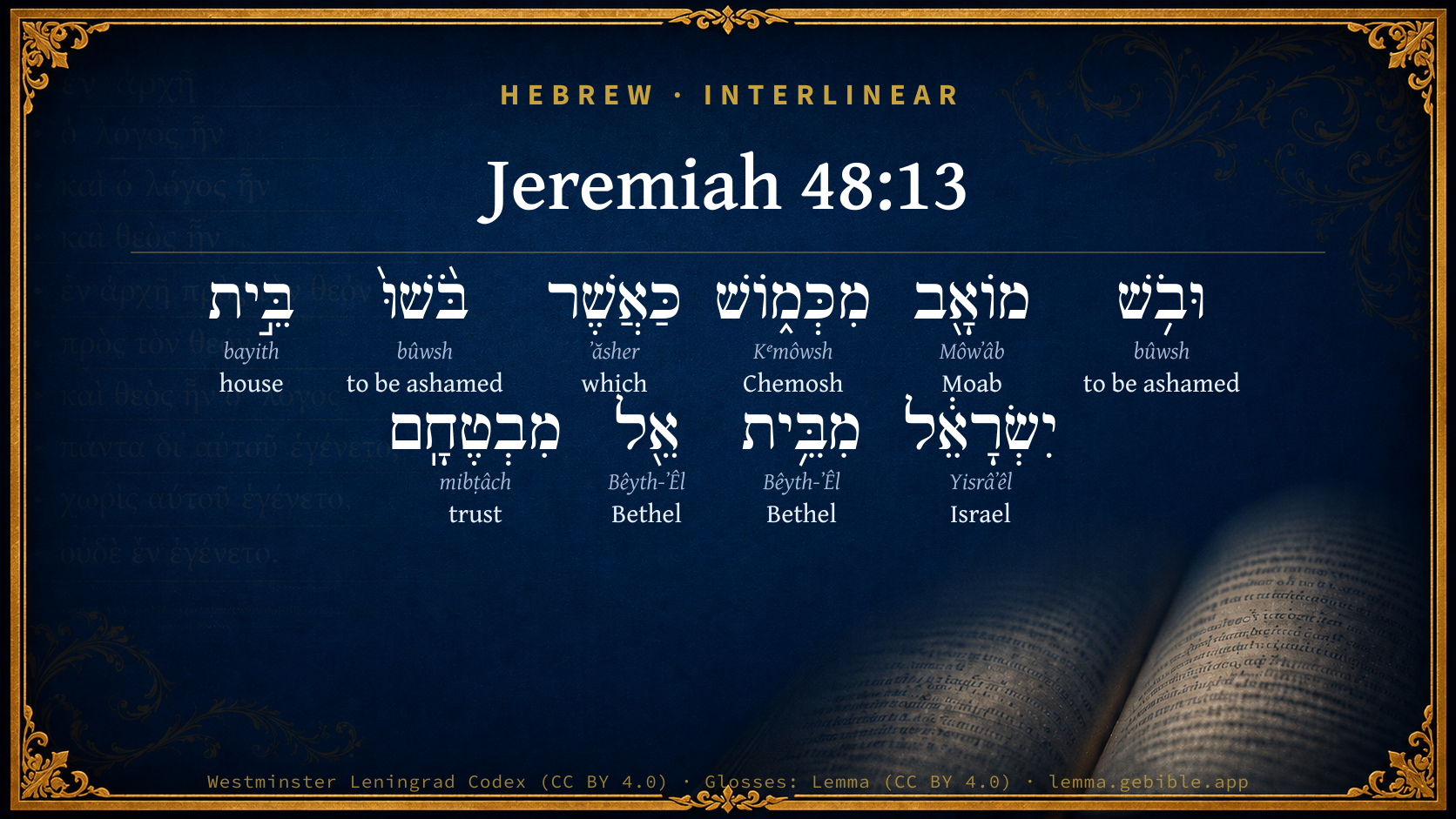
Hebrew (Westminster Leningrad Codex) Jeremiah 48:13 appears in the Hebrew Old Testament. The text above is from the Westminster Leningrad Codex. Each word links to its Strong’s number, a concise gloss, and parsing drawn from the Open Scriptures Hebrew Bible morphology. Click any word for its full Brown-Driver-Briggs (BDB) entry.
Download image
Cite this verse

Jeremiah 48:13 (World English Bible). Public Domain. Lemma interlinear Bible study tool, https://lemma.gebible.app/v/jeremiah/48/13.

Show BibTeX & RIS
BibTeX
RIS
English Translation
Moab shall be ashamed of Chemosh, as the house of Israel was ashamed of Bethel their confidence.
World English Bible · Public Domain
Download a study sheet

One document with this verse’s original text, its word-by-word gloss line, the meaning frame, cross-references with their text, attributed commentary, and full source and license credits — printable, and it pastes into notes with its structure intact.

This verse Autodidact and up

Study sheet (.html) Plain text (.txt)

A passage Seminary Student

Up to 50 verses in one chapter. A passage sheet keeps up to 6 commentary sources and 12 cross-references per verse, in the order this page ranks them, and says so on the sheet whenever that leaves anything out. Ask for a single verse and you get the Autodidact verse sheet above.

Everything on this page stays free to read, with no account — the sheet is a download of what is already on screen, not access to it.

Want to remove ads? Support Godless Engineer
Compare translations 3

The same verse in 3 English versions, stacked beneath the original-language interlinear above. Click any original word for its lexicon entry.

Each is an independent rendering of the whole verse — the interlinear is not word-aligned to these translations.

Highlighted words mark where these versions differ — a whole-verse word diff, not a word-by-word alignment.

  • World English Bible Public Domain
    Moab shall be ashamed of Chemosh, as the house of Israel was ashamed of Bethel their confidence.
  • King James Version Public Domain
    And Moab shall be ashamed of Chemosh, as the house of Israel was ashamed of Bethel their confidence.
  • unfoldingWord Literal Text CC BY-SA 4.0
    Then Moab will be ashamed of Chemosh just as the house of Israel was ashamed of Bethel, their object of trust.

unfoldingWord Literal Text — © unfoldingWord, licensed CC BY-SA 4.0. Word-aligned USFM3 via Door43 (git.door43.org/unfoldingWord/en_ult).

Versions to compare (up to 4)

3 of 4 selected

Show all 18 translations

Every available English version of this verse, each an independent rendering of the whole verse.

  • World English Bible Public Domain
    Moab shall be ashamed of Chemosh, as the house of Israel was ashamed of Bethel their confidence.
  • Berean Standard Bible Public Domain
    Then Moab will be ashamed of Chemosh, just as the house of Israel was ashamed when they trusted in Bethel.
  • Majority Standard Bible Public Domain
    Then Moab will be ashamed of Chemosh, just as the house of Israel was ashamed when they trusted in Bethel.
  • King James Version Public Domain
    And Moab shall be ashamed of Chemosh, as the house of Israel was ashamed of Bethel their confidence.
  • American Standard Version (1901) Public Domain
    And Moab shall be ashamed of Chemosh, as the house of Israel was ashamed of Beth-el their confidence.
  • Revised Version (1885) Public Domain
    And Moab shall be ashamed of Chemosh, as the house of Israel was ashamed of Beth-el their confidence.
  • Geneva Bible (1599) Public Domain
    And Moab shalbe ashamed of Chemosh as the house of Israel was ashamed of Beth-el their confidence.
  • Douay-Rheims (1899) Public Domain
    And Moab shall be ashamed of Chamos, as the house of Israel was ashamed of Bethel, in which they trusted.
  • Young's Literal Translation Public Domain
    And ashamed hath been Moab because of Chemosh, As the house of Israel have been ashamed Because of Beth-El their confidence.
  • Literal Standard Version CC BY-SA 4.0
    And Moab has been ashamed because of Chemosh, || As the house of Israel has been ashamed || Because of Beth-El, their confidence.
  • Unlocked Literal Bible CC BY-SA 4.0
    Then Moab will be ashamed of Chemosh just as the house of Israel was ashamed of Bethel, their object of trust.
  • unfoldingWord Literal Text CC BY-SA 4.0
    Then Moab will be ashamed of Chemosh just as the house of Israel was ashamed of Bethel, their object of trust.
  • Darby Bible Public Domain
    And Moab shall be ashamed of Chemosh, as the house of Israel was ashamed of Bethel, their confidence.
  • World Messianic Bible Public Domain
    Moab will be ashamed of Chemosh, as the house of Israel was ashamed of Bethel, their confidence.
  • Webster's Bible Public Domain
    And Moab shall be ashamed of Chemosh, as the house of Israel was ashamed of Beth-el their confidence.
  • Free Bible Version CC BY-SA 4.0
    Then the Moabites will feel let down by Chemosh, just as the people of Israel felt let down when they trusted in the golden calf idol at Bethel.
  • Bible in Basic English Public Domain
    And Moab will be shamed on account of Chemosh, as the children of Israel were shamed on account of Beth-el their hope.
  • JPS Tanakh (1917) Public Domain
    And Moab shall be ashamed of Chemosh, as the house of Israel was ashamed of Beth-el their confidence.

Literal Standard Version (2020), Covenant Press — licensed CC BY-SA 4.0. Text via the HelloAO Bible API (eBible.org). Unlocked Literal Bible (unfoldingWord) — licensed CC BY-SA 4.0. Text via the HelloAO Bible API (eBible.org). unfoldingWord Literal Text — © unfoldingWord, licensed CC BY-SA 4.0. Word-aligned USFM3 via Door43 (git.door43.org/unfoldingWord/en_ult). Free Bible Version, Dr. Jonathan Gallagher — licensed CC BY-SA 4.0. Text via the HelloAO Bible API (eBible.org).

Word by word

More ways to search: Search by grammar → Find every occurrence → Compare this word →

Practice this passage: Drill this verse → Learn its vocabulary →

מִכְּמ֑וֹשׁ
Kᵉmôwsh
H3645
“from · Chemosh”
Preposition + Noun, Proper
Part of Speech
Preposition + Noun
Type
Proper
Full BDB Definition

Origin: from an unused root meaning to subdue

TWOT: None

Chemosh = "subduer" - the national deity of the Moabites and a god of the Ammonites - also identified with 'Baal-peor', 'Baal-zebub', 'Mars' and 'Saturn' - worship of this god was introduced into Jerusalem by Solomon and abolished by king Josiah of Judah
  1. וּבֹ֥שׁ bûwsh H954 “and · to be ashamed” Conjunction + Verb, Qal, Sequential Perfect, 3rd Person, Masculine, Singular
  2. מוֹאָ֖ב Môwʼâb H4124 “Moab” Noun, Proper
  3. כַּאֲשֶׁר ʼăsher H834 “like/as · which” Preposition + Particle, Relative
  4. בֹּ֨שׁוּ֙ bûwsh H954 “to be ashamed” Verb, Qal, Perfect, 3rd Person, Common, Plural
  5. בֵּ֣ית bayith H1004 “house of” Noun, Common, Masculine, Singular, Construct
  6. יִשְׂרָאֵ֔ל Yisrâʼêl H3478 “Israel” Noun, Proper
  7. מִבֵּ֥ית Bêyth-ʼÊl H1008 “from · Bethel” Preposition + Noun, Proper
  8. אֵ֖ל Bêyth-ʼÊl H1008 “Bethel” Noun, Proper
  9. מִבְטֶחָֽם mibṭâch H4009 “trust · their” Noun, Common, Masculine, Singular, Construct + Suffix, Personal, 3rd Person, Masculine, Plural

About this verse

These counts appear in no published source. They are computed here, from the morphology-tagged text and Lemma’s own curated glosses. What Lemma adds →

10
words
8
distinct lemmas
Prophets
section

Notable vocabulary

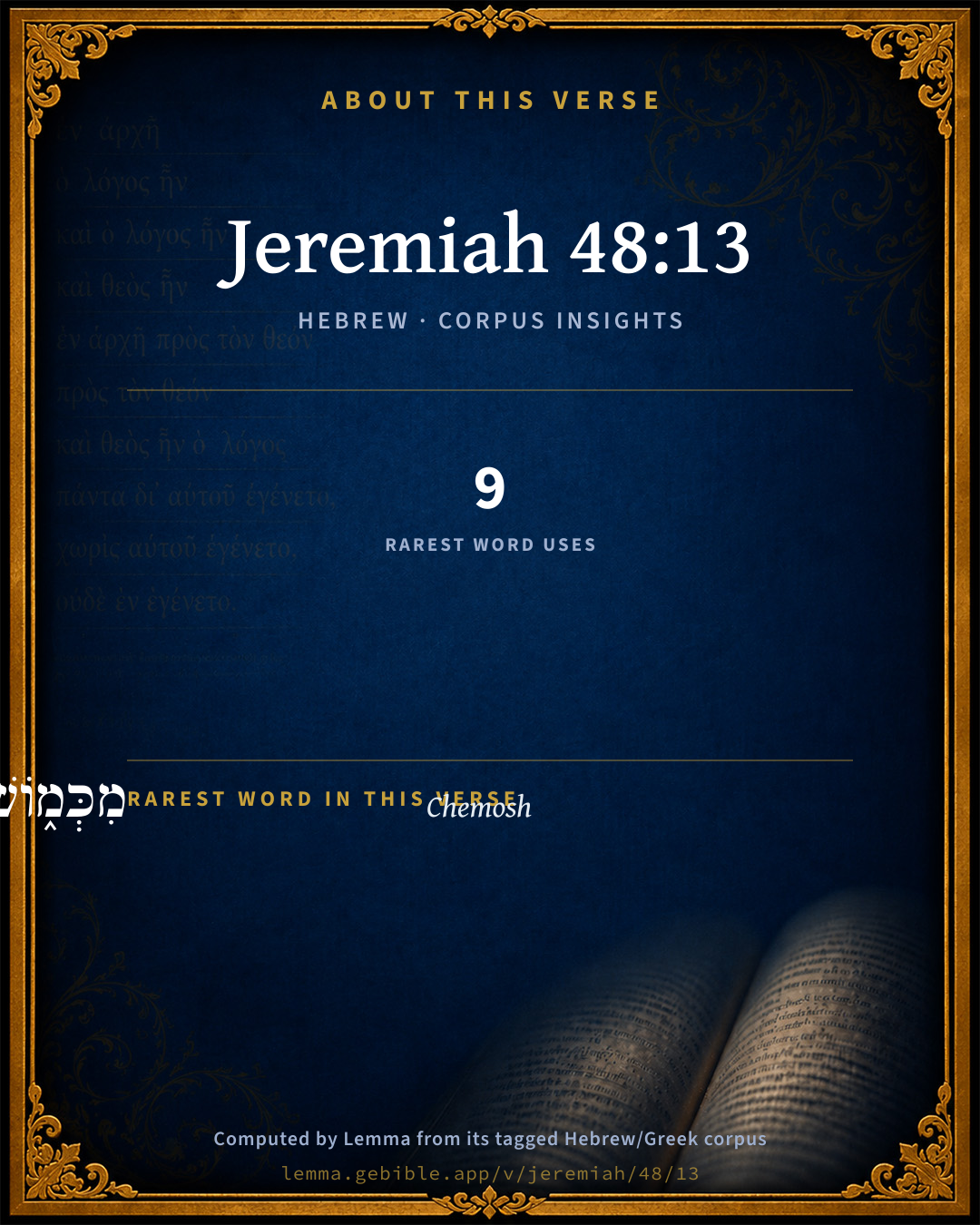
The rarest word here is מִכְּמ֑וֹשׁ Chemosh H3645 — appearing just 9 times in the whole Hebrew Bible.

Shared distinctive vocabulary

מִכְּמ֑וֹשׁ Chemosh H3645 occurs in 8 verses of the Hebrew Bible. Also found in:

Grammatical profile

  • 2 verbs
  • 7 nouns
  • 1 particle

Verb forms

  • וּבֹ֥שׁ Qal · Sequential Perfect
  • בֹּ֨שׁוּ֙ Qal · Perfect

Repetition

Words recur within this verse — often emphatic in Hebrew:

  • וּבֹ֥שׁ to be ashamed H954 ×2
  • מִבֵּ֥ית Bethel H1008 ×2

Cross-references

18

Topical passages linked to Jeremiah 48:13 in the Treasury of Scripture Knowledge — connected by theme and wording, ordered by reader-vote popularity; previews shown in the World English Bible.

  • Isaiah 45:16 They shall be disappointed, yes, confounded, all of them; they shall go into confusion together who are makers of idols.
  • Judges 11:24 Won't you possess that which Chemosh your god gives you to possess? So whoever Yahweh our God has dispossessed from before us, them will we possess.
  • Jeremiah 48:39 How is it broken down! [how] do they wail! how has Moab turned the back with shame! so shall Moab become a derision and a terror to all who are round about him.
  • Hosea 8:5–6 Let Samaria throw out his calf-idol! My anger burns against them! How long will it be before the are capable of purity?
  • 1 Samuel 5:3–7 When they of Ashdod arose early on the next day, behold, Dagon was fallen on his face to the ground before the ark of Yahweh. They took Dagon, and set him in his place again.
  • 1 Kings 11:7 Then did Solomon build a high place for Chemosh the abomination of Moab, on the mountain that is before Jerusalem, and for Molech the abomination of the children of Ammon.
  • 1 Kings 12:28–29 Whereupon the king took counsel, and made two calves of gold; and he said to them, It is too much for you to go up to Jerusalem: see your gods, Israel, which brought you up out of the land of Egypt.
  • 1 Kings 18:26–29 They took the bull which was given them, and they dressed it, and called on the name of Baal from morning even until noon, saying, Baal, hear us. But there was no voice, nor any who answered. They leaped about the altar which was made.
  • 1 Kings 18:40 and Elijah said to them, Take the prophets of Baal; don't let one of them escape. They took them; and Elijah brought them down to the brook Kishon, and killed them there.
  • Isaiah 2:20 In that day, men shall cast away their idols of silver, And their idols of gold, Which have been made for themselves to worship, To the moles and to the bats;
  • Isaiah 16:12 It shall happen, when Moab presents himself, when he wearies himself on the high place, and shall come to his sanctuary to pray, that he shall not prevail.
  • Isaiah 45:20 Assemble yourselves and come; draw near together, you who have escaped from the nations: they have no knowledge who carry the wood of their engraved image, and pray to a god that can't save.
  • Isaiah 46:1–2 Bel bows down, Nebo stoops; their idols are on the animals, and on the cattle: the things that you carried about are made a load, a burden to the weary [animal].
  • Jeremiah 48:7 For, because you have trusted in your works and in your treasures, you also shall be taken: and Chemosh shall go forth into captivity, his priests and his princes together.
  • Jeremiah 48:46 Woe to you, O Moab! the people of Chemosh is undone; for your sons are taken away captive, and your daughters into captivity.
  • Hosea 10:5–6 The inhabitants of Samaria will be in terror for the calves of Beth Aven; For its people will mourn over it, Along with its priests who rejoiced over it, For its glory, because it has departed from it.
  • Hosea 10:14–15 Therefore a battle roar will arise among your people, And all your fortresses will be destroyed, As Shalman destroyed Beth Arbel in the day of battle. The mother was dashed in pieces with her children.
  • Amos 5:5–6 But don't seek Bethel, Nor enter into Gilgal, And don't pass to Beersheba: For Gilgal shall surely go into captivity, And Bethel shall come to nothing.

Cross-references courtesy of OpenBible.info (CC BY 4.0).

Hebrew and Greek witnesses Masoretic Hebrew ↔ Greek Septuagint

The same verse in the two great witnesses to the Old Testament, shown verse-for-verse.

These are two independent witnesses, not word-aligned to each other, and the Septuagint is shown in lemma (dictionary) form.

Hebrew Jeremiah 48:13 Masoretic · Westminster Leningrad Codex

וּבֹ֥שׁ מוֹאָ֖ב מִכְּמ֑וֹשׁ כַּאֲשֶׁר בֹּ֨שׁוּ֙ בֵּ֣ית יִשְׂרָאֵ֔ל מִבֵּ֥ית אֵ֖ל מִבְטֶחָֽם

Moab shall be ashamed of Chemosh, as the house of Israel was ashamed of Bethel their confidence.

World English Bible · Public Domain

Greek LXX Structure differs

In the Septuagint, Jeremiah is about an eighth shorter than the Hebrew and arranges its material differently — the Oracles Against the Nations (Hebrew chapters 46–51) appear in the middle of the Greek book, after 25:13. Because the chapter and verse boundaries do not line up, a verse-for-verse comparison with the Hebrew is not shown.

A verse-for-verse comparison isn’t shown here because the chapters and verses don’t line up. Switch to the LXX edition with the MT / LXX toggle above to read the Greek directly.

Hebrew: Westminster Leningrad Codex (CC BY 4.0). Greek: Septuagint (public domain); English from a public-domain English Septuagint. How the Septuagint differs from the Hebrew →

Targum (Aramaic paraphrase)

1

The Targum is the ancient Jewish Aramaic paraphrase of the Hebrew Scriptures — an interpretive translation, not the Hebrew text itself. Onkelos (literal) and Pseudo-Jonathan (expansive) render the Torah, and Jonathan the Prophets. Coverage is partial: where no permissively-licensed English translation exists for a verse, only the Aramaic is shown. This is verse-level text, not a word-by-word alignment to the Hebrew.

  1. Targum Jonathan Prophets (Joshua–Malachi)
    וְיִבְהֲתוּן מוֹאֲבָאֵי דְפָלְחִין לִכְמוֹשׁ כְּמָא דִבְהִיתוּ בֵּית יִשְׂרָאֵל מִבֵּית אֵל רוּחֲצָנְהוֹן:

    (no public-domain English translation for this verse)

    Targum Jonathan — Aramaic: “Mikraot Gedolot” (public domain). English: “Sefaria Community Translation” (CC0 1.0 (public-domain dedication)); “London "Chaldee Paraphrase," 1871” (public domain). Text via Sefaria.

Commentary

Notes on Jeremiah 48:13 from classic Christian and Jewish commentators (each source and its license shown beneath its notes). The classic Christian expositions comment on the surrounding passage and are grouped to its opening verse, so a note may address several verses; the Jewish commentaries on the Tanakh (Rashi and others) are per-verse, so they appear only where the commentator wrote on this verse.

Lemma curates 59 commentaries, every one of them public domain or Creative Commons licensed, each selected and text-cleaned for this edition rather than reprinted as found. About our sources →

Trapp's Complete Commentary

John Trapp

Jer 48:13 And Moab shall be ashamed of Chemosh, as the house of Israel was ashamed of Bethel their confidence.

Ver. 13. As the house of Israel was ashamed of Bethel.] When their golden calf was carried into captivity.

John Trapp, A Commentary or Exposition upon All the Books of the Old and New Testament (1647–1656) — public domain. Text from a community e-Sword module.

Joseph Benson's Commentary

Jer 48:13-17. And Moab shall be ashamed of Chemosh, &c. — They shall be disappointed in their expectations of succour from their tutelary idol, as the ten tribes have been in the trust they reposed in the calf they worshipped at Bethel. Moab is spoiled, and gone up out of her cities — The words out of are not in the Hebrew; therefore some render this clause, Moab is spoiled, and the cities to which she ascended; that is, those situated on high eminences. All ye that are about him bemoan him — His calamities are so great as must needs make all who see him, or have heard of his former fame and glory, bewail his misfortunes. How is the strong staff broken — A staff, or rod, is an emblem of authority, and thence comes to signify a kingdom, or government, especially such a one as oppresses its subjects, or neighbours, Isa 9:4; Isa 10:5.

Joseph Benson's Commentary on the Old and New Testaments (1811–1818) — public domain. Text from a community e-Sword module.

Tyndale Open Study Notes

Tyndale Open Resources

48:13 The Lord’s judgment would make the Moabites ashamed that Chemosh was unable to protect them from harm, just as the Israelites of the northern kingdom were ashamed that the false gods they worshiped in apostasy were not able to protect them from the Assyrians (1 Kgs 12:28-29; 13:33-34; Hos 8:5-6). • ashamed of their gold calf at Bethel: See 1 Kgs 12:28-30.

Tyndale Open Study Notes — © Tyndale Open Resources, licensed CC BY-SA 4.0. Text via the HelloAO Bible API.

Geneva Bible (1599)

Geneva Bible translators

As the calf of Bethel was not able to deliver the Israelites: no more shall Chemosh deliver the Moabites.

Geneva Bible (1599) marginal notes — public domain. Text via Bolls.life.

Jamieson, Fausset & Brown

Robert Jamieson, A. R. Fausset & David Brown

ashamed--have the shame of disappointment as to the hopes they entertained of aid from Chemosh, their idol.

Beth-el-- (Kg1 12:27, Kg1 12:29) --that is, the golden calf set up there by Jeroboam.

Jamieson, Fausset & Brown — Commentary Critical and Explanatory on the Whole Bible (1871) — public domain (CC PDM 1.0). Text via the HelloAO Bible API.

Adam Clarke's Commentary

Verse 13. Beth-el their confidence.] Alluding to the golden calves which Jeroboam had there set up, and commanded all the Israelites to worship.

Adam Clarke's Commentary on the Bible (1810–1826) — public domain. Text from a community e-Sword/MySword module.

John Calvin's Commentaries

We may see more clearly from this verse, that the Prophet does not so much address the Moabites as his own people; for he was not a teacher to the Moabites to promote their safety; on the contrary, he intended his doctrine for the benefit of the Jews, as in the present instance.

Ashamed, he says, shall Moab be of his idol: for we have said that Chemosh was the god of the Moabites, as every nation had its own peculiar god, even its own invention. Now, the comparison made here shews that the Prophet wished to exhort the people, to whom he was appointed a teacher, to repentance; for he set before them the example of the ten tribes. And we know that at the time Jeremiah announced this prophecy, the kingdom of Israel was destroyed. All the Israelites, then, had been driven into exile except the tribe of Judah and the half tribe of Benjamin. Now, the ten tribes, as it is well known, had, under Jeroboam, departed from the pure worship of God, and had built for themselves an altar in Bethel. Hence, then, the Prophet now says, As ashamed were the Israelites of their superstitions, which they had devised for themselves, so a similar vengeance of God awaited the people of Moab; and thus he shews to the Jews what it is to trust in the only true God. The Jews were not, indeed, involved in so gross a superstition as to worship idols, at least publicly; but Ezekiel shews that they also were contaminated with this kind of pollution, and that the very sanctuary was defiled with idols; and at the same time the worship of God, according to the Law, continued to be celebrated. But the Jews had nothing but the external form: they had, indeed, the temple and the altar, they professed to worship the true God, but in the meantime impiety and contempt of true religion prevailed among them, and they had begun to involve themselves in many ungodly superstitions, as we have before seen.

What, then, does Jeremiah now do? He sets before their eyes the ten tribes whom God had destroyed, though the Israelites, as well as the Jews, had descended from the same father, even Abraham. As, then, God had inflicted so heavy a punishment on the kingdom of Israel, he now shews to the Jews, that the punishment of the Moabites was not less probable; and why? because they have, he says, their idol. God shews that this was a most atrocious wickedness, by which the Moabites had provoked his anger; for there is nothing less intolerable than for men to transfer the glory of God to their own inventions, to statues, to logs of wood, to stones, or to idols of gold and silver. We now, then, understand the object of the Prophet. It follows —

John Calvin's Commentaries (1540-1563) — public domain. Text from the Calvin Translation Society English edition (1840s-50s) via the Christian Classics Ethereal Library (ccel.org). Calvin's coverage is partial (roughly two-thirds of the Bible); uncommented books and verses are honest gaps, never fabricated. The 19th-century editor's footnotes and remarks are omitted so the notes are faithfully Calvin's own voice.

Ellicott's Commentary for English Readers

(13) Beth-el their confidence.—The name of the sanctuary stands for the golden calf that was worshipped there as the symbol of Jehovah (1Ki_12:29; Amo_7:10). That worship had been put to shame in the captivity of the Ten Tribes. So also should it be with the Chemosh-worship of Moab.

A Bible Commentary for English Readers, edited by Charles John Ellicott (1878–1897) — public domain. Text from a community e-Sword module.

The Cambridge Bible for Schools and Colleges

gen. ed. J. J. S. Perowne

13. shall be ashamed] See on Jer_2:26.

was ashamed of Beth-el their confidence] Bethel was the southern seat of Jeroboam’s idolatrous worship. But Israel found their confidence in the worship there misplaced, when Shalmaneser carried them away. Cp. Amo_5:5. Pe. remarks that the mention of Bethel and not Jerusalem in this connexion is a noteworthy proof that this ch. contains a pre-exilic element.

The Cambridge Bible for Schools and Colleges (gen. ed. J. J. S. Perowne; Cambridge University Press, 1878–1918) — public domain. Text from a community e-Sword module.

John Gill's Exposition

And Moab shall be ashamed of Chemosh,.... His idol; see Jer 48:7; of his worship of him, prayers to him, and confidence in him; he not being able to save him from the destruction of the Chaldeans, and being carried captive by them; he himself also going into captivity:

as the house of Israel were ashamed of Bethel their confidence; that is, of the golden calf that was set up in Bethel by Jeroboam, and which the ten tribes of Israel worshipped, and in which they trusted; but that could not save them from being carried captive by the Assyrians; and so were ashamed of it, and of their idolatrous worship, and vain confidence.

John Gill's Exposition of the Whole Bible (1746–1763) — public domain (CC PDM 1.0). Text via the HelloAO Bible API.

Albert Barnes' Notes on the Bible

Israel was ashamed of Beth-el - After Salmaneser had carried Israel away, they could trust no longer in the calf of Bethel established by Jeroboam.

Albert Barnes' Notes on the Bible (1834–1885) — public domain. Text from a community e-Sword/MySword module.

Haydock's Catholic Bible Commentary

Of Bethel. That is, of their golden calves, which they worshipped in Bethel. (Challoner) --- Chamos and the golden calves were both taken away, Osee viii. 5. (Calmet) --- The ten tribes had foolishly trusted in the latter, 3 Kings xii. (Worthington)

George Leo Haydock (1774–1849), Haydock's Catholic Family Bible and Commentary, 1859 edition — public domain. Excludes Psalms (Douay-Rheims chapter numbering differs from Protestant) and Deuterocanonical books (Catholic canon only).

Matthew Poole's English Annotations

It is a natural and a penal shame which is here spoken of; we are naturally ashamed when we have reposed a great confidence in, and made great boasts of, a thing which, when it comes to be tried, proveth of no use, but mischievous to us.

Chemosh was their great idol, in which the Moabites had great confidence, and of which they boasted; the prophet tells them they should be ashamed of this idol, or for this idol; as the Israelites, that is, the ten tribes, were ashamed of or for the golden calves, which Jeroboam set up at Dan and Beth-el, which were the cause of ruin to those tribes. Confidences in any thing but in God alone in a time of danger will bring both natural and penal shame.

Matthew Poole's English Annotations on the Holy Bible (1683–1685) — public domain. Text from a community e-Sword/MySword module.

Whedon's Commentary on the Bible

Daniel D. Whedon

13. As the house of Israel was ashamed of Beth-el — That is, of their golden calf at Beth-el.

Daniel D. Whedon (gen. ed.), Commentary on the Old and New Testaments (1874–1909) — public domain. Text from a community e-Sword module.

The Pulpit Commentary

Ashamed of Bethel; i.e. of the golden calf or bull at Bethel, set up by Jeroboam I as a symbol of the strong God, Jehovah. This idolatry was odious to the prophetic teachers of a nobler and more spiritual form of religion. They saw that the deity and the symbol were too much confounded, and that such a religion would not save its adherents from captivity and ruin. (comp. Hos_10:15 Amo_3:14 Amo_5:5, Amo_5:6)

Betrayed by their gods.

This statement, as it is more especially from the religious standpoint, is a generalization of the cause of Moab"s ruin, full of spiritual insight and sagacity. It is in such directions as these we are to seek for the reasons of human success or failure; everything else is but superficial.

I THE TRUE CAUSES OF HUMAN SUCCESS OR FAILURE, HAPPINESS OR MISERY, ARE OF A MORAL OR SPIRITUAL KIND. We do not know the exact nature of the Chemosh worship of Moab, but it is evident that, like other idolatries, it favoured materialism and the gratification of passion (ver. 7). The idol was the centre and representative of the whole life of the people.

1. Material circumstances are in themselves indifferent towards the achievement of national or individual greatness, but trust in material circumstances is an invariable precursor of ruin. It is the virtues that are the true bulwarks of a people. "If all the historians who record the ultimate extinction of nations were inspired of God to give the true reasons of their fall, we should often meet this testimony: "Perished of national pride, producing contempt of God and of fundamental morality (Cowles); Pro_14:34.

2. The chief object of desire to any one is his ruler and destiny. The god is the embodiment of all the sentiments and passions associated with its worship; the leading desire attracts towards itself and assimilates all others. It gradually but inevitably becomes his god. His whole life will henceforth take its complexion and direction from it. He conceives it to be the best and to be able to secure for him all that is desirable. From this we see:

(1) The peril of idolatry. Pandering to the worst and most selfish passions, it blinds and infatuates its votaries and leads them eventually to their ruin.

(2) Their importance of a true worship. It cultures the nature according to its essential principles, and secures the supremacy of the moral and spiritual. And all true guidance, help, and comfort are afforded in answer to believing prayer. M.

The Pulpit Commentary (1880–1919), ed. H.D.M. Spence-Jones & Joseph S. Exell — public domain. Text from a community e-Sword module.

John Wesley's Explanatory Notes

Bethel - The golden calves, which Jeroboam set up at Daniel and Bethel.

John Wesley, Explanatory Notes Upon the Whole Bible (1754–1765) — public domain. Text via the GEBible commentary corpus.

unfoldingWord translationNotes

Door43 World Missions Community

Then Moab

Here "Moab" represents the people. AT: "Then the people of Moab" (See: Metonymy)

Chemosh

Chemosh is the chief god of the Moabites. See how you translated this name in Jeremiah 48:7. (See: How to Translate Names)

the house of Israel

The word "house" is a metonym for the family that lives in the house. In this case it refers to Israel's descendants. See how you translated this in Jeremiah 2:4. AT: "the Israelites" or "the Israelite people group" (See: Metonymy)

Bethel

Possible meanings are 1) this refers to the city of Bethel where the Israelites worshiped a golden calf or 2) Bethel is the name of a false god the Israelites worshiped.

How can you say, 'We are soldiers, powerful fighting men'?

Here Yahweh is speaking to the soldiers of Moab. Yahweh uses a question to rebuke the soldiers. AT: "No longer can you say, 'We are soldiers, powerful fighting men.'" (See: Rhetorical Question)

translationWords

Moab

shame

house

Bethel

trust

power

unfoldingWord translationNotes — © Distant Shores Media and the Door43 World Missions Community, licensed CC BY-SA 4.0. Source: git.door43.org/Door43/en_tn.

Rashi

Rabbi Shlomo Yitzchaki (Rashi)

of Chemosh in whom they trusted.

of Beth-el The golden calf.

Rashi on the Tanakh — English translations: “The Judaica Press complete Tanach with Rashi, translated by A. J. Rosenberg” (CC BY 4.0); “Pentateuch with Rashi's commentary by M. Rosenbaum and A.M. Silbermann, 1929-1934” (public domain); “The Metsudah Tanach series, Lakewood, N.J” (CC BY 4.0); and “The Book of Joshua, Metsudah Publications, 1997” (CC BY 4.0). Text via Sefaria.

Lesson kit

Teaching starters — assembled from the data on this page, not authored interpretation. Every prompt links to the verse data it draws on. Edit before teaching.

Jeremiah, in the Prophets, opens this verse with 10 words (8 distinct Hebrew lemmas). Its most distinctive word is Kᵉmôwsh (“Chemosh”). A historical commentator’s framing appears above. Read the whole chapter for the surrounding context.

Discussion questions

  1. What does “Chemosh” (Kᵉmôwsh) contribute to the verse as a whole?
  2. How does Numbers 21:29, which shares the word «Chemosh», read alongside this verse?
  3. What does the repetition of “to be ashamed” (2× in this one verse) do in this verse?
  4. These translations render this verse differently. What is at stake in choosing one wording over another?
  5. «וּבֹ֥שׁ» is a Qal Sequential Perfect verb. How does that grammatical form shape the action described?
  6. Compare how Trapp's Complete Commentary and Joseph Benson's Commentary read this verse. Where do they agree or differ?

Things to notice

  • These translations choose different wording for 6 words in this verse.
  • “to be ashamed” occurs 2× in this single verse.
  • 8 distinct Hebrew lemmas span 10 words in this verse.

Reading settings

Reading text

Shown beneath each verse's original-language words.

Old Testament
Old Testament edition

Read the OT as the Masoretic Hebrew (MT) or the Greek Septuagint (LXX).

English shown for the Greek Septuagint (in the Hebrew ↔ Greek comparison).

Comparing translations? Open the Compare panel on any verse page to stack up to four side by side.