Jeremiah 48:46

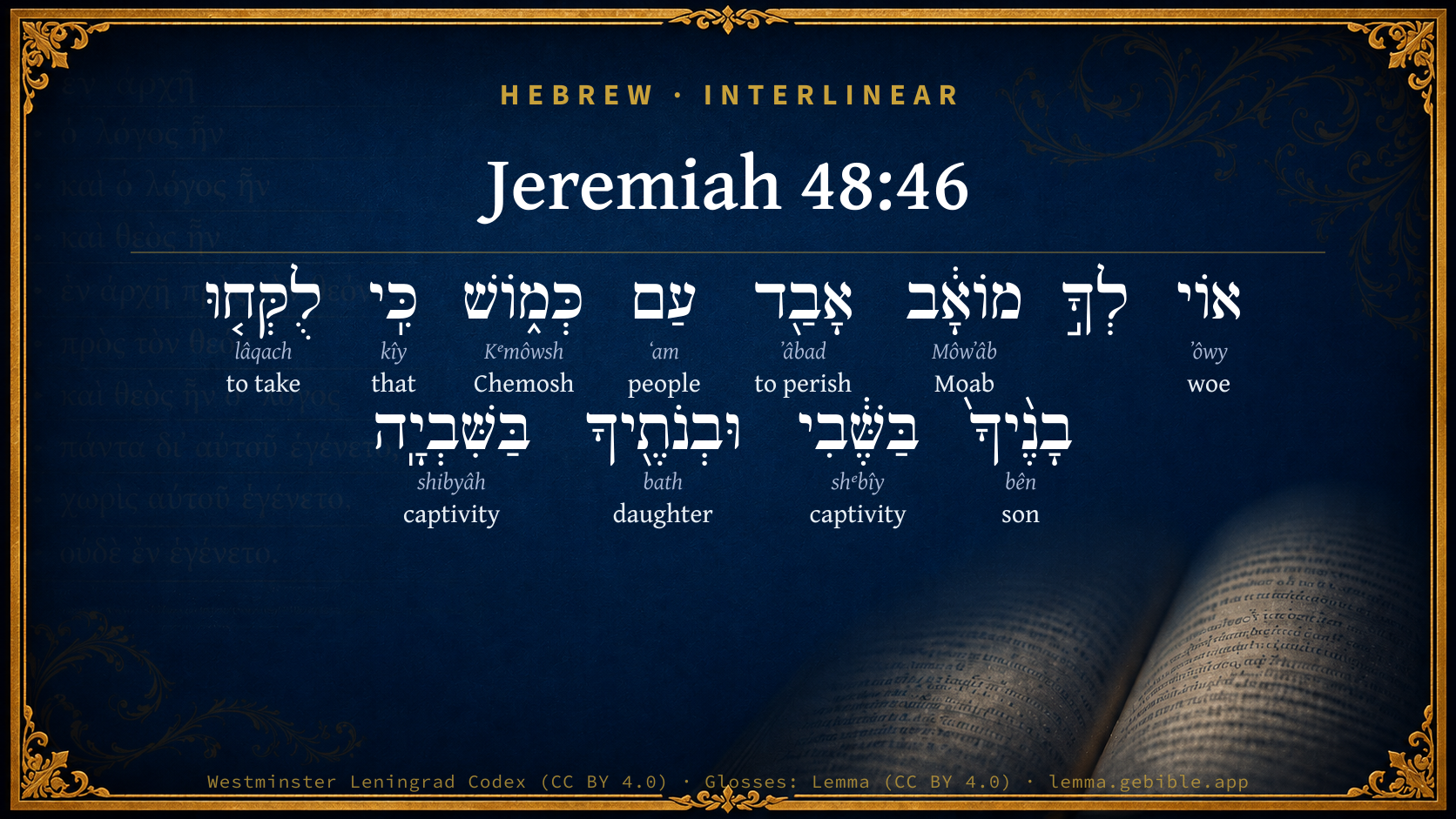
Hebrew (Westminster Leningrad Codex) Jeremiah 48:46 appears in the Hebrew Old Testament. The text above is from the Westminster Leningrad Codex. Each word links to its Strong’s number, a concise gloss, and parsing drawn from the Open Scriptures Hebrew Bible morphology. Click any word for its full Brown-Driver-Briggs (BDB) entry.
Download image
Cite this verse

Jeremiah 48:46 (World English Bible). Public Domain. Lemma interlinear Bible study tool, https://lemma.gebible.app/v/jeremiah/48/46.

Show BibTeX & RIS
BibTeX
RIS
English Translation
Woe to you, O Moab! the people of Chemosh is undone; for your sons are taken away captive, and your daughters into captivity.
World English Bible · Public Domain
Download a study sheet

One document with this verse’s original text, its word-by-word gloss line, the meaning frame, cross-references with their text, attributed commentary, and full source and license credits — printable, and it pastes into notes with its structure intact.

This verse Autodidact and up

Study sheet (.html) Plain text (.txt)

A passage Seminary Student

Up to 50 verses in one chapter. A passage sheet keeps up to 6 commentary sources and 12 cross-references per verse, in the order this page ranks them, and says so on the sheet whenever that leaves anything out. Ask for a single verse and you get the Autodidact verse sheet above.

Everything on this page stays free to read, with no account — the sheet is a download of what is already on screen, not access to it.

Want to remove ads? Support Godless Engineer
Compare translations 3

The same verse in 3 English versions, stacked beneath the original-language interlinear above. Click any original word for its lexicon entry.

Each is an independent rendering of the whole verse — the interlinear is not word-aligned to these translations.

Highlighted words mark where these versions differ — a whole-verse word diff, not a word-by-word alignment.

  • World English Bible Public Domain
    Woe to you, O Moab! the people of Chemosh is undone; for your sons are taken away captive, and your daughters into captivity.
  • King James Version Public Domain
    Woe be unto thee, O Moab! the people of Chemosh perisheth: for thy sons are taken captives, and thy daughters captives.
  • unfoldingWord Literal Text CC BY-SA 4.0
    Woe to you, Moab! Chemosh’s people are destroyed, For your sons are taken as captives and your daughters into captivity.

unfoldingWord Literal Text — © unfoldingWord, licensed CC BY-SA 4.0. Word-aligned USFM3 via Door43 (git.door43.org/unfoldingWord/en_ult).

Versions to compare (up to 4)

3 of 4 selected

Show all 18 translations

Every available English version of this verse, each an independent rendering of the whole verse.

  • World English Bible Public Domain
    Woe to you, O Moab! the people of Chemosh is undone; for your sons are taken away captive, and your daughters into captivity.
  • Berean Standard Bible Public Domain
    Woe to you, O Moab! The people of Chemosh have perished; for your sons have been taken into exile and your daughters have gone into captivity.
  • Majority Standard Bible Public Domain
    Woe to you, O Moab! The people of Chemosh have perished; for your sons have been taken into exile and your daughters have gone into captivity.
  • King James Version Public Domain
    Woe be unto thee, O Moab! the people of Chemosh perisheth: for thy sons are taken captives, and thy daughters captives.
  • American Standard Version (1901) Public Domain
    Woe unto thee, O Moab! the people of Chemosh is undone; for thy sons are taken away captive, and thy daughters into captivity.
  • Revised Version (1885) Public Domain
    Woe unto thee, O Moab! the people of Chemosh is undone: for thy sons are taken away captive, and thy daughters into captivity.
  • Geneva Bible (1599) Public Domain
    Wo be vnto thee, O Moab: the people of Chemosh perisheth: for thy sonnes are taken captiues, and thy daughters led into captiuitie.
  • Douay-Rheims (1899) Public Domain
    Woe to thee, Moab, thou hast perished, O people of Chamos: for thy sons, and thy daughters are taken captives.
  • Young's Literal Translation Public Domain
    Wo to thee, O Moab, Perished hath the people of Chemosh, For thy sons were taken with the captives, And thy daughters with the captivity.
  • Literal Standard Version CC BY-SA 4.0
    Woe to you, O Moab, || The people of Chemosh have perished, || For your sons were taken with the captives, || And your daughters with the captivity.
  • Unlocked Literal Bible CC BY-SA 4.0
    Woe to you, Moab! Chemosh's people are destroyed, For your sons are taken as captives and your daughters into captivity.
  • unfoldingWord Literal Text CC BY-SA 4.0
    Woe to you, Moab! Chemosh’s people are destroyed, For your sons are taken as captives and your daughters into captivity.
  • Darby Bible Public Domain
    Woe to thee, Moab! The people of Chemosh is undone; for thy sons are taken away in captivity, and thy daughters are captives.
  • World Messianic Bible Public Domain
    Woe to you, O Moab! The people of Chemosh are undone; for your sons are taken away captive, and your daughters into captivity.
  • Webster's Bible Public Domain
    Woe be to thee, O Moab! the people of Chemosh perisheth: for thy sons are taken captives, and thy daughters captives.
  • Free Bible Version CC BY-SA 4.0
    What a disaster has come to you Moabites! The people of Chemosh have been wiped out. Your sons and daughters have been taken prisoner and have gone into exile.
  • Bible in Basic English Public Domain
    Sorrow is yours, O Moab! the people of Chemosh are overcome: for your sons have been taken away as prisoners, and your daughters made servants.
  • JPS Tanakh (1917) Public Domain
    Woe unto thee, O Moab! The people of Chemosh is undone; for thy sons are taken away captive, and thy daughters into captivity.

Literal Standard Version (2020), Covenant Press — licensed CC BY-SA 4.0. Text via the HelloAO Bible API (eBible.org). Unlocked Literal Bible (unfoldingWord) — licensed CC BY-SA 4.0. Text via the HelloAO Bible API (eBible.org). unfoldingWord Literal Text — © unfoldingWord, licensed CC BY-SA 4.0. Word-aligned USFM3 via Door43 (git.door43.org/unfoldingWord/en_ult). Free Bible Version, Dr. Jonathan Gallagher — licensed CC BY-SA 4.0. Text via the HelloAO Bible API (eBible.org).

Word by word

More ways to search: Search by grammar → Find every occurrence → Compare this word →

Practice this passage: Drill this verse → Learn its vocabulary →

כְּמ֑וֹשׁ
Kᵉmôwsh
H3645
“Chemosh”
Noun, Proper
Part of Speech
Noun
Type
Proper
Full BDB Definition

Origin: from an unused root meaning to subdue

TWOT: None

Chemosh = "subduer" - the national deity of the Moabites and a god of the Ammonites - also identified with 'Baal-peor', 'Baal-zebub', 'Mars' and 'Saturn' - worship of this god was introduced into Jerusalem by Solomon and abolished by king Josiah of Judah
  1. אוֹי ʼôwy H188 “woe” Particle, Interjection
  2. מוֹאָ֔ב Môwʼâb H4124 “Moab” Noun, Proper
  3. אָבַ֖ד ʼâbad H6 “to perish” Verb, Qal, Perfect, 3rd Person, Masculine, Singular
  4. עַם ʻam H5971 “people of” Noun, Common, Masculine, Singular, Construct
  5. כִּֽי kîy H3588 “that” Conjunction
  6. לֻקְּח֤וּ lâqach H3947 “to take” Verb, Pual, Perfect, 3rd Person, Common, Plural
  7. בָנֶ֨יךָ֙ bên H1121 “sons · your” Noun, Common, Masculine, Plural, Construct + Suffix, Personal, 2nd Person, Masculine, Singular
  8. בַּשֶּׁ֔בִי shᵉbîy H7628 “in/at the · captivity” Preposition, Determined + Noun, Common, Both, Singular, Absolute
  9. וּבְנֹתֶ֖יךָ bath H1323 “and · daughters · your” Conjunction + Noun, Common, Feminine, Plural, Construct + Suffix, Personal, 2nd Person, Masculine, Singular
  10. בַּשִּׁבְיָֽה shibyâh H7633 “in/at the · captivity” Preposition, Determined + Noun, Common, Both, Singular, Absolute

About this verse

These counts appear in no published source. They are computed here, from the morphology-tagged text and Lemma’s own curated glosses. What Lemma adds →

12
words
11
distinct lemmas
Prophets
section

Notable vocabulary

The rarest word here is כְּמ֑וֹשׁ Chemosh H3645 — appearing just 9 times in the whole Hebrew Bible.

Shared distinctive vocabulary

כְּמ֑וֹשׁ Chemosh H3645 occurs in 8 verses of the Hebrew Bible. Also found in:

Grammatical profile

  • 2 verbs
  • 7 nouns
  • 1 preposition
  • 1 conjunction
  • 1 particle

Verb forms

  • אָבַ֖ד Qal · Perfect
  • לֻקְּח֤וּ Pual · Perfect

Cross-references

6

Topical passages linked to Jeremiah 48:46 in the Treasury of Scripture Knowledge — connected by theme and wording, ordered by reader-vote popularity; previews shown in the World English Bible.

  • Numbers 21:29 Woe to you, Moab! You are undone, people of Chemosh: He has given his sons as fugitives, His daughters into captivity, To Sihon king of the Amorites.
  • Judges 11:24 Won't you possess that which Chemosh your god gives you to possess? So whoever Yahweh our God has dispossessed from before us, them will we possess.
  • 1 Kings 11:7 Then did Solomon build a high place for Chemosh the abomination of Moab, on the mountain that is before Jerusalem, and for Molech the abomination of the children of Ammon.
  • Jeremiah 48:7 For, because you have trusted in your works and in your treasures, you also shall be taken: and Chemosh shall go forth into captivity, his priests and his princes together.
  • Jeremiah 48:13 Moab shall be ashamed of Chemosh, as the house of Israel was ashamed of Bethel their confidence.
  • 2 Kings 23:13 The high places that were before Jerusalem, which were on the right hand of the mountain of corruption, which Solomon the king of Israel had built for Ashtoreth the abomination of the Sidonians, and for Chemosh the abomination of Moab, and for Milcom the abomination of the children of Ammon, did the king defile.

Cross-references courtesy of OpenBible.info (CC BY 4.0).

Hebrew and Greek witnesses Masoretic Hebrew ↔ Greek Septuagint

The same verse in the two great witnesses to the Old Testament, shown verse-for-verse.

These are two independent witnesses, not word-aligned to each other, and the Septuagint is shown in lemma (dictionary) form.

Hebrew Jeremiah 48:46 Masoretic · Westminster Leningrad Codex

אוֹי לְךָ֣ מוֹאָ֔ב אָבַ֖ד עַם כְּמ֑וֹשׁ כִּֽי לֻקְּח֤וּ בָנֶ֨יךָ֙ בַּשֶּׁ֔בִי וּבְנֹתֶ֖יךָ בַּשִּׁבְיָֽה

Woe to you, O Moab! the people of Chemosh is undone; for your sons are taken away captive, and your daughters into captivity.

World English Bible · Public Domain

Greek LXX Structure differs

In the Septuagint, Jeremiah is about an eighth shorter than the Hebrew and arranges its material differently — the Oracles Against the Nations (Hebrew chapters 46–51) appear in the middle of the Greek book, after 25:13. Because the chapter and verse boundaries do not line up, a verse-for-verse comparison with the Hebrew is not shown.

A verse-for-verse comparison isn’t shown here because the chapters and verses don’t line up. Switch to the LXX edition with the MT / LXX toggle above to read the Greek directly.

Hebrew: Westminster Leningrad Codex (CC BY 4.0). Greek: Septuagint (public domain); English from a public-domain English Septuagint. How the Septuagint differs from the Hebrew →

Targum (Aramaic paraphrase)

1

The Targum is the ancient Jewish Aramaic paraphrase of the Hebrew Scriptures — an interpretive translation, not the Hebrew text itself. Onkelos (literal) and Pseudo-Jonathan (expansive) render the Torah, and Jonathan the Prophets. Coverage is partial: where no permissively-licensed English translation exists for a verse, only the Aramaic is shown. This is verse-level text, not a word-by-word alignment to the Hebrew.

  1. Targum Jonathan Prophets (Joshua–Malachi)
    וַי לְכוֹן מוֹאֲבָאֵי אֲבַדְתּוּן עַמָא דְפַלְחִין לִכְמוֹשׁ אֲרֵי אִדַבְּרוּ בְנָךְ בְּשִׁבְיָא וּבְנָתָךְ בְּגָלוּתָא:

    (no public-domain English translation for this verse)

    Targum Jonathan — Aramaic: “Mikraot Gedolot” (public domain). English: “Sefaria Community Translation” (CC0 1.0 (public-domain dedication)); “London "Chaldee Paraphrase," 1871” (public domain). Text via Sefaria.

Commentary

Notes on Jeremiah 48:46 from classic Christian and Jewish commentators (each source and its license shown beneath its notes). The classic Christian expositions comment on the surrounding passage and are grouped to its opening verse, so a note may address several verses; the Jewish commentaries on the Tanakh (Rashi and others) are per-verse, so they appear only where the commentator wrote on this verse.

Lemma curates 59 commentaries, every one of them public domain or Creative Commons licensed, each selected and text-cleaned for this edition rather than reprinted as found. About our sources →

Trapp's Complete Commentary

John Trapp

Jer 48:46 Woe be unto thee, O Moab! the people of Chemosh perisheth: for thy sons are taken captives, and thy daughters captives.

Ver. 46. Woe be unto thee, O Moab.] See Num 21:29.

John Trapp, A Commentary or Exposition upon All the Books of the Old and New Testament (1647–1656) — public domain. Text from a community e-Sword module.

Geneva Bible (1599)

Geneva Bible translators

Which vaunted themselves of their idol, as though he could have defended them.

Geneva Bible (1599) marginal notes — public domain. Text via Bolls.life.

Jamieson, Fausset & Brown

Robert Jamieson, A. R. Fausset & David Brown

Copied from Num 21:29.

Jamieson, Fausset & Brown — Commentary Critical and Explanatory on the Whole Bible (1871) — public domain (CC PDM 1.0). Text via the HelloAO Bible API.

Adam Clarke's Commentary

Verse 46. The people of Chemosh] The Moabites, who worshipped Chemosh as their supreme god.

Adam Clarke's Commentary on the Bible (1810–1826) — public domain. Text from a community e-Sword/MySword module.

John Calvin's Commentaries

Here the Prophet, as he comes to the end of his prophecy, suddenly exclaims, Woe to thee! as though he had said, that words failed him to express the grievousness of God’s vengeance. There is then more force in this single expression, than if he had at large described the miseries of that nation. He then adds, The people of Chemosh have perished The Prophet again intimates, that the Moabites vainly confided in their idol, Chemosh; they thought that there would be a sure safety to them from their god, who was, as they commonly say, a tutelar god. But the Prophet says, that their superstition would avail them nothing, for they and their idol would perish together. He exults over this fictitious god, that on the other hand he might extol the power of the only true God. For there is here an implied contrast between the God of Israel and Chemosh whom the Moabites worshipped.

He then adds, Thy sons and thy daughters shall be carried away into captivity The Prophet does not seem here to continue the same subject; for he had said before that ruin or destruction was coming on the Moabites, but he now mitigates that punishment, and speaks only of exile. But as captivity is like death, as it abolishes the name of a nation, he speaks correctly and suitably. And then we must observe, that God, for a time, so executed his vengeance on the Moabites, that he left them some hope as to the future, according to what follows in the last verse —

John Calvin's Commentaries (1540-1563) — public domain. Text from the Calvin Translation Society English edition (1840s-50s) via the Christian Classics Ethereal Library (ccel.org). Calvin's coverage is partial (roughly two-thirds of the Bible); uncommented books and verses are honest gaps, never fabricated. The 19th-century editor's footnotes and remarks are omitted so the notes are faithfully Calvin's own voice.

John Gill's Exposition

Yet will I bring again the captivity of Moab in the latter day, saith the Lord,.... Some think this is added, not so much for the sake of Moab as of the Jews, to assure them of their return from captivity, as had been promised them, since this would be the case even of Moab. It had a literal accomplishment under Cyrus, as is thought, when they were restored to their land; and certain it is they were a people in the times of Alexander, or King Jannaeus, who subdued them, as Josephus (t) relates: and it had a spiritual one in the times of the Messiah, in the conversion of some of these people, as very probably in the first times of the Gospel; so it will have in the latter day; see Isa 11:14. Kimchi interprets it of the days of the Messiah. For though that people are no more, yet there are a people which inhabit their country, who will, at least many of them, be converted, when the fulness of the Gentiles is brought in; and it is no unusual thing in Scripture for the present inhabitants of many countries to be called after those who formerly inhabited them, as the Turks are often called Assyrians;

thus far is the judgment of Moab; that is, either so long, unto the latter days, will the judgment of Moab continue. So the Targum,

"hitherto to execute vengeance of judgment on Moab;''

or rather, thus far is the prophecy concerning the destruction of Moab; this is the conclusion of it; here it ends, being a long one.

(t) Antiqu. l. 13. c. 13. sect 5.

Next: Jeremiah Chapter 49

John Gill's Exposition of the Whole Bible (1746–1763) — public domain (CC PDM 1.0). Text via the HelloAO Bible API.

Matthew Poole's English Annotations

The prophet, closing the threatening part of his prophecy against Moab, repeateth the same thing which he had often said, that the Moabites should be carried into captivity by the king of Babylon, and denounceth a woe unto them upon that account.

Matthew Poole's English Annotations on the Holy Bible (1683–1685) — public domain. Text from a community e-Sword/MySword module.

The Pulpit Commentary

Based on Num_21:29. The chief difference is in the second half of the verse, in which the bold expression of Chemosh "giving his sons and his daughters into captivity" is changed for a mere ordinary and prosaic phrase.

The Pulpit Commentary (1880–1919), ed. H.D.M. Spence-Jones & Joseph S. Exell — public domain. Text from a community e-Sword module.

unfoldingWord translationNotes

Door43 World Missions Community

Chemosh's people are destroyed

This can be stated in active form. AT: "The enemy army has destroyed the people who worship Chemosh" (See: Assumed Knowledge and Implicit Information and Active or Passive)

Chemosh

This is the chief god of the Moabites. See how you translated this in Jeremiah 48:07.

your sons are taken as captives and your daughters into captivity

This can be stated in active form. AT: "the enemy army has taken your sons and daughters as captives" (See: Active or Passive)

I will restore the fortunes of Moab

"I will cause things to go well for Moab again" or "I will cause Moab to live well again." See how similar words are translated in Jeremiah 29:14.

in later days

"in the future"

this is Yahweh's declaration

Yahweh speaks of himself by name to express the certainty of what he is declaring. See how you translated this in Jeremiah 1:8. AT: "this is what Yahweh has declared" or "this is what I, Yahweh, have declared" (See: First, Second, or Third Person)

The judgment on Moab ends here

"That is the end of what Jeremiah prophesied about Moab"

translationWords

woe

Moab

son

captive

restore

judge

unfoldingWord translationNotes — © Distant Shores Media and the Door43 World Missions Community, licensed CC BY-SA 4.0. Source: git.door43.org/Door43/en_tn.

Lesson kit

Teaching starters — assembled from the data on this page, not authored interpretation. Every prompt links to the verse data it draws on. Edit before teaching.

Jeremiah, in the Prophets, opens this verse with 12 words (11 distinct Hebrew lemmas). Its most distinctive word is Kᵉmôwsh (“Chemosh”). A historical commentator’s framing appears above. Read the whole chapter for the surrounding context.

Discussion questions

  1. What does “Chemosh” (Kᵉmôwsh) contribute to the verse as a whole?
  2. How does Numbers 21:29, which shares the word «Chemosh», read alongside this verse?
  3. These translations render this verse differently. What is at stake in choosing one wording over another?
  4. «אָבַ֖ד» is a Qal Perfect verb. How does that grammatical form shape the action described?
  5. Compare how Trapp's Complete Commentary and Geneva Bible (1599) read this verse. Where do they agree or differ?

Things to notice

Reading settings

Reading text

Shown beneath each verse's original-language words.

Old Testament
Old Testament edition

Read the OT as the Masoretic Hebrew (MT) or the Greek Septuagint (LXX).

English shown for the Greek Septuagint (in the Hebrew ↔ Greek comparison).

Comparing translations? Open the Compare panel on any verse page to stack up to four side by side.