
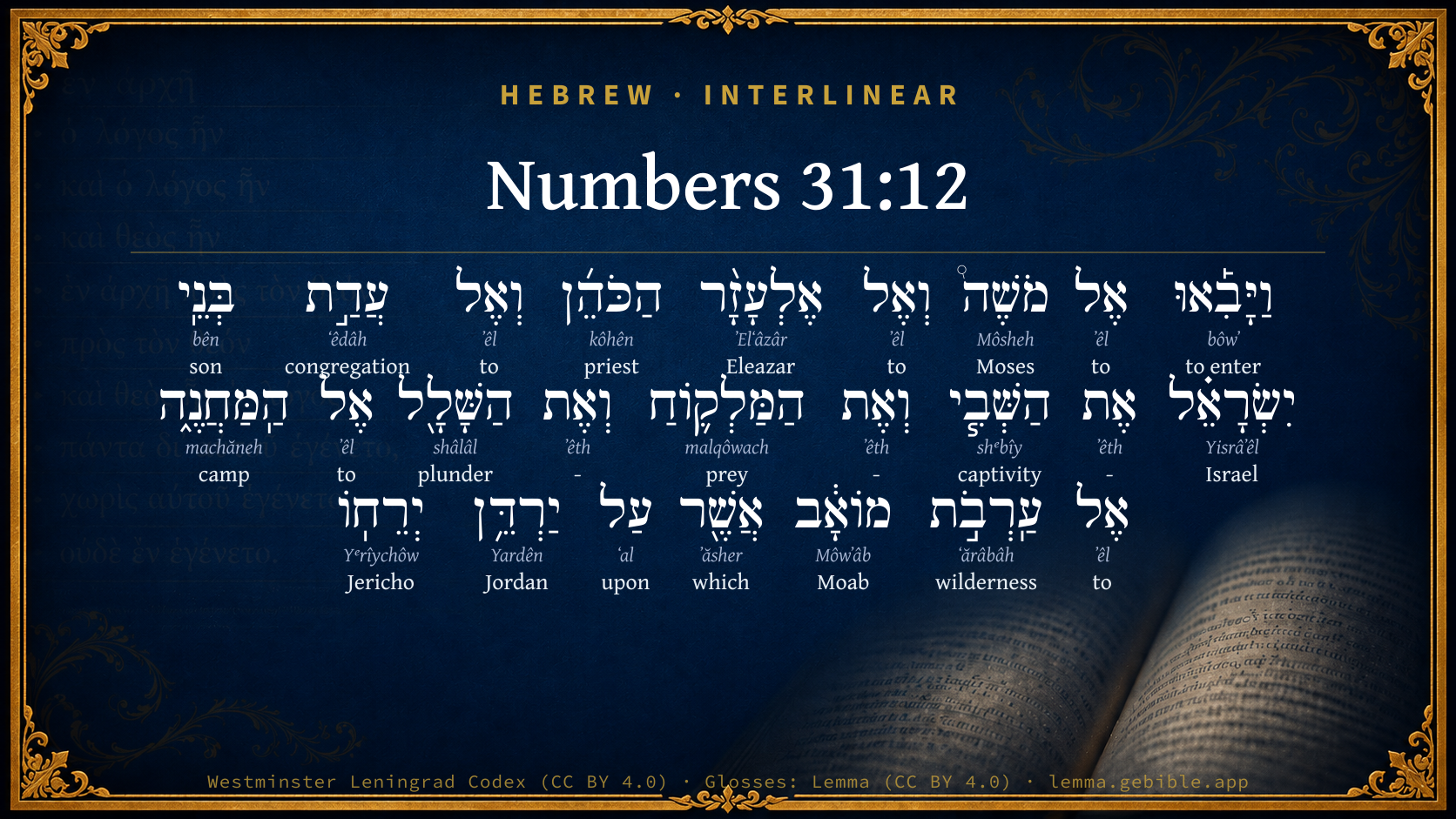
Numbers 31:12

Hebrew (Westminster Leningrad Codex) Numbers 31:12 appears in the Hebrew Old Testament. The text above is from the Westminster Leningrad Codex. Each word links to its Strong’s number, a concise gloss, and parsing drawn from the Open Scriptures Hebrew Bible morphology. Click any word for its full Brown-Driver-Briggs (BDB) entry.
Download image
Cite this verse

Numbers 31:12 (World English Bible). Public Domain. Lemma interlinear Bible study tool, https://lemma.gebible.app/v/numbers/31/12.

Show BibTeX & RIS
BibTeX
RIS
English Translation
They brought the captives, and the prey, and the spoil, to Moses, and to Eleazar the priest, and to the congregation of the children of Israel, to the camp at the plains of Moab, which are by the Jordan at Jericho.
World English Bible · Public Domain
Download a study sheet

One document with this verse’s original text, its word-by-word gloss line, the meaning frame, cross-references with their text, attributed commentary, and full source and license credits — printable, and it pastes into notes with its structure intact.

This verse Autodidact and up

Study sheet (.html) Plain text (.txt)

A passage Seminary Student

Up to 50 verses in one chapter. A passage sheet keeps up to 6 commentary sources and 12 cross-references per verse, in the order this page ranks them, and says so on the sheet whenever that leaves anything out. Ask for a single verse and you get the Autodidact verse sheet above.

Everything on this page stays free to read, with no account — the sheet is a download of what is already on screen, not access to it.

Want to remove ads? Support Godless Engineer
Compare translations 3

The same verse in 3 English versions, stacked beneath the original-language interlinear above. Click any original word for its lexicon entry.

Each is an independent rendering of the whole verse — the interlinear is not word-aligned to these translations.

Highlighted words mark where these versions differ — a whole-verse word diff, not a word-by-word alignment.

  • World English Bible Public Domain
    They brought the captives, and the prey, and the spoil, to Moses, and to Eleazar the priest, and to the congregation of the children of Israel, to the camp at the plains of Moab, which are by the Jordan at Jericho.
  • King James Version Public Domain
    And they brought the captives, and the prey, and the spoil, unto Moses, and Eleazar the priest, and unto the congregation of the children of Israel, unto the camp at the plains of Moab, which are by Jordan near Jericho.
  • unfoldingWord Literal Text CC BY-SA 4.0
    And they brought to Moses and to Eleazar the priest and to the congregation of the sons of Israel, the captives and the booty and the spoil to the camp at the plains of Moab, which are beside the Jordan at Jericho.

unfoldingWord Literal Text — © unfoldingWord, licensed CC BY-SA 4.0. Word-aligned USFM3 via Door43 (git.door43.org/unfoldingWord/en_ult).

Versions to compare (up to 4)

3 of 4 selected

Show all 18 translations

Every available English version of this verse, each an independent rendering of the whole verse.

  • World English Bible Public Domain
    They brought the captives, and the prey, and the spoil, to Moses, and to Eleazar the priest, and to the congregation of the children of Israel, to the camp at the plains of Moab, which are by the Jordan at Jericho.
  • Berean Standard Bible Public Domain
    They brought the captives, spoils, and plunder to Moses, to Eleazar the priest, and to the congregation of Israel at the camp on the plains of Moab, by the Jordan across from Jericho.
  • Majority Standard Bible Public Domain
    They brought the captives, spoils, and plunder to Moses, to Eleazar the priest, and to the congregation of Israel at the camp on the plains of Moab, by the Jordan across from Jericho.
  • King James Version Public Domain
    And they brought the captives, and the prey, and the spoil, unto Moses, and Eleazar the priest, and unto the congregation of the children of Israel, unto the camp at the plains of Moab, which are by Jordan near Jericho.
  • American Standard Version (1901) Public Domain
    And they brought the captives, and the prey, and the spoil, unto Moses, and unto Eleazar the priest, and unto the congregation of the children of Israel, unto the camp at the plains of Moab, which are by the Jordan at Jericho.
  • Revised Version (1885) Public Domain
    And they brought the captives, and the prey, and the spoil, unto Moses, and unto Eleazar the priest, and unto the congregation of the children of Israel, unto the camp at the plains of Moab, which are by the Jordan at Jericho.
  • Geneva Bible (1599) Public Domain
    And they brought the captiues and that which they had taken, and the spoyle vnto Moses and to Eleazar the Priest, and vnto the Congregation of the children of Israel, into ye campe in the playne of Moab, which was by Iorden toward Iericho.
  • Douay-Rheims (1899) Public Domain
    And they brought them to Moses, and Eleazar the priest, and to all the multitude of the children of Israel. But the rest of the things for use they carried to the camp on the plains of Moab, beside the Jordan over against Jericho.
  • Young's Literal Translation Public Domain
    and they bring in, unto Moses, and unto Eleazar the priest, and unto the company of the sons of Israel, the captives, and the prey, and the spoil, unto the camp, unto the plains of Moab, which `are' by Jordan, `near' Jericho.
  • Literal Standard Version CC BY-SA 4.0
    and they bring in the captives, and the prey, and the spoil to Moses, and to Eleazar the priest, and to the congregation of the sons of Israel, to the camp, to the plains of Moab, which [are] by the Jordan, [near] Jericho.
  • Unlocked Literal Bible CC BY-SA 4.0
    They brought the prisoners, the plunder, and the captured things to Moses, to Eleazar the priest, and to the community of the people of Israel. They brought these to the camp in the plains of Moab, by the Jordan near Jericho.
  • unfoldingWord Literal Text CC BY-SA 4.0
    And they brought to Moses and to Eleazar the priest and to the congregation of the sons of Israel, the captives and the booty and the spoil to the camp at the plains of Moab, which are beside the Jordan at Jericho.
  • Darby Bible Public Domain
    and they brought to Moses and Eleazar the priest, and to the assembly of the children of Israel, the captives and the prey and the booty, to the camp in the plains of Moab, which are by the Jordan of Jericho.
  • World Messianic Bible Public Domain
    They brought the captives with the prey and the plunder, to Moses, and to Eleazar the priest, and to the congregation of the children of Israel, to the camp at the plains of Moab, which are by the Jordan at Jericho.
  • Webster's Bible Public Domain
    And they brought the captives, and the prey, and the spoil to Moses and Eleazar the priest, and to the congregation of the children of Israel, to the camp at the plains of Moab, which are by Jordan near Jericho.
  • Free Bible Version CC BY-SA 4.0
    They brought the prisoners, loot, and plunder to Moses, to Eleazar the priest, and to the rest of the Israelites where they were camped on the plains of Moab, beside the Jordan opposite Jericho.
  • Bible in Basic English Public Domain
    And the prisoners and the goods and everything they had taken, they took to Moses and Eleazar the priest and the people of Israel, to the tent-circle in the lowlands of Moab by the Jordan at Jericho.
  • JPS Tanakh (1917) Public Domain
    And they brought the captives, and the prey, and the spoil, unto Moses, and unto Eleazar the priest, and unto the congregation of the children of Israel, unto the camp, unto the plains of Moab, which are by the Jordan at Jericho.

Literal Standard Version (2020), Covenant Press — licensed CC BY-SA 4.0. Text via the HelloAO Bible API (eBible.org). Unlocked Literal Bible (unfoldingWord) — licensed CC BY-SA 4.0. Text via the HelloAO Bible API (eBible.org). unfoldingWord Literal Text — © unfoldingWord, licensed CC BY-SA 4.0. Word-aligned USFM3 via Door43 (git.door43.org/unfoldingWord/en_ult). Free Bible Version, Dr. Jonathan Gallagher — licensed CC BY-SA 4.0. Text via the HelloAO Bible API (eBible.org).

Word by word

More ways to search: Search by grammar → Find every occurrence → Compare this word →

Practice this passage: Drill this verse → Learn its vocabulary →

הַמַּלְק֛וֹחַ
malqôwach
H4455
“the · prey”
Particle, Definite Article + Noun, Common, Masculine, Singular, Absolute
Part of Speech
Particle + Noun
Type
Common
Gender
Masculine
Number
Singular
State
Absolute
Full BDB Definition

Origin: from H3947

TWOT: 1124b , 1124c

booty, prey - jaw
  1. וַיָּבִ֡אוּ bôwʼ H935 “and · to enter” Conjunction + Verb, Hiphil, Sequential Imperfect, 3rd Person, Masculine, Plural
  2. אֶל ʼêl H413 “to” Preposition
  3. מֹשֶׁה֩ Môsheh H4872 “Moses” Noun, Proper
  4. וְאֶל ʼêl H413 “and · to” Conjunction + Preposition
  5. אֶלְעָזָ֨ר ʼElʻâzâr H499 “Eleazar” Noun, Proper
  6. הַכֹּהֵ֜ן kôhên H3548 “the · priest” Particle, Definite Article + Noun, Common, Masculine, Singular, Absolute
  7. וְאֶל ʼêl H413 “and · to” Conjunction + Preposition
  8. עֲדַ֣ת ʻêdâh H5712 “congregation of” Noun, Common, Feminine, Singular, Construct
  9. בְּנֵֽי bên H1121 “sons of” Noun, Common, Masculine, Plural, Construct
  10. יִשְׂרָאֵ֗ל Yisrâʼêl H3478 “Israel” Noun, Proper
  11. אֶת ʼêth H853 “-” Particle, Direct Object
  12. הַשְּׁבִ֧י shᵉbîy H7628 “the · captivity” Particle, Definite Article + Noun, Common, Both, Singular, Absolute
  13. וְאֶת ʼêth H853 “and · -” Conjunction + Particle, Direct Object
  14. וְאֶת ʼêth H853 “and · -” Conjunction + Particle, Direct Object
  15. הַשָּׁלָ֖ל shâlâl H7998 “the · plunder” Particle, Definite Article + Noun, Common, Masculine, Singular, Absolute
  16. אֶל ʼêl H413 “to” Preposition
  17. הַֽמַּחֲנֶ֑ה machăneh H4264 “the · camp” Particle, Definite Article + Noun, Common, Both, Singular, Absolute
  18. אֶל ʼêl H413 “to” Preposition
  19. עַֽרְבֹ֣ת ʻărâbâh H6160 “wildernesses of” Noun, Common, Feminine, Plural, Construct
  20. מוֹאָ֔ב Môwʼâb H4124 “Moab” Noun, Proper
  21. אֲשֶׁ֖ר ʼăsher H834 “which” Particle, Relative
  22. עַל ʻal H5921 “upon” Preposition
  23. יַרְדֵּ֥ן Yardên H3383 “Jordan” Noun, Proper
  24. יְרֵחֽוֹ Yᵉrîychôw H3405 “Jericho” Noun, Proper

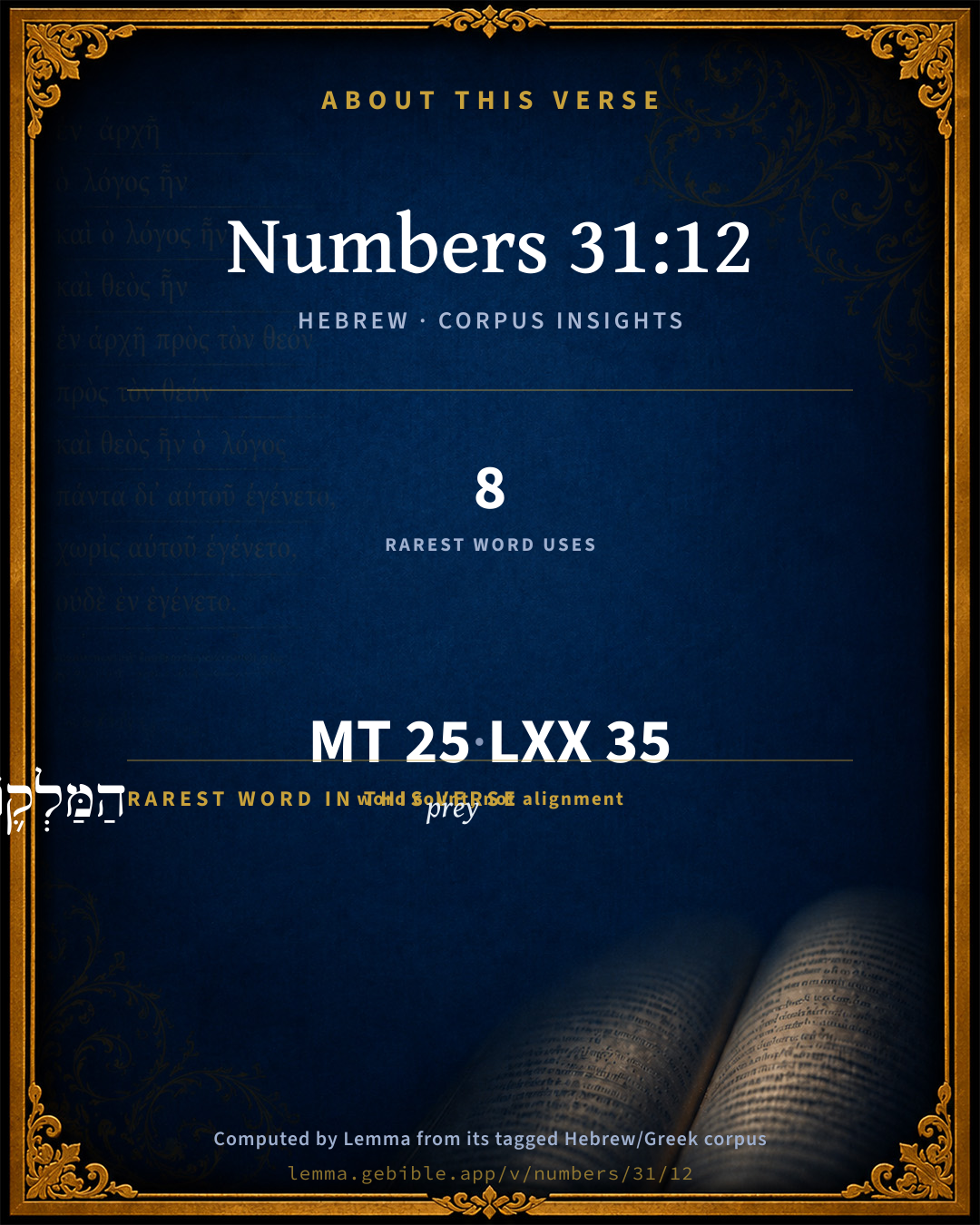
About this verse

These counts appear in no published source. They are computed here, from the morphology-tagged text and Lemma’s own curated glosses. What Lemma adds →

25
words
19
distinct lemmas
Pentateuch
section

Notable vocabulary

The rarest word here is הַמַּלְק֛וֹחַ prey H4455 — appearing just 8 times in the whole Hebrew Bible.

Shared distinctive vocabulary

הַמַּלְק֛וֹחַ prey H4455 occurs in 8 verses of the Hebrew Bible. Also found in:

Grammatical profile

  • 1 verb
  • 14 nouns
  • 6 prepositions
  • 4 particles

Verb forms

  • וַיָּבִ֡אוּ Hiphil · Sequential Imperfect

Repetition

A word recurs within this verse — often emphatic in Hebrew:

  • אֶל to H413 ×5

Hebrew & Septuagint length

In English translation the verse runs 41 words from the Hebrew and 37 from the Septuagint (LXX English) — closely comparable.

A rough comparison of the two English renderings, which tokenize alike — not a word-level alignment.

Word counts can differ between the Hebrew and the Greek without any difference in meaning — e.g. the Hebrew direct-object marker אֵת has no separate Greek word, and Greek often adds the article ὁ.

In the original languages it is 25 Hebrew tokens and 35 Greek tokens — but the two are counted differently (Hebrew bundles its prefixes and suffixes into one token; the Greek is in lemma form), so that isn’t a like-for-like length.

Cross-references

1

Topical passages linked to Numbers 31:12 in the Treasury of Scripture Knowledge — connected by theme and wording, ordered by reader-vote popularity; previews shown in the World English Bible.

  • Numbers 22:1 The children of Israel traveled, and encamped in the plains of Moab beyond the Jordan at Jericho.

Cross-references courtesy of OpenBible.info (CC BY 4.0).

Hebrew and Greek witnesses Masoretic Hebrew ↔ Greek Septuagint

The same verse in the two great witnesses to the Old Testament, shown verse-for-verse.

These are two independent witnesses, not word-aligned to each other, and the Septuagint is shown in lemma (dictionary) form.

Hebrew Numbers 31:12 Masoretic · Westminster Leningrad Codex

וַיָּבִ֡אוּ אֶל מֹשֶׁה֩ וְאֶל אֶלְעָזָ֨ר הַכֹּהֵ֜ן וְאֶל עֲדַ֣ת בְּנֵֽי יִשְׂרָאֵ֗ל אֶת הַשְּׁבִ֧י וְאֶת הַמַּלְק֛וֹחַ וְאֶת הַשָּׁלָ֖ל אֶל הַֽמַּחֲנֶ֑ה אֶל עַֽרְבֹ֣ת מוֹאָ֔ב אֲשֶׁ֖ר עַל יַרְדֵּ֥ן יְרֵחֽוֹ

They brought the captives, and the prey, and the spoil, to Moses, and to Eleazar the priest, and to the congregation of the children of Israel, to the camp at the plains of Moab, which are by the Jordan at Jericho.

World English Bible · Public Domain

Greek LXX Numbers 31:12 Septuagint · lemma form

καί ἄγω πρός μωυσῆς καί πρός ελεαζαρ ὁ ἱερεύς καί πρός πᾶς υἱός ἰσραήλ ὁ αἰχμαλωσία καί ὁ σκῦλον καί ὁ προνομή εἰς ὁ παρεμβολή εἰς ἀραβώθ μωαβ ὅς εἰμί ἐπί ὁ ἰορδάνης κατά ιεριχω

And they brought to Moses and to Eleazar the priest, and to all the children of Israel, the captives, and the spoils, and the plunder, to the camp to Araboth Moab, which is at Jordan by Jericho.

LXX2012 (modern English Septuagint) · Public Domain

Hebrew: Westminster Leningrad Codex (CC BY 4.0). Greek: Septuagint (public domain); English from LXX2012 (modern English Septuagint) (Public Domain). How the Septuagint differs from the Hebrew →

Targum (Aramaic paraphrase)

2

The Targum is the ancient Jewish Aramaic paraphrase of the Hebrew Scriptures — an interpretive translation, not the Hebrew text itself. Onkelos (literal) and Pseudo-Jonathan (expansive) render the Torah, and Jonathan the Prophets. Coverage is partial: where no permissively-licensed English translation exists for a verse, only the Aramaic is shown. This is verse-level text, not a word-by-word alignment to the Hebrew.

  1. Targum Onkelos Torah (Genesis–Deuteronomy)
    וְאַיתִיוּ לְוָת משֶׁה וּלְוָת אֶלְעָזָר כַּהֲנָא וּלְוָת כְּנִשְׁתָּא דִבְנֵי יִשְׂרָאֵל יָת שִׁבְיָא וְיָת דְבַרְתָּא וְיָת עֲדָאָה לְמַשְׁרִיתָא לְמֵישְׁרַיָא דְמוֹאָב דִי עַל יַרְדְנָא דִירֵחוֹ

    (no public-domain English translation for this verse)

    Targum Onkelos — Aramaic: “Onkelos Genesis” (public domain); “Onkelos Exodus” (public domain); “Onkelos Leviticus” (public domain); “Onkelos Numbers” (public domain); “Onkelos Deuteronomy” (public domain). English: “Sefaria Community Translation” (CC0 1.0 (public-domain dedication)); “J.W. Etheridge. The Targums of Onkelos and Jonathan Ben Uzziel on the Pentateuch. London: Longmans, Green, 1862” (public domain). Text via Sefaria.

  2. Targum Pseudo-Jonathan Torah (Genesis–Deuteronomy)
    וְאַיְתִיאוּ לְוַת משֶׁה וּלְוַת אֶלְעָזָר כַּהֲנָא וּלְוַת כָּל כְּנִשְׁתָּא דִבְנֵי יִשְרָאֵל יַת שִׁבְיָיתָא וְיַת דְבַרְתָּא וְיַת עָדִיתָא לְמַשְׁרִיתָא לְמֵישְׁרַיָא דְמוֹאָב עַל יַרְדְנָא דִירֵיחוֹ

    and brought to Mosheh, Elazar the priest, and all the congregation of Israel, the captives, the prey, and the spoils, at the camp in the fields of Moab, by the Jordan, near Jericho.

    Targum Pseudo-Jonathan — Aramaic: “Targum Jonathan on Genesis” (public domain); “Targum Jonathan on Exodus” (public domain); “Targum Jonathan on Leviticus” (public domain); “Targum Jonathan on Numbers” (public domain); “Targum Jonathan on Deuteronomy” (public domain). English: “The Targum of Jonathan ben Uzziel, trans. J. W. Etheridge, London, 1862” (public domain). Text via Sefaria.

Commentary

Notes on Numbers 31:12 from classic Christian and Jewish commentators (each source and its license shown beneath its notes). The classic Christian expositions comment on the surrounding passage and are grouped to its opening verse, so a note may address several verses; the Jewish commentaries on the Tanakh (Rashi and others) are per-verse, so they appear only where the commentator wrote on this verse.

Lemma curates 59 commentaries, every one of them public domain or Creative Commons licensed, each selected and text-cleaned for this edition rather than reprinted as found. About our sources →

Geneva Bible (1599)

Geneva Bible translators

As the women and little children.

Geneva Bible (1599) marginal notes — public domain. Text via Bolls.life.

Ellicott's Commentary for English Readers

(12) The captives, and the prey, and the spoil.—The first word denotes the women and children; the second, which in Num_5:11 includes both the captives and the cattle, appears in this place to refer to the animals only; whilst the third refers to the rest of the spoil.

A Bible Commentary for English Readers, edited by Charles John Ellicott (1878–1897) — public domain. Text from a community e-Sword module.

John Gill's Exposition

And Moses and Eleazar the priest, and all the princes of the congregation,.... Attended, no doubt, with a proper retinue:

went forth to meet them without the camp; partly to do honour to them, and to congratulate them on their victory, and partly to hinder them going into the camp directly, until they were purified; see Gen 14:17.

John Gill's Exposition of the Whole Bible (1746–1763) — public domain (CC PDM 1.0). Text via the HelloAO Bible API.

Whedon's Commentary on the Bible

Daniel D. Whedon

12. The plains of Moab — Num_22:1, note.

Daniel D. Whedon (gen. ed.), Commentary on the Old and New Testaments (1874–1909) — public domain. Text from a community e-Sword module.

Lesson kit

Teaching starters — assembled from the data on this page, not authored interpretation. Every prompt links to the verse data it draws on. Edit before teaching.

Numbers, in the Pentateuch, opens this verse with 25 words (19 distinct Hebrew lemmas). Its most distinctive word is malqôwach (“prey”). A historical commentator’s framing appears above. Read the whole chapter for the surrounding context.

Discussion questions

  1. The word malqôwach carries the sense “prey.” How does it shape the verse?
  2. How does Numbers 31:11, which shares the word «prey», read alongside this verse?
  3. What does the repetition of “to” (5× in this one verse) do in this verse?
  4. These translations render this verse differently. What is at stake in choosing one wording over another?
  5. «וַיָּבִ֡אוּ» is a Hiphil Sequential Imperfect verb. How does that grammatical form shape the action described?
  6. Compare how Geneva Bible (1599) and Ellicott's Commentary for English Readers read this verse. Where do they agree or differ?

Things to notice

Reading settings

Reading text

Shown beneath each verse's original-language words.

Old Testament
Old Testament edition

Read the OT as the Masoretic Hebrew (MT) or the Greek Septuagint (LXX).

English shown for the Greek Septuagint (in the Hebrew ↔ Greek comparison).

Comparing translations? Open the Compare panel on any verse page to stack up to four side by side.