
Jeremiah 48:44

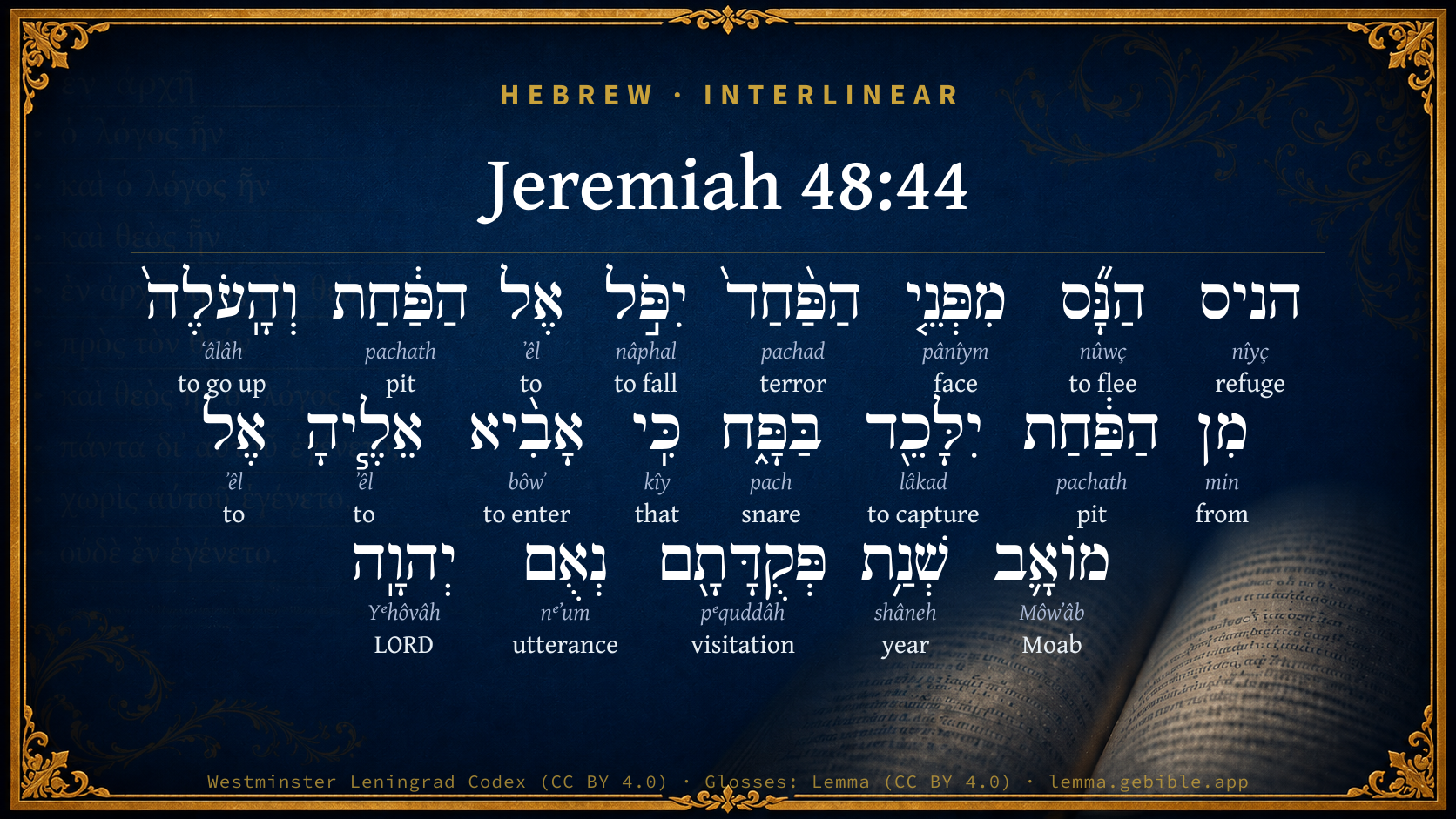
Hebrew (Westminster Leningrad Codex) Jeremiah 48:44 appears in the Hebrew Old Testament. The text above is from the Westminster Leningrad Codex. Each word links to its Strong’s number, a concise gloss, and parsing drawn from the Open Scriptures Hebrew Bible morphology. Click any word for its full Brown-Driver-Briggs (BDB) entry.
Download image
Cite this verse

Jeremiah 48:44 (World English Bible). Public Domain. Lemma interlinear Bible study tool, https://lemma.gebible.app/v/jeremiah/48/44.

Show BibTeX & RIS
BibTeX
RIS
English Translation
He who flees from the fear shall fall into the pit; and he who gets up out of the pit shall be taken in the snare: for I will bring on him, even on Moab, the year of their visitation, says Yahweh.
World English Bible · Public Domain
Highlights
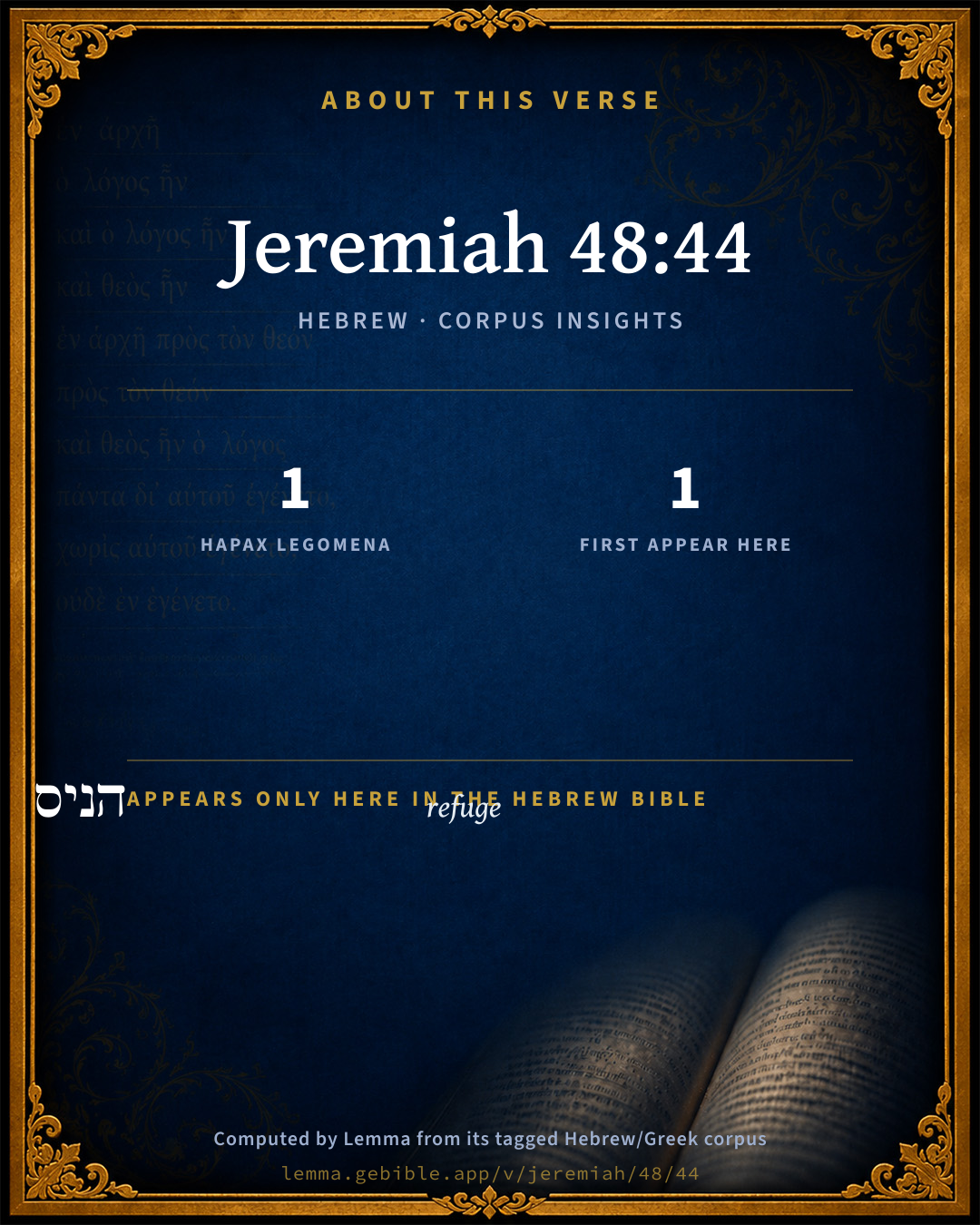
  • 1 hapax legomenon — only here in the Hebrew Bible
  • 1 first appearance in the Hebrew Bible
Full analysis ↓
Download a study sheet

One document with this verse’s original text, its word-by-word gloss line, the meaning frame, cross-references with their text, attributed commentary, and full source and license credits — printable, and it pastes into notes with its structure intact.

This verse Autodidact and up

Study sheet (.html) Plain text (.txt)

A passage Seminary Student

Up to 50 verses in one chapter. A passage sheet keeps up to 6 commentary sources and 12 cross-references per verse, in the order this page ranks them, and says so on the sheet whenever that leaves anything out. Ask for a single verse and you get the Autodidact verse sheet above.

Everything on this page stays free to read, with no account — the sheet is a download of what is already on screen, not access to it.

Want to remove ads? Support Godless Engineer
Compare translations 3

The same verse in 3 English versions, stacked beneath the original-language interlinear above. Click any original word for its lexicon entry.

Each is an independent rendering of the whole verse — the interlinear is not word-aligned to these translations.

Highlighted words mark where these versions differ — a whole-verse word diff, not a word-by-word alignment.

  • World English Bible Public Domain
    He who flees from the fear shall fall into the pit; and he who gets up out of the pit shall be taken in the snare: for I will bring on him, even on Moab, the year of their visitation, says Yahweh.
  • King James Version Public Domain
    He that fleeth from the fear shall fall into the pit; and he that getteth up out of the pit shall be taken in the snare: for I will bring upon it, even upon Moab, the year of their visitation, saith the LORD.
  • unfoldingWord Literal Text CC BY-SA 4.0
    Anyone who flees because of terror will fall into the pit, and anyone who climbs out of the pit will be caught in the trap, for I will bring this on them in the year of my vengeance against them—this is Yahweh’s declaration.

unfoldingWord Literal Text — © unfoldingWord, licensed CC BY-SA 4.0. Word-aligned USFM3 via Door43 (git.door43.org/unfoldingWord/en_ult).

Versions to compare (up to 4)

3 of 4 selected

Show all 18 translations

Every available English version of this verse, each an independent rendering of the whole verse.

  • World English Bible Public Domain
    He who flees from the fear shall fall into the pit; and he who gets up out of the pit shall be taken in the snare: for I will bring on him, even on Moab, the year of their visitation, says Yahweh.
  • Berean Standard Bible Public Domain
    “Whoever flees the panic will fall into the pit, and whoever climbs from the pit will be caught in the snare. For I will bring upon Moab the year of their punishment,” declares the LORD.
  • Majority Standard Bible Public Domain
    “Whoever flees the panic will fall into the pit, and whoever climbs from the pit will be caught in the snare. For I will bring upon Moab the year of their punishment,” declares the LORD.
  • King James Version Public Domain
    He that fleeth from the fear shall fall into the pit; and he that getteth up out of the pit shall be taken in the snare: for I will bring upon it, even upon Moab, the year of their visitation, saith the LORD.
  • American Standard Version (1901) Public Domain
    He that fleeth from the fear shall fall into the pit; and he that getteth up out of the pit shall be taken in the snare: for I will bring upon him, even upon Moab, the year of their visitation, saith Jehovah.
  • Revised Version (1885) Public Domain
    He that fleeth from the fear shall fall into the pit; and he that getteth up out of the pit shall be taken in the snare: for I will bring upon her, even upon Moab, the year of their visitation, saith the LORD.
  • Geneva Bible (1599) Public Domain
    He that escapeth from the feare, shall fall in the pit, and he that getteth vp out of the pit, shall be taken in the snare: for I will bring vpon it, euen vpon Moab, the yeere of their visitation, sayeth the Lord.
  • Douay-Rheims (1899) Public Domain
    He that shall flee from the fear, shall fall into the pit: and he that shall get up out of the pit, shall be taken in the snare: for I will bring upon Moab the year of their visitation, saith the Lord.
  • Young's Literal Translation Public Domain
    Whoso is fleeing because of the fear falleth into the snare, And whoso is coming up from the snare is captured by the gin, For I bring in unto her -- unto Moab -- The year of their inspection, An affirmation of Jehovah.
  • Literal Standard Version CC BY-SA 4.0
    Whoever is fleeing because of the fear falls into the snare, || And whoever is coming up from the snare is captured by the trap, || For I bring to her—to Moab—The year of their inspection, || A declaration of YHWH.
  • Unlocked Literal Bible CC BY-SA 4.0
    Anyone who flees because of terror will fall into the pit, and anyone who climbs out of the pit will be caught in the trap, for I will bring this on them in the year of my vengeance against them—this is Yahweh's declaration.
  • unfoldingWord Literal Text CC BY-SA 4.0
    Anyone who flees because of terror will fall into the pit, and anyone who climbs out of the pit will be caught in the trap, for I will bring this on them in the year of my vengeance against them—this is Yahweh’s declaration.
  • Darby Bible Public Domain
    He that fleeth from the fear shall fall into the pit; and he that getteth up out of the pit shall be taken in the snare: for I will bring upon her, upon Moab, the year of their visitation, saith Jehovah.
  • World Messianic Bible Public Domain
    “He who flees from the terror will fall into the pit; and he who gets up out of the pit will be taken in the snare, for I will bring on him, even on Moab, the year of their visitation,” says the LORD.
  • Webster's Bible Public Domain
    He that fleeth from the fear, shall fall into the pit; and he that getteth out of the pit, shall be taken in the snare: for I will bring upon it, even upon Moab, the year of their visitation, saith the LORD.
  • Free Bible Version CC BY-SA 4.0
    You will run away in terror and fall into a trap, and when you climb out of the trap, you'll be caught in a snare. I will do this to the Moabites at the time when they're punished, declares the Lord.
  • Bible in Basic English Public Domain
    He who goes in flight from the fear will be overtaken by death; and he who gets free from death will be taken in the net: for I will make this come on Moab, even the year of their punishment, says the Lord.
  • JPS Tanakh (1917) Public Domain
    He that fleeth from the terror shall fall into the pit; and he that getteth up out of the pit shall be taken in the trap; for I will bring upon her, even upon Moab, the year of their visitation, saith the LORD.

Literal Standard Version (2020), Covenant Press — licensed CC BY-SA 4.0. Text via the HelloAO Bible API (eBible.org). Unlocked Literal Bible (unfoldingWord) — licensed CC BY-SA 4.0. Text via the HelloAO Bible API (eBible.org). unfoldingWord Literal Text — © unfoldingWord, licensed CC BY-SA 4.0. Word-aligned USFM3 via Door43 (git.door43.org/unfoldingWord/en_ult). Free Bible Version, Dr. Jonathan Gallagher — licensed CC BY-SA 4.0. Text via the HelloAO Bible API (eBible.org).

Word by word

More ways to search: Search by grammar → Find every occurrence → Compare this word →

Practice this passage: Drill this verse → Learn its vocabulary →

הניס
nîyç
H5211
“the · refuge”
Particle, Definite Article + Verb, Qal, Participle Active, Masculine, Singular, Absolute
Part of Speech
Particle + Verb
Stem
Qal
Form
Participle Active
Gender
Masculine
Number
Singular
State
Absolute
Full BDB Definition

Origin: from H5127

TWOT: 1327

refuge, a fleeing one
  1. הַנָּ֞ס nûwç H5127 “the · fleeing” Particle, Definite Article + Verb, Qal, Participle Active, Masculine, Singular, Absolute
  2. מִפְּנֵ֤י pânîym H6440 “from · face(s) of” Preposition + Noun, Common, Both, Plural, Construct
  3. הַפַּ֨חַד֙ pachad H6343 “the · terror” Particle, Definite Article + Noun, Common, Masculine, Singular, Absolute
  4. יִפֹּ֣ל nâphal H5307 “to fall” Verb, Qal, Imperfect, 3rd Person, Masculine, Singular
  5. אֶל ʼêl H413 “to” Preposition
  6. הַפַּ֔חַת pachath H6354 “the · pit” Particle, Definite Article + Noun, Common, Masculine, Singular, Absolute
  7. וְהָֽעֹלֶה֙ ʻâlâh H5927 “and · the · going up” Conjunction + Particle, Definite Article + Verb, Qal, Participle Active, Masculine, Singular, Absolute
  8. מִן min H4480 “from” Preposition
  9. הַפַּ֔חַת pachath H6354 “the · pit” Particle, Definite Article + Noun, Common, Masculine, Singular, Absolute
  10. יִלָּכֵ֖ד lâkad H3920 “to capture” Verb, Niphal, Imperfect, 3rd Person, Masculine, Singular
  11. בַּפָּ֑ח pach H6341 “in/at the · snare” Preposition, Determined + Noun, Common, Masculine, Singular, Absolute
  12. כִּֽי kîy H3588 “that” Conjunction
  13. אָבִ֨יא bôwʼ H935 “to enter” Verb, Hiphil, Imperfect, 1st Person, Common, Singular
  14. אֵלֶ֧יהָ ʼêl H413 “to · her” Preposition + Suffix, Personal, 3rd Person, Feminine, Singular
  15. אֶל ʼêl H413 “to” Preposition
  16. מוֹאָ֛ב Môwʼâb H4124 “Moab” Noun, Proper
  17. שְׁנַ֥ת shâneh H8141 “year of” Noun, Common, Feminine, Singular, Construct
  18. פְּקֻדָּתָ֖ם pᵉquddâh H6486 “visitation · their” Noun, Common, Feminine, Singular, Construct + Suffix, Personal, 3rd Person, Masculine, Plural
  19. נְאֻם nᵉʼum H5002 “utterance of” Noun, Common, Masculine, Singular, Construct
  20. יְהוָֽה Yᵉhôvâh H3068 “LORD” Noun, Proper

About this verse

These counts appear in no published source. They are computed here, from the morphology-tagged text and Lemma’s own curated glosses. What Lemma adds →

21
words
18
distinct lemmas
Prophets
section

Notable vocabulary

1 hapax legomenon — a word that appears only here in the entire Hebrew Bible:

First appearance in Scripture

This word makes its first canonical appearance in the Hebrew Bible here:

Shared distinctive vocabulary

הַפַּ֔חַת pit H6354 occurs in 8 verses of the Hebrew Bible. Also found in:

Grammatical profile

  • 6 verbs
  • 10 nouns
  • 4 prepositions
  • 1 conjunction

Verb forms

  • הניס Qal · Participle Active
  • הַנָּ֞ס Qal · Participle Active
  • יִפֹּ֣ל Qal · Imperfect
  • וְהָֽעֹלֶה֙ Qal · Participle Active
  • יִלָּכֵ֖ד Niphal · Imperfect
  • אָבִ֨יא Hiphil · Imperfect

Repetition

Words recur within this verse — often emphatic in Hebrew:

  • הַפַּ֔חַת pit H6354 ×2
  • אֶל to H413 ×3

Cross-references

17

Topical passages linked to Jeremiah 48:44 in the Treasury of Scripture Knowledge — connected by theme and wording, ordered by reader-vote popularity; previews shown in the World English Bible.

  • 1 Kings 19:17 It shall happen, that he who escapes from the sword of Hazael shall Jehu kill; and he who escapes from the sword of Jehu shall Elisha kill.
  • Jeremiah 11:23 and there shall be no remnant to them: for I will bring evil on the men of Anathoth, even the year of their visitation.
  • Jeremiah 46:21 Also her hired men in the midst of her are like calves of the stall; for they also are turned back, they are fled away together, they didn't stand: for the day of their calamity is come on them, the time of their visitation.
  • Amos 5:19 As if a man fled from a lion, And a bear met him; Or he went into the house and leaned his hand on the wall, And a snake bit him.
  • 1 Kings 20:30 But the rest fled to Aphek, into the city; and the wall fell on twenty-seven thousand men who were left. Ben Hadad fled, and came into the city, into an inner chamber.
  • Isaiah 10:3 What will you do in the day of visitation, and in the desolation which shall come from far? to whom will you flee for help? and where will you leave your glory?
  • Isaiah 24:18 It shall happen, that he who flees from the noise of the fear shall fall into the pit; and he who comes up out of the midst of the pit shall be taken in the snare: for the windows on high are opened, and the foundations of the earth tremble.
  • Isaiah 37:36–38 The angel of Yahweh went forth, and struck in the camp of the Assyrians one hundred and eighty-five thousand; and when men arose early in the morning, behold, these were all dead bodies.
  • Jeremiah 10:15 They are vanity, a work of delusion: in the time of their visitation they shall perish.
  • Jeremiah 16:16 Behold, I will send for many fishermen, says Yahweh, and they shall fish them up; and afterward I will send for many hunters, and they shall hunt them from every mountain, and from every hill, and out of the clefts of the rocks.
  • Jeremiah 23:12 Therefore their way shall be to them as slippery places in the darkness: they shall be driven on, and fall therein; for I will bring evil on them, even the year of their visitation, says Yahweh.
  • Jeremiah 51:18 They are vanity, a work of delusion: in the time of their visitation they shall perish.
  • Hosea 9:7 The days of visitation have come. The days of reckoning have come. Israel will consider the prophet to be a fool, And the man who is inspired to be insane, Because of the abundance of your sins, And because your hostility is great.
  • Amos 2:14–15 Flight will perish from the swift; And the strong won't strengthen his force; Neither shall the mighty deliver himself;
  • Amos 9:1–4 I saw the Lord standing beside the altar, and he said, "Strike the tops of the pillars, that the thresholds may shake; and break them in pieces on the head of all of them; and I will kill the last of them with the sword: there shall not one of them flee away, and there shall not one of them escape.
  • Micah 7:4 The best of them is like a brier. The most upright is worse than a thorn hedge. The day of your watchmen, Even your visitation, has come; Now is the time of their confusion.
  • Jeremiah 8:12 Were they ashamed when they had committed abomination? nay, they were not at all ashamed, neither could they blush: therefore shall they fall among those who fall; in the time of their visitation they shall be cast down, says Yahweh.

Cross-references courtesy of OpenBible.info (CC BY 4.0).

Hebrew and Greek witnesses Masoretic Hebrew ↔ Greek Septuagint

The same verse in the two great witnesses to the Old Testament, shown verse-for-verse.

These are two independent witnesses, not word-aligned to each other, and the Septuagint is shown in lemma (dictionary) form.

Hebrew Jeremiah 48:44 Masoretic · Westminster Leningrad Codex

הניס הַנָּ֞ס מִפְּנֵ֤י הַפַּ֨חַד֙ יִפֹּ֣ל אֶל הַפַּ֔חַת וְהָֽעֹלֶה֙ מִן הַפַּ֔חַת יִלָּכֵ֖ד בַּפָּ֑ח כִּֽי אָבִ֨יא אֵלֶ֧יהָ אֶל מוֹאָ֛ב שְׁנַ֥ת פְּקֻדָּתָ֖ם נְאֻם יְהוָֽה

He who flees from the fear shall fall into the pit; and he who gets up out of the pit shall be taken in the snare: for I will bring on him, even on Moab, the year of their visitation, says Yahweh.

World English Bible · Public Domain

Greek LXX Structure differs

In the Septuagint, Jeremiah is about an eighth shorter than the Hebrew and arranges its material differently — the Oracles Against the Nations (Hebrew chapters 46–51) appear in the middle of the Greek book, after 25:13. Because the chapter and verse boundaries do not line up, a verse-for-verse comparison with the Hebrew is not shown.

A verse-for-verse comparison isn’t shown here because the chapters and verses don’t line up. Switch to the LXX edition with the MT / LXX toggle above to read the Greek directly.

On this verse, The Cambridge Bible for Schools and Colleges discusses the Septuagint’s reading. Read the note in Commentary ↓

Hebrew: Westminster Leningrad Codex (CC BY 4.0). Greek: Septuagint (public domain); English from a public-domain English Septuagint. How the Septuagint differs from the Hebrew →

Targum (Aramaic paraphrase)

1

The Targum is the ancient Jewish Aramaic paraphrase of the Hebrew Scriptures — an interpretive translation, not the Hebrew text itself. Onkelos (literal) and Pseudo-Jonathan (expansive) render the Torah, and Jonathan the Prophets. Coverage is partial: where no permissively-licensed English translation exists for a verse, only the Aramaic is shown. This is verse-level text, not a word-by-word alignment to the Hebrew.

  1. Targum Jonathan Prophets (Joshua–Malachi)
    דְיֶעְרוֹק מִן קֳדָם דַחֲלָא יִפּוֹל לְגוֹ כוּמְצָא וּדְיִסַק מִגוֹ כוּמְצָא אִתְאַחַד בִּסְרִגְתָּא אֲרֵי אַיְתֵי עֲלֵיהוֹן עַל מוֹאֲבָאֵי שְׁנַת סְעוּרַן חוֹבֵיהוֹן אָמַר יְיָ:

    (no public-domain English translation for this verse)

    Targum Jonathan — Aramaic: “Mikraot Gedolot” (public domain). English: “Sefaria Community Translation” (CC0 1.0 (public-domain dedication)); “London "Chaldee Paraphrase," 1871” (public domain). Text via Sefaria.

Commentary

Notes on Jeremiah 48:44 from classic Christian and Jewish commentators (each source and its license shown beneath its notes). The classic Christian expositions comment on the surrounding passage and are grouped to its opening verse, so a note may address several verses; the Jewish commentaries on the Tanakh (Rashi and others) are per-verse, so they appear only where the commentator wrote on this verse.

Lemma curates 59 commentaries, every one of them public domain or Creative Commons licensed, each selected and text-cleaned for this edition rather than reprinted as found. About our sources →

Trapp's Complete Commentary

John Trapp

Jer 48:44 He that fleeth from the fear shall fall into the pit; and he that getteth up out of the pit shall be taken in the snare: for I will bring upon it, [even] upon Moab, the year of their visitation, saith the LORD.

Ver. 44. He that seeth.] See Isa 24:18.

John Trapp, A Commentary or Exposition upon All the Books of the Old and New Testament (1647–1656) — public domain. Text from a community e-Sword module.

Jamieson, Fausset & Brown

Robert Jamieson, A. R. Fausset & David Brown

When thou thinkest thou hast escaped one kind of danger, a fresh one will start up.

Jamieson, Fausset & Brown — Commentary Critical and Explanatory on the Whole Bible (1871) — public domain (CC PDM 1.0). Text via the HelloAO Bible API.

John Calvin's Commentaries

Now all this has not been expressed without reason, because we know with how many flatteries men are wont to delude themselves when God summons them to judgment; for they immediately look around here and there, and promise themselves impunity, and then they hope for light punishment, as though they were at peace with God. But the unbelieving harden themselves, as Isaiah says, as though they had made a covenant with death and a compact with hell. (Isaiah 28:15.) As, then, the wicked set up security in opposition to God, the Prophet here shews that there are many ways in his hand, by which he can take the fugitives, and those who seem to think that they can escape through their own astuteness; and hence he said, He who flees from terror, that is, from present danger, shall fall into the pit, that is, when the Moabites shall now think themselves secure, they shall meet with new dangers, and new deaths will surround them.

But we must notice what is added at the end of the verse, Because I will bring on Moab the year of their visitation Here God sustains the minds of the godly, that they might not faint on account of long delay. As, then, the faithful might have been worn out with weariness while God prolonged the time as to the Moabites, the Prophet says, “Come at length shall the year of their visitation.” For as it has been stated elsewhere, by this mode of speaking God intimates that though he for a time passes by things and connives at them, he will at length show himself to be the judge of the world. We would have God ever to act in haste; and hence, when he exhorts us to patience, all our feelings rebel. This happens, because we do not consider that the fitness of times is determined by his will. Hence he speaks now of the year of visitation, as though he had said, “I may for a time appear to disregard human affairs and to neglect my own, while my people are cruelly oppressed by the wicked; but the time of visitation will come.” For by this word “visitation,” God means that there are changes, or, as they commonly say, revolutions, which are fixed and certain. We now then understand the design of God, when he says, that he would bring a visitation on the Moabites. It follows, —

John Calvin's Commentaries (1540-1563) — public domain. Text from the Calvin Translation Society English edition (1840s-50s) via the Christian Classics Ethereal Library (ccel.org). Calvin's coverage is partial (roughly two-thirds of the Bible); uncommented books and verses are honest gaps, never fabricated. The 19th-century editor's footnotes and remarks are omitted so the notes are faithfully Calvin's own voice.

The Cambridge Bible for Schools and Colleges

gen. ed. J. J. S. Perowne

44. Co. considers “for I will bring … saith the Lord” to be genuinely Jeremianic.

the year of their visitation] Cp. Jer_11:23, Jer_23:12.

45–47 are wanting in the LXX and are pretty clearly an insertion. The greater part of Jer_48:45 f. is from Num_21:28 f., Num_24:17.

The Cambridge Bible for Schools and Colleges (gen. ed. J. J. S. Perowne; Cambridge University Press, 1878–1918) — public domain. Text from a community e-Sword module.

John Gill's Exposition

They that fled stood under the shadow of Heshbon, because of the force,.... Heshbon was a strong city in the land of Moab, to which many of the Moabites betook themselves in this time of their calamity; thinking they should be sheltered, under the protection of it, from the fury of the Chaldean army; hither they fled, and here they stood, imagining they were safe, "because of the force"; because of the strength of the city of Heshbon, as Kimchi; or because of the force of their enemies, for fear of them, as Kimchi's father; or for want of strength, because they had no more strength to flee, and therefore stopped there, so Jarchi and Abarbinel: but the words should rather be rendered, "they that stood under the shadow of Heshbon"; thinking themselves safe, but now perceiving danger, "fled with strength" (r); or as swiftly as they could, and with all the strength they had, that they might, if possible, escape from thence:

for a fire (s) (for so it should be rendered, and not "but a fire")

shall come forth out of Heshbon, and a flame from the midst of Sihon; the same with Heshbon; so called from Sihon, an ancient king of it; the meaning is, that the Chaldeans should make themselves masters of Heshbon, this strong city, in which the Moabites trusted; and from thence should go out like a flame of fire, and spread themselves all over the country, and destroy it: what was formerly said of the Amorites, who took the land of Moab out of the hands of the king of it, and it became afterwards a proverbial expression, is here applied to the Chaldeans; see Num 21:26; so the Targum, by a flame of fire, understands warriors:

and shall devour the corner of Moab; the whole country, even to the borders of it. The Targum is,

"and shall slay the princes of Moab;''

so great men are sometimes called corners; see Zac 10:4;

and the crown of the head of the tumultuous ones; not of the common people that were tumultuous and riotous, but of the great ones, who swaggered and boasted, and made a noise about their strength and riches; but now should have their heads broke, and their pride and glory laid in the dust. So the Targum,

"and the nobles, the children of noise.''

(r) "ex virbus (soil. suis) erunt fugientes", Schmidt. (s) "quia ignis", V. L. Pagninus, Montanus, Cocceius, Schmidt.

John Gill's Exposition of the Whole Bible (1746–1763) — public domain (CC PDM 1.0). Text via the HelloAO Bible API.

Lesson kit

Teaching starters — assembled from the data on this page, not authored interpretation. Every prompt links to the verse data it draws on. Edit before teaching.

Jeremiah, in the Prophets, opens this verse with 21 words (18 distinct Hebrew lemmas). Its most distinctive word is nîyç (“refuge”). A historical commentator’s framing appears above. Read the whole chapter for the surrounding context.

Discussion questions

  1. How does “refuge” (nîyç) shape what this verse is saying?
  2. 1 word here appears nowhere else in the Hebrew Bible. Why might the author reach for such rare wording?
  3. This is the first place “refuge” appears in Scripture (first appears here). What does its debut here establish?
  4. How does 2 Samuel 17:9, which shares the word «pit», read alongside this verse?
  5. What does the repetition of “pit” (2× in this one verse) do in this verse?
  6. These translations render this verse differently. What is at stake in choosing one wording over another?
  7. «הניס» is a Qal Participle Active verb. How does that grammatical form shape the action described?
  8. Compare how Trapp's Complete Commentary and Jamieson, Fausset & Brown read this verse. Where do they agree or differ?

Things to notice

  • 1 word in this verse appears nowhere else in the Hebrew Bible.
  • 1 word makes its first canonical appearance in Scripture here.
  • These translations choose different wording for 29 words in this verse.
  • “pit” occurs 2× in this single verse.
  • 18 distinct Hebrew lemmas span 21 words in this verse.

Reading settings

Reading text

Shown beneath each verse's original-language words.

Old Testament
Old Testament edition

Read the OT as the Masoretic Hebrew (MT) or the Greek Septuagint (LXX).

English shown for the Greek Septuagint (in the Hebrew ↔ Greek comparison).

Comparing translations? Open the Compare panel on any verse page to stack up to four side by side.