
Psalms 83:6

Hebrew (Westminster Leningrad Codex) Psalms 83:6 appears in the Hebrew Old Testament. The text above is from the Westminster Leningrad Codex. Each word links to its Strong’s number, a concise gloss, and parsing drawn from the Open Scriptures Hebrew Bible morphology. Click any word for its full Brown-Driver-Briggs (BDB) entry.
Download image
Cite this verse

Psalms 83:6 (World English Bible). Public Domain. Lemma interlinear Bible study tool, https://lemma.gebible.app/v/psalms/83/6.

Show BibTeX & RIS
BibTeX
RIS
English Translation
The tents of Edom and the Ishmaelites; Moab, and the Hagrites;
World English Bible · Public Domain
Download a study sheet

One document with this verse’s original text, its word-by-word gloss line, the meaning frame, cross-references with their text, attributed commentary, and full source and license credits — printable, and it pastes into notes with its structure intact.

This verse Autodidact and up

Study sheet (.html) Plain text (.txt)

A passage Seminary Student

Up to 50 verses in one chapter. A passage sheet keeps up to 6 commentary sources and 12 cross-references per verse, in the order this page ranks them, and says so on the sheet whenever that leaves anything out. Ask for a single verse and you get the Autodidact verse sheet above.

Everything on this page stays free to read, with no account — the sheet is a download of what is already on screen, not access to it.

Want to remove ads? Support Godless Engineer
Compare translations 3

The same verse in 3 English versions, stacked beneath the original-language interlinear above. Click any original word for its lexicon entry.

Each is an independent rendering of the whole verse — the interlinear is not word-aligned to these translations.

Highlighted words mark where these versions differ — a whole-verse word diff, not a word-by-word alignment.

  • World English Bible Public Domain
    The tents of Edom and the Ishmaelites; Moab, and the Hagrites;
  • King James Version Public Domain
    The tabernacles of Edom, and the Ishmaelites; of Moab, and the Hagarenes;
  • unfoldingWord Literal Text CC BY-SA 4.0
    the tents of Edom and the Ishmaelites, Moab and the Hagrites,

unfoldingWord Literal Text — © unfoldingWord, licensed CC BY-SA 4.0. Word-aligned USFM3 via Door43 (git.door43.org/unfoldingWord/en_ult).

Versions to compare (up to 4)

3 of 4 selected

Show all 18 translations

Every available English version of this verse, each an independent rendering of the whole verse.

  • World English Bible Public Domain
    The tents of Edom and the Ishmaelites; Moab, and the Hagrites;
  • Berean Standard Bible Public Domain
    the tents of Edom and the Ishmaelites, of Moab and the Hagrites,
  • Majority Standard Bible Public Domain
    the tents of Edom and the Ishmaelites, of Moab and the Hagrites,
  • King James Version Public Domain
    The tabernacles of Edom, and the Ishmaelites; of Moab, and the Hagarenes;
  • American Standard Version (1901) Public Domain
    The tents of Edom and the Ishmaelites; Moab, and the Hagarenes;
  • Revised Version (1885) Public Domain
    The tents of Edom and the Ishmaelites; Moab, and the Hagarenes;
  • Geneva Bible (1599) Public Domain
    The tabernacles of Edom, and the Ishmaelites, Moab and the Agarims:
  • Douay-Rheims (1899) Public Domain
    For they have contrived with one consent: they have made a covenant together against thee,
  • Young's Literal Translation Public Domain
    Tents of Edom, and Ishmaelites, Moab, and the Hagarenes,
  • Literal Standard Version CC BY-SA 4.0
    Tents of Edom, and Ishmaelites, Moab, and the Hagarenes,
  • Unlocked Literal Bible CC BY-SA 4.0
    This includes the tents of Edom and the Ishmaelites, and the people of Moab and the Hagrites, who plot together with
  • unfoldingWord Literal Text CC BY-SA 4.0
    the tents of Edom and the Ishmaelites, Moab and the Hagrites,
  • Darby Bible Public Domain
    The tents of Edom and the Ishmaelites, Moab and the Hagarites;
  • World Messianic Bible Public Domain
    The tents of Edom and the Ishmaelites; Moab, and the Hagrites;
  • Webster's Bible Public Domain
    \\83:5\\For they have consulted together with one consent: they are confederate against thee,
  • Free Bible Version CC BY-SA 4.0
    the people of Edom, the Ishmaelites, Moab, and the Hagirites;
  • Bible in Basic English Public Domain
    The tents of Edom and the Ishmaelites; Moab and the Hagarites;
  • JPS Tanakh (1917) Public Domain
    (83-7) The tents of Edom and the Ishmaelites; Moab, and the Hagrites;

Literal Standard Version (2020), Covenant Press — licensed CC BY-SA 4.0. Text via the HelloAO Bible API (eBible.org). Unlocked Literal Bible (unfoldingWord) — licensed CC BY-SA 4.0. Text via the HelloAO Bible API (eBible.org). unfoldingWord Literal Text — © unfoldingWord, licensed CC BY-SA 4.0. Word-aligned USFM3 via Door43 (git.door43.org/unfoldingWord/en_ult). Free Bible Version, Dr. Jonathan Gallagher — licensed CC BY-SA 4.0. Text via the HelloAO Bible API (eBible.org).

Word by word

More ways to search: Search by grammar → Find every occurrence → Compare this word →

Practice this passage: Drill this verse → Learn its vocabulary →

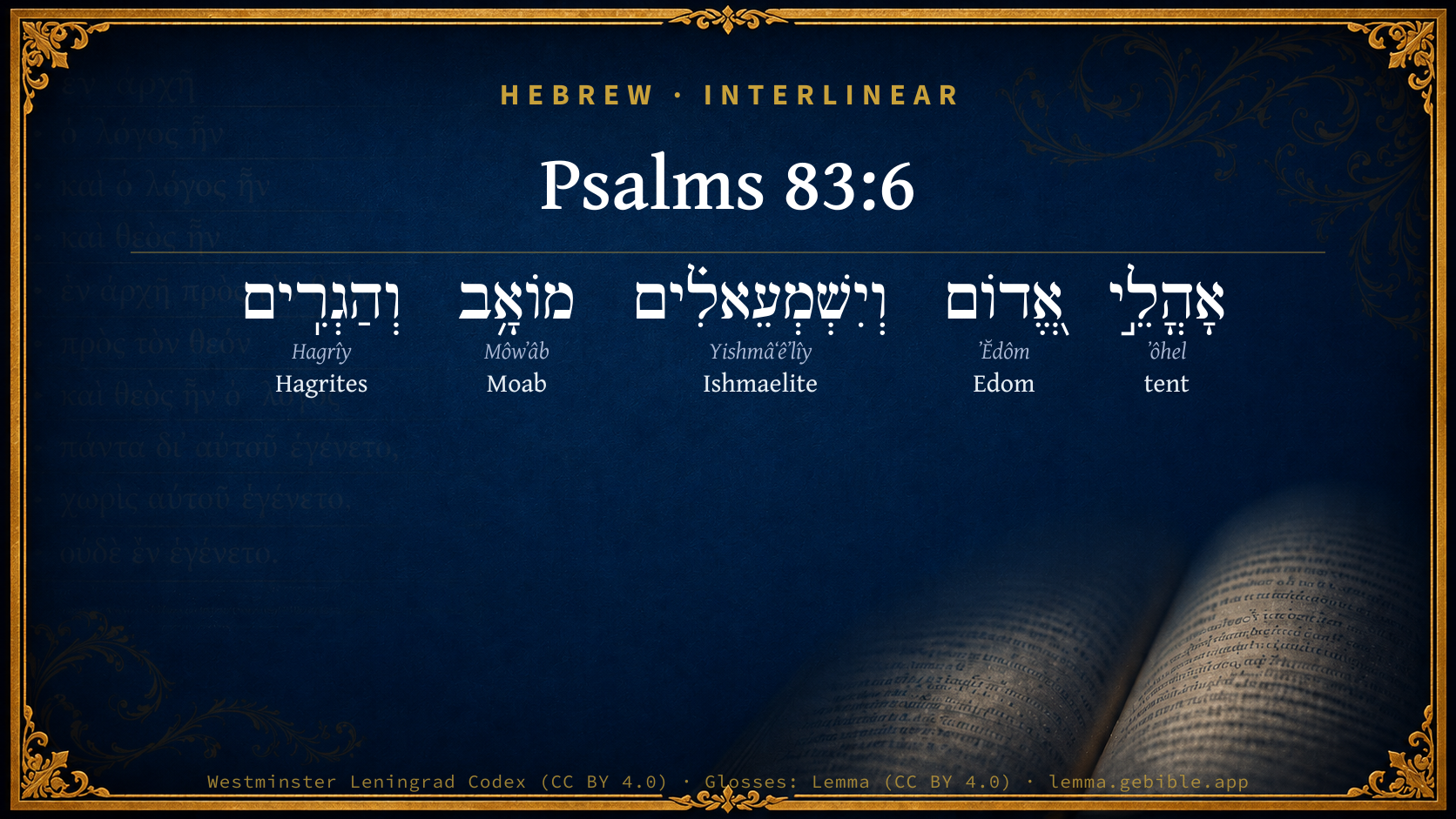
וְהַגְרִֽים
Hagrîy
H1905
“and · Hagrites”
Conjunction + Noun, Gentilic, Masculine, Singular, Absolute
Part of Speech
Conjunction + Noun
Type
Gentilic
Gender
Masculine
Number
Singular
State
Absolute
Full BDB Definition

Origin: perhaps patronymically from H1904

TWOT: None

Haggeri = "wanderer" - a people dwelling to the east of Palestine, with whom the tribes of Reuben made war in the time of Saul (noun proper gentilic) - of one of David's servants (adjective patrial) - father of Mibhar and one of David's mighty warriors (noun proper masculine)
  1. אָהֳלֵ֣י ʼôhel H168 “tents of” Noun, Common, Masculine, Plural, Construct
  2. אֱ֭דוֹם ʼĔdôm H123 “Edom” Noun, Proper
  3. וְיִשְׁמְעֵאלִ֗ים Yishmâʻêʼlîy H3459 “and · Ishmaelites” Conjunction + Noun, Gentilic, Masculine, Plural, Absolute
  4. מוֹאָ֥ב Môwʼâb H4124 “Moab” Noun, Proper

About this verse

These counts appear in no published source. They are computed here, from the morphology-tagged text and Lemma’s own curated glosses. What Lemma adds →

5
words
5
distinct lemmas
Wisdom
section

Notable vocabulary

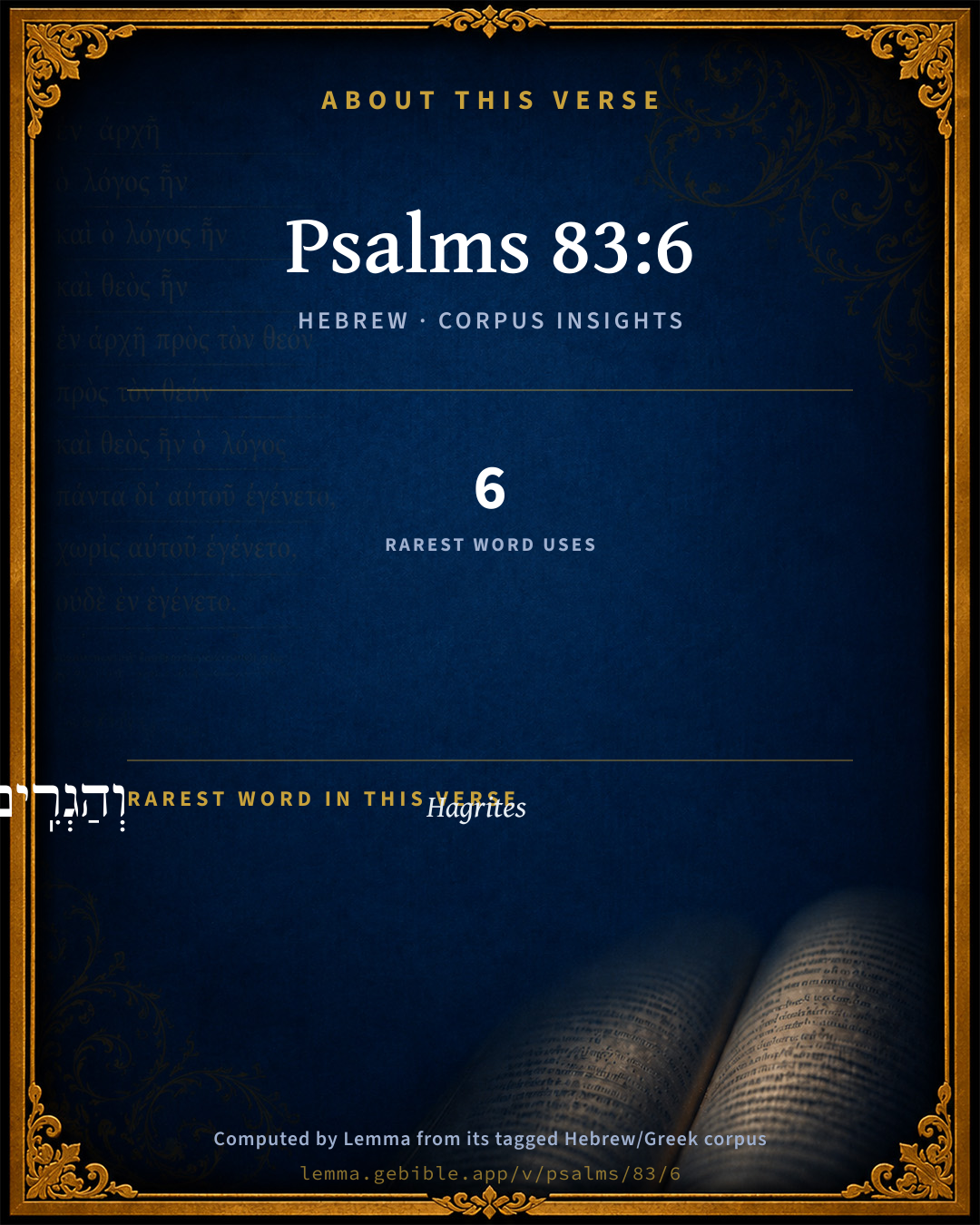
The rarest word here is וְהַגְרִֽים Hagrites H1905 — appearing just 6 times in the whole Hebrew Bible.

Shared distinctive vocabulary

וְהַגְרִֽים Hagrites H1905 occurs in 6 verses of the Hebrew Bible. Also found in:

Grammatical profile

  • 5 nouns

Hebrew & Septuagint length

In English translation the verse runs 11 words from the Hebrew and 13 from the Septuagint (LXX English) — closely comparable.

A rough comparison of the two English renderings, which tokenize alike — not a word-level alignment.

Word counts can differ between the Hebrew and the Greek without any difference in meaning — e.g. the Hebrew direct-object marker אֵת has no separate Greek word, and Greek often adds the article ὁ.

Cross-references

6

Topical passages linked to Psalms 83:6 in the Treasury of Scripture Knowledge — connected by theme and wording, ordered by reader-vote popularity; previews shown in the World English Bible.

  • 1 Chronicles 5:10 In the days of Saul, they made war with the Hagrites, who fell by their hand; and they lived in their tents throughout all the [land] east of Gilead.
  • 2 Chronicles 20:1 It happened after this, that the children of Moab, and the children of Ammon, and with them some of the Ammonites, came against Jehoshaphat to battle.
  • 2 Chronicles 20:10–11 Now, behold, the children of Ammon and Moab and Mount Seir, whom you would not let Israel invade, when they came out of the land of Egypt, but they turned aside from them, and didn't destroy them;
  • Psalms 137:7 Remember, Yahweh, against the children of Edom, The day of Jerusalem; Who said, "Raze it! Raze it even to its foundation!"
  • Genesis 25:12–18 Now this is the history of the generations of Ishmael, Abraham's son, whom Hagar the Egyptian, Sarah's handmaid, bore to Abraham.
  • 1 Chronicles 5:19–20 They made war with the Hagrites, with Jetur, and Naphish, and Nodab.

Cross-references courtesy of OpenBible.info (CC BY 4.0).

Hebrew and Greek witnesses Masoretic Hebrew ↔ Greek Septuagint

The same verse in the two great witnesses to the Old Testament, shown verse-for-verse.

You’re reading Greek Psalm 82 (Hebrew Psalm 83). The Septuagint counts the superscription, so verse numbers can differ from the Hebrew — chapter-level alignment, not verse-by-verse. Numbering follows Rahlfs.

These are two independent witnesses, not word-aligned to each other, and the Septuagint is shown in lemma (dictionary) form.

Hebrew Psalms 83:6 Masoretic · Westminster Leningrad Codex

אָהֳלֵ֣י אֱ֭דוֹם וְיִשְׁמְעֵאלִ֗ים מוֹאָ֥ב וְהַגְרִֽים

The tents of Edom and the Ishmaelites; Moab, and the Hagrites;

World English Bible · Public Domain

Greek LXX Greek Psalm 82:6 Septuagint · lemma form

ὅτι βουλεύω ἐν ὁμόνοια ἐπί ὁ αὐτός κατά σύ διαθήκη διατίθημι

even the tents of the Idumeans, and the Ismaelites; Moab, and the Agarenes;

LXX2012 (modern English Septuagint) · Public Domain

Hebrew: Westminster Leningrad Codex (CC BY 4.0). Greek: Septuagint (public domain); English from LXX2012 (modern English Septuagint) (Public Domain). How the Septuagint differs from the Hebrew →

Commentary

Notes on Psalms 83:6 from classic Christian and Jewish commentators (each source and its license shown beneath its notes). The classic Christian expositions comment on the surrounding passage and are grouped to its opening verse, so a note may address several verses; the Jewish commentaries on the Tanakh (Rashi and others) are per-verse, so they appear only where the commentator wrote on this verse.

Lemma curates 59 commentaries, every one of them public domain or Creative Commons licensed, each selected and text-cleaned for this edition rather than reprinted as found. About our sources →

Trapp's Complete Commentary

John Trapp

Psa 83:6 The tabernacles of Edom, and the Ishmaelites; of Moab, and the Hagarenes;

Ver. 6. The tabernacles of Edom, and the Ishmaelites, &c.] Exercitu ex variis gentibus conflato, at odds among themselves, and yet well agreed for a mischief to the Church, who might ever well say, as the hare in Martial,

In me omnis terraeque aviumque marisque rapina est;

Forsitan et coeli, si canis astra tenet.

As dogs, fighting and intertearing one another, can give over and join together to follow the harmless hare that passeth by them; so here. If Manasseh be against Ephraim, and Ephraim against Manasseh, yet they will be both against Judah.

And the Hagarenes] Who came also of Hagar, as well as the Ishmaelites; but were a distinct people, and would be called Saracens, from Sarah, the freewoman, for honour’ sake, as if the promises made to Abraham and Sarah had belonged to them (Saracens, in Arabic, is thieves). Ptolemy maketh mention of the Saracens, and placeth in Arabia, the seat of the Hagarenes, where there is also a city called Agra, of Hagar, likely. Aben Ezra saith they came of Hagar, by another husband. The Chaldee calleth them Hungarians.

John Trapp, A Commentary or Exposition upon All the Books of the Old and New Testament (1647–1656) — public domain. Text from a community e-Sword module.

The Treasury of David

Charles H. Spurgeon

Ver. 6. The tabernacles of Edom. Nearest of kin, yet first in enmity. Their sire despised the birthright, and they despise the possessors of it. Leaving their rock built mansions for the tents of war, the Edomites invaded the land of Israel.

And the Ishmaelites. A persecuting spirit ran in their blood, they perpetuated the old grudge between the child of the bondwoman and the son of the freewoman.

Of Moab. Born of incest, but yet a near kinsman, the feud of Moab against Israel was very bitter. Little could righteous Lot have dreamed that his unhallowed seed would be such unrelenting enemies of his uncle Abraham's posterity.

And the Hagarenes perhaps descendants of Hagar by a second husband. Whoever they may have been, they cast their power into the wrong scale, and with all their might sought the ruin of Israel. Children of Hagar, and all others who dwell around Mount Sinai, which is in Arabia, are of the seed which gendereth to bondage, and hence they hate the seed according to promise.

Ver. 6. The tabernacle of Edom, etc. The prophet having entered his suit and complaint in general, he comes to particulars, and tells God who they are that had done this. God might say, Who are these that conspire against me, and against my people, and hidden ones? Lord, saith the prophet, I will tell thee who they are... He names some ten nations that joined together against one poor Israel. It is a thing you should observe, that when the people of God are conspired against, God rests not in general complaints, but he will know who they are. As I told you, He is the Lord of Hosts, the great general. When there is mutiny the general asks, what officer, or what corporal, or what sergeant, or who did begin the mutiny? and it is a fearful thing when the poor persecuted saint shall bring thy name as a persecutor before the God of heaven. When a poor saint shall go home and say, There is a confederacy in London, a conspiracy against the saints of God; and when a poor saint shall say, such a magistrate, such a minister, such a man in such a street, such a woman set her husband against the saints, and against thine ordinances; it is a fearful thing. Therefore I remember a blessed woman, if it be true that is reported of her in the Book of Martyrs, that when the wicked abused her, and reproached her, and oppressed her, she would say no more but this, "I will go home and tell my Father" give over, or else I will bring your names before God, and tell him: there was all, and that was enough; for he would presently take it up. A man may better bear a pound of dirt on his feet, than a grain of dirt in his eye; the saints are "the apple of God's eye." Walter Cradock.

Ver. 6. Hagarenes. These people dwelt on the east of Gilead; and were nearly destroyed in the days of Saul, being totally expelled from their country, 1Ch 5:10, but afterwards recovered some strength and consequence. Adam Clarke.

Ver. 6-8. It may be observed that these were on all sides of the land of Israel; the Edomites, Ishmaelites, and Amalekites, were on the south; the Moabites, Ammonites, and Hagarenes, were on the east; the Assyrians on the north; and the Philistines, Gebalites, and Tyrians, on the west; so that Israel was surrounded on all sides with enemies, as the Lord's people are troubled on every side, 2Ch 4:8; and so the Gog and Magog army, of which some understand this, will encompass the camp of the saints about, and the beloved city, Re 20:9. John Gill.

Ver. 6-8. The enemies of Israel, as enumerated by the psalmist, fall into four main divisions: 1st, those most nearly connected with the Israelites themselves by the ties of blood relationship, the descendants of Esau and Ishmael; 2ndly, the two branches of the descendants of Lot along with their respective Arabian auxiliaries, viz., the Moabites, who had engaged the assistance of the Hagarenes, and the Ammonites, who had gathered round their standard the Giblites and Amalekites; 3rdly, the inhabitants of the coast, the Philistines and Tyrians; 4thly, the more distant Assyrians. Of all these the bitterest in their hostility to Israel were those who were the most nearly allied to them in blood, the Edomites. Their hostility was founded upon hatred. From their conduct to the Israelites through a long course of years it would seem as though in them were lastingly perpetuated that older hatred wherewith their forefather Essau had hated Jacob because of Isaac's blessing. And though they had once and again succeeded, according to the prophecy, in breaking Israel's yoke from off their neck, yet they never could wrest away from Israel the possession of the birthright, and with it of the promises, which their ancestors had profanely despised; from Israel, not from Edom, was the Redeemer of the world to spring, and in Israel were all the families of the earth to be blessed. The Edomites may accordingly be appropriately viewed as the types of those whom the Church of Christ has ever found her bitterest foes, the sceptics who have refused to acknowledge that redemption through a personal Redeemer, on which, as on a basis, the church is founded, whose intellectual pride is offended by the humbling doctrines of Christianity, and who hate those that hold them for their possession of blessings which they have wilfully neglected; whose human learning has nevertheless all along been subservient on the whole to the edification of the church, in spite of the violence with which they have striven, and for a while, as it should sometimes appear, successfully, to gain the mastery over her by opposing her, and to exercise a temporary dominion. Dwelling themselves in tabernacles, they cannot bear that others, more blessed that they, should have the houses of God in possession: "owning themselves to be astray, and unable to find the way to the truth, they are yet most importunate and imperious that others should come away from the ancient paths, and try to join them, or at least, wander as they are wandering." In conjunction with the Edomites, the psalmist makes mention of the Ishmaelites. And these, as the descendants of the bondwoman, may fitly represent those Jewish opponents of Christianity, still, perhaps, locally, if not generally, formidable, who in their rejection of Christian doctrine have been swayed by the same feelings of intellectual pride as the sceptics of Christian descent; who professing to hold fast to that covenant of Mount Sinai which gendereth to bondage, persecuted, so long as they were able, those born after the Spirit.

In the descendants of Lot and their Arabian auxiliaries, we have the types of a different class of foes. The historical origin of the former marks them as the appropriate representatives of the slaves of sinful lusts; who hate the church not for the humbling tone of her doctrines, but for the standard of holiness which she exacts and for which she is continually witnessing. And experience shews how such persons are wont, in their attacks upon the church, to enlist into their service those who are more wildly, but at the same time more ignorantly, unholy than themselves; how in order, if possible, to uproot those fences and safeguards of the law of holiness on which, having transgressed them, they hate to look, they appeal to the unbridled passions of the lawless multitude by whom the very existence of the fences had been utterly disregarded. From the enemies of the Church who are animated by feelings of positive hatred we pass to those who act from calculation rather than passion, and whose proceeding are all directed with a view to their own earthly aggrandisement. The Philistines and Tyrians had engaged in the hostile confederacy with the hope of obtaining Israelitish captives, from whom they might reap a profit by selling them abroad as slaves. It does not appear that they regarded the Israelites in themselves with other feelings than those of mere selfish indifference. Both nations had tendered their service to Israel in the days of Israel's prosperity; for the Philistines had probably furnished the Cherethites and Pelethites of David's body guard, and the Tyrians had furnished Solomon with materials and workmen for the building of the temple: both nations were now seeking to enrich themselves at Israel's expense in the days of Israel's adversity. And these then are the fitting types of all who in their varying professions of friendliness or hostility to the Church of God are actuated by the mere mercenary desire of lucre; favouring, and even zealously favouring her interests, when they can procure a good recompense for their services; unhesitatingly combining with her bitterest enemies to vilify and despoil her, whenever the opportunity offers of increasing their worldly substance thereby. The last class of enemies are those of whom Assyria is the type; the worldly potentates, whether ecclesiastical or temporal, papal or imperial, who are unscrupulously ready to employ all means for the ultimate accomplishment of their one object, that of extending and consolidating their dominion.

Such potentates seem to represent most truly that determined and resolute selfishness, which, to eyes that are not dazzled by the grandeur of its proportions or the gorgeousness in which it is arrayed, must ever appear as one of the most terrible embodiments of the enmity of the world to God. Pride of intellect and unbelief, unholiness and lawlessness of life, covetousness, worldly ambition, such are the characteristics of four important classes of those by whom God's church is threatened. Joseph Francis Thrupp.

None.

Psalms 83:7*

Ver. 6-8. See Psalms on "Ps 83:6" for further information.

Ver. 6-8. See Psalms on "Ps 83:6" for further information.

Ver. 6-8. See Psalms on "Ps 83:6" for further information.

Ver. 6-8. See Psalms on "Ps 83:6" for further information.

Charles H. Spurgeon's The Treasury of David (1869–1885) — public domain. Psalms only. Text from a community e-Sword/MySword module.

Joseph Benson's Commentary

Psa 83:6-8. The tabernacles of Edom — Called the children of Seir, 2 Chronicles 20. He says the tabernacles of Edom, from the custom of these Arabians to live in tents all the year long; encamping sometimes in one place and sometimes in another, as they found convenience for themselves and their cattle, a custom retained by their descendants even to this day. And the Ishmaelites — Some of the posterity of Ishmael, called by their father’s name, as others of them are supposed by many to be called Hagarenes, from their grandmother Hagar. Gebal — The Giblites, or Gebalites, dwelling near Zidon, of whom see Eze 27:9. “Gebal was once a place of renown: the country of the Giblites is mentioned as left by Joshua to be conquered after his death, Jos 13:5. And the people of this place were of service to Hiram, king of Tyre, in preparing materials for Solomon’s temple, 1Ki 5:18. At present this city has lost all its ancient grandeur, which appears to have been considerable by the remaining ruins of it. But it still retains its name, with very little alteration, which is Gibyle. It is situated upon the Mediterranean sea, between Tripoli and Sidon.” Assur also is joined with them — In their counsels, and possibly also with some of their forces, though not so openly and powerfully as afterward. They have holpen the children of Lot — Moab and Ammon, who were the principal parties in that war, (2 Chronicles 20.,) called here the children of Lot, to intimate their great degeneracy from the example of their pious progenitors.

Joseph Benson's Commentary on the Old and New Testaments (1811–1818) — public domain. Text from a community e-Sword module.

J. A. Alexander on Psalms

Joseph Addison Alexander

7. (Psa 83:6). The tents of Edom and the Ishmaelites, Moab and the Hagarenes. The use of the word tents does not necessarily imply a wandering mode of life, as it may mean military tents, or be a figure for dwellings. See above, on Psa 78:67, and compare Jdg 7:8, 1Ki 12:16. The Ishmaelites inhabited a part of Desert Arabia (Gen. xxv. 18), as did also the Hagarenes or Hagarites, a people driven from their lands by the tribe of Simeon in, the reign of Saul. See 1Ch 5:10; 1Ch 5:19-22, and compare 1Ch 11:38; 1Ch 27:31.

Joseph Addison Alexander, The Psalms Translated and Explained (1850) — public domain. Text from a community e-Sword module.

Tyndale Open Study Notes

Tyndale Open Resources

83:6-7 The Edomites, descendants of Esau, were located to the southeast of Judah (see Gen 25:30; 32:3; 36:1-8). • Ishmaelites were desert-dwelling descendants of Hagar. • Moabites and Ammonites descended from Lot; both were located to the east of Israel and Judah. • The Hagrites were possibly located north of the Ammonites (1 Chr 5:10).

Tyndale Open Study Notes — © Tyndale Open Resources, licensed CC BY-SA 4.0. Text via the HelloAO Bible API.

Adam Clarke's Commentary

Verse 6. The tabernacles of Edom] The tents of these different people are seen in the grand encampment. Tents are probably mentioned because it seas the custom of some of these people, particularly the Ishmaelites, to live a migratory or wandering life; having no fixed habitation, but always abiding in tents. Their posterity remain to the present day, and act and live in the same manner.

Hagarenes] These people dwelt on the east of Gilead; and were nearly destroyed in the days of Saul, being totally expelled from their country, 1Ch 5:10, but afterwards recovered some strength and consequence; but where they dwelt after their expulsion by the Israelites is not known.

Adam Clarke's Commentary on the Bible (1810–1826) — public domain. Text from a community e-Sword/MySword module.

Ellicott's Commentary for English Readers

(6) The tabernacles—i.e., the tents of the nomad tribes.

Hagarenes.—A tribe mentioned in 1Ch_5:10; 1Ch_5:19 (Hagarites), where see Note.

(6-8) In the enumeration of the confederate powers, the psalmist seems to follow a geographical order. He first glances southwards and eastwards, then turns to the west, and, finally, to the north.

A Bible Commentary for English Readers, edited by Charles John Ellicott (1878–1897) — public domain. Text from a community e-Sword module.

The Cambridge Bible for Schools and Colleges

gen. ed. J. J. S. Perowne

6. The tabernacles &c.] The tents of Edom and the Ishmaelites, i.e. the nomadic Edomites and Ishmaelites who dwell in tents. Cp. Hab_3:7. of Moab] Omit of.

The Cambridge Bible for Schools and Colleges (gen. ed. J. J. S. Perowne; Cambridge University Press, 1878–1918) — public domain. Text from a community e-Sword module.

John Gill's Exposition

The tabernacles of Edom, &c. Or the Idumeans, as the Targum; the posterity of Esau, who, with the rest that joined with them, hereafter mentioned, and made the confederate army, brought their tents with them, pitched them, and encamped in them against Israel:

and the Ishmaelites; or Arabians, as the Targum, who descended from Ishmael, the son of Abraham:

of Moab, and the Hagarenes; the Moabites, who sprung from Lot by one of his daughters, in an incestuous way; and the Hagarenes are the same with the Hagarites, Ch1 5:10 who dwelt to the east of the land of Israel, so called from Hagar, the handmaid of Abraham, but not by him, but by another husband, after sent away from him, as Aben Ezra and Kimchi think, or by him, supposing Hagar to be the same with Keturah, as some do: the Targum calls them Hungarians; the Syriac version renders it Gadareans, or Gadarenes; of which see Mar 5:1.

John Gill's Exposition of the Whole Bible (1746–1763) — public domain (CC PDM 1.0). Text via the HelloAO Bible API.

Albert Barnes' Notes on the Bible

The tabernacles of Edom - The tents of Edom; meaning here, the dwellers in those tents, that is, the Edomites. The word tabernacles or tents does not necessarily imply that the nation then led a wandering life, for the word came to signify in process of time a dwelling-place, or a habitation. The Edomites were not, in fact, a roving and wandering people, but a people of fixed boundaries. In early periods, however, like most ancient people, they doubtless dwelt in tents. Edom, or Idumea, was south of Palestine. See the notes at Isa 11:14.

And the Ishmaelites - The descendants of Ishmael. They dwelt in Arabia Deserta.

Of Moab - On the situation of Moab, see the notes at Isa 15:1-9. It was on the southeast of Palestine.

And the Hagarenes - The Hagarenes were properly Arabs, so called from Hagar, the handmaid of Abraham, the mother of Ishmael. Gen 16:1; Gen 25:12. As connected with the Ishmaelites they would naturally join in this alliance.

Albert Barnes' Notes on the Bible (1834–1885) — public domain. Text from a community e-Sword/MySword module.

Matthew Poole's English Annotations

The tabernacles, put for the people dwelling in them, as Job 12:6; Pro 14:11; Hab 3:7.

Edom; called the children of Seir, 2Ch 20. The Ishmaelites; some of the posterity of Ishmael, called by their father’s name, as others of them are supposed by divers to be called

Hagarenes, from their grandmother Hagar. See 1Ch 5:10,20.

Matthew Poole's English Annotations on the Holy Bible (1683–1685) — public domain. Text from a community e-Sword/MySword module.

Whedon's Commentary on the Bible

Daniel D. Whedon

6. The tabernacles of Edom—The military tents of Edom. On Edom see on Psa_60:9.

Ishmaelites—From Ishmael, son of Abraham.

Gen_16:11. They roamed chiefly in northern Arabia “from Havilah to Shur,” or from Egypt to the Persian Gulf. Gen_25:17-18.

Moab—On the east of the Dead Sea, and indisputably the chief mover in this whole conspiracy. Their King Mesha was a brave warrior and an energetic ruler.

Hagarenes—Or, Hagarites; probably a separated branch of the Ishmaelitish family, and so called from their maternal ancestor, Hagar. They dwelt on the east of Gilead in the Arabian desert. 1Ch_5:10; 1Ch_5:19-20

Daniel D. Whedon (gen. ed.), Commentary on the Old and New Testaments (1874–1909) — public domain. Text from a community e-Sword module.

John Wesley's Explanatory Notes

The tabernacles - The people dwelling in them. Ishmaelites - Some of the posterity of Ishmael, called by their father's name, as others of them are supposed to be called Hagarens from their grandmother Hagar.

John Wesley, Explanatory Notes Upon the Whole Bible (1754–1765) — public domain. Text via the GEBible commentary corpus.

unfoldingWord translationNotes

Door43 World Missions Community

General Information:

The writer continues to list the people groups who want to destroy Israel.

the tents of Edom

This refers to the people of Edom who lived in tents. (See: Metonymy)

Hagrites

This is the name of a people group that lived on the east side of the Jordan River. (See: How to Translate Names)

Gebal, Ammon, Amalek ... Philistia

These all represent the people of each area or tribe. AT: "the people of Gebal, the Ammonites, the Amalekites ... the Philistines" (See: Metonymy)

Gebal

This is the name of a region south of the Dead Sea. (See: How to Translate Names)

translationWords

tent

Edom

Ishmael

Moab

Ammon

Amalek

Philistines

Tyre

unfoldingWord translationNotes — © Distant Shores Media and the Door43 World Missions Community, licensed CC BY-SA 4.0. Source: git.door43.org/Door43/en_tn.

Rashi

Rabbi Shlomo Yitzchaki (Rashi)

against You they form a pact This pact is only against You, to cause Your name to be forgotten, for You are called the God of Israel, and since Israel will not be remembered, even Your great name is not remembered. I found this.

Rashi on the Tanakh — English translations: “The Judaica Press complete Tanach with Rashi, translated by A. J. Rosenberg” (CC BY 4.0); “Pentateuch with Rashi's commentary by M. Rosenbaum and A.M. Silbermann, 1929-1934” (public domain); “The Metsudah Tanach series, Lakewood, N.J” (CC BY 4.0); and “The Book of Joshua, Metsudah Publications, 1997” (CC BY 4.0). Text via Sefaria.

Lesson kit

Teaching starters — assembled from the data on this page, not authored interpretation. Every prompt links to the verse data it draws on. Edit before teaching.

Psalms, in the Wisdom, opens this verse with 5 words (5 distinct Hebrew lemmas). Its most distinctive word is Hagrîy (“Hagrites”). A historical commentator’s framing appears above. Read the whole chapter for the surrounding context.

Discussion questions

  1. How does “Hagrites” (Hagrîy) shape what this verse is saying?
  2. How does 1 Chronicles 5:10, which shares the word «Hagrites», read alongside this verse?
  3. These translations render this verse differently. What is at stake in choosing one wording over another?
  4. Compare how Trapp's Complete Commentary and The Treasury of David read this verse. Where do they agree or differ?

Things to notice

Reading settings

Reading text

Shown beneath each verse's original-language words.

Old Testament
Old Testament edition

Read the OT as the Masoretic Hebrew (MT) or the Greek Septuagint (LXX).

English shown for the Greek Septuagint (in the Hebrew ↔ Greek comparison).

Comparing translations? Open the Compare panel on any verse page to stack up to four side by side.