
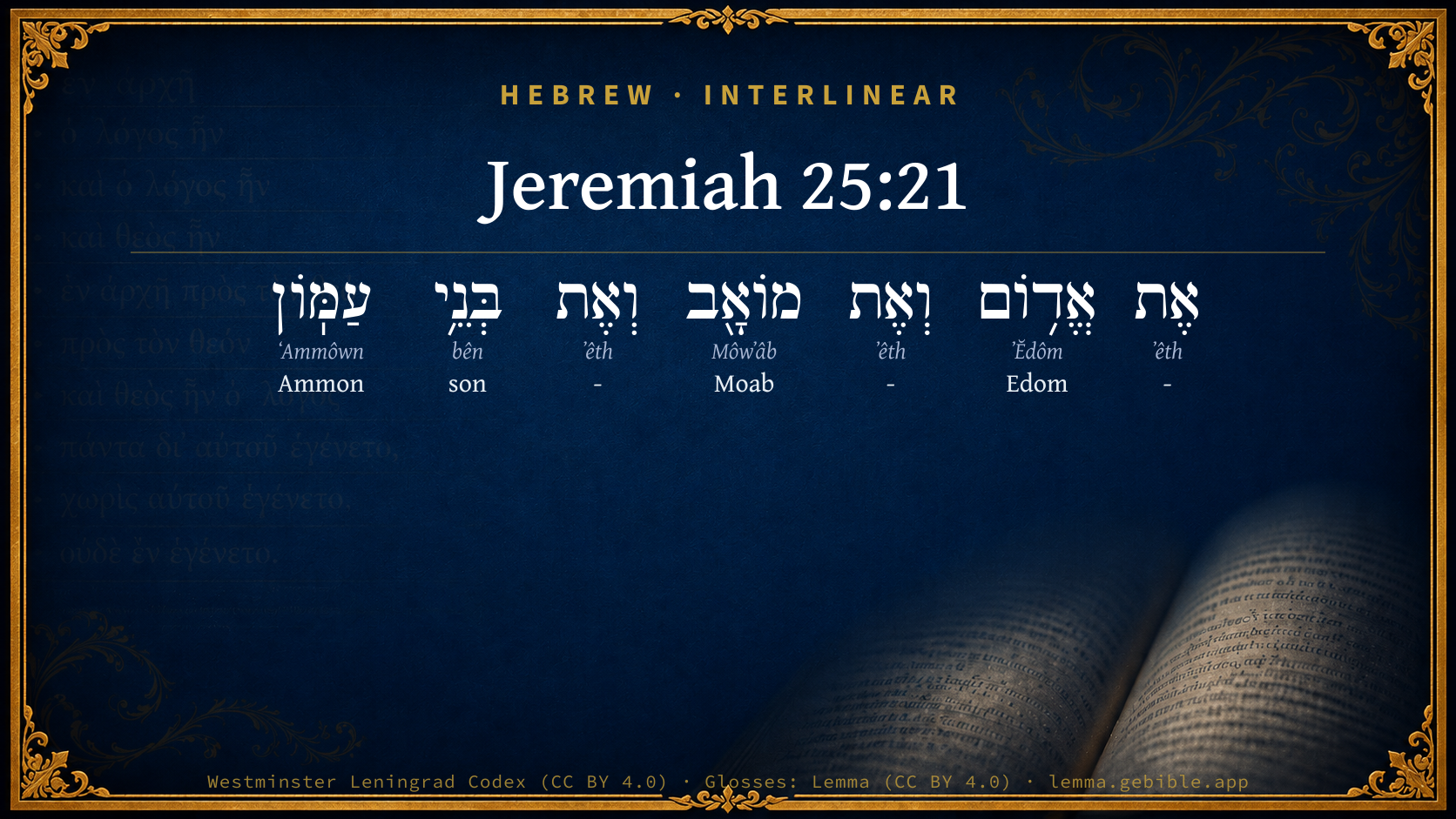
Jeremiah 25:21

Hebrew (Westminster Leningrad Codex) Jeremiah 25:21 appears in the Hebrew Old Testament. The text above is from the Westminster Leningrad Codex. Each word links to its Strong’s number, a concise gloss, and parsing drawn from the Open Scriptures Hebrew Bible morphology. Click any word for its full Brown-Driver-Briggs (BDB) entry.
Download image
Cite this verse

Jeremiah 25:21 (World English Bible). Public Domain. Lemma interlinear Bible study tool, https://lemma.gebible.app/v/jeremiah/25/21.

Show BibTeX & RIS
BibTeX
RIS
English Translation
Edom, and Moab, and the children of Ammon;
World English Bible · Public Domain
Download a study sheet

One document with this verse’s original text, its word-by-word gloss line, the meaning frame, cross-references with their text, attributed commentary, and full source and license credits — printable, and it pastes into notes with its structure intact.

This verse Autodidact and up

Study sheet (.html) Plain text (.txt)

A passage Seminary Student

Up to 50 verses in one chapter. A passage sheet keeps up to 6 commentary sources and 12 cross-references per verse, in the order this page ranks them, and says so on the sheet whenever that leaves anything out. Ask for a single verse and you get the Autodidact verse sheet above.

Everything on this page stays free to read, with no account — the sheet is a download of what is already on screen, not access to it.

Want to remove ads? Support Godless Engineer
Compare translations 3

The same verse in 3 English versions, stacked beneath the original-language interlinear above. Click any original word for its lexicon entry.

Each is an independent rendering of the whole verse — the interlinear is not word-aligned to these translations.

Highlighted words mark where these versions differ — a whole-verse word diff, not a word-by-word alignment.

  • World English Bible Public Domain
    Edom, and Moab, and the children of Ammon;
  • King James Version Public Domain
    Edom, and Moab, and the children of Ammon,
  • unfoldingWord Literal Text CC BY-SA 4.0
    Edom and Moab and the sons of Ammon;

unfoldingWord Literal Text — © unfoldingWord, licensed CC BY-SA 4.0. Word-aligned USFM3 via Door43 (git.door43.org/unfoldingWord/en_ult).

Versions to compare (up to 4)

3 of 4 selected

Show all 18 translations

Every available English version of this verse, each an independent rendering of the whole verse.

  • World English Bible Public Domain
    Edom, and Moab, and the children of Ammon;
  • Berean Standard Bible Public Domain
    Edom, Moab, and the Ammonites;
  • Majority Standard Bible Public Domain
    Edom, Moab, and the Ammonites;
  • King James Version Public Domain
    Edom, and Moab, and the children of Ammon,
  • American Standard Version (1901) Public Domain
    Edom, and Moab, and the children of Ammon;
  • Revised Version (1885) Public Domain
    Edom, and Moab, and the children of Ammon;
  • Geneva Bible (1599) Public Domain
    Edom, and Moab, and the Ammonites,
  • Douay-Rheims (1899) Public Domain
    And Edom, and Moab, and the children of Ammon.
  • Young's Literal Translation Public Domain
    Edom, and Moab, and the sons of Ammon,
  • Literal Standard Version CC BY-SA 4.0
    Edom, and Moab, and the sons of Ammon,
  • Unlocked Literal Bible CC BY-SA 4.0
    Edom and Moab and the people of Ammon.
  • unfoldingWord Literal Text CC BY-SA 4.0
    Edom and Moab and the sons of Ammon;
  • Darby Bible Public Domain
    Edom, and Moab, and the children of Ammon;
  • World Messianic Bible Public Domain
    Edom, Moab, and the children of Ammon;
  • Webster's Bible Public Domain
    Edom, and Moab, and the children of Ammon,
  • Free Bible Version CC BY-SA 4.0
    to Edom, Moab, and the Ammonites;
  • Bible in Basic English Public Domain
    Edom and Moab and the children of Ammon,
  • JPS Tanakh (1917) Public Domain
    Edom, and Moab, and the children of Ammon;

Literal Standard Version (2020), Covenant Press — licensed CC BY-SA 4.0. Text via the HelloAO Bible API (eBible.org). Unlocked Literal Bible (unfoldingWord) — licensed CC BY-SA 4.0. Text via the HelloAO Bible API (eBible.org). unfoldingWord Literal Text — © unfoldingWord, licensed CC BY-SA 4.0. Word-aligned USFM3 via Door43 (git.door43.org/unfoldingWord/en_ult). Free Bible Version, Dr. Jonathan Gallagher — licensed CC BY-SA 4.0. Text via the HelloAO Bible API (eBible.org).

Word by word

More ways to search: Search by grammar → Find every occurrence → Compare this word →

Practice this passage: Drill this verse → Learn its vocabulary →

About this verse

These counts appear in no published source. They are computed here, from the morphology-tagged text and Lemma’s own curated glosses. What Lemma adds →

7
words
5
distinct lemmas
Prophets
section

Grammatical profile

  • 4 nouns
  • 3 particles

Cross-references

17

Topical passages linked to Jeremiah 25:21 in the Treasury of Scripture Knowledge — connected by theme and wording, ordered by reader-vote popularity; previews shown in the World English Bible.

  • Jeremiah 48:1–49:22 Of Moab. Thus says Yahweh of Hosts, the God of Israel: Woe to Nebo! for it is laid waste; Kiriathaim is disappointed, it is taken; Misgab is put to shame and broken down.
  • Psalms 137:7 Remember, Yahweh, against the children of Edom, The day of Jerusalem; Who said, "Raze it! Raze it even to its foundation!"
  • Jeremiah 9:26 Egypt, and Judah, and Edom, and the children of Ammon, and Moab, and all that have the corners [of their hair] cut off, who dwell in the wilderness; for all the nations are uncircumcised, and all the house of Israel are uncircumcised in heart.
  • Isaiah 15:1–9 The burden of Moab. For in a night Ar of Moab is laid waste, [and] brought to nothing; for in a night Kir of Moab is laid waste, [and] brought to nothing.
  • Isaiah 25:10 For in this mountain will the hand of Yahweh rest; and Moab shall be trodden down in his place, even as straw is trodden down in the water of the dung-hill.
  • Isaiah 34:1–17 Come near, you nations, to hear; and listen, you peoples: let the earth hear, and the fullness of it; the world, and all things that come forth from it.
  • Isaiah 63:1–6 Who is this who comes from Edom, with dyed garments from Bozrah? this who is glorious in his clothing, marching in the greatness of his strength? I who speak in righteousness, mighty to save.
  • Jeremiah 27:3 and send them to the king of Edom, and to the king of Moab, and to the king of the children of Ammon, and to the king of Tyre, and to the king of Sidon, by the hand of the messengers who come to Jerusalem to Zedekiah king of Judah;
  • Lamentations 4:21–22 Rejoice and be glad, daughter of Edom, that dwell in the land of Uz: The cup shall pass through to you also; you shall be drunken, and shall make yourself naked.
  • Ezekiel 25:2–14 Son of man, set your face toward the children of Ammon, and prophesy against them:
  • Ezekiel 32:29 There is Edom, her kings and all her princes, who in their might are laid with those who are slain by the sword: they shall lie with the uncircumcised, and with those who go down to the pit.
  • Ezekiel 35:1–15 Moreover the word of Yahweh came to me, saying,
  • Amos 1:11–2:3 Thus says Yahweh: "For three transgressions of Edom, yes, for four, I will not turn away its punishment; Because he pursued his brother with the sword, And cast off all pity, And his anger raged continually, And he kept his wrath forever;
  • Obadiah 1:1–16 The vision of Obadiah. This is what the Lord Yahweh says about Edom. We have heard news from Yahweh, and an ambassador is sent among the nations, saying, "Arise, and let's rise up against her in battle.
  • Obadiah 1:18 The house of Jacob will be a fire, the house of Joseph a flame, and the house of Esau for stubble. They will burn among them, and devour them. There will not be any remaining to the house of Esau." Indeed, Yahweh has spoken.
  • Zephaniah 2:8–10 I have heard the reproach of Moab, and the insults of the children of Ammon, with which they have reproached my people, and magnified themselves against their border.
  • Malachi 1:2–4 "I have loved you," says Yahweh. Yet you say, "How have you loved us?" "Wasn't Esau Jacob's brother?" says Yahweh, "Yet I loved Jacob;

Cross-references courtesy of OpenBible.info (CC BY 4.0).

Hebrew and Greek witnesses Masoretic Hebrew ↔ Greek Septuagint

The same verse in the two great witnesses to the Old Testament, shown verse-for-verse.

These are two independent witnesses, not word-aligned to each other, and the Septuagint is shown in lemma (dictionary) form.

Hebrew Jeremiah 25:21 Masoretic · Westminster Leningrad Codex

אֶת אֱד֥וֹם וְאֶת מוֹאָ֖ב וְאֶת בְּנֵ֥י עַמּֽוֹן

Edom, and Moab, and the children of Ammon;

World English Bible · Public Domain

Greek LXX Structure differs

In the Septuagint, Jeremiah is about an eighth shorter than the Hebrew and arranges its material differently — the Oracles Against the Nations (Hebrew chapters 46–51) appear in the middle of the Greek book, after 25:13. Because the chapter and verse boundaries do not line up, a verse-for-verse comparison with the Hebrew is not shown.

A verse-for-verse comparison isn’t shown here because the chapters and verses don’t line up. Switch to the LXX edition with the MT / LXX toggle above to read the Greek directly.

Hebrew: Westminster Leningrad Codex (CC BY 4.0). Greek: Septuagint (public domain); English from a public-domain English Septuagint. How the Septuagint differs from the Hebrew →

Targum (Aramaic paraphrase)

1

The Targum is the ancient Jewish Aramaic paraphrase of the Hebrew Scriptures — an interpretive translation, not the Hebrew text itself. Onkelos (literal) and Pseudo-Jonathan (expansive) render the Torah, and Jonathan the Prophets. Coverage is partial: where no permissively-licensed English translation exists for a verse, only the Aramaic is shown. This is verse-level text, not a word-by-word alignment to the Hebrew.

  1. Targum Jonathan Prophets (Joshua–Malachi)
    יַת אֱדוֹם וְיַת מוֹאָב וְיַת בְּנֵי עֲמוֹן:

    (no public-domain English translation for this verse)

    Targum Jonathan — Aramaic: “Mikraot Gedolot” (public domain). English: “Sefaria Community Translation” (CC0 1.0 (public-domain dedication)); “London "Chaldee Paraphrase," 1871” (public domain). Text via Sefaria.

Commentary

Notes on Jeremiah 25:21 from classic Christian and Jewish commentators (each source and its license shown beneath its notes). The classic Christian expositions comment on the surrounding passage and are grouped to its opening verse, so a note may address several verses; the Jewish commentaries on the Tanakh (Rashi and others) are per-verse, so they appear only where the commentator wrote on this verse.

Lemma curates 59 commentaries, every one of them public domain or Creative Commons licensed, each selected and text-cleaned for this edition rather than reprinted as found. About our sources →

Trapp's Complete Commentary

John Trapp

Jer 25:21 Edom, and Moab, and the children of Ammon,

Ver. 21. Edom and Moab, &c.] By the destruction of all these nations we may make a conjecture at the destructiou of all the wicked, when Christ shall come to judgment. All that befalleth them in this world, is but as drops of wrath forerunning the great storm: or as a crack foretokening the fall of the whole house. Here the leaves only fall upon them as it were, but then the body of the tree in its full weight to crush them for ever.

John Trapp, A Commentary or Exposition upon All the Books of the Old and New Testament (1647–1656) — public domain. Text from a community e-Sword module.

Tyndale Open Study Notes

Tyndale Open Resources

25:21-22 The small nations of Edom, Moab, and Ammon were east and southeast of the Dead Sea. The Phoenician cities of Tyre and Sidon were to the northwest, along the Mediterranean Sea. The regions across the sea were probably the islands of Cyprus and Crete.

Tyndale Open Study Notes — © Tyndale Open Resources, licensed CC BY-SA 4.0. Text via the HelloAO Bible API.

Geneva Bible (1599)

Geneva Bible translators

Edom is here taken for the whole country, and Uz for a part thereof.

Geneva Bible (1599) marginal notes — public domain. Text via Bolls.life.

Jamieson, Fausset & Brown

Robert Jamieson, A. R. Fausset & David Brown

Edom . . . Moab . . . Ammon--joined together, as being related to Israel (see Jer. 48:1-49:39).

Jamieson, Fausset & Brown — Commentary Critical and Explanatory on the Whole Bible (1871) — public domain (CC PDM 1.0). Text via the HelloAO Bible API.

John Calvin's Commentaries

The same words are ever to be repeated, that Jeremiah made all these nations to drink the cup. He mentions the Idumeans, the posterity of Esau, and also the Moabites, the descendants of Lot, as also were the Ammonites There was a relationship between these three nations and the Israelites; hence the Prophet seems designedly to have connected these three nations together. He adds —

John Calvin's Commentaries (1540-1563) — public domain. Text from the Calvin Translation Society English edition (1840s-50s) via the Christian Classics Ethereal Library (ccel.org). Calvin's coverage is partial (roughly two-thirds of the Bible); uncommented books and verses are honest gaps, never fabricated. The 19th-century editor's footnotes and remarks are omitted so the notes are faithfully Calvin's own voice.

John Gill's Exposition

Edom, and Moab, and the children of Ammon. All well known and implacable enemies of Israel. The Edomites descended from Esau; and the Moabites and Ammonites from Moab and Ammon, the two sons of Lot by his daughters. Their destruction is prophesied of in the forty eighth and forty ninth chapters.

Edom, and Moab, and the children of Ammon. All well known and implacable enemies of Israel. The Edomites descended from Esau; and the Moabites and Ammonites from Moab and Ammon, the two sons of Lot by his daughters. Their destruction is prophesied of in the forty eighth and forty ninth chapters.

Jeremiah 25:22

jer 25:22

jer 25:22

jer 25:22And all the kings of Tyrus, and all the kings of Zidon,.... Two very ancient cities in Phoenicia, frequently mentioned together in Scripture, being near each other. Their ruin is foretold in Jer 47:4;

and the kings of the isles which are beyond the sea; which some understand of Greece and Italy; others of Rhodes, Cyprus, and Crete, and other islands in the Mediterranean sea; the Cyclades, as Jerom: but the words may be rendered, "and the kings of the country by the seaside"; and may design those that dwell upon the coast of the Mediterranean sea.

John Gill's Exposition of the Whole Bible (1746–1763) — public domain (CC PDM 1.0). Text via the HelloAO Bible API.

Haydock's Catholic Bible Commentary

Ammon. The details are given in chap. xlviii., and xlix., and Ezechiel xxv. to xxxiv., and Abdias and Sophonias.

George Leo Haydock (1774–1849), Haydock's Catholic Family Bible and Commentary, 1859 edition — public domain. Excludes Psalms (Douay-Rheims chapter numbering differs from Protestant) and Deuterocanonical books (Catholic canon only).

Matthew Poole's English Annotations

The Edomites were the posterity of Esau the son of Isaac, to whom God had given a land which they inherited, and he would not suffer the Israelites to make their way through them by force, when they denied them a passage through their country; now he threatens their ruin, as also Jer 49:7; and Obadiah’s prophecy was against them, where their triumphing in the captivity of the Jews is mentioned as one thing that had provoked God against them. The Moabites and Ammonites were descended from Lot. Jer 48 is an entire prophecy against Moab; they had lived in long prosperity, as appears there, Jer 25:12; so had the Ammonites, against whom also Jeremiah prophesied particularly, Jer 49:1-7.

Matthew Poole's English Annotations on the Holy Bible (1683–1685) — public domain. Text from a community e-Sword/MySword module.

Lesson kit

Teaching starters — assembled from the data on this page, not authored interpretation. Every prompt links to the verse data it draws on. Edit before teaching.

Jeremiah, in the Prophets, opens this verse with 7 words (5 distinct Hebrew lemmas). Its most distinctive word is ʼĔdôm (“Edom”). A historical commentator’s framing appears above. Read the whole chapter for the surrounding context.

Discussion questions

  1. The word ʼĔdôm carries the sense “Edom.” How does it shape the verse?
  2. How does Jeremiah 48:1–49:22, which shares this passage’s theme, read alongside this verse?
  3. These translations render this verse differently; the difference is in the English rendering, not the original. What questions does that raise?
  4. Compare how Trapp's Complete Commentary and Tyndale Open Study Notes read this verse. Where do they agree or differ?

Things to notice

Reading settings

Reading text

Shown beneath each verse's original-language words.

Old Testament
Old Testament edition

Read the OT as the Masoretic Hebrew (MT) or the Greek Septuagint (LXX).

English shown for the Greek Septuagint (in the Hebrew ↔ Greek comparison).

Comparing translations? Open the Compare panel on any verse page to stack up to four side by side.