
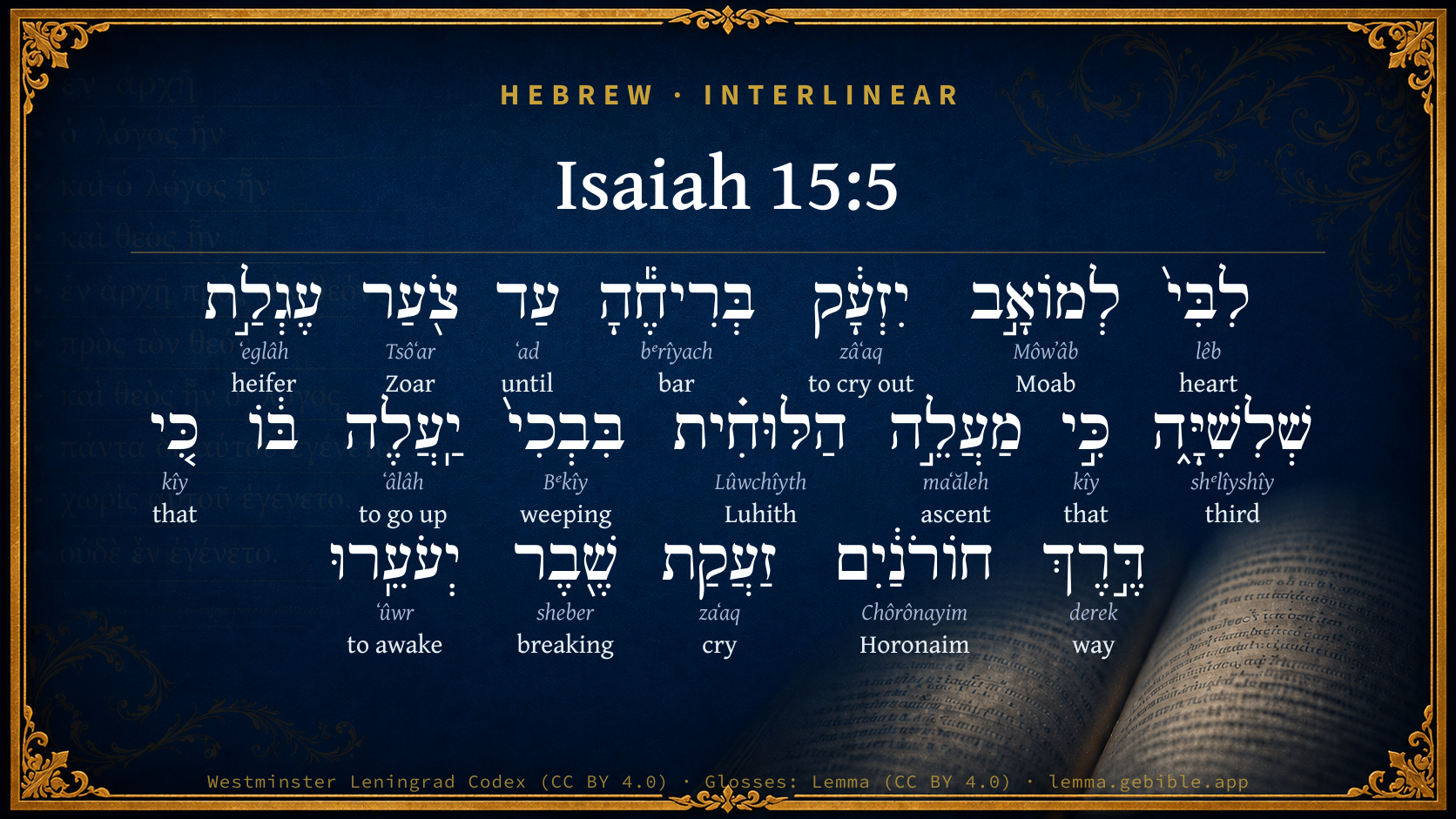
Isaiah 15:5

Hebrew (Westminster Leningrad Codex) Isaiah 15:5 appears in the Hebrew Old Testament. The text above is from the Westminster Leningrad Codex. Each word links to its Strong’s number, a concise gloss, and parsing drawn from the Open Scriptures Hebrew Bible morphology. Click any word for its full Brown-Driver-Briggs (BDB) entry.
Download image
Cite this verse

Isaiah 15:5 (World English Bible). Public Domain. Lemma interlinear Bible study tool, https://lemma.gebible.app/v/isaiah/15/5.

Show BibTeX & RIS
BibTeX
RIS
English Translation
My heart cries out for Moab; her nobles [flee] to Zoar, to Eglath Shelishiyah: for by the ascent of Luhith with weeping they go up; for in the way of Horonaim they raise up a cry of destruction.
World English Bible · Public Domain
Highlights
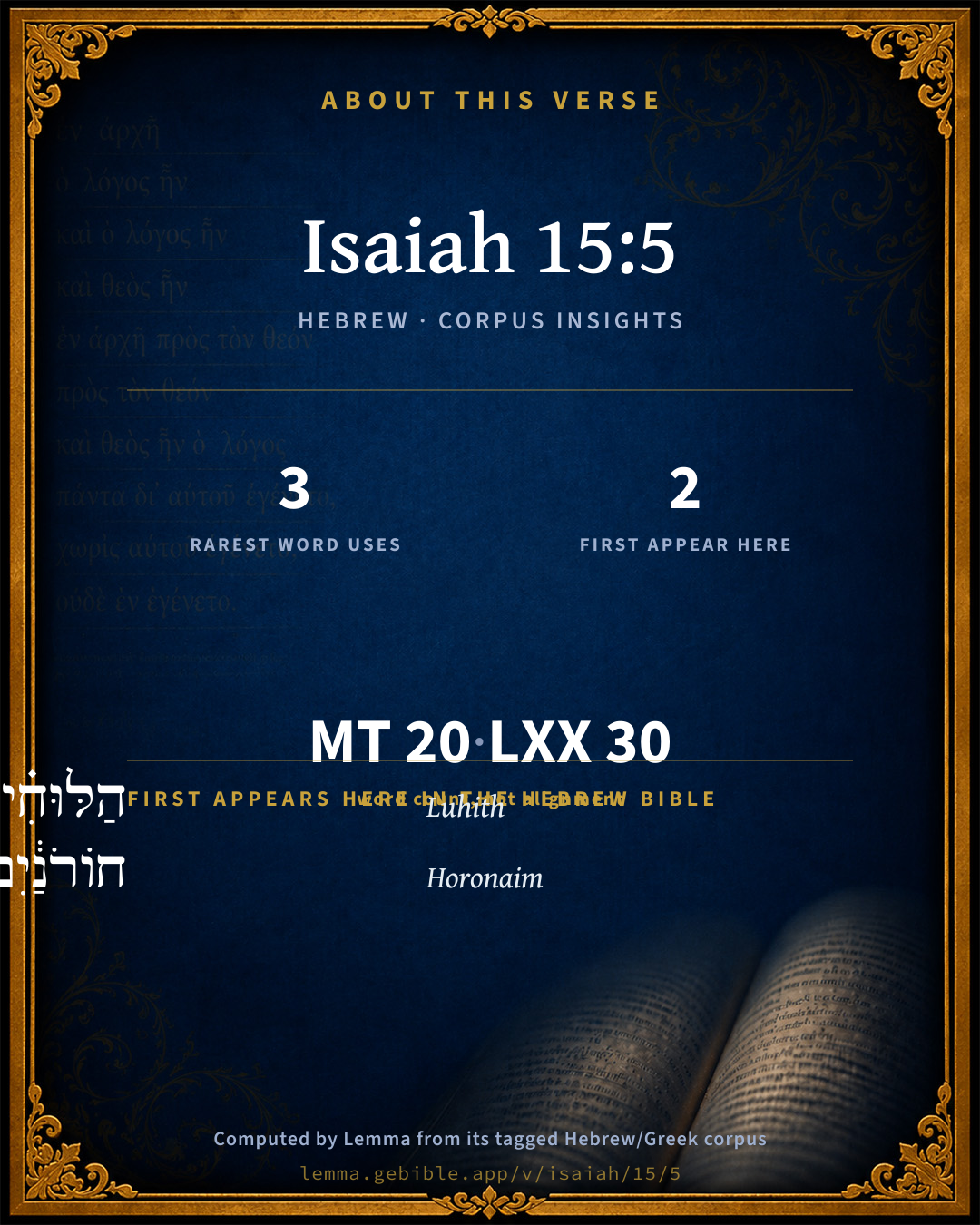
  • 2 first appearances in the Hebrew Bible
Full analysis ↓
Download a study sheet

One document with this verse’s original text, its word-by-word gloss line, the meaning frame, cross-references with their text, attributed commentary, and full source and license credits — printable, and it pastes into notes with its structure intact.

This verse Autodidact and up

Study sheet (.html) Plain text (.txt)

A passage Seminary Student

Up to 50 verses in one chapter. A passage sheet keeps up to 6 commentary sources and 12 cross-references per verse, in the order this page ranks them, and says so on the sheet whenever that leaves anything out. Ask for a single verse and you get the Autodidact verse sheet above.

Everything on this page stays free to read, with no account — the sheet is a download of what is already on screen, not access to it.

Want to remove ads? Support Godless Engineer
Compare translations 3

The same verse in 3 English versions, stacked beneath the original-language interlinear above. Click any original word for its lexicon entry.

Each is an independent rendering of the whole verse — the interlinear is not word-aligned to these translations.

Highlighted words mark where these versions differ — a whole-verse word diff, not a word-by-word alignment.

  • World English Bible Public Domain
    My heart cries out for Moab; her nobles [flee] to Zoar, to Eglath Shelishiyah: for by the ascent of Luhith with weeping they go up; for in the way of Horonaim they raise up a cry of destruction.
  • King James Version Public Domain
    My heart shall cry out for Moab; his fugitives shall flee unto Zoar, an heifer of three years old: for by the mounting up of Luhith with weeping shall they go it up; for in the way of Horonaim they shall raise up a cry of destruction.
  • unfoldingWord Literal Text CC BY-SA 4.0
    My heart cries out for Moab, its fugitives to Zoar, Eglath Shelishiyah. For the ascent of Luhith, one goes up by it with weeping; for the way of Horonaim they awaken an outcry of destruction.

unfoldingWord Literal Text — © unfoldingWord, licensed CC BY-SA 4.0. Word-aligned USFM3 via Door43 (git.door43.org/unfoldingWord/en_ult).

Versions to compare (up to 4)

3 of 4 selected

Show all 18 translations

Every available English version of this verse, each an independent rendering of the whole verse.

  • World English Bible Public Domain
    My heart cries out for Moab; her nobles [flee] to Zoar, to Eglath Shelishiyah: for by the ascent of Luhith with weeping they go up; for in the way of Horonaim they raise up a cry of destruction.
  • Berean Standard Bible Public Domain
    My heart cries out over Moab; her fugitives flee as far as Zoar, as far as Eglath-shelishiyah. With weeping they ascend the slope of Luhith; they lament their destruction on the road to Horonaim.
  • Majority Standard Bible Public Domain
    My heart cries out over Moab; her fugitives flee as far as Zoar, as far as Eglath-shelishiyah. With weeping they ascend the slope of Luhith; they lament their destruction on the road to Horonaim.
  • King James Version Public Domain
    My heart shall cry out for Moab; his fugitives shall flee unto Zoar, an heifer of three years old: for by the mounting up of Luhith with weeping shall they go it up; for in the way of Horonaim they shall raise up a cry of destruction.
  • American Standard Version (1901) Public Domain
    My heart crieth out for Moab; her nobles `flee' unto Zoar, to Eglath-shelishi-yah: for by the ascent of Luhith with weeping they go up; for in the way of Horonaim they raise up a cry of destruction.
  • Revised Version (1885) Public Domain
    My heart crieth out for Moab; her nobles flee unto Zoar, to Eglath-shelishiyah: for by the ascent of Luhith with weeping they go up; for in the way of Horonaim they raise up a cry of destruction.
  • Geneva Bible (1599) Public Domain
    Mine heart shall crie for Moab: his fugitiues shall flee vnto Zoar, an heiffer of three yere olde: for they shall goe vp with weeping by the mounting vp of Luhith: and by the way of Horonaim they shall raise vp a crie of destruction.
  • Douay-Rheims (1899) Public Domain
    My heart shall cry to Moab, the bars thereof shall flee unto Segor a heifer of three years old: for by the ascent of Luith they shall go up weeping: and in the way of Oronaim they shall lift up a cry of destruction.
  • Young's Literal Translation Public Domain
    My heart `is' toward Moab, Cry do her fugitives unto Zoar, a heifer of the third `year', For -- the ascent of Luhith -- With weeping he goeth up in it, For, in the way of Horonaim, A cry of destruction they wake up.
  • Literal Standard Version CC BY-SA 4.0
    My heart [is] toward Moab, || Her fugitives cry to Zoar, a heifer of the third [year], || For—the ascent of Luhith—He goes up in it with weeping, || For in the way of Horonaim, || They wake up a cry of destruction.
  • Unlocked Literal Bible CC BY-SA 4.0
    My heart cries out for Moab; her fugitives flee to Zoar and to Eglath Shelishiyah. They go up the ascent of Luhith weeping; on the road to Horonaim they loudly wail over their destruction.
  • unfoldingWord Literal Text CC BY-SA 4.0
    My heart cries out for Moab, its fugitives to Zoar, Eglath Shelishiyah. For the ascent of Luhith, one goes up by it with weeping; for the way of Horonaim they awaken an outcry of destruction.
  • Darby Bible Public Domain
    My heart crieth out for Moab; their fugitives [have fled] unto Zoar, unto Eglath-Sheli-shijah: for by the ascent of Luhith, with weeping they go up by it; for in the way of Horonaim they raise up a cry of destruction.
  • World Messianic Bible Public Domain
    My heart cries out for Moab! Her Nazirites flee to Zoar, to Eglath Shelishiyah; for they go up by the ascent of Luhith with weeping; for on the way to Horonaim, they raise up a cry of destruction.
  • Webster's Bible Public Domain
    My heart shall cry out for Moab; his fugitives shall flee to Zoar, a heifer of three years old: for they shall go up the ascent of Luhith with weeping; for in the way of Horonaim they shall raise a cry of destruction.
  • Free Bible Version CC BY-SA 4.0
    I weep over Moab. Moabite refugees run all the way to Zoar and to Eglath-shelishiyah. Weeping they go up Luhith hill; crying for their destruction they walk along the road to Horonaim.
  • Bible in Basic English Public Domain
    My heart is crying out for Moab; her people go in flight to Zoar, and to Eglath-shelishiyah: for they go up with weeping by the slope of Luhith; on the way to Horonaim they send up a cry of destruction.
  • JPS Tanakh (1917) Public Domain
    My heart crieth out for Moab; her fugitives reach unto Zoar, a heifer of three years old; for by the ascent of Luhith with weeping they go up; for in the way of Horonaim they raise up a cry of destruction.

Literal Standard Version (2020), Covenant Press — licensed CC BY-SA 4.0. Text via the HelloAO Bible API (eBible.org). Unlocked Literal Bible (unfoldingWord) — licensed CC BY-SA 4.0. Text via the HelloAO Bible API (eBible.org). unfoldingWord Literal Text — © unfoldingWord, licensed CC BY-SA 4.0. Word-aligned USFM3 via Door43 (git.door43.org/unfoldingWord/en_ult). Free Bible Version, Dr. Jonathan Gallagher — licensed CC BY-SA 4.0. Text via the HelloAO Bible API (eBible.org).

Word by word

More ways to search: Search by grammar → Find every occurrence → Compare this word →

Practice this passage: Drill this verse → Learn its vocabulary →

הַלּוּחִ֗ית
Lûwchîyth
H3872
“the · Luhith”
Particle, Definite Article + Noun, Proper
Part of Speech
Particle + Noun
Type
Proper
Full BDB Definition

Origin: from the same as H3871

TWOT: None

Luhith = "tablets" - a town of Moab, south of the Arnon River
  1. לִבִּי֙ lêb H3820 “heart · my” Noun, Common, Masculine, Singular, Construct + Suffix, Personal, 1st Person, Common, Singular
  2. לְמוֹאָ֣ב Môwʼâb H4124 “to/for · Moab” Preposition + Noun, Proper
  3. יִזְעָ֔ק zâʻaq H2199 “to cry out” Verb, Qal, Imperfect, 3rd Person, Masculine, Singular
  4. בְּרִיחֶ֕הָ bᵉrîyach H1280 “bars · her” Noun, Common, Masculine, Plural, Construct + Suffix, Personal, 3rd Person, Feminine, Singular
  5. עַד ʻad H5704 “until” Preposition
  6. צֹ֖עַר Tsôʻar H6820 “Zoar” Noun, Proper
  7. עֶגְלַ֣ת ʻeglâh H5697 “heifer” Noun, Proper
  8. שְׁלִשִׁיָּ֑ה shᵉlîyshîy H7992 “third” Noun, Proper
  9. כִּ֣י kîy H3588 “that” Conjunction
  10. מַעֲלֵ֣ה maʻăleh H4608 “ascent of” Noun, Common, Masculine, Singular, Construct
  11. בִּבְכִי֙ Bᵉkîy H1065 “in/at · weeping” Preposition + Noun, Common, Masculine, Singular, Absolute
  12. יַֽעֲלֶה ʻâlâh H5927 “to go up” Verb, Qal, Imperfect, 3rd Person, Masculine, Singular
  13. כִּ֚י kîy H3588 “that” Conjunction
  14. דֶּ֣רֶךְ derek H1870 “way of” Noun, Common, Both, Singular, Construct
  15. חוֹרֹנַ֔יִם Chôrônayim H2773 “Horonaim” Noun, Proper
  16. זַעֲקַת zaʻaq H2201 “cry of” Noun, Common, Feminine, Singular, Construct
  17. שֶׁ֖בֶר sheber H7667 “breaking” Noun, Common, Masculine, Singular, Absolute
  18. יְעֹעֵֽרוּ ʻûwr H5782 “to awake” Verb, Polel, Imperfect, 3rd Person, Masculine, Plural

About this verse

These counts appear in no published source. They are computed here, from the morphology-tagged text and Lemma’s own curated glosses. What Lemma adds →

20
words
18
distinct lemmas
Prophets
section

Notable vocabulary

The rarest word here is הַלּוּחִ֗ית Luhith H3872 — appearing just 3 times in the whole Hebrew Bible.

First appearance in Scripture

These words make their first canonical appearance in the Hebrew Bible here:

  • הַלּוּחִ֗ית Luhith H3872
  • חוֹרֹנַ֔יִם Horonaim H2773

Shared distinctive vocabulary

הַלּוּחִ֗ית Luhith H3872 occurs in 2 verses of the Hebrew Bible. Also found in:

Grammatical profile

  • 3 verbs
  • 13 nouns
  • 2 prepositions
  • 2 conjunctions

Verb forms

  • יִזְעָ֔ק Qal · Imperfect
  • יַֽעֲלֶה Qal · Imperfect
  • יְעֹעֵֽרוּ Polel · Imperfect

Repetition

A word recurs within this verse — often emphatic in Hebrew:

  • כִּ֣י that H3588 ×2

Hebrew & Septuagint length

In English translation the verse runs 38 words from the Hebrew and 45 from the Septuagint (LXX English) — closely comparable.

A rough comparison of the two English renderings, which tokenize alike — not a word-level alignment.

Word counts can differ between the Hebrew and the Greek without any difference in meaning — e.g. the Hebrew direct-object marker אֵת has no separate Greek word, and Greek often adds the article ὁ.

In the original languages it is 20 Hebrew tokens and 30 Greek tokens — but the two are counted differently (Hebrew bundles its prefixes and suffixes into one token; the Greek is in lemma form), so that isn’t a like-for-like length.

Cross-references

18

Topical passages linked to Isaiah 15:5 in the Treasury of Scripture Knowledge — connected by theme and wording, ordered by reader-vote popularity; previews shown in the World English Bible.

  • Jeremiah 48:5 For by the ascent of Luhith with continual weeping shall they go up; for at the descent of Horonaim they have heard the distress of the cry of destruction.
  • Jeremiah 4:20 Destruction on destruction is cried; for the whole land is laid waste: suddenly are my tents destroyed, [and] my curtains in a moment.
  • Jeremiah 48:31–36 Therefore will I wail for Moab; yes, I will cry out for all Moab: for the men of Kir Heres shall they mourn.
  • Luke 19:41–44 When he drew near, he saw the city and wept over it,
  • Genesis 13:10 Lot lifted up his eyes, and saw all the plain of the Jordan, that it was well watered every where, before Yahweh destroyed Sodom and Gomorrah, like the garden of Yahweh, like the land of Egypt, as you go to Zoar.
  • Genesis 14:2 that they made war with Bera, king of Sodom, and with Birsha, king of Gomorrah, Shinab, king of Admah, and Shemeber, king of Zeboiim, and the king of Bela (the same is Zoar).
  • Genesis 19:22 Hurry, escape there, for I can't do anything until you get there." Therefore the name of the city was called Zoar.
  • 2 Samuel 15:23 All the country wept with a loud voice, and all the people passed over: the king also himself passed over the brook Kidron, and all the people passed over, toward the way of the wilderness.
  • 2 Samuel 15:30 David went up by the ascent of the [Mount of] Olives, and wept as he went up; and he had his head covered, and went barefoot: and all the people who were with him covered every man his head, and they went up, weeping as they went up.
  • Isaiah 16:9–11 Therefore I will weep with the weeping of Jazer for the vine of Sibmah; I will water you with my tears, Heshbon, and Elealeh: for on your summer fruits and on your harvest the [battle] shout is fallen.
  • Isaiah 16:14 But now Yahweh has spoken, saying, Within three years, as the years of a hireling, the glory of Moab shall be brought into contempt, with all his great multitude; and the remnant shall be very small and of no account.
  • Isaiah 22:5 For it is a day of confusion, and of treading down, and of perplexity, from the Lord, Yahweh of Hosts, in the valley of vision; a breaking down of the walls, and a crying to the mountains.
  • Jeremiah 8:18–19 Oh that I could comfort myself against sorrow! my heart is faint within me.
  • Jeremiah 9:10 For the mountains will I take up a weeping and wailing, and for the pastures of the wilderness a lamentation, because they are burned up, so that none passes through; neither can men hear the voice of the cattle; both the birds of the sky and the animals are fled, they are gone.
  • Jeremiah 9:18–19 and let them make haste, and take up a wailing for us, that our eyes may run down with tears, and our eyelids gush out with waters.
  • Jeremiah 13:17 But if you will not hear it, my soul shall weep in secret for [your] pride; and my eye shall weep sore, and run down with tears, because Yahweh's flock is taken captive.
  • Jeremiah 17:16 As for me, I have not hurried from being a shepherd after you; neither have I desired the woeful day; you know: that which came out of my lips was before your face.
  • Romans 9:1–3 I tell the truth in Christ. I am not lying, my conscience testifying with me in the Holy Spirit,

Cross-references courtesy of OpenBible.info (CC BY 4.0).

Hebrew and Greek witnesses Masoretic Hebrew ↔ Greek Septuagint

The same verse in the two great witnesses to the Old Testament, shown verse-for-verse.

These are two independent witnesses, not word-aligned to each other, and the Septuagint is shown in lemma (dictionary) form.

Hebrew Isaiah 15:5 Masoretic · Westminster Leningrad Codex

לִבִּי֙ לְמוֹאָ֣ב יִזְעָ֔ק בְּרִיחֶ֕הָ עַד צֹ֖עַר עֶגְלַ֣ת שְׁלִשִׁיָּ֑ה כִּ֣י מַעֲלֵ֣ה הַלּוּחִ֗ית בִּבְכִי֙ יַֽעֲלֶה בּ֔וֹ כִּ֚י דֶּ֣רֶךְ חוֹרֹנַ֔יִם זַעֲקַת שֶׁ֖בֶר יְעֹעֵֽרוּ

My heart cries out for Moab; her nobles [flee] to Zoar, to Eglath Shelishiyah: for by the ascent of Luhith with weeping they go up; for in the way of Horonaim they raise up a cry of destruction.

World English Bible · Public Domain

Greek LXX Isaiah 15:5 Septuagint · lemma form

ὁ καρδία ὁ μωαβῖτις βοάω ἐν αὐτός ἕως σηγωρ δάμαλις γάρ εἰμί τριετής ἐπί δέ ὁ ἀνάβασις ὁ λουιθ πρός σύ κλαίω ἀναβαίνω ὁ ὁδός αρωνιιμ βοάω σύντριμμα καί σεισμός

The heart of the region of Moab cries within her to Segor; for it is as a heifer of three years old: and on the ascent of Luith they shall go up to you weeping by the way of Aroniim: she cries, Destruction, and trembling.

LXX2012 (modern English Septuagint) · Public Domain

On this verse, Adam Clarke's Commentary discusses the Septuagint’s reading. Read the note in Commentary ↓

Hebrew: Westminster Leningrad Codex (CC BY 4.0). Greek: Septuagint (public domain); English from LXX2012 (modern English Septuagint) (Public Domain). How the Septuagint differs from the Hebrew →

Targum (Aramaic paraphrase)

1

The Targum is the ancient Jewish Aramaic paraphrase of the Hebrew Scriptures — an interpretive translation, not the Hebrew text itself. Onkelos (literal) and Pseudo-Jonathan (expansive) render the Torah, and Jonathan the Prophets. Coverage is partial: where no permissively-licensed English translation exists for a verse, only the Aramaic is shown. This is verse-level text, not a word-by-word alignment to the Hebrew.

  1. Targum Jonathan Prophets (Joshua–Malachi)
    בְּלִבְּהוֹן מוֹאֲבָאֵי יֵימְרוּן לְמַעֲרַק עַד צוֹעַר עֶגְלַת תִּלְתּוּת רַבְּתָא אֲרֵי בְמַסוּקִית לוּחִית בִּדְבָכָן יִסְקוּן בֵּיהּ אֲרֵי בְמָחוֹתִית חוֹרְנַיִם צִוְחַת תְּבִירֵי קְרָב יְבַסְרוּן:

    The Moabites shall think to flee to Zoar, unto Eglath Tiltum' Rabb'tha; for the ascent of Luhith they shall ascend it as with weeping; because in the descent of Horonaim they shall declare the cry of the broken in battle.

    Targum Jonathan — Aramaic: “Mikraot Gedolot” (public domain). English: “Sefaria Community Translation” (CC0 1.0 (public-domain dedication)); “London "Chaldee Paraphrase," 1871” (public domain). Text via Sefaria.

Commentary

Notes on Isaiah 15:5 from classic Christian and Jewish commentators (each source and its license shown beneath its notes). The classic Christian expositions comment on the surrounding passage and are grouped to its opening verse, so a note may address several verses; the Jewish commentaries on the Tanakh (Rashi and others) are per-verse, so they appear only where the commentator wrote on this verse.

Lemma curates 59 commentaries, every one of them public domain or Creative Commons licensed, each selected and text-cleaned for this edition rather than reprinted as found. About our sources →

Trapp's Complete Commentary

John Trapp

Isa 15:5 My heart shall cry out for Moab; his fugitives [shall flee] unto Zoar, an heifer of three years old: for by the mounting up of Luhith with weeping shall they go it up; for in the way of Horonaim they shall raise up a cry of destruction.

Ver. 5. My heart shall cry out for Moab.] Let others do as they will, saith the prophet here, I can do no less than bewail the woeful condition of Moab, bad though they be. {a}

“ Tu quibus ista legis incertum est, Lector, ocellls:

Ipse quidem siccis scribere non potui ”

His fugitives shall flee unto Zoar.] Whither once their father Lot fled for refuge; but it was too hot to hold him. Or, His fugitives shall cry to Zoar.

An heifer of three years old.] Which, being in her prime, loweth aloud, coelum mugitibus implens; so shall these fugitives set up their note, clamore fragoso boantes; as they pass through the countries they shall even break or rend themselves with crying.

{a} Heu quam doleo corde toto. - Oecol.

John Trapp, A Commentary or Exposition upon All the Books of the Old and New Testament (1647–1656) — public domain. Text from a community e-Sword module.

The Biblical Illustrator

Joseph S. Exell

Isa_15:5

My heart shall cry out for Moab

The burden of souls

Too often have Gods servants spoken with dry eyes and hard voices of the doom of the ungodly; and have only made them more obdurate and determined.

We never need so much brokenness of spirit as when we utter Gods judgments against sin. In his autobiography, Finney says, Here I must introduce the name of a man whom I shall have occasion to mention frequently, Mr. Abel Clary, He was the son of a very excellent man, and an elder of the Church where I was converted. He had been licensed to preach; but his spirit of prayer was such, he was so burdened with the souls of men, that he was not able to preach much, his whole time and strength being given to prayer. The burden of his soul would frequently be so great that he was unable to stand, and he would writhe and groan in agony. I was well acquainted with him, and knew something of the wonderful spirit of prayer that was upon him The pastor told me afterwards that he found that in the six weeks I was in that church five hundred souls had been converted. (F. B. Meyer, B. A.)

The prophets distress concerning Moab

(see also Isa_16:9):--These are the men who prevail with men. In the early part of the sixteenth century there was a great religious awakening in Ulster, which began under a minister named Glendinning. He was of very meagre natural gifts, but would spend many days and nights alone with God, and seems to have been greatly burdened with the souls of men and their state before God. It is not to be wondered at, therefore, that, under his pleading, multitudes of hearers were brought into great anxiety and terror of conscience. They looked on themselves as altogether lost. They were stricken into a swoon by the vower of Gods Word. A dozen in one day were carried out of doors as dead. These were not women, but some of the boldest spirits of the neighbourhood some who had formerly not feared with their swords to put the whole market town into a fray. This revival changed the whole character of northern Ireland. Would that God might lay on our hearts a similar burden for our Churches and our land! (F. B. Meyer, B. A.)

.

The Biblical Illustrator, edited by Joseph S. Exell (c. 1880s–1900s) — public domain. Text from a community e-Sword module.

Joseph Benson's Commentary

Isa 15:5. My heart shall cry out for Moab — “Hitherto the prophet had set forth the lamentations of the Moabites, but, seeing these future evils, as it were, present to his own mind, he compassionates their griefs, and declares his own participation of their sorrows.” His fugitives shall flee unto Zoar, &c. — The meaning of this clause is thought to be, His fugitives shall cry, so as they may be heard unto Zoar; or, shall wander and cry as they go along the way, even till they come to Zoar. A heifer — Or, as a heifer; as the words are translated Jer 48:34; that is, they shall send forth their cries, by weeping and lamenting, like a heifer. “Three years old, is mentioned only to denote a full-grown heifer, the lowing of which, naturalists have remarked, is deeper and more affecting than that of the male.” Zoar was a town bordering upon Moab. By the mounting up of Luhith — It is not certain what place this was, but it is evident enough that it was some elevated tract, or ascent, in the extremity of Moab. Horonaim was also a city of Moab, situated probably in the descent from Luhith. They shall raise up a cry of destruction — Such a cry as men send forth when they are just falling into the pit of destruction. He signifies that the cry should be universal in all places where they should come, and reaching from one side of the country to the other.

Joseph Benson's Commentary on the Old and New Testaments (1811–1818) — public domain. Text from a community e-Sword module.

The Pulpit Commentary

My heart shall cry out for Moab.The (comp. Isa_16:9, Isa_16:11) prophet sympathizes with the sufferings of Moab, as a kindred people, (Gen_19:37) and perhaps as having, in the person of Ruth, furnished an ancestress to the Messiah. (Mat_1:5) His fugitives; literally, her fugitives. The country is here personified, instead of the people, the former being feminine, the latter masculine. Shall flee unto Zoar. Zoar, the "little" town, spared for Lot"s sake, (Gen_19:20-22) is placed by some at the northern, by others at the southern, extremity of the Dead Sea. The present passage makes in favor of the more southern site. A heifer of three years old. Those who defend this rendering refer the simile either to Zest, or to Moab, or to the fugitives. Having regard to the parallel passage of Jeremiah, (Jer_48:34) we may pronounce the last explanation to be the best. The resemblance to the heifer will consist in the cries uttered. To ninny critics, however, this idea appears harsh, and the alternative is proposed of regarding Eglath the word translated "heifer as a place, and the epithet, "of three years old," as really meaning "the third." Attempts are made to show the existence of three Eglaths in these parts; but they are not very successful; nor is any instance adduced of a city being distinguished from others of the same name by a numerical suffix. The rendering of the Authorized Version may therefore stand, the comparison being regarded as one of the fugitive Moabites to a heifer in its third year, rushing along with loud, hopeless bellowings" (Kay). By the mounting up of Luhith. This ascent has not been identified. It should have been on the way from Moab proper to Zoar. The way of Horonaim. On the Moabite Stone Horonaim is mentioned as a town of the Edomites attacked and taken by Mesha. (Isa 11) It lay probably south or southeast of the Dead Sea. The Moabites, flying kern their invaders, seek a refuge in the territories of Edom and Judah, weeping and wailing as they go.

Ver. 5. Denunciations of God"s wrath upon sinners compatible with the deepest pity for them.

It is sometimes assumed that those who exert themselves earnestly to set before men the severer aspects of religion, who, like Paul before Felix, "reason of righteousness, temperance, and judgment to come", (Act_24:25) must be persons of harsh, stern, and pitiless tempers, devoid of the gentler feelings, or at any rate without keen sympathy with their fellowmen. The advocates of universal salvation claim to be more tender-hearted than their opponents, and brand the latter with epithets denoting a want of humanity and kindliness. But true tenderness and kindness will not lead men to conceal unpleasant truths, but to state them with the utmost clearness and distinctness to press them upon men, insist upon them, compel attention to them. Their outspokenness is no sign of want of sympathy, but rather an indication of the contrary. It springs froth the deepest love, from the most earnest desire to save souls, Throe great examples may be alleged in proof of this.

I THE EXAMPLE OF ISAIAH. Nowhere do we find more unreserved denunciations of God"s wrath against sinners than in the writings of "the evangelical prophet." All the enemies of God are in their turn arraigned, condemned, and sentenced to the severest sufferings. But can it be said that Isaiah is cold, or harsh, or unsympathetic? No. Far otherwise. His "heart cries out for Moab". (Isa_15:5) He "bewails with the weeping of Jazer the vine of Sibmah"; (Isa_16:9) he "waters Heshbon and Elealeh with his tears"; (Isa_16:9) his "bowels sound like an harp for Moab," and his "inward parts for Kir-Haresh". (Isa_16:11) Nor is it only the kindred nation of Moab which draws forth such feelings. A vision of the siege of Babylon causes him to cry out, "Therefore are my loins filled with pain: pangs have taken hold upon me, as the pangs of a woman that travaileth; I was bowed down at the hearing of it; I was dismayed at the seeing of it. My heart punted, fearfulness affrighted me: the night of my pleasure hath he turned into fear unto me". (Isa_21:3, Isa_21:4)

II THE EXAMPLE OF ST. PAUL. NO sacred writer is more direct in his warnings against sin, or more plain in his denunciations of eternal death to sinners, than St. Paul. "As many as have sinned without Law shall also perish without Law: and as many as have sinned in the Law shall be judged by the Law". (Rom_2:12) "The wages of sin is death". (Rom_6:23) "The works of the flesh are manifest, which are these; Adultery, fornication, uncleanness, lasciviousness, idolatry, witchcraft, hatred, variance, emulations, wrath, strife, seditions, heresies, envyings, murders, drunkenness, revelings, and such like: of the which I tell you before, as I have also told you in time past, that they who do such things shall not inherit the kingdom of God". (Gal_5:19-21) Yet what writer shows greater tenderness towards those whom he warns, or a more affectionate concern for them, than the great apostle of the Gentiles? "Brethren, my heart"s desire and prayer to God for Israel is, that they might be saved". (Rom_10:1) "I say the truth in Christ, I lie not, my conscience also bearing me witness in the Holy Ghost, that I have great heaviness and continual sorrow in my heart. For I could wish that myself were accursed from Christ for my brethren, my kinsfolk according to the flesh". (Rom_9:1-3)

III THE EXAMPLE OF OUR LORD. The tenderness of Christ" is without a parallel in the history of man. Not only did he die for men, but throughout his life he showed at every turn a love for them surpassing human love. For their sake becoming poor and despised, for their sake unwearied in works of mercy, moved with compassion if he saw them faint or weary, grieving bitterly, even weeping, when he found them impenitent, never breaking the bruised reed nor quenching the smoking flax, on his way to his death of shame praying for his murderers, it is yet he who delivers the warnings concerning final judgment, which are most awful and most impossible to explain away. "Every tree that bringeth not forth good fruit is hewn down, and cast into the fire". (Mat_7:19) "As the tares are gathered and burned in the fire, so shall it be in the end of the world. The Son of man shall send forth his angels, and they shall gather out of his kingdom all things that offend, and them which do iniquity; and shall cast them into a furnace of fire: there shall be weeping and gnashing of teeth". (Mat_13:40-42) "Then shall he say to them on the left hand, Depart from me, ye cursed, into everlasting fire, prepared for the devil and his angels And these shall go away into everlasting punishment: but the righteous into life eternal". (Mat_25:41, Mat_25:46) "It is better for thee to enter into life maimed, than having two hands to go into hell, into the fire that never shall be quenched: where their worm dieth not, and the fire is not quenched". (Mar_9:43, 44)

The Pulpit Commentary (1880–1919), ed. H.D.M. Spence-Jones & Joseph S. Exell — public domain. Text from a community e-Sword module.

Tyndale Open Study Notes

Tyndale Open Resources

15:5 My heart weeps for Moab: The prophet joined in the lament to express the greatness of Moab’s pain. • Zoar was in the southeastern area of the Dead Sea (Gen 14:2; 19:23).

Tyndale Open Study Notes — © Tyndale Open Resources, licensed CC BY-SA 4.0. Text via the HelloAO Bible API.

Geneva Bible (1599)

Geneva Bible translators

The Prophet speaketh this in the person of the Moabites: or as one that felt the great judgment of God that God should come upon them.

He describeth the miserable dissipation and flight of the Moabites.

Meaning, that it was a city that ever lived in pleasure, and never felt sorrow.

Geneva Bible (1599) marginal notes — public domain. Text via Bolls.life.

Jamieson, Fausset & Brown

Robert Jamieson, A. R. Fausset & David Brown

My--The prophet himself is moved with pity for Moab. Ministers, in denouncing the wrath of God against sinners, should do it with tender sorrow, not with exultation.

fugitives--fleeing from Moab, wander as far as to Zoar, on the extreme boundary south of the Dead Sea. HORSLEY translates, "her nobility," or "rulers" (Hos 4:18).

heifer, &c.--that is, raising their voices "like a heifer" (compare Jer 48:34, Jer 48:36). The expression "three years old," implies one at its full vigor (Gen 15:9), as yet not brought under the yoke; as Moab heretofore unsubdued, but now about to be broken. So Jer 31:18; Hos 4:13. MAURER translates, "Eglath" (in English Version, "a heifer") Shelishijah (that is, the third, to distinguish it from two others of the same name).

by the mounting up--up the ascent.

Luhith--a mountain in Moab.

Horonaim--a town of Moab not far from Zoar (Jer 48:5). It means "the two poles," being near caves.

cry of destruction--a cry appropriate to the destruction which visits their country.

Jamieson, Fausset & Brown — Commentary Critical and Explanatory on the Whole Bible (1871) — public domain (CC PDM 1.0). Text via the HelloAO Bible API.

Adam Clarke's Commentary

Verse 5. My heart shall cry out for Moab - "The heart of Moab crieth within her"] For לבי libbi, my heart, the Septuagint reads לבו libbo, his heart, or לב leb; the Chaldee, לבו libbo. For בריחיה bericheyha, the Syriac reads ברוחה berocheh; and so likewise the Septuagint, rendering it εν αυτη, Edit. Vat: or εν ἑαυτῃ, Edit. Alex. and MSS. I., D. II.

A heifer of three years old - "A young heifer."] Hebrew, a heifer three years old, in full strength; as Horace uses equa trima, for a young mare just coming to her prime. Bochart observes, from Aristotle, Hist. Animal. lib. iv. that in this kind of animals alone the voice of the female is deeper than that of the male; therefore the lowing of the heifer, rather than of the bullock, is chosen by the prophet, as the more proper image to express the mourning of Moab. But I must add that the expression here is very short and obscure; and the opinions of interpreters are various in regard to the meaning. Compare Jer 48:34.

Shall they go it up - "They shall ascend"] For יעלה yaaleh, the Septuagint and a MS. read in the plural, יעלו yaalu. And from this passage the parallel place in Jer 48:5 must be corrected; where, for יעלה בכי yaaleh bechi, which gives no good sense, read יעלה בו yaaleh bo.

Adam Clarke's Commentary on the Bible (1810–1826) — public domain. Text from a community e-Sword/MySword module.

Ellicott's Commentary for English Readers

(5) My heart shall cry out for Moab . . .—The prophet, though a stranger to Moab, and belonging to a hostile people, is touched with pity at the sight—the fugitives fleeing before the army coming from the north to Zoar, at the extreme south of the Dead Sea (see Note on Gen_19:22), in the wild scare as of a frightened heifer as yet untamed by the yoke (Jer_31:18; Jer_48:34; Jer_1:11). The English “fugitives” answers to the marginal reading of the Hebrew, the text of which (followed by the Vulg.) gives, “his bars reach unto Zoar;” but it is not easy to connect this with the context.

By the mounting up of Luhith . . .—No city has been identified as bearing this name. Probably “the ascent of Luhith” (the name may indicate a staircase of boards) was the well-known approach (Jer_48:5) to a Moabite sanctuary. Eusebius (Onomast.) speaks of it as between Zoar and Areopolis (Rabbath Moab). Horonaim (here and in Jer_48:3; Jer_48:5; Jer_48:34) is as little known as its companion. The name, which in Hebrew means “two caverns,” is, perhaps, descriptive of the nature of the sanctuary. The point of the description is that the fugitives when they reach Horonaim, are met with the cry of destruction, “All is over.”

A Bible Commentary for English Readers, edited by Charles John Ellicott (1878–1897) — public domain. Text from a community e-Sword module.

The Cambridge Bible for Schools and Colleges

gen. ed. J. J. S. Perowne

5. (Jer_48:34; Jer_48:5; Jer_48:3) The new theme is introduced by an expression of the writer’s sympathy with the homeless fugitives: My heart crieth out for Moab (cf. Isa_16:9; Isa_16:11).

his fugitives] R.V. renders less suitably “her nobles.” The word as pointed means “bolts,” which is here taken as a symbol for princes. But it is better, with the Targum and nearly all modern commentators, to change the vowel, and translate “fugitives” as in Isa_43:14, where, curiously enough, the A.V. gives the same rendering as the R.V. here. The R.V. however is right in using the fem. “her”; Moab is here regarded not as a people but as a land.

Zoar (Gen_19:22) lies near the S.E. corner of the Dead Sea; the flight therefore is southward, towards Edom.

a heifer of three years old] R.V. is better: to Eglath-shelishiyah; i.e. probably, “the third Eglath.” The locality is not known.

the mounting up (the ascent, R.V.) of Luhith is located by Eusebius’ Onomasticon between Rabba and Zoar.

the way of Horonaim] Jeremiah (Jer_48:5) speaks of “the slope of H.,” which lay apparently (Jer_48:34) between Zoar and Eglath-shelishiyah.

5–9. The flight of the Moabites.

The Cambridge Bible for Schools and Colleges (gen. ed. J. J. S. Perowne; Cambridge University Press, 1878–1918) — public domain. Text from a community e-Sword module.

John Gill's Exposition

My heart shall cry out for Moab,.... These seem to be the words of the prophet, pitying them as they were fellow creatures, though enemies; which shows humanity in him, and signifies that their calamities were very great, that a stranger should be concerned for them, and such to whom they had been troublesome; so Jarchi understands it, who observes the difference between the true and false prophet, particularly between Isaiah and Balaam; but others, as Kimchi, interpret it of the Moabites themselves, everyone expressing their concern for the desolation of their country; and so the Targum,

"the Moabites shall say in their hearts:''

his fugitives shall flee unto Zoar; a city where Lot fled to, when he came out of Sodom, to which it is thought the allusion is, see Gen 19:20 the meaning seems to be, that those that escaped out of the above cities, when taken and destroyed, should flee hither for safety: the words may be supplied thus, "his fugitives" shall cry out "unto Zoar"; that is, those that flee from other places shall cry so loud as they go along, that their cry shall be heard unto Zoar, Jer 48:34,

an heifer of three years old; which is not to be understood of Zoar in particular, or of the country of Moab in general, comparable to such an heifer for fatness, strength, beauty, and lasciviousness; but of the cry of the fugitives, that should be very loud and clamorous, like the lowing of an ox, or an heifer in its full strength, which is heard a great way; see Sa1 6:9. Dr. Lightfoot (c) conjectures that "Eglath Shelishiah", translated an heifer of three years old, is the proper name of a place; and observes, that there was another place in this country called Eneglaim, Eze 47:10 which being of the dual number, shows that there were two Egels, in reference to which this may be called the "third" Eglath; and so the words may be rendered, "his fugitives shall flee unto Zoar, unto the third Eglath"; and he further conjectures, that this may be the Necla of Ptolemy (d), mentioned by him in Arabia Petraea, along with Zoara; and also to be the Agella of Josephus (e), reckoned with Zoara and Oronai, and other cities of Moab:

for by the mounting up of Luhith with weeping shall they go it up; which seems to have been a very high place, and the ascent to it very great; and as the Moabites went up it, whither they might go for safety, they should weep greatly, thinking of their houses and riches they had left to the plunder of the enemy, and the danger of their lives they were still in. This place is thought by some to be the same with the Lysa of Ptolemy (f); Josephus (g) calls it Lyssa; Jerom (h) says in his time it was a village between Areopolis and Zoara, and went by the name of Luitha; it is mentioned in Jer 48:5,

for in the way of Horonaim they shall raise up a cry of destruction; of Moab, and the several cities of it; or "of breaking", of breaking down of walls and of houses. The Targum is,

"the cry of the broken (or conquered) in battle;''

whose bones are broken, or however their strength, so that they are obliged to surrender; or a "broken cry", such as is made when there is a multitude of people together, and in great distress. The word Horonaim is of the dual number, and signifies two Horons, the upper and the lower, as say Kimchi and Ben Melech; which is true of Bethhoron, if that was the same place with this, Jos 16:3. By Josephus (i) it is called Oronas and Oronae; it is taken by some to be the Avara of Ptolemy (k); it seems, by the Targum, that as Luhith was a very high place, this lay low, since it renders it,

"in the descent of Horonaim;''

to which its name agrees, which signifies caverns; and mention is made of Bethhoron in the valley, along with Bethnimrah (l).

(c) See his Works, vol. 2. p. 502. (d) Geograph. l. 5. c. 17. (e) Antiqu. l. 1. c. 1. sect. 4. (f) Geograph. l. 5. c. 17. p. 137. (g) Antiqu. l. 14. c. 1. sect. 4. (h) De locis Hebraicis, fol. 93. A. (i) Antiqu. l. 13. c. 15. sect. 4. & l. 14. c. 1. sect. 4. (k) Geograph. l. 5. c. 17. p. 137. (l) T. Hieros. Sheviith, fol. 38. 4.

John Gill's Exposition of the Whole Bible (1746–1763) — public domain (CC PDM 1.0). Text via the HelloAO Bible API.

Albert Barnes' Notes on the Bible

My heart shall cry out for Moab - This is expressive of deep compassion; and is proof that, in the view of the prophet, the calamities which were coming upon it were exceedingly heavy. The same sentiment is expressed more fully in Isa 16:11; see also Jer 48:36 : ‘My heart shall sound for Moab like pipes.’ The phrase denotes great inward pain and anguish in view of the calamities of others; and is an expression of the fact that we feel ourselves oppressed and borne down by sympathy on account of their sufferings (see the note at Isa 21:3). It is worthy of remark, that the Septuagint reads this as if it were ‘“his” heart’ - referring to the Moabites, ‘the heart of Moab shall cry out.’ So the Chaldee; and so Lowth, Michaelis, and others read it. But there is no authority for this change in the Hebrew text; nor is it needful. In the parallel place in Jer 48:36, there is no doubt that the heart of the prophet is intended; and here, the phrase is designed to denote the deep compassion which a holy man of God would have, even when predicting the ills that should come upon others. How much compassion, how much deep and tender feeling should ministers of the gospel have when they are describing the final ruin - the unutterable woes of impenitent sinners under the awful wrath of God in the world of woe!

His fugitives - Margin, ‘Or to the borders thereof, even as an heifer’ (בריחיה berı̂ychehā). Jerome and the Vulgate render this ‘her “bars,”’ and it has been explained as meaning that the voice of the prophet, lamenting the calamity of Moab, could be heard as far as the “bars,” or gates, of Zoar; or that the word “bars” means “princes, that is,” protectors, a figure similar to “shields of the land” Ps. 47:10; Hos 4:18. The Septuagint renders it, Ἐν αὐτὴ en autē - ‘The voice of Moab in her is heard to Zoar.’ But the more correct rendering is, undoubtedly, that of our translation, referring to the fugitives who should attempt to make their escape from Moab when the calamities should come upon her.

Unto Zoar - Zoar was a small town in the southern extremity of the Dead Sea, to which Lot fled when Sodom was overthrown Gen 19:23. Abulfeda writes the name Zoghar, and speaks of it as existing in his day. The city of Zoar was near to Sodom, so as to be exposed to the danger of being overthrown in the same manner that Sodom was, Zoar being exempted from destruction by the angel at the solicitation of Lot Gen 19:21. That the town lay on the east side of the Dead Sea, is apparent from several considerations. Lot ascended from it to the mountain where his daughters bore each of them a son, who became the ancestors of the Moabites and the Ammonites. But these nations both dwelt on the east side of the Dead Sea. Further, Josephus, speaking of this place, calls it Ζοάρων τῆς Ἀραβίας Zoarōn tēs Arabias - ‘Zoar of Arabia’ (Bell. Jud. iv. 8, 4). But the Arabia of Josephus was on the east of the Dead Sea. So the crusaders, in the expedition of King Baldwin, 1100 a.d., after marching from Hebron, proceeded around the lake, and came, at length, to a place called “Segor,” doubtless the Zoghar of Abulfeda. The probability, therefore, is, that it was near the southern end of the sea, but on the eastern side. The exact place is now unknown. In the time of Eusebius and Jerome, it is described as having many inhabitants, and a Roman garrison. In the time of the crusaders, it is mentioned as a place pleasantly situated, with many palm trees. But the palm trees have disappeared, and the site of the city can be only a matter of conjecture (see Robinson’s “Bib. Researches,” vol. ii. pp. 648-651).

An heifer of three years old - That is, their fugitives flying unto Zoar shall lift up the voice like an heifer, for so Jeremiah in the parallel place explains it Jer 48:34. Many interpreters have referred this, however, to Zoar as an appellation of that city, denoting its flourishing condition. Bochart refers it to Isaiah, and supposes that he designed to say that “he” lifted his voice as an heifer. But the more obvious interpretation is that given above, and is that which occurs in Jeremiah. The expression, however, is a very obscure one. See the various senses which it may bear, examined in Rosenmuller and Gesenius in loc. Gesenius renders it, ‘To Eglath the third;’ and supposes, in accordance with many interpreters, that it denotes a place called “Eglath,” called the third in distinction from two other places of the same name; though he suggests that the common explanation, that it refers to a heifer of the age of three years, may be defended. In the third year, says he, the heifer was most vigorous, and hence, was used for an offering Gen 15:9. Until that age she was accustomed to go unbroken, and bore no yoke (Pliny, 8, 4, 5). If this refers to Moab, therefore, it may mean that hitherto it was vigorous, unsubdued, and active; but that now, like the heifer, it was to be broken and brought under the yoke by chastisement. The expression is a very difficult one, and it is impossible, perhaps, to determine what is the true sense.

By the mounting up of Luhith - The “ascent” of Luhith. It is evident, from Jer 48:5, that it was a mountain, but where, is not clearly ascertained. Eusebius supposes it was a place between Areopolis and Zoar (see Reland’s “Palestine,” pp. 577-579). The whole region there is mountainous.

In the way of Horonaim - This was, doubtless, a town of Moab, but where it was situated is uncertain. The word means “two holes.” The region abounds to this day with caves, which are used for dwellings (Seetzen). The place lay, probably, on a declivity from which one descended from Luhith.

A cry of destruction - Hebrew, ‘Breaking.’ A cry “appropriate” to the great calamity that should come upon Moab.

Albert Barnes' Notes on the Bible (1834–1885) — public domain. Text from a community e-Sword/MySword module.

Haydock's Catholic Bible Commentary

My. A charitable heart will grieve for the misfortune of an enemy. (Worthington) --- I shall join in the general lamentations, though Moab has always been so great an enemy of Israel. (Calmet) --- Septuagint, "the heart of Moab cries in itself to Segor." (Haydock) --- We will retire thither. (Chaldean) --- Bars. Princes. Protestants, "his fugitives shall," &c. --- Heifer. Strong and ungovernable. Hebrew, "to Heglath and to Shelishia for," &c., though we may as well adhere to the Vulgate, Septuagint, &c.

George Leo Haydock (1774–1849), Haydock's Catholic Family Bible and Commentary, 1859 edition — public domain. Excludes Psalms (Douay-Rheims chapter numbering differs from Protestant) and Deuterocanonical books (Catholic canon only).

Matthew Poole's English Annotations

My heart shall cry out for Moab; their destruction approaching is so dreadful, that although they are a most vile nation, and by their implacable enmity against God and his people do abundantly deserve it, yet the respect which I have to human nature fills me with horror at the very thoughts of it. Compare Isa 16:11.

His fugitives; or, his bars, as others render it, and as this word is frequently taken, as Exo 26:26,27; Psa 107:16, &c.; whereby we may understand their valiant men, or their princes and rulers, who as they are called the shields of the earth, Psa 47:9, because, like shields, they do or should defend their people; so for the same reason they may be called bars, because bars are the strength of the gates of cities or castles, and therefore are mentioned as such, Psa 147:13; Pro 18:19; Jer 51:30.

Shall flee unto Zoar; or, shall cry unto Zoar; either shall cry as they go along the way, even till they come to Zoar; or shall cry so as they may be heard to Zoar; which may easily be understood out of the foregoing verse. Zoar was a town bordering upon Moab; of which see Gen 19:20-22; Deu 34:3.

An heifer of three years old; which some understand of the city of Zoar, so called for her strength and wantonness. But such a description of Zoar seems very improper and impertinent in this place. The words therefore are to be translated here, as they are by our translators, Jer 48:34 as

an heifer of three years old; and so they belong to their cry, and signify that it is strong and loud, like that of such an heifer.

In the way of Horonaim they shall raise up a cry; he signifies that the cry should be universal, in all places where they come, and reaching from one side of the country to another. Of Luhith, see Jer 48:4,5.

Of destruction; such a cry as men send forth when they are just falling into the pit of destruction.

Matthew Poole's English Annotations on the Holy Bible (1683–1685) — public domain. Text from a community e-Sword/MySword module.

Whedon's Commentary on the Bible

Daniel D. Whedon

5. My heart shall cry out — The prophet himself enters into sympathy with the affrighted people, whose stampede is even to Zoar, with a terror like that of the bellowing heifer. Zoar was for long held to be at the south of Moab, or at the foot of the Dead Sea. So Josephus, Jerome, and Dr. Robinson. But more recently its location is thought to be identical with Zi’ara, near Mt. Nebo. But see TRISTRAM, Land of Moab; also, SMITH’S Bible Dictionary, pro and con.

Daniel D. Whedon (gen. ed.), Commentary on the Old and New Testaments (1874–1909) — public domain. Text from a community e-Sword module.

John Wesley's Explanatory Notes

Moab - Tho' they are a most vile nation. Zoar - Zoar was a town bordering upon Moab. Of destruction - Such a cry as men send forth when they are just falling into the pit of destruction.

John Wesley, Explanatory Notes Upon the Whole Bible (1754–1765) — public domain. Text via the GEBible commentary corpus.

Keil & Delitzsch

C. F. Keil & F. Delitzsch

The difficult words in which the prophet expresses this sympathy we render as follows: "My heart, towards Moab it crieth out; its bolts reached to Zoar, the three-year-old heifer." The Lamed in l'Moab is the same both here and in Isa 16:11 as in Isa 14:8-9, viz., "turned toward Moab." Moab, which was masculine in Isa 15:4, is feminine here. We may infer from this that עד־צער בריחה is a statement which concerns Moab as a land. Now, berichim signifies the bolts in every other passage in which it occurs; and it is possible to speak of the bolts of a land with just as much propriety as in Lam 2:9 and Jer 51:30 (cf., Jon 2:7) of the bolts of a city. And the statement that the bolts of this land went to Zoar is also a very appropriate one, for Kir Moab and Zoar formed the southern fortified girdle of the land; and Zoar, on the south-western tongue of land which runs into the Dead Sea, was the uttermost fortress of Moab, looking over towards Judah; and in its depressed situation below the level of the sea it formed, as it were, the opposite pole of Kir Moab, the highest point in the high land itself. Hence we agree with Jerome, who adopts the rendering vectes ejus usque ad Segor, whereas all the modern translators have taken the word in the sense of fugitives. ‛Eglath sheilshiyyâh, which Rosenmller, Knobel, Drechsler, Meier, and others have taken quite unnecessarily as a proper name, is either in apposition to Zoar or to Moab. In the former case it is a distinguishing epithet. An ox of the three years, or more literally of the third year (cf., meshullesheth, Gen 15:9), i.e., a three-year-old ox, is one that is still in all the freshness and fulness of its strength, and that has not yet been exhausted by the length of time that it has worn the yoke. The application of the term to the Moabitish nation is favoured by Jer 46:20, where Egypt is called "a very fair heifer" (‛eglâh yephēh-phiyyâh), whilst Babylon is called the same in Jer 50:11 (cf., Hos 4:16; Hos 10:11). And in the same way, according to the lxx, Vulg., Targum, and Gesenius, Moab is called juvenca tertii anni, h. e. indomita jugoque non assueta, as a nation that was still in the vigour of youth, and if it had hitherto borne the yoke, had always shaken it off again. But the application of it to Zoar is favoured (1.) by Jer 48:34, where this epithet is applied to another Moabitish city; (2.) by the accentuation; and (3.) by the fact that in the other case we should expect berı̄châh (the three-year-old heifer, i.e., Moab, is a fugitive to Zoar: vid., Luzzatto). Thus Zoar, the fine, strong, and hitherto unconquered city, is now the destination of the wildest flight before the foe that is coming from the north. A blow has fallen upon Joab, that is more terrible than any that has preceded it.

In a few co-ordinate clauses the prophet now sets before us the several scenes of mourning and desolation. "for the mountain slope of Luhith they ascend with weeping; for on the road to Horonayim they lift up a cry of despair. For the waters of Nimrim are waste places from this time forth: for the grass is dried up, the vegetation wasteth away, the green is gone." The road to Luhith (according to the Onom. between Ar-Moab and Zoar, and therefore in the centre of Moabitis proper) led up a height, and the road to Horonayim (according to Jer 48:5) down a slope. Weeping, they ran up to the mountain city to hide themselves there (bo, as in Psa 24:3; in Jer 48:5 it is written incorrectly בּכי). Raising loud cries of despair, they stand in front of Horonayim, which lay below, and was more exposed to the enemy. יעערוּ is softened from יערערוּ (possibly to increase the resemblance to an echo), like כּוכב from כּבכּב. The Septuagint renders it very well, κραυγὴν συντριμμοῦ ἐξαναγεροῦσιν - an unaccustomed expression of intense and ever renewed cries at the threatening danger of utter destruction, and with the hope of procuring relief and assistance (sheber, as in Isa 1:28; Isa 30:26). From the farthest south the scene would suddenly be transferred to the extreme north of the territory of Moab, if Nimrim were the Nimra (Beth-Nimra, Talm. nimrin) which was situated near to the Jordan in Gilead, and therefore farther north than any of the places previously mentioned, and the ruins of which lie a little to the south of Salt, and are still called Nimrin. But the name itself, which is derived from the vicinity of fresh water (Arab. nemir, nemı̄r, clear, pure, sound), is one of frequent occurrence; and even to the south of Moabitis proper there is a Wadi Numere, and a brook called Moyet Numere (two diminutives: "dear little stream of Nimra"), which flows through stony tracks, and which formerly watered the country (Burckhardt, Seetzen, and De Saulcy). In all probability the ruins of Numere by the side of this wady are the Nimrim referred to here, and the waters of the brook the "waters of Nimrim" (me Nimrim). The waters that flowed fresh from the spring had been filled up with rubbish by the enemy, and would now probably lie waste for ever (a similar expression to that in Isa 17:2). He had gone through the land scorching and burning, so that all the vegetation had vanished. On the miniature-like short sentences, see Isa 29:20; Isa 33:8-9; Isa 32:10; and on היה לא ("it is not in existence," or "it has become not," i.e., annihilated), vid., Eze 21:32.

Keil & Delitzsch — Biblical Commentary on the Old Testament (1861–1891) — public domain (CC PDM 1.0). Text via the HelloAO Bible API. (Old Testament only.)

J. A. Alexander on Isaiah

Joseph Addison Alexander

“My heart for Moab cries out, her fugitives (are fled) as far as Zoar, an heifer of three years old, for he that goes up Luhith with weeping goes up by it, for in the way of Horonaim a cry of destruction they lift up.” Every part of this obscure verse has given rise to some diversity of exposition. Zoar, one of the cities of the plain, preserved by Lot’s intercession, is now ascertained to have been situated on the eastern shore of the Dead Sea, at the foot of the mountains near its southern extremity. (Robinson’s Palestine II 480, 648.) It is here mentioned as an extreme southern point, but not without allusion to Lot’s escape from the destruction of Sodom. The next phrase is famous as the subject of discordant explanations. These may however be reduced to two classes, those which regard the words as proper names, and those which regard them as appellatives. All the ancient versions, and the great majority of modern writers, regard the words in question as appellatives, and all agree in rendering the first of the two heifer. The other is explained to mean three years old, or retaining the form of the original more closely, a heifer of the third (year). By a heifer three years old, we may understand one that has never yet been tamed or broken, according to Pliny’s maxim, domitura boum in trimatu, postea sera, antea praematura. Now as personal afflictions are sometimes likened to the taming of animals (Jer 31:18: Hos 10:11), and as communities and governments are often represented by the figure of a heifer (Jer 46:20; Jer 50:11; Hos 4:16), the expressions thus interpreted would not be inappropriate to the state of Moab, hitherto flourishing and uncontrolled, but now three years old and subjected to the yoke. Some of the older interpreters suppose this statement of the age to have reference to the voice of the animal, which is said to be deepest at that age. There is still a doubt, however, with respect to the application of the simile, as last explained. Some refer it to the Prophet himself. Others to the fugitives of Moab, who escape to Zoar, crying like a heifer three years old. Luhith is mentioned only here and in Jer 48:5. Eusebius describes it as a village still called Aousulo between Areopolis and Zoar. Horonaim is mentioned only here and in Jer 48:3; Jer 48:5; Jer 48:34. The name originally means two caverns, and is near akin to Beth-horon. It is not improbable that Luhith and Horonaim were on opposite faces of the same hill, so that the fugitives on their way to Zoar, after going up the ascent of Luhith, are seen going down the descent of Horonaim. A cry of breaking is explained by some of the rabbinical interpreters as meaning the explosive sound produced by clapping the hands or smiting the thigh. Others understand it to mean a cry of contrition, (i.e., a penitent and humble cry). Gill suggests that it may mean a broken cry, (i.e., one interrupted by sighs and sobs). It is possible however that it may be mentioned as the very word uttered.

Joseph Addison Alexander, The Prophecies of Isaiah (1846–1847; New York: Scribner, 1870–1878) — public domain. Text from a community e-Sword module.

unfoldingWord translationNotes

Door43 World Missions Community

General Information:

This continues the prophecy about the people of Moab. God describes events that will happen in the future as if it is happening in the present. (See: Isaiah 15:1-2)

My heart cries out for Moab

Here God is represented by his "heart" which emphasizes his emotions. God speaks of his great sadness as if his heart cried out. AT: "I am extremely sad about what is happening to Moab" (See: Synecdoche or Metaphor)

her fugitives flee

"the fugitives from Moab will flee." A fugitive is a person who runs away so that his enemy will not capture him.

Zoar ... Eglath Shelishiyah ... Luhith ... Horonaim ... Nimrim

These are names of cities and towns. (See: How to Translate Names)

over their destruction

This can be reworded so that the abstract noun "destruction" is expressed as the verb "destroyed." AT: "because their city is destroyed" (See: Abstract Nouns)

The abundance

"Everything"

brook of the poplars

This may refer to the river at the southern border of Moab.

translationWords

heart

water

die

unfoldingWord translationNotes — © Distant Shores Media and the Door43 World Missions Community, licensed CC BY-SA 4.0. Source: git.door43.org/Door43/en_tn.

Rashi

Rabbi Shlomo Yitzchaki (Rashi)

My heart shall cry out for Moab The Jewish prophets are not like the gentile prophets. Balaam sought to uproot Israel for no reason, whereas the prophets of Israel bewail the calamity that befalls the nations.

its bars as far as Zoar Heb. בְּרִיחֶיהָ, bars. For the entire strength of Moab shall my heart cry, as far as Zoar, which is a third born heifer; it is their main strength, like a heifer born third to its mother. Alternatively, שְׁלִשִׁיָּה means a strong heifer. Jonathan, however, renders בְּרִיחֶיהָ like בּוֹרְחֶיהָ, those of her who flee. Those who flee shall flee from them to escape to Zoar, as Lot, their forebear, fled to Zoar.

the ascent of Haluhith A place on the ascents of the mountain, named “the ascent of Haluhith,” and similarly (Jer. 48:5), “The descent of Horonaim.” Those who flee through them shall weep. All these locations are from Moab.

they shall raise Heb. יְעֹעֵרוּ, they shall cry, and this is an Aramaic expression, for Jonathan renders (infra 16:10): “The treader shall not tread; I have abolished the cry,” as: “They shall not cry (יְעוֹעֲרוּן) with their voice.”

Rashi on the Tanakh — English translations: “The Judaica Press complete Tanach with Rashi, translated by A. J. Rosenberg” (CC BY 4.0); “Pentateuch with Rashi's commentary by M. Rosenbaum and A.M. Silbermann, 1929-1934” (public domain); “The Metsudah Tanach series, Lakewood, N.J” (CC BY 4.0); and “The Book of Joshua, Metsudah Publications, 1997” (CC BY 4.0). Text via Sefaria.

Ibn Ezra

Rabbi Abraham ibn Ezra

למואב For Moab.

בריחיה ונו׳ Her bars, etc. The bars of the country cry, etc.; comp. Howl, O gate (14:31); or Her bars have been brought to Egypt, whence the king of Assyria was coming, or to Zoar near Sodom; in either case ענלת שלישיה a heifer of three years oldis in apposition to Zoar; or בריחיה being equivalent to בורחיה —not to ברוחיה for how could a participle passive be formed of a neuter verb!—her fugitive men came to Zoar.

יעערו They shall raise up. The second ע is not radical, but the reduplication of the radical ע. The form is irregular.

Ibn Ezra on the Tanakh — English translations: “Sefaria Community Translation” (CC0 1.0 (public-domain dedication)); “Yalkut, Sifsei Chachomim Chumash, Metsudah Publications, 2009” (CC BY 4.0); and “Commentary of Ibn Ezra on Isaiah - trans. by M. Friedlander, 1873” (public domain). Text via Sefaria.

Lesson kit

Teaching starters — assembled from the data on this page, not authored interpretation. Every prompt links to the verse data it draws on. Edit before teaching.

Isaiah, in the Prophets, opens this verse with 20 words (18 distinct Hebrew lemmas). Its most distinctive word is Lûwchîyth (“Luhith”). A historical commentator’s framing appears above. Read the whole chapter for the surrounding context.

Discussion questions

  1. What does “Luhith” (Lûwchîyth) contribute to the verse as a whole?
  2. 2 words here appear for the first time in Scripture. What is being introduced at this debut?
  3. Jeremiah 48:5 shares the word «Luhith» with this verse. How do the two illuminate each other?
  4. “that” occurs 2× in this one verse. What is the effect of the repetition?
  5. These translations render this verse differently; the difference is in the English rendering, not the original. What questions does that raise?
  6. The verb «יִזְעָ֔ק» is Qal Imperfect. How does its form color the action?
  7. Reading how Trapp's Complete Commentary and The Biblical Illustrator read this verse, where do the two commentators agree and where do they part?

Things to notice

Reading settings

Reading text

Shown beneath each verse's original-language words.

Old Testament
Old Testament edition

Read the OT as the Masoretic Hebrew (MT) or the Greek Septuagint (LXX).

English shown for the Greek Septuagint (in the Hebrew ↔ Greek comparison).

Comparing translations? Open the Compare panel on any verse page to stack up to four side by side.