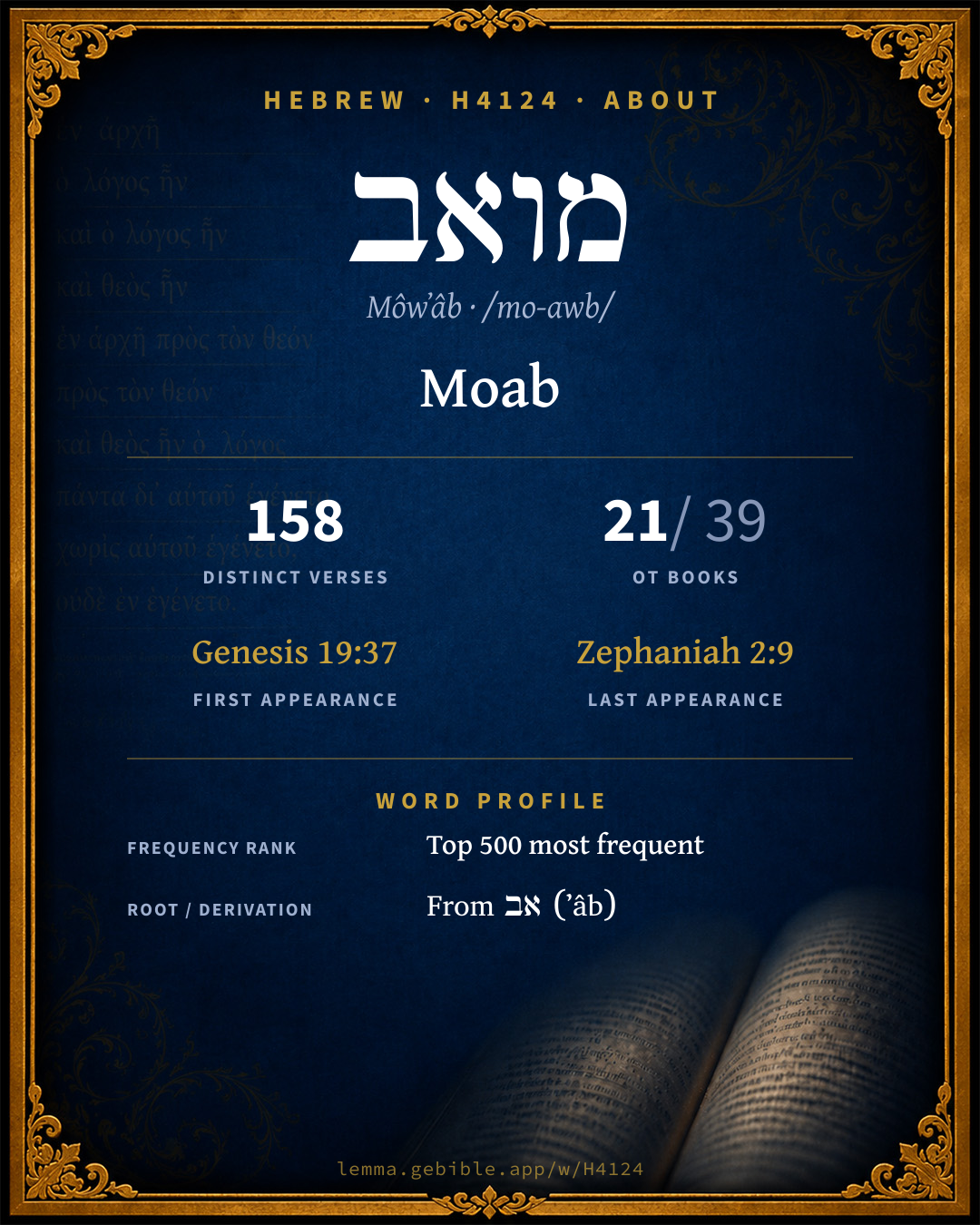
מוֹאָב
Moab
BDB lists 4 entries for ‘Moab’ fuller range ↓
Full lexicon entry — Brown-Driver-Briggs (BDB)
From Brown-Driver-Briggs (BDB)
Where this word appears
Grammar key — what these labels mean
Part of speech
- Noun
- A naming word — a person, place, thing, or idea.
Noun type
- Proper
- A name of a specific person, place, or people (e.g. Abraham, Zion, Israel).
Every verse where H4124 appears in the Book of Psalms — 3 distinct verses. Click any verse to open its interlinear word-by-word view. Verse text shown in the World English Bible for context — . Each verse’s Hebrew form is shown with its reference; the English is not keyword-highlighted, since the data carries no word-level English alignment. Use “Compare translations” on any verse to read it across multiple English versions. This concordance covers the Hebrew Bible; Septuagint (Greek Old Testament) occurrences are not indexed here.
Psalms
- Psalms 60:8 מוֹאָ֤ב n Proper Moab is my wash basin. I will throw my shoe on Edom. I shout in triumph over Philistia."
- Psalms 83:6 מוֹאָ֥ב n Proper The tents of Edom and the Ishmaelites; Moab, and the Hagrites;
- Psalms 108:9 מוֹאָ֤ב n Proper Moab is my wash pot. I will toss my sandal on Edom. I will shout over Philistia."
About this entry
At a glance — auto-summarized from this page’s data, not written by a person. Every figure links to its source below. This summary describes the numbers; it doesn’t interpret them.
מואב — transliterated Môwʼâb — is a Hebrew name carrying the sense “Moab.” Debuting at Genesis 19:37, it then recurs through the corpus. The Hebrew Bible uses it across 158 verses — common. See 158-verse concordance and the renderings breakdown below.
Gloss history
Strong's 1890 vs modern scholarship
About this word
Strong's H4124 catalogs a Hebrew word from the Hebrew Old Testament.
These counts are not copied from any lexicon or concordance. They are computed here, from the morphology-tagged Hebrew Old Testament. What Lemma adds →
- 158
- distinct verses
- The word appears in 158 distinct verses.
- 21 / 39
- OT books
- The word appears in 21 of 39 Old Testament books.
- #258
- by frequency
- Top 500 most frequent Hebrew words (rank 258 of 8,640 Hebrew words by occurrence).
View all 158 occurrences in the concordance →
By section of the Old Testament
By traditional corpus
Conventional, traditional groupings — biblical authorship is debated, so this is a traditional corpus grouping, not an authorship claim. Each share is this word’s portion of its verses in that division of the Hebrew canon. Each figure is a share of the word’s 158 distinct verses.
- Prophets (Nevi'im) 95 verses · 60%
- Torah (Pentateuch) 43 verses · 27%
- Writings (Ketuvim) 20 verses · 13%
How translations render this word
Counts come from each version’s own published word-to-Strong’s tagging or interlinear alignment — an approximate guide to how each version renders this word, not a word-level alignment the data otherwise carries. Because each total is that version’s own tagged count, the per-version totals vary from one another and need not match the appearance or distinct-verse counts above. These counts may also differ from a printed concordance because Lemma counts each distinctly tagged rendering and does not collapse phrase taggings into a single head-word total. This is a fixed set of word-tagged versions (KJV, ASV, BSB, ULT) and does not change with the reading translation you choose elsewhere. Each version’s license is shown beside its name below (and on Sources).
- King James Version: Moab 149×, Moabites 14×, Against moab 3×
- American Standard Version: Moab 143×, Moabites 9×, Thee 3×
- Berean Standard Bible: Moab 144×, Moabites 17×, Moab’s 5×
- unfoldingWord Literal Text: Moab 143×
King James Version Public Domain
Renders H4124 across 181 tagged occurrences — most commonly:
Plus 13 renderings that appear only once — usually multi-word phrases or single function words the recovered tagging swept in, not distinct renderings.
American Standard Version Public Domain
Renders H4124 across 181 tagged occurrences — most commonly:
Plus 22 renderings that appear only once — usually multi-word phrases or single function words the recovered tagging swept in, not distinct renderings.
Berean Standard Bible Public Domain
Renders H4124 across 178 tagged occurrences — most commonly:
Plus 8 renderings that appear only once — usually multi-word phrases or single function words the recovered tagging swept in, not distinct renderings. Not rendered by a distinct English word in 3 further occurrences.
unfoldingWord Literal Text CC BY-SA 4.0
Renders H4124 across 146 tagged occurrences — most commonly:
Plus 3 renderings that appear only once — usually multi-word phrases or single function words the recovered tagging swept in, not distinct renderings.
Senses in the full BDB
What do BDB’s symbols mean?
BDB uses these scholarly abbreviations:
| Symbol | Meaning |
|---|---|
| 𝔊 | the Septuagint (the ancient Greek translation, LXX) |
| 𝔙 | the Vulgate (the Latin translation) |
| 𝔖 | the Syriac version (the Peshitta) |
| 𝔗 | the Targum (the Aramaic translation) |
| ψ | the Psalms |
| √ | root (the underlying root or stem) |
| ‖ | parallel passage (a synonymous or contrasted parallel) |
| † | the dagger: every passage where the word occurs is cited |
The 4 senses and sub-senses the full Brown-Driver-Briggs lexicon distinguishes for this word, in lexicon order (not ranked by frequency), with BDB’s own verbatim wording and sub-sense lettering. Shown in Hebrew script with BDB’s own scholarly abbreviations. The condensed entry is in the Lexicon Entry tab. See also the Forms in the corpus table below.
- 1. Moab as son of Lot by his elder daughter according to Gn 19:37. e.g. Genesis 19:37
- 2. Moab:
- a. = nation of which Lot’s son is represented as ancestor Gn 19:37 Nu 21:29; 22:3(×2) Am 2:1, 2 Je 48:1, 2 + 30 times Je 48 + often; having a king, Nu 21:26; 22:4, 10 Ju 3:12 1 S 12:9 +. e.g. Genesis 19:37
- b. = territory of Moab Nu 21:11, 13(×2), 15 +; שְׂדֵה מ׳ †Gn 36:25 Nu 15:20 Ru 1:1, 2, 6(×2), 22; 2:6; 4:3 1 Ch 1:46; 8:8; אֶרֶץ מ׳ †Dt 1:5; 28:69; 32:49; 34:5, 6 Ju 11:15, 18(×2) Je 48:24, 33; מִדְבַּר מ׳ †Dt 2:8; עַרְבוֹת מ׳ †Nu 22:1; 26:3, 63; 31:12; 33:48, 49, 50; 35:1; 36:13; Dt 34:1, 8 Jos 13:32. e.g. Numbers 21:11
Senses from the full Brown-Driver-Briggs lexicon (Brown, Driver, Briggs; Oxford 1906 — public domain), digitized via Sefaria, supplemented by the OpenScriptures HebrewLexicon (CC BY 4.0). Full attribution on Sources.
Word origin
n.pr. gent. et terr. Moab (MI 1, 2, 5, 6, 12, 20 מאב; Assyrian Maʾaba, Maʾbu, Muʾâba, etc., Schr COT Gloss., and on Gn 19, 37 DlPar. 294 f., 296;—on etym. cf. LagBN 90 Anm., NeSK 1892, 573, GrayProp. N. 25);—מו׳ Gn 19:37 + 178 times; מֹאָב 2 S 8:12; 𝔊 Μωαβ;—
— Brown-Driver-Briggs (Oxford 1906, public domain), digitized via Sefaria, supplemented by the OpenScriptures HebrewLexicon (CC BY 4.0). See Sources.
Derived from אב (ʼâb) (H1) — father.
Jastrow Dictionary
A second Hebrew/Aramaic lexicon for comparison, covering Aramaic and post-biblical (Talmudic, Targumic, Midrashic) usage that the biblical-Hebrew BDB does not. Matched by lemma rather than by Strong’s number, so a lemma may carry more than one Jastrow headword (shown separately below), and the entries cover usage well beyond the Bible.
מוֹאָב
- (b. h.) Moab, son of Lot; the Moabite people. Gen. R. s. 51, end בזכות מ׳ מי אב through the merits of Moab, that is mi ab, of him who is called father (Abraham). Num. R. s. 20 נתחברו מ׳ עם מדין Moab and Midian formed an alliance; a. fr.—Targ. Y. Num. XXV, 15. Targ. Gen. XIX, 37; a. fr.
A Dictionary of the Targumim, the Talmud Babli and Yerushalmi, and the Midrashic Literature (Marcus Jastrow; London, Luzac, 1903) — Public Domain. Digitized via Sefaria. Digitized via Sefaria. Full attribution on Sources.
Forms in the corpus
The 29 distinct written forms H4124 takes in the Hebrew Bible, most frequent first — each parse links to that state’s occurrences in the concordance. Hebrew forms include their vowel points and cantillation, so a single lemma takes many written forms.
| Form | Parsing | Example | Uses |
|---|---|---|---|
| מוֹאָ֔ב | Noun, Proper | Amos 2:1 | 47 |
| מוֹאָ֖ב | Noun, Proper | Deuteronomy 2:18 | 25 |
| מוֹאָב֙ | Noun, Proper | Deuteronomy 34:1 | 21 |
| מוֹאָ֑ב | Noun, Proper | Deuteronomy 1:5 | 19 |
| מוֹאָֽב | Noun, Proper | Deuteronomy 2:8 | 18 |
| מוֹאָ֛ב | Noun, Proper | 2 Kings 13:20 | 9 |
| מוֹאָ֗ב | Noun, Proper | 1 Samuel 22:3 | 7 |
| לְ/מוֹאָ֖ב | Noun, Proper | 1 Chronicles 4:22 | 4 |
| מוֹאָ֜ב | Noun, Proper | Jeremiah 48:11 | 4 |
| לְ/מוֹאָ֔ב | Noun, Proper | Isaiah 16:11 | 3 |
| בְּ/מוֹאָ֣ב | Noun, Proper | 1 Samuel 14:47 | 2 |
| וּ/מִ/מּוֹאָב֙ | Noun, Proper | 1 Chronicles 18:11 | 2 |
| מוֹאָ֣ב | Noun, Proper | Isaiah 15:2 | 2 |
| מוֹאָ֤ב | Noun, Proper | Psalms 60:8 | 2 |
| מוֹאָ֥ב | Noun, Proper | 2 Kings 3:22 | 2 |
| בְּ/מוֹאָ֔ב | Noun, Proper | Amos 2:2 | 1 |
| וּ/בְ/מוֹאָ֖ב | Noun, Proper | Ezekiel 25:11 | 1 |
| וּ/לְ/מוֹאָ֥ב | Noun, Proper | Jeremiah 48:31 | 1 |
| וּ/מוֹאָ֔ב | Noun, Proper | Daniel 11:41 | 1 |
| וּ/מוֹאָ֛ב | Noun, Proper | 2 Chronicles 20:23 | 1 |
| וּ/מוֹאָ֜ב | Noun, Proper | 2 Chronicles 20:10 | 1 |
| וּ/מוֹאָב֙ | Noun, Proper | Isaiah 11:14 | 1 |
| לְ/מוֹאָ֡ב | Noun, Proper | Jeremiah 48:1 | 1 |
| לְ/מוֹאָ֣ב | Noun, Proper | Isaiah 15:5 | 1 |
| לְ/מוֹאָב֙ | Noun, Proper | Jeremiah 48:36 | 1 |
| מוֹאָ֞ב | Noun, Proper | Zephaniah 2:9 | 1 |
| מוֹאָ֧ב | Noun, Proper | 2 Chronicles 20:22 | 1 |
| מוֹאָב֒ | Noun, Proper | Jeremiah 48:2 | 1 |
| מוֹאָב֩ | Noun, Proper | 2 Chronicles 20:1 | 1 |
Same root — word family
Other BDB entries built from the same root as H4124, grouped by Strong’s listed origin. These share a root / origin per the lexicon — not necessarily a shared meaning. Each links to that word’s own entry.
Derives from
Shares the same root
Proper names from this root
People and places named from this root — a name, not an additional meaning of the word.
- אבי ʼĂbîy H21 Abi
- אביאל ʼĂbîyʼêl H22 Abiel
- אביאסף ʼĂbîyʼâçâph H23 Abiasaph
- אבי גבעון ʼĂbîy Gibʻôwn H25 father of Gibeon
- אביגיל ʼĂbîygayil H26 Abigail
- אבידן ʼĂbîydân H27 Abidan
- אבידע ʼĂbîydâʻ H28 Abida
- אביה ʼĂbîyâh H29 Abijah
- אביהוא ʼĂbîyhûwʼ H30 Abihu
- אביהוד ʼĂbîyhûwd H31 Ahihud
- אביהיל ʼĂbîyhayil H32 Abihail
- אביטוב ʼĂbîyṭûwb H36 Abitub
- אביטל ʼĂbîyṭâl H37 Abital
- אבים ʼĂbîyâm H38 Abijam
- אבימאל ʼĂbîymâʼêl H39 Abimael
- אבימלך ʼĂbîymelek H40 Abimelech
- אבינדב ʼĂbîynâdâb H41 Abinadab
- אבינעם ʼĂbîynôʻam H42 Abinoam
- אביעזר ʼĂbîyʻezer H44 Abiezer
- אביעלבון ʼĂbîy-ʻalbôwn H45 Abialbon
- אבירם ʼĂbîyrâm H48 Abiram
- אבישג ʼĂbîyshag H49 Abishag
- אבישוע ʼĂbîyshûwaʻ H50 Abishua
- אבישור ʼĂbîyshûwr H51 Abishur
- מואבי Môwʼâbîy H4125 Moabite
+6 more proper names from this root (not shown).
Compare all same-root words → Showing 4 of 35 — not the complete family. 31 of the same-root words are proper names (people or places). They share a root, not necessarily a meaning.
Bible dictionary
Public-domain dictionary articles matched to this entry by name (Moab). A biblical name can be shared by more than one person or place, so an article may treat several.
Easton's Bible Dictionary · M. G. Easton, 1897
The seed of the father, or, according to others, the desirable land, the eldest son of Lot (Gen. 19:37), of incestuous birth.
(2.) Used to denote the people of Moab (Num. 22:3-14; Judg. 3:30; 2 Sam. 8:2; Jer. 48:11, 13).
(3.) The land of Moab (Jer. 48:24), called also the "country of Moab" (Ruth 1:2, 6; 2:6), on the east of Jordan and the Dead Sea, and south of the Arnon (Num. 21:13, 26). In a wider sense it included the whole region that had been occupied by the Amorites. It bears the modern name of Kerak.
In the Plains of Moab, opposite Jericho (Num. 22:1; 26:63; Josh. 13:32), the children of Israel had their last encampment before they entered the land of Canaan. It was at that time in the possession of the Amorites (Num. 21:22). "Moses went up from the plains of Moab unto the mountain of Nebo, to the top of Pisgah," and "died there in the land of Moab, according to the word of the Lord" (Deut. 34:5, 6). "Surely if we had nothing else to interest us in the land of Moab, the fact that it was from the top of Pisgah, its noblest height, this mightiest of the prophets looked out with eye undimmed upon the Promised Land; that it was here on Nebo, its loftiest mountain, that he died his solitary death; that it was here, in the valley over against Beth-peor, he found his mysterious sepulchre, we have enough to enshrine the memory in our hearts."
Smith's Bible Dictionary · William Smith, 1863
(of his father), Mo'abites. Moab was the son of the Lot's eldest daughter, the progenitor of the Moabites. Zoar was the cradle of the race of Lot. From this centre the brother tribes spread themselves. The Moabites first inhabited the rich highlands which crown the eastern side of the chasm of the Dead Sea, extending as far north as the mountain of Gilead, from which country they expelled the Emims, the original inhabitants, (2:11) but they themselves were afterward driven southward by the warlike Amorites, who had crossed the Jordan, and were confined to the country south of the river Arnon, which formed their northern boundary. (Numbers 21:13; Judges 11:18) The territory occupied by Moab at the period of its greatest extent, before the invasion of the Amorites, divided itself naturally into three distinct and independent portions:-- (1) The enclosed corner or canton south of the Arnon was the "field of Moab." (Ruth 1:1,2,6) etc. (2) The more open rolling country north of the Arnon, opposite Jericho, and up to the hills of Gilead, was the "land of Moab." (1:5; 32:49) etc. (3) The sunk district in the tropical depths of the Jordan valley. (Numbers 22:1) etc. The Israelites, in entering the promised land, did not pass through the Moabites, (Judges 11:18) but conquered the Amorites, who occupied the country from which the Moabites had been so lately expelled. After the conquest of Canaan the relations of Moab with Israel were of a mixed character, sometimes warlike and sometimes peaceable. With the tribe of Benjamin they had at least one severe struggle, in union with their kindred the Ammonites. (Judges 3:12-30) The story of Ruth, on the other hand, testifies to the existence of a friendly intercourse between Moab and Bethlehem, one of the towns of Judah. By his descent from Ruth, David may be said to have had Moabite blood in his veins. He committed his parents to the protection of the king of Moab, when hard pressed by Saul. (1 Samuel 22:3,4) But here all friendly relations stop forever. The next time the name is mentioned is in the account of David's war, who made the Moabites tributary. (2 Samuel 8:2; 1 Chronicles 18:2) At the disruption of the kingdom Moab seems to have fallen to the northern realm. At the death of Ahab the Moabites refused to pay tribute and asserted their independence, making war upon the kingdom of Judah. (2 Chronicles 22:1) ... As a natural consequence of the late events, Israel, Judah and Edom united in an attack on Moab, resulting in the complete overthrow of the Moabites. Falling back into their own country, they were followed and their cities and farms destroyed. Finally, shut up within the walls of his own capital, the king, Mesha, in the sight of the thousands who covered the sides of that vast amphitheater, killed and burnt his child as a propitiatory sacrifice to the cruel gods of his country. Isaiah, chs. (Isaiah 15,16,25:10-12) predicts the utter annihilation of the Moabites; and they are frequently denounced by the subsequent prophets. For the religion of the Moabites see Chemosh; Molech; Peor. See also Tristram's "Land of Moab." Present condition.--(Noldeke says that the extinction of the Moabites was about A.D. 200, at the time when the Yemen tribes Galib and Gassara entered the eastern districts of the Jordan. Since A.D. 536 the last trace of the name Moab, which lingered in the town of Kir-moab, has given place to Kerak, its modern name. Over the whole region are scattered many ruins of ancient cities; and while the country is almost bare of larger vegetation, it is still a rich pasture-ground, with occasional fields of grain. The land thus gives evidence of its former wealth and power.--ED.)
Hitchcock's Bible Names Dictionary · Roswell D. Hitchcock, 1869
of his father
Classic public-domain reference works; full attribution on Sources.
Septuagint verse parallels
This word appears in 135 verses that also exist in the Greek Old Testament (Septuagint), out of the 158 Hebrew verses it occurs in. You can read those verses in Greek by switching the Old Testament edition to the Septuagint.
Read these verses in the Septuagint
- Genesis 19:37
- Exodus 15:15
- Numbers 21:11
- Deuteronomy 1:5
- Joshua 13:32
- Judges 3:12
- Ruth 1:1
- 1 Samuel 12:9
- 2 Samuel 8:2
- 1 Kings 11:7
- 2 Kings 1:1
- 1 Chronicles 4:22
This is a verse-level parallel only — the same verses exist in both the Hebrew and Greek Old Testaments. No word-level Hebrew↔Greek correspondence is claimed: the data carries no such alignment, so no Greek word is shown as this Hebrew word’s translation. Coverage is not total — the Septuagint omits the deuterocanon and renumbers the Psalms, so some Hebrew verses have no direct Greek parallel.