Deuteronomy 34:8

Hebrew (Westminster Leningrad Codex) Deuteronomy 34:8 appears in the Hebrew Old Testament. The text above is from the Westminster Leningrad Codex. Each word links to its Strong’s number, a concise gloss, and parsing drawn from the Open Scriptures Hebrew Bible morphology. Click any word for its full Brown-Driver-Briggs (BDB) entry.
Download image
Cite this verse

Deuteronomy 34:8 (World English Bible). Public Domain. Lemma interlinear Bible study tool, https://lemma.gebible.app/v/deuteronomy/34/8.

Show BibTeX & RIS
BibTeX
RIS
English Translation
The children of Israel wept for Moses in the plains of Moab thirty days: so the days of weeping in the mourning for Moses were ended.
World English Bible · Public Domain
Download a study sheet

One document with this verse’s original text, its word-by-word gloss line, the meaning frame, cross-references with their text, attributed commentary, and full source and license credits — printable, and it pastes into notes with its structure intact.

This verse Autodidact and up

Study sheet (.html) Plain text (.txt)

A passage Seminary Student

Up to 50 verses in one chapter. A passage sheet keeps up to 6 commentary sources and 12 cross-references per verse, in the order this page ranks them, and says so on the sheet whenever that leaves anything out. Ask for a single verse and you get the Autodidact verse sheet above.

Everything on this page stays free to read, with no account — the sheet is a download of what is already on screen, not access to it.

Want to remove ads? Support Godless Engineer
Compare translations 3

The same verse in 3 English versions, stacked beneath the original-language interlinear above. Click any original word for its lexicon entry.

Each is an independent rendering of the whole verse — the interlinear is not word-aligned to these translations.

Highlighted words mark where these versions differ — a whole-verse word diff, not a word-by-word alignment.

  • World English Bible Public Domain
    The children of Israel wept for Moses in the plains of Moab thirty days: so the days of weeping in the mourning for Moses were ended.
  • King James Version Public Domain
    And the children of Israel wept for Moses in the plains of Moab thirty days: so the days of weeping and mourning for Moses were ended.
  • unfoldingWord Literal Text CC BY-SA 4.0
    And the sons of Israel mourned Moses in the plains of Moab 30 days, and the days of the tears of mourning Moses were finished.

unfoldingWord Literal Text — © unfoldingWord, licensed CC BY-SA 4.0. Word-aligned USFM3 via Door43 (git.door43.org/unfoldingWord/en_ult).

Versions to compare (up to 4)

3 of 4 selected

Show all 18 translations

Every available English version of this verse, each an independent rendering of the whole verse.

  • World English Bible Public Domain
    The children of Israel wept for Moses in the plains of Moab thirty days: so the days of weeping in the mourning for Moses were ended.
  • Berean Standard Bible Public Domain
    The Israelites grieved for Moses in the plains of Moab thirty days, until the time of weeping and mourning for Moses came to an end.
  • Majority Standard Bible Public Domain
    The Israelites grieved for Moses in the plains of Moab thirty days, until the time of weeping and mourning for Moses came to an end.
  • King James Version Public Domain
    And the children of Israel wept for Moses in the plains of Moab thirty days: so the days of weeping and mourning for Moses were ended.
  • American Standard Version (1901) Public Domain
    And the children of Israel wept for Moses in the plains of Moab thirty days: so the days of weeping in the mourning for Moses were ended.
  • Revised Version (1885) Public Domain
    And the children of Israel wept for Moses in the plains of Moab thirty days: so the days of weeping in the mourning for Moses were ended.
  • Geneva Bible (1599) Public Domain
    And the children of Israel wept for Moses in the plaine of Moab thirtie dayes: so the dayes of weeping and mourning for Moses were ended.
  • Douay-Rheims (1899) Public Domain
    And the children of Israel mourned for him in the plains of Moab thirty days: and the days of their mourning in which they mourned for Moses were ended.
  • Young's Literal Translation Public Domain
    And the sons of Israel bewail Moses in the plains of Moab thirty days; and the days of weeping `and' mourning for Moses are completed.
  • Literal Standard Version CC BY-SA 4.0
    And the sons of Israel lament Moses in the plains of Moab [for] thirty days; and the days of weeping [and] mourning for Moses are completed.
  • Unlocked Literal Bible CC BY-SA 4.0
    The people of Israel mourned for Moses in the plains of Moab for thirty days, and then the days of mourning for Moses were finished.
  • unfoldingWord Literal Text CC BY-SA 4.0
    And the sons of Israel mourned Moses in the plains of Moab 30 days, and the days of the tears of mourning Moses were finished.
  • Darby Bible Public Domain
    And the children of Israel wept for Moses in the plains of Moab thirty days; and the days of weeping and mourning for Moses were ended.
  • World Messianic Bible Public Domain
    The children of Israel wept for Moses in the plains of Moab thirty days, until the days of weeping in the mourning for Moses were ended.
  • Webster's Bible Public Domain
    And the children of Israel wept for Moses in the plains of Moab thirty days: so the days of weeping and mourning for Moses were ended.
  • Free Bible Version CC BY-SA 4.0
    The Israelites mourned for Moses on the plains of Moab for thirty days, until the time of mourning was over.
  • Bible in Basic English Public Domain
    For thirty days the children of Israel were weeping for Moses in the table-lands of Moab, till the days of weeping and sorrow for Moses were ended.
  • JPS Tanakh (1917) Public Domain
    And the children of Israel wept for Moses in the plains of Moab thirty days; so the days of weeping in the mourning for Moses were ended.

Literal Standard Version (2020), Covenant Press — licensed CC BY-SA 4.0. Text via the HelloAO Bible API (eBible.org). Unlocked Literal Bible (unfoldingWord) — licensed CC BY-SA 4.0. Text via the HelloAO Bible API (eBible.org). unfoldingWord Literal Text — © unfoldingWord, licensed CC BY-SA 4.0. Word-aligned USFM3 via Door43 (git.door43.org/unfoldingWord/en_ult). Free Bible Version, Dr. Jonathan Gallagher — licensed CC BY-SA 4.0. Text via the HelloAO Bible API (eBible.org).

Word by word

More ways to search: Search by grammar → Find every occurrence → Compare this word →

Practice this passage: Drill this verse → Learn its vocabulary →

אֵ֥בֶל
ʼêbel
H60
“mourning of”
Noun, Common, Masculine, Singular, Construct
Part of Speech
Noun
Type
Common
Gender
Masculine
Number
Singular
State
Construct
Full BDB Definition

Origin: from H56

TWOT: 6a

mourning - for the dead - for rites of mourning (metaphorically) - mourning garb - period of mourning
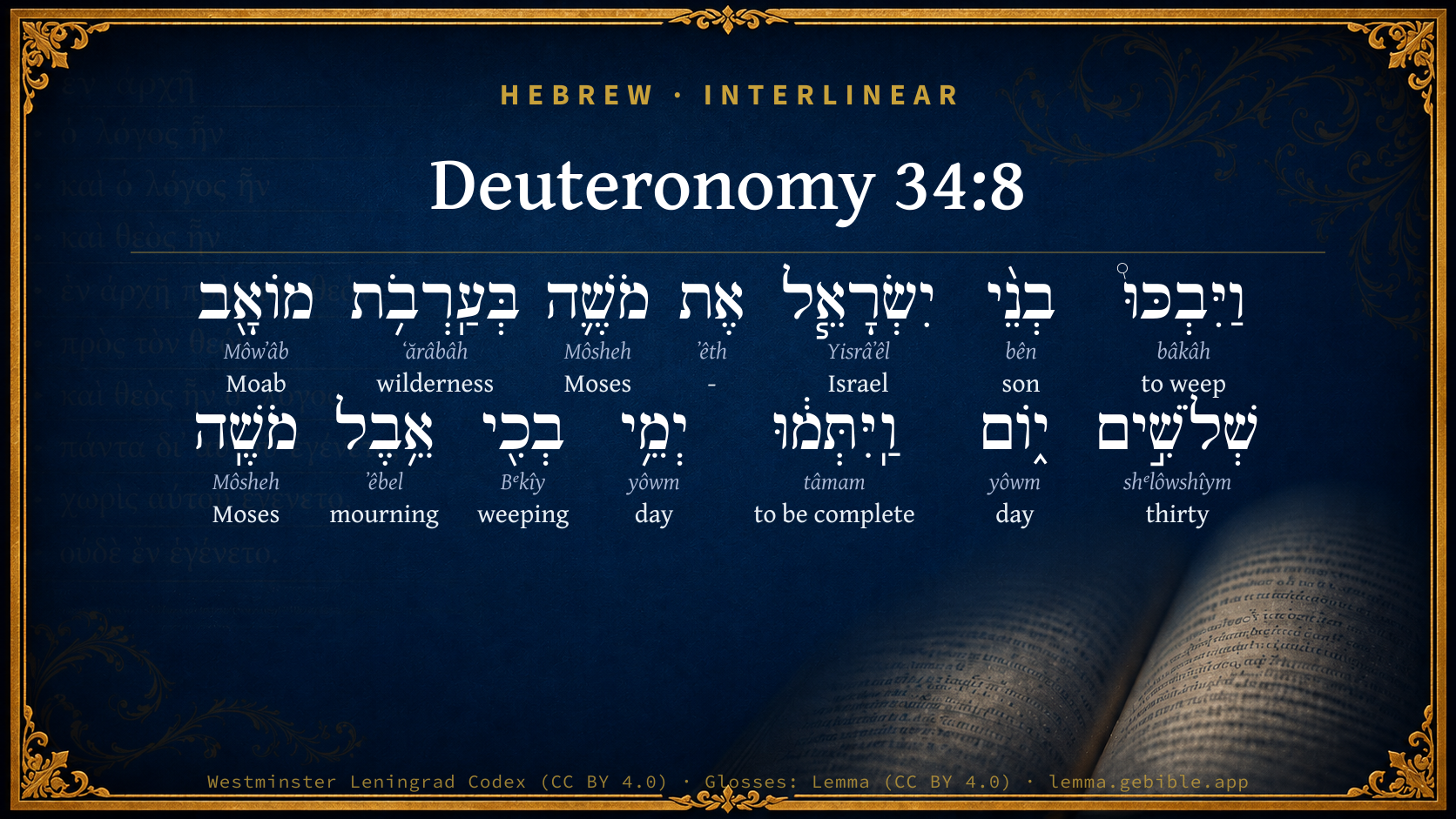
  1. וַיִּבְכּוּ֩ bâkâh H1058 “and · to weep” Conjunction + Verb, Qal, Sequential Imperfect, 3rd Person, Masculine, Plural
  2. בְנֵ֨י bên H1121 “sons of” Noun, Common, Masculine, Plural, Construct
  3. יִשְׂרָאֵ֧ל Yisrâʼêl H3478 “Israel” Noun, Proper
  4. אֶת ʼêth H853 “-” Particle, Direct Object
  5. מֹשֶׁ֛ה Môsheh H4872 “Moses” Noun, Proper
  6. בְּעַֽרְבֹ֥ת ʻărâbâh H6160 “in/at · wildernesses of” Preposition + Noun, Common, Feminine, Plural, Construct
  7. מוֹאָ֖ב Môwʼâb H4124 “Moab” Noun, Proper
  8. שְׁלֹשִׁ֣ים shᵉlôwshîym H7970 “thirty” Adjective, Cardinal number, Both, Plural, Absolute
  9. י֑וֹם yôwm H3117 “day” Noun, Common, Masculine, Singular, Absolute
  10. וַֽיִּתְּמ֔וּ tâmam H8552 “and · to be complete” Conjunction + Verb, Qal, Sequential Imperfect, 3rd Person, Masculine, Plural
  11. יְמֵ֥י yôwm H3117 “days of” Noun, Common, Masculine, Plural, Construct
  12. בְכִ֖י Bᵉkîy H1065 “weeping of” Noun, Common, Masculine, Singular, Construct
  13. מֹשֶֽׁה Môsheh H4872 “Moses” Noun, Proper

About this verse

These counts appear in no published source. They are computed here, from the morphology-tagged text and Lemma’s own curated glosses. What Lemma adds →

14
words
12
distinct lemmas
Pentateuch
section

Notable vocabulary

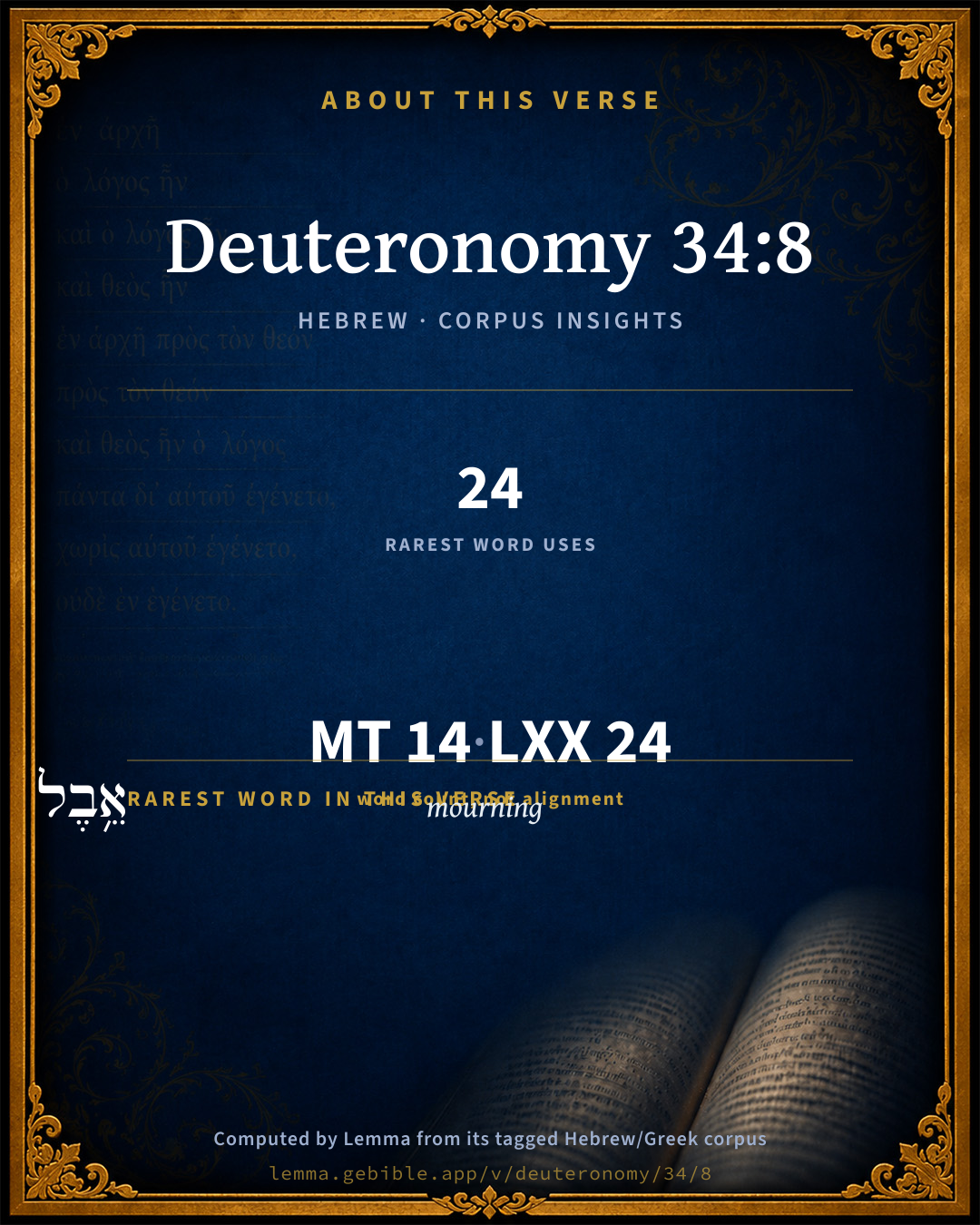
The rarest word here is אֵ֥בֶל mourning H60 — appearing just 24 times in the whole Hebrew Bible.

Shared distinctive vocabulary

אֵ֥בֶל mourning H60 occurs in 22 verses of the Hebrew Bible. Also found in:

Grammatical profile

  • 2 verbs
  • 10 nouns
  • 1 adjective
  • 1 particle

Verb forms

  • וַיִּבְכּוּ֩ Qal · Sequential Imperfect
  • וַֽיִּתְּמ֔וּ Qal · Sequential Imperfect

Repetition

Words recur within this verse — often emphatic in Hebrew:

  • מֹשֶׁ֛ה Moses H4872 ×2
  • י֑וֹם day H3117 ×2

Hebrew & Septuagint length

In English translation the verse runs 26 words from the Hebrew and 29 from the Septuagint (LXX English) — closely comparable.

A rough comparison of the two English renderings, which tokenize alike — not a word-level alignment.

Word counts can differ between the Hebrew and the Greek without any difference in meaning — e.g. the Hebrew direct-object marker אֵת has no separate Greek word, and Greek often adds the article ὁ.

In the original languages it is 14 Hebrew tokens and 24 Greek tokens — but the two are counted differently (Hebrew bundles its prefixes and suffixes into one token; the Greek is in lemma form), so that isn’t a like-for-like length.

Cross-references

6

Topical passages linked to Deuteronomy 34:8 in the Treasury of Scripture Knowledge — connected by theme and wording, ordered by reader-vote popularity; previews shown in the World English Bible.

  • Genesis 50:3 Forty days were fulfilled for him, for that is how many the days it takes to embalm. The Egyptians wept for him for seventy days.
  • Numbers 20:29 When all the congregation saw that Aaron was dead, they wept for Aaron thirty days, even all the house of Israel.
  • Genesis 50:10 They came to the threshing floor of Atad, which is beyond the Jordan, and there they lamented with a very great and sore lamentation. He mourned for his father seven days.
  • 1 Samuel 25:1 Samuel died; and all Israel gathered themselves together, and lamented him, and buried him in his house at Ramah. David arose, and went down to the wilderness of Paran.
  • Isaiah 57:1 The righteous perishes, and no man lays it to heart; and merciful men are taken away, none considering that the righteous is taken away from the evil [to come].
  • Acts 8:2 Devout men buried Stephen, and lamented greatly over him.

Cross-references courtesy of OpenBible.info (CC BY 4.0).

Hebrew and Greek witnesses Masoretic Hebrew ↔ Greek Septuagint

The same verse in the two great witnesses to the Old Testament, shown verse-for-verse.

These are two independent witnesses, not word-aligned to each other, and the Septuagint is shown in lemma (dictionary) form.

Hebrew Deuteronomy 34:8 Masoretic · Westminster Leningrad Codex

וַיִּבְכּוּ֩ בְנֵ֨י יִשְׂרָאֵ֧ל אֶת מֹשֶׁ֛ה בְּעַֽרְבֹ֥ת מוֹאָ֖ב שְׁלֹשִׁ֣ים י֑וֹם וַֽיִּתְּמ֔וּ יְמֵ֥י בְכִ֖י אֵ֥בֶל מֹשֶֽׁה

The children of Israel wept for Moses in the plains of Moab thirty days: so the days of weeping in the mourning for Moses were ended.

World English Bible · Public Domain

Greek LXX Deuteronomy 34:8 Septuagint · lemma form

καί κλαίω ὁ υἱός ἰσραήλ ὁ μωυσῆς ἐν ἀραβώθ μωαβ ἐπί ὁ ἰορδάνης κατά ιεριχω τριάκοντα ἡμέρα καί συντελέω ὁ ἡμέρα πένθος κλαυθμός μωυσῆς

And the children of Israel wept for Moses in Araboth of Moab at Jordan near Jericho thirty days; and the days of the sad mourning for Moses were completed.

LXX2012 (modern English Septuagint) · Public Domain

Hebrew: Westminster Leningrad Codex (CC BY 4.0). Greek: Septuagint (public domain); English from LXX2012 (modern English Septuagint) (Public Domain). How the Septuagint differs from the Hebrew →

Targum (Aramaic paraphrase)

2

The Targum is the ancient Jewish Aramaic paraphrase of the Hebrew Scriptures — an interpretive translation, not the Hebrew text itself. Onkelos (literal) and Pseudo-Jonathan (expansive) render the Torah, and Jonathan the Prophets. Coverage is partial: where no permissively-licensed English translation exists for a verse, only the Aramaic is shown. This is verse-level text, not a word-by-word alignment to the Hebrew.

  1. Targum Onkelos Torah (Genesis–Deuteronomy)
    וּבְכוֹ בְנֵי יִשְׂרָאֵל יָת מֹשֶׁה בְּמֵישְׁרַיָא דְמוֹאָב תְּלָתִין יוֹמִין וּשְׁלִימוּ יוֹמֵי בָכִיתָא אֶבְלָא דְמֹשֶׁה

    (no public-domain English translation for this verse)

    Targum Onkelos — Aramaic: “Onkelos Genesis” (public domain); “Onkelos Exodus” (public domain); “Onkelos Leviticus” (public domain); “Onkelos Numbers” (public domain); “Onkelos Deuteronomy” (public domain). English: “Sefaria Community Translation” (CC0 1.0 (public-domain dedication)); “J.W. Etheridge. The Targums of Onkelos and Jonathan Ben Uzziel on the Pentateuch. London: Longmans, Green, 1862” (public domain). Text via Sefaria.

  2. Targum Pseudo-Jonathan Torah (Genesis–Deuteronomy)
    וּבְכוֹן בְּנֵי יִשְרָאֵל יַת משֶׁה בְּמֵישְׁרַיָא דְמוֹאָב תְּלָתִין יוֹמִין וּשְׁלִימוּ יוֹמֵי בָּכוּתָא דְאֶבְלֵיהּ דְמשֶׁה בִּתְמַנְיָא בְּנִיסָן וּבְתִשְׁעָא בְּנִיסָן אַתְקִינוּ עַמָא בֵּית יִשְרָאֵל יַת מָאנֵיהוֹן וּטְכוּסוּ יַת בְּעִירֵיהוֹן וַעֲבָרוּ יַת יוֹרְדְנָא בְּעַשְרָא בְּנִיסָן וּפְסַק לְהוֹן מַנָא בְּשִׁיתֵיסַר בְּנִיסָן הִשְׁתְּכָחוּ אָכְלִין יַת מַנָא בִּזְכוּתֵיהּ דְמשֶׁה בָּתַר דְשָׁכִיב תְּלָתִין וְשַׁבְעָא יוֹמִין

    And the children of Israel wept for Mosheh in the plains of Moab thirty days; and the days of weeping in the mourning for Mosheh were completed on the eighth of the month of Nisan. And on the ninth of Nisan the people of Beth Israel prepared their vessels and set their cattle in order, and passed over the Jordan on the tenth of Nisan. And the manna ceased for them on the sixteenth of Nisan. They found manna to eat thirty_seven days after the death of Mosheh, for the sake of his righteousness.

    Targum Pseudo-Jonathan — Aramaic: “Targum Jonathan on Genesis” (public domain); “Targum Jonathan on Exodus” (public domain); “Targum Jonathan on Leviticus” (public domain); “Targum Jonathan on Numbers” (public domain); “Targum Jonathan on Deuteronomy” (public domain). English: “The Targum of Jonathan ben Uzziel, trans. J. W. Etheridge, London, 1862” (public domain). Text via Sefaria.

Commentary

Notes on Deuteronomy 34:8 from classic Christian and Jewish commentators (each source and its license shown beneath its notes). The classic Christian expositions comment on the surrounding passage and are grouped to its opening verse, so a note may address several verses; the Jewish commentaries on the Tanakh (Rashi and others) are per-verse, so they appear only where the commentator wrote on this verse.

Lemma curates 59 commentaries, every one of them public domain or Creative Commons licensed, each selected and text-cleaned for this edition rather than reprinted as found. About our sources →

Trapp's Complete Commentary

John Trapp

Deu 34:8 And the children of Israel wept for Moses in the plains of Moab thirty days: so the days of weeping [and] mourning for Moses were ended.

Ver. 8. And the children of Israel wept.] And were ready to wish, likely, as the Romans did for Augustus, that either he had never been born, or never died.

Thirty days.] As before they had done for Aaron. {Num 20:29} The Jewish doctors tell us that Moses was born on the seventh day of the month Adar (which answereth to our February), and that on the seventh day of the same month Adar he was taken out of the world, being exactly 120 years old. One third part of his days he spent in Egypt, another in Midian, and the last in conducting this people to the borders of Canaan, as Josephus {a} well observeth. The Jews to this day keep a solemn fast on the seventh of Adar, in remembrance of his death.

{a} Antiq., lib. iv. ad fin.

John Trapp, A Commentary or Exposition upon All the Books of the Old and New Testament (1647–1656) — public domain. Text from a community e-Sword module.

Joseph Benson's Commentary

Deu 34:8. Thirty days — Which was the usual time of mourning for persons of high place and eminence. It is a debt owing to the surviving honour of deceased worthies, to follow them with our tears, as those who loved and valued them, are sensible of the loss of them, and humbled for the sins which have provoked God to deprive us of them.

Joseph Benson's Commentary on the Old and New Testaments (1811–1818) — public domain. Text from a community e-Sword module.

Jamieson, Fausset & Brown

Robert Jamieson, A. R. Fausset & David Brown

wept for Moses . . . thirty days--Seven days was the usual period of mourning, but for persons in high rank or official eminence, it was extended to thirty (Gen 50:3-10; Num 20:29).

Jamieson, Fausset & Brown — Commentary Critical and Explanatory on the Whole Bible (1871) — public domain (CC PDM 1.0). Text via the HelloAO Bible API.

Ellicott's Commentary for English Readers

(8) The children of Israel wept for Moses . . . thirty days . . .—As they did for Aaron, his brother (Num_20:29). It is remarkable that the burial and the tomb of Aaron are only alluded to in Deu_10:6. (See Note and Excursus on that passage.) Miriam was buried in Kadesh (Num_20:1).

A Bible Commentary for English Readers, edited by Charles John Ellicott (1878–1897) — public domain. Text from a community e-Sword module.

The Cambridge Bible for Schools and Colleges

gen. ed. J. J. S. Perowne

8. the children of Israel wept … thirty days] So P, Num_20:29, of Aaron; plains of Moab again ‘arbôth Mo’ab, see Deu_34:1.

The Cambridge Bible for Schools and Colleges (gen. ed. J. J. S. Perowne; Cambridge University Press, 1878–1918) — public domain. Text from a community e-Sword module.

John Gill's Exposition

And the children of Israel wept for Moses in the plains of Moab thirty days,.... According both to Josephus (n) and the Samaritan Chronicle (o), they cried and wept in a very vehement manner, when he signified to them his approaching death, and took his leave of them; and when he was dead they mourned for him, in a public manner, the space of time here mentioned, the time of mourning for his brother Aaron, Num 20:29,

so the days of weeping and mourning for Moses were ended; on the eighth of Nisan or March, as says the Targum of Jonathan, and on the "ninth" they prepared their vessels and their cattle for a march, and on the tenth passed over Jordan, and on the "sixteenth" the manna ceased, according to the said paraphrase.

(n) Ut supra. (De Bello Jud. l. 4. c. 8. sect. 49.) (o) Apud Hottinger, p. 456.

John Gill's Exposition of the Whole Bible (1746–1763) — public domain (CC PDM 1.0). Text via the HelloAO Bible API.

Haydock's Catholic Bible Commentary

Days, as they had done for Mary [Miriam] and for Aaron: (Josephus) the usual term was only seven days. (Calmet) --- The Jews would probably have prolonged their mourning for Moses forty days, in honour of the years of his government, if they had not been ordered to cross the Jordan. (Salien)

George Leo Haydock (1774–1849), Haydock's Catholic Family Bible and Commentary, 1859 edition — public domain. Excludes Psalms (Douay-Rheims chapter numbering differs from Protestant) and Deuterocanonical books (Catholic canon only).

Matthew Poole's English Annotations

Thirty days was the usual time of mourning for persons of high place and eminency. See Gen 1:3,10; Num 20:29. For others seven days sufficed.

Matthew Poole's English Annotations on the Holy Bible (1683–1685) — public domain. Text from a community e-Sword/MySword module.

Whedon's Commentary on the Bible

Daniel D. Whedon

8. The children of Israel wept for Moses in the plains of Moab thirty days — So “they mourned for Aaron thirty days, even all the house of Israel.” Num_20:29.

Daniel D. Whedon (gen. ed.), Commentary on the Old and New Testaments (1874–1909) — public domain. Text from a community e-Sword module.

The Pulpit Commentary

The people mourned for Moses thirty days, as they did for. (Num_20:29)

The Pulpit Commentary (1880–1919), ed. H.D.M. Spence-Jones & Joseph S. Exell — public domain. Text from a community e-Sword module.

John Wesley's Explanatory Notes

Thirty day's - Which was the usual time of mourning for persons of high place and eminency. 'Tis a debt owing to the surviving honour of deceased worthies, to follow them with our tears, as those who loved and valued them, are sensible of the loss, and humbled for the sins which have provoked God to deprive us of them.

John Wesley, Explanatory Notes Upon the Whole Bible (1754–1765) — public domain. Text via the GEBible commentary corpus.

Rashi

Rabbi Shlomo Yitzchaki (Rashi)

בני ישראל THE CHILDREN OF ISRAEL [WEPT] — i.e., the men; but regarding Aaron, — because he pursued peace, and made peace between a man and his fellow, and between a woman and her husband, it is stated, (Numbers 20:29) “The whole house of Israel [wept for him]” — the men and the women (Pirkei DeRabbi Eliezer 17).

Rashi on the Tanakh — English translations: “The Judaica Press complete Tanach with Rashi, translated by A. J. Rosenberg” (CC BY 4.0); “Pentateuch with Rashi's commentary by M. Rosenbaum and A.M. Silbermann, 1929-1934” (public domain); “The Metsudah Tanach series, Lakewood, N.J” (CC BY 4.0); and “The Book of Joshua, Metsudah Publications, 1997” (CC BY 4.0). Text via Sefaria.

Lesson kit

Teaching starters — assembled from the data on this page, not authored interpretation. Every prompt links to the verse data it draws on. Edit before teaching.

Deuteronomy, in the Pentateuch, opens this verse with 14 words (12 distinct Hebrew lemmas). Its most distinctive word is ʼêbel (“mourning”). A historical commentator’s framing appears above. Read the whole chapter for the surrounding context.

Discussion questions

  1. The word ʼêbel carries the sense “mourning.” How does it shape the verse?
  2. Genesis 27:41 shares the word «mourning» with this verse. How do the two illuminate each other?
  3. “Moses” occurs 2× in this one verse. What is the effect of the repetition?
  4. These translations render this verse differently; the difference is in the English rendering, not the original. What questions does that raise?
  5. The verb «וַיִּבְכּוּ֩» is Qal Sequential Imperfect. How does its form color the action?
  6. Reading how Trapp's Complete Commentary and Joseph Benson's Commentary read this verse, where do the two commentators agree and where do they part?

Things to notice

Reading settings

Reading text

Shown beneath each verse's original-language words.

Old Testament
Old Testament edition

Read the OT as the Masoretic Hebrew (MT) or the Greek Septuagint (LXX).

English shown for the Greek Septuagint (in the Hebrew ↔ Greek comparison).

Comparing translations? Open the Compare panel on any verse page to stack up to four side by side.