Numbers 23:17

Hebrew (Westminster Leningrad Codex) Numbers 23:17 appears in the Hebrew Old Testament. The text above is from the Westminster Leningrad Codex. Each word links to its Strong’s number, a concise gloss, and parsing drawn from the Open Scriptures Hebrew Bible morphology. Click any word for its full Brown-Driver-Briggs (BDB) entry.
Download image
Cite this verse

Numbers 23:17 (World English Bible). Public Domain. Lemma interlinear Bible study tool, https://lemma.gebible.app/v/numbers/23/17.

Show BibTeX & RIS
BibTeX
RIS
English Translation
He came to him, and, behold, he was standing by his burnt offering, and the princes of Moab with him. Balak said to him, What has Yahweh spoken?
World English Bible · Public Domain
Download a study sheet

One document with this verse’s original text, its word-by-word gloss line, the meaning frame, cross-references with their text, attributed commentary, and full source and license credits — printable, and it pastes into notes with its structure intact.

This verse Autodidact and up

Study sheet (.html) Plain text (.txt)

A passage Seminary Student

Up to 50 verses in one chapter. A passage sheet keeps up to 6 commentary sources and 12 cross-references per verse, in the order this page ranks them, and says so on the sheet whenever that leaves anything out. Ask for a single verse and you get the Autodidact verse sheet above.

Everything on this page stays free to read, with no account — the sheet is a download of what is already on screen, not access to it.

Want to remove ads? Support Godless Engineer
Compare translations 3

The same verse in 3 English versions, stacked beneath the original-language interlinear above. Click any original word for its lexicon entry.

Each is an independent rendering of the whole verse — the interlinear is not word-aligned to these translations.

Highlighted words mark where these versions differ — a whole-verse word diff, not a word-by-word alignment.

  • World English Bible Public Domain
    He came to him, and, behold, he was standing by his burnt offering, and the princes of Moab with him. Balak said to him, What has Yahweh spoken?
  • King James Version Public Domain
    And when he came to him, behold, he stood by his burnt offering, and the princes of Moab with him. And Balak said unto him, What hath the LORD spoken?
  • unfoldingWord Literal Text CC BY-SA 4.0
    And he came to him, and behold, he was stationed beside his burnt offering, and the princes of Moab were with him. And Balak said to him, “What has Yahweh spoken?”

unfoldingWord Literal Text — © unfoldingWord, licensed CC BY-SA 4.0. Word-aligned USFM3 via Door43 (git.door43.org/unfoldingWord/en_ult).

Versions to compare (up to 4)

3 of 4 selected

Show all 18 translations

Every available English version of this verse, each an independent rendering of the whole verse.

  • World English Bible Public Domain
    He came to him, and, behold, he was standing by his burnt offering, and the princes of Moab with him. Balak said to him, What has Yahweh spoken?
  • Berean Standard Bible Public Domain
    So he returned to Balak, who was standing there by his burnt offering with the princes of Moab. “What did the LORD say?” Balak asked.
  • Majority Standard Bible Public Domain
    So he returned to Balak, who was standing there by his burnt offering with the princes of Moab. “What did the LORD say?” Balak asked.
  • King James Version Public Domain
    And when he came to him, behold, he stood by his burnt offering, and the princes of Moab with him. And Balak said unto him, What hath the LORD spoken?
  • American Standard Version (1901) Public Domain
    And he came to him, and, lo, he was standing by his burnt-offering, and the princes of Moab with him. And Balak said unto him, What hath Jehovah spoken?
  • Revised Version (1885) Public Domain
    And he came to him, and, lo, he stood by his burnt offering, and the princes of Moab with him. And Balak said unto him, What hath the LORD spoken?
  • Geneva Bible (1599) Public Domain
    And when he came to him, beholde, hee stoode by his burnt offering, and the princes of Moab with him: so Balak sayde vnto him, What hath the Lord sayd?
  • Douay-Rheims (1899) Public Domain
    Returning he found him standing by his burnt sacrifice, and the princes of the Moabites with him. And Balac said to him: What hath the Lord spoken?
  • Young's Literal Translation Public Domain
    And he cometh unto him, and lo, he is standing by his burnt-offering, and the princes of Moab with him, and Balak saith to him: `What hath Jehovah spoken?'
  • Literal Standard Version CC BY-SA 4.0
    And he comes to him, and behold, he is standing by his burnt-offering, and the princes of Moab [are] with him, and Balak says to him: “What has YHWH spoken?”
  • Unlocked Literal Bible CC BY-SA 4.0
    Balaam returned to him, and look, he was standing by his burnt offering, and the leaders of Moab were with him. Then Balak said to him, “What has Yahweh said?”
  • unfoldingWord Literal Text CC BY-SA 4.0
    And he came to him, and behold, he was stationed beside his burnt offering, and the princes of Moab were with him. And Balak said to him, “What has Yahweh spoken?”
  • Darby Bible Public Domain
    And he came to him, and behold, he was standing by his burnt-offering, and the princes of Moab with him; and Balak said to him, What has Jehovah spoken?
  • World Messianic Bible Public Domain
    He came to him, and behold, he was standing by his burnt offering, and the princes of Moab with him. Balak said to him, “What has the LORD spoken?”
  • Webster's Bible Public Domain
    And when he came to him, behold, he stood by his burnt-offering, and the princes of Moab with him. And Balak said to him, What hath the LORD spoken?
  • Free Bible Version CC BY-SA 4.0
    So he went back to Balak, who was waiting there beside his burnt offering, along with all the Moabite leaders. “What did the Lord say?” Balak asked.
  • Bible in Basic English Public Domain
    So he came to him where he was waiting by his burned offering with the chiefs of Moab by his side. And Balak said to him, What has the Lord said?
  • JPS Tanakh (1917) Public Domain
    And he came to him, and, lo, he stood by his burnt-offering, and the princes of Moab with him. And Balak said unto him: 'What hath the LORD spoken?'

Literal Standard Version (2020), Covenant Press — licensed CC BY-SA 4.0. Text via the HelloAO Bible API (eBible.org). Unlocked Literal Bible (unfoldingWord) — licensed CC BY-SA 4.0. Text via the HelloAO Bible API (eBible.org). unfoldingWord Literal Text — © unfoldingWord, licensed CC BY-SA 4.0. Word-aligned USFM3 via Door43 (git.door43.org/unfoldingWord/en_ult). Free Bible Version, Dr. Jonathan Gallagher — licensed CC BY-SA 4.0. Text via the HelloAO Bible API (eBible.org).

Word by word

More ways to search: Search by grammar → Find every occurrence → Compare this word →

Practice this passage: Drill this verse → Learn its vocabulary →

בָּלָ֔ק
Bâlâq
H1111
“Balak”
Noun, Proper
Part of Speech
Noun
Type
Proper
Full BDB Definition

Origin: from H1110

TWOT: None

Balak = "devastator" - a king of Moab who hired Balaam to curse Israel
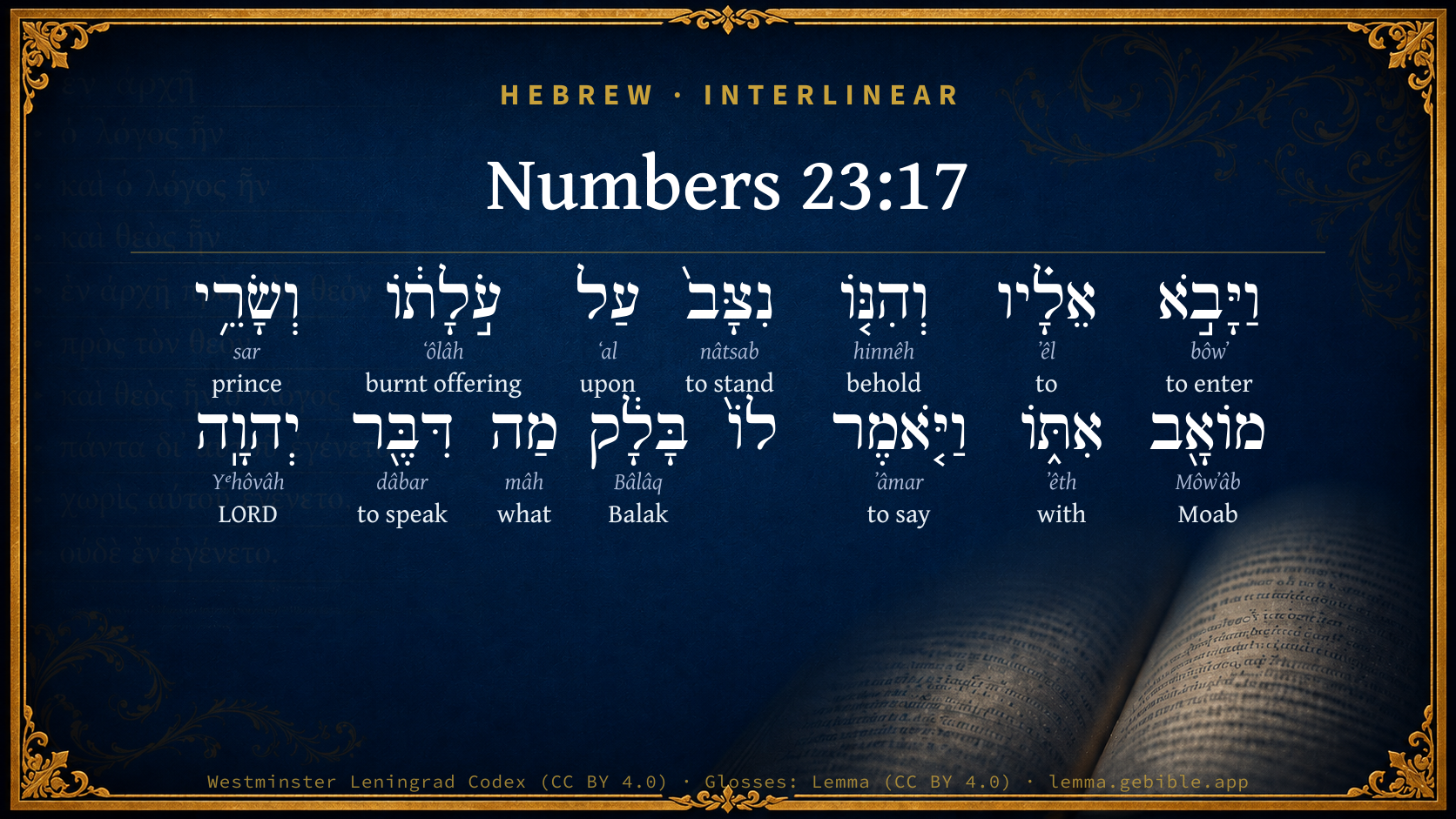
  1. וַיָּבֹ֣א bôwʼ H935 “and · to enter” Conjunction + Verb, Qal, Sequential Imperfect, 3rd Person, Masculine, Singular
  2. אֵלָ֗יו ʼêl H413 “to · him” Preposition + Suffix, Personal, 3rd Person, Masculine, Singular
  3. וְהִנּ֤וֹ hinnêh H2009 “and · behold · him” Conjunction + Particle, Demonstrative + Suffix, Personal, 3rd Person, Masculine, Singular
  4. נִצָּב֙ nâtsab H5324 “standing” Verb, Niphal, Participle Active, Masculine, Singular, Absolute
  5. עַל ʻal H5921 “upon” Preposition
  6. עֹ֣לָת֔וֹ ʻôlâh H5930 “burnt offering · his” Noun, Common, Feminine, Singular, Construct + Suffix, Personal, 3rd Person, Masculine, Singular
  7. וְשָׂרֵ֥י sar H8269 “and · princes of” Conjunction + Noun, Common, Masculine, Plural, Construct
  8. מוֹאָ֖ב Môwʼâb H4124 “Moab” Noun, Proper
  9. אִתּ֑וֹ ʼêth H854 “with · him” Preposition + Suffix, Personal, 3rd Person, Masculine, Singular
  10. וַיֹּ֤אמֶר ʼâmar H559 “and · to say” Conjunction + Verb, Qal, Sequential Imperfect, 3rd Person, Masculine, Singular
  11. מַה mâh H4100 “what” Particle, Interrogative
  12. דִּבֶּ֖ר dâbar H1696 “to speak” Verb, Piel, Perfect, 3rd Person, Masculine, Singular
  13. יְהוָֽה Yᵉhôvâh H3068 “LORD” Noun, Proper

About this verse

These counts appear in no published source. They are computed here, from the morphology-tagged text and Lemma’s own curated glosses. What Lemma adds →

15
words
14
distinct lemmas
Pentateuch
section

Shared distinctive vocabulary

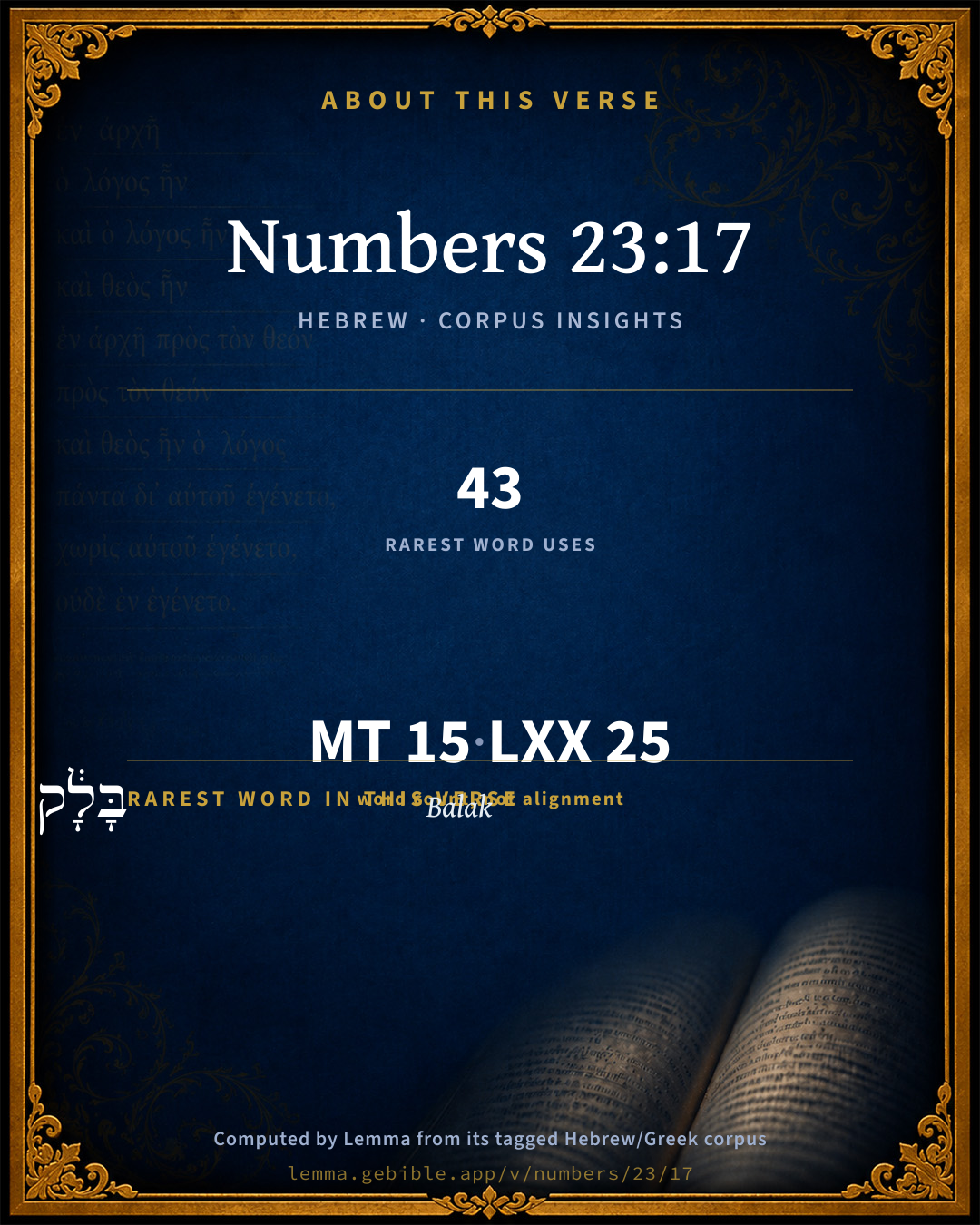
בָּלָ֔ק Balak H1111 occurs in 40 verses of the Hebrew Bible. Also found in:

Grammatical profile

  • 4 verbs
  • 5 nouns
  • 4 prepositions
  • 2 particles

Verb forms

  • וַיָּבֹ֣א Qal · Sequential Imperfect
  • נִצָּב֙ Niphal · Participle Active
  • וַיֹּ֤אמֶר Qal · Sequential Imperfect
  • דִּבֶּ֖ר Piel · Perfect

Hebrew & Septuagint length

In English translation the verse runs 28 words from the Hebrew and 33 from the Septuagint (LXX English) — closely comparable.

A rough comparison of the two English renderings, which tokenize alike — not a word-level alignment.

Word counts can differ between the Hebrew and the Greek without any difference in meaning — e.g. the Hebrew direct-object marker אֵת has no separate Greek word, and Greek often adds the article ὁ.

In the original languages it is 15 Hebrew tokens and 25 Greek tokens — but the two are counted differently (Hebrew bundles its prefixes and suffixes into one token; the Greek is in lemma form), so that isn’t a like-for-like length.

Cross-references

3

Topical passages linked to Numbers 23:17 in the Treasury of Scripture Knowledge — connected by theme and wording, ordered by reader-vote popularity; previews shown in the World English Bible.

  • Numbers 23:26 But Balaam answered Balak, Didn't I tell you, saying, All that Yahweh speaks, that I must do?
  • 1 Samuel 3:17 He said, "What is the thing that [Yahweh] has spoken to you? Please don't hide it from me. God do so to you, and more also, if you hide anything from me of all the things that he spoke to you."
  • Jeremiah 37:17 Then Zedekiah the king sent, and fetched him: and the king asked him secretly in his house, and said, Is there any word from Yahweh? Jeremiah said, There is. He said also, You shall be delivered into the hand of the king of Babylon.

Cross-references courtesy of OpenBible.info (CC BY 4.0).

Hebrew and Greek witnesses Masoretic Hebrew ↔ Greek Septuagint

The same verse in the two great witnesses to the Old Testament, shown verse-for-verse.

These are two independent witnesses, not word-aligned to each other, and the Septuagint is shown in lemma (dictionary) form.

Hebrew Numbers 23:17 Masoretic · Westminster Leningrad Codex

וַיָּבֹ֣א אֵלָ֗יו וְהִנּ֤וֹ נִצָּב֙ עַל עֹ֣לָת֔וֹ וְשָׂרֵ֥י מוֹאָ֖ב אִתּ֑וֹ וַיֹּ֤אמֶר לוֹ֙ בָּלָ֔ק מַה דִּבֶּ֖ר יְהוָֽה

He came to him, and, behold, he was standing by his burnt offering, and the princes of Moab with him. Balak said to him, What has Yahweh spoken?

World English Bible · Public Domain

Greek LXX Numbers 23:17 Septuagint · lemma form

καί ἀποστρέφω πρός αὐτός καί ὅδε ἐπιἵστημι ἐπί ὁ ὁλοκαύτωσις αὐτός καί πᾶς ὁ ἄρχων μωαβ μετά αὐτός καί εἶπον αὐτός βαλακ τίς λαλέω κύριος

And he returned to him: and he also was standing by his whole burnt sacrifice, and all the princes of Moab with him; and Balac said to him, What has the Lord spoken?

LXX2012 (modern English Septuagint) · Public Domain

Hebrew: Westminster Leningrad Codex (CC BY 4.0). Greek: Septuagint (public domain); English from LXX2012 (modern English Septuagint) (Public Domain). How the Septuagint differs from the Hebrew →

Targum (Aramaic paraphrase)

2

The Targum is the ancient Jewish Aramaic paraphrase of the Hebrew Scriptures — an interpretive translation, not the Hebrew text itself. Onkelos (literal) and Pseudo-Jonathan (expansive) render the Torah, and Jonathan the Prophets. Coverage is partial: where no permissively-licensed English translation exists for a verse, only the Aramaic is shown. This is verse-level text, not a word-by-word alignment to the Hebrew.

  1. Targum Onkelos Torah (Genesis–Deuteronomy)
    וַאֲתָא לְוָתֵיהּ וְהוּא מְעַתַּד עַל עֲלָתֵיהּ וְרַבְרְבֵי מוֹאָב עִמֵיהּ וַאֲמַר לֵיהּ בָּלָק מָה מַלִיל יְיָ

    (no public-domain English translation for this verse)

    Targum Onkelos — Aramaic: “Onkelos Genesis” (public domain); “Onkelos Exodus” (public domain); “Onkelos Leviticus” (public domain); “Onkelos Numbers” (public domain); “Onkelos Deuteronomy” (public domain). English: “Sefaria Community Translation” (CC0 1.0 (public-domain dedication)); “J.W. Etheridge. The Targums of Onkelos and Jonathan Ben Uzziel on the Pentateuch. London: Longmans, Green, 1862” (public domain). Text via Sefaria.

  2. Targum Pseudo-Jonathan Torah (Genesis–Deuteronomy)
    וְאָתָא לְוָתֵיהּ וְהָא מְעַתֵּיד עַל עֲלָתֵיהּ וְרַבְרְבֵי מוֹאָב עִמֵיהּ וַאֲמַר לֵיהּ בָּלָק מַה מַלֵיל יְיָ

    And he came to him, and, behold, he was standing by his burnt offering, and the princes of Moab with him. And Balak said to him, What hath the Lord spoken?

    Targum Pseudo-Jonathan — Aramaic: “Targum Jonathan on Genesis” (public domain); “Targum Jonathan on Exodus” (public domain); “Targum Jonathan on Leviticus” (public domain); “Targum Jonathan on Numbers” (public domain); “Targum Jonathan on Deuteronomy” (public domain). English: “The Targum of Jonathan ben Uzziel, trans. J. W. Etheridge, London, 1862” (public domain). Text via Sefaria.

Commentary

Notes on Numbers 23:17 from classic Christian and Jewish commentators (each source and its license shown beneath its notes). The classic Christian expositions comment on the surrounding passage and are grouped to its opening verse, so a note may address several verses; the Jewish commentaries on the Tanakh (Rashi and others) are per-verse, so they appear only where the commentator wrote on this verse.

Lemma curates 59 commentaries, every one of them public domain or Creative Commons licensed, each selected and text-cleaned for this edition rather than reprinted as found. About our sources →

Adam Clarke's Commentary

Verse 17. What hath the Lord spoken?] Balak himself now understood that Balaam was wholly under the influence of Jehovah, and would say nothing but what God commanded him; but not knowing Jehovah as Balaam did, he hoped that he might be induced to change his mind, and curse a people whom he had hitherto determined to bless.

Adam Clarke's Commentary on the Bible (1810–1826) — public domain. Text from a community e-Sword/MySword module.

Ellicott's Commentary for English Readers

(17) What hath the Lord spoken?—Balak here speaks of God under the name Jehovah.

A Bible Commentary for English Readers, edited by Charles John Ellicott (1878–1897) — public domain. Text from a community e-Sword module.

John Gill's Exposition

And when he came to him, behold, he stood by his burnt offering,.... As before; Num 23:6 and the princes of Moab with him; Jarchi observes, that before it is said, all the princes of Moab, but not so here; for when they saw there was no hope of succeeding, some of them went away, and only some were left:

and Balak said unto him, what hath the Lord spoken? being in haste to know what it was, whether agreeable or not.

John Gill's Exposition of the Whole Bible (1746–1763) — public domain (CC PDM 1.0). Text via the HelloAO Bible API.

Whedon's Commentary on the Bible

Daniel D. Whedon

17. He stood by his burnt offering — The seven smoking altars, surrounded by the anxious king and his expectant princes, present a scene worthy of the painter.

Daniel D. Whedon (gen. ed.), Commentary on the Old and New Testaments (1874–1909) — public domain. Text from a community e-Sword module.

Rashi

Rabbi Shlomo Yitzchaki (Rashi)

ושרי מואב עמו AND THE PRINCES OF MOAB WITH HIM — But above (v. 6) it states, “And all the princes of Moab”?! As soon as they saw that there was no hope for them in him, part of them went away, and only part of them remained (Midrash Tanchuma, Balak 13).

מה דבר ה׳ WHAT HATH THE LORD SPOKEN? — This was a derisive expression, as much as to say, “You are not your own master” (Midrash Tanchuma, Balak 13).

Rashi on the Tanakh — English translations: “The Judaica Press complete Tanach with Rashi, translated by A. J. Rosenberg” (CC BY 4.0); “Pentateuch with Rashi's commentary by M. Rosenbaum and A.M. Silbermann, 1929-1934” (public domain); “The Metsudah Tanach series, Lakewood, N.J” (CC BY 4.0); and “The Book of Joshua, Metsudah Publications, 1997” (CC BY 4.0). Text via Sefaria.

Lesson kit

Teaching starters — assembled from the data on this page, not authored interpretation. Every prompt links to the verse data it draws on. Edit before teaching.

Numbers, in the Pentateuch, opens this verse with 15 words (14 distinct Hebrew lemmas). Its most distinctive word is Bâlâq (“Balak”). A historical commentator’s framing appears above. Read the whole chapter for the surrounding context.

Discussion questions

  1. How does “Balak” (Bâlâq) shape what this verse is saying?
  2. How does Numbers 22:2, which shares the word «Balak», read alongside this verse?
  3. These translations render this verse differently. What is at stake in choosing one wording over another?
  4. «וַיָּבֹ֣א» is a Qal Sequential Imperfect verb. How does that grammatical form shape the action described?
  5. Compare how Adam Clarke's Commentary and Ellicott's Commentary for English Readers read this verse. Where do they agree or differ?

Things to notice

Reading settings

Reading text

Shown beneath each verse's original-language words.

Old Testament
Old Testament edition

Read the OT as the Masoretic Hebrew (MT) or the Greek Septuagint (LXX).

English shown for the Greek Septuagint (in the Hebrew ↔ Greek comparison).

Comparing translations? Open the Compare panel on any verse page to stack up to four side by side.