
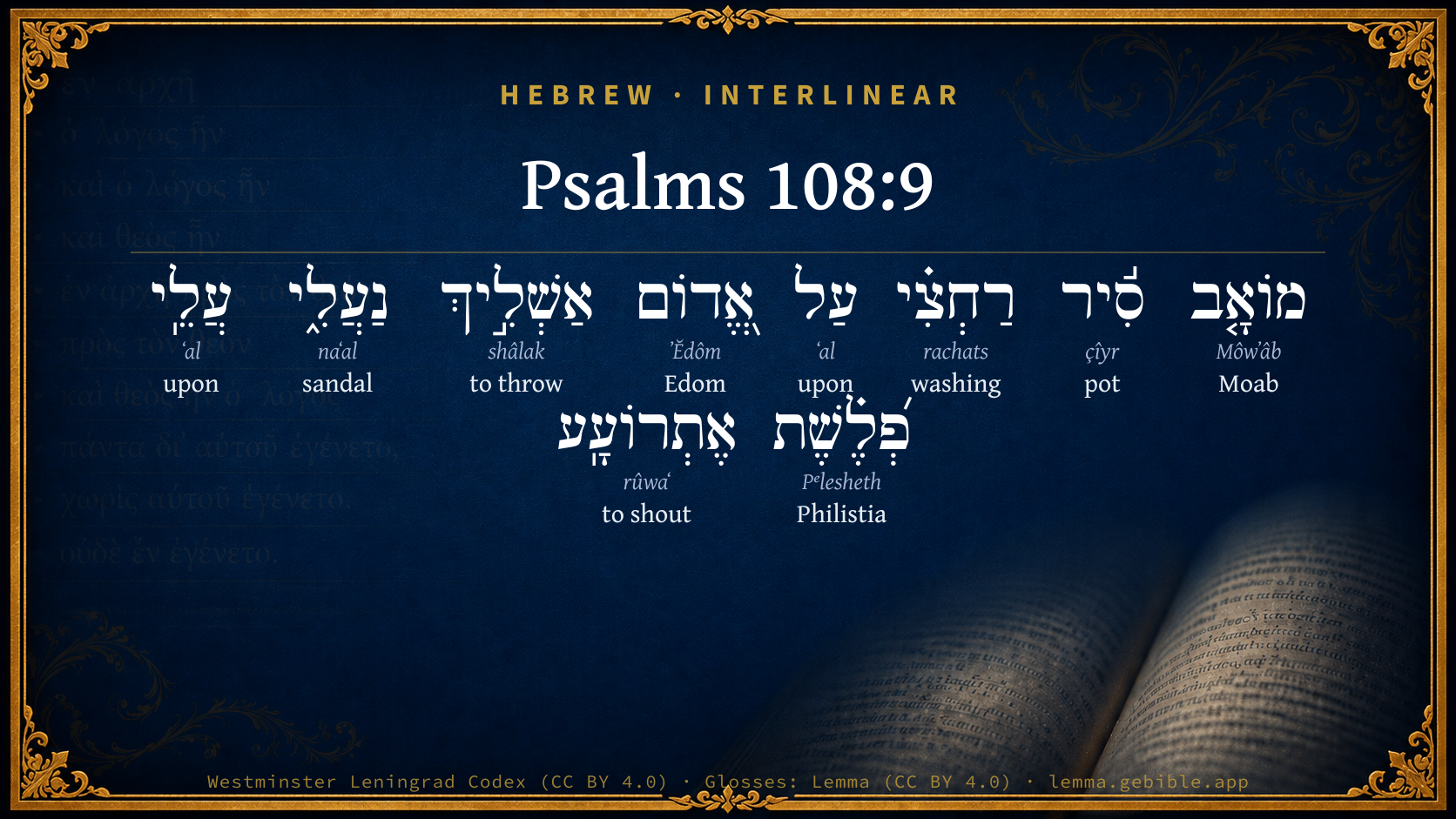
Psalms 108:9

Hebrew (Westminster Leningrad Codex) Psalms 108:9 appears in the Hebrew Old Testament. The text above is from the Westminster Leningrad Codex. Each word links to its Strong’s number, a concise gloss, and parsing drawn from the Open Scriptures Hebrew Bible morphology. Click any word for its full Brown-Driver-Briggs (BDB) entry.
Download image
Cite this verse

Psalms 108:9 (World English Bible). Public Domain. Lemma interlinear Bible study tool, https://lemma.gebible.app/v/psalms/108/9.

Show BibTeX & RIS
BibTeX
RIS
English Translation
Moab is my wash pot. I will toss my sandal on Edom. I will shout over Philistia."
World English Bible · Public Domain
Download a study sheet

One document with this verse’s original text, its word-by-word gloss line, the meaning frame, cross-references with their text, attributed commentary, and full source and license credits — printable, and it pastes into notes with its structure intact.

This verse Autodidact and up

Study sheet (.html) Plain text (.txt)

A passage Seminary Student

Up to 50 verses in one chapter. A passage sheet keeps up to 6 commentary sources and 12 cross-references per verse, in the order this page ranks them, and says so on the sheet whenever that leaves anything out. Ask for a single verse and you get the Autodidact verse sheet above.

Everything on this page stays free to read, with no account — the sheet is a download of what is already on screen, not access to it.

Want to remove ads? Support Godless Engineer
Compare translations 3

The same verse in 3 English versions, stacked beneath the original-language interlinear above. Click any original word for its lexicon entry.

Each is an independent rendering of the whole verse — the interlinear is not word-aligned to these translations.

Highlighted words mark where these versions differ — a whole-verse word diff, not a word-by-word alignment.

  • World English Bible Public Domain
    Moab is my wash pot. I will toss my sandal on Edom. I will shout over Philistia."
  • King James Version Public Domain
    Moab is my washpot; over Edom will I cast out my shoe; over Philistia will I triumph.
  • unfoldingWord Literal Text CC BY-SA 4.0
    Moab a tub for my washing; over Edom I throw my sandal; over Philistia I shout triumphantly.”

unfoldingWord Literal Text — © unfoldingWord, licensed CC BY-SA 4.0. Word-aligned USFM3 via Door43 (git.door43.org/unfoldingWord/en_ult).

Versions to compare (up to 4)

3 of 4 selected

Show all 18 translations

Every available English version of this verse, each an independent rendering of the whole verse.

  • World English Bible Public Domain
    Moab is my wash pot. I will toss my sandal on Edom. I will shout over Philistia."
  • Berean Standard Bible Public Domain
    Moab is My washbasin; upon Edom I toss My sandal; over Philistia I shout in triumph.”
  • Majority Standard Bible Public Domain
    Moab is My washbasin; upon Edom I toss My sandal; over Philistia I shout in triumph.”
  • King James Version Public Domain
    Moab is my washpot; over Edom will I cast out my shoe; over Philistia will I triumph.
  • American Standard Version (1901) Public Domain
    Moab is my washpot; Upon Edom will I cast my shoe; Over Philistia will I shout.
  • Revised Version (1885) Public Domain
    Moab is my washpot; upon Edom will I cast my shoe: over Philistia will I shout.
  • Geneva Bible (1599) Public Domain
    Moab shalbe my washpot: ouer Edom wil I cast out my shoe: vpon Palestina wil I triumph.
  • Douay-Rheims (1899) Public Domain
    Galaad is mine, and Manasses is mine and Ephraim the protection of my head. Juda is my king:
  • Young's Literal Translation Public Domain
    Moab `is' a pot for my washing, Upon Edom I cast my shoe, Over Philistia I shout habitually.
  • Literal Standard Version CC BY-SA 4.0
    Moab [is] a pot for My washing, || On Edom I cast My shoe, || Over Philistia I habitually shout.
  • Unlocked Literal Bible CC BY-SA 4.0
    Moab is my washbasin; over Edom I will throw my shoe; I will shout in triumph because of Philistia.
  • unfoldingWord Literal Text CC BY-SA 4.0
    Moab a tub for my washing; over Edom I throw my sandal; over Philistia I shout triumphantly.”
  • Darby Bible Public Domain
    Moab is my wash-pot; upon Edom will I cast my sandal; over Philistia will I shout aloud.
  • World Messianic Bible Public Domain
    Moab is my wash pot. I will toss my sandal on Edom. I will shout over Philistia.”
  • Webster's Bible Public Domain
    \\108:8\\Gilead is mine; Manasseh is mine; Ephraim also is the strength of my head; Judah is my lawgiver;
  • Free Bible Version CC BY-SA 4.0
    I will treat Moab as my washbasin; I will place my sandal on Edom; I will shout in triumph over Philistia.”
  • Bible in Basic English Public Domain
    Moab is my washpot; on Edom is the resting-place of my shoe; over Philistia will I send out a glad cry.
  • JPS Tanakh (1917) Public Domain
    (108-10) Moab is my washpot; upon Edom do I cast my shoe; over Philistia do I cry aloud.

Literal Standard Version (2020), Covenant Press — licensed CC BY-SA 4.0. Text via the HelloAO Bible API (eBible.org). Unlocked Literal Bible (unfoldingWord) — licensed CC BY-SA 4.0. Text via the HelloAO Bible API (eBible.org). unfoldingWord Literal Text — © unfoldingWord, licensed CC BY-SA 4.0. Word-aligned USFM3 via Door43 (git.door43.org/unfoldingWord/en_ult). Free Bible Version, Dr. Jonathan Gallagher — licensed CC BY-SA 4.0. Text via the HelloAO Bible API (eBible.org).

Word by word

More ways to search: Search by grammar → Find every occurrence → Compare this word →

Practice this passage: Drill this verse → Learn its vocabulary →

About this verse

These counts appear in no published source. They are computed here, from the morphology-tagged text and Lemma’s own curated glosses. What Lemma adds →

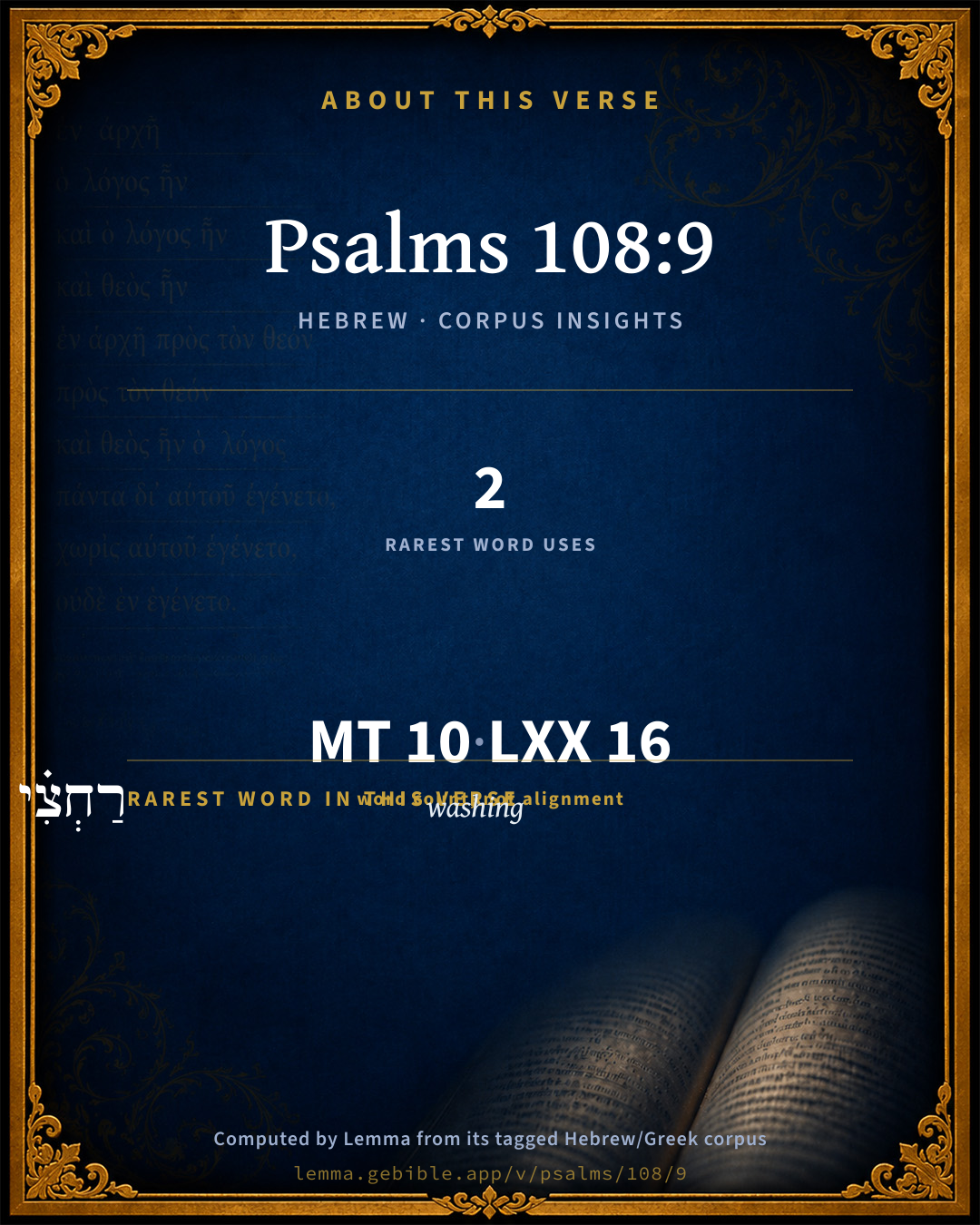
10
words
9
distinct lemmas
Wisdom
section

Notable vocabulary

The rarest word here is רַחְצִ֗י washing H7366 — appearing just 2 times in the whole Hebrew Bible.

Shared distinctive vocabulary

רַחְצִ֗י washing H7366 occurs in 2 verses of the Hebrew Bible. Also found in:

Grammatical profile

  • 2 verbs
  • 6 nouns
  • 2 prepositions

Verb forms

  • אַשְׁלִ֣יךְ Hiphil · Imperfect
  • אֶתְרוֹעָֽע Hithpolel · Imperfect

Repetition

A word recurs within this verse — often emphatic in Hebrew:

Hebrew & Septuagint length

In English translation the verse runs 17 words from the Hebrew and 21 from the Septuagint (LXX English) — closely comparable.

A rough comparison of the two English renderings, which tokenize alike — not a word-level alignment.

Word counts can differ between the Hebrew and the Greek without any difference in meaning — e.g. the Hebrew direct-object marker אֵת has no separate Greek word, and Greek often adds the article ὁ.

In the original languages it is 10 Hebrew tokens and 16 Greek tokens — but the two are counted differently (Hebrew bundles its prefixes and suffixes into one token; the Greek is in lemma form), so that isn’t a like-for-like length.

Cross-references

7

Topical passages linked to Psalms 108:9 in the Treasury of Scripture Knowledge — connected by theme and wording, ordered by reader-vote popularity; previews shown in the World English Bible.

  • Ruth 4:7–8 Now this was [the custom] in former time in Israel concerning redeeming and concerning exchanging, to confirm all things: a man drew off his shoe, and gave it to his neighbor; and this was the [manner of] attestation in Israel.
  • Isaiah 14:29–32 Don't rejoice, O Philistia, all of you, because the rod that struck you is broken; for out of the serpent's root shall come forth an adder, and his fruit shall be a fiery flying serpent.
  • John 13:8 Peter said to him, "You will never wash my feet!" Jesus answered him, "If I don't wash you, you have no part with me."
  • John 13:14 If I then, the Lord and the Teacher, have washed your feet, you also ought to wash one another's feet.
  • 2 Samuel 21:15–22 The Philistines had war again with Israel; and David went down, and his servants with him, and fought against the Philistines. David grew faint;
  • Psalms 60:8–10 Moab is my wash basin. I will throw my shoe on Edom. I shout in triumph over Philistia."
  • 2 Samuel 8:1–2 After this it happened that David struck the Philistines, and subdued them: and David took the bridle of the mother city out of the hand of the Philistines.

Cross-references courtesy of OpenBible.info (CC BY 4.0).

Hebrew and Greek witnesses Masoretic Hebrew ↔ Greek Septuagint

The same verse in the two great witnesses to the Old Testament, shown verse-for-verse.

You’re reading Greek Psalm 107 (Hebrew Psalm 108). The Septuagint counts the superscription, so verse numbers can differ from the Hebrew — chapter-level alignment, not verse-by-verse. Numbering follows Rahlfs.

These are two independent witnesses, not word-aligned to each other, and the Septuagint is shown in lemma (dictionary) form.

Hebrew Psalms 108:9 Masoretic · Westminster Leningrad Codex

מוֹאָ֤ב סִ֬יר רַחְצִ֗י עַל אֱ֭דוֹם אַשְׁלִ֣יךְ נַעֲלִ֑י עֲלֵֽי פְ֝לֶ֗שֶׁת אֶתְרוֹעָֽע

Moab is my wash pot. I will toss my sandal on Edom. I will shout over Philistia."

World English Bible · Public Domain

Greek LXX Greek Psalm 107:9 Septuagint · lemma form

ἐμός εἰμί γαλαάδ καί ἐμός εἰμί μανασσή καί εφράιμ ἀντίληψις ὁ κεφαλή ἐγώ ἰούδας βασιλεύς ἐγώ

Moab is the caldron of my hope; over Idumea will I cast my sandal; the Philistines are made subject to me.

LXX2012 (modern English Septuagint) · Public Domain

On this verse, The Cambridge Bible for Schools and Colleges discusses the Septuagint’s reading. Read the note in Commentary ↓

Hebrew: Westminster Leningrad Codex (CC BY 4.0). Greek: Septuagint (public domain); English from LXX2012 (modern English Septuagint) (Public Domain). How the Septuagint differs from the Hebrew →

Commentary

Notes on Psalms 108:9 from classic Christian and Jewish commentators (each source and its license shown beneath its notes). The classic Christian expositions comment on the surrounding passage and are grouped to its opening verse, so a note may address several verses; the Jewish commentaries on the Tanakh (Rashi and others) are per-verse, so they appear only where the commentator wrote on this verse.

Lemma curates 59 commentaries, every one of them public domain or Creative Commons licensed, each selected and text-cleaned for this edition rather than reprinted as found. About our sources →

J. A. Alexander on Psalms

Joseph Addison Alexander

10. (Psa 108:9) Moab (is) my wash-pot; at Edom will I throw my shoe; over Philistia will I shout aloud. See above, on Psa 60:8. At the end of this verse is the most material variation in the whole psalm, which, however, is evidently not fortuitous or by a later hand, but intentional and made by the original writer. I will shout aloud, as an expression of triumph over a conquered enemy.

Joseph Addison Alexander, The Psalms Translated and Explained (1850) — public domain. Text from a community e-Sword module.

The Cambridge Bible for Schools and Colleges

gen. ed. J. J. S. Perowne

9. The neighbouring nations are reduced to servitude. In striking contrast to the honour assigned to Ephraim and Judah is the disgrace of Moab and Edom. Moab, notorious for its pride (Isa_16:6), is compared to the vessel which is brought to the victorious warrior to wash his feet in when he returns from battle. The old enemy of God and His people is degraded to do menial service: in other words, it becomes a subject and a vassal.

In close connexion with this metaphor the next line may be rendered, Unto Edom will I cast my shoe. Edom is like the slave to whom the warrior flings his sandals to carry or to clean. Haughty and defiant Edom (Oba_1:3-4) must perform the duty of the lowest slave (cp. Mat_3:11). The R.V. renders, Upon Edom will I cast my shoe. This would mean, ‘I will take possession of Edom,’ in allusion to an oriental custom of taking possession of land by casting the shoe upon it; but the first explanation agrees best with the context.

over Philistia will I triumph] Or, will I shout in triumph. This reading gives a good and simple sense, and may possibly be the original reading. For the various explanations of the difficult text in Psa_60:8, shout thou because of me, see note there. The LXX has the same rendering in both places, ἐμοὶ (οἰ) ἀλλόφυλοι ὑπετάγησαν, ‘unto me the aliens are subjected.’

The Cambridge Bible for Schools and Colleges (gen. ed. J. J. S. Perowne; Cambridge University Press, 1878–1918) — public domain. Text from a community e-Sword module.

Albert Barnes' Notes on the Bible

Moab ... - This is fallen from Psa 60:8. The only change is in the close of the verse. Instead of “Plilistia, triumph thou because of me” Psa 60:8, it is here, “Over Philistia will I triumph.” Why the change was made is unknown.

Albert Barnes' Notes on the Bible (1834–1885) — public domain. Text from a community e-Sword/MySword module.

The Treasury of David

Charles H. Spurgeon

Ver. 9. Moab is my washpot. This nation had shown no friendly spirit to the Israelites, but had continually viewed them as a detested rival, therefore they were to be subdued and made subject to David's throne. He claims by faith the victory, and regards his powerful enemy with contempt. Nor was he disappointed, for "the Moabites became David's servants and brought him gifts" (2Sa 8:2). As men wash their feet after a long journey, and so are revived, so vanquished difficulties serve to refresh us: we use Moab for a washpot.

Over Edom will I cast out my shoe. It shall be as the floor upon which the bather throws his sandals, it shall lie beneath his foot, subject to his will and altogether his own. Edom was proud, but David throws his slipper at it; its capital was high, but he casts his sandal over it; it was strong, but he hurls his shoe at it as the gage of battle. He had not entered yet into its rock built fortresses, but since the Lord was with him he felt sure that he would do so. Under the leadership of the Almighty, he felt so secure of conquering even fierce Edom itself that he looks upon it as a mere slave, over which he could exult with impunity. We ought never to fear those who are defending the wrong side, for since God is not with them their wisdom is folly, their strength is weakness, and their glory is their shame. We think too much of God's foes and talk of them with too much respect. Who is this hope of Rome? His Holiness? Call him not so, but call him His Blasphemy! His Profanity! His Impudence! What are he and his cardinals, and his legates, but the image and incarnation of Antichrist, to be in due time cast with the beast and the false prophet into the lake of fire?

Over Philistia will I triumph. David had done so in his youth, and he is all the more sure of doing it again. We read that "David smote the Philistines and subdued them" (2Sa 8:1), even as he hath smitten Edom and filled it with his garrisons. The enemies with whom we battled in our youth are yet alive, and we shall have more brushes with them before we die, but, blessed be God, we are by no means dismayed at the prospect, for we expect to triumph over them even more easily than aforetime.

Thy right hand shall thy people aid;

Thy faithful promise makes us strong;

We will Philistia's land invade.

And over Edom chant the song.

Through thee we shall most valiant prove,

And tread the foe beneath our feet;

Through thee our faith shall hills remove,

And small as chaff the mountains beat.

Ver. 9. Moab, who had enticed Israel to impurity, is made a vessel for its purifying. Edom, descendant of him who despised his birthright, is deprived of his independence; for "flinging a shoe" was a sign of the transference of a prior claim on land. Ru 4:7. William Kay.

Ver. 9. Moab is my washpot. The office of washing the feet was in the East commonly performed by slaves, and the meanest of the family, as appears from what Abigail said to David when he took her to wife, "Behold, let thine handmaid be a servant to wash the feet of the servants of my lord", 1Sa 25:41; and from the fact of our Saviour washing his disciples' feet, to give them an example of humility, Joh 8:5. The word nipthr, used in this last passage, signifies in general a washing pot, and is put for the word podoniptron, the term which the Greeks, in strict propriety of speech, applied to a vessel for washing the feet. As this office was servile, so the vessels employed for this purpose were a mean part of household stuff. Gataker and Le Clerc illustrate this text from an anecdote related by Herodotus, concerning Amasis, king of Egypt, who expressed the meanness of his own origin by comparing himself to a pot for washing the feet in, (Herod. Lib. 2. c. 172). When, therefore, it is said, "Moab is my washing pot", the complete and servile subjection of Moab to David is strongly marked. This is expressed, not by comparing Moab to a slave who performs the lowest offices, as presenting to his master the basin for washing his feet, but by comparing him to the mean utensil itself. See 2Sa 8:2 1Ch 18:1-2, 12-13. James Anderson's Note to Calvin on Isa 60:1-12.

Ver. 9. Moab is my washpot; over Edom will I cast my shoe. This somewhat difficult expression may be thus explained. Moab and Edom were to be reduced to a state of lowest vassalage to the people of God. The one was to be like a pot or tub fit only for washing the feet in, while the other was to be like the domestic slave standing by to receive the sandals thrown to him by the person about to perform his ablutions, that he might first put them by in a safe place, and then come and wash his master's feet. "Rays from the East."

Ver. 9. Over Edom will I cast my shoe. David overthrew their army in the "Valley of Salt", and his general, Joab, following up the victory, destroyed nearly the whole male population (1Ki 11:15-16), and placed Jewish garrisons in all the strongholds of Edom (2Sa 8:13-14). In honour of that victory the Psalmist warrior may have penned the words in Ps 60:8, "Over Edom will I cast my shoe." J.L. Porter in, "Smith's Dictionary of the Bible."

Psalms 108:10*

Charles H. Spurgeon's The Treasury of David (1869–1885) — public domain. Psalms only. Text from a community e-Sword/MySword module.

Whedon's Commentary on the Bible

Daniel D. Whedon

9. Over Philistia will I triumph—The declarative, here, instead of the imperative, as Psa_60:8. Here the psalmist confidently predicts that he will shout as a victor over Philistia; there, he calls upon Philistia to break out in the cry of a captive. See note there.

Daniel D. Whedon (gen. ed.), Commentary on the Old and New Testaments (1874–1909) — public domain. Text from a community e-Sword module.

The Pulpit Commentary

Moab is my washpot; over Edom will I east out my shoe. Identical with the first two clauses of Psa_60:8. Over Philistia will I triumph. In Psa_60:8 the expression used is different. There we have, "Philistia, triumph thou over me," or, "because of me." Apparently the compiler has not understood David"s irony, and has therefore changed the form of the verb.

The Pulpit Commentary (1880–1919), ed. H.D.M. Spence-Jones & Joseph S. Exell — public domain. Text from a community e-Sword module.

unfoldingWord translationNotes

Door43 World Missions Community

General Information:

These verses are the same as those in Psalms 60:8-9.

Moab is my washbasin

God speaks of Moab being unimportant as if Moab were a washbasin or a lowly servant. AT: "Moab is like a bowl that I use for washing" (See: Metaphor)

over Edom I will throw my shoe

God was probably speaking of taking ownership of Edom as if he were symbolically throwing his shoe onto that land to show that he owns it. However some versions have other interpretations. AT: "I take ownership of the land of Edom" or "I throw my shoe onto the land of Edom to show that it is mine" (See: Metaphor and Symbolic Action)

translationWords

Moab

Edom

Philistines

unfoldingWord translationNotes — © Distant Shores Media and the Door43 World Missions Community, licensed CC BY-SA 4.0. Source: git.door43.org/Door43/en_tn.

Lesson kit

Teaching starters — assembled from the data on this page, not authored interpretation. Every prompt links to the verse data it draws on. Edit before teaching.

Psalms, in the Wisdom, opens this verse with 10 words (9 distinct Hebrew lemmas). Its most distinctive word is rachats (“washing”). A historical commentator’s framing appears above. Read the whole chapter for the surrounding context.

Discussion questions

  1. The word rachats carries the sense “washing.” How does it shape the verse?
  2. Psalms 60:8 shares the word «washing» with this verse. How do the two illuminate each other?
  3. “upon” occurs 2× in this one verse. What is the effect of the repetition?
  4. The translations on this page render this verse differently — a whole-verse word diff, not a word-by-word alignment. What might account for the different wordings?
  5. The verb «אַשְׁלִ֣יךְ» is Hiphil Imperfect. How does its form color the action?
  6. Reading how J. A. Alexander on Psalms and The Cambridge Bible for Schools and Colleges read this verse, where do the two commentators agree and where do they part?

Things to notice

Reading settings

Reading text

Shown beneath each verse's original-language words.

Old Testament
Old Testament edition

Read the OT as the Masoretic Hebrew (MT) or the Greek Septuagint (LXX).

English shown for the Greek Septuagint (in the Hebrew ↔ Greek comparison).

Comparing translations? Open the Compare panel on any verse page to stack up to four side by side.