Isaiah 16:7

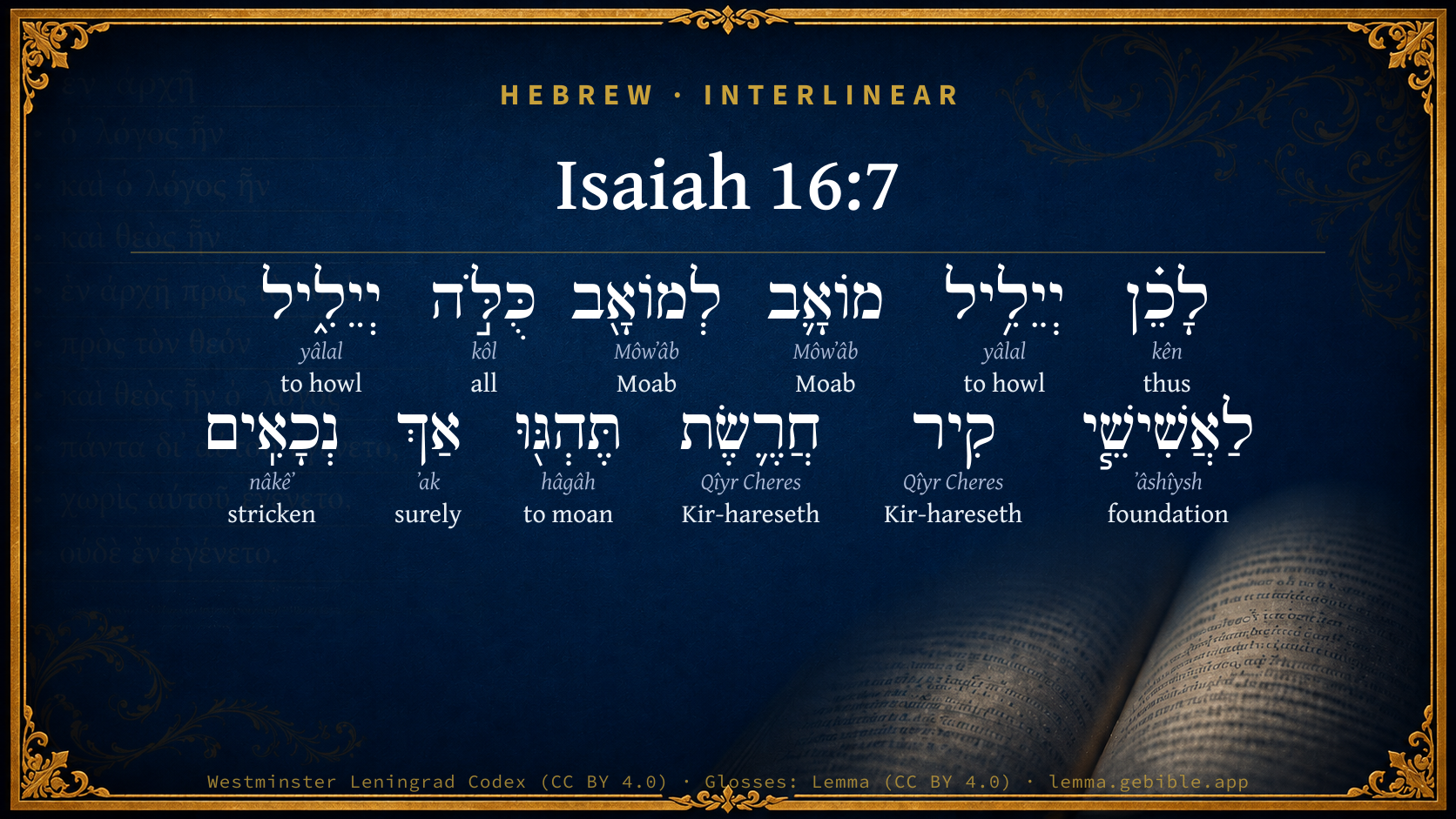
Hebrew (Westminster Leningrad Codex) Isaiah 16:7 appears in the Hebrew Old Testament. The text above is from the Westminster Leningrad Codex. Each word links to its Strong’s number, a concise gloss, and parsing drawn from the Open Scriptures Hebrew Bible morphology. Click any word for its full Brown-Driver-Briggs (BDB) entry.
Download image
Cite this verse

Isaiah 16:7 (World English Bible). Public Domain. Lemma interlinear Bible study tool, https://lemma.gebible.app/v/isaiah/16/7.

Show BibTeX & RIS
BibTeX
RIS
English Translation
Therefore shall Moab wail for Moab, everyone shall wail: for the raisin-cakes of Kir Hareseth shall you mourn, utterly stricken.
World English Bible · Public Domain
Highlights Full analysis ↓
Download a study sheet

One document with this verse’s original text, its word-by-word gloss line, the meaning frame, cross-references with their text, attributed commentary, and full source and license credits — printable, and it pastes into notes with its structure intact.

This verse Autodidact and up

Study sheet (.html) Plain text (.txt)

A passage Seminary Student

Up to 50 verses in one chapter. A passage sheet keeps up to 6 commentary sources and 12 cross-references per verse, in the order this page ranks them, and says so on the sheet whenever that leaves anything out. Ask for a single verse and you get the Autodidact verse sheet above.

Everything on this page stays free to read, with no account — the sheet is a download of what is already on screen, not access to it.

Want to remove ads? Support Godless Engineer
Compare translations 3

The same verse in 3 English versions, stacked beneath the original-language interlinear above. Click any original word for its lexicon entry.

Each is an independent rendering of the whole verse — the interlinear is not word-aligned to these translations.

Highlighted words mark where these versions differ — a whole-verse word diff, not a word-by-word alignment.

  • World English Bible Public Domain
    Therefore shall Moab wail for Moab, everyone shall wail: for the raisin-cakes of Kir Hareseth shall you mourn, utterly stricken.
  • King James Version Public Domain
    Therefore shall Moab howl for Moab, every one shall howl: for the foundations of Kirhareseth shall ye mourn; surely they are stricken.
  • unfoldingWord Literal Text CC BY-SA 4.0
    Therefore Moab will wail for Moab; all of it will wail. For the raisin cakes of Kir Hareseth, you will moan; surely stricken.

unfoldingWord Literal Text — © unfoldingWord, licensed CC BY-SA 4.0. Word-aligned USFM3 via Door43 (git.door43.org/unfoldingWord/en_ult).

Versions to compare (up to 4)

3 of 4 selected

Show all 18 translations

Every available English version of this verse, each an independent rendering of the whole verse.

  • World English Bible Public Domain
    Therefore shall Moab wail for Moab, everyone shall wail: for the raisin-cakes of Kir Hareseth shall you mourn, utterly stricken.
  • Berean Standard Bible Public Domain
    Therefore let Moab wail; let them wail together for Moab. Moan for the raisin cakes of Kir-hareseth, you who are utterly stricken.
  • Majority Standard Bible Public Domain
    Therefore let Moab wail; let them wail together for Moab. Moan for the raisin cakes of Kir-hareseth, you who are utterly stricken.
  • King James Version Public Domain
    Therefore shall Moab howl for Moab, every one shall howl: for the foundations of Kirhareseth shall ye mourn; surely they are stricken.
  • American Standard Version (1901) Public Domain
    Therefore shall Moab wail for Moab, every one shall wail: for the raisin-cakes of Kir-hareseth shall ye mourn, utterly stricken.
  • Revised Version (1885) Public Domain
    Therefore shall Moab howl for Moab, every one shall howl: for the raisin-cakes of Kir-hareseth shall ye mourn, utterly stricken.
  • Geneva Bible (1599) Public Domain
    Therefore shall Moab howle vnto Moab: euery one shall howle: for the foundations of Kirhareseth shall ye mourne, yet they shalbe striken.
  • Douay-Rheims (1899) Public Domain
    Therefore shall Moab howl to Moab, every one shall howl: to them that rejoice upon the brick walls, tell ye their stripes.
  • Young's Literal Translation Public Domain
    Therefore howl doth Moab for Moab, all of it doth howl, For the grape-cakes of Kir-Hareseth it meditateth, Surely they are smitten.
  • Literal Standard Version CC BY-SA 4.0
    Therefore Moab howls for Moab, all of it howls, || It meditates for the grape-cakes of Kir-Hareseth, || They are surely struck.
  • Unlocked Literal Bible CC BY-SA 4.0
    So Moab wails for Moab—they all wail! Mourn, you who are utterly destroyed, for the raisin cakes of Kir Hareseth.
  • unfoldingWord Literal Text CC BY-SA 4.0
    Therefore Moab will wail for Moab; all of it will wail. For the raisin cakes of Kir Hareseth, you will moan; surely stricken.
  • Darby Bible Public Domain
    Therefore shall Moab howl for Moab; every one of them shall howl. For the foundations of Kirhareseth shall ye mourn, verily afflicted.
  • World Messianic Bible Public Domain
    Therefore Moab will wail for Moab. Everyone will wail. You will mourn for the raisin cakes of Kir Hareseth, utterly stricken.
  • Webster's Bible Public Domain
    Therefore shall Moab howl for Moab, every one shall howl: for the foundations of Kir-hareseth shall ye mourn; surely they are stricken.
  • Free Bible Version CC BY-SA 4.0
    All the Moabites grieve for Moab. They all mourn the loss of the raisin cakes of Kir-hareseth, all of them destroyed.
  • Bible in Basic English Public Domain
    For this cause everyone in Moab will give cries of grief for Moab: crushed to the earth, they will be weeping for the men of Kir-hareseth.
  • JPS Tanakh (1917) Public Domain
    Therefore shall Moab wail for Moab, every one shall wail; for the sweet cakes of Kir-hareseth shall ye mourn, sorely stricken.

Literal Standard Version (2020), Covenant Press — licensed CC BY-SA 4.0. Text via the HelloAO Bible API (eBible.org). Unlocked Literal Bible (unfoldingWord) — licensed CC BY-SA 4.0. Text via the HelloAO Bible API (eBible.org). unfoldingWord Literal Text — © unfoldingWord, licensed CC BY-SA 4.0. Word-aligned USFM3 via Door43 (git.door43.org/unfoldingWord/en_ult). Free Bible Version, Dr. Jonathan Gallagher — licensed CC BY-SA 4.0. Text via the HelloAO Bible API (eBible.org).

Word by word

More ways to search: Search by grammar → Find every occurrence → Compare this word →

Practice this passage: Drill this verse → Learn its vocabulary →

לַאֲשִׁישֵׁ֧י
ʼâshîysh
H808
“to/for · foundations of”
Preposition + Noun, Common, Masculine, Plural, Construct
Part of Speech
Preposition + Noun
Type
Common
Gender
Masculine
Number
Plural
State
Construct
Full BDB Definition

Origin: from the same as H784 (compare H803 )

TWOT: 185a

with sense of pressing down, foundation
  1. לָכֵ֗ן kên H3651 “to/for · thus” Preposition + Adverb
  2. יְיֵלִ֥יל yâlal H3213 “to howl” Verb, Hiphil, Imperfect, 3rd Person, Masculine, Singular
  3. מוֹאָ֛ב Môwʼâb H4124 “Moab” Noun, Proper
  4. לְמוֹאָ֖ב Môwʼâb H4124 “to/for · Moab” Preposition + Noun, Proper
  5. כֻּלֹּ֣ה kôl H3605 “all · her” Noun, Common, Masculine, Singular, Construct + Suffix, Personal, 3rd Person, Feminine, Singular
  6. יְיֵלִ֑יל yâlal H3213 “to howl” Verb, Hiphil, Imperfect, 3rd Person, Masculine, Singular
  7. קִיר Qîyr Cheres H7025 “Kir-hareseth” Noun, Proper
  8. חֲרֶ֛שֶׂת Qîyr Cheres H7025 “Kir-hareseth” Noun, Proper
  9. תֶּהְגּ֖וּ hâgâh H1897 “to moan” Verb, Qal, Imperfect, 2nd Person, Masculine, Plural
  10. אַךְ ʼak H389 “surely” Particle, Accusative
  11. נְכָאִֽים nâkêʼ H5218 “stricken” Adjective, Adjective, Masculine, Plural, Absolute

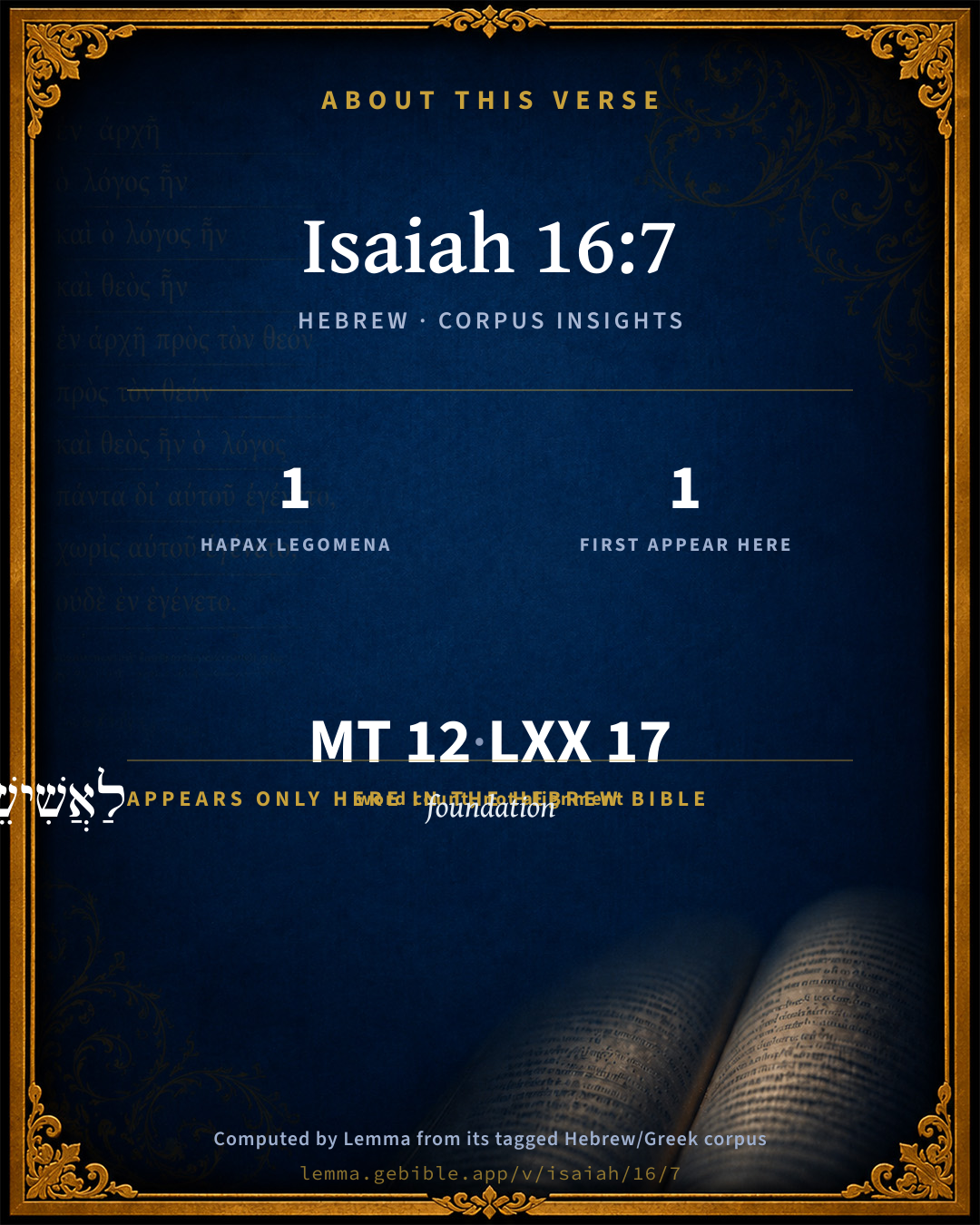
About this verse

These counts appear in no published source. They are computed here, from the morphology-tagged text and Lemma’s own curated glosses. What Lemma adds →

12
words
9
distinct lemmas
Prophets
section

Notable vocabulary

1 hapax legomenon — a word that appears only here in the entire Hebrew Bible:

  • לַאֲשִׁישֵׁ֧י foundation H808

First appearance in Scripture

This word makes its first canonical appearance in the Hebrew Bible here:

  • לַאֲשִׁישֵׁ֧י foundation H808

Shared distinctive vocabulary

נְכָאִֽים stricken H5218 occurs in 4 verses of the Hebrew Bible. Also found in:

Grammatical profile

  • 3 verbs
  • 6 nouns
  • 1 adjective
  • 1 adverb
  • 1 particle

Verb forms

  • יְיֵלִ֥יל Hiphil · Imperfect
  • יְיֵלִ֑יל Hiphil · Imperfect
  • תֶּהְגּ֖וּ Qal · Imperfect

Repetition

Words recur within this verse — often emphatic in Hebrew:

  • יְיֵלִ֥יל to howl H3213 ×2
  • מוֹאָ֛ב Moab H4124 ×2
  • קִיר Kir-hareseth H7025 ×2

Hebrew & Septuagint length

In English translation the verse runs 20 words from the Hebrew and 28 from the Septuagint (LXX English) — the Septuagint runs noticeably longer here. See the side-by-side →

A rough comparison of the two English renderings, which tokenize alike — not a word-level alignment.

Word counts can differ between the Hebrew and the Greek without any difference in meaning — e.g. the Hebrew direct-object marker אֵת has no separate Greek word, and Greek often adds the article ὁ.

In the original languages it is 12 Hebrew tokens and 17 Greek tokens — but the two are counted differently (Hebrew bundles its prefixes and suffixes into one token; the Greek is in lemma form), so that isn’t a like-for-like length.

Cross-references

6

Topical passages linked to Isaiah 16:7 in the Treasury of Scripture Knowledge — connected by theme and wording, ordered by reader-vote popularity; previews shown in the World English Bible.

  • 2 Kings 3:25 They beat down the cities; and on every good piece of land they cast every man his stone, and filled it; and they stopped all the springs of water, and felled all the good trees, until in Kir Hareseth [only] they left the stones of it; however the men armed with slings went about it, and struck it.
  • 1 Chronicles 16:3 He dealt to everyone of Israel, both man and woman, to every one a loaf of bread, and a portion [of flesh], and a cake of raisins.
  • Jeremiah 48:20 Moab is disappointed; for it is broken down: wail and cry; tell you it by the Arnon, that Moab is laid waste.
  • Isaiah 8:19 When they shall tell you, "Consult with those who have familiar spirits and with the wizards, who chirp and who mutter:" shouldn't a people consult with their God? on behalf of the living [should they consult] with the dead?
  • Isaiah 15:1–5 The burden of Moab. For in a night Ar of Moab is laid waste, [and] brought to nothing; for in a night Kir of Moab is laid waste, [and] brought to nothing.
  • Isaiah 16:11 Why my heart sounds like a harp for Moab, and my inward parts for Kir Heres.

Cross-references courtesy of OpenBible.info (CC BY 4.0).

Hebrew and Greek witnesses Masoretic Hebrew ↔ Greek Septuagint

The same verse in the two great witnesses to the Old Testament, shown verse-for-verse.

Here the Septuagint runs noticeably longer than the Hebrew — LXX2012 (modern English Septuagint) 28 words vs World English Bible 20. A rough length comparison of the two English translations, not a word-level alignment — read both below.

These are two independent witnesses, not word-aligned to each other, and the Septuagint is shown in lemma (dictionary) form.

Hebrew Isaiah 16:7 Masoretic · Westminster Leningrad Codex

לָכֵ֗ן יְיֵלִ֥יל מוֹאָ֛ב לְמוֹאָ֖ב כֻּלֹּ֣ה יְיֵלִ֑יל לַאֲשִׁישֵׁ֧י קִיר חֲרֶ֛שֶׂת תֶּהְגּ֖וּ אַךְ נְכָאִֽים

Therefore shall Moab wail for Moab, everyone shall wail: for the raisin-cakes of Kir Hareseth shall you mourn, utterly stricken.

World English Bible · Public Domain

Greek LXX Isaiah 16:7 Septuagint · lemma form

οὐ οὕτως ὀλολύζω μωαβ ἐν γάρ ὁ μωαβῖτις πᾶς ὀλολύζω ὁ καταοἰκέω δεσεθ μελετάω καί οὐ ἐντρέπω

Moab shall howl; for all shall howl in the land of Moab: but you shall care for them that dwell in Seth, and you shall not be ashamed.

LXX2012 (modern English Septuagint) · Public Domain

On this verse, Albert Barnes' Notes on the Bible discusses the Septuagint’s reading. Read the note in Commentary ↓

Hebrew: Westminster Leningrad Codex (CC BY 4.0). Greek: Septuagint (public domain); English from LXX2012 (modern English Septuagint) (Public Domain). How the Septuagint differs from the Hebrew →

Targum (Aramaic paraphrase)

1

The Targum is the ancient Jewish Aramaic paraphrase of the Hebrew Scriptures — an interpretive translation, not the Hebrew text itself. Onkelos (literal) and Pseudo-Jonathan (expansive) render the Torah, and Jonathan the Prophets. Coverage is partial: where no permissively-licensed English translation exists for a verse, only the Aramaic is shown. This is verse-level text, not a word-by-word alignment to the Hebrew.

  1. Targum Jonathan Prophets (Joshua–Malachi)
    בְּכֵן מְיַלְלִין מוֹאֲבָאֵי עַל מוֹאֲבָאֵי כּוּלְהוֹן מְצַוְחִין וּמְיַלְלִין עַל אֱנַשׁ כְּרַךְ תּוּקְפֵהוֹן דָוָן יֵמְרוּן בְּרַם כְּבִישִׁין:

    Therefore the Moabites shall howl: over the Moabites all of them shall cry aloud; and they shall howl over the men of the city of their strength; they, mourning, shall say, surely they are conquered.

    Targum Jonathan — Aramaic: “Mikraot Gedolot” (public domain). English: “Sefaria Community Translation” (CC0 1.0 (public-domain dedication)); “London "Chaldee Paraphrase," 1871” (public domain). Text via Sefaria.

Commentary

Notes on Isaiah 16:7 from classic Christian and Jewish commentators (each source and its license shown beneath its notes). The classic Christian expositions comment on the surrounding passage and are grouped to its opening verse, so a note may address several verses; the Jewish commentaries on the Tanakh (Rashi and others) are per-verse, so they appear only where the commentator wrote on this verse.

Lemma curates 59 commentaries, every one of them public domain or Creative Commons licensed, each selected and text-cleaned for this edition rather than reprinted as found. About our sources →

Trapp's Complete Commentary

John Trapp

Isa 16:7 Therefore shall Moab howl for Moab, every one shall howl: for the foundations of Kirhareseth shall ye mourn; surely [they are] stricken.

Ver. 7. Therefore shall Moab howl for Moab.] One Moabite to another, or each within himself, ut solent desperantes.

For the foundations of Kirhareseth.] Which shall be utterly razed and harassed. Kirhareseth is interpreted the "city of brick walls," as was Babylon, or rather the "city of the sun," as Bethshemesh and Heliopolis, because there the sun was in a special manner worshipped.

Shall ye mourn.] Or, Roar, or mutter, or muse.

John Trapp, A Commentary or Exposition upon All the Books of the Old and New Testament (1647–1656) — public domain. Text from a community e-Sword module.

Geneva Bible (1599)

Geneva Bible translators

For all your mourning, yet the city shall be destroyed, even unto the foundation.

Geneva Bible (1599) marginal notes — public domain. Text via Bolls.life.

Jamieson, Fausset & Brown

Robert Jamieson, A. R. Fausset & David Brown

Therefore--all hope of being allowed shelter by the Jews being cut off.

foundations--that is, "ruins"; because, when houses are pulled down, the "foundations" alone are left (Isa 58:12). Jeremiah, in the parallel place (Jer 48:31), renders it "men," who are the moral foundations or stay of a city.

Kirhareseth--literally, "a citadel of brick."

surely they are stricken--rather, joined with "mourn"; "Ye shall mourn utterly stricken" [MAURER and HORSLEY].

Jamieson, Fausset & Brown — Commentary Critical and Explanatory on the Whole Bible (1871) — public domain (CC PDM 1.0). Text via the HelloAO Bible API.

Adam Clarke's Commentary

Verse 7. For the foundations of Kir-hareseth - "For the men of Kirhares."] A palpable mistake in this place is happily corrected by the parallel text of Jer 48:31, where, instead of אשישי ashishey, foundations or flagons, nve read אנשי anshey, men. In the same place of Jeremiah, and in Jer 48:36, and here in Isa 16:11, the name of the city is Kirhares, not Kir-hareseth.

Adam Clarke's Commentary on the Bible (1810–1826) — public domain. Text from a community e-Sword/MySword module.

Ellicott's Commentary for English Readers

(7) Therefore shall Moab howl for Moab.—Either the whole nation wailing for its downfall, or the survivors wailing for the fallen.

The foundations of Kir-hareseth.—The name has been commonly explained as the “brick fortress,” (city of pottery). Others, with a different derivation, make it “city of the sun.” Others, again (E. H. Palmer, in the Athenæum of August 19, 1871), connect it with háreith, the modern Moabite name for the hillocks on which the rock fortresses were built. The word for foundations occurs in Hos_3:1, for raisin-cakes (“flagons of wine” in the Authorised version (comp. 2Sa_6:19, Song Son_2:5), and has been supposed to refer to this as the main product of Kir-hareseth, the traffic in which she lost through the destruction of the vineyards, mentioned in the next verse. Ruins would, in any case, be better than “foundations.”

A Bible Commentary for English Readers, edited by Charles John Ellicott (1878–1897) — public domain. Text from a community e-Sword module.

The Cambridge Bible for Schools and Colleges

gen. ed. J. J. S. Perowne

7. the foundations] R.V. renders rightly raisin-cakes. These cakes of compressed grapes are mentioned less as an article of commerce than as a delicacy used at religious feasts (cf. Hos_3:1, R.V.). The word never means “foundations.” The parallel passage in Jeremiah substitutes the tamer “men.” Kir-hareseth is the same as Kir-heres (Isa_16:11) and perhaps identical with Kir of Moab (Isa_15:1).

surely they are stricken] Better, as R.V.: utterly stricken (apposition to “ye”).

7, 8. (Cf. Jer_48:31-32.) Moab’s last hope being thus disappointed, the poet resumes his lament over the doomed people.

The Cambridge Bible for Schools and Colleges (gen. ed. J. J. S. Perowne; Cambridge University Press, 1878–1918) — public domain. Text from a community e-Sword module.

John Gill's Exposition

Therefore shall Moab howl for Moab,.... One Moabite shall mourn for another; the living for the dead; or one part of the country for another; or to Moab, they shall howl in turns, answering to one another:

everyone shall howl: every Moabite, or the whole country of Moab shall howl, being everywhere desolate:

for the foundations of Kirhareseth shall ye mourn: surely they are stricken; this was a very principal city in the land of Moab, and a very strong one, see Kg2 3:25. It signifies, according to some, "the city of the sun", so called, it may be, because the sun was worshipped here; or, according to others, "the earthen city", or "city of brick", because its houses and walls were made of brick; and so the Vulgate Latin version renders it, "the walls of burnt brick". Now this strong city was to be razed even to the foundations, so that these would be discovered, which would occasion mourning to its inhabitants, and those of other places. Kimchi interprets "the foundations", of the great men and princes of Moab, see Jer 48:31 so the Targum,

"and they shall howl over the men of the city of their strength;''

R. Jonah, of the men of the army, the foundation of the kingdom; so Ben Melech. The word translated "foundations" signifies also flagons or bottles, and so Aben Ezra and Abendana understand it here; and accordingly the words may be thus rendered, "for the bottles of Kirhareseth shall ye mourn, verily they are broken" (d); this agrees with the signification of the word in Hos 3:1 and with what follows, concerning the vine of Sibmah; the reason of the mourning seems to be, that there would be no wine, and the bottles would lie useless, and be broken.

(d) "de lagenis Kir-hareseth gemetis, ubique confractae sunt", De Dieu; "propter dolia Cir-hareseth gemetis"; so some in Vatablus.

John Gill's Exposition of the Whole Bible (1746–1763) — public domain (CC PDM 1.0). Text via the HelloAO Bible API.

Albert Barnes' Notes on the Bible

Therefore shall Moab howl for Moab - One part of the nation shall mourn for another; they shall howl, or lament, in alternate responses. Jerome renders it, ‘the people (shall howl) to the city; the city to the provinces.’ The general idea is, that there would be an universal lamentation throughout the land. This would be the punishment which would result from their pride in neglecting to send the tribute and seeking the favor of the Jews; or they would lament because the expectation of finding a refuge among the Israelites was taken away.

For the foundations - On account of the foundations of Kir-hareseth, for they shall be overthrown; that is, that city shall be destroyed. The word rendered here ‘foundations’ (אשׁישׁי 'ăshı̂yshēy), occurs nowhere else but in this place, and in Hos 3:1. The Septuagint renders it: ‘The inhabitants.’ The Chaldee, ‘Men.’ Jeremiah, in the parallel place, renders it also ‘men’ Jer 48:31. In Hos 3:1, it is rendered ‘flagons of wine’ - and it has been supposed by many that it has this sense here, as this would agree with what is immediately added of the fields of Heshbon, and the vine of Sibmah. Rosenmuller renders it by ‘strong people, or heroes;’ and supposes that it means that the “strong” people of Kir-hareseth would be destroyed, and that they would mourn on that account. The probable sense is, that that on which the city rested, or was based, was to be destroyed. So Kimchi, Jarchi, and the Syriac understand it.

Kir-ha-reseth - literally, “wall of potsherds, or of bricks.” Aquila renders it, Τοιχῳ ὀστρακίνῳ Toichō ostrakinō. Symmachus, Τείχει ὀστρακίνῳ Teichei ostrakinō. This was a city of Moab, but where it was situated is unknown. Vitringa supposes that it was the same as Kir Moab Isa 15:1, which, Gesenius says, is not improbable, for it is now mentioned as in ruins, and as one of the chief cities.

Albert Barnes' Notes on the Bible (1834–1885) — public domain. Text from a community e-Sword/MySword module.

Haydock's Catholic Bible Commentary

Walls. Hebrew, "Kir-hareseth," chap. xv. 1. (Haydock)

George Leo Haydock (1774–1849), Haydock's Catholic Family Bible and Commentary, 1859 edition — public domain. Excludes Psalms (Douay-Rheims chapter numbering differs from Protestant) and Deuterocanonical books (Catholic canon only).

Matthew Poole's English Annotations

For Moab; for itself; the noun put for the pronoun, as is usual in the Hebrew text. Or, to Moab. One Moabite shall howl or lament to or for another.

Kir-hareseth; an ancient and eminent city of Moab, called Kir, Isa 15:1 and Kir-haresh, Isa 16:11, which signifies, The city of the sun, probably because there was the temple of the sun; which city was preserved when their other cities were ruined, 2Ki 3:25, and therefore the destruction of it was more lamented.

Shall ye mourn; or, ye shall meditate or talk, as this word commonly signifies. Your thoughts and discourses will run much upon the ruin of such a city.

Stricken; or, broken; overthrown or destroyed.

Matthew Poole's English Annotations on the Holy Bible (1683–1685) — public domain. Text from a community e-Sword/MySword module.

Whedon's Commentary on the Bible

Daniel D. Whedon

7. Therefore — As a certain result foreseen in the fate of Moab.

Shall Moab howl for Moab — One part for the other parts shall mutually mourn. It shall be a universal “howl.”

Foundations of Kir-hareseth — The strongest fortress of the nation shall be overthrown. Kir was on the southernmost limits. The word means a wall, a strong wall.

Hareseth — Used of bricks, potsherds, glazed tiles. Some (as Vitringa, Delitzsch, Alexander, and others) hint at another meaning to the word here rendered “foundations.” They render it grapes, cakes, raisins, or pressed grapes, an article of refreshment to wearied ones, thus changing the thought entirely, yet making it congruous with the thought of the verse following.

Daniel D. Whedon (gen. ed.), Commentary on the Old and New Testaments (1874–1909) — public domain. Text from a community e-Sword module.

The Pulpit Commentary

Every one shall howl; rather, the whole of it shall howl; i.e. the entire nation collectively (comp. Herod., 8:99; 9:24). For the foundations of Kir-Hareseth shall ye mourn. The word here translated "foundations" is elsewhere always rendered "flagons" or "flagons of wine". (Son_2:5 Hos_3:1) And this rendering is more agreeable to the context than "foundations," since it is the loss of the products of the soil which is threatened in the next three verses. "Kir-Hareseth" is probably the same place as the "Kir-Moab" of Isa_15:1. It was one of the principal cities of Moab. (see 2Ki_2:25)

Vers. 7-14. Lament over Moab.

I MOAB"S SELF-LAMENTATION. "Moab will wail for Moab; everything will wail." In her misery and distress, she reflects on her beauty. A fair land is like a fair maiden, and her desolation excites the like poignant self-pity. "I know not a greater grief," said Dante, "than to recall the happy time in the midst of distress." The picture of Moabs former happiness. The vineyard and all its gladdening associations represent the endearing charms of the land. These are no more to be enjoyed in the smitten and drooping fields of Kir-Hareseth and Heshbon. Once a splendid vine threw its noble branches and its trailing shoots far over the borders of the land to the north, to Jazer, near the Dead Sea. The lords of the heathen have beaten it down.

II THE PROPHET"S SYMPATHY WITH THE LAMENT. He, too, will bewail the noble vine of Sibmah; he will water Heshbon and Elealeh with his tears, as he thinks of the wild uproar that fell upon the midst of the harvest of fruit and corn. In the irony of grief he uses a figure of speech very expressive. The hedad was the shout raised by the treaders of the grapes. It was a mighty heaven-rending cry, giving forth in full volume the joy and thankfulness of the rustic heart of the tillers. (cf. Jer_25:30) There was another shout of different import, one that fell like a knell upon the ear the yell of a swarming host of invaders, of Jer_51:14, bursting in upon the summer fruits and the vintage. (Jer_48:32) Then, instead of the rich flow of the trodden grape, there will be "the red rain that makes the battle-harvest grow." The silence of desolation succeeds to the sounds of rejoicing . There is a silence "more dreadful than severest sounds." It is the silence of scenes once thronged with life, and resounding with cheerful songs and cries. The prophet, as he muses, finds "Remembrance wake with all her busy train, Swell at his heart and turn the past to pain.

Joy and exultation is withdrawn from the fruit-fields, and in the vineyards there is no jubilation or shouting; no treader treads wine in the presses, and the shout of the vintagers is at end. "The sounds of population fail; No cheerful murmurs fluctuate in the gale.... Thy sports are fled, and all thy charms withdrawn; Amidst thy bowers the tyrant"s hand is seen, And desolation saddens all thy green.

The prophet"s inmost heart is touched, his feelings vibrate like the strings of a harp at the sound of Moab"s woes. In like manner Jeremiah compares his heart to the flute. The poet and the prophet are indeed organs of the world"s sorrows. And indeed these sorrows turn to music even at the worst, when interpreted by the heart of him who is in sympathy with the universal and eternal love. They are "tears most sacred" which are "shed for others" pain," and athwart them the rainbow of hope seldom fails to glimmer. So here.

III A GLIMPSE OF HOPE. He sorrows over Moab, because Moab does not know the living God. But "when Moab, in the pressure of the further calamities of the future, again appears, as now in his idol-temple, or wearies himself, vainly wringing his hands, and in utter despair, then he wilt be ashamed of his god Chemosh, and learn true humility in Jehovah." So Ewald, who thinks that the last words, necessary to complete the sense, have been lost. Like the priests of Baal calling upon their god from morning to noon, and saying, "O Baal, hear us!" and when there was no voice, nor any that answered, leaping upon the altar, crying and gashing themselves with knives, so will the Moabites, in the extremity of their despair, appeal to Chemosh. What is more sad in the life of superstition than this passionate resort to any means, however irrational, to wring a favor from the deities of special shrines and sanctuaries? As if the true help were not ever near; as if, that being neglected, there could be hope elsewhere! Calvin observes, "While idolaters have their ordinary temples and places of worship, if any uncommon calamity befalls them, they go to another temple more sacred than the rest, expecting that there they will be more abundantly favored with the presence of their god. In like manner, the Papists of the present day, when they are reduced to any uncommon danger (for this fault has existed in all ages), think that they will more readily obtain their wish by running to St. Claude, or to Mary of Loretto, or to any other celebrated idol, than if they assembled in some neighboring church. They resolve that their extraordinary prayers shall be offered up in a church at a great distance. It is in this sense that the prophet applies the term sanctuary to that most highly celebrated among the Moabites, and says they will go to it without any advantage." One cannot help thinking of those melancholy pilgrimages to Lourdes, that focus of superstition in our own times. So do men continue to hew out to themselves cisterns that hold no water; and so necessary still is the living word of prophecy, to remind the world that only in a genuine spiritual relation to the Eternal, only in a faith and worship which is independent of place, because ever fixed in the heart, can true comfort and help be found.

IV RATIFICATION OF THE PROPHECY. It is the word spoken long ago by Jehovah concerning Moab. And now he speaks to solemn effect, that in three years, like the years of a hireling, the glory of Moab will be disgraced, together with all the multitude of the great; only a very small remnant will be left. The days or years of the day-laborer or hireling, are those strictly measured, neither more nor less (so in Isa_21:16; cf. Isa_20:3). "Of working time the hirer remits nothing, and the laborer gives nothing in." The statement is to be taken in its exactness. As the laborer knows that his time is appointed, and may look for an end of his toil when the shadow comes, (Job_7:1, Job_7:2) as life itself must surely come to its, (Job_14:6) so with the long-suffering of God, so with the iniquityof nations and men, so with every abuse and oppression; nay, so with every nation and institution. "They have their day and cease to be; But thou, O Lord, art more than they. "After the lapse of almost three thousand years," says Barnes, "every successive traveler who visits Moab, Idumaea, or Palestine, does something to confirm the accuracy of Isaiah. Towns bearing the same name, or the ruins of towns, are located in the same relative position he said they were; and the ruins of once splendid cities, broken columns, dilapidated walls, trodden-down vineyards, half-demolished temples, and fragments broken and consumed by time, proclaim to the world that those cities are what he said they would be, and that he was under the inspiration of God." And how powerfully come back to us from such scenes those "truths which wake, to perish never!" Amidst the gloom the word of prophecy shines as a light in a dark place. Its voice prevails overtime; imparts warmth to the heart amidst the rigors of Providence; calls to mind with its persuasive strain long-slighted truths; teaches that while "Trade"s proud empire hastes to swift decay, As oceans sweep the labor"d mole away, the state or the individual that is possessed of moral strength may be blessed in poverty; that there is a good which is not dependent on the fertility of a land, or the strength of its fortresses which will survive the desolation of its fields, the downfall of its kings, the overthrow of its idols. J.

The Pulpit Commentary (1880–1919), ed. H.D.M. Spence-Jones & Joseph S. Exell — public domain. Text from a community e-Sword module.

John Wesley's Explanatory Notes

Moab - One Moabite shall howl or lament to or for another. Kirhareseth - An ancient and eminent city of Moab, which was preserved when their other cities were ruined, and therefore the destruction of it was more lamented. Stricken - Or, broken, overthrown or destroyed.

John Wesley, Explanatory Notes Upon the Whole Bible (1754–1765) — public domain. Text via the GEBible commentary corpus.

Keil & Delitzsch

C. F. Keil & F. Delitzsch

Therefore the delightful land is miserably laid waste. "Therefore will Moab wail for Moab, everything will wail: for the grape-cakes of Kir-hareseth will ye whine, utterly crushed. For the fruit-fields of Heshbon have faded away: the vine of Sibmah, lords of the nations its branches smote down; they reached to Ja'zer, trailed through the desert: its branches spread themselves out wide, crossed over the sea." The Lamed in l'Moab is the same as in Isa 15:5, and in la'ashishē, which follows here. Kir-hareseth (written Kir-heres in Isa 16:11, and by Jeremiah; compare Kg2 3:25, where the vowel-pointing is apparently false): Heres or Hareseth may possibly refer to the glazed tiles or grooved stones. As this was the principal fortress of Moab, and according to Isa 15:1 it had already been destroyed, ‛ashishē appears to mean the "strong foundations," - namely, as laid bare; in other words, the "ruins" (cf., Jer 50:15, and mōsedē in Isa 58:12). But in every other passage in which the word occurs it signifies a kind of cake; and as the devastation of the vines of Moab is made the subject of mourning afterwards, it has the same meaning here as in Hos 3:1, namely raisin-cakes, or raisins pressed into the form of cakes. Such cakes as these may have been a special article of the export trade of Kir. Jeremiah has altered 'ashishē into 'anshē (Jer 48:31), and thus made men out of the grapes. Hâgâh is to be understood in accordance with Isa 38:14; Isa 59:11 (viz., of the cooing of the dove); 'ac (in good texts it is written with mercha, not with makkeph) according to Deu 16:15. On the construction of the pluralet. shadmoth, compare Hab 3:17. We have rendered the clause commencing with baalē goyim (lords of the nations) with the same amphibolism as we find in the Hebrew. It might mean either "lords of the nations (domini gentium) smote down its branches" (viz., those of the vine of Sibmah;

(Note: In MSS Shibmah is written with gaya, in order that the two labials may be distinctly expressed.)

hâlam being used as in Isa 41:7), or "its branches smote down (i.e., intoxicated) lords of the nations" (dominos gentium; hâlam having the same meaning as in the undisputed prophecy of Isaiah in Isa 28:1). As the prophet enlarges here upon the excellence of the Moabitish wine, the latter is probably intended. The wine of Sibmah was so good, that it was placed upon the tables of monarchs, and so strong that it smote down, i.e., inevitably intoxicated, even those who were accustomed to good wines. This Sibmah wine was cultivated, as the prophet says, far and wide in Moab - northwards as far as Ja'zer (between Ramoth, i.e., Salt, and Heshbon, now a heap of ruins), eastwards into the desert, and southwards across the Dead Sea - a hyperbolical expression for close up to its shores. Jeremiah defines yâm (the sea) more closely as yam Ja‛zer (the sea of Jazer; vid., Jer 48:32), so that the hyperbole vanishes. But what sea can the sea of Jazer be? Probably some celebrated large pool, like the pools of Heshbon, in which the waters of the Wady (Nahr) Sir, which takes its rise close by, were collected. Seetzen found some pools still there. The "sea" (yâm) in Solomon's temple shows clearly enough that the term sea was also commonly applied to artificial basins of a large size; and in Damascus the marble basins of flowing water in the halls of houses are still called baharât; and the same term is applied to the public reservoirs in all the streets of the city, which are fed by a network of aqueducts from the river Baradâ. The expression "break through the desert" (tâ‛u midbâr) is also a bold one, probably pointing to the fact that, like the red wines of Hungary at the present time, they were trailing vines, which did not require to be staked, but ran along the ground.

Keil & Delitzsch — Biblical Commentary on the Old Testament (1861–1891) — public domain (CC PDM 1.0). Text via the HelloAO Bible API. (Old Testament only.)

J. A. Alexander on Isaiah

Joseph Addison Alexander

“Therefore (because thus rejected) Moab shall howl for Moab; all of it shall howl; for the grapes (or raisin-cakes) of Kir-hareseth shall ye sigh (or moan), only (i.e., altogether) smitten.” The idea may be that the nation of Moab mourns for the land of Moab, but the simplest supposition is that Moab for Mikoab means Moab for itself,

Joseph Addison Alexander, The Prophecies of Isaiah (1846–1847; New York: Scribner, 1870–1878) — public domain. Text from a community e-Sword module.

Rashi

Rabbi Shlomo Yitzchaki (Rashi)

Therefore, Moab shall wail for Moab [lit. to Moab,] for Moab.

for the walls of Kir-hareseth Heb. לַאֲשִׁישֵׁי, for the walls of Kir-hareseth. for the walls Comp. (Jer. 50:15) “Her walls (אָשְׁיוֹתֶיהָ) fell.”

shall you lament, but broken-hearted Heb. נְכָאִים, broken.

shall you lament Heb. תֶּהֶגּוּ.

Rashi on the Tanakh — English translations: “The Judaica Press complete Tanach with Rashi, translated by A. J. Rosenberg” (CC BY 4.0); “Pentateuch with Rashi's commentary by M. Rosenbaum and A.M. Silbermann, 1929-1934” (public domain); “The Metsudah Tanach series, Lakewood, N.J” (CC BY 4.0); and “The Book of Joshua, Metsudah Publications, 1997” (CC BY 4.0). Text via Sefaria.

Ibn Ezra

Rabbi Abraham ibn Ezra

לאשישי קיר חרשת תהגו אך נכאים Some explain, For the foundations of Kir Haresheth shall you mourn, Surely they are stricken; that is, they will think of the present ruins of Kir Haresheth, when people will speak of their former grandeur. As to אשישי foundations, comp. the Chaldæan אֻשַׁיָא the foundations (Ezra 4:12). I, however, prefer to connect לאשישי with אשישי flagons (Hos. 3:1), since the vine of Sibma is mentioned immediately afterwards, and to explain the passage thus—When you will remember the joyful days of the past, which are a contrast to the distress now prevailing, you will lament that you are stricken.

Ibn Ezra on the Tanakh — English translations: “Sefaria Community Translation” (CC0 1.0 (public-domain dedication)); “Yalkut, Sifsei Chachomim Chumash, Metsudah Publications, 2009” (CC BY 4.0); and “Commentary of Ibn Ezra on Isaiah - trans. by M. Friedlander, 1873” (public domain). Text via Sefaria.

Lesson kit

Teaching starters — assembled from the data on this page, not authored interpretation. Every prompt links to the verse data it draws on. Edit before teaching.

Isaiah, in the Prophets, opens this verse with 12 words (9 distinct Hebrew lemmas). Its most distinctive word is ʼâshîysh (“foundation”). The Greek Septuagint runs longer here. A historical commentator’s framing appears above. Read the whole chapter for the surrounding context.

Discussion questions

  1. The word ʼâshîysh carries the sense “foundation.” How does it shape the verse?
  2. 1 word here appears nowhere else in the Hebrew Bible. Why might the author reach for such rare wording?
  3. This is the first place “foundation” appears in Scripture (first appears here). What does its debut here establish?
  4. How does Proverbs 15:13, which shares the word «stricken», read alongside this verse?
  5. What does the repetition of “to howl” (2× in this one verse) do in this verse?
  6. The Septuagint runs longer here than the Hebrew. What might account for the difference?
  7. These translations render this verse differently; the difference is in the English rendering, not the original. What questions does that raise?
  8. «יְיֵלִ֥יל» is a Hiphil Imperfect verb. How does that grammatical form shape the action described?

Things to notice

  • 1 word in this verse appears nowhere else in the Hebrew Bible.
  • 1 word makes its first canonical appearance in Scripture here.
  • This verse counts 12 Hebrew ↔ 17 Greek words.
  • These translations choose different wording for 20 words in this verse.
  • “to howl” occurs 2× in this single verse.

Reading settings

Reading text

Shown beneath each verse's original-language words.

Old Testament
Old Testament edition

Read the OT as the Masoretic Hebrew (MT) or the Greek Septuagint (LXX).

English shown for the Greek Septuagint (in the Hebrew ↔ Greek comparison).

Comparing translations? Open the Compare panel on any verse page to stack up to four side by side.