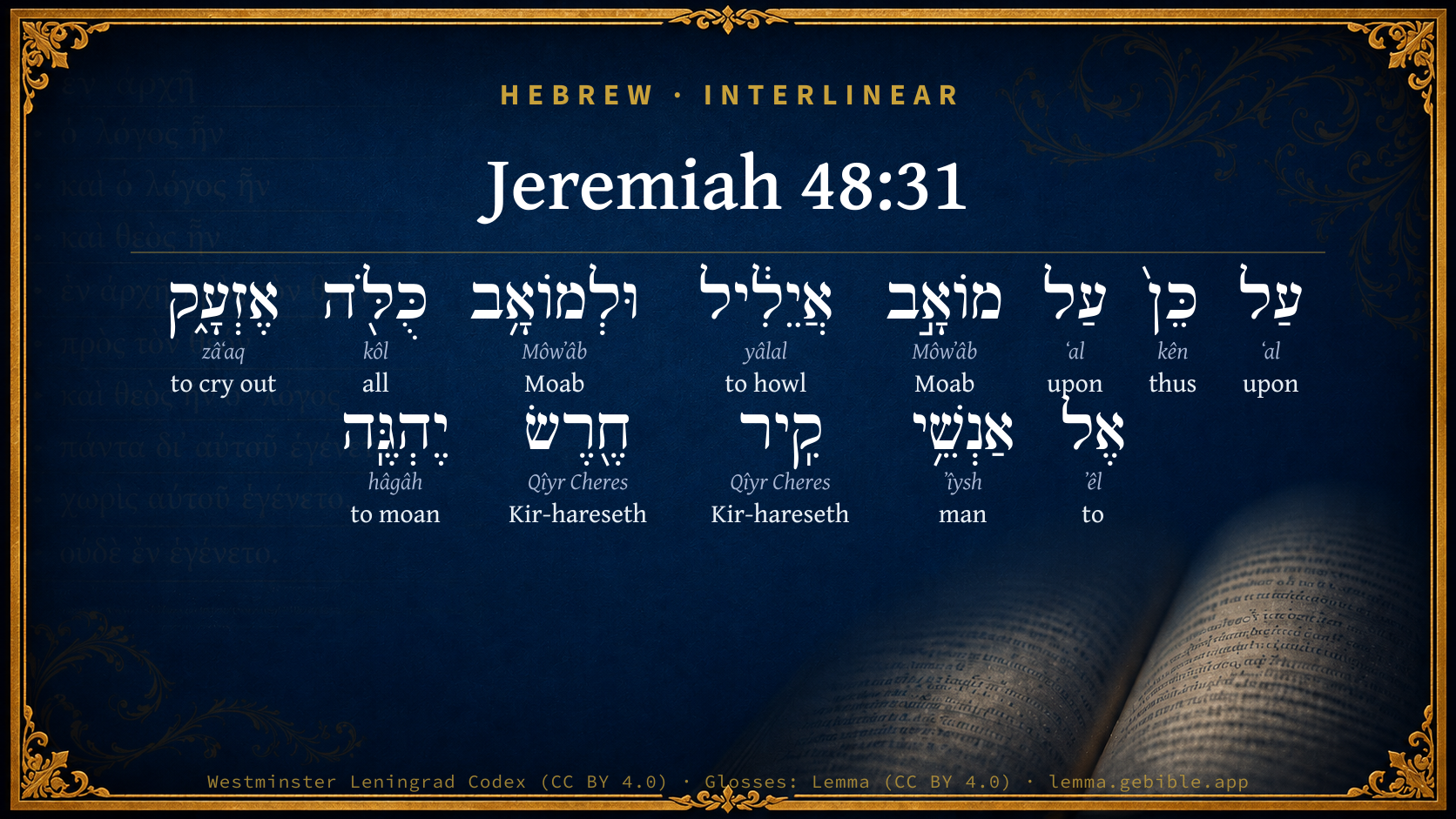
Jeremiah 48:31

Hebrew (Westminster Leningrad Codex) Jeremiah 48:31 appears in the Hebrew Old Testament. The text above is from the Westminster Leningrad Codex. Each word links to its Strong’s number, a concise gloss, and parsing drawn from the Open Scriptures Hebrew Bible morphology. Click any word for its full Brown-Driver-Briggs (BDB) entry.
Download image
Cite this verse

Jeremiah 48:31 (World English Bible). Public Domain. Lemma interlinear Bible study tool, https://lemma.gebible.app/v/jeremiah/48/31.

Show BibTeX & RIS
BibTeX
RIS
English Translation
Therefore will I wail for Moab; yes, I will cry out for all Moab: for the men of Kir Heres shall they mourn.
World English Bible · Public Domain
Download a study sheet

One document with this verse’s original text, its word-by-word gloss line, the meaning frame, cross-references with their text, attributed commentary, and full source and license credits — printable, and it pastes into notes with its structure intact.

This verse Autodidact and up

Study sheet (.html) Plain text (.txt)

A passage Seminary Student

Up to 50 verses in one chapter. A passage sheet keeps up to 6 commentary sources and 12 cross-references per verse, in the order this page ranks them, and says so on the sheet whenever that leaves anything out. Ask for a single verse and you get the Autodidact verse sheet above.

Everything on this page stays free to read, with no account — the sheet is a download of what is already on screen, not access to it.

Want to remove ads? Support Godless Engineer
Compare translations 3

The same verse in 3 English versions, stacked beneath the original-language interlinear above. Click any original word for its lexicon entry.

Each is an independent rendering of the whole verse — the interlinear is not word-aligned to these translations.

Highlighted words mark where these versions differ — a whole-verse word diff, not a word-by-word alignment.

  • World English Bible Public Domain
    Therefore will I wail for Moab; yes, I will cry out for all Moab: for the men of Kir Heres shall they mourn.
  • King James Version Public Domain
    Therefore will I howl for Moab, and I will cry out for all Moab; mine heart shall mourn for the men of Kirheres.
  • unfoldingWord Literal Text CC BY-SA 4.0
    So I will howl a lament for Moab, and I will shout in sorrow for all of Moab. I will lament for the people of Kir Hareseth.

unfoldingWord Literal Text — © unfoldingWord, licensed CC BY-SA 4.0. Word-aligned USFM3 via Door43 (git.door43.org/unfoldingWord/en_ult).

Versions to compare (up to 4)

3 of 4 selected

Show all 18 translations

Every available English version of this verse, each an independent rendering of the whole verse.

  • World English Bible Public Domain
    Therefore will I wail for Moab; yes, I will cry out for all Moab: for the men of Kir Heres shall they mourn.
  • Berean Standard Bible Public Domain
    Therefore I will wail for Moab; I will cry out for all of Moab; I will moan for the men of Kir-heres.
  • Majority Standard Bible Public Domain
    Therefore I will wail for Moab; I will cry out for all of Moab; I will moan for the men of Kir-heres.
  • King James Version Public Domain
    Therefore will I howl for Moab, and I will cry out for all Moab; mine heart shall mourn for the men of Kirheres.
  • American Standard Version (1901) Public Domain
    Therefore will I wail for Moab; yea, I will cry out for all Moab: for the men of Kir-heres shall they mourn.
  • Revised Version (1885) Public Domain
    Therefore will I howl for Moab; yea, I will cry out for all Moab: for the men of Kir-heres shall they mourn.
  • Geneva Bible (1599) Public Domain
    Therefore will I howle for Moab, and I will crie out for all Moab: mine heart shall mourne for the men of Kir-heres.
  • Douay-Rheims (1899) Public Domain
    Therefore will I lament for Moab, and I will cry out to all Moab, for the men of the brick wall that mourn.
  • Young's Literal Translation Public Domain
    Therefore for Moab I howl, even for Moab -- all of it, I cry for men of Kir-Heres, it doth mourn,
  • Literal Standard Version CC BY-SA 4.0
    Therefore I howl for Moab, even for Moab—all of it, || I cry for men of Kir-Heres, it mourns,
  • Unlocked Literal Bible CC BY-SA 4.0
    So I will howl a lament for Moab, and I will shout in sorrow for all of Moab. I will lament for the people of Kir Hareseth.
  • unfoldingWord Literal Text CC BY-SA 4.0
    So I will howl a lament for Moab, and I will shout in sorrow for all of Moab. I will lament for the people of Kir Hareseth.
  • Darby Bible Public Domain
    Therefore will I howl for Moab, and I will cry out for all Moab: for the men of Kir-heres shall there be moaning.
  • World Messianic Bible Public Domain
    Therefore I will wail for Moab. Yes, I will cry out for all Moab. They will mourn for the men of Kir Heres.
  • Webster's Bible Public Domain
    Therefore will I howl for Moab, and I will cry out for all Moab; my heart shall mourn for the men of Kirheres.
  • Free Bible Version CC BY-SA 4.0
    So I will weep for Moab; I will cry out for all the Moabites; I will mourn for the people of Kir-heres.
  • Bible in Basic English Public Domain
    For this cause I will give cries of grief for Moab, crying out for Moab, even for all of it; I will be sorrowing for the men of Kir-heres.
  • JPS Tanakh (1917) Public Domain
    Therefore will I wail for Moab; yea, I will cry out for all Moab; for the men of Kir-heres shall my heart moan.

Literal Standard Version (2020), Covenant Press — licensed CC BY-SA 4.0. Text via the HelloAO Bible API (eBible.org). Unlocked Literal Bible (unfoldingWord) — licensed CC BY-SA 4.0. Text via the HelloAO Bible API (eBible.org). unfoldingWord Literal Text — © unfoldingWord, licensed CC BY-SA 4.0. Word-aligned USFM3 via Door43 (git.door43.org/unfoldingWord/en_ult). Free Bible Version, Dr. Jonathan Gallagher — licensed CC BY-SA 4.0. Text via the HelloAO Bible API (eBible.org).

Word by word

More ways to search: Search by grammar → Find every occurrence → Compare this word →

Practice this passage: Drill this verse → Learn its vocabulary →

About this verse

These counts appear in no published source. They are computed here, from the morphology-tagged text and Lemma’s own curated glosses. What Lemma adds →

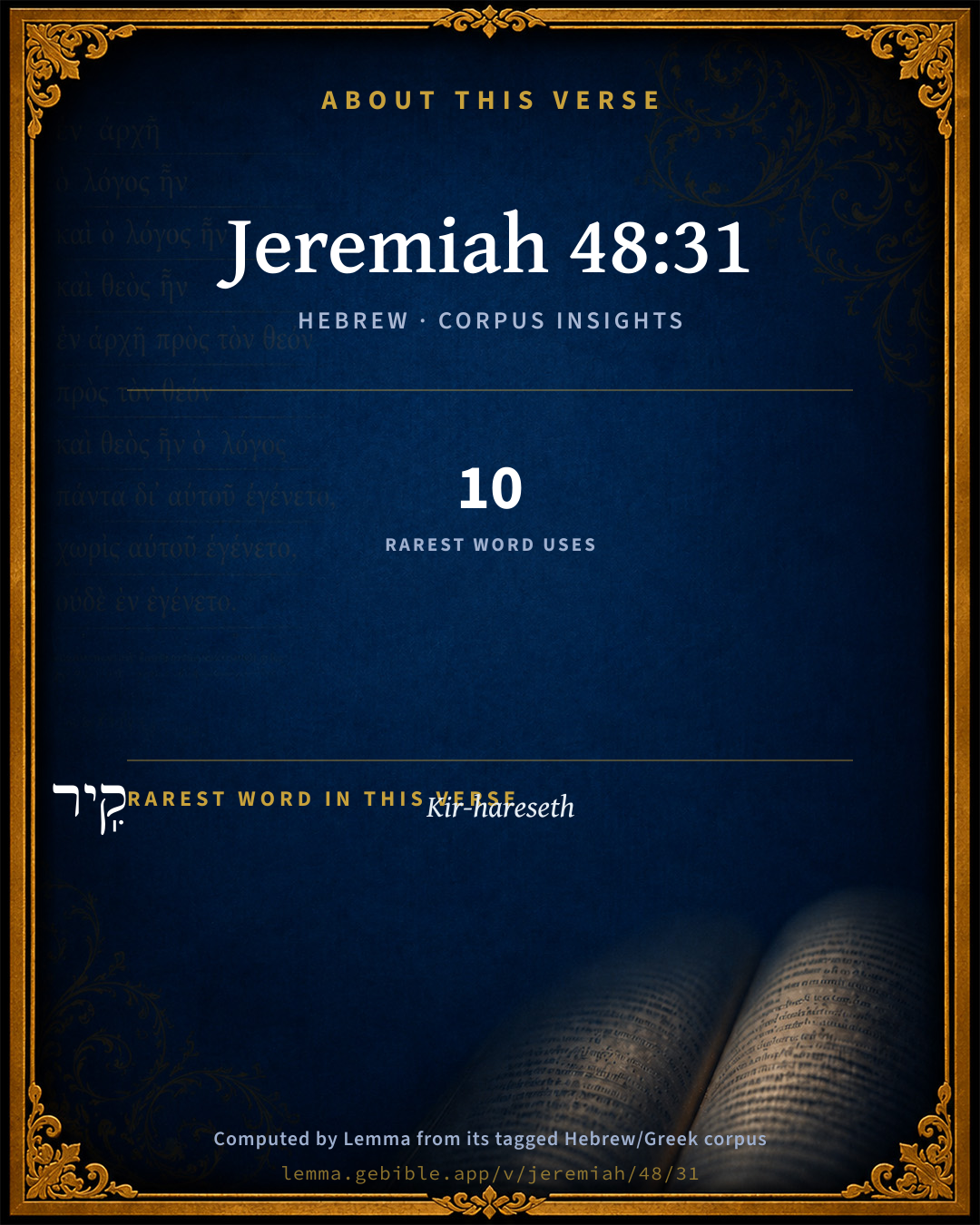
13
words
10
distinct lemmas
Prophets
section

Notable vocabulary

The rarest word here is קִֽיר Kir-hareseth H7025 — appearing just 10 times in the whole Hebrew Bible.

Shared distinctive vocabulary

קִֽיר Kir-hareseth H7025 occurs in 5 verses of the Hebrew Bible. Also found in:

Grammatical profile

  • 3 verbs
  • 6 nouns
  • 3 prepositions
  • 1 particle

Verb forms

  • אֲיֵלִ֔יל Hiphil · Imperfect
  • אֶזְעָ֑ק Qal · Imperfect
  • יֶהְגֶּֽה Qal · Imperfect

Repetition

Words recur within this verse — often emphatic in Hebrew:

  • עַל upon H5921 ×2
  • מוֹאָ֣ב Moab H4124 ×2
  • קִֽיר Kir-hareseth H7025 ×2

Cross-references

4

Topical passages linked to Jeremiah 48:31 in the Treasury of Scripture Knowledge — connected by theme and wording, ordered by reader-vote popularity; previews shown in the World English Bible.

  • 2 Kings 3:25 They beat down the cities; and on every good piece of land they cast every man his stone, and filled it; and they stopped all the springs of water, and felled all the good trees, until in Kir Hareseth [only] they left the stones of it; however the men armed with slings went about it, and struck it.
  • Isaiah 15:5 My heart cries out for Moab; her nobles [flee] to Zoar, to Eglath Shelishiyah: for by the ascent of Luhith with weeping they go up; for in the way of Horonaim they raise up a cry of destruction.
  • Jeremiah 48:36 Therefore my heart sounds for Moab like pipes, and my heart sounds like pipes for the men of Kir Heres: therefore the abundance that he has gotten is perished.
  • Isaiah 16:7–11 Therefore shall Moab wail for Moab, everyone shall wail: for the raisin-cakes of Kir Hareseth shall you mourn, utterly stricken.

Cross-references courtesy of OpenBible.info (CC BY 4.0).

Hebrew and Greek witnesses Masoretic Hebrew ↔ Greek Septuagint

The same verse in the two great witnesses to the Old Testament, shown verse-for-verse.

These are two independent witnesses, not word-aligned to each other, and the Septuagint is shown in lemma (dictionary) form.

Hebrew Jeremiah 48:31 Masoretic · Westminster Leningrad Codex

עַל כֵּן֙ עַל מוֹאָ֣ב אֲיֵלִ֔יל וּלְמוֹאָ֥ב כֻּלֹּ֖ה אֶזְעָ֑ק אֶל אַנְשֵׁ֥י קִֽיר חֶ֖רֶשׂ יֶהְגֶּֽה

Therefore will I wail for Moab; yes, I will cry out for all Moab: for the men of Kir Heres shall they mourn.

World English Bible · Public Domain

Greek LXX Structure differs

In the Septuagint, Jeremiah is about an eighth shorter than the Hebrew and arranges its material differently — the Oracles Against the Nations (Hebrew chapters 46–51) appear in the middle of the Greek book, after 25:13. Because the chapter and verse boundaries do not line up, a verse-for-verse comparison with the Hebrew is not shown.

A verse-for-verse comparison isn’t shown here because the chapters and verses don’t line up. Switch to the LXX edition with the MT / LXX toggle above to read the Greek directly.

On this verse, The Pulpit Commentary discusses the Septuagint’s reading. Read the note in Commentary ↓

Hebrew: Westminster Leningrad Codex (CC BY 4.0). Greek: Septuagint (public domain); English from a public-domain English Septuagint. How the Septuagint differs from the Hebrew →

Targum (Aramaic paraphrase)

1

The Targum is the ancient Jewish Aramaic paraphrase of the Hebrew Scriptures — an interpretive translation, not the Hebrew text itself. Onkelos (literal) and Pseudo-Jonathan (expansive) render the Torah, and Jonathan the Prophets. Coverage is partial: where no permissively-licensed English translation exists for a verse, only the Aramaic is shown. This is verse-level text, not a word-by-word alignment to the Hebrew.

  1. Targum Jonathan Prophets (Joshua–Malachi)
    עַל כֵּן עַל מוֹאָבָאֵי מְיַלְלִין וְעַל מוֹאָבָאֵי כּוּלְהוֹן מְצַוְחִין עַל אֱנַשׁ כְּרַךְ תּוּקְפֵהוֹן דָוָן:

    (no public-domain English translation for this verse)

    Targum Jonathan — Aramaic: “Mikraot Gedolot” (public domain). English: “Sefaria Community Translation” (CC0 1.0 (public-domain dedication)); “London "Chaldee Paraphrase," 1871” (public domain). Text via Sefaria.

Commentary

Notes on Jeremiah 48:31 from classic Christian and Jewish commentators (each source and its license shown beneath its notes). The classic Christian expositions comment on the surrounding passage and are grouped to its opening verse, so a note may address several verses; the Jewish commentaries on the Tanakh (Rashi and others) are per-verse, so they appear only where the commentator wrote on this verse.

Lemma curates 59 commentaries, every one of them public domain or Creative Commons licensed, each selected and text-cleaned for this edition rather than reprinted as found. About our sources →

Trapp's Complete Commentary

John Trapp

Jer 48:31 Therefore will I howl for Moab, and I will cry out for all Moab; [mine heart] shall mourn for the men of Kirheres.

Ver. 31. Therefore will I howl.] Isa 16:7; Isa 15:5.

John Trapp, A Commentary or Exposition upon All the Books of the Old and New Testament (1647–1656) — public domain. Text from a community e-Sword module.

Joseph Benson's Commentary

Jer 48:31-33. Therefore will I howl for Moab — See note on Isa 15:5. I will cry out for all Moab — The whole country of Moab: the phrase is the same with whole Palestina, Isa 14:31. For the men of Kirheres — See note on Isa 16:7; Isa 16:11. O vine of Sibmah — The expressions here denote the destruction of the fruitful vineyards of Sibmah; the loss of which the neighbouring places of Jazer would have reason to lament. Thy plants are gone over the sea — The vineyards of Sibmah seem to have been of a vast extent, and to have been greatly celebrated: see note on Isa 16:8-9. And joy and gladness is taken from the plentiful field — The gathering in of the harvest and other fruits of the earth is usually accompanied with great expressions of joy; but there would be no occasion for this in the land of Moab, as the enemy would spoil or carry away their crop and vintage. None shall tread with shouting — They shall not have a vintage left sufficient to excite them to shouts of joy, or to induce them to exhort and encourage one another to labour diligently.

Joseph Benson's Commentary on the Old and New Testaments (1811–1818) — public domain. Text from a community e-Sword module.

Keil & Delitzsch

C. F. Keil & F. Delitzsch

Jer 48:31-33 are also an imitation of Isa 16:7-10. V. 31 is a reproduction of Isa 16:7. In Jer 48:7, Isaiah sets forth the lamentation of Moab over the devastation of his country and its precious fruits; and not until v. 9 does the prophet, in deep sympathy, mingle his tears with those of the Moabites. Jeremiah, on the other hand, with his natural softness, at once begins, in the first person, his lament over Moab. על־כּן, "therefore," is not immediately connected with Jer 48:29., but with the leading idea presented in Jer 48:26 and Jer 48:28, that Moab will fall like one intoxicated, and that he must flee out of his cities. If we refer it to Jer 48:30, there we must attach it to the thought implicitly contained in the emphatic statement, "I (Jahveh) know his wrath," viz., "and I will punish him for it." The I who makes lament is the prophet, as in Isa 16:9 and Isa 15:5. Schnurrer, Hitzig, and Graf, on the contrary, think that it is an indefinite third person who is introduced as representing the Moabites; but there is no analogous case to support this assumption, since the instances in which third persons are introduced are of a different kind. But when Graf further asserts, against referring the I to the prophet, that, according to what precedes, especially what we find in Jer 48:26., such an outburst of sympathy for Moab would involve a contradiction, he makes out the prophet to be a Jew thirsting for revenge, which he was not. Raschi has already well remarked, on the other hand, under Isa 15:5, that "the prophets of Israel differ from heathen prophets like Balaam in this, that they lay to heart the distress which they announce to the nations;" cf. Isa 21:3. The prophet weeps for all Moab, because the judgment is coming not merely on the northern portion (Jer 48:18-25), but on the whole of the country. In Jer 48:31, Jeremiah has properly changed לאשׁישׁי (cakes of dried grapes) into אל־אנשׁי, the people of Kir-heres, because his sympathy was directed, not to dainties, but to the men in Moab; he has also omitted "surely they are smitten," as being too strong for his sympathy. יהגּה, to groan, taken from the cooing of doves, perhaps after Isa 38:15; Isa 59:11. The third person indicates a universal indefinite. Kir-heres, as in Isa 16:11, or Kir-haresheth in Isa 16:7; Kg2 3:25, was the chief stronghold of Moab, probably the same as Kir-Moab, the modern Kerek, as we may certainly infer from a comparison of Isa 16:7 with Isa 15:1 see on Kg2 3:25, and Dietrich, S. 324.

Jer 48:32-33

מבּכי יעזר, "more than the weeping of Jazer," may signify, "More than Jazer weeps do I weep over thee;" or, "More than over Jazer weeps do I weep over thee;" or, "More than over Jazer do I weep over thee." However, the former interpretation is the more obvious, and is confirmed by the reading in Isa 16:9. According to the Onomasticon, Jazer was fifteen Roman miles north from Heshbon. Seetzen recognises it in the ruins called es Szir at the source of the Nahr Szir; see on Num 21:32. According to Jerome, on Isa 16:8, Sibmah was only five hundred paces from Heshbon; see on Num 32:38. Judging from the verse now before us, and from Isa. l.c., the vines of Sibmah must have been famed for the strength and excellence of their clusters. Even now, that region produces excellent grapes in abundance. From Szalt, which lies only ten miles north from Szir, raisins and grapes are carried to Jerusalem, and these of excellent quality (Seetzen, i. S. 399; Burckhardt, p. 350). In what follows, "his tendrils crossed the sea," etc., the extensive cultivation of the grape is set forth under the figure of a vine whose tendrils stretch out on all sides. "They have crossed over the sea" has reference in Isaiah (Isa 16:8) to the Dead Sea (ים, as in Psa 68:23; Ch2 20:2); not merely, however, in the sense of the shoots reaching close to the Dead Sea, but also over it, for Engedi was famed for its vines (Sol 1:14). Jeremiah also has reproduced the words taken from Isaiah in this sense. From the following clause, "they reached to the sea of Jazer," it does not follow that he has specified "the sea" by "Jazer." What tells rather the other way is the fact that עבר, which means to cross over, cannot possibly be used as equivalent to נגע עד, "to reach to." "They crossed over the sea" shows extension towards the west, while "they reached to the sea of Jazer" indicates extension towards the north. This latter statement also is an imitation of what we find in Isa 16:8; and "Jazer" is merely further specified as "the sea of Jazer." In spite of the most diligent inquiries, Seetzen (i. S. 406) could learn nothing from the people of that region regarding an inland lake; but in the beautiful green vale in the vicinity of Szr (i.e., Jazer) there were several ponds, which he supposes may possibly be the mare Jazer, since this valley lying among the mountains is somewhat depressed, and in ancient times was probably filled with water. The "sea" (ים) of Solomon's temple further shows that ים does not necessarily denote only a large lake, but might also be applied to a large artificial basin of water. So also, at the present day, the artificial water-basins on the streets of Damascus are called baharat, "seas;" cf. Wetzstein in Delitzsch on Isa 16:8. This cultivation of the vine is at an end; for the destroyer has fallen upon the fruit-harvest and the vintage. Jeremiah, by "the destroyer has fallen," explains the words of Isaiah (Isa 16:9), "shouting has fallen." - In Jer 48:33, Isa 16:10 is reproduced. "Joy and gladness are taken away from the gardens, and from the whole land of Moab." כּרמל is not here a proper name, for Mount Carmel does not at all suit the present context; it is an appellative, fruit-land, i.e., the fruitful wine-country near Jazer. Jeremiah adds, "and from the land (i.e., the whole land) of Moab." The pressing of the grapes comes to an end; there is no wine in the vat; no longer is the wine pressed with "Hedad." הידד is an adverbial accusative. This is further specified by the oxymoron: a "Hedad, and yet not a Hedad." This word generally signifies any loud shout, - not merely the shout of the wine-pressers as they tread the grapes (see on Jer 25:30), but also a battle-cry; cf. Jer 51:14. Hence the meaning is, "Hedad is heard, but not a merry shout of the wine-pressers."

Keil & Delitzsch — Biblical Commentary on the Old Testament (1861–1891) — public domain (CC PDM 1.0). Text via the HelloAO Bible API. (Old Testament only.)

Tyndale Open Study Notes

Tyndale Open Resources

48:31 The Lord had to punish Moab and other nations that sinned, but it caused him to mourn. • Kir-hareseth was Moab’s capital city.

Tyndale Open Study Notes — © Tyndale Open Resources, licensed CC BY-SA 4.0. Text via the HelloAO Bible API.

Geneva Bible (1599)

Geneva Bible translators

Read Isa. 16:7.

Geneva Bible (1599) marginal notes — public domain. Text via Bolls.life.

Jamieson, Fausset & Brown

Robert Jamieson, A. R. Fausset & David Brown

I will cry . . . for . . . Moab--Not that it deserves pity, but the prophet's "crying" for it vividly represents the greatness of the calamity.

Kir-heres--Kir-hareseth, in Isa 16:7; see on Isa 16:7. It means "the city of potters," or else "the city of the sun" [GROTIUS]. Here "the men of Kir-heres" are substituted for "the foundations of Kir-hareseth," in Isa 16:7. The change answers probably to the different bearing of the disaster under Nebuchadnezzar, as compared with that former one under Shalmaneser.

Jamieson, Fausset & Brown — Commentary Critical and Explanatory on the Whole Bible (1871) — public domain (CC PDM 1.0). Text via the HelloAO Bible API.

John Calvin's Commentaries

Some think the last word to be a proper name, though, according to etymology, it is “the city of potsherd.” They therefore give this rendering, “the strong city.” But Isaiah calls it “Kir-hareseth,” קיר-הרשת; he extends the word by adding a syllable to it; but the word, however, is the same. Then he says, I will think of the men of Kir-cheres The word הגה, ege, is properly to complain, to whisper, to murmur; and hence some render the words not improperly, “I will mutter to the men of the city of potsherd.”

The Prophet does not relate here what he would do, as I have before reminded you; but that he might represent to the life the ruin of Moab, he mentions their howling, crying, and complaints. He then says, I will howl, cry aloud, and with a trembling voice complain, as those who are grievously oppressed with evils; at one time they complain, cry aloud, and howl, and at another they mutter inwardly, grumble and murmur. Thus the Prophet assumes the character of such persons, in order that he might more fully set forth the extreme calamity of that nation. He afterwards comes to particulars: —

John Calvin's Commentaries (1540-1563) — public domain. Text from the Calvin Translation Society English edition (1840s-50s) via the Christian Classics Ethereal Library (ccel.org). Calvin's coverage is partial (roughly two-thirds of the Bible); uncommented books and verses are honest gaps, never fabricated. The 19th-century editor's footnotes and remarks are omitted so the notes are faithfully Calvin's own voice.

Ellicott's Commentary for English Readers

(31) Therefore will I howl for Moab.—The changes of person are remarkable. The “I” that speaks is neither Jehovah nor the prophet, but the unnamed mourner, who in the next clause appears in the third person (“she shall mourn,” the English “mine heart” having no equivalent in the Hebrew) as the representative of those who mourn for Moab. In Jer_48:33, “I have caused wine to fail” appears as the utterance of Jehovah. In Isa_16:7, of which the whole passage is a free reproduction, Moab is named as the mourner. Possibly, however, Jeremiah in his sympathy may speak here in his own person.

For the men of Kir-heres.—The name appears in Isa_16:7 as Kirhareseth, and is probably identical with the “Kir of Moab” of Isa_15:1. The place was obviously an important stronghold. The Targum on Isaiah and Jeremiah renders it by Crac, and this has led to its being identified with the modern Kerak, occupying a strong position on one of the Moabite mountains to the south-east of the Dead Sea. The name, which signifies “City of the Sun,” may indicate its connection with that form of nature-worship.

A Bible Commentary for English Readers, edited by Charles John Ellicott (1878–1897) — public domain. Text from a community e-Sword module.

The Cambridge Bible for Schools and Colleges

gen. ed. J. J. S. Perowne

31. Based on Isa_16:7, but the influence of the first person in Jer_48:9 there (“I will, etc.”) has led here to the prophet’s grief for Moab being represented as caused by her pride.

will I howl] In the corresponding passage in Isaiah it is first the country that mourns for itself, Jer_48:7, and only later, Jer_48:9, the prophet also expresses grief.

For “the men of” we should probably read, as in Isaiah, raisin-cakes of Kir-heres. They were made of a mixture of raisins and meal. Cp. Hos_3:1. The two words in the original resemble each other. Kir-heres was probably the modern Kerak, eighteen miles S. of the Arnon and eight miles E. of the Dead Sea; a strong fortress on a steep hill surrounded by ravines.

The Cambridge Bible for Schools and Colleges (gen. ed. J. J. S. Perowne; Cambridge University Press, 1878–1918) — public domain. Text from a community e-Sword module.

John Gill's Exposition

O vine of Sibmah, I will weep for thee with the weeping of Jazer,.... Sibmah was a city in the land of Moab abounding with vines, but now should be destroyed; and Jazer another city in the same country, which was destroyed before the other; and therefore its destruction should be lamented and wept over, as that had been: or "from", or "after the weeping of Jazer" (h); when that is over, or from thence will I go in course as the desolation proceeds, to weep for Sibmah: or I will weep for that "more than the weeping of Jazer" (i); make a greater lamentation for it than for Jazer; or, as some, than Isaiah made for Jazer; of which see Isa 16:9;

thy plants are gone over the sea; the Dead sea; meaning the inhabitants of Sibmah, the governors and common people, who were gone over sea into captivity, as it is generally understood:

they reach even to the sea of Jazer; a lake or confluence of water near to Jazer, called a sea; as it was usual with the Jews to call such seas; as the sea of Tiberias, and the like: this spread of the plants seems to refer to the multitudes of those that belonged to Sibmah, and the villages of it, which extended beyond the Dead sea, even to the sea of Jazer; but as fruitful as this vine was, and extensive as its branches were, they should come to destruction:

the spoiler is fallen upon thy summer fruits, and upon thy vintage: the king of Babylon, who came upon them with his army in the summer season, and at the time of their vintage, and devoured the fruits of their vines and fig trees, with which this country abounded; and so impoverished and ruined them. The Targum of the whole is,

"therefore as I have brought an army against Jazer, so I will bring slayers against Sibmah; they that carry them captive have waded; they have passed through the sea; they are come to the sea of Jazer; upon thy harvest, and upon thy vintage, the spoilers are fallen.''

(h) "a fletu", Pagninus, Montanus, Calvin, Schmidt. (i) "Supra fletum", Junius & Tremellius, Piscator, Gataker.

John Gill's Exposition of the Whole Bible (1746–1763) — public domain (CC PDM 1.0). Text via the HelloAO Bible API.

Albert Barnes' Notes on the Bible

Mine heart ... - Rather, “there shall be mourning for” etc.

Albert Barnes' Notes on the Bible (1834–1885) — public domain. Text from a community e-Sword/MySword module.

Haydock's Catholic Bible Commentary

Brick wall. Hebrew Kir-cheres, (Isaias xvi. 7.; Calmet) "the city of the sun;" (Grotius) Ar, the capital. The prophet joins in the mournful canticle, as was usual, Luke vii. 32. (Calmet) --- Those who boast of more than they have, are compared to an earthen wall. (Worthington)

George Leo Haydock (1774–1849), Haydock's Catholic Family Bible and Commentary, 1859 edition — public domain. Excludes Psalms (Douay-Rheims chapter numbering differs from Protestant) and Deuterocanonical books (Catholic canon only).

Matthew Poole's English Annotations

Though wicked men rejoice and triumph in the ruin of good men, yet their charity suffereth them not to do the like, but engageth them to mourn for them in the day of their affliction. Jeremiah declareth his compassion toward these Moabites, though they derided the Jews when they were carried into captivity. nay, he mourns upon the prospect of their misery at some distance; when the sight of the Jews’ present calamity would not affect the Moabites with any compassion at all. We find the like compassion in another prophet, Isa 16:11; Jer 48:7 there it is called Kir-hareseth, which was a city of Moab, as we read, 2Ki 3:25.

Matthew Poole's English Annotations on the Holy Bible (1683–1685) — public domain. Text from a community e-Sword/MySword module.

The Pulpit Commentary

Based upon Isa_16:7. Therefore. Moab cannot escape the catastrophe, for his moral basis is utterly insecure. "Therefore," etc. Will I howl. It is at first sight strange that the prophet should speak thus sympathetically after the strong language in ver. 26. But the fact is that an inspired prophet has, as it were, a double personality. Sometimes his human feelings seem quite lost in the consciousness of his message; sometimes (and especially in Jeremiah) the natural, emotional life refuses to be thus restrained, and will have itself expressed. All Moab; i.e. Moab in all its districts, both north and south of the Amen, or, at any rate, the fugitive populations. Mine heart shall mourn. The Authorized Version effaces one of the points of difference between Jeremiah and his original. The former leaves the subject indefiniteone shall mourn. For the men of Kir-heres. Isa_16:7 has "for the raisin cakes of Kir-heres" (i.e. for the cakes of pressed grapes, for which Kir-heres was specially famous) a much more expressive phrase. Jeremiah, or his scribe, has changed ashishe into anshe, and the Targum and Septuagint have adopted this weak reading in Isaiah, l.c.

The Pulpit Commentary (1880–1919), ed. H.D.M. Spence-Jones & Joseph S. Exell — public domain. Text from a community e-Sword module.

John Wesley's Explanatory Notes

Kir-herez - A city of Moab.

John Wesley, Explanatory Notes Upon the Whole Bible (1754–1765) — public domain. Text via the GEBible commentary corpus.

Rashi

Rabbi Shlomo Yitzchaki (Rashi)

Kir-heres A city of the land of Moab.

they shall moan Moaning like moaning doves.

Rashi on the Tanakh — English translations: “The Judaica Press complete Tanach with Rashi, translated by A. J. Rosenberg” (CC BY 4.0); “Pentateuch with Rashi's commentary by M. Rosenbaum and A.M. Silbermann, 1929-1934” (public domain); “The Metsudah Tanach series, Lakewood, N.J” (CC BY 4.0); and “The Book of Joshua, Metsudah Publications, 1997” (CC BY 4.0). Text via Sefaria.

Lesson kit

Teaching starters — assembled from the data on this page, not authored interpretation. Every prompt links to the verse data it draws on. Edit before teaching.

Jeremiah, in the Prophets, opens this verse with 13 words (10 distinct Hebrew lemmas). Its most distinctive word is Qîyr Cheres (“Kir-hareseth”). A historical commentator’s framing appears above. Read the whole chapter for the surrounding context.

Discussion questions

  1. The word Qîyr Cheres carries the sense “Kir-hareseth.” How does it shape the verse?
  2. How does 2 Kings 3:25, which shares the word «Kir-hareseth», read alongside this verse?
  3. What does the repetition of “upon” (2× in this one verse) do in this verse?
  4. These translations render this verse differently; the difference is in the English rendering, not the original. What questions does that raise?
  5. «אֲיֵלִ֔יל» is a Hiphil Imperfect verb. How does that grammatical form shape the action described?
  6. Compare how Trapp's Complete Commentary and Joseph Benson's Commentary read this verse. Where do they agree or differ?

Things to notice

Reading settings

Reading text

Shown beneath each verse's original-language words.

Old Testament
Old Testament edition

Read the OT as the Masoretic Hebrew (MT) or the Greek Septuagint (LXX).

English shown for the Greek Septuagint (in the Hebrew ↔ Greek comparison).

Comparing translations? Open the Compare panel on any verse page to stack up to four side by side.