
Numbers 21:26

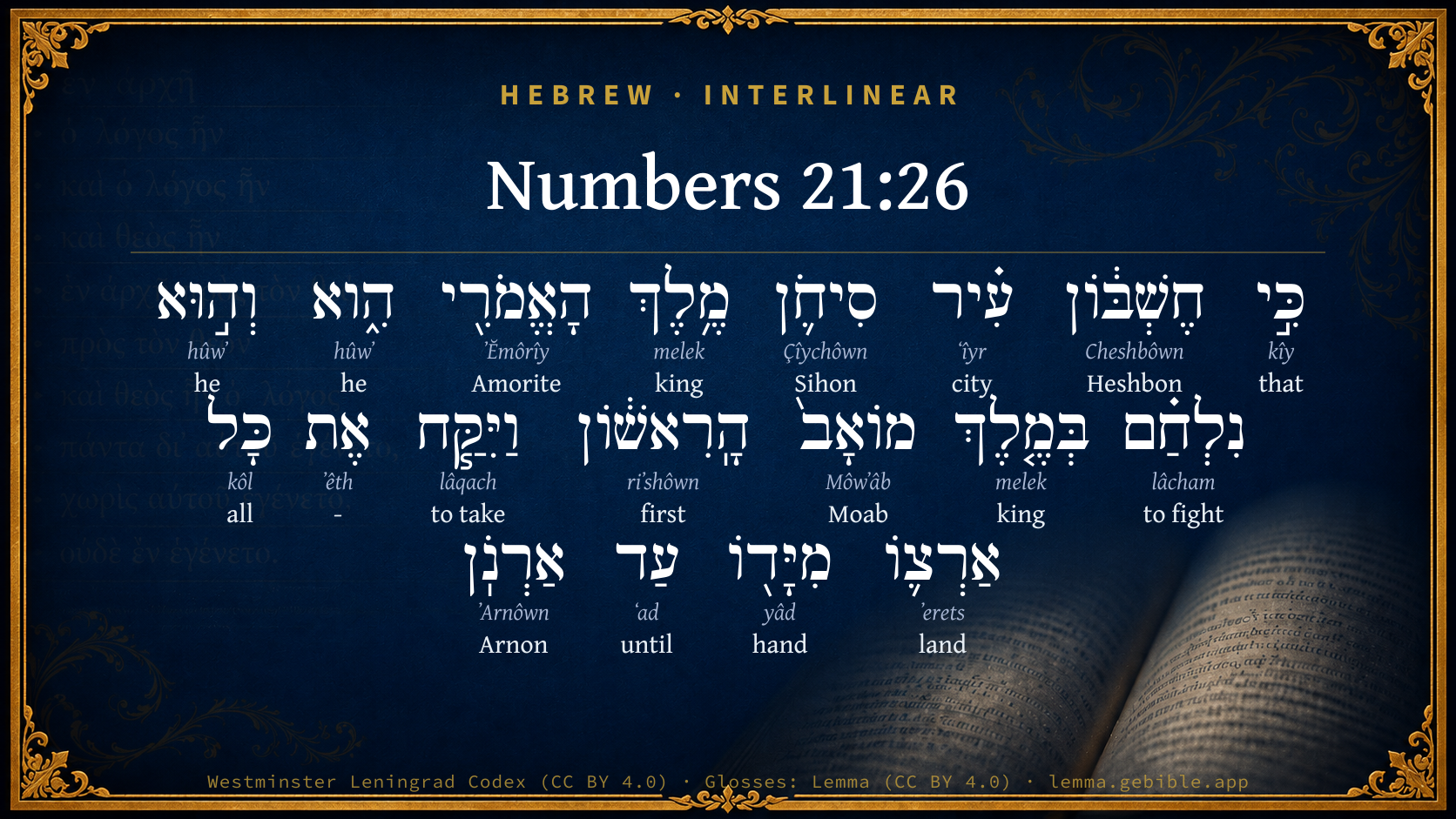
Hebrew (Westminster Leningrad Codex) Numbers 21:26 appears in the Hebrew Old Testament. The text above is from the Westminster Leningrad Codex. Each word links to its Strong’s number, a concise gloss, and parsing drawn from the Open Scriptures Hebrew Bible morphology. Click any word for its full Brown-Driver-Briggs (BDB) entry.
Download image
Cite this verse

Numbers 21:26 (World English Bible). Public Domain. Lemma interlinear Bible study tool, https://lemma.gebible.app/v/numbers/21/26.

Show BibTeX & RIS
BibTeX
RIS
English Translation
For Heshbon was the city of Sihon the king of the Amorites, who had fought against the former king of Moab, and taken all his land out of his hand, even to the Arnon.
World English Bible · Public Domain
Download a study sheet

One document with this verse’s original text, its word-by-word gloss line, the meaning frame, cross-references with their text, attributed commentary, and full source and license credits — printable, and it pastes into notes with its structure intact.

This verse Autodidact and up

Study sheet (.html) Plain text (.txt)

A passage Seminary Student

Up to 50 verses in one chapter. A passage sheet keeps up to 6 commentary sources and 12 cross-references per verse, in the order this page ranks them, and says so on the sheet whenever that leaves anything out. Ask for a single verse and you get the Autodidact verse sheet above.

Everything on this page stays free to read, with no account — the sheet is a download of what is already on screen, not access to it.

Want to remove ads? Support Godless Engineer
Compare translations 3

The same verse in 3 English versions, stacked beneath the original-language interlinear above. Click any original word for its lexicon entry.

Each is an independent rendering of the whole verse — the interlinear is not word-aligned to these translations.

Highlighted words mark where these versions differ — a whole-verse word diff, not a word-by-word alignment.

  • World English Bible Public Domain
    For Heshbon was the city of Sihon the king of the Amorites, who had fought against the former king of Moab, and taken all his land out of his hand, even to the Arnon.
  • King James Version Public Domain
    For Heshbon was the city of Sihon the king of the Amorites, who had fought against the former king of Moab, and taken all his land out of his hand, even unto Arnon.
  • unfoldingWord Literal Text CC BY-SA 4.0
    For Heshbon the city of Sihon, king of the Amorite, and he had fought against the former king of Moab and had taken all his land from his hand as far as the Arnon.

unfoldingWord Literal Text — © unfoldingWord, licensed CC BY-SA 4.0. Word-aligned USFM3 via Door43 (git.door43.org/unfoldingWord/en_ult).

Versions to compare (up to 4)

3 of 4 selected

Show all 18 translations

Every available English version of this verse, each an independent rendering of the whole verse.

  • World English Bible Public Domain
    For Heshbon was the city of Sihon the king of the Amorites, who had fought against the former king of Moab, and taken all his land out of his hand, even to the Arnon.
  • Berean Standard Bible Public Domain
    Heshbon was the city of Sihon king of the Amorites, who had fought against the former king of Moab and taken all his land as far as the Arnon.
  • Majority Standard Bible Public Domain
    Heshbon was the city of Sihon king of the Amorites, who had fought against the former king of Moab and taken all his land as far as the Arnon.
  • King James Version Public Domain
    For Heshbon was the city of Sihon the king of the Amorites, who had fought against the former king of Moab, and taken all his land out of his hand, even unto Arnon.
  • American Standard Version (1901) Public Domain
    For Heshbon was the city of Sihon the king of the Amorites, who had fought against the former king of Moab, and taken all his land out of his hand, even unto the Arnon.
  • Revised Version (1885) Public Domain
    For Heshbon was the city of Sihon the king of the Amorites, who had fought against the former king of Moab, and taken all his land out of his hand, even unto Arnon.
  • Geneva Bible (1599) Public Domain
    For Heshbon was the citie of Sihon the king of the Amorites, which had fought beforetime against the king of the Moabites, and had taken al his land out of his hand, euen vnto Arnon.
  • Douay-Rheims (1899) Public Domain
    Hesebon was the city of Sehon the king of the Amorrhites, who fought against the king of Moab: and took all the land, that had been of his dominions, as far as the Arnon.
  • Young's Literal Translation Public Domain
    for Heshbon is a city of Sihon king of the Amorite, and he hath fought against the former king of Moab, and taketh all his land out of his hand, unto Arnon;
  • Literal Standard Version CC BY-SA 4.0
    for Heshbon is a city of Sihon king of the Amorite, and he has fought against the former king of Moab, and takes all his land out of his hand as far as Arnon;
  • Unlocked Literal Bible CC BY-SA 4.0
    Heshbon was the city of Sihon king of the Amorites, who had fought against the former king of Moab. Sihon had taken all his land from his territory to the Arnon River.
  • unfoldingWord Literal Text CC BY-SA 4.0
    For Heshbon the city of Sihon, king of the Amorite, and he had fought against the former king of Moab and had taken all his land from his hand as far as the Arnon.
  • Darby Bible Public Domain
    For Heshbon was the city of Sihon the king of the Amorites; and he had fought against the former king of Moab, and had taken all his land out of his hand, even unto the Arnon.
  • World Messianic Bible Public Domain
    For Heshbon was the city of Sihon the king of the Amorites, who had fought against the former king of Moab, and taken all his land out of his hand, even to the Arnon.
  • Webster's Bible Public Domain
    For Heshbon was the city of Sihon the king of the Amorites, who had fought against the former king of Moab, and taken all his land out of his hand, even to Arnon.
  • Free Bible Version CC BY-SA 4.0
    Heshbon was the capital of Sihon, king of the Amorites, who had fought against the previous king of Moab and had taken from him all his land as far as the Arnon River.
  • Bible in Basic English Public Domain
    For Heshbon was the town of Sihon, king of the Amorites, who had made war against an earlier king of Moab and taken from him all his land as far as the Arnon.
  • JPS Tanakh (1917) Public Domain
    For Heshbon was the city of Sihon the king of the Amorites, who had fought against the former king of Moab, and taken all his land out of his hand, even unto the Arnon.

Literal Standard Version (2020), Covenant Press — licensed CC BY-SA 4.0. Text via the HelloAO Bible API (eBible.org). Unlocked Literal Bible (unfoldingWord) — licensed CC BY-SA 4.0. Text via the HelloAO Bible API (eBible.org). unfoldingWord Literal Text — © unfoldingWord, licensed CC BY-SA 4.0. Word-aligned USFM3 via Door43 (git.door43.org/unfoldingWord/en_ult). Free Bible Version, Dr. Jonathan Gallagher — licensed CC BY-SA 4.0. Text via the HelloAO Bible API (eBible.org).

Word by word

More ways to search: Search by grammar → Find every occurrence → Compare this word →

Practice this passage: Drill this verse → Learn its vocabulary →

אַרְנֹֽן
ʼArnôwn
H769
“Arnon”
Noun, Proper
Part of Speech
Noun
Type
Proper
Full BDB Definition

Origin: from H7442

TWOT: None

Arnon = "rushing stream" - a river and surrounding valley in south Palestine, forms the border between Moab and the Amorites
  1. כִּ֣י kîy H3588 “that” Conjunction
  2. חֶשְׁבּ֔וֹן Cheshbôwn H2809 “Heshbon” Noun, Proper
  3. עִ֗יר ʻîyr H5892 “city of” Noun, Common, Feminine, Singular, Construct
  4. סִיחֹ֛ן Çîychôwn H5511 “Sihon” Noun, Proper
  5. מֶ֥לֶךְ melek H4428 “king of” Noun, Common, Masculine, Singular, Construct
  6. הָאֱמֹרִ֖י ʼĔmôrîy H567 “the · Amorite” Particle, Definite Article + Noun, Gentilic, Masculine, Singular, Absolute
  7. הִ֑וא hûwʼ H1931 “he” Pronoun, Personal, 3rd Person, Feminine, Singular
  8. וְה֣וּא hûwʼ H1931 “and · he” Conjunction + Pronoun, Personal, 3rd Person, Masculine, Singular
  9. נִלְחַ֗ם lâcham H3898 “to fight” Verb, Niphal, Perfect, 3rd Person, Masculine, Singular
  10. בְּמֶ֤לֶךְ melek H4428 “in/at · king of” Preposition + Noun, Common, Masculine, Singular, Construct
  11. מוֹאָב֙ Môwʼâb H4124 “Moab” Noun, Proper
  12. הָֽרִאשׁ֔וֹן riʼshôwn H7223 “the · first” Particle, Definite Article + Adjective, Ordinal number, Masculine, Singular, Absolute
  13. וַיִּקַּ֧ח lâqach H3947 “and · to take” Conjunction + Verb, Qal, Sequential Imperfect, 3rd Person, Masculine, Singular
  14. אֶת ʼêth H853 “-” Particle, Direct Object
  15. כָּל kôl H3605 “all of” Noun, Common, Masculine, Singular, Construct
  16. אַרְצ֛וֹ ʼerets H776 “land · his” Noun, Common, Both, Singular, Construct + Suffix, Personal, 3rd Person, Masculine, Singular
  17. מִיָּד֖וֹ yâd H3027 “from · hand · his” Preposition + Noun, Common, Both, Singular, Construct + Suffix, Personal, 3rd Person, Masculine, Singular
  18. עַד ʻad H5704 “until” Preposition

About this verse

These counts appear in no published source. They are computed here, from the morphology-tagged text and Lemma’s own curated glosses. What Lemma adds →

19
words
17
distinct lemmas
Pentateuch
section

Notable vocabulary

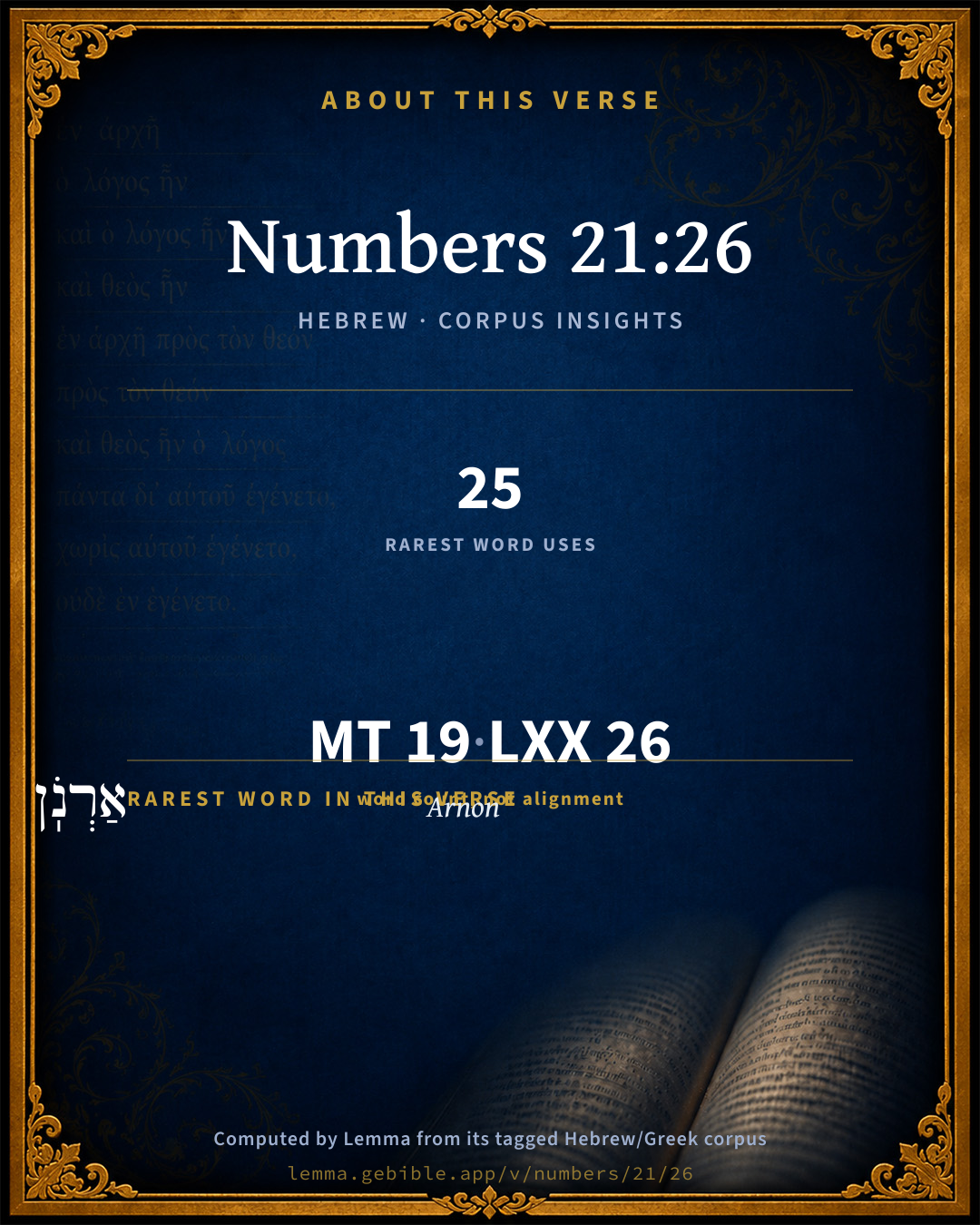
The rarest word here is אַרְנֹֽן Arnon H769 — appearing just 25 times in the whole Hebrew Bible.

Shared distinctive vocabulary

אַרְנֹֽן Arnon H769 occurs in 23 verses of the Hebrew Bible. Also found in:

Grammatical profile

  • 2 verbs
  • 11 nouns
  • 1 adjective
  • 2 pronouns
  • 1 preposition
  • 1 conjunction
  • 1 particle

Verb forms

  • נִלְחַ֗ם Niphal · Perfect
  • וַיִּקַּ֧ח Qal · Sequential Imperfect

Repetition

Words recur within this verse — often emphatic in Hebrew:

  • מֶ֥לֶךְ king H4428 ×2
  • הִ֑וא he H1931 ×2

Hebrew & Septuagint length

In English translation the verse runs 34 words from the Hebrew and 30 from the Septuagint (LXX English) — closely comparable.

A rough comparison of the two English renderings, which tokenize alike — not a word-level alignment.

Word counts can differ between the Hebrew and the Greek without any difference in meaning — e.g. the Hebrew direct-object marker אֵת has no separate Greek word, and Greek often adds the article ὁ.

In the original languages it is 19 Hebrew tokens and 26 Greek tokens — but the two are counted differently (Hebrew bundles its prefixes and suffixes into one token; the Greek is in lemma form), so that isn’t a like-for-like length.

Hebrew and Greek witnesses Masoretic Hebrew ↔ Greek Septuagint

The same verse in the two great witnesses to the Old Testament, shown verse-for-verse.

These are two independent witnesses, not word-aligned to each other, and the Septuagint is shown in lemma (dictionary) form.

Hebrew Numbers 21:26 Masoretic · Westminster Leningrad Codex

כִּ֣י חֶשְׁבּ֔וֹן עִ֗יר סִיחֹ֛ן מֶ֥לֶךְ הָאֱמֹרִ֖י הִ֑וא וְה֣וּא נִלְחַ֗ם בְּמֶ֤לֶךְ מוֹאָב֙ הָֽרִאשׁ֔וֹן וַיִּקַּ֧ח אֶת כָּל אַרְצ֛וֹ מִיָּד֖וֹ עַד אַרְנֹֽן

For Heshbon was the city of Sihon the king of the Amorites, who had fought against the former king of Moab, and taken all his land out of his hand, even to the Arnon.

World English Bible · Public Domain

Greek LXX Numbers 21:26 Septuagint · lemma form

εἰμί γάρ εσεβων πόλις σηων ὁ βασιλεύς ὁ ἀμορραῖος καί οὗτος πολεμέω βασιλεύς μωαβ ὁ πρότερος καί λαμβάνω πᾶς ὁ γῆ αὐτός ἀπό αροηρ ἕως αρνων

For Esebon is the city of Seon king of the Amorites; and he before fought against the king of Moab, and they took all his land, from Aroer to Arnon.

LXX2012 (modern English Septuagint) · Public Domain

Hebrew: Westminster Leningrad Codex (CC BY 4.0). Greek: Septuagint (public domain); English from LXX2012 (modern English Septuagint) (Public Domain). How the Septuagint differs from the Hebrew →

Targum (Aramaic paraphrase)

2

The Targum is the ancient Jewish Aramaic paraphrase of the Hebrew Scriptures — an interpretive translation, not the Hebrew text itself. Onkelos (literal) and Pseudo-Jonathan (expansive) render the Torah, and Jonathan the Prophets. Coverage is partial: where no permissively-licensed English translation exists for a verse, only the Aramaic is shown. This is verse-level text, not a word-by-word alignment to the Hebrew.

  1. Targum Onkelos Torah (Genesis–Deuteronomy)
    אֲרֵי חֶשְׁבּוֹן קַרְתָּא דְסִיחוֹן מַלְכָּא דֶאֱמוֹרָאָה הִיא וְהוּא אַגַח קְרָבָא בְּמַלְכָּא דְמוֹאָב קַדְמָאָה וּנְסֵיב יָת כָּל אַרְעֵיהּ מִידֵיהּ עַד אַרְנוֹן

    (no public-domain English translation for this verse)

    Targum Onkelos — Aramaic: “Onkelos Genesis” (public domain); “Onkelos Exodus” (public domain); “Onkelos Leviticus” (public domain); “Onkelos Numbers” (public domain); “Onkelos Deuteronomy” (public domain). English: “Sefaria Community Translation” (CC0 1.0 (public-domain dedication)); “J.W. Etheridge. The Targums of Onkelos and Jonathan Ben Uzziel on the Pentateuch. London: Longmans, Green, 1862” (public domain). Text via Sefaria.

  2. Targum Pseudo-Jonathan Torah (Genesis–Deuteronomy)
    אֲרוּם חֶשְׁבּוֹן קַרְתָּא דְסִיחוֹן מַלְכָּא דֶאֱמוֹרָאָה הִיא וְהוּא אַגַח קְרָבָא בְּמַלְכָּא דְמוֹאָב קַדְמָאָה וּנְסֵיב יַת כָּל אַרְעֵיהּ מִן יְדֵיהּ עַד אַרְנוֹן

    For Heshbon was the city of Sihon, king of the Amorites; for he had beforetime made war with the King of Moab, and had taken all his country from his hand unto the Arnon.

    Targum Pseudo-Jonathan — Aramaic: “Targum Jonathan on Genesis” (public domain); “Targum Jonathan on Exodus” (public domain); “Targum Jonathan on Leviticus” (public domain); “Targum Jonathan on Numbers” (public domain); “Targum Jonathan on Deuteronomy” (public domain). English: “The Targum of Jonathan ben Uzziel, trans. J. W. Etheridge, London, 1862” (public domain). Text via Sefaria.

Commentary

Notes on Numbers 21:26 from classic Christian and Jewish commentators (each source and its license shown beneath its notes). The classic Christian expositions comment on the surrounding passage and are grouped to its opening verse, so a note may address several verses; the Jewish commentaries on the Tanakh (Rashi and others) are per-verse, so they appear only where the commentator wrote on this verse.

Lemma curates 59 commentaries, every one of them public domain or Creative Commons licensed, each selected and text-cleaned for this edition rather than reprinted as found. About our sources →

The Cambridge Bible for Schools and Colleges

gen. ed. J. J. S. Perowne

26–30. The writer explains that Heshbon used to belong to the Moabites, but that Sihon had taken it from them. He quotes an ancient poem with which he was acquainted, having heard it from the lips of ‘those that speak in proverbs’ (see on Num_21:27).

The interpretation of the song is somewhat doubtful, and Num_21:30 is corrupt and almost untranslateable. The word ‘wherefore’ (Num_21:27) suggests that the poem is quoted in order to explain Num_21:26; the writer, as in Num_21:14, illustrates by an ancient song a statement which he has just made. This statement is that Moab had been previously conquered by the Amorites; and the song is a taunt to the Amorites whose capital Israel has destroyed. The taunt is, in effect, ‘Why do you not come and rebuild your fallen capital, for you shewed prowess enough in the past when you conquered Moab!’ All the verbs in Num_21:28 f. must therefore be rendered as aorists—‘a fire went out,’ ‘it devoured,’ ‘thou wast undone,’ ‘he gave.’ Another interpretation of the song will be mentioned after the notes on Num_21:30; but the above is much the more probable.

The Cambridge Bible for Schools and Colleges (gen. ed. J. J. S. Perowne; Cambridge University Press, 1878–1918) — public domain. Text from a community e-Sword module.

Joseph Benson's Commentary

Num 21:26. Heshbon was the city of Sihon — This is added as a reason why Israel took possession of this land, because it was not now the land of the Moabites, but in the possession of the Amorites. The former king — The predecessor of Balak, who was the present king. See the wisdom of God’s providence, which prepares long before for the accomplishment of his purposes in their season! This country, being designed for Israel, is beforehand put into the hand of the Amorites, who little think they have it but as trustees, till Israel comes of age. We understand not the vast schemes of Providence: but known unto God are all his works!

Joseph Benson's Commentary on the Old and New Testaments (1811–1818) — public domain. Text from a community e-Sword module.

Tyndale Open Study Notes

Tyndale Open Resources

21:26 King Sihon of the Amorites had taken the area north of the Arnon from the Moabites, who earlier controlled it. After Israel occupied this region for several hundred years, it was reclaimed by King Mesha of Moab (see 2 Kgs 3:4-27) through a campaign described in detail around 830 BC on the Mesha Inscription (also known as the Moabite Stone). • Heshbon is usually identified with Tell Hesban, which has not yielded evidence of Late Bronze Age occupation; see study note on Num 21:1.

Tyndale Open Study Notes — © Tyndale Open Resources, licensed CC BY-SA 4.0. Text via the HelloAO Bible API.

Geneva Bible (1599)

Geneva Bible translators

For if it had been the Moabites, the Israelites might not have possessed it, Deut. 2:9.

Geneva Bible (1599) marginal notes — public domain. Text via Bolls.life.

Jamieson, Fausset & Brown

Robert Jamieson, A. R. Fausset & David Brown

Heshbon-- (Sol 7:4) --situated sixteen English miles north of the Arnon, and from its ruins it appears to have been a large city.

Jamieson, Fausset & Brown — Commentary Critical and Explanatory on the Whole Bible (1871) — public domain (CC PDM 1.0). Text via the HelloAO Bible API.

Adam Clarke's Commentary

Verse 26. For Heshbon was the city of Sihon, &c.] It appears therefore that the territory now taken from Sihon by the Israelites was taken from a former king of Moab, in commemoration of which an epikedion or war song was made, several verses of which, in their ancient poetic form, are here quoted by Moses.

Adam Clarke's Commentary on the Bible (1810–1826) — public domain. Text from a community e-Sword/MySword module.

Ellicott's Commentary for English Readers

(26) And taken all his land . . . —i.e., the land between the Arnon and the Jabbok, as it is explained in the last clause of the verse.

A Bible Commentary for English Readers, edited by Charles John Ellicott (1878–1897) — public domain. Text from a community e-Sword module.

John Gill's Exposition

Woe to thee, Moab! thou art undone,.... The whole country ruined, or likely to be so:

O people of Chemosh; which was the name of their idol, who is called the abomination of the Moabites, Kg1 11:7,

he hath given his sons that escaped; that is, the idol Chemosh had given his sons, the men of the country that worshipped him, who escaped the sword of the Amorites, these:

and his daughters, into captivity unto Sihon king of the Amorites; who took captive what he slew not, or would do so, Chemosh their god not being able to preserve them, but obliged to deliver them up: thus the composers of this song insult the god of the Moabites, as it was usual for conquerors so to do; see Isa 10:10, though some think these are the words of the Israelites, making their observations upon the above song, which ends at verse twenty eight, and scoffing at the idol of the Moabites.

John Gill's Exposition of the Whole Bible (1746–1763) — public domain (CC PDM 1.0). Text via the HelloAO Bible API.

Haydock's Catholic Bible Commentary

Arnon. Hence this territory, which formerly belonged to Moab, being taken in a just war, the Moabites could not lawfully retain it, as they attempted to do under Jephte, Judges xi. 13. (Grotius, Jur. iii. 6.) --- Hesebon, or Esbus, was the capital, and lay over-against Jericho, twenty miles from the Jordan.

George Leo Haydock (1774–1849), Haydock's Catholic Family Bible and Commentary, 1859 edition — public domain. Excludes Psalms (Douay-Rheims chapter numbering differs from Protestant) and Deuterocanonical books (Catholic canon only).

Matthew Poole's English Annotations

The city of Sihon: this is added as a reason why Israel took possession of this land, notwithstanding God’s prohibition of meddling with them or their land, Deu 2:9, because it was not now the land of the Moabites, but had been some time since taken from them, and in the possession of the Amorites.

The former king of Moab, i.e. the predecessor of Balak, who was the present king.

Matthew Poole's English Annotations on the Holy Bible (1683–1685) — public domain. Text from a community e-Sword/MySword module.

The Pulpit Commentary

All his land. This is qualified by what follows: "even unto Arnon". (cf. Jud 11:13-19)

The Pulpit Commentary (1880–1919), ed. H.D.M. Spence-Jones & Joseph S. Exell — public domain. Text from a community e-Sword module.

John Wesley's Explanatory Notes

Was the city of Sihon - This is added as a reason why Israel took possession of this land, because it was not now the land of the Moabites, but in the possession of the Amorites. The former king -The predecessor of Balak, who was the present king. See the wisdom of providence, which prepares long before, for the accomplishing God's purposes in their season! This country being designed for Israel, is before-hand put into the hand of the Amorites, who little think they have it but as trustees, till Israel comes of age. We understand not the vast reaches of providence: but known unto God are all his works!

John Wesley, Explanatory Notes Upon the Whole Bible (1754–1765) — public domain. Text via the GEBible commentary corpus.

Rashi

Rabbi Shlomo Yitzchaki (Rashi)

והוא נלחם AND HE (SIHON) HAD FOUGHT [AGAINST THE FORMER KING OF MOAB] — Why is it necessary that this should be written? Because it is said (Deuteronomy 2:9), “Harass not Moab”, and Heshbon belonged to Moab (and therefore should not have been attacked), it (Scripture) tells us that Sihon had taken it from them, and through him it (Heshbon) became permissible to Israel as an object of attack (Chullin 60b; Gittin 38a).

מידו means FROM HIS POSSESSION (Bava Metzia 56b).

Rashi on the Tanakh — English translations: “The Judaica Press complete Tanach with Rashi, translated by A. J. Rosenberg” (CC BY 4.0); “Pentateuch with Rashi's commentary by M. Rosenbaum and A.M. Silbermann, 1929-1934” (public domain); “The Metsudah Tanach series, Lakewood, N.J” (CC BY 4.0); and “The Book of Joshua, Metsudah Publications, 1997” (CC BY 4.0). Text via Sefaria.

Ramban (Nachmanides)

Rabbi Moshe ben Nachman (Ramban / Nachmanides)

FOR HESHBON WAS THE CITY OF SIHON THE KING OF THE AMORITES. That is to say, now when Israel waged battle against it, it was the city of Sihon the king of the Amorites, meaning to say the city of the royal residence, for he had fought against ‘melech harishon’ (the first king) of Moab, [meaning the one] who had ruled over them before any king reigned, or harishon [may mean] “the one before Balak,” who was the king of Moab at that time, and Sihon had taken all his land out of his hand, even unto the Arnon. Now Heshbon marked the border at which this conquest [of Sihon] began; therefore it was considered the Amorites’, and Israel was only prohibited [from capturing] that land of Moab and Ammon which was land that was in their possession at the time of the Divine command [not to capture any of the lands of Moab and Ammon]. And Scripture brings a proof that Heshbon was the city of Sihon, for those that speak in parables [as explained above in Verse 13] say, come ye to Heshbon etc., for when Sihon fought against the king of Moab, he captured at first the city of Heshbon, and the city was destroyed, and afterwards he rebuilt it as his royal abode. This is the meaning of [the phrase], who dwelleth in Heshbon. And similarly it is said in the Book of Joshua, Sihon king of the Amorites, who reigned in Heshbon. Thus those who spoke in parables would say to the Amorites: “Come to Heshbon, and settle therein; let the city of Sihon, over which he has become king, be built and established after its destruction.” And after Sihon had established himself in Heshbon, he assembled his army therein and captured from the border of Moab until Arnon, including Arnon itself. Arnon itself” is not found. Other scholars have also commented that the reading should be: “excluding Arnon itself.” This is undoubtedly correct, as Ramban himself expressly states above in Verse 13. Therefore they that speak in parables said, that a fire is gone out of Heshbon, a flame from the city of Sihon wherein he dwells; and it has devoured Ar of Moab, and the lords of the high places which belong to Arnon. For Sihon has captured from Moab unto Arnon, and all the high places of the land and the lords of the high places, this being similar [in meaning to]: even the ancient high places are ours in possession. He [Sihon] also took from the children of Ammon [the territory] from the Arnon to the Jabbok, as it is said in [the Book of] Joshua, And Moses gave unto the tribe of Gad etc. Jazer, and all the cities of Gilead, and half the land of the children of Ammon unto Aroer, this being the land which the king of Ammon claimed from Jephthah, as he said, Because Israel took away my land, when he came up out of Egypt, from the Arnon even unto the Jabbok, and unto the Jordan.

Ramban (Nachmanides) on the Tanakh — English translation: “Commentary on the Torah by Ramban (Nachmanides). Translated and annotated by Charles B. Chavel. New York, Shilo Pub. House, 1971-1976” (CC BY 4.0). Text via Sefaria.

Lesson kit

Teaching starters — assembled from the data on this page, not authored interpretation. Every prompt links to the verse data it draws on. Edit before teaching.

Numbers, in the Pentateuch, opens this verse with 19 words (17 distinct Hebrew lemmas). Its most distinctive word is ʼArnôwn (“Arnon”). A historical commentator’s framing appears above. Read the whole chapter for the surrounding context.

Discussion questions

  1. How does “Arnon” (ʼArnôwn) shape what this verse is saying?
  2. How does Numbers 21:13, which shares the word «Arnon», read alongside this verse?
  3. What does the repetition of “king” (2× in this one verse) do in this verse?
  4. These translations render this verse differently. What is at stake in choosing one wording over another?
  5. «נִלְחַ֗ם» is a Niphal Perfect verb. How does that grammatical form shape the action described?
  6. Compare how The Cambridge Bible for Schools and Colleges and Joseph Benson's Commentary read this verse. Where do they agree or differ?

Things to notice

Reading settings

Reading text

Shown beneath each verse's original-language words.

Old Testament
Old Testament edition

Read the OT as the Masoretic Hebrew (MT) or the Greek Septuagint (LXX).

English shown for the Greek Septuagint (in the Hebrew ↔ Greek comparison).

Comparing translations? Open the Compare panel on any verse page to stack up to four side by side.