Jeremiah 48:35

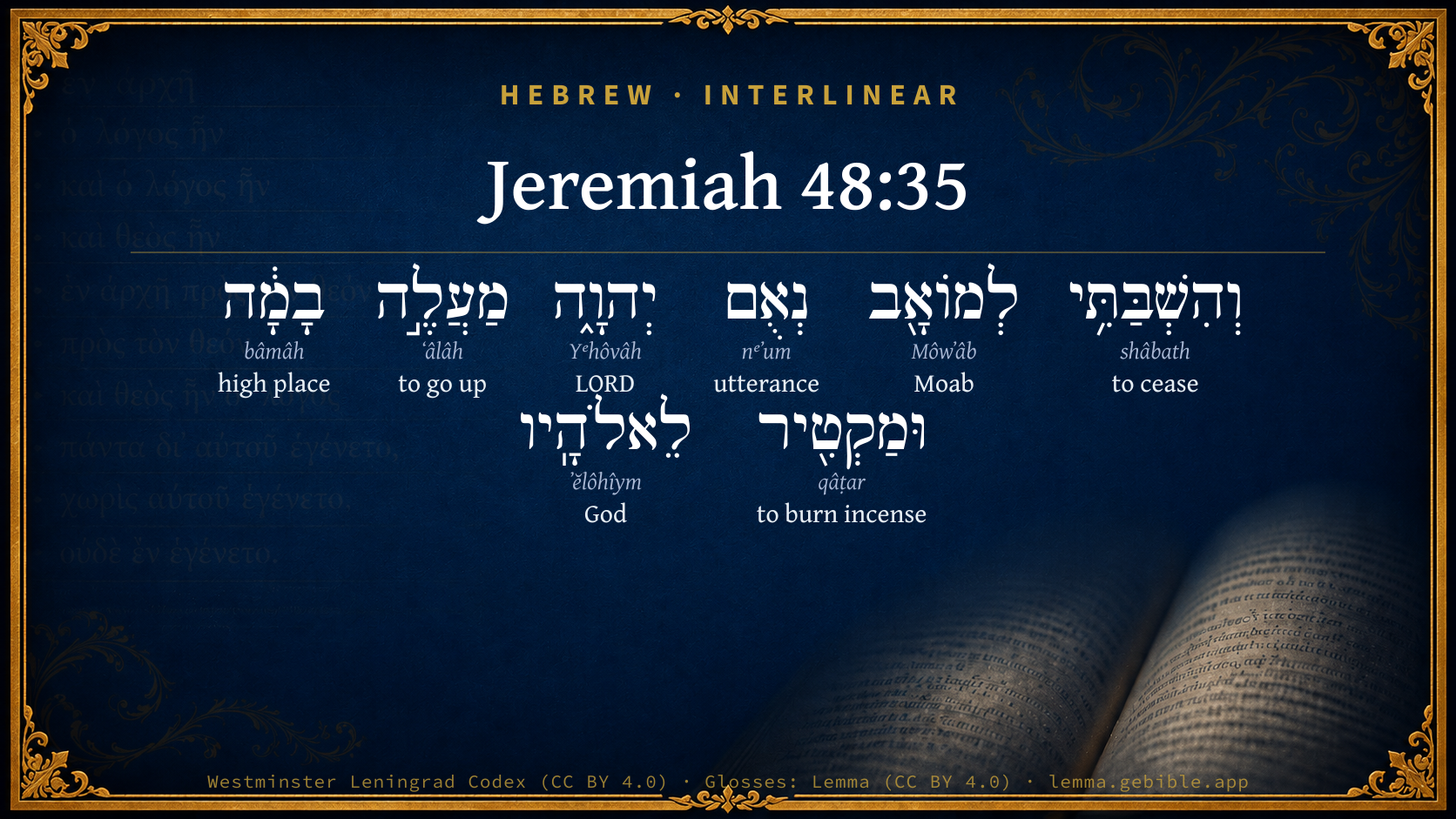
Hebrew (Westminster Leningrad Codex) Jeremiah 48:35 appears in the Hebrew Old Testament. The text above is from the Westminster Leningrad Codex. Each word links to its Strong’s number, a concise gloss, and parsing drawn from the Open Scriptures Hebrew Bible morphology. Click any word for its full Brown-Driver-Briggs (BDB) entry.
Download image
Cite this verse

Jeremiah 48:35 (World English Bible). Public Domain. Lemma interlinear Bible study tool, https://lemma.gebible.app/v/jeremiah/48/35.

Show BibTeX & RIS
BibTeX
RIS
English Translation
Moreover I will cause to cease in Moab, says Yahweh, him who offers in the high place, and him who burns incense to his gods.
World English Bible · Public Domain
Download a study sheet

One document with this verse’s original text, its word-by-word gloss line, the meaning frame, cross-references with their text, attributed commentary, and full source and license credits — printable, and it pastes into notes with its structure intact.

This verse Autodidact and up

Study sheet (.html) Plain text (.txt)

A passage Seminary Student

Up to 50 verses in one chapter. A passage sheet keeps up to 6 commentary sources and 12 cross-references per verse, in the order this page ranks them, and says so on the sheet whenever that leaves anything out. Ask for a single verse and you get the Autodidact verse sheet above.

Everything on this page stays free to read, with no account — the sheet is a download of what is already on screen, not access to it.

Want to remove ads? Support Godless Engineer
Compare translations 3

The same verse in 3 English versions, stacked beneath the original-language interlinear above. Click any original word for its lexicon entry.

Each is an independent rendering of the whole verse — the interlinear is not word-aligned to these translations.

Highlighted words mark where these versions differ — a whole-verse word diff, not a word-by-word alignment.

  • World English Bible Public Domain
    Moreover I will cause to cease in Moab, says Yahweh, him who offers in the high place, and him who burns incense to his gods.
  • King James Version Public Domain
    Moreover I will cause to cease in Moab, saith the LORD, him that offereth in the high places, and him that burneth incense to his gods.
  • unfoldingWord Literal Text CC BY-SA 4.0
    For I will put an end to anyone in Moab who makes sacrifices on the high places and burns incense to his gods—this is Yahweh’s declaration.

unfoldingWord Literal Text — © unfoldingWord, licensed CC BY-SA 4.0. Word-aligned USFM3 via Door43 (git.door43.org/unfoldingWord/en_ult).

Versions to compare (up to 4)

3 of 4 selected

Show all 18 translations

Every available English version of this verse, each an independent rendering of the whole verse.

  • World English Bible Public Domain
    Moreover I will cause to cease in Moab, says Yahweh, him who offers in the high place, and him who burns incense to his gods.
  • Berean Standard Bible Public Domain
    In Moab, declares the LORD, I will bring an end to those who make offerings on the high places and burn incense to their gods.
  • Majority Standard Bible Public Domain
    In Moab, declares the LORD, I will bring an end to those who make offerings on the high places and burn incense to their gods.
  • King James Version Public Domain
    Moreover I will cause to cease in Moab, saith the LORD, him that offereth in the high places, and him that burneth incense to his gods.
  • American Standard Version (1901) Public Domain
    Moreover I will cause to cease in Moab, saith Jehovah, him that offereth in the high place, and him that burneth incense to his gods.
  • Revised Version (1885) Public Domain
    Moreover I will cause to cease in Moab, saith the LORD, him that offereth in the high place, and him that burneth incense to his gods.
  • Geneva Bible (1599) Public Domain
    Moreouer, I will cause to cease in Moab, saith the Lord, him that offered in the high places, and him that burneth incense to his gods.
  • Douay-Rheims (1899) Public Domain
    And I will take away from Moab, saith the Lord, him that offereth in the high places, and that sacrificeth to his gods.
  • Young's Literal Translation Public Domain
    And I have caused to cease to Moab, An affirmation of Jehovah, Him who is offering in a high place, And him who is making perfume to his god.
  • Literal Standard Version CC BY-SA 4.0
    And I have caused to cease in Moab, || A declaration of YHWH, || Him who is offering in a high place, || And him who is making incense to his god.
  • Unlocked Literal Bible CC BY-SA 4.0
    For I will put an end to anyone in Moab who makes sacrifices on the high places and burns incense to his gods—this is Yahweh's declaration.
  • unfoldingWord Literal Text CC BY-SA 4.0
    For I will put an end to anyone in Moab who makes sacrifices on the high places and burns incense to his gods—this is Yahweh’s declaration.
  • Darby Bible Public Domain
    And I will cause to cease in Moab, saith Jehovah, him that offereth in the high place, and him that burneth incense to his gods.
  • World Messianic Bible Public Domain
    Moreover I will cause to cease in Moab,” says the LORD, “him who offers in the high place, and him who burns incense to his gods.
  • Webster's Bible Public Domain
    Moreover I will cause to cease in Moab, saith the LORD, him that offereth in the high places, and him that burneth incense to his gods.
  • Free Bible Version CC BY-SA 4.0
    I'm going to finish off those in Moab who sacrifice on the pagan high places and burn incense to their gods, declares the Lord.
  • Bible in Basic English Public Domain
    And I will put an end in Moab, says the Lord, to him who is making offerings in the high place and burning perfumes to his gods.
  • JPS Tanakh (1917) Public Domain
    Moreover I will cause to cease in Moab, saith the LORD, him that offereth in the high place, and him that offereth to his gods.

Literal Standard Version (2020), Covenant Press — licensed CC BY-SA 4.0. Text via the HelloAO Bible API (eBible.org). Unlocked Literal Bible (unfoldingWord) — licensed CC BY-SA 4.0. Text via the HelloAO Bible API (eBible.org). unfoldingWord Literal Text — © unfoldingWord, licensed CC BY-SA 4.0. Word-aligned USFM3 via Door43 (git.door43.org/unfoldingWord/en_ult). Free Bible Version, Dr. Jonathan Gallagher — licensed CC BY-SA 4.0. Text via the HelloAO Bible API (eBible.org).

Word by word

More ways to search: Search by grammar → Find every occurrence → Compare this word →

Practice this passage: Drill this verse → Learn its vocabulary →

וְהִשְׁבַּתִּ֥י
shâbath
H7673
“and · to cease”
Conjunction + Verb, Hiphil, Sequential Perfect, 1st Person, Common, Singular
Part of Speech
Conjunction + Verb
Stem
Hiphil
Form
Sequential Perfect
Person
1st Person
Gender
Common
Number
Singular
Full BDB Definition

Origin: a primitive root

TWOT: 2323 , 2323c

to cease, desist, rest - (Qal) - to cease - to rest, desist (from labour) - (Niphal) to cease - (Hiphil) - to cause to cease, put an end to - to exterminate, destroy - to cause to desist from - to remove - to cause to fail - (Qal) to keep or observe the sabbath
  1. לְמוֹאָ֖ב Môwʼâb H4124 “to/for · Moab” Preposition + Noun, Proper
  2. נְאֻם nᵉʼum H5002 “utterance of” Noun, Common, Masculine, Singular, Construct
  3. יְהוָ֑ה Yᵉhôvâh H3068 “LORD” Noun, Proper
  4. מַעֲלֶ֣ה ʻâlâh H5927 “going up” Verb, Hiphil, Participle Active, Masculine, Singular, Absolute
  5. בָמָ֔ה bâmâh H1116 “high place” Noun, Common, Feminine, Singular, Absolute
  6. וּמַקְטִ֖יר qâṭar H6999 “and · burning incense” Conjunction + Verb, Hiphil, Participle Active, Masculine, Singular, Absolute
  7. לֵאלֹהָֽיו ʼĕlôhîym H430 “to/for · God(s) · his” Preposition + Noun, Common, Masculine, Plural, Construct + Suffix, Personal, 3rd Person, Masculine, Singular

About this verse

These counts appear in no published source. They are computed here, from the morphology-tagged text and Lemma’s own curated glosses. What Lemma adds →

8
words
8
distinct lemmas
Prophets
section

Grammatical profile

  • 3 verbs
  • 5 nouns

Verb forms

  • וְהִשְׁבַּתִּ֥י Hiphil · Sequential Perfect
  • מַעֲלֶ֣ה Hiphil · Participle Active
  • וּמַקְטִ֖יר Hiphil · Participle Active

Cross-references

7

Topical passages linked to Jeremiah 48:35 in the Treasury of Scripture Knowledge — connected by theme and wording, ordered by reader-vote popularity; previews shown in the World English Bible.

  • Isaiah 15:2 They are gone up to Bayith, and to Dibon, to the high places, to weep: Moab wails over Nebo, and over Medeba; on all their heads is baldness, every beard is cut off.
  • Isaiah 16:12 It shall happen, when Moab presents himself, when he wearies himself on the high place, and shall come to his sanctuary to pray, that he shall not prevail.
  • Numbers 22:40–41 Balak sacrificed oxen and sheep, and sent to Balaam, and to the princes who were with him.
  • Numbers 28:14 Their drink-offerings shall be half a hin of wine for a bull, and the third part of a hin for the ram, and the fourth part of a hin for a lamb: this is the burnt offering of every month throughout the months of the year.
  • Numbers 28:28–30 and their meal-offering, fine flour mixed with oil, three tenth parts for each bull, two tenth parts for the one ram,
  • Jeremiah 11:13 For according to the number of your cities are your gods, Judah; and according to the number of the streets of Jerusalem have you set up altars to the shameful thing, even altars to burn incense to Baal.
  • Jeremiah 48:7 For, because you have trusted in your works and in your treasures, you also shall be taken: and Chemosh shall go forth into captivity, his priests and his princes together.

Cross-references courtesy of OpenBible.info (CC BY 4.0).

Hebrew and Greek witnesses Masoretic Hebrew ↔ Greek Septuagint

The same verse in the two great witnesses to the Old Testament, shown verse-for-verse.

These are two independent witnesses, not word-aligned to each other, and the Septuagint is shown in lemma (dictionary) form.

Hebrew Jeremiah 48:35 Masoretic · Westminster Leningrad Codex

וְהִשְׁבַּתִּ֥י לְמוֹאָ֖ב נְאֻם יְהוָ֑ה מַעֲלֶ֣ה בָמָ֔ה וּמַקְטִ֖יר לֵאלֹהָֽיו

Moreover I will cause to cease in Moab, says Yahweh, him who offers in the high place, and him who burns incense to his gods.

World English Bible · Public Domain

Greek LXX Structure differs

In the Septuagint, Jeremiah is about an eighth shorter than the Hebrew and arranges its material differently — the Oracles Against the Nations (Hebrew chapters 46–51) appear in the middle of the Greek book, after 25:13. Because the chapter and verse boundaries do not line up, a verse-for-verse comparison with the Hebrew is not shown.

A verse-for-verse comparison isn’t shown here because the chapters and verses don’t line up. Switch to the LXX edition with the MT / LXX toggle above to read the Greek directly.

On this verse, The Cambridge Bible for Schools and Colleges discusses the Septuagint’s reading. Read the note in Commentary ↓

Hebrew: Westminster Leningrad Codex (CC BY 4.0). Greek: Septuagint (public domain); English from a public-domain English Septuagint. How the Septuagint differs from the Hebrew →

Targum (Aramaic paraphrase)

1

The Targum is the ancient Jewish Aramaic paraphrase of the Hebrew Scriptures — an interpretive translation, not the Hebrew text itself. Onkelos (literal) and Pseudo-Jonathan (expansive) render the Torah, and Jonathan the Prophets. Coverage is partial: where no permissively-licensed English translation exists for a verse, only the Aramaic is shown. This is verse-level text, not a word-by-word alignment to the Hebrew.

  1. Targum Jonathan Prophets (Joshua–Malachi)
    וַאֲבַטֵיל מִן מוֹאָב אֲמַר יְיָ מַקְרִיב קוּרְבַּן עַל בָּמָתָא וּמַסִיק בּוּסְמִין לְטַעֲוָתֵיהּ:

    (no public-domain English translation for this verse)

    Targum Jonathan — Aramaic: “Mikraot Gedolot” (public domain). English: “Sefaria Community Translation” (CC0 1.0 (public-domain dedication)); “London "Chaldee Paraphrase," 1871” (public domain). Text via Sefaria.

Commentary

Notes on Jeremiah 48:35 from classic Christian and Jewish commentators (each source and its license shown beneath its notes). The classic Christian expositions comment on the surrounding passage and are grouped to its opening verse, so a note may address several verses; the Jewish commentaries on the Tanakh (Rashi and others) are per-verse, so they appear only where the commentator wrote on this verse.

Lemma curates 59 commentaries, every one of them public domain or Creative Commons licensed, each selected and text-cleaned for this edition rather than reprinted as found. About our sources →

Trapp's Complete Commentary

John Trapp

Jer 48:35 Moreover I will cause to cease in Moab, saith the LORD, him that offereth in the high places, and him that burneth incense to his gods.

Ver. 35. Moreover I will cause to cease.] Such a scarcity there shall be of people. See Jer 48:7 Num 21:28.

John Trapp, A Commentary or Exposition upon All the Books of the Old and New Testament (1647–1656) — public domain. Text from a community e-Sword module.

Keil & Delitzsch

C. F. Keil & F. Delitzsch

Jer 48:35 ends the strophe of which it is a part; here the Lord declares that He will make to cease למואב (for, or from Moab, lit., to Moab), every one who offers on a high place and burns incense to his gods. מעלה cannot be a substantive, else the parallelism would be destroyed. Nor may we, with Hitzig, render "he who raises a high place," i.e., builds it, for העלה is not used in this sense.

Keil & Delitzsch — Biblical Commentary on the Old Testament (1861–1891) — public domain (CC PDM 1.0). Text via the HelloAO Bible API. (Old Testament only.)

Tyndale Open Study Notes

Tyndale Open Resources

48:35-37 The Moabites expressed their sorrow and grief with customary actions; they shaved their heads and beards, cut their hands, and used burlap for clothing (41:5; Job 1:20).

Tyndale Open Study Notes — © Tyndale Open Resources, licensed CC BY-SA 4.0. Text via the HelloAO Bible API.

Jamieson, Fausset & Brown

Robert Jamieson, A. R. Fausset & David Brown

him that offereth--namely, whole burnt offerings as the Hebrew requires [GROTIUS]. Compare the awful burnt offering of the king of Moab (Kg2 3:27).

high places-- (Isa 16:12).

Jamieson, Fausset & Brown — Commentary Critical and Explanatory on the Whole Bible (1871) — public domain (CC PDM 1.0). Text via the HelloAO Bible API.

John Calvin's Commentaries

In this verse the Prophet expresses what he had before referred to, that God would become in such a way the avenger of the pride and cruelty of the Moabites as to punish them for their superstitions. They had descended from a pious father, for they were the posterity of Lot; but they had renounced the worship of the only true God, and had defiled themselves with the pollutions of heathens. Justly then does God declare that he would be the avenger of idolatry, while executing punishment on the pride and cruelty of the Moabites.

Now this passage, as innumerable others, clearly shews that idolatry and all profanation of divine worship, cannot finally escape punishment. God may indeed for a time connive at it, but he must necessarily at last appear as the vindicator of his own glory in punishing superstitions. But, if he spared not the Moabites, to whom the law had not, been given, and who had been corrupted through many long years, how shall they now escape unpunished, to whom God’s Word is daily propounded, and in whose ears it sounds? Let, us then remember that superstitions cannot be endured, for God will at length vindicate his own glory with regard to these abominations; for every superstition is nothing less than a profanation of God’s glory, which is thus transferred to idols and vain inventions.

John Calvin's Commentaries (1540-1563) — public domain. Text from the Calvin Translation Society English edition (1840s-50s) via the Christian Classics Ethereal Library (ccel.org). Calvin's coverage is partial (roughly two-thirds of the Bible); uncommented books and verses are honest gaps, never fabricated. The 19th-century editor's footnotes and remarks are omitted so the notes are faithfully Calvin's own voice.

Ellicott's Commentary for English Readers

(35) I will cause to cease in Moab . . .—The words indicate that the pilgrimages to the sanctuary of Chemosh, on the mountains of Moab, were a prominent feature in the nation’s life. One result of the Chaldæan conquest would be that they should be brought to an end.

A Bible Commentary for English Readers, edited by Charles John Ellicott (1878–1897) — public domain. Text from a community e-Sword module.

The Cambridge Bible for Schools and Colleges

gen. ed. J. J. S. Perowne

35. him that offereth in] This involves a slight modification of MT. which, as it stands, will mean, him that bringeth up (worshippers) to. LXX, omitting one consonant, render him that goeth up to.

The Cambridge Bible for Schools and Colleges (gen. ed. J. J. S. Perowne; Cambridge University Press, 1878–1918) — public domain. Text from a community e-Sword module.

John Gill's Exposition

Therefore my heart shall sound for Moab like pipes,.... That are sounded on mournful occasions, as at funerals, and the like; see Mat 9:23. This the prophet said, as Kimchi observes, in the person of the people, the inhabitants of Moab; whose hearts would yearn and sound for the calamities of their country like the doleful sound of minstrels. So the Targum,

"therefore the Moabites shall sound in their hearts like a harp:''

and my heart shall sound like pipes for the men of Kirheres; as for the country of Moab in general, so for this principal city, and the inhabitants of it, in particular; See Gill on Isa 16:11;

because the riches that he hath gotten is perished; either Moab or Kirheres; the abundance of goods they had got together were now lost, falling into the hands of the enemy; and which was matter of lamentation. The Targum is,

"for the rest of their substance they had got were spoiled.''

Some understand it of the residue of men that escaped the sword; these perished by famine, or other means; see Isa 15:7.

John Gill's Exposition of the Whole Bible (1746–1763) — public domain (CC PDM 1.0). Text via the HelloAO Bible API.

Matthew Poole's English Annotations

That is, every one, or some of all orders, for the Moabites generally were idolaters; though the expressing it under this notion may hint to us also one great cause of this judgment coming upon them, viz. their idolatry.

Matthew Poole's English Annotations on the Holy Bible (1683–1685) — public domain. Text from a community e-Sword/MySword module.

Whedon's Commentary on the Bible

Daniel D. Whedon

35. Clause to cease… in the high places — As the last sign and proof of national desolation.

Daniel D. Whedon (gen. ed.), Commentary on the Old and New Testaments (1874–1909) — public domain. Text from a community e-Sword module.

The Pulpit Commentary

Him that offereth in the high places; rather, him that goeth up to a high place. Apparently a reminiscence of Isa_15:2 and Isa_16:12. As Dr. Payne Smith well remarks, "The last stage of natural ruin is reached, when thus the rites of religion entirely cease."

The Pulpit Commentary (1880–1919), ed. H.D.M. Spence-Jones & Joseph S. Exell — public domain. Text from a community e-Sword module.

Lesson kit

Teaching starters — assembled from the data on this page, not authored interpretation. Every prompt links to the verse data it draws on. Edit before teaching.

Jeremiah, in the Prophets, opens this verse with 8 words (8 distinct Hebrew lemmas). Its most distinctive word is shâbath (“to cease”). A historical commentator’s framing appears above. Read the whole chapter for the surrounding context.

Discussion questions

  1. How does “to cease” (shâbath) shape what this verse is saying?
  2. How does Isaiah 15:2, which shares this passage’s theme, read alongside this verse?
  3. These translations render this verse differently. What is at stake in choosing one wording over another?
  4. «וְהִשְׁבַּתִּ֥י» is a Hiphil Sequential Perfect verb. How does that grammatical form shape the action described?
  5. Compare how Trapp's Complete Commentary and Keil & Delitzsch read this verse. Where do they agree or differ?

Things to notice

Reading settings

Reading text

Shown beneath each verse's original-language words.

Old Testament
Old Testament edition

Read the OT as the Masoretic Hebrew (MT) or the Greek Septuagint (LXX).

English shown for the Greek Septuagint (in the Hebrew ↔ Greek comparison).

Comparing translations? Open the Compare panel on any verse page to stack up to four side by side.