
Ezekiel 25:9

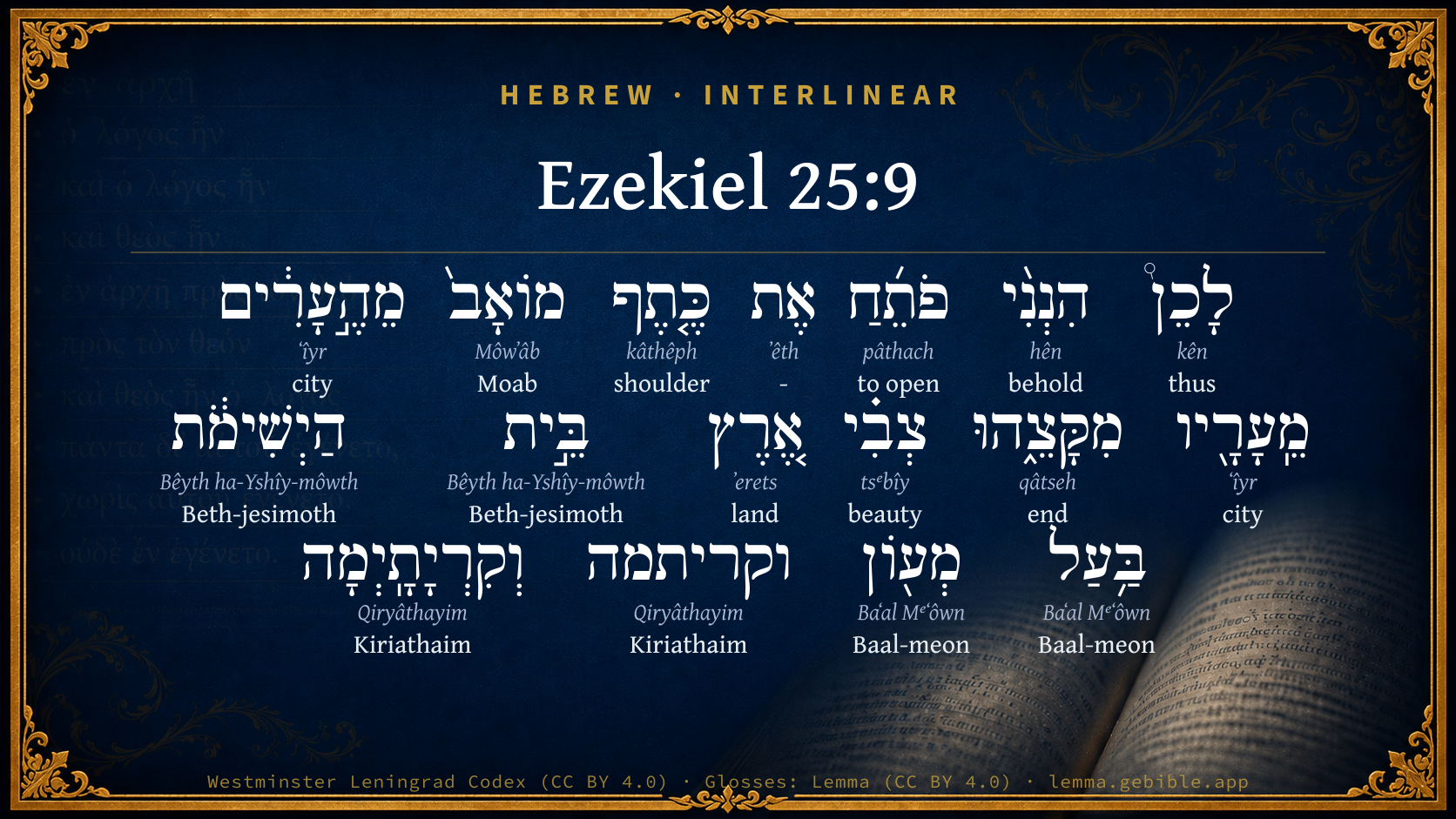
Hebrew (Westminster Leningrad Codex) Ezekiel 25:9 appears in the Hebrew Old Testament. The text above is from the Westminster Leningrad Codex. Each word links to its Strong’s number, a concise gloss, and parsing drawn from the Open Scriptures Hebrew Bible morphology. Click any word for its full Brown-Driver-Briggs (BDB) entry.
Download image
Cite this verse

Ezekiel 25:9 (World English Bible). Public Domain. Lemma interlinear Bible study tool, https://lemma.gebible.app/v/ezekiel/25/9.

Show BibTeX & RIS
BibTeX
RIS
English Translation
therefore, behold, I will open the side of Moab from the cities, from his cities which are on his frontiers, the glory of the country, Beth-jeshimoth, Baal Meon, and Kiriathaim,
World English Bible · Public Domain
Download a study sheet

One document with this verse’s original text, its word-by-word gloss line, the meaning frame, cross-references with their text, attributed commentary, and full source and license credits — printable, and it pastes into notes with its structure intact.

This verse Autodidact and up

Study sheet (.html) Plain text (.txt)

A passage Seminary Student

Up to 50 verses in one chapter. A passage sheet keeps up to 6 commentary sources and 12 cross-references per verse, in the order this page ranks them, and says so on the sheet whenever that leaves anything out. Ask for a single verse and you get the Autodidact verse sheet above.

Everything on this page stays free to read, with no account — the sheet is a download of what is already on screen, not access to it.

Want to remove ads? Support Godless Engineer
Compare translations 3

The same verse in 3 English versions, stacked beneath the original-language interlinear above. Click any original word for its lexicon entry.

Each is an independent rendering of the whole verse — the interlinear is not word-aligned to these translations.

Highlighted words mark where these versions differ — a whole-verse word diff, not a word-by-word alignment.

  • World English Bible Public Domain
    therefore, behold, I will open the side of Moab from the cities, from his cities which are on his frontiers, the glory of the country, Beth-jeshimoth, Baal Meon, and Kiriathaim,
  • King James Version Public Domain
    Therefore, behold, I will open the side of Moab from the cities, from his cities which are on his frontiers, the glory of the country, Bethjeshimoth, Baalmeon, and Kiriathaim,
  • unfoldingWord Literal Text CC BY-SA 4.0
    Therefore, behold! I will open the slopes of Moab, starting at his cities on the border—the splendor of Beth Jeshimoth, Baal Meon, and Kiriathaim—

unfoldingWord Literal Text — © unfoldingWord, licensed CC BY-SA 4.0. Word-aligned USFM3 via Door43 (git.door43.org/unfoldingWord/en_ult).

Versions to compare (up to 4)

3 of 4 selected

Show all 18 translations

Every available English version of this verse, each an independent rendering of the whole verse.

  • World English Bible Public Domain
    therefore, behold, I will open the side of Moab from the cities, from his cities which are on his frontiers, the glory of the country, Beth-jeshimoth, Baal Meon, and Kiriathaim,
  • Berean Standard Bible Public Domain
    therefore I will indeed expose the flank of Moab beginning with its frontier cities—Beth-jeshimoth, Baal-meon, and Kiriathaim—the glory of the land.
  • Majority Standard Bible Public Domain
    therefore I will indeed expose the flank of Moab beginning with its frontier cities—Beth-jeshimoth, Baal-meon, and Kiriathaim—the glory of the land.
  • King James Version Public Domain
    Therefore, behold, I will open the side of Moab from the cities, from his cities which are on his frontiers, the glory of the country, Bethjeshimoth, Baalmeon, and Kiriathaim,
  • American Standard Version (1901) Public Domain
    therefore, behold, I will open the side of Moab from the cities, from his cities which are on his frontiers, the glory of the country, Beth-jeshimoth, Baal-meon, and Kiriathaim,
  • Revised Version (1885) Public Domain
    therefore behold, I will open the side of Moab from the cities, from his cities which are on his frontiers, the glory of the country, Beth-jeshimoth, Baal-meon, and Kiriathaim,
  • Geneva Bible (1599) Public Domain
    Therefore, beholde, I will open the side of Moab, euen of the cities of his cities, I say, in his frontiers with the pleasant countrey, Beth-ieshimoth, Baal-meon, and Karia-thaim.
  • Douay-Rheims (1899) Public Domain
    Therefore behold I will open the shoulder of Moab from the cities, from his cities, I say, and his borders, the noble cities of the land of Bethiesimoth, and Beelmeon, and Cariathaim,
  • Young's Literal Translation Public Domain
    Therefore, lo, I am opening the shoulder of Moab -- From the cities -- from his cities -- from his frontier, The beauty of the land, Beth-Jeshimoth, Baal-Meon, and Kiriathaim,
  • Literal Standard Version CC BY-SA 4.0
    Therefore, behold, I am opening the shoulder of Moab—From the cities—from his cities—from his frontier, || The beauty of the land, Beth-Jeshimoth, Ba‘al-Meon, and Kiriathaim,
  • Unlocked Literal Bible CC BY-SA 4.0
    Therefore, behold! I will open the slopes of Moab, starting at his cities on the border—the splendor of Beth Jeshimoth, Baal Meon, and Kiriathaim—
  • unfoldingWord Literal Text CC BY-SA 4.0
    Therefore, behold! I will open the slopes of Moab, starting at his cities on the border—the splendor of Beth Jeshimoth, Baal Meon, and Kiriathaim—
  • Darby Bible Public Domain
    therefore behold, I will open the side of Moab from the cities, from his cities even to the last of them, the glory of the country, Beth-jeshimoth, Baal-meon, and Kirjathaim,
  • World Messianic Bible Public Domain
    therefore, behold, I will open the side of Moab from the cities, from his cities which are on its frontiers, the glory of the country, Beth Jeshimoth, Baal Meon, and Kiriathaim,
  • Webster's Bible Public Domain
    Therefore behold, I will open the side of Moab from the cities, from his cities which are on his frontiers, the glory of the country, Beth-jeshimoth, Baal-meon, and Kiriathaim,
  • Free Bible Version CC BY-SA 4.0
    that's why I will open Moab's border to attack, including Beth-jeshimoth, Baal-meon, and Kiriathaim, the country's famous cities.
  • Bible in Basic English Public Domain
    For this cause, I will let the side of Moab be uncovered, and his towns on every side, the glory of the land, Beth-jeshimoth, Baal-meon and as far as Kiriathaim.
  • JPS Tanakh (1917) Public Domain
    therefore, behold, I will open the flank of Moab on the side of the cities, on the side of his cities which are on his frontiers, the beauteous country of Beth-jeshimoth, Baal-meon, and Kiriathaim,

Literal Standard Version (2020), Covenant Press — licensed CC BY-SA 4.0. Text via the HelloAO Bible API (eBible.org). Unlocked Literal Bible (unfoldingWord) — licensed CC BY-SA 4.0. Text via the HelloAO Bible API (eBible.org). unfoldingWord Literal Text — © unfoldingWord, licensed CC BY-SA 4.0. Word-aligned USFM3 via Door43 (git.door43.org/unfoldingWord/en_ult). Free Bible Version, Dr. Jonathan Gallagher — licensed CC BY-SA 4.0. Text via the HelloAO Bible API (eBible.org).

Word by word

More ways to search: Search by grammar → Find every occurrence → Compare this word →

Practice this passage: Drill this verse → Learn its vocabulary →

בַּ֥עַל
Baʻal Mᵉʻôwn
H1186
“Baal-meon”
Noun, Proper
Part of Speech
Noun
Type
Proper
Full BDB Definition

Origin: from H1168 and H4583

TWOT: None

Baal-meon = "lord of the habitation" - a town in Reuben, mentioned in connection with Nebo, and in the time of Ezekiel, Moabite
  1. לָכֵן֩ kên H3651 “to/for · thus” Preposition + Adverb
  2. הִנְנִ֨י hên H2005 “behold · me” Particle, Demonstrative + Suffix, Personal, 1st Person, Common, Singular
  3. פֹתֵ֜חַ pâthach H6605 “opening” Verb, Qal, Participle Active, Masculine, Singular, Absolute
  4. אֶת ʼêth H853 “-” Particle, Direct Object
  5. כֶּ֤תֶף kâthêph H3802 “shoulder of” Noun, Common, Feminine, Singular, Construct
  6. מוֹאָב֙ Môwʼâb H4124 “Moab” Noun, Proper
  7. מֵהֶ֣עָרִ֔ים ʻîyr H5892 “from · the · cities” Preposition + Particle, Definite Article + Noun, Common, Feminine, Plural, Absolute
  8. מֵֽעָרָ֖יו ʻîyr H5892 “from · cities · his” Preposition + Noun, Common, Feminine, Plural, Construct + Suffix, Personal, 3rd Person, Masculine, Singular
  9. מִקָּצֵ֑הוּ qâtseh H7097 “from · end · his” Preposition + Noun, Common, Both, Singular, Construct + Suffix, Personal, 3rd Person, Masculine, Singular
  10. צְבִ֗י tsᵉbîy H6643 “beauty of” Noun, Common, Masculine, Singular, Construct
  11. אֶ֚רֶץ ʼerets H776 “land” Noun, Common, Both, Singular, Absolute
  12. בֵּ֣ית Bêyth ha-Yshîy-môwth H1020 “Beth-jesimoth” Noun, Proper
  13. הַיְשִׁימֹ֔ת Bêyth ha-Yshîy-môwth H1020 “Beth-jesimoth” Noun, Proper
  14. מְע֖וֹן Baʻal Mᵉʻôwn H1186 “Baal-meon” Noun, Proper
  15. וקריתמה Qiryâthayim H7156 “and · Kiriathaim · toward” Conjunction + Noun, Proper + Suffix, Demonstrative
  16. וְקִרְיָתָֽיְמָה Qiryâthayim H7156 “and · Kiriathaim · toward” Conjunction + Noun, Proper + Suffix, Demonstrative

About this verse

These counts appear in no published source. They are computed here, from the morphology-tagged text and Lemma’s own curated glosses. What Lemma adds →

17
words
13
distinct lemmas
Prophets
section

Notable vocabulary

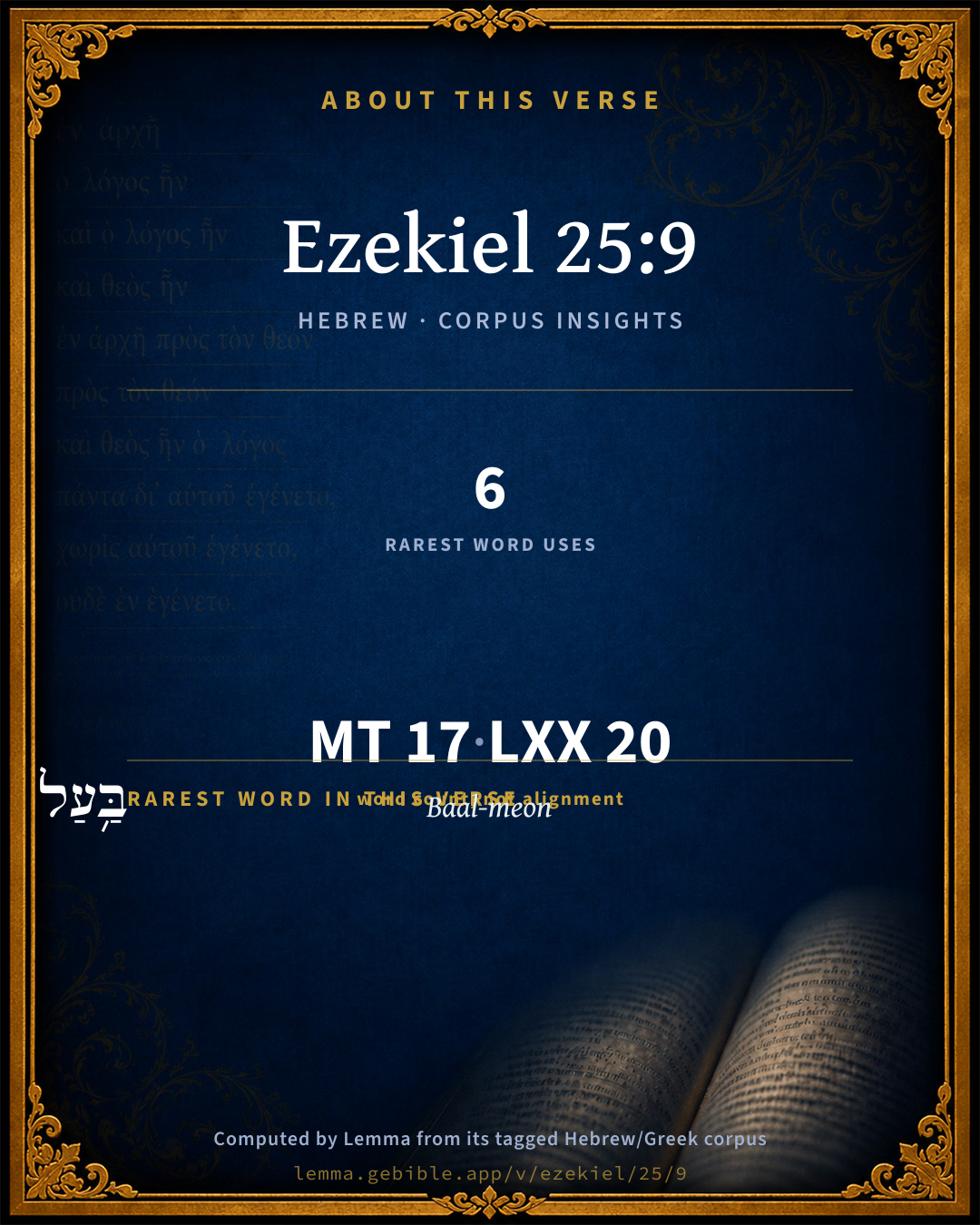
The rarest word here is בַּ֥עַל Baal-meon H1186 — appearing just 6 times in the whole Hebrew Bible.

Shared distinctive vocabulary

בַּ֥עַל Baal-meon H1186 occurs in 3 verses of the Hebrew Bible. Also found in:

Grammatical profile

  • 1 verb
  • 13 nouns
  • 1 adverb
  • 2 particles

Verb forms

  • פֹתֵ֜חַ Qal · Participle Active

Repetition

Words recur within this verse — often emphatic in Hebrew:

  • מֵהֶ֣עָרִ֔ים city H5892 ×2
  • בֵּ֣ית Beth-jesimoth H1020 ×2
  • בַּ֥עַל Baal-meon H1186 ×2
  • וקריתמה Kiriathaim H7156 ×2

Hebrew & Septuagint length

In English translation the verse runs 30 words from the Hebrew and 30 from the Septuagint (LXX English) — the same length.

A rough comparison of the two English renderings, which tokenize alike — not a word-level alignment.

Word counts can differ between the Hebrew and the Greek without any difference in meaning — e.g. the Hebrew direct-object marker אֵת has no separate Greek word, and Greek often adds the article ὁ.

In the original languages it is 17 Hebrew tokens and 20 Greek tokens — but the two are counted differently (Hebrew bundles its prefixes and suffixes into one token; the Greek is in lemma form), so that isn’t a like-for-like length.

Cross-references

9

Topical passages linked to Ezekiel 25:9 in the Treasury of Scripture Knowledge — connected by theme and wording, ordered by reader-vote popularity; previews shown in the World English Bible.

  • Joshua 13:17 Heshbon, and all its cities that are in the plain; Dibon, and Bamoth Baal, and Beth Baal Meon,
  • Jeremiah 48:23 and on Kiriathaim, and on Beth Gamul, and on Beth Meon,
  • Numbers 32:37–38 The children of Reuben built Heshbon, and Elealeh, and Kiriathaim,
  • Joshua 13:19–20 and Kiriathaim, and Sibmah, and Zereth-shahar in the mount of the valley,
  • Numbers 32:3 Ataroth, and Dibon, and Jazer, and Nimrah, and Heshbon, and Elealeh, and Sebam, and Nebo, and Beon,
  • Numbers 33:49 They encamped by the Jordan, from Beth-jeshimoth even to Abel Shittim in the plains of Moab.
  • Joshua 12:3 and the Arabah to the sea of Chinneroth, eastward, and to the sea of the Arabah, even the Salt Sea, eastward, the way to Beth-jeshimoth; and on the south, under the slopes of Pisgah:
  • 1 Chronicles 5:8 and Bela the son of Azaz, the son of Shema, the son of Joel, who lived in Aroer, even to Nebo and Baal Meon:
  • Jeremiah 48:1 Of Moab. Thus says Yahweh of Hosts, the God of Israel: Woe to Nebo! for it is laid waste; Kiriathaim is disappointed, it is taken; Misgab is put to shame and broken down.

Cross-references courtesy of OpenBible.info (CC BY 4.0).

Hebrew and Greek witnesses Masoretic Hebrew ↔ Greek Septuagint

The same verse in the two great witnesses to the Old Testament, shown verse-for-verse.

These are two independent witnesses, not word-aligned to each other, and the Septuagint is shown in lemma (dictionary) form.

Hebrew Ezekiel 25:9 Masoretic · Westminster Leningrad Codex

לָכֵן֩ הִנְנִ֨י פֹתֵ֜חַ אֶת כֶּ֤תֶף מוֹאָב֙ מֵהֶ֣עָרִ֔ים מֵֽעָרָ֖יו מִקָּצֵ֑הוּ צְבִ֗י אֶ֚רֶץ בֵּ֣ית הַיְשִׁימֹ֔ת בַּ֥עַל מְע֖וֹן וקריתמה וְקִרְיָתָֽיְמָה

therefore, behold, I will open the side of Moab from the cities, from his cities which are on his frontiers, the glory of the country, Beth-jeshimoth, Baal Meon, and Kiriathaim,

World English Bible · Public Domain

Greek LXX Ezekiel 25:9 Septuagint · lemma form

διά οὗτος ἰδού ἐγώ παραλύω ὁ ὦμος μωαβ ἀπό πόλις ἀκρωτήριον αὐτός ἐκλεκτός γῆ οἶκος ασιμουθ ἐπάνω πηγή πόλις παραθαλάσσιος

Therefore, behold, I will weaken the shoulder of Moab from his frontier cities, even the choice land, the house of Bethasimuth above the fountain of the city, by the sea-side.

LXX2012 (modern English Septuagint) · Public Domain

Hebrew: Westminster Leningrad Codex (CC BY 4.0). Greek: Septuagint (public domain); English from LXX2012 (modern English Septuagint) (Public Domain). How the Septuagint differs from the Hebrew →

Targum (Aramaic paraphrase)

1

The Targum is the ancient Jewish Aramaic paraphrase of the Hebrew Scriptures — an interpretive translation, not the Hebrew text itself. Onkelos (literal) and Pseudo-Jonathan (expansive) render the Torah, and Jonathan the Prophets. Coverage is partial: where no permissively-licensed English translation exists for a verse, only the Aramaic is shown. This is verse-level text, not a word-by-word alignment to the Hebrew.

  1. Targum Jonathan Prophets (Joshua–Malachi)
    בְּכֵן הָא אֲנָא תָבַר יַת תְּקוֹף מוֹאָב מִקִרְוֵיהוֹן מִכְּרַכֵּיהוֹן עַד פַּצִיחֵיהוֹן חֶדְוַת אַרְעֲהוֹן בֵּית יְשִׁימוֹת בַּעַל מְעוֹן וְקִרְיָתָיִם:

    (no public-domain English translation for this verse)

    Targum Jonathan — Aramaic: “Mikraot Gedolot” (public domain). English: “Sefaria Community Translation” (CC0 1.0 (public-domain dedication)); “London "Chaldee Paraphrase," 1871” (public domain). Text via Sefaria.

Commentary

Notes on Ezekiel 25:9 from classic Christian and Jewish commentators (each source and its license shown beneath its notes). The classic Christian expositions comment on the surrounding passage and are grouped to its opening verse, so a note may address several verses; the Jewish commentaries on the Tanakh (Rashi and others) are per-verse, so they appear only where the commentator wrote on this verse.

Lemma curates 59 commentaries, every one of them public domain or Creative Commons licensed, each selected and text-cleaned for this edition rather than reprinted as found. About our sources →

Trapp's Complete Commentary

John Trapp

Eze 25:9 Therefore, behold, I will open the side of Moab from the cities, from his cities [which are] on his frontiers, the glory of the country, Bethjeshimoth, Baalmeon, and Kiriathaim,

Ver. 9. Behold, I will open the side of Moab.] Heb., The shoulder - that is, the border that is fortified - to let in the enemy; like as the side being opened, an entrance is given into the body through the ribs for the destruction thereof, because the strongest defence is taken away. {a}

{a} Dr Mayr.

John Trapp, A Commentary or Exposition upon All the Books of the Old and New Testament (1647–1656) — public domain. Text from a community e-Sword module.

Geneva Bible (1599)

Geneva Bible translators

So that no power or strength should be able to resist the Babylonians.

Geneva Bible (1599) marginal notes — public domain. Text via Bolls.life.

Jamieson, Fausset & Brown

Robert Jamieson, A. R. Fausset & David Brown

open . . . from the cities--I will open up the side, or border of Moab (metaphor from a man whose side is open to blows), from the (direction of) the cities on his northwest border beyond the Arnon, once assigned to Reuben (Jos 13:15-21), but now in the hands of their original owners; and the "men of the east," the wandering Bedouin hordes, shall enter through these cities into Moab and waste it. Moab accordingly was so wasted by them, that long before the time of Christ it had melted away among the hordes of the desert. For "cities," GROTIUS translates the Hebrew as proper names, the Ar and Aroer, on the Arnon. Hence the Hebrew for "cities," "Ar" is repeated twice (Num 21:28; Deu 2:36; Isa 15:1).

glory of the country--The region of Moab was richer than that of Ammon; it answers to the modern Belka, the richest district in South Syria, and the scene in consequence of many a contest among the Bedouins. Hence it is called here a "glorious land" (literally, "a glory," or "ornament of a land") [FAIRBAIRN]. Rather, "the glory of the country" is in apposition with "cities" which immediately precedes, and the names of which presently follow.

Beth-jeshimoth--meaning "the city of desolations"; perhaps so named from some siege it sustained; it was towards the west.

Baal-meon--called also "Beth-meon" (Jer 48:23), and "Beth-baal-meon" (Jos 13:17, called so from the worship of Baal), and "Bajith," simply (Isa 15:2).

Kiriathaim--"the double city." The strength of these cities engendered "the pride" of Moab (Isa 16:6).

Jamieson, Fausset & Brown — Commentary Critical and Explanatory on the Whole Bible (1871) — public domain (CC PDM 1.0). Text via the HelloAO Bible API.

Adam Clarke's Commentary

Verse 9. I will open the side] קתף ketheph, the shoulder, the strongest frontier place. Beth-jeshimoth, Baal-meon, and Kiriathaim were strong frontier towns of Moab.

Adam Clarke's Commentary on the Bible (1810–1826) — public domain. Text from a community e-Sword/MySword module.

Ellicott's Commentary for English Readers

(9) Open the side of Moab—i.e., lay it open to the enemy. This is to be done “from the cities,” on which a special emphasis is placed. The cities named were all on the north of the Arnon, and before the time of Moses had been wrested from the Moabites by the Amorites, from whom in turn they were taken by the Israelites, and long formed a part of their territory. In the decay of the power of Israel they were re-conquered by Moab, and are here spoken of, perhaps in view of their being rightfully a possession of Israel, as appropriately the point from which desolation should go out over the whole of Moab.

The glory of the country.—The territory designated by the mention of these three cities is still considered by the Arabs as the best part of the land, and is called Belka. They have a proverb, “Thou canst find no land like Belka.” The sites of all the cities which are alluded to here have been probably identified by existing ruins.

A Bible Commentary for English Readers, edited by Charles John Ellicott (1878–1897) — public domain. Text from a community e-Sword module.

The Cambridge Bible for Schools and Colleges

gen. ed. J. J. S. Perowne

9. open the side] Lit. the shoulder of Moab, i.e. the border or territory of Moab conceived as looking towards other countries, as “shoulder” has hardly reference to the shape of the Moabite territory (Isa_11:14). To open the side is to give invaders access to the country (Nah_3:13).

from the cities … frontiers] Perhaps: at the cities, at his cities in every quarter. The prep. from seems to indicate position, by or on the cities, i.e. where they are. Others take it in a privative sense: stript of the cities. The three towns named are given as examples of the glory of Moab. Beth-Jeshimoth lay at the N.E. of the head of the Dead Sea, Num_33:49; Jos_12:3; Jos_13:20; it is supposed to be Suweimeh, at the mouth of the Jordan. Baal-meon, Num_32:3; Num_32:38, more fully Beth-baal-meon (Jos_13:17), and in another form, Bethmeon (Jer_48:23), lay further inland, a little S. of Heshbon; supposed to be Mâ‘in. Kirjathaim lay somewhat further south (Num_32:37; Jos_13:19; Jer_48:1; Jer_48:23); supposed to be El Kureyat.

The Cambridge Bible for Schools and Colleges (gen. ed. J. J. S. Perowne; Cambridge University Press, 1878–1918) — public domain. Text from a community e-Sword module.

John Gill's Exposition

Therefore, behold, I will open the side of Moab from the cities,.... Or, "the shoulder of Moab" (t); that part of their country where their greatest strength lay, So the Targum renders it,

"the strength of Moab;''

where their principal cities were, their frontier towns, and fortified places, as appears by what follows:

from his cities which are on his frontiers; or, "from his Ars" (u),

from his cities which are at his end; at the extreme part of the land, upon the borders of his countries; the two cities of Ar and Aroer, Num 21:28,

the glory of the country; as the above cities were, and what follow:

Bethjeshimoth; this was formerly in the tribe of Reuben, now in the possession of the Moabites, and one of their principal cities, Jos 13:20,

Baalmeon; the same with Bethbaalmeon, and which was also of the tribe of Reuben, Jos 13:17, in Jerom's time it was a large village in Moab, about nine miles from Heshbon: some think by Meon is meant Menes, or Osiris the god of the Egyptians, and so this might be a temple of his; or at least he might have a temple in it, from whence it had its name:

and Kirjathaim; or the double city, built also by the Reubenites, Num 32:37, now in the hands of the Moabites, ten miles from Medeba; on this side of the country of Moab, and through these cities, the Lord threatens to open a way for their enemies to enter in and destroy them, as follows:

(t) , Sept.; "humerum", V. L. Montanus. (u) "ab ipsis", Haris, Junius & Tremellius, Polanus.

John Gill's Exposition of the Whole Bible (1746–1763) — public domain (CC PDM 1.0). Text via the HelloAO Bible API.

Albert Barnes' Notes on the Bible

I will open the side ... - i. e., lay it open to the attack of the enemy from the cities, from his cities, from his frontier (or, in every quarter). There is an ironical stress on “his” cities, because these cities belonged not to Moab but to Israel, having been assigned to the Reubenites Num 32:38; Jos 13:20. They lay to the north of the river Arnon, which was the proper boundary of Moab Num 21:13. The Moabites had in the last days of the kingdom of Israel recovered this territory Isa 16:1-14. They still occupied this land in the time of Ezekiel (see Jer. 48).

The glory of the country - This tract, belonging to the district called by the Arabians “Al Belka,” has been at all times highly valued on account of the excellence of its pastures for cattle. The most southern of these three cities is Kiriathaim, called on the Moabitic stone Kirjath, and now Kureiyat. The dual termination of the name Kiriathaim,” is explained by the fact that Kureiyat is situated on two sister hillocks half a mile apart, both covered by the ancient city. It is situated about eight miles north of the Arnon, and seven miles east of the shore of the Dead Sea. Baal-meon is about ten miles north of Kureiyat - known at present as Main. It is probable that Kiriathaim was the “Kirjath-Huzoth” (city of streets), and Baal-meon, the “Bamoth-Baal” (high places of Baal), to which Balak took Balaam Num 22:39, Num 22:41. Baal-meon occurs on the Moabitic stone as a place which Mesa built or fortified. He probably erected a stronghold on the old locality, reviving the ancient name. Beth-jeshimoth is identified with a knoll at the northeasternmost point of the Dead Sea.

Albert Barnes' Notes on the Bible (1834–1885) — public domain. Text from a community e-Sword/MySword module.

Haydock's Catholic Bible Commentary

Shoulder; reduce to slavery, (Haydock) or take the strong places, (Jeremias xlviii. 7.; Calmet) or cities and strength of Moab. (Worthington)

George Leo Haydock (1774–1849), Haydock's Catholic Family Bible and Commentary, 1859 edition — public domain. Excludes Psalms (Douay-Rheims chapter numbering differs from Protestant) and Deuterocanonical books (Catholic canon only).

Matthew Poole's English Annotations

I will open; when the Lord will open the gates of iron, and say, The gates shall not be shut, as Isa 45:1,2, every attempt shall be easy, and his soldiers shall break through the defences, that were vainly boasted impregnable.

The side of Moab; that part of his country, which was best fortified for the safeguard of the whole.

From the cities; from the cities of strength, called here his, because he gloried and trusted in them, such as Har and Aroer, seated on Arnon, very strong garrisons.

On his frontiers; or, from his frontiers, (for it is the same construction, Hebrew,) or from his outmost bounds, I will lay all open to the Chaldeans, they shall overrun it, as if it were an open country, as easily as if no fortresses to impede them.

The glory; so the great, strong, and beautiful, or regularly built and fortified cities are ever accounted the glory of the country, and these are reckoned beside Ar and Aroer.

Beth-jeshimoth; an ancient city, and formerly Reuben’s lot, Jos 13:20; its name tells you it was a fortress toward the desert, which watched, lest any should, through those wastes, make an inroad on the country.

Baal-meon; called also Moon, and Baiith, and Beth-baal-meon, mansion-house of Baal, word for word; it was situate on the north coast of Moab, as the other on the west.

Kiriathaim; a city, which probably consisted of two cities, or principal parts; a very strong frontier town, but not able to keep out those that God would lead in.

Matthew Poole's English Annotations on the Holy Bible (1683–1685) — public domain. Text from a community e-Sword/MySword module.

Whedon's Commentary on the Bible

Daniel D. Whedon

9. The side — Hebrews, the shoulder; that is, the frontier plateau or mesa (Hebrews, meshar), which had always been Moab’s best defense.

From the cities — Davidson reads, “at the cities;” Smend and Cornill, “that the cities be no more, even his,” etc.

Which are on his frontiers — Rather, in every quarter.

Beth-jeshimoth, Baal-meon, and Kiriathaim — It is curious that two of these cities which were “the glory of the country” should appear in the Mesha inscription (ninth century B.C.) where the king says, “I built Baal-meon and made therein the ditches; I built Kirjathaim;” and again, “I built Beth-medeba and Beth-diblathaim and Beth-baal-meon.” (Compare Jos_13:17; Num_32:37.) Beth (house), Baal (Lord), and Kir or Gir (the old homeland of the Arameans between Elam and Babylon) are constantly found in compound Moabitish names. The ruins of these three cities are on the northeast border of the Dead Sea (Num_32:37-38; Num_33:49; Jos_12:3; Jos_13:19-20; Jer_48:22-23), in the Belka (compare Balak, Numbers xxii), a region famous in ancient and modern times as a pasture land. A Bedouin proverb says, “There is no land like the Belka.”

Daniel D. Whedon (gen. ed.), Commentary on the Old and New Testaments (1874–1909) — public domain. Text from a community e-Sword module.

The Pulpit Commentary

I will open the side of Moab; literally, the shoulder, i.e. the slopes of the mountain of Moab. (Jos_15:8, Jos_15:10) For Bethjeshimoth (equivalent to "House of wastes"), see Num_33:49; Jos_12:3 Jos_13:20. It had been assigned to Reuben, but had been seized by the Moabites. It has been identified by De Sauley with the ruins now known as Suaime, on the northeastern border of the Dead Sea. Baal-, (Num_32:38) more fully Beth-baal-meon, (Jos_13:17) or Beth-moon. (Jer_48:23) The name is found in ruins of some extent, known as the fortress of Miun or Maein, about three miles south of Heshbon ("Dict. Bible," s.v.). Kiriathaim. The dual form of the name (equivalent to "Two cities") implies, perhaps, the union of an old and new town, or two towns on the opposite sides of a brook or wady. The name appears in Gen_14:5; Num_32:37; Jos_13:19; Jer_48:1, Jer_48:23. It has been identified with El-Teym, about two miles from Medeba (Burckhardt) and with Kurei-yat, on the south side of Jebel Attarus. Eusebius ("Onom.," s.v .) describes it as about ten miles from Medeba, and close to the Baris, lint nothing is known as to the last-named place. The three cities all belonged to the region which Sihon and Og had conquered from the Moabites before Israel obtained possession of them, and they were afterwards claimed as belonging to the Israelites by right of conquest, (Jud_1:11:23) and them may therefore be a touch of irony in Ezekiel"s language describing them as Moabite cities. Collectively they were the glory of the country, the region known as the Belka, in which they were situated, giving the best pasturage, then as now, in Southern Syria. Havernick quotes a Bedouin proverb, "There is no land like Belka" (see Tristram"s "Land of Moab," pp. 275, 303-305, 350). Kirjath and Baalmeon appear in Mesha"s inscription on the Moabite Stone.

The Pulpit Commentary (1880–1919), ed. H.D.M. Spence-Jones & Joseph S. Exell — public domain. Text from a community e-Sword module.

John Wesley's Explanatory Notes

The side - That part of his country which was best fortified. Bethjeshimoth - An ancient city; it was a fortress toward the desert, which watched lest any should make an inroad on the country.

John Wesley, Explanatory Notes Upon the Whole Bible (1754–1765) — public domain. Text via the GEBible commentary corpus.

Rashi

Rabbi Shlomo Yitzchaki (Rashi)

behold I will expose the fortresses of the land of Moab that are on the border at the end of their boundary; that is the flank, the end of the boundary of their land, like (Exod. 27:15): “And on the other side,” to the flank, which Targum [Jonathan] translates לְעִיבְרָא, to the side.

Rashi on the Tanakh — English translations: “The Judaica Press complete Tanach with Rashi, translated by A. J. Rosenberg” (CC BY 4.0); “Pentateuch with Rashi's commentary by M. Rosenbaum and A.M. Silbermann, 1929-1934” (public domain); “The Metsudah Tanach series, Lakewood, N.J” (CC BY 4.0); and “The Book of Joshua, Metsudah Publications, 1997” (CC BY 4.0). Text via Sefaria.

Lesson kit

Teaching starters — assembled from the data on this page, not authored interpretation. Every prompt links to the verse data it draws on. Edit before teaching.

Ezekiel, in the Prophets, opens this verse with 17 words (13 distinct Hebrew lemmas). Its most distinctive word is Baʻal Mᵉʻôwn (“Baal-meon”). A historical commentator’s framing appears above. Read the whole chapter for the surrounding context.

Discussion questions

  1. The word Baʻal Mᵉʻôwn carries the sense “Baal-meon.” How does it shape the verse?
  2. How does Numbers 32:38, which shares the word «Baal-meon», read alongside this verse?
  3. What does the repetition of “city” (2× in this one verse) do in this verse?
  4. The translations on this page render this verse differently — a whole-verse word diff, not a word-by-word alignment. What might account for the different wordings?
  5. «פֹתֵ֜חַ» is a Qal Participle Active verb. How does that grammatical form shape the action described?
  6. Compare how Trapp's Complete Commentary and Geneva Bible (1599) read this verse. Where do they agree or differ?

Things to notice

Reading settings

Reading text

Shown beneath each verse's original-language words.

Old Testament
Old Testament edition

Read the OT as the Masoretic Hebrew (MT) or the Greek Septuagint (LXX).

English shown for the Greek Septuagint (in the Hebrew ↔ Greek comparison).

Comparing translations? Open the Compare panel on any verse page to stack up to four side by side.