Judges 11:15

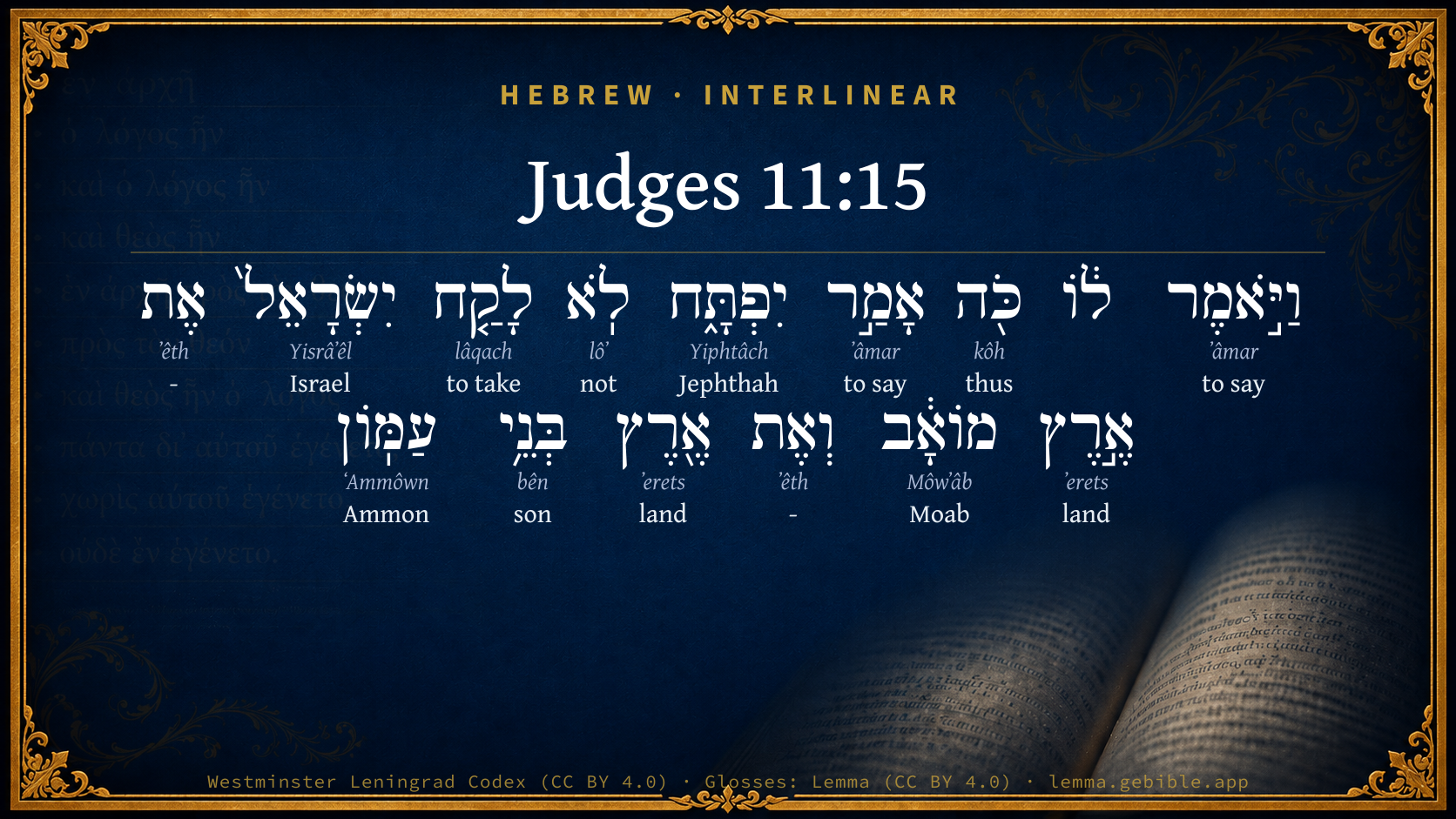
Hebrew (Westminster Leningrad Codex) Judges 11:15 appears in the Hebrew Old Testament. The text above is from the Westminster Leningrad Codex. Each word links to its Strong’s number, a concise gloss, and parsing drawn from the Open Scriptures Hebrew Bible morphology. Click any word for its full Brown-Driver-Briggs (BDB) entry.
Download image
Cite this verse

Judges 11:15 (World English Bible). Public Domain. Lemma interlinear Bible study tool, https://lemma.gebible.app/v/judges/11/15.

Show BibTeX & RIS
BibTeX
RIS
English Translation
and he said to him, Thus says Jephthah: Israel didn't take away the land of Moab, nor the land of the children of Ammon,
World English Bible · Public Domain
Download a study sheet

One document with this verse’s original text, its word-by-word gloss line, the meaning frame, cross-references with their text, attributed commentary, and full source and license credits — printable, and it pastes into notes with its structure intact.

This verse Autodidact and up

Study sheet (.html) Plain text (.txt)

A passage Seminary Student

Up to 50 verses in one chapter. A passage sheet keeps up to 6 commentary sources and 12 cross-references per verse, in the order this page ranks them, and says so on the sheet whenever that leaves anything out. Ask for a single verse and you get the Autodidact verse sheet above.

Everything on this page stays free to read, with no account — the sheet is a download of what is already on screen, not access to it.

Want to remove ads? Support Godless Engineer
Compare translations 3

The same verse in 3 English versions, stacked beneath the original-language interlinear above. Click any original word for its lexicon entry.

Each is an independent rendering of the whole verse — the interlinear is not word-aligned to these translations.

Highlighted words mark where these versions differ — a whole-verse word diff, not a word-by-word alignment.

  • World English Bible Public Domain
    and he said to him, Thus says Jephthah: Israel didn't take away the land of Moab, nor the land of the children of Ammon,
  • King James Version Public Domain
    And said unto him, Thus saith Jephthah, Israel took not away the land of Moab, nor the land of the children of Ammon:
  • unfoldingWord Literal Text CC BY-SA 4.0
    and said to him, “Thus says Jephthah: ‘Israel did not take the land of Moab or the land of the sons of Ammon.

unfoldingWord Literal Text — © unfoldingWord, licensed CC BY-SA 4.0. Word-aligned USFM3 via Door43 (git.door43.org/unfoldingWord/en_ult).

Versions to compare (up to 4)

3 of 4 selected

Show all 18 translations

Every available English version of this verse, each an independent rendering of the whole verse.

  • World English Bible Public Domain
    and he said to him, Thus says Jephthah: Israel didn't take away the land of Moab, nor the land of the children of Ammon,
  • Berean Standard Bible Public Domain
    to tell him, “This is what Jephthah says: Israel did not take away the land of Moab or of the Ammonites.
  • Majority Standard Bible Public Domain
    to tell him, “This is what Jephthah says: Israel did not take away the land of Moab or of the Ammonites.
  • King James Version Public Domain
    And said unto him, Thus saith Jephthah, Israel took not away the land of Moab, nor the land of the children of Ammon:
  • American Standard Version (1901) Public Domain
    and he said unto him, Thus saith Jephthah: Israel took not away the land of Moab, nor the land of the children of Ammon,
  • Revised Version (1885) Public Domain
    and he said unto him, Thus saith Jephthah: Israel took not away the land of Moab, nor the land of the children of Ammon:
  • Geneva Bible (1599) Public Domain
    And said vnto him, Thus saith Iphtah, Israel tooke not the lande of Moab, nor the lande of the children of Ammon.
  • Douay-Rheims (1899) Public Domain
    Thus saith Jephte: Israel did not take away the land of Moab, nor the land of the children of Ammon:
  • Young's Literal Translation Public Domain
    and saith to him, `Thus said Jephthah, Israel took not the land of Moab, and the land of the Bene-Ammon,
  • Literal Standard Version CC BY-SA 4.0
    and says to him, “Thus said Jephthah: Israel did not take the land of Moab, and the land of the sons of Ammon,
  • Unlocked Literal Bible CC BY-SA 4.0
    and he said, “This is what Jephthah says: Israel did not take the land of Moab and the land of the people of Ammon,
  • unfoldingWord Literal Text CC BY-SA 4.0
    and said to him, “Thus says Jephthah: ‘Israel did not take the land of Moab or the land of the sons of Ammon.
  • Darby Bible Public Domain
    and said to him, "Thus says Jephthah: Israel did not take away the land of Moab or the land of the Ammonites,
  • World Messianic Bible Public Domain
    and he said to him, “Jephthah says: Israel didn’t take away the land of Moab, nor the land of the children of Ammon;
  • Webster's Bible Public Domain
    And said to him, Thus saith Jephthah, Israel took not away the land of Moab, nor the land of the children of Ammon:
  • Free Bible Version CC BY-SA 4.0
    to tell him, “This is Jephthah's reply: The Israelites did not take any land from Moab or from the Ammonites.
  • Bible in Basic English Public Domain
    And said to him, This is the word of Jephthah: Israel did not take away the land of Moab or the land of the children of Ammon;
  • JPS Tanakh (1917) Public Domain
    and he said unto him: 'Thus saith Jephthah: Israel took not away the land of Moab, nor the land of the children of Ammon.

Literal Standard Version (2020), Covenant Press — licensed CC BY-SA 4.0. Text via the HelloAO Bible API (eBible.org). Unlocked Literal Bible (unfoldingWord) — licensed CC BY-SA 4.0. Text via the HelloAO Bible API (eBible.org). unfoldingWord Literal Text — © unfoldingWord, licensed CC BY-SA 4.0. Word-aligned USFM3 via Door43 (git.door43.org/unfoldingWord/en_ult). Free Bible Version, Dr. Jonathan Gallagher — licensed CC BY-SA 4.0. Text via the HelloAO Bible API (eBible.org).

Word by word

More ways to search: Search by grammar → Find every occurrence → Compare this word →

Practice this passage: Drill this verse → Learn its vocabulary →

יִפְתָּ֑ח
Yiphtâch
H3316
“Jephthah”
Noun, Proper
Part of Speech
Noun
Type
Proper
Full BDB Definition

Origin: from H6605

TWOT: None

Jephthah or Jiphtah = "he opens" - a son of Gilead and a concubine and the judge who defeated the Ammonites; after the victory because of a vow taken before the battle he sacrificed his daughter as a burnt offering (noun proper masculine) - a city in Judah (noun proper locative)
  1. וַיֹּ֣אמֶר ʼâmar H559 “and · to say” Conjunction + Verb, Qal, Sequential Imperfect, 3rd Person, Masculine, Singular
  2. כֹּ֖ה kôh H3541 “thus” Adverb
  3. אָמַ֣ר ʼâmar H559 “to say” Verb, Qal, Perfect, 3rd Person, Masculine, Singular
  4. לֹֽא lôʼ H3808 “not” Particle, Negative
  5. לָקַ֤ח lâqach H3947 “to take” Verb, Qal, Perfect, 3rd Person, Masculine, Singular
  6. יִשְׂרָאֵל֙ Yisrâʼêl H3478 “Israel” Noun, Proper
  7. אֶת ʼêth H853 “-” Particle, Direct Object
  8. אֶ֣רֶץ ʼerets H776 “land of” Noun, Common, Both, Singular, Construct
  9. מוֹאָ֔ב Môwʼâb H4124 “Moab” Noun, Proper
  10. וְאֶת ʼêth H853 “and · -” Conjunction + Particle, Direct Object
  11. אֶ֖רֶץ ʼerets H776 “land of” Noun, Common, Both, Singular, Construct
  12. בְּנֵ֥י bên H1121 “sons of” Noun, Common, Masculine, Plural, Construct
  13. עַמּֽוֹן ʻAmmôwn H5983 “Ammon” Noun, Proper

About this verse

These counts appear in no published source. They are computed here, from the morphology-tagged text and Lemma’s own curated glosses. What Lemma adds →

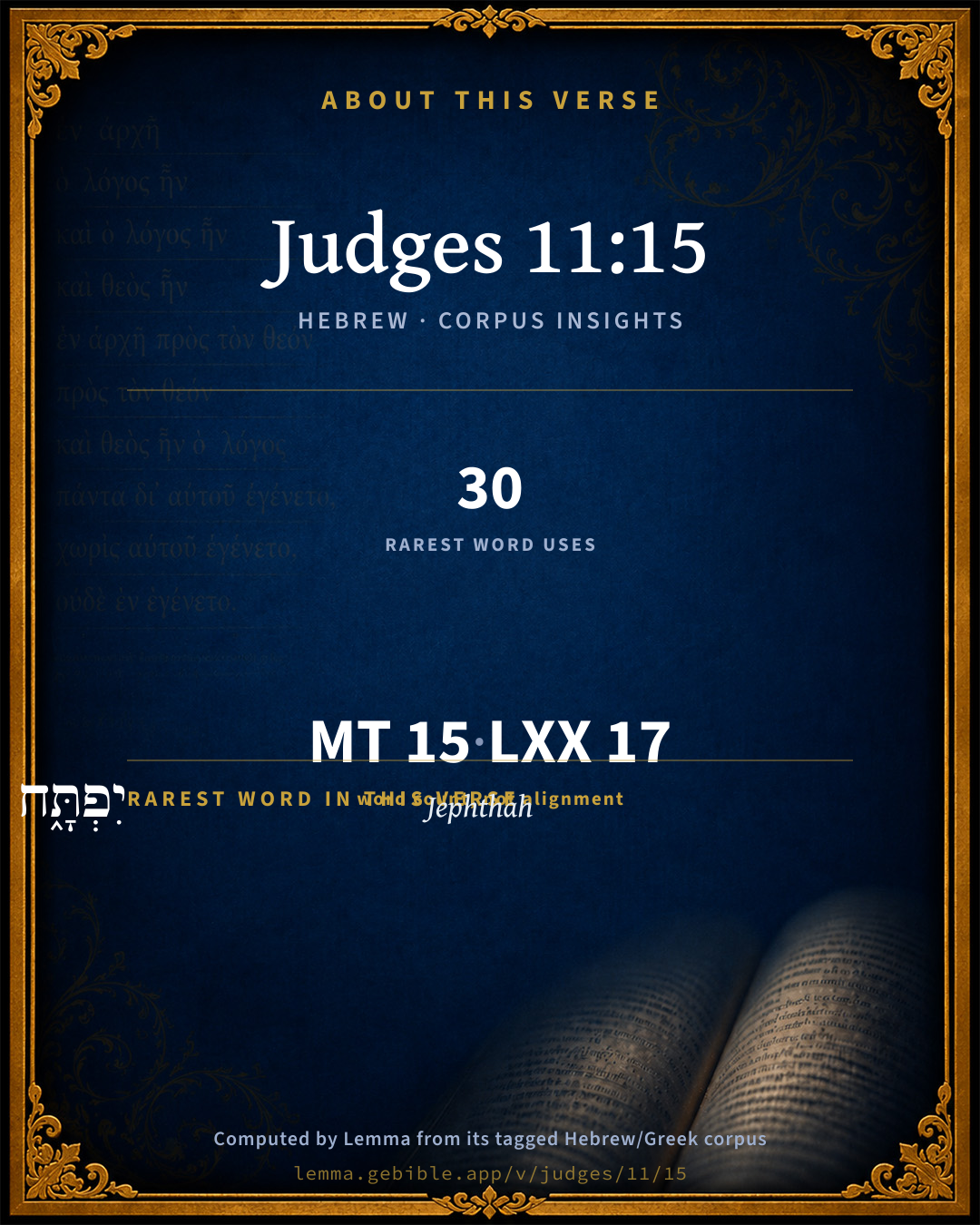
15
words
11
distinct lemmas
Historical
section

Shared distinctive vocabulary

יִפְתָּ֑ח Jephthah H3316 occurs in 26 verses of the Hebrew Bible. Also found in:

Grammatical profile

  • 3 verbs
  • 7 nouns
  • 1 preposition
  • 1 adverb
  • 3 particles

Verb forms

  • וַיֹּ֣אמֶר Qal · Sequential Imperfect
  • אָמַ֣ר Qal · Perfect
  • לָקַ֤ח Qal · Perfect

Repetition

Words recur within this verse — often emphatic in Hebrew:

  • וַיֹּ֣אמֶר to say H559 ×2
  • אֶ֣רֶץ land H776 ×2

Hebrew & Septuagint length

In English translation the verse runs 24 words from the Hebrew and 22 from the Septuagint (LXX English) — closely comparable.

A rough comparison of the two English renderings, which tokenize alike — not a word-level alignment.

Word counts can differ between the Hebrew and the Greek without any difference in meaning — e.g. the Hebrew direct-object marker אֵת has no separate Greek word, and Greek often adds the article ὁ.

In the original languages it is 15 Hebrew tokens and 17 Greek tokens — but the two are counted differently (Hebrew bundles its prefixes and suffixes into one token; the Greek is in lemma form), so that isn’t a like-for-like length.

Cross-references

6

Topical passages linked to Judges 11:15 in the Treasury of Scripture Knowledge — connected by theme and wording, ordered by reader-vote popularity; previews shown in the World English Bible.

  • Deuteronomy 2:19 and when you come near over against the children of Ammon, don't bother them, nor contend with them; for I will not give you of the land of the children of Ammon for a possession; because I have given it to the children of Lot for a possession.
  • Deuteronomy 2:9 Yahweh said to me, Don't bother Moab, neither contend with them in battle; for I will not give you of his land for a possession; because I have given Ar to the children of Lot for a possession.
  • Numbers 21:13–15 From there they traveled, and encamped on the other side of the Arnon, which is in the wilderness, that comes out of the border of the Amorites: for the Arnon is the border of Moab, between Moab and the Amorites.
  • Numbers 21:27–30 Therefore those who speak in proverbs say, Come you to Heshbon; Let the city of Sihon be built and established:
  • 2 Chronicles 20:10 Now, behold, the children of Ammon and Moab and Mount Seir, whom you would not let Israel invade, when they came out of the land of Egypt, but they turned aside from them, and didn't destroy them;
  • Acts 24:12–13 In the temple they didn't find me disputing with anyone or stirring up a crowd, either in the synagogues, or in the city.

Cross-references courtesy of OpenBible.info (CC BY 4.0).

Hebrew and Greek witnesses Masoretic Hebrew ↔ Greek Septuagint

The same verse in the two great witnesses to the Old Testament, shown verse-for-verse.

These are two independent witnesses, not word-aligned to each other, and the Septuagint is shown in lemma (dictionary) form.

Hebrew Judges 11:15 Masoretic · Westminster Leningrad Codex

וַיֹּ֣אמֶר ל֔וֹ כֹּ֖ה אָמַ֣ר יִפְתָּ֑ח לֹֽא לָקַ֤ח יִשְׂרָאֵל֙ אֶת אֶ֣רֶץ מוֹאָ֔ב וְאֶת אֶ֖רֶץ בְּנֵ֥י עַמּֽוֹן

and he said to him, Thus says Jephthah: Israel didn't take away the land of Moab, nor the land of the children of Ammon,

World English Bible · Public Domain

Greek LXX Judges 11:15 Septuagint · lemma form

καί εἶπον αὐτός οὕτως λέγω ιεφθαε οὐ λαμβάνω ἰσραήλ ὁ γῆ μωαβ καί ὁ γῆ υἱός αμμων

and said to him, Thus says Jephthae, Israel took not the land of Moab, nor the land of the children of Ammon;

LXX2012 (modern English Septuagint) · Public Domain

Hebrew: Westminster Leningrad Codex (CC BY 4.0). Greek: Septuagint (public domain); English from LXX2012 (modern English Septuagint) (Public Domain). How the Septuagint differs from the Hebrew →

Targum (Aramaic paraphrase)

1

The Targum is the ancient Jewish Aramaic paraphrase of the Hebrew Scriptures — an interpretive translation, not the Hebrew text itself. Onkelos (literal) and Pseudo-Jonathan (expansive) render the Torah, and Jonathan the Prophets. Coverage is partial: where no permissively-licensed English translation exists for a verse, only the Aramaic is shown. This is verse-level text, not a word-by-word alignment to the Hebrew.

  1. Targum Jonathan Prophets (Joshua–Malachi)
    וַאֲמַר לֵיהּ כִּדְנַן אֲמַר יִפְתָּח לָא נִסִיב יִשְׂרָאֵל יַת אַרְעָא דְמוֹאָב וְיַת אַרְעָא בְּנֵי עַמוֹן:

    (no public-domain English translation for this verse)

    Targum Jonathan — Aramaic: “Mikraot Gedolot” (public domain). English: “Sefaria Community Translation” (CC0 1.0 (public-domain dedication)); “London "Chaldee Paraphrase," 1871” (public domain). Text via Sefaria.

Commentary

Notes on Judges 11:15 from classic Christian and Jewish commentators (each source and its license shown beneath its notes). The classic Christian expositions comment on the surrounding passage and are grouped to its opening verse, so a note may address several verses; the Jewish commentaries on the Tanakh (Rashi and others) are per-verse, so they appear only where the commentator wrote on this verse.

Lemma curates 59 commentaries, every one of them public domain or Creative Commons licensed, each selected and text-cleaned for this edition rather than reprinted as found. About our sources →

Trapp's Complete Commentary

John Trapp

Jdg 11:15 And said unto him, Thus saith Jephthah, Israel took not away the land of Moab, nor the land of the children of Ammon:

Ver. 15. Israel took not away.] It falls out often that plain dealing puts craft out of countenance. "There is no such thing as thou sayest, but thou feignest them out of thine heart," saith Nehemiah to his adversary; so here.

John Trapp, A Commentary or Exposition upon All the Books of the Old and New Testament (1647–1656) — public domain. Text from a community e-Sword module.

Ellicott's Commentary for English Readers

(15) Took not away the land of Moab . . .—What they took was the territory of Sihon, which they had never been forbidden to take, and had indeed been forced to take by Sihon’s attack on them. It was not likely that they could enter into discussion as ‘to the previous owners of the land.

A Bible Commentary for English Readers, edited by Charles John Ellicott (1878–1897) — public domain. Text from a community e-Sword module.

The Cambridge Bible for Schools and Colleges

gen. ed. J. J. S. Perowne

15. nor the land of … Ammon] So Num_21:24, Deu_2:19; Deu_2:37.

The Cambridge Bible for Schools and Colleges (gen. ed. J. J. S. Perowne; Cambridge University Press, 1878–1918) — public domain. Text from a community e-Sword module.

John Gill's Exposition

But when Israel came up from Egypt,.... In order to go to the land of Canaan, which was higher than the land of Egypt, which lay low (k):

and walked through the wilderness unto the Red sea; which is to be understood not of their walking to it; when they first came out of Egypt, they indeed then came to the edge of the wilderness of Etham, and so to the Red sea, and walked through it as on dry land, and came into the wilderness of Shur, Sin, and Sinai; and after their departure from Mount Sinai they came into the wilderness of Paran, in which they were thirty eight years; and this is the wilderness meant they walked through, and came to Eziongaber, on the shore of the Red sea, Num 33:35.

and came to Kadesh; not Kadeshbarnea, from whence the spies were sent, but Kadesh on the borders of Edom, from whence messengers were sent to the king of it, as follows.

(k) Theocrit. Idyll. 17. ver. 79.

John Gill's Exposition of the Whole Bible (1746–1763) — public domain (CC PDM 1.0). Text via the HelloAO Bible API.

Albert Barnes' Notes on the Bible

Consult the marginal references. If the ark with the copy of the Law Deu 31:26 was at Mizpeh, it would account for Jephthah’s accurate knowledge of it; and this exact agreement of his message with Numbers and Deuteronomy would give additional force to the expression, “he uttered all his words before the Lord” Jdg 11:11.

Jdg 11:17

No mention is made of this embassy to Moab in the Pentateuch.

Jdg 11:19

Into my place - This expression implies that the trans-Jordanic possessions of Israel were not included in the land of Canaan properly speaking.

Jdg 11:21

The title “God of Israel” has a special emphasis here, and in Jdg 11:23. in a narrative of transactions relating to the pagan and their gods.

Jdg 11:24

Chemosh was the national god of the Moabites (see the marginal references); and as the territory in question was Moabitish territory before the Amorites took it from “the people of Chemosh,” this may account for the mention of Chemosh here rather than of Moloch, or Milcom, the god of the Ammonites. Possibly the king of the children of Ammon at this time may have been a Moabite.

Jdg 11:25, Jdg 11:26

Jephthah advances another historical argument. Balak, the king of Moab, never disputed the possession of Sihon’s kingdom with Israel.

Albert Barnes' Notes on the Bible (1834–1885) — public domain. Text from a community e-Sword/MySword module.

Haydock's Catholic Bible Commentary

Moab. After the death of Eglon, the Ammonites had probably seized upon his dominion, (ver. 25,) as we find no farther mention of the Moabites among the enemies of Israel, nor any king of that nation till the reign of David. Hence, as the king of Ammon laid claim to all the country, and had many of the Moabites in his army, Jephte answers at once, that the land under dispute belonged to neither of these nations. (Calmet) --- They had entirely lost it when Israel attacked Sehon, and took it from him, as was plain from the history of Moses and of the Amorrhites, Numbers xxi. 27. (Haydock) --- Jephte refers to facts universally known. (Calmet)

George Leo Haydock (1774–1849), Haydock's Catholic Family Bible and Commentary, 1859 edition — public domain. Excludes Psalms (Douay-Rheims chapter numbering differs from Protestant) and Deuterocanonical books (Catholic canon only).

Whedon's Commentary on the Bible

Daniel D. Whedon

15. Israel took not — Israel took the land in question not of Ammonites or Moabites, but of Sihon, king of the Amorites, and therefore with previous owners they had nothing to do. Jephthah’s messengers proceed to state the real facts in the case. For the facts which they state, see the passages referred to in the margin. This whole message of Jephthah is a most primitive and honest piece of diplomacy, and a weighty argument for the antiquity and genuineness of the Pentateuch.

Daniel D. Whedon (gen. ed.), Commentary on the Old and New Testaments (1874–1909) — public domain. Text from a community e-Sword module.

Lesson kit

Teaching starters — assembled from the data on this page, not authored interpretation. Every prompt links to the verse data it draws on. Edit before teaching.

Judges, in the Historical, opens this verse with 15 words (11 distinct Hebrew lemmas). Its most distinctive word is Yiphtâch (“Jephthah”). A historical commentator’s framing appears above. Read the whole chapter for the surrounding context.

Discussion questions

  1. How does “Jephthah” (Yiphtâch) shape what this verse is saying?
  2. Joshua 15:43 shares the word «Jephthah» with this verse. How do the two illuminate each other?
  3. “to say” occurs 2× in this one verse. What is the effect of the repetition?
  4. These translations render this verse differently. What is at stake in choosing one wording over another?
  5. The verb «וַיֹּ֣אמֶר» is Qal Sequential Imperfect. How does its form color the action?
  6. Reading how Trapp's Complete Commentary and Ellicott's Commentary for English Readers read this verse, where do the two commentators agree and where do they part?

Things to notice

Reading settings

Reading text

Shown beneath each verse's original-language words.

Old Testament
Old Testament edition

Read the OT as the Masoretic Hebrew (MT) or the Greek Septuagint (LXX).

English shown for the Greek Septuagint (in the Hebrew ↔ Greek comparison).

Comparing translations? Open the Compare panel on any verse page to stack up to four side by side.