
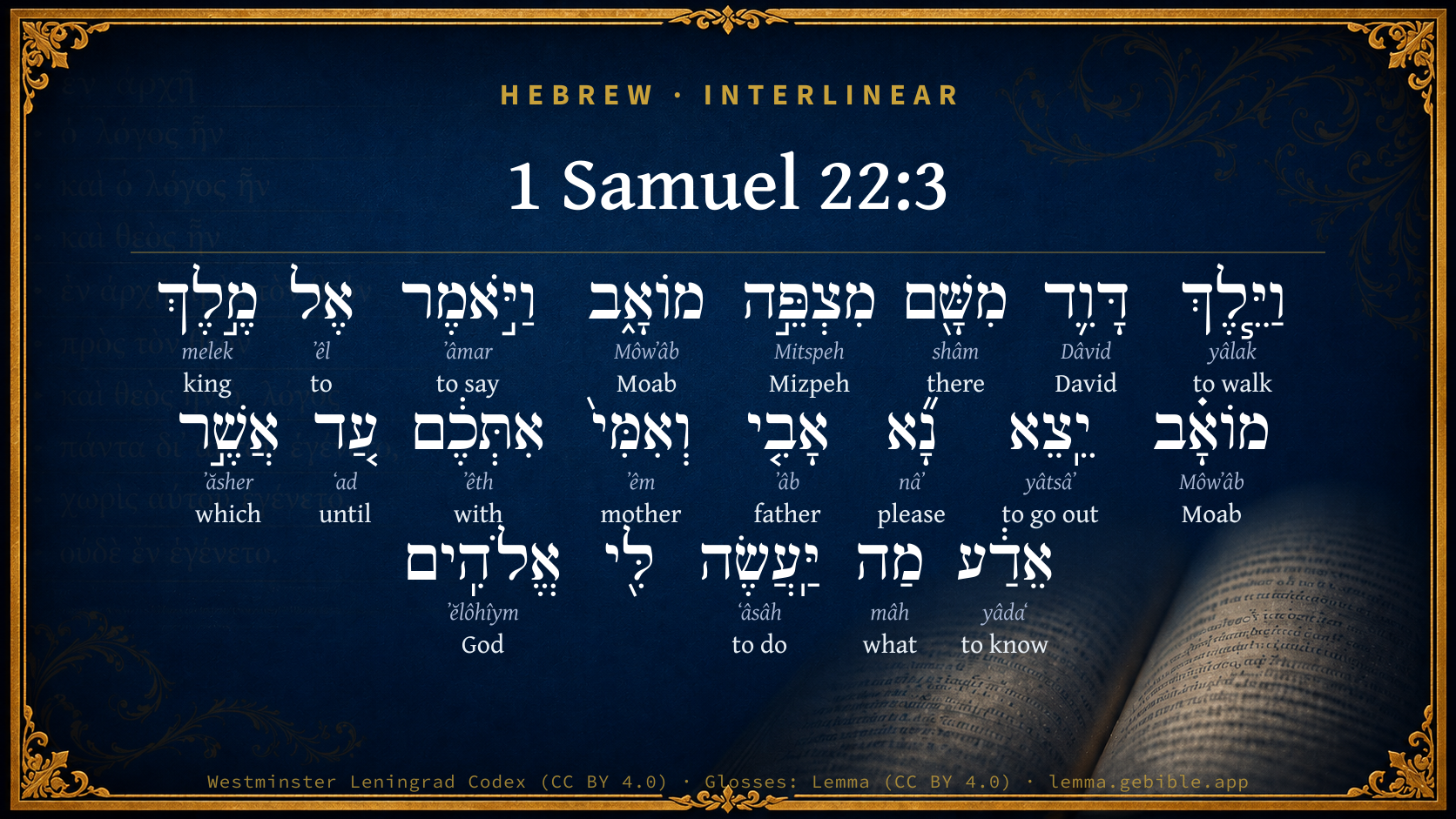
1 Samuel 22:3

Hebrew (Westminster Leningrad Codex) 1 Samuel 22:3 appears in the Hebrew Old Testament. The text above is from the Westminster Leningrad Codex. Each word links to its Strong’s number, a concise gloss, and parsing drawn from the Open Scriptures Hebrew Bible morphology. Click any word for its full Brown-Driver-Briggs (BDB) entry.
Download image
Cite this verse

1 Samuel 22:3 (World English Bible). Public Domain. Lemma interlinear Bible study tool, https://lemma.gebible.app/v/1-samuel/22/3.

Show BibTeX & RIS
BibTeX
RIS
English Translation
David went there to Mizpeh of Moab: and he said to the king of Moab, Please let my father and my mother come forth, [and be] with you, until I know what God will do for me.
World English Bible · Public Domain
Download a study sheet

One document with this verse’s original text, its word-by-word gloss line, the meaning frame, cross-references with their text, attributed commentary, and full source and license credits — printable, and it pastes into notes with its structure intact.

This verse Autodidact and up

Study sheet (.html) Plain text (.txt)

A passage Seminary Student

Up to 50 verses in one chapter. A passage sheet keeps up to 6 commentary sources and 12 cross-references per verse, in the order this page ranks them, and says so on the sheet whenever that leaves anything out. Ask for a single verse and you get the Autodidact verse sheet above.

Everything on this page stays free to read, with no account — the sheet is a download of what is already on screen, not access to it.

Want to remove ads? Support Godless Engineer
Compare translations 3

The same verse in 3 English versions, stacked beneath the original-language interlinear above. Click any original word for its lexicon entry.

Each is an independent rendering of the whole verse — the interlinear is not word-aligned to these translations.

Highlighted words mark where these versions differ — a whole-verse word diff, not a word-by-word alignment.

  • World English Bible Public Domain
    David went there to Mizpeh of Moab: and he said to the king of Moab, Please let my father and my mother come forth, [and be] with you, until I know what God will do for me.
  • King James Version Public Domain
    And David went thence to Mizpeh of Moab: and he said unto the king of Moab, Let my father and my mother, I pray thee, come forth, and be with you, till I know what God will do for me.
  • unfoldingWord Literal Text CC BY-SA 4.0
    And David went from there Mizpah of Moab. And he said to the king of Moab, “Please let my father and my mother come out with you until when I know what God will do for me.”

unfoldingWord Literal Text — © unfoldingWord, licensed CC BY-SA 4.0. Word-aligned USFM3 via Door43 (git.door43.org/unfoldingWord/en_ult).

Versions to compare (up to 4)

3 of 4 selected

Show all 18 translations

Every available English version of this verse, each an independent rendering of the whole verse.

  • World English Bible Public Domain
    David went there to Mizpeh of Moab: and he said to the king of Moab, Please let my father and my mother come forth, [and be] with you, until I know what God will do for me.
  • Berean Standard Bible Public Domain
    From there David went to Mizpeh of Moab, where he said to the king of Moab, “Please let my father and mother stay with you until I learn what God will do for me.”
  • Majority Standard Bible Public Domain
    From there David went to Mizpeh of Moab, where he said to the king of Moab, “Please let my father and mother stay with you until I learn what God will do for me.”
  • King James Version Public Domain
    And David went thence to Mizpeh of Moab: and he said unto the king of Moab, Let my father and my mother, I pray thee, come forth, and be with you, till I know what God will do for me.
  • American Standard Version (1901) Public Domain
    And David went thence to Mizpeh of Moab: and he said unto the king of Moab, Let my father and my mother, I pray thee, come forth, `and be' with you, till I know what God will do for me.
  • Revised Version (1885) Public Domain
    And David went thence to Mizpeh of Moab: and he said unto the king of Moab, Let my father and my mother, I pray thee, come forth, and be with you, till I know what God will do for me.
  • Geneva Bible (1599) Public Domain
    And Dauid went thence to Mizpeh in Moab, and said vnto the King of Moab, I pray thee, let my father and my mother come and abide with you, till I knowe what God wil doe for me.
  • Douay-Rheims (1899) Public Domain
    And David departed from thence into Maspha of Moab: and he said to the king of Moab: Let my father and my mother tarry with you, I beseech thee, till I know what God will do for me.
  • Young's Literal Translation Public Domain
    And David goeth thence to Mizpeh of Moab, and saith unto the king of Moab, `Let, I pray thee, my father and my mother go out with you, till that I know what God doth for me;'
  • Literal Standard Version CC BY-SA 4.0
    And David goes from there to Mizpeh of Moab and says to the king of Moab, “Please let my father and my mother come out with you, until I know what God does for me”;
  • Unlocked Literal Bible CC BY-SA 4.0
    Then David went from there to Mizpah in Moab. He said to the king of Moab, “Please let my father and my mother go out with you until I know what God will do for me.”
  • unfoldingWord Literal Text CC BY-SA 4.0
    And David went from there Mizpah of Moab. And he said to the king of Moab, “Please let my father and my mother come out with you until when I know what God will do for me.”
  • Darby Bible Public Domain
    And David went thence to Mizpeh in Moab, and said to the king of Moab, Let my father and my mother, I pray thee, come forth amongst you, till I know what God will do for me.
  • World Messianic Bible Public Domain
    David went from there to Mizpeh of Moab; and he said to the king of Moab, “Please let my father and my mother come out to you, until I know what God will do for me.”
  • Webster's Bible Public Domain
    And David went thence to Mizpeh of Moab: and he said to the king of Moab, Let my father and my mother, I pray thee, come forth, and be with you, till I know what God will do for me.
  • Free Bible Version CC BY-SA 4.0
    Then David went to Mizpeh in the country of Moab. He asked the king of Moab, “Please let my father and mother come and stay with you until I find out what God is planning for me.”
  • Bible in Basic English Public Domain
    And from there David went to Mizpeh in the land of Moab: and he said to the king of Moab, Let my father and mother come and make their living-place with you till it is clear to me what God will do for me.
  • JPS Tanakh (1917) Public Domain
    And David went thence to Mizpeh of Moab; and he said unto the king of Moab: 'Let my father and my mother, I pray thee, come forth, and be with you, till I know what God will do for me.'

Literal Standard Version (2020), Covenant Press — licensed CC BY-SA 4.0. Text via the HelloAO Bible API (eBible.org). Unlocked Literal Bible (unfoldingWord) — licensed CC BY-SA 4.0. Text via the HelloAO Bible API (eBible.org). unfoldingWord Literal Text — © unfoldingWord, licensed CC BY-SA 4.0. Word-aligned USFM3 via Door43 (git.door43.org/unfoldingWord/en_ult). Free Bible Version, Dr. Jonathan Gallagher — licensed CC BY-SA 4.0. Text via the HelloAO Bible API (eBible.org).

Word by word

More ways to search: Search by grammar → Find every occurrence → Compare this word →

Practice this passage: Drill this verse → Learn its vocabulary →

מִצְפֵּ֣ה
Mitspeh
H4708
“Mizpeh”
Noun, Proper
Part of Speech
Noun
Type
Proper
Full BDB Definition

Origin: the same as H4707

TWOT: None

Mizpeh = "watchtower" - a city in the district of the Shephelah or lowlands of Judah - a place in Moab on the east of the Jordan - a place in Gilead - a place near Mount Hermon - a place in Benjamin; also 'Mizpah'
  1. וַיֵּ֧לֶךְ yâlak H3212 “and · to walk” Conjunction + Verb, Qal, Sequential Imperfect, 3rd Person, Masculine, Singular
  2. דָּוִ֛ד Dâvid H1732 “David” Noun, Proper
  3. מִשָּׁ֖ם shâm H8033 “from · there” Preposition + Adverb
  4. מוֹאָ֑ב Môwʼâb H4124 “Moab” Noun, Proper
  5. וַיֹּ֣אמֶר ʼâmar H559 “and · to say” Conjunction + Verb, Qal, Sequential Imperfect, 3rd Person, Masculine, Singular
  6. אֶל ʼêl H413 “to” Preposition
  7. מֶ֣לֶךְ melek H4428 “king of” Noun, Common, Masculine, Singular, Construct
  8. מוֹאָ֗ב Môwʼâb H4124 “Moab” Noun, Proper
  9. יֵֽצֵא yâtsâʼ H3318 “to go out” Verb, Qal, Jussive, 3rd Person, Masculine, Singular
  10. נָ֞א nâʼ H4994 “please” Particle, Exhortation
  11. אָבִ֤י ʼâb H1 “father · my” Noun, Common, Masculine, Singular, Construct + Suffix, Personal, 1st Person, Common, Singular
  12. וְאִמִּי֙ ʼêm H517 “and · mother · my” Conjunction + Noun, Common, Feminine, Singular, Construct + Suffix, Personal, 1st Person, Common, Singular
  13. אִתְּכֶ֔ם ʼêth H854 “with · you” Preposition + Suffix, Personal, 2nd Person, Masculine, Plural
  14. עַ֚ד ʻad H5704 “until” Preposition
  15. אֲשֶׁ֣ר ʼăsher H834 “which” Particle, Relative
  16. אֵדַ֔ע yâdaʻ H3045 “to know” Verb, Qal, Imperfect, 1st Person, Common, Singular
  17. מַה mâh H4100 “what” Particle, Interrogative
  18. יַּֽעֲשֶׂה ʻâsâh H6213 “to do” Verb, Qal, Imperfect, 3rd Person, Masculine, Singular
  19. אֱלֹהִֽים ʼĕlôhîym H430 “God(s)” Noun, Common, Masculine, Plural, Absolute

About this verse

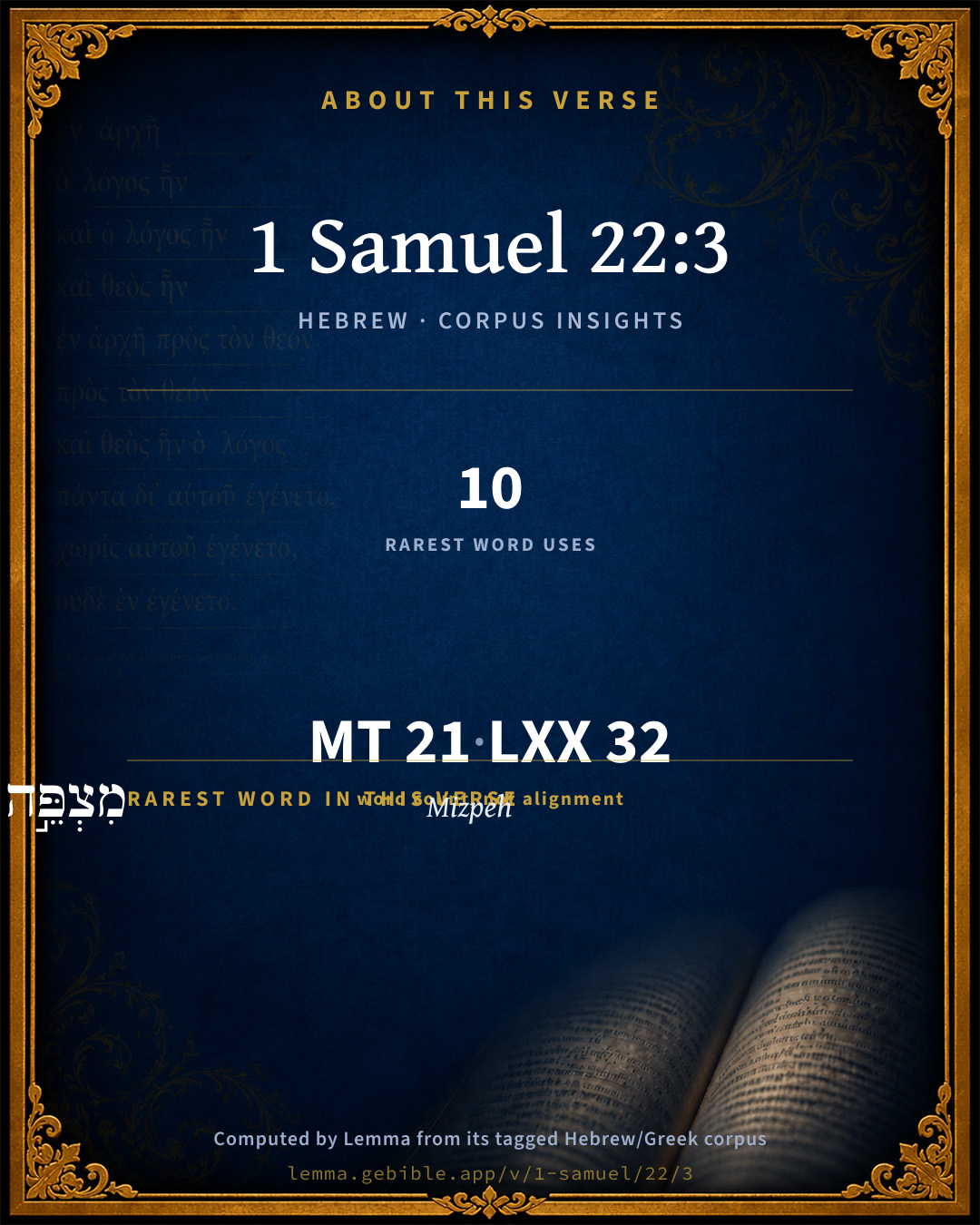
These counts appear in no published source. They are computed here, from the morphology-tagged text and Lemma’s own curated glosses. What Lemma adds →

21
words
19
distinct lemmas
Historical
section

Notable vocabulary

The rarest word here is מִצְפֵּ֣ה Mizpeh H4708 — appearing just 10 times in the whole Hebrew Bible.

Shared distinctive vocabulary

מִצְפֵּ֣ה Mizpeh H4708 occurs in 9 verses of the Hebrew Bible. Also found in:

Grammatical profile

  • 5 verbs
  • 8 nouns
  • 4 prepositions
  • 1 adverb
  • 3 particles

Verb forms

  • וַיֵּ֧לֶךְ Qal · Sequential Imperfect
  • וַיֹּ֣אמֶר Qal · Sequential Imperfect
  • יֵֽצֵא Qal · Jussive
  • אֵדַ֔ע Qal · Imperfect
  • יַּֽעֲשֶׂה Qal · Imperfect

Repetition

A word recurs within this verse — often emphatic in Hebrew:

  • מוֹאָ֑ב Moab H4124 ×2

Hebrew & Septuagint length

In English translation the verse runs 37 words from the Hebrew and 36 from the Septuagint (LXX English) — closely comparable.

A rough comparison of the two English renderings, which tokenize alike — not a word-level alignment.

Word counts can differ between the Hebrew and the Greek without any difference in meaning — e.g. the Hebrew direct-object marker אֵת has no separate Greek word, and Greek often adds the article ὁ.

In the original languages it is 21 Hebrew tokens and 32 Greek tokens — but the two are counted differently (Hebrew bundles its prefixes and suffixes into one token; the Greek is in lemma form), so that isn’t a like-for-like length.

Cross-references

12

Topical passages linked to 1 Samuel 22:3 in the Treasury of Scripture Knowledge — connected by theme and wording, ordered by reader-vote popularity; previews shown in the World English Bible.

  • Genesis 47:11 Joseph placed his father and his brothers, and gave them a possession in the land of Egypt, in the best of the land, in the land of Rameses, as Pharaoh had commanded.
  • Exodus 20:12 "Honor your father and your mother, that your days may be long in the land which Yahweh your God gives you.
  • Judges 11:29 Then the Spirit of Yahweh came on Jephthah, and he passed over Gilead and Manasseh, and passed over Mizpeh of Gilead, and from Mizpeh of Gilead he passed over to the children of Ammon.
  • Ruth 1:1–4 It happened in the days when the judges judged, that there was a famine in the land. A certain man of Bethlehem Judah went to sojourn in the country of Moab, he, and his wife, and his two sons.
  • Ruth 4:10 Moreover Ruth the Moabitess, the wife of Mahlon, have I purchased to be my wife, to raise up the name of the dead on his inheritance, that the name of the dead not be cut off from among his brothers, and from the gate of his place: you are witnesses this day.
  • Ruth 4:17 The women her neighbors gave it a name, saying, There is a son born to Naomi; and they named him Obed: he is the father of Jesse, the father of David.
  • 1 Samuel 3:18 Samuel told him every whit, and hid nothing from him. He said, It is Yahweh: let him do what seems him good.
  • 1 Samuel 14:47 Now when Saul had taken the kingdom over Israel, he fought against all his enemies on every side, against Moab, and against the children of Ammon, and against Edom, and against the kings of Zobah, and against the Philistines: and wherever he turned himself, he put [them] to the worse.
  • 2 Samuel 15:25–26 The king said to Zadok, Carry back the ark of God into the city: if I shall find favor in the eyes of Yahweh, he will bring me again, and show me both it, and his habitation:
  • Matthew 15:4–6 For God commanded, 'Honor your father and your mother,' and, 'He who speaks evil of father or mother, let him be put to death.'
  • Philippians 2:23–24 Therefore I hope to send him at once, as soon as I see how it will go with me.
  • 1 Timothy 5:4 But if any widow has children or grandchildren, let them learn first to show piety towards their own family, and to repay their parents, for this is acceptable in the sight of God.

Cross-references courtesy of OpenBible.info (CC BY 4.0).

Hebrew and Greek witnesses Masoretic Hebrew ↔ Greek Septuagint

The same verse in the two great witnesses to the Old Testament, shown verse-for-verse.

These are two independent witnesses, not word-aligned to each other, and the Septuagint is shown in lemma (dictionary) form.

Hebrew 1 Samuel 22:3 Masoretic · Westminster Leningrad Codex

וַיֵּ֧לֶךְ דָּוִ֛ד מִשָּׁ֖ם מִצְפֵּ֣ה מוֹאָ֑ב וַיֹּ֣אמֶר אֶל מֶ֣לֶךְ מוֹאָ֗ב יֵֽצֵא נָ֞א אָבִ֤י וְאִמִּי֙ אִתְּכֶ֔ם עַ֚ד אֲשֶׁ֣ר אֵדַ֔ע מַה יַּֽעֲשֶׂה לִּ֖י אֱלֹהִֽים

David went there to Mizpeh of Moab: and he said to the king of Moab, Please let my father and my mother come forth, [and be] with you, until I know what God will do for me.

World English Bible · Public Domain

Greek LXX 1 Samuel 22:3 Septuagint · lemma form

καί ἀποἔρχομαι δαυίδ ἐκεῖθεν εἰς μασσηφα ὁ μωαβ καί εἶπον πρός βασιλεύς μωαβ γίγνομαι δή ὁ πατήρ ἐγώ καί ὁ μήτηρ ἐγώ παρά σύ ἕως ὅστις γιγνώσκω τίς ποιέω ἐγώ ὁ θεός

And David departed thence to Massephath of Moab, and said to the king of Moab, Let, I pray you, my father and my mother be with you, until I know what God will do to me.

LXX2012 (modern English Septuagint) · Public Domain

Hebrew: Westminster Leningrad Codex (CC BY 4.0). Greek: Septuagint (public domain); English from LXX2012 (modern English Septuagint) (Public Domain). How the Septuagint differs from the Hebrew →

Targum (Aramaic paraphrase)

1

The Targum is the ancient Jewish Aramaic paraphrase of the Hebrew Scriptures — an interpretive translation, not the Hebrew text itself. Onkelos (literal) and Pseudo-Jonathan (expansive) render the Torah, and Jonathan the Prophets. Coverage is partial: where no permissively-licensed English translation exists for a verse, only the Aramaic is shown. This is verse-level text, not a word-by-word alignment to the Hebrew.

  1. Targum Jonathan Prophets (Joshua–Malachi)
    וַאֲזַל דָוִד מִתַּמָן לְמִצְפַּיָא דְמוֹאָב וַאֲמַר לְמַלְכָּא דְמוֹאָב יִפּוֹק כְּעַן אַבָּא וְאִמָא עִמְכוֹן עַד דְאִידַע מַה יַעְבֵּיד לִי יְיָ:

    (no public-domain English translation for this verse)

    Targum Jonathan — Aramaic: “Mikraot Gedolot” (public domain). English: “Sefaria Community Translation” (CC0 1.0 (public-domain dedication)); “London "Chaldee Paraphrase," 1871” (public domain). Text via Sefaria.

Commentary

Notes on 1 Samuel 22:3 from classic Christian and Jewish commentators (each source and its license shown beneath its notes). The classic Christian expositions comment on the surrounding passage and are grouped to its opening verse, so a note may address several verses; the Jewish commentaries on the Tanakh (Rashi and others) are per-verse, so they appear only where the commentator wrote on this verse.

Lemma curates 59 commentaries, every one of them public domain or Creative Commons licensed, each selected and text-cleaned for this edition rather than reprinted as found. About our sources →

Trapp's Complete Commentary

John Trapp

1Sa 22:3 And David went thence to Mizpeh of Moab: and he said unto the king of Moab, Let my father and my mother, I pray thee, come forth, [and be] with you, till I know what God will do for me.

Ver. 3. To Mizpeh of Moab.] Called also Malle, {/APC 1Ma 5:26} as Junius after Josephus thinketh - that is, a fort.

And he said unto the king of Moab.] Who might therefore favour him, because Saul, their common enemy, hated and persecuted him: like as Queen Elizabeth respected and aided the king of Portugal, cast out by the Spaniard.

Let my father and my mother, I pray thee.] This care of his for his aged parents’ ease and safety was very commendable, and worthy of imitation. He might haply plead that his father’s grandmother, Ruth, was a Moabitess.

John Trapp, A Commentary or Exposition upon All the Books of the Old and New Testament (1647–1656) — public domain. Text from a community e-Sword module.

Joseph Benson's Commentary

1Sa 22:3. David went from thence to Mizpeh — For the Moabites were at difference with Saul, 1Sa 14:47. Let my father and my mother be with you — David, perhaps, the rather hoped for this kindness to be shown to his aged parents, who were not able to travel up and down, as he was likely to be obliged to do, because he was descended from Ruth, a Moabitess. The filial tenderness of David here deserves our admiration, who makes it his first care to fix his parents in a place of safety and ease, not being able to bear their being exposed to the dangers and hardships which the necessity of his affairs obliged him to undergo. His address to the king manifests his great tenderness to his parents, and his entire submission to the will of God. Till I know what God will do for me — He expresses his hopes very modestly, as one that had entirely cast himself upon God, and committed his way to him, trusting not in his own arts or arms, but in the wisdom, power, and goodness of God.

Joseph Benson's Commentary on the Old and New Testaments (1811–1818) — public domain. Text from a community e-Sword module.

Whedon's Commentary on the Bible

Daniel D. Whedon

DAVID IN MIZPEH OF MOAB, 1Sa_22:3-4.

3. Mizpeh of Moab — The name of this place does not occur again, and we are left in uncertainty as to its situation. Some have supposed that the place was identical with Kir-Moab, the modern Kerak; but greater plausibility attaches to the supposition that this Mizpeh was some commanding eminence on the east of the Jordan, like Nebo or Pisgah, at that time in the possession of the Moabites. David had reason to expect a kind reception among the Moabites, on the ground that his great grandmother, Ruth, was a Moabitess.

Let my father and my mother… be with you — He regarded their age and feebleness as too great to endure the anxieties and hardships of his wild mode of life, and the cave of Adullam was for them too dark and cheerless an asylum.

Till I know what God will do for me — He knew that he was innocent, and the victim of a wicked persecution, but he cherished a strong hope that in the end his cause would be vindicated.

Daniel D. Whedon (gen. ed.), Commentary on the Old and New Testaments (1874–1909) — public domain. Text from a community e-Sword module.

Tyndale Open Study Notes

Tyndale Open Resources

22:3-4 Mizpeh in Moab lay east of the Dead Sea and the Jordan River—not an easy trip from Adullam, especially if the 400 men (22:2) accompanied David. • David’s parents stayed in Moab: Jesse’s grandmother was Ruth, a Moabite (Ruth 4:13-22).

Tyndale Open Study Notes — © Tyndale Open Resources, licensed CC BY-SA 4.0. Text via the HelloAO Bible API.

Geneva Bible (1599)

Geneva Bible translators

For there was another so called in Judah.

Geneva Bible (1599) marginal notes — public domain. Text via Bolls.life.

Jamieson, Fausset & Brown

Robert Jamieson, A. R. Fausset & David Brown

David went thence to Mizpeh of Moab--"Mizpeh" signifies a watchtower, and it is evident that it must be taken in this sense here, for it is called "the hold" or fort (Sa1 22:4). The king of Moab was an enemy of Saul (Sa1 14:47), and the great-grandson of Ruth, of course, was related to the family of Jesse. David, therefore, had less anxiety in seeking an asylum within the dominions of this prince than those of Achish, because the Moabites had no grounds for entertaining vindictive feelings against him, and their enmity, to Saul rendered them the more willing to receive so illustrious a refugee from his court.

Jamieson, Fausset & Brown — Commentary Critical and Explanatory on the Whole Bible (1871) — public domain (CC PDM 1.0). Text via the HelloAO Bible API.

Adam Clarke's Commentary

Verse 3. He said unto the king of Moab] David could not trust his parents within the reach of Saul, and he found it very inconvenient to them to be obliged to go through all the fatigues of a military life, and therefore begs the king of Moab to give them shelter. The king of Moab, being one of Saul's enemies, would be the more ready to oblige a person from whom he might at least expect friendship, if not considerable services.

Adam Clarke's Commentary on the Bible (1810–1826) — public domain. Text from a community e-Sword/MySword module.

Ellicott's Commentary for English Readers

(3) Mizpeh.—This particular Mizpeh is mentioned nowhere else. The word means a watch tower; it was probably some mountain fortress in Moab. It has been suggested that it was the same as Zophim, a word of the same root as Mizpeh (see Num_23:14). David evidently sought hospitality among his kin in Moab. Jesse, his father, was the grandson of Ruth the Moabitess. The distance from the south of Judah Where the fugitives were wandering was not great.

Till I know what God will do for me.—This memory of David’s words to the King of Moab shows that the old trust and love, which in his first moments of care and sorrow had failed him, had come back again to the son of Jesse. It is interesting to note that David when addressing the Moabite sovereign speaks of “God” “Elohim,” not of Jehovah. This was probably out of deep reverence; an idolator had nothing to do with the awful name by which the Eternal was known to His covenant people—a Name which, as originally uttered, has now passed away from the earth. We read the mystic four letters, but no man, Jew or Gentile, can pronounce the Name of Names. The “Name,” however, was not unknown in Moab, for the mystic letters which compose it occur in the inscription of Mesha, dating about 150 years from the days of David’s exile.

A Bible Commentary for English Readers, edited by Charles John Ellicott (1878–1897) — public domain. Text from a community e-Sword module.

The Cambridge Bible for Schools and Colleges

gen. ed. J. J. S. Perowne

3. Mizpeh of Moab] Mentioned here only. Perhaps either the strong rock citadel afterwards known as Kir-Moab, now Kerak is meant: or some place not in Moab proper, but on the mountains of Abarim or Pisgah north of the Arnon, which would be more easily accessible from Bethlehem by way of Jericho. The long purple wall of the mountains of Moab is a striking feature in the view from Bethlehem (Sin. and Pal. p. 104), and would naturally suggest a retreat thither: but no doubt it was his connexion with Moab through his great-grandmother Ruth, which chiefly induced David to choose that country as a refuge for his parents.

The Cambridge Bible for Schools and Colleges (gen. ed. J. J. S. Perowne; Cambridge University Press, 1878–1918) — public domain. Text from a community e-Sword module.

John Gill's Exposition

And David went thence to Mizpeh of Moab,.... So called to distinguish it from a place of the same name in the land of Israel; which Junius says is the same with Malle, and signifies a fortified place, and refers to the Apocrypha:"And how that many of them were shut up in Bosora, and Bosor, and Alema, Casphor, Maked, and Carnaim; all these cities are strong and great:'' (1 Maccabees 5:26)here he might think himself safer, though in an enemy's country, than in the land of Israel:

and he said unto the king of Moab, let my father and my mother, I pray thee, come forth; out of the land of Israel, or out of the cave of Adullam, whither they were come to him:

and be with you; if not with the king of Moab at his court, yet in some part or other of his country, where they might be safe from the rage of Saul:

till I know what God will do for me; on whose power and providence he wholly relied, and not upon the men that flocked to him, nor upon his own power and policy, courage and wisdom; he knew the promise of God to him, and he put his trust in him for the performance of it; but knew not the time, nor way, and manner, in which it would be performed; and expected in the meanwhile to be obliged to remove from place to place; and considering that his aged parents were not fit for such quick and sudden motions, and long flights, he provided as well as he could for their settlement; which was an instance of his filial affection for them, and piety towards them. His father's name is well known, Jesse, Rut 4:22, &c. but his mother's name is nowhere mentioned; the Jews say her name was Natzbet, the daughter of Adal (y).

(y) T. Bab. Bava Bathra, fol. 91. 1.

John Gill's Exposition of the Whole Bible (1746–1763) — public domain (CC PDM 1.0). Text via the HelloAO Bible API.

Albert Barnes' Notes on the Bible

Mizpeh of Moab - A good conjecture connects it with “Zophim” (a word of the same root as Mizpeh) on the top of Pisgah Num 23:14. It is probable that David’s descent from Ruth the Moabitess may have had something to do with his seeking an asylum for Jesse, Ruth’s grandson, in the land of her birth. It would be very easy to get to the Jordan from the neighborhood of Bethlehem, and cross over near its embouchure into the Dead Sea.

Come forth, and be with you - The construction of the Hebrew is very strange. The Vulgate, Syriac, and Arabic seem to have read “dwell” instead of “come forth.”

Albert Barnes' Notes on the Bible (1834–1885) — public domain. Text from a community e-Sword/MySword module.

Haydock's Catholic Bible Commentary

Of Moab, to distinguish it from the city of Benjamin, where Samuel had assembled the people; (Menochius) and perhaps also from the birth-place of Jephte, unless the Moabites had taken possession again of that part of Galaad. (Calmet) --- Saul had made war upon this king, so that he was more ready to protect David, who departing soon after, by the admonition of Gad, (ver. 5.; Calmet) left those who could not follow him under his care. In the mean time he lived on plunder, taken from the surrounding enemies, (Tostat) and was joined by 200 men from the tribes of Benjamin and of Juda, (1 Paralipomenon xii. 16,) with Amasai, his nephew, by his sister Abigail, at their head. (Salien, the year before Christ 1079.)

George Leo Haydock (1774–1849), Haydock's Catholic Family Bible and Commentary, 1859 edition — public domain. Excludes Psalms (Douay-Rheims chapter numbering differs from Protestant) and Deuterocanonical books (Catholic canon only).

Matthew Poole's English Annotations

Mizpeh of Moab; so called, to distinguish it from that Mizpeh, 1Sa 7:5.

He said unto the king of Moab; partly because he was related to and descended from one of his people, Rth 4:10; and partly because he was Saul’s enemy, 1Sa 14:47, and therefore more likely to be David’s friend.

My father and my mother, who being very aged, were not able to endure those journeys and hardships which David foresaw that he was likely to be exposed to.

Till I know what God will do for me; till I see the accomplishment of God’s promise made to me.

Matthew Poole's English Annotations on the Holy Bible (1683–1685) — public domain. Text from a community e-Sword/MySword module.

The Pulpit Commentary

Vers. 3, 4. David went thence to Mizpeh of Moab. The position of this place is unknown, but as the word means a watch tower, it was no doubt some beacon hill in the highlands of Moab on the east of the Dead Sea, and probably in the mountains of Abarim or Pisgah. Here David placed his father and mother under the care of the king of Moab. They had fled from Bethlehem under the combined fear of Saul and the Philistines, but were too old to bear the fatigues of David"s life. He therefore asks for a refuge for them with the king of Moab, probably on the ground that Jesse"s grandmother, Ruth, was a Moabitess. But as Saul had waged war on Moab, (1Sa_14:47) the king was probably glad to help one who would keep Saul employed at home. The language of David is remarkable, and is literally, "Let, I pray, my father and my mother come forth with you" (pl.); but no better interpretation has been suggested than that in the A.V: "Let them come forth, i.e. from the hold in Mizpeh, to be or dwell with you." While David was in the hold. Not merely that in the land of Moab, but up to the time when David was settled in Hebron. During all this period David was wandering from one natural fortress to another. Till I know what God will do for (or to) me. These words show that David had recovered his composure, and was willing calmly to leave everything to the wise disposal of God.

Vers. 3, 4. (MOAB.)

Filial kindness.

To honour parents is the earliest obligation of life, the foundation of human duties and a stepping stone to Divine. It applies to children not only when they dwell at home and depend on their parents, but also when they leave home and become independent of them. The manner in which it should be shown in the latter case differs in some respects from that in the former; but such kindness as David exhibited towards his aged father and mother ought never to be neglected. It was

I NEEDFUL. In early life we need the care of parents, in old age that of children.

1. Bodily weakness and failing health often render parents dependent for physical comforts and even necessaries. (Gen_47:12)

2. Increasing loneliness makes them desirous of the cheering presence and intercourse of their children; and much pain is naturally given by lack of respect, affection, confidence, and gentle ministrations.

3. Special emergencies, like those here alluded to, sometimes demand unusual efforts for their safety and happiness. Their condition appeals to the tenderest and best feelings of the heart, though, alas, it sometimes appeals in vain.

II OBLIGATORY.

1. Arising out of natural relationship, the duties of which on the part of children, however imperfectly they may have been fulfilled on the part of parents, cannot be cancelled.

2. Required by the claims of gratitude for innumerable benefits received.

3 . Enjoined by the Divine word in many precepts to which great promises are annexed. "The fifth commandment is the centre of all the others; for upwards it is the point of departure for Divine, and downwards for human duties". (Eph_6:1) "Despise not thy mother when she is old". (Pro_23:22) "God commanded, saying, Honour thy father," etc. (Mat_15:4-9) "Let them learn first to show (filial) reverence to their own household, and to requite their parents," etc.. (1Ti_5:4)

4 . Commended by the example of the good. "Because ye have obeyed the commandment of Jonadab your father, etc.. (Jer_35:18, Jer_35:19) Jesus Christ himself. (Joh_19:26)

III EXEMPLARY the way in which it was displayed.

1. Thoughtful, affectionate, and tender.

2. Self-denying and self-sacrificing, with much effort and risk, and as was best suited to the circumstances of the case.

3 . Religious: "Till I know what God will do to me;" where there is a recognition of his will as supreme, faith in his wise and gracious disposal, (Psa_27:10) and hope of his enabling him to see again his parents, from whom he parted with regret, and provide for their permanent welfare.

Exhortation:

1. To children. Be kind to your parents, though you no longer need their care, if you would not have your children be unkind to you.

2. To parents. Seek to gain the respect and affection of your children, andteach them to honour God, if you would have them to honour you.

3 . To all. Be not like those of whom the heavenly Father said of old, "Ihave nourished and brought up children, and they have rebelled against. D. (Isa_1:2)

The Pulpit Commentary (1880–1919), ed. H.D.M. Spence-Jones & Joseph S. Exell — public domain. Text from a community e-Sword module.

John Wesley's Explanatory Notes

'Till I know, &c. - He expresses his hopes very modestly, as one that had entirely cast himself upon God, and committed his way to him, trusting not in his own arts or arms, but in the wisdom, power and goodness of God.

John Wesley, Explanatory Notes Upon the Whole Bible (1754–1765) — public domain. Text via the GEBible commentary corpus.

unfoldingWord translationNotes

Door43 World Missions Community

Then David went from there

"Then David went from the cave at Adullam"

Mizpah

This is the name of a city. (See: How to Translate Names)

go out with you

David wanted his parents to live with the king of Moab so that King Saul would not be able to harm them. Translators can express his basic meaning by using the ideas of "come to stay with you," "stay with you," or "live here with you," as in the UDB.

go into the land of Judah

"go to your home land of Judah"

Hereth

This is the name of a city. (See: How to Translate Names)

translationWords

David

Moab

king

ancestor

know

God

stronghold

prophet

Gad

Judah

unfoldingWord translationNotes — © Distant Shores Media and the Door43 World Missions Community, licensed CC BY-SA 4.0. Source: git.door43.org/Door43/en_tn.

Lesson kit

Teaching starters — assembled from the data on this page, not authored interpretation. Every prompt links to the verse data it draws on. Edit before teaching.

1 Samuel, in the Historical, opens this verse with 21 words (19 distinct Hebrew lemmas). Its most distinctive word is Mitspeh (“Mizpeh”). A historical commentator’s framing appears above. Read the whole chapter for the surrounding context.

Discussion questions

  1. The word Mitspeh carries the sense “Mizpeh.” How does it shape the verse?
  2. How does Joshua 11:8, which shares the word «Mizpeh», read alongside this verse?
  3. What does the repetition of “Moab” (2× in this one verse) do in this verse?
  4. These translations render this verse differently; the difference is in the English rendering, not the original. What questions does that raise?
  5. «וַיֵּ֧לֶךְ» is a Qal Sequential Imperfect verb. How does that grammatical form shape the action described?
  6. Compare how Trapp's Complete Commentary and Joseph Benson's Commentary read this verse. Where do they agree or differ?

Things to notice

Reading settings

Reading text

Shown beneath each verse's original-language words.

Old Testament
Old Testament edition

Read the OT as the Masoretic Hebrew (MT) or the Greek Septuagint (LXX).

English shown for the Greek Septuagint (in the Hebrew ↔ Greek comparison).

Comparing translations? Open the Compare panel on any verse page to stack up to four side by side.