
Numbers 36:13

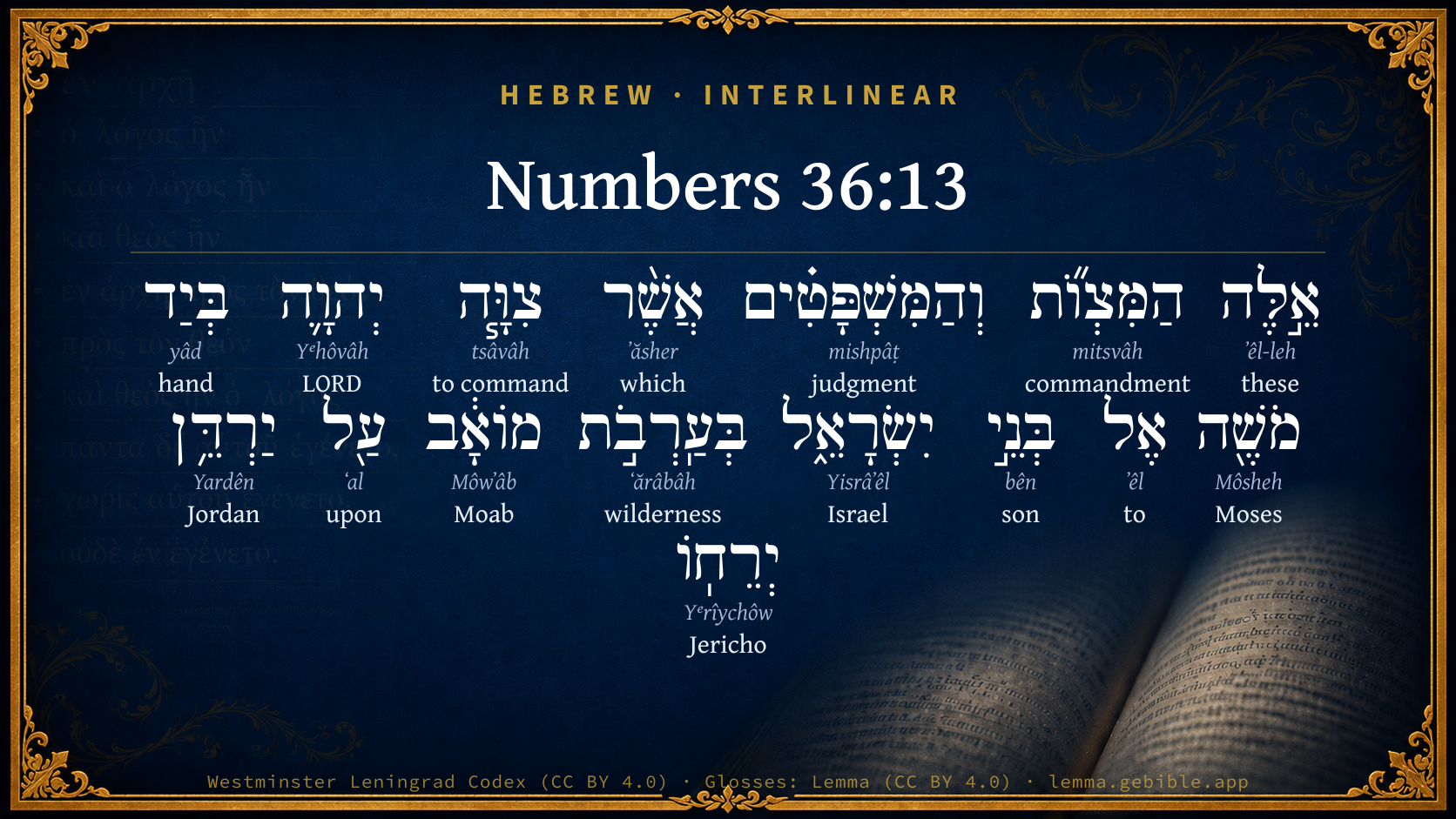
Hebrew (Westminster Leningrad Codex) Numbers 36:13 appears in the Hebrew Old Testament. The text above is from the Westminster Leningrad Codex. Each word links to its Strong’s number, a concise gloss, and parsing drawn from the Open Scriptures Hebrew Bible morphology. Click any word for its full Brown-Driver-Briggs (BDB) entry.
Download image
Cite this verse

Numbers 36:13 (World English Bible). Public Domain. Lemma interlinear Bible study tool, https://lemma.gebible.app/v/numbers/36/13.

Show BibTeX & RIS
BibTeX
RIS
English Translation
These are the commandments and the ordinances which Yahweh commanded by Moses to the children of Israel in the plains of Moab by the Jordan at Jericho.
World English Bible · Public Domain
Download a study sheet

One document with this verse’s original text, its word-by-word gloss line, the meaning frame, cross-references with their text, attributed commentary, and full source and license credits — printable, and it pastes into notes with its structure intact.

This verse Autodidact and up

Study sheet (.html) Plain text (.txt)

A passage Seminary Student

Up to 50 verses in one chapter. A passage sheet keeps up to 6 commentary sources and 12 cross-references per verse, in the order this page ranks them, and says so on the sheet whenever that leaves anything out. Ask for a single verse and you get the Autodidact verse sheet above.

Everything on this page stays free to read, with no account — the sheet is a download of what is already on screen, not access to it.

Want to remove ads? Support Godless Engineer
Compare translations 3

The same verse in 3 English versions, stacked beneath the original-language interlinear above. Click any original word for its lexicon entry.

Each is an independent rendering of the whole verse — the interlinear is not word-aligned to these translations.

Highlighted words mark where these versions differ — a whole-verse word diff, not a word-by-word alignment.

  • World English Bible Public Domain
    These are the commandments and the ordinances which Yahweh commanded by Moses to the children of Israel in the plains of Moab by the Jordan at Jericho.
  • King James Version Public Domain
    These are the commandments and the judgments, which the LORD commanded by the hand of Moses unto the children of Israel in the plains of Moab by Jordan near Jericho.
  • unfoldingWord Literal Text CC BY-SA 4.0
    These are the commands and the judgments that Yahweh commanded by the hand of Moses to the sons of Israel in the plains of Moab beside the Jordan at Jericho.

unfoldingWord Literal Text — © unfoldingWord, licensed CC BY-SA 4.0. Word-aligned USFM3 via Door43 (git.door43.org/unfoldingWord/en_ult).

Versions to compare (up to 4)

3 of 4 selected

Show all 18 translations

Every available English version of this verse, each an independent rendering of the whole verse.

  • World English Bible Public Domain
    These are the commandments and the ordinances which Yahweh commanded by Moses to the children of Israel in the plains of Moab by the Jordan at Jericho.
  • Berean Standard Bible Public Domain
    These are the commandments and ordinances that the LORD gave the Israelites through Moses on the plains of Moab by the Jordan across from Jericho.
  • Majority Standard Bible Public Domain
    These are the commandments and ordinances that the LORD gave the Israelites through Moses on the plains of Moab by the Jordan across from Jericho.
  • King James Version Public Domain
    These are the commandments and the judgments, which the LORD commanded by the hand of Moses unto the children of Israel in the plains of Moab by Jordan near Jericho.
  • American Standard Version (1901) Public Domain
    These are the commandments and the ordinances which Jehovah commanded by Moses unto the children of Israel in the plains of Moab by the Jordan at Jericho.
  • Revised Version (1885) Public Domain
    These are the commandments and the judgments, which the LORD commanded by the hand of Moses unto the children of Israel in the plains of Moab by the Jordan at Jericho.
  • Geneva Bible (1599) Public Domain
    These are the commandements and lawes which the Lord commanded by the hand of Moses, vnto the children of Israel in the plaine of Moab, by Iorden toward Iericho.
  • Douay-Rheims (1899) Public Domain
    These are the commandments and judgments, which the Lord commanded by the hand of Moses to the children of Israel, in the plains of Moab upon the Jordan over against Jericho.
  • Young's Literal Translation Public Domain
    These `are' the commands and the judgments which Jehovah hath commanded, by the hand of Moses, concerning the sons of Israel, in the plains of Moab, by Jordan, `near' Jericho.
  • Literal Standard Version CC BY-SA 4.0
    These [are] the commands and the judgments which YHWH has commanded by the hand of Moses concerning the sons of Israel, in the plains of Moab by the Jordan, [near] Jericho.
  • Unlocked Literal Bible CC BY-SA 4.0
    These are the commands and the decrees that Yahweh gave by Moses to the people of Israel in the plains of Moab by the Jordan at Jericho.
  • unfoldingWord Literal Text CC BY-SA 4.0
    These are the commands and the judgments that Yahweh commanded by the hand of Moses to the sons of Israel in the plains of Moab beside the Jordan at Jericho.
  • Darby Bible Public Domain
    These are the commandments and the ordinances which Jehovah commanded through Moses to the children of Israel, in the plains of Moab, by the Jordan of Jericho.
  • World Messianic Bible Public Domain
    These are the commandments and the ordinances which the LORD commanded by Moses to the children of Israel in the plains of Moab by the Jordan at Jericho.
  • Webster's Bible Public Domain
    These are the commandments and the judgments, which the LORD commanded by the hand of Moses to the children of Israel in the plains of Moab by Jordan near Jericho.
  • Free Bible Version CC BY-SA 4.0
    These are the orders and regulations that the Lord gave the Israelites through Moses on the plains of Moab beside the Jordan opposite Jericho.
  • Bible in Basic English Public Domain
    These are the laws and the orders which the Lord gave to the children of Israel by Moses, in the lowlands of Moab by Jordan at Jericho.
  • JPS Tanakh (1917) Public Domain
    These are the commandments and the ordinances, which the LORD commanded by the hand of Moses unto the children of Israel in the plains of Moab by the Jordan at Jericho.

Literal Standard Version (2020), Covenant Press — licensed CC BY-SA 4.0. Text via the HelloAO Bible API (eBible.org). Unlocked Literal Bible (unfoldingWord) — licensed CC BY-SA 4.0. Text via the HelloAO Bible API (eBible.org). unfoldingWord Literal Text — © unfoldingWord, licensed CC BY-SA 4.0. Word-aligned USFM3 via Door43 (git.door43.org/unfoldingWord/en_ult). Free Bible Version, Dr. Jonathan Gallagher — licensed CC BY-SA 4.0. Text via the HelloAO Bible API (eBible.org).

Word by word

More ways to search: Search by grammar → Find every occurrence → Compare this word →

Practice this passage: Drill this verse → Learn its vocabulary →

יְרֵחֽוֹ
Yᵉrîychôw
H3405
“Jericho”
Noun, Proper
Part of Speech
Noun
Type
Proper
Full BDB Definition

Origin: perhaps from H3394

TWOT: 915

Jericho = "its moon" - a city 5 miles (8 kilometers) west of the Jordan and 7 miles (11.5 kilometers) north of the Dead Sea and the first city conquered by the Israelites upon entering the promised land of Canaan
  1. אֵ֣לֶּה ʼêl-leh H428 “these” Pronoun, Demonstrative, Common, Plural
  2. הַמִּצְוֺ֞ת mitsvâh H4687 “the · commandments” Particle, Definite Article + Noun, Common, Feminine, Plural, Absolute
  3. וְהַמִּשְׁפָּטִ֗ים mishpâṭ H4941 “and · the · judgments” Conjunction + Particle, Definite Article + Noun, Common, Masculine, Plural, Absolute
  4. אֲשֶׁ֨ר ʼăsher H834 “which” Particle, Relative
  5. צִוָּ֧ה tsâvâh H6680 “to command” Verb, Piel, Perfect, 3rd Person, Masculine, Singular
  6. יְהוָ֛ה Yᵉhôvâh H3068 “LORD” Noun, Proper
  7. בְּיַד yâd H3027 “in/at · hand of” Preposition + Noun, Common, Both, Singular, Construct
  8. מֹשֶׁ֖ה Môsheh H4872 “Moses” Noun, Proper
  9. אֶל ʼêl H413 “to” Preposition
  10. בְּנֵ֣י bên H1121 “sons of” Noun, Common, Masculine, Plural, Construct
  11. יִשְׂרָאֵ֑ל Yisrâʼêl H3478 “Israel” Noun, Proper
  12. בְּעַֽרְבֹ֣ת ʻărâbâh H6160 “in/at · wildernesses of” Preposition + Noun, Common, Feminine, Plural, Construct
  13. מוֹאָ֔ב Môwʼâb H4124 “Moab” Noun, Proper
  14. עַ֖ל ʻal H5921 “upon” Preposition
  15. יַרְדֵּ֥ן Yardên H3383 “Jordan” Noun, Proper

About this verse

These counts appear in no published source. They are computed here, from the morphology-tagged text and Lemma’s own curated glosses. What Lemma adds →

16
words
16
distinct lemmas
Pentateuch
section

Shared distinctive vocabulary

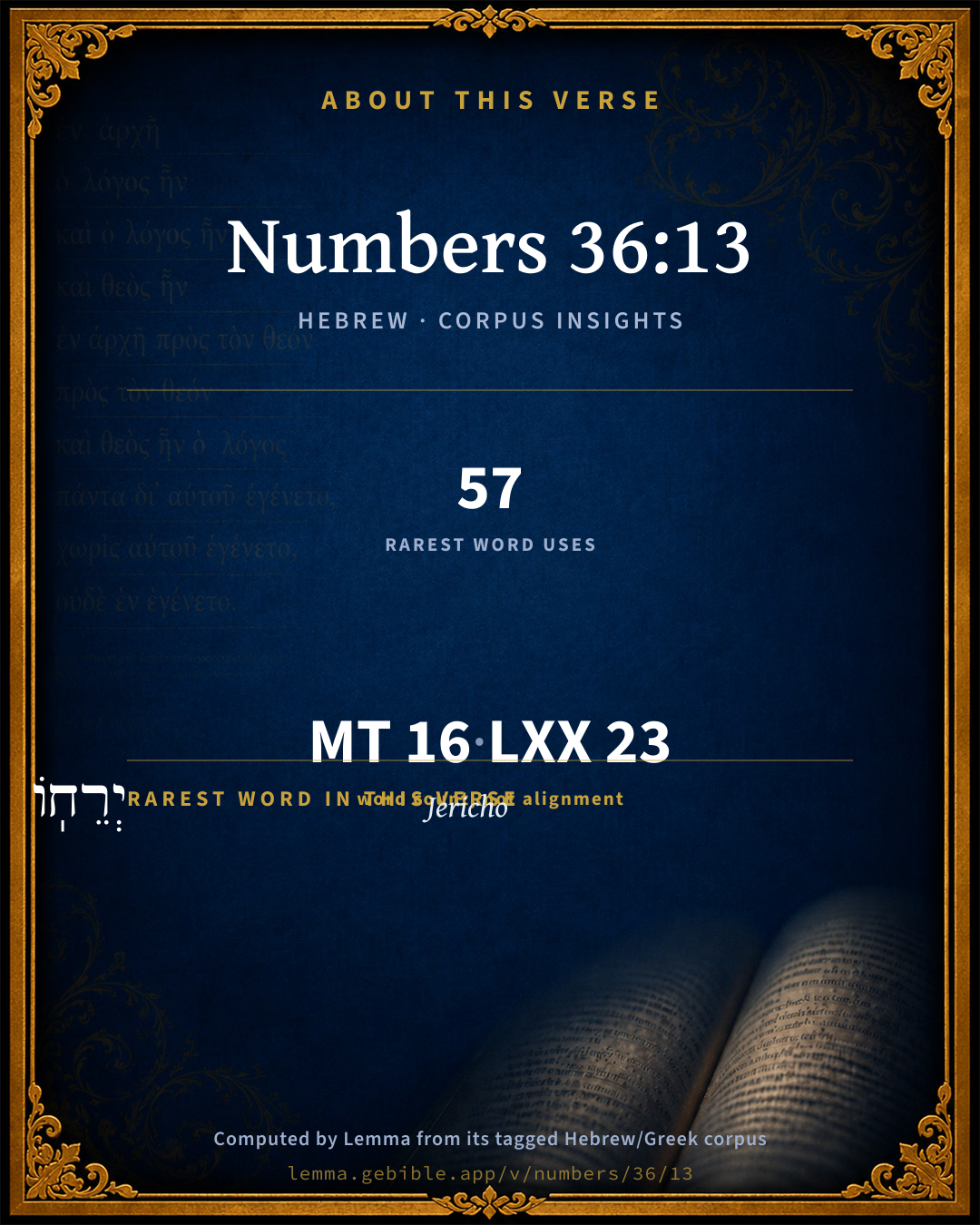
יְרֵחֽוֹ Jericho H3405 occurs in 53 verses of the Hebrew Bible. Also found in:

Grammatical profile

  • 1 verb
  • 11 nouns
  • 1 pronoun
  • 2 prepositions
  • 1 particle

Verb forms

  • צִוָּ֧ה Piel · Perfect

Hebrew & Septuagint length

In English translation the verse runs 27 words from the Hebrew and 28 from the Septuagint (LXX English) — closely comparable.

A rough comparison of the two English renderings, which tokenize alike — not a word-level alignment.

Word counts can differ between the Hebrew and the Greek without any difference in meaning — e.g. the Hebrew direct-object marker אֵת has no separate Greek word, and Greek often adds the article ὁ.

In the original languages it is 16 Hebrew tokens and 23 Greek tokens — but the two are counted differently (Hebrew bundles its prefixes and suffixes into one token; the Greek is in lemma form), so that isn’t a like-for-like length.

Cross-references

11

Topical passages linked to Numbers 36:13 in the Treasury of Scripture Knowledge — connected by theme and wording, ordered by reader-vote popularity; previews shown in the World English Bible.

  • Leviticus 27:34 These are the commandments which Yahweh commanded Moses for the children of Israel on Mount Sinai.
  • Leviticus 26:46 These are the statutes, ordinances and laws, which Yahweh made between him and the children of Israel in Mount Sinai by Moses.
  • Numbers 22:1 The children of Israel traveled, and encamped in the plains of Moab beyond the Jordan at Jericho.
  • Leviticus 7:37–38 This is the law of the burnt offering, of the meal offering, and of the sin offering, and of the trespass offering, and of the consecration, and of the sacrifice of peace offerings;
  • Leviticus 11:46 "'This is the law of the animal, and of the bird, and of every living creature that moves in the waters, and of every creature that creeps on the earth,
  • Leviticus 13:59 This is the law of the plague of mildew in a garment of wool or linen, either in the warp, or the woof, or in anything of skin, to pronounce it clean, or to pronounce it unclean.
  • Leviticus 14:54–57 This is the law for any plague of leprosy, and for an itch,
  • Leviticus 15:32–33 This is the law of him who has a discharge, and of him who has an emission of semen, so that he is unclean thereby;
  • Numbers 26:3 Moses and Eleazar the priest spoke with them in the plains of Moab by the Jordan at Jericho, saying,
  • Numbers 33:50 Yahweh spoke to Moses in the plains of Moab by the Jordan at Jericho, saying,
  • Numbers 35:1 Yahweh spoke to Moses in the plains of Moab by the Jordan at Jericho, saying,

Cross-references courtesy of OpenBible.info (CC BY 4.0).

Hebrew and Greek witnesses Masoretic Hebrew ↔ Greek Septuagint

The same verse in the two great witnesses to the Old Testament, shown verse-for-verse.

These are two independent witnesses, not word-aligned to each other, and the Septuagint is shown in lemma (dictionary) form.

Hebrew Numbers 36:13 Masoretic · Westminster Leningrad Codex

אֵ֣לֶּה הַמִּצְוֺ֞ת וְהַמִּשְׁפָּטִ֗ים אֲשֶׁ֨ר צִוָּ֧ה יְהוָ֛ה בְּיַד מֹשֶׁ֖ה אֶל בְּנֵ֣י יִשְׂרָאֵ֑ל בְּעַֽרְבֹ֣ת מוֹאָ֔ב עַ֖ל יַרְדֵּ֥ן יְרֵחֽוֹ

These are the commandments and the ordinances which Yahweh commanded by Moses to the children of Israel in the plains of Moab by the Jordan at Jericho.

World English Bible · Public Domain

Greek LXX Numbers 36:13 Septuagint · lemma form

οὗτος ὁ ἐντολή καί ὁ δικαίωμα καί ὁ κρίμα ὅς ἐντέλλομαι κύριος ἐν χείρ μωυσῆς ἐπί δυσμή μωαβ ἐπί ὁ ἰορδάνης κατά ιεριχω

These are the commandments, and the ordinances, and the judgments, which the Lord commanded by the hand of Moses, at the west of Moab, at Jordan by Jericho.

LXX2012 (modern English Septuagint) · Public Domain

Hebrew: Westminster Leningrad Codex (CC BY 4.0). Greek: Septuagint (public domain); English from LXX2012 (modern English Septuagint) (Public Domain). How the Septuagint differs from the Hebrew →

Targum (Aramaic paraphrase)

2

The Targum is the ancient Jewish Aramaic paraphrase of the Hebrew Scriptures — an interpretive translation, not the Hebrew text itself. Onkelos (literal) and Pseudo-Jonathan (expansive) render the Torah, and Jonathan the Prophets. Coverage is partial: where no permissively-licensed English translation exists for a verse, only the Aramaic is shown. This is verse-level text, not a word-by-word alignment to the Hebrew.

  1. Targum Onkelos Torah (Genesis–Deuteronomy)
    אִלֵין פִּקוּדַיָא וְדִינַיָא דִי פַקִיד יְיָ בִּידָא דְמשֶׁה לְוַת בְּנֵי יִשְׂרָאֵל בְּמֵישְׁרַיָא דְמוֹאָב עַל יַרְדְנָא דִירֵיחוֹ

    (no public-domain English translation for this verse)

    Targum Onkelos — Aramaic: “Onkelos Genesis” (public domain); “Onkelos Exodus” (public domain); “Onkelos Leviticus” (public domain); “Onkelos Numbers” (public domain); “Onkelos Deuteronomy” (public domain). English: “Sefaria Community Translation” (CC0 1.0 (public-domain dedication)); “J.W. Etheridge. The Targums of Onkelos and Jonathan Ben Uzziel on the Pentateuch. London: Longmans, Green, 1862” (public domain). Text via Sefaria.

  2. Targum Pseudo-Jonathan Torah (Genesis–Deuteronomy)
    אִלֵין פִּקוּדַיָא וְסִדְרֵי דִינַיָא דְפַקֵיד יְיָ בִּידָא דְמשֶׁה לְוַת בְּנֵי יִשְרָאֵל בְּמֵישְׁרַיָא דְמוֹאָב עַל יַרְדְנָא דִירֵיחוֹ

    These are the commandments and orders of judgments which the Lord commanded the children of Israel, by Mosheh, in the plains of Moab by the Jordan near Jericho.

    Targum Pseudo-Jonathan — Aramaic: “Targum Jonathan on Genesis” (public domain); “Targum Jonathan on Exodus” (public domain); “Targum Jonathan on Leviticus” (public domain); “Targum Jonathan on Numbers” (public domain); “Targum Jonathan on Deuteronomy” (public domain). English: “The Targum of Jonathan ben Uzziel, trans. J. W. Etheridge, London, 1862” (public domain). Text via Sefaria.

Commentary

Notes on Numbers 36:13 from classic Christian and Jewish commentators (each source and its license shown beneath its notes). The classic Christian expositions comment on the surrounding passage and are grouped to its opening verse, so a note may address several verses; the Jewish commentaries on the Tanakh (Rashi and others) are per-verse, so they appear only where the commentator wrote on this verse.

Lemma curates 59 commentaries, every one of them public domain or Creative Commons licensed, each selected and text-cleaned for this edition rather than reprinted as found. About our sources →

Adam Clarke's Commentary

Verse 13. These are the commandments, c.] See these different terms analyzed and explained, Clarke "Le 26:15".

THUS ends the book of Numbers, containing a series of astonishing providences and events. Scarcely any piece of history in the sacred writings is better calculated to impress the mind of a serious reader with a sense of the goodness and severity of God. In every transaction his holiness and justice appear in closest union with his benevolence and mercy. From such a Being what have the wicked not to fear! From such a Father and Friend what have the upright not to hope! His justice requires him to punish iniquity, but his mercy inclines him to pardon all who truly repent and believe in the Son of his love.

The journeyings of this people, from the time they left Egypt, exhibit a series of providential wonders. Every where, and in every circumstance, God appears: and yet there is no circumstance or occasion that does not justify those signal displays of his GRACE and his JUSTICE. The genuine history of God's providence must be sought for in this book alone and as every occurrence happened as an example, we have authority to conclude that in every case where his own glory and the salvation of man are interested, he will interfere and give the fullest proofs that he is the same to-day that he was yesterday, and will continue unchangeable for ever and ever. Reader, are these matters ensamples to thee? Art thou, like the Israelites, come into the plains of Moab, on the very verge of the promised land? Jordan alone separates thee from the promised inheritance. O, watch and pray, that thou come not short of the glory of God. The last enemy that shall be destroyed is death; see then that the sting of death, which is sin, be extracted from thy soul, that, being justified by Christ's blood, thou mayest be made an heir according to the hope of an eternal life. Amen, amen.

"I will bring you into the WILDERNESS of the people, and there will I plead with you face to face, like as I pleaded with your fathers in the WILDERNESS of the land of Egypt. And I will cause you to pass under the rod, and bring you into the bond of the covenant," Eze 20:35-37.

"He (Christ) is the Mediator of the New Testament, that by means of death, for the redemption of the transgressions that were under the first testament, they which are called might receive the promise of eternal inheritance," Heb 9:15.

SECTIONS In the Book of Numbers, carried on from Leviticus, which ends with the THIRTY-THIRD.

The THIRTY-FOURTH, called במדבר bemidbar, begins Nu 1:1, and ends Nu 4:20.

The THIRTY-FIFTH, called נשא nasa, begins Nu 4:21, and ends Nu 7:89.

The THIRTY-SIXTH, called בהעלתך behaalothecha, begins Nu 8:1, and ends Nu 12:16.

The THIRTY-SEVENTH, called שלח shelach, begins Nu 13:1, and ends Nu 15:41.

The THIRTY-EIGHTH, called קרח korach, begins Nu 16:1, and ends Nu 18:32.

The THIRTY-NINTH, called חקת chukkath, begins Nu 19:1, and ends Nu 22:1.

The FORTIETH, called בלק balak, begins Nu 22:2, and ends Nu 25:9.

The FORTY-FIRST, called פינחס pinechas, begins Nu 25:10, and ends Nu 30:1.

The FORTY-SECOND, called מטות mattoth, begins Nu 30:2, and ends Nu 32:42.

The FORTY-THIRD, called מסעי masey, begins Nu 33:1, and ends Nu 36:13.

MASORETIC Notes on NUMBERS.

The number of verses in this book is 1,288, of which ארפח is the symbol: for א aleph stands for 1,000, ר, resh for 200, פ phe for 80, and ח cheth for 8.

The middle verse is Nu 17:20. And the man's rod whom I shall choose shall blossom. (N. B. In our English Bibles this is Nu 17:5.)

Its pareshioth, or larger sections, are 10, expressed by the letters of the word בדד badad, alone: The Lord ALONE did lead him, De 32:12. ד daleth stands for 4, repeated here, 8, and ב beth for 2.

Its sedarim, or Masoretic sections, are 32, expressed by the word לב leb, heart, Ps 51:12: Create in me a clean HEART, O God; in which word ב beth stands for 2, and ל lamed for 30.

Its chapters are 36, expressed by the word לו lu, O! De 32:29: O that they were wise! in which word ל lamed stands for 30, and ו vau for 6.

The number of its open sections is 92; its close or shut sections, 66; together 158; expressed in the memorial word חלקך chelkecha: I am THY PORTION; in which word ק koph stands for 100, ל lamed for 30, ך caph for 20, and ח, cheth for 8.

Though this sort of notations may appear trifling to some, yet to an upright Jew they were of much consequence. The very technical words used in such cases put him always in mind of something in which the glory of God and the happiness and salvation of his own soul were concerned. See the note at the end of Genesis, See Clarke on Ge 50:26, and see the concluding notes on the Book of Deuteronomy. See Clarke on De 34:10.

Revised and corrected for a new edition, August 4th, 1827. - A. CLARKE.

Adam Clarke's Commentary on the Bible (1810–1826) — public domain. Text from a community e-Sword/MySword module.

Tyndale Open Study Notes

Tyndale Open Resources

36:13 Commands and regulations might refer to legal pronouncements from the whole book (cp. Lev 27:34) or only to those given on the plains of Moab (Num 26–36). • All that remained to make the Israelites ready to enter Canaan was for Moses to remind them of their history and covenant obligations—the subjects of the book of Deuteronomy.

Tyndale Open Study Notes — © Tyndale Open Resources, licensed CC BY-SA 4.0. Text via the HelloAO Bible API.

Geneva Bible (1599)

Geneva Bible translators

Touching the ceremonial and judicial laws.

Geneva Bible (1599) marginal notes — public domain. Text via Bolls.life.

Jamieson, Fausset & Brown

Robert Jamieson, A. R. Fausset & David Brown

These are the commandments and the judgments, which the Lord commanded by the hand of Moses unto the children of Israel in the plains of Moab--The Israelitish encampment was on an extensive plateau north of the Arnon, which, though wrested from the Moabites by Sihon and Og, still retained the name of its original possessors. The particular site, as indicated by the words "Jordan near Jericho," is now called El-Koura--a large plain lying not far from Nebo, between the Arnon and a small tributary stream, the Wael [BURCKHARDT]. It was a desert plain on the eastern bank, and marked only by groves of the wild, thorny acacia tree.

Next: Deuteronomy Introduction

Jamieson, Fausset & Brown — Commentary Critical and Explanatory on the Whole Bible (1871) — public domain (CC PDM 1.0). Text via the HelloAO Bible API.

The Cambridge Bible for Schools and Colleges

gen. ed. J. J. S. Perowne

13. A subscription appended to the series of priestly laws related to have been given during the time that Israel was in the land of Moab, i.e. between Num_22:1 and Num_36:12. A similar subscription is appended, in Lev_27:34, to the laws given at Sinai. But after that subscription further laws at Sinai are collected in Numbers 1 ff. It has therefore been conjectured that both subscriptions were added by a scribe, when the Pentateuch was divided into five books.

The Cambridge Bible for Schools and Colleges (gen. ed. J. J. S. Perowne; Cambridge University Press, 1878–1918) — public domain. Text from a community e-Sword module.

Whedon's Commentary on the Bible

Daniel D. Whedon

13. Commandments… judgments — Referring to all the legislation in the plains of Moab, (chaps. 25-30,) as well as the laws and rights contained in Num_33:50, to the end of the book. This conclusion in no way implies that the exposition of these laws, their further development, and enforcement by exhortations, which follow in Deuteronomy, are not Mosaic, as recent destructive criticism asserts.

Daniel D. Whedon (gen. ed.), Commentary on the Old and New Testaments (1874–1909) — public domain. Text from a community e-Sword module.

The Pulpit Commentary

The commandments, twOxMih. This is one of the words which recur so continually in Deuteronomy and in Ps 119. It is found four times in chapter 15, and in a few other passages of the earlier books, including Lev_27:34. The judgments. A similar formula is found at the conclusion of Leviticus, (Lev_26:46) where, however, "the commandments" represents a different word ( and a third term, "the laws" (trowOTh), is added. It is difficult to say confidently what is included under the "these" of this verse. Comparing it with Num_33:50, it would seem that it only referred to the final regulations and enactments of the last four chapters; but as we have no reason to believe that the later sections of the Book are arranged in any methodical order, we cannot limit its scope to those, or deny that it may include the laws of chapters 28-30. For a similar reason we cannot say that the use of this concluding formula excludes the possibility of further large additions having been subsequently made to the Divine legislation in the same place and by the same person, as recorded in the Book of Deuteronomy. All we can say is, that the Book of Numbers knows nothing about any such additions, and concludes in such sort as to make it a matter of surprise that such additions are afterwards met with. The continuity, which so clearly binds together the main bulk of the four books of Moses, ends with this verse. This fact does not of course decide any question which arises concerning the fifth book; it merely leaves all such questions to be determined on their own merits.

The Pulpit Commentary (1880–1919), ed. H.D.M. Spence-Jones & Joseph S. Exell — public domain. Text from a community e-Sword module.

unfoldingWord translationNotes

Door43 World Missions Community

plains

a large area of flat land

translationWords

decree

Moab

Jordan River

Jericho

unfoldingWord translationNotes — © Distant Shores Media and the Door43 World Missions Community, licensed CC BY-SA 4.0. Source: git.door43.org/Door43/en_tn.

Lesson kit

Teaching starters — assembled from the data on this page, not authored interpretation. Every prompt links to the verse data it draws on. Edit before teaching.

Numbers, in the Pentateuch, opens this verse with 16 words (16 distinct Hebrew lemmas). Its most distinctive word is Yᵉrîychôw (“Jericho”). A historical commentator’s framing appears above. Read the whole chapter for the surrounding context.

Discussion questions

  1. What does “Jericho” (Yᵉrîychôw) contribute to the verse as a whole?
  2. How does Numbers 22:1, which shares the word «Jericho», read alongside this verse?
  3. These translations render this verse differently. What is at stake in choosing one wording over another?
  4. «צִוָּ֧ה» is a Piel Perfect verb. How does that grammatical form shape the action described?
  5. Compare how Adam Clarke's Commentary and Tyndale Open Study Notes read this verse. Where do they agree or differ?

Things to notice

Reading settings

Reading text

Shown beneath each verse's original-language words.

Old Testament
Old Testament edition

Read the OT as the Masoretic Hebrew (MT) or the Greek Septuagint (LXX).

English shown for the Greek Septuagint (in the Hebrew ↔ Greek comparison).

Comparing translations? Open the Compare panel on any verse page to stack up to four side by side.