
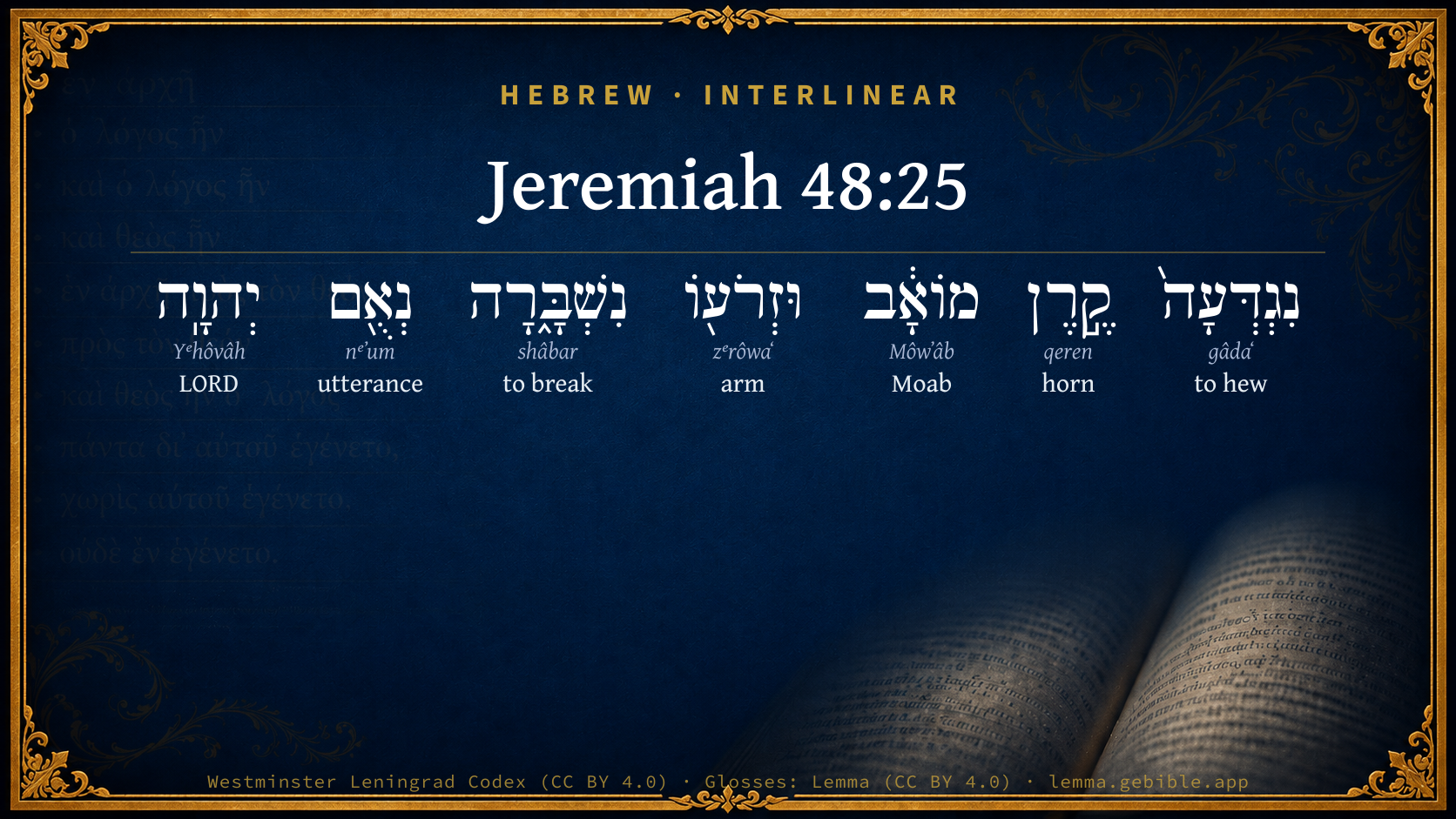
Jeremiah 48:25

Hebrew (Westminster Leningrad Codex) Jeremiah 48:25 appears in the Hebrew Old Testament. The text above is from the Westminster Leningrad Codex. Each word links to its Strong’s number, a concise gloss, and parsing drawn from the Open Scriptures Hebrew Bible morphology. Click any word for its full Brown-Driver-Briggs (BDB) entry.
Download image
Cite this verse

Jeremiah 48:25 (World English Bible). Public Domain. Lemma interlinear Bible study tool, https://lemma.gebible.app/v/jeremiah/48/25.

Show BibTeX & RIS
BibTeX
RIS
English Translation
The horn of Moab is cut off, and his arm is broken, says Yahweh.
World English Bible · Public Domain
Download a study sheet

One document with this verse’s original text, its word-by-word gloss line, the meaning frame, cross-references with their text, attributed commentary, and full source and license credits — printable, and it pastes into notes with its structure intact.

This verse Autodidact and up

Study sheet (.html) Plain text (.txt)

A passage Seminary Student

Up to 50 verses in one chapter. A passage sheet keeps up to 6 commentary sources and 12 cross-references per verse, in the order this page ranks them, and says so on the sheet whenever that leaves anything out. Ask for a single verse and you get the Autodidact verse sheet above.

Everything on this page stays free to read, with no account — the sheet is a download of what is already on screen, not access to it.

Want to remove ads? Support Godless Engineer
Compare translations 3

The same verse in 3 English versions, stacked beneath the original-language interlinear above. Click any original word for its lexicon entry.

Each is an independent rendering of the whole verse — the interlinear is not word-aligned to these translations.

Highlighted words mark where these versions differ — a whole-verse word diff, not a word-by-word alignment.

  • World English Bible Public Domain
    The horn of Moab is cut off, and his arm is broken, says Yahweh.
  • King James Version Public Domain
    The horn of Moab is cut off, and his arm is broken, saith the LORD.
  • unfoldingWord Literal Text CC BY-SA 4.0
    The horn of Moab has been hacked off; its arm has been broken—this is Yahweh’s declaration.

unfoldingWord Literal Text — © unfoldingWord, licensed CC BY-SA 4.0. Word-aligned USFM3 via Door43 (git.door43.org/unfoldingWord/en_ult).

Versions to compare (up to 4)

3 of 4 selected

Show all 18 translations

Every available English version of this verse, each an independent rendering of the whole verse.

  • World English Bible Public Domain
    The horn of Moab is cut off, and his arm is broken, says Yahweh.
  • Berean Standard Bible Public Domain
    The horn of Moab has been cut off, and his arm is broken,” declares the LORD.
  • Majority Standard Bible Public Domain
    The horn of Moab has been cut off, and his arm is broken,” declares the LORD.
  • King James Version Public Domain
    The horn of Moab is cut off, and his arm is broken, saith the LORD.
  • American Standard Version (1901) Public Domain
    The horn of Moab is cut off, and his arm is broken, saith Jehovah.
  • Revised Version (1885) Public Domain
    The horn of Moab is cut off, and his arm is broken, saith the LORD.
  • Geneva Bible (1599) Public Domain
    The horne of Moab is cut off, and his arme is broken, saith the Lord.
  • Douay-Rheims (1899) Public Domain
    The horn of Moab is cut off, and his arm is broken, saith the Lord.
  • Young's Literal Translation Public Domain
    Cut down hath been the horn of Moab, And his arm hath been broken, An affirmation of Jehovah.
  • Literal Standard Version CC BY-SA 4.0
    The horn of Moab has been cut down, || And his arm has been broken, || A declaration of YHWH.
  • Unlocked Literal Bible CC BY-SA 4.0
    The horn of Moab has been hacked off; its arm has been broken—this is Yahweh's declaration.
  • unfoldingWord Literal Text CC BY-SA 4.0
    The horn of Moab has been hacked off; its arm has been broken—this is Yahweh’s declaration.
  • Darby Bible Public Domain
    The horn of Moab is cut off, and his arm is broken, saith Jehovah.
  • World Messianic Bible Public Domain
    The horn of Moab is cut off, and his arm is broken,” says the LORD.
  • Webster's Bible Public Domain
    The horn of Moab is cut off, and his arm is broken, saith the LORD.
  • Free Bible Version CC BY-SA 4.0
    Moab's strength is gone; their power has been broken, declares the Lord.
  • Bible in Basic English Public Domain
    The horn of Moab is cut off, and his arm is broken, says the Lord.
  • JPS Tanakh (1917) Public Domain
    The horn of Moab is cut off, and his arm is broken, saith the LORD.

Literal Standard Version (2020), Covenant Press — licensed CC BY-SA 4.0. Text via the HelloAO Bible API (eBible.org). Unlocked Literal Bible (unfoldingWord) — licensed CC BY-SA 4.0. Text via the HelloAO Bible API (eBible.org). unfoldingWord Literal Text — © unfoldingWord, licensed CC BY-SA 4.0. Word-aligned USFM3 via Door43 (git.door43.org/unfoldingWord/en_ult). Free Bible Version, Dr. Jonathan Gallagher — licensed CC BY-SA 4.0. Text via the HelloAO Bible API (eBible.org).

Word by word

More ways to search: Search by grammar → Find every occurrence → Compare this word →

Practice this passage: Drill this verse → Learn its vocabulary →

About this verse

These counts appear in no published source. They are computed here, from the morphology-tagged text and Lemma’s own curated glosses. What Lemma adds →

7
words
7
distinct lemmas
Prophets
section

Notable vocabulary

The rarest word here is נִגְדְּעָה֙ to hew H1438 — appearing just 22 times in the whole Hebrew Bible.

Shared distinctive vocabulary

נִגְדְּעָה֙ to hew H1438 occurs in 22 verses of the Hebrew Bible. Also found in:

Grammatical profile

  • 2 verbs
  • 5 nouns

Verb forms

  • נִגְדְּעָה֙ Niphal · Perfect
  • נִשְׁבָּ֑רָה Niphal · Perfect

Cross-references

11

Topical passages linked to Jeremiah 48:25 in the Treasury of Scripture Knowledge — connected by theme and wording, ordered by reader-vote popularity; previews shown in the World English Bible.

  • Psalms 75:10 I will cut off all the horns of the wicked, But the horns of the righteous shall be lifted up.
  • Psalms 10:15 Break the arm of the wicked. As for the evil man, seek out his wickedness until you find none.
  • Job 22:9 You have sent widows away empty, And the arms of the fatherless have been broken.
  • Zechariah 1:19–21 I asked the angel who talked with me, "What are these?" He answered me, "These are the horns which have scattered Judah, Israel, and Jerusalem."
  • Numbers 32:37 The children of Reuben built Heshbon, and Elealeh, and Kiriathaim,
  • Psalms 37:17 For the arms of the wicked shall be broken, But Yahweh upholds the righteous.
  • Lamentations 2:3 He has cut off in fierce anger all the horn of Israel; He has drawn back his right hand from before the enemy: He has burned up Jacob like a flaming fire, which devours round about.
  • Ezekiel 30:21–25 Son of man, I have broken the arm of Pharaoh king of Egypt; and, behold, it has not been bound up, to apply [healing] medicines, to put a bandage to bind it, that it be strong to hold the sword.
  • Daniel 7:8 I considered the horns, and, behold, there came up among them another horn, a little one, before which three of the first horns were plucked up by the roots: and, behold, in this horn were eyes like the eyes of a man, and a mouth speaking great things.
  • Daniel 8:7–9 I saw him come close to the ram, and he was moved with anger against him, and struck the ram, and broke his two horns; and there was no power in the ram to stand before him; but he cast him down to the ground, and trampled on him; and there was none who could deliver the ram out of his hand.
  • Daniel 8:21 The rough male goat is the king of Greece: and the great horn that is between his eyes is the first king.

Cross-references courtesy of OpenBible.info (CC BY 4.0).

Hebrew and Greek witnesses Masoretic Hebrew ↔ Greek Septuagint

The same verse in the two great witnesses to the Old Testament, shown verse-for-verse.

These are two independent witnesses, not word-aligned to each other, and the Septuagint is shown in lemma (dictionary) form.

Hebrew Jeremiah 48:25 Masoretic · Westminster Leningrad Codex

נִגְדְּעָה֙ קֶ֣רֶן מוֹאָ֔ב וּזְרֹע֖וֹ נִשְׁבָּ֑רָה נְאֻ֖ם יְהוָֽה

The horn of Moab is cut off, and his arm is broken, says Yahweh.

World English Bible · Public Domain

Greek LXX Structure differs

In the Septuagint, Jeremiah is about an eighth shorter than the Hebrew and arranges its material differently — the Oracles Against the Nations (Hebrew chapters 46–51) appear in the middle of the Greek book, after 25:13. Because the chapter and verse boundaries do not line up, a verse-for-verse comparison with the Hebrew is not shown.

A verse-for-verse comparison isn’t shown here because the chapters and verses don’t line up. Switch to the LXX edition with the MT / LXX toggle above to read the Greek directly.

Hebrew: Westminster Leningrad Codex (CC BY 4.0). Greek: Septuagint (public domain); English from a public-domain English Septuagint. How the Septuagint differs from the Hebrew →

Targum (Aramaic paraphrase)

1

The Targum is the ancient Jewish Aramaic paraphrase of the Hebrew Scriptures — an interpretive translation, not the Hebrew text itself. Onkelos (literal) and Pseudo-Jonathan (expansive) render the Torah, and Jonathan the Prophets. Coverage is partial: where no permissively-licensed English translation exists for a verse, only the Aramaic is shown. This is verse-level text, not a word-by-word alignment to the Hebrew.

  1. Targum Jonathan Prophets (Joshua–Malachi)
    אִתְקַטְפַת מַלְכוּת מוֹאָב וְשִׁלְטָנֵיהוֹן אִתְּבָרוּ אֲמַר יְיָ:

    (no public-domain English translation for this verse)

    Targum Jonathan — Aramaic: “Mikraot Gedolot” (public domain). English: “Sefaria Community Translation” (CC0 1.0 (public-domain dedication)); “London "Chaldee Paraphrase," 1871” (public domain). Text via Sefaria.

Commentary

Notes on Jeremiah 48:25 from classic Christian and Jewish commentators (each source and its license shown beneath its notes). The classic Christian expositions comment on the surrounding passage and are grouped to its opening verse, so a note may address several verses; the Jewish commentaries on the Tanakh (Rashi and others) are per-verse, so they appear only where the commentator wrote on this verse.

Lemma curates 59 commentaries, every one of them public domain or Creative Commons licensed, each selected and text-cleaned for this edition rather than reprinted as found. About our sources →

Trapp's Complete Commentary

John Trapp

Jer 48:25 The horn of Moab is cut off, and his arm is broken, saith the LORD.

Ver. 25. The horn of Moab is cut off,] i.e., His strength, power, glory, kingdoms; his sultans and princes, saith the Chaldee.

John Trapp, A Commentary or Exposition upon All the Books of the Old and New Testament (1647–1656) — public domain. Text from a community e-Sword module.

The Biblical Illustrator

Joseph S. Exell

Jer_48:25

The horn of Moab is cut off.

The history of Moab

The first charge brought against Moab is self-confidence, self-trust, self-sufficiency (Jer_48:7). This makes us contemporaries of the Moabites. We thought they were an ancient people, but behold how human they are, how English, how like ourselves and our children! They were so pleased with the stone wall they had put up; they measured it, and admired it, and said that it would save them from the high wind and the mighty storm. It was enough--high enough, broad enough, impenetrable, invincible. Now that is the kind of reasoning which God will not allow in human life. He demands that human life be lived in Himself, and not in things that our own hands have made. We are to be taught distinctly that we do not live in ourselves; that in ourselves we have actually no life; that we have nothing that we have not received, and in that spirit alone we are to hold life and to live. It would seem to be easy to put our whole trust in the living God, and yet it is the most difficult of all lessons. We will persist, even in opposition to many theories of our own to the contrary, that we are self-contained, self-consisting, and self-managing; and herein arises Gods perpetual controversy with mankind. There is, too, so much to favour the temptation. It looks as if we could do most things; that as we have so much we might easily have more. God says to us in every days providence, You are here for a purpose; you are here for a little time; you now but begin to be; every lesson you must learn, and every commandment you must keep. It is against that arrangement that we chafe, just as the little child chafes against parental authority and loving restraint. From the history of Moab we see that even blessings may be perverted, and sacred privileges may be turned into occasions of self-destruction (Jer_48:11). Too much ease, too little upset, too little anxiety, too little trouble will kill any soul. To come into a business made to your hands, to have a fortune left you, and to have everything prearranged, is to be exposed to very peculiar and urgent temptation. Thank God for the rough places in your lives. They are unpleasant, but they are disciplinary. They are like steep hills, but remember that great temples and blessed sanctuaries stand at the top of them. When discipline is not endured gradually it is brought to bear upon the life as an overwhelming judgment. This is the burden of the text. Two classes of persons should consider this. First, those who have daily discipline; they should say, Better have discipline a little at, a time, as we are able to bear it. Whom the Lord loveth He chasteneth. No chastening for the present seemeth to be joyous, but grievous: nevertheless afterward it yieldeth the peaceable fruit of righteousness unto them which are exercised thereby. These daily chafings and frettings are nard to bear, these daily disappointments are sharp thorns thrust into the very eyes; yet who knows what the judgment would be were it all to come at once? I will rest in the Lord, and wait patiently for Him: no temptation has happened unto me but such as is common to men; by and by the explanation will come, and then I shall be able to say, He hath done all things well. Then the lesson should be well considered by those who seem to escape discipline of God. The volcano is a long time in gathering all its fiery energy, but the outburst is momentary, and who can measure the destruction which follows? Christ may well say, What I say unto one, I say unto all, Watch,--even those who have apparently least necessity to watch, should not relax their vigils for a moment. Let him that thinketh he standeth take heed lest he fall See how frightful m the humiliation to which God can bring a man or a people. Look at the picture of Moab--horn cut off, the arm broken, the man drunk but not with wine, and reeling in helplessness, the proud one wallowing in his vomit and laughed to derision! We cannot, however, rest here: for the mercy of the Lord endureth for ever. Mercy triumphs over judgment. The destruction, therefore, was not arbitrary, but moral, being based upon an assigned reason. Pride goeth before destruction, and an haughty spirit before a fall. We should say, therefore, that this verse was the concluding verse in the whole history of Moab. What can there be after destruction? With men this is impossible, but with God all things are possible. The chapter does not end with the forty-second verse, but with the forty-seventh, and this is how it reads, Yet will I bring again, &c. One would fain construe these words into a hopeful omen. Out of what extremities cannot God deliver mankind? Let the most desponding rekindle their hope, and the most distant prodigal hear his fathers voice. Who can set bounds to the mercy of God? Yet must there be no trifling, even with a Gospel of hope. (J. Parker, D. D.)

The Biblical Illustrator, edited by Joseph S. Exell (c. 1880s–1900s) — public domain. Text from a community e-Sword module.

Geneva Bible (1599)

Geneva Bible translators

That is, his power and strength.

Geneva Bible (1599) marginal notes — public domain. Text via Bolls.life.

Jamieson, Fausset & Brown

Robert Jamieson, A. R. Fausset & David Brown

horn--the emblem of strength and sovereignty: it is the horned animal's means of offense and defense (Psa 75:5, Psa 75:10; Lam 2:3).

Jamieson, Fausset & Brown — Commentary Critical and Explanatory on the Whole Bible (1871) — public domain (CC PDM 1.0). Text via the HelloAO Bible API.

Adam Clarke's Commentary

Verse 25. The horn of Moab is cut off, and his arm is broken] His political and physical powers are no more.

Adam Clarke's Commentary on the Bible (1810–1826) — public domain. Text from a community e-Sword/MySword module.

John Calvin's Commentaries

By another metaphor he expresses the same thing. By horn he means power, as all who are in any measure acquainted with Scripture well know that by this word is set forth power, strength, or any defense for the protection of a nation. He then says that the horn of Moab was cut off; and he adds afterwards as all explanation, that his strength was broken Hence by this second clause we understand what the Prophet meant when he said, that the horn of Moab was cut off. But he again introduces God as the speaker, because the Moabites thought that their horn could not be broken. As then Jeremiah would not have obtained credit, had he spoken in his own name, he again brought forward God as declaring his own words. It now follows, —

John Calvin's Commentaries (1540-1563) — public domain. Text from the Calvin Translation Society English edition (1840s-50s) via the Christian Classics Ethereal Library (ccel.org). Calvin's coverage is partial (roughly two-thirds of the Bible); uncommented books and verses are honest gaps, never fabricated. The 19th-century editor's footnotes and remarks are omitted so the notes are faithfully Calvin's own voice.

Ellicott's Commentary for English Readers

(25) The horn of Moab.—The horn of animals was naturally the symbol of their strength, and it was as natural that the symbolism should be extended to men and nations. (Comp. 1Sa_2:1; Psa_92:10; Lam_2:3; Dan_7:7-8; Luk_1:69.) The figure of the broken arm, powerless to grasp sword or sceptre, meets us again in Eze_30:21.

A Bible Commentary for English Readers, edited by Charles John Ellicott (1878–1897) — public domain. Text from a community e-Sword module.

The Cambridge Bible for Schools and Colleges

gen. ed. J. J. S. Perowne

25. The horn is an emblem of strength, the arm of authority. For the former see Psa_75:4-5; Psa_75:10, for the latter ch. Jer_17:5.

The Cambridge Bible for Schools and Colleges (gen. ed. J. J. S. Perowne; Cambridge University Press, 1878–1918) — public domain. Text from a community e-Sword module.

John Gill's Exposition

Make ye him drunken,.... Not with wine, but with the cup of divine wrath; with the vengeance of God; with sore judgments, afflictions, and calamities; give him his fill of them, till he is quite intoxicated with them, and has lost his senses, and is brought to madness and distraction, and reels, and staggers, and falls to the ground, like a drunken man; and his state and kingdom is quite ruined: this is said to the enemies of Moab, the king of Babylon and his army:

for he magnified himself against the Lord; made himself as great as he; yea, set himself above him; thought himself out of his reach; spoke proudly, haughtily, and contemptibly of him, and blasphemously against him, as if he could not deliver his people, or destroy his and their enemies. The Targum interprets it of the people of God, as in Zep 2:10; paraphrasing the words thus;

"bring distress upon them, that they may be like to drunken men; for against the people of the Lord have they magnified themselves:''

Moab also shall wallow in his vomit; as drunken men do: or, he shall "clap", or "dash (a) his hand in his vomit": dash his hands and feet against the ground as he lies in his vomit, as persons in such a condition do: or shall wring his hands, and clap them together for sorrow, being sick, and in distress. Some render it, "he shall clap the hand at Moab in his vomit" (b); men shall laugh at him as he lies wallowing in it, or rejoice at his fall and ruin; but this is expressed in the next clause:

and he also shall be in derision; as drunken men are; he shall be derided by others, as others have been derided by him; now it will be his turn.

(a) "plaudat", Junius & Tremellius, Cocceius; "plaudet", Piscator; "complodat", Munster, Tigurine version, Schmidt; "allidet", Lyranus. (b) "Complodet manus super Moabum jacentem in vomitu suo", Gataker.

John Gill's Exposition of the Whole Bible (1746–1763) — public domain (CC PDM 1.0). Text via the HelloAO Bible API.

Albert Barnes' Notes on the Bible

The horn - i. e., his pride (marginal reference); his arm, i. e., his strength Jer 17:5.

Albert Barnes' Notes on the Bible (1834–1885) — public domain. Text from a community e-Sword/MySword module.

Matthew Poole's English Annotations

That is, the beauty and the strength of Moab. So these two terms often signify in holy writ, the horn being much the beauty of some beasts, and that part of their bodies by which they both do injury to others, and defend themselves from the assaults of others. God here declares that Moab should both lose its glory and beauty, and also all the power it formerly had to defend itself, or offend others.

Matthew Poole's English Annotations on the Holy Bible (1683–1685) — public domain. Text from a community e-Sword/MySword module.

John Wesley's Explanatory Notes

The horn - That is the beauty and the strength of Moab.

John Wesley, Explanatory Notes Upon the Whole Bible (1754–1765) — public domain. Text via the GEBible commentary corpus.

Lesson kit

Teaching starters — assembled from the data on this page, not authored interpretation. Every prompt links to the verse data it draws on. Edit before teaching.

Jeremiah, in the Prophets, opens this verse with 7 words (7 distinct Hebrew lemmas). Its most distinctive word is gâdaʻ (“to hew”). A historical commentator’s framing appears above. Read the whole chapter for the surrounding context.

Discussion questions

  1. What does “to hew” (gâdaʻ) contribute to the verse as a whole?
  2. Deuteronomy 7:5 shares the word «to hew» with this verse. How do the two illuminate each other?
  3. These translations render this verse differently. What is at stake in choosing one wording over another?
  4. The verb «נִגְדְּעָה֙» is Niphal Perfect. How does its form color the action?
  5. Reading how Trapp's Complete Commentary and The Biblical Illustrator read this verse, where do the two commentators agree and where do they part?

Things to notice

Reading settings

Reading text

Shown beneath each verse's original-language words.

Old Testament
Old Testament edition

Read the OT as the Masoretic Hebrew (MT) or the Greek Septuagint (LXX).

English shown for the Greek Septuagint (in the Hebrew ↔ Greek comparison).

Comparing translations? Open the Compare panel on any verse page to stack up to four side by side.