Jeremiah 48:47

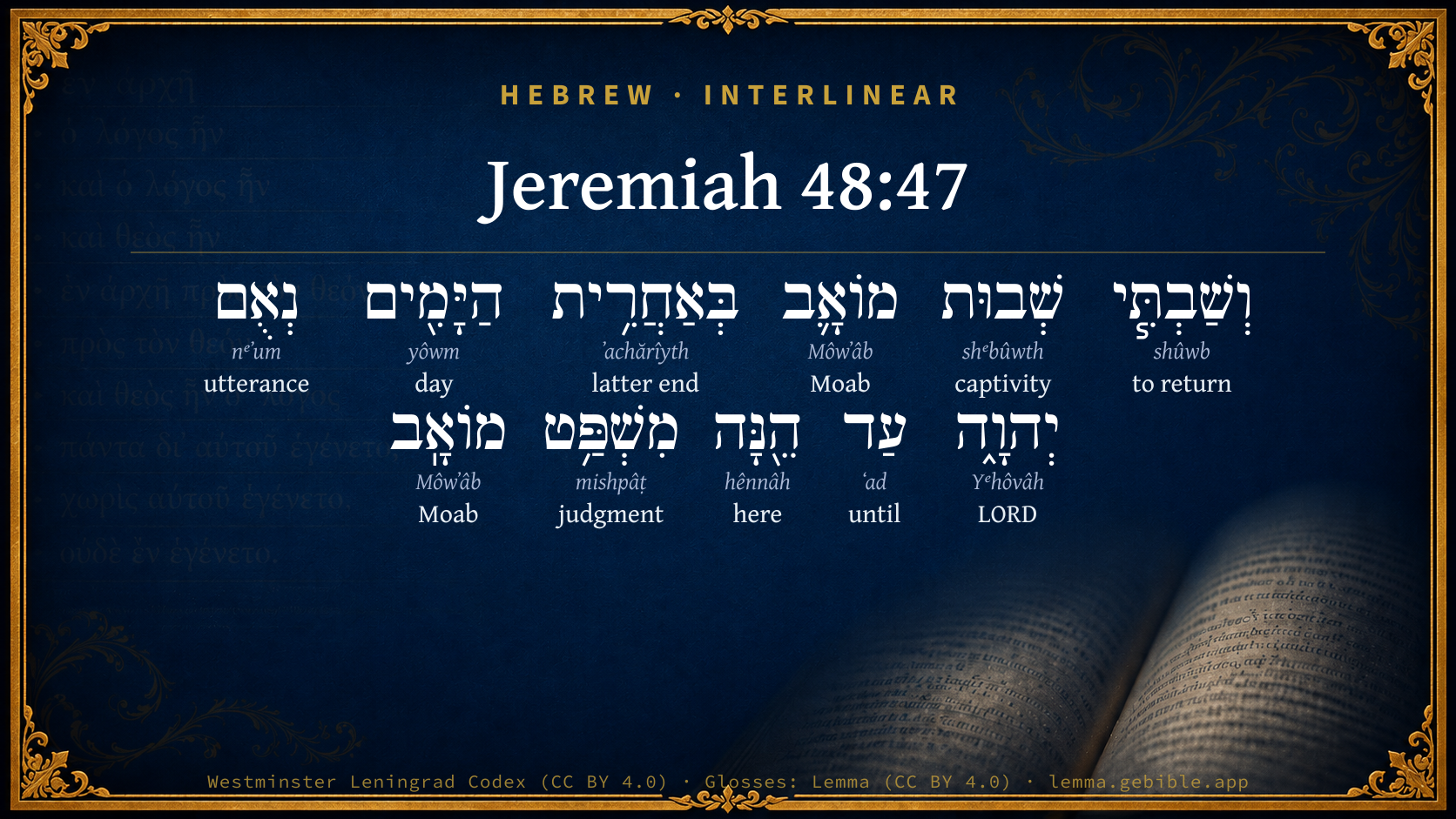
Hebrew (Westminster Leningrad Codex) Jeremiah 48:47 appears in the Hebrew Old Testament. The text above is from the Westminster Leningrad Codex. Each word links to its Strong’s number, a concise gloss, and parsing drawn from the Open Scriptures Hebrew Bible morphology. Click any word for its full Brown-Driver-Briggs (BDB) entry.
Download image
Cite this verse

Jeremiah 48:47 (World English Bible). Public Domain. Lemma interlinear Bible study tool, https://lemma.gebible.app/v/jeremiah/48/47.

Show BibTeX & RIS
BibTeX
RIS
English Translation
Yet will I bring back the captivity of Moab in the latter days, says Yahweh. Thus far is the judgment of Moab.
World English Bible · Public Domain
Download a study sheet

One document with this verse’s original text, its word-by-word gloss line, the meaning frame, cross-references with their text, attributed commentary, and full source and license credits — printable, and it pastes into notes with its structure intact.

This verse Autodidact and up

Study sheet (.html) Plain text (.txt)

A passage Seminary Student

Up to 50 verses in one chapter. A passage sheet keeps up to 6 commentary sources and 12 cross-references per verse, in the order this page ranks them, and says so on the sheet whenever that leaves anything out. Ask for a single verse and you get the Autodidact verse sheet above.

Everything on this page stays free to read, with no account — the sheet is a download of what is already on screen, not access to it.

Want to remove ads? Support Godless Engineer
Compare translations 3

The same verse in 3 English versions, stacked beneath the original-language interlinear above. Click any original word for its lexicon entry.

Each is an independent rendering of the whole verse — the interlinear is not word-aligned to these translations.

Highlighted words mark where these versions differ — a whole-verse word diff, not a word-by-word alignment.

  • World English Bible Public Domain
    Yet will I bring back the captivity of Moab in the latter days, says Yahweh. Thus far is the judgment of Moab.
  • King James Version Public Domain
    Yet will I bring again the captivity of Moab in the latter days, saith the LORD. Thus far is the judgment of Moab.
  • unfoldingWord Literal Text CC BY-SA 4.0
    But I will restore the fortunes of Moab in later days—this is Yahweh’s declaration.” The judgment on Moab ends here.

unfoldingWord Literal Text — © unfoldingWord, licensed CC BY-SA 4.0. Word-aligned USFM3 via Door43 (git.door43.org/unfoldingWord/en_ult).

Versions to compare (up to 4)

3 of 4 selected

Show all 18 translations

Every available English version of this verse, each an independent rendering of the whole verse.

  • World English Bible Public Domain
    Yet will I bring back the captivity of Moab in the latter days, says Yahweh. Thus far is the judgment of Moab.
  • Berean Standard Bible Public Domain
    Yet in the latter days I will restore Moab from captivity,” declares the LORD. Here ends the judgment on Moab.
  • Majority Standard Bible Public Domain
    Yet in the latter days I will restore Moab from captivity,” declares the LORD. Here ends the judgment on Moab.
  • King James Version Public Domain
    Yet will I bring again the captivity of Moab in the latter days, saith the LORD. Thus far is the judgment of Moab.
  • American Standard Version (1901) Public Domain
    Yet will I bring back the captivity of Moab in the latter days, saith Jehovah. Thus far is the judgment of Moab.
  • Revised Version (1885) Public Domain
    Yet will I bring again the captivity of Moab in the latter days, saith the LORD. Thus far is the judgment of Moab.
  • Geneva Bible (1599) Public Domain
    Yet will I bring againe the captiuitie of Moab in the latter dayes, sayeth the Lord. Thus farre of the iudgement of Moab.
  • Douay-Rheims (1899) Public Domain
    And I will bring back the captivity of Moab in the last days, saith the Lord. Hitherto the judgments of Moab.
  • Young's Literal Translation Public Domain
    And I have turned back `to' the captivity of Moab, In the latter end of the days, An affirmation of Jehovah! Hitherto `is' the judgment of Moab.
  • Literal Standard Version CC BY-SA 4.0
    And I have turned back [to] the captivity of Moab, || In the latter end of the days,” || A declaration of YHWH! “Until now [is] the judgment of Moab.”
  • Unlocked Literal Bible CC BY-SA 4.0
    But I will restore the fortunes of Moab in later days—this is Yahweh's declaration.” The judgment on Moab ends here.
  • unfoldingWord Literal Text CC BY-SA 4.0
    But I will restore the fortunes of Moab in later days—this is Yahweh’s declaration.” The judgment on Moab ends here.
  • Darby Bible Public Domain
    But I will turn the captivity of Moab at the end of the days, saith Jehovah. Thus far is the judgement of Moab.
  • World Messianic Bible Public Domain
    “Yet I will reverse the captivity of Moab in the latter days,” says the LORD. Thus far is the judgment of Moab.
  • Webster's Bible Public Domain
    Yet will I bring again the captivity of Moab in the latter days, saith the LORD. Thus far is the judgment of Moab.
  • Free Bible Version CC BY-SA 4.0
    But even so, later on, I will bring the people of Moab back from exile, declares the Lord. This is the end of the description of the judgment on Moab.
  • Bible in Basic English Public Domain
    But still, I will let the fate of Moab be changed in the last days, says the Lord.
  • JPS Tanakh (1917) Public Domain
    Yet will I turn the captivity of Moab in the end of days, saith the LORD. Thus far is the judgment of Moab.

Literal Standard Version (2020), Covenant Press — licensed CC BY-SA 4.0. Text via the HelloAO Bible API (eBible.org). Unlocked Literal Bible (unfoldingWord) — licensed CC BY-SA 4.0. Text via the HelloAO Bible API (eBible.org). unfoldingWord Literal Text — © unfoldingWord, licensed CC BY-SA 4.0. Word-aligned USFM3 via Door43 (git.door43.org/unfoldingWord/en_ult). Free Bible Version, Dr. Jonathan Gallagher — licensed CC BY-SA 4.0. Text via the HelloAO Bible API (eBible.org).

Word by word

More ways to search: Search by grammar → Find every occurrence → Compare this word →

Practice this passage: Drill this verse → Learn its vocabulary →

About this verse

These counts appear in no published source. They are computed here, from the morphology-tagged text and Lemma’s own curated glosses. What Lemma adds →

11
words
10
distinct lemmas
Prophets
section

Shared distinctive vocabulary

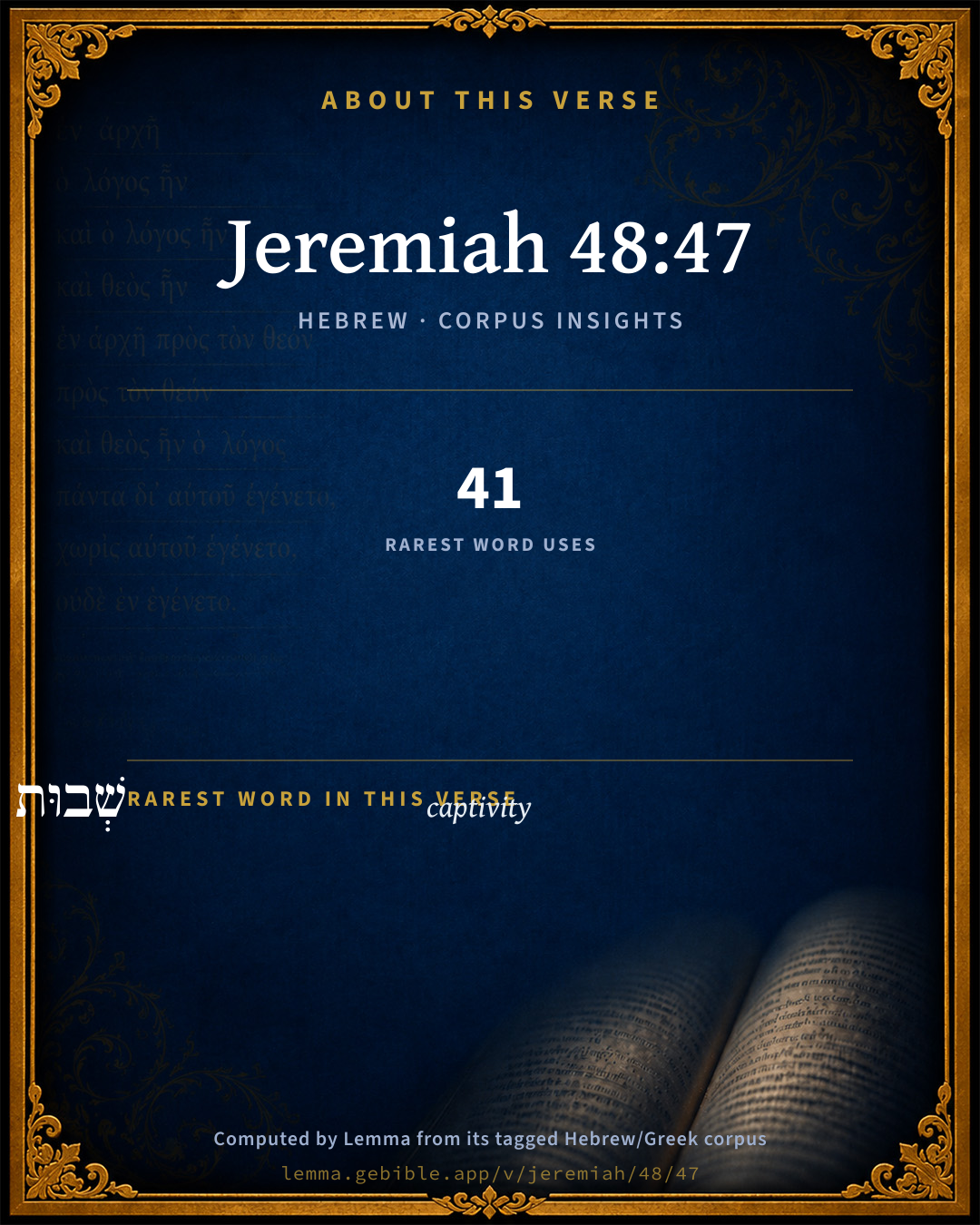
שְׁבוּת captivity H7622 occurs in 26 verses of the Hebrew Bible. Also found in:

Grammatical profile

  • 1 verb
  • 8 nouns
  • 1 preposition
  • 1 adverb

Verb forms

  • וְשַׁבְתִּ֧י Qal · Sequential Perfect

Repetition

A word recurs within this verse — often emphatic in Hebrew:

  • מוֹאָ֛ב Moab H4124 ×2

Cross-references

18

Topical passages linked to Jeremiah 48:47 in the Treasury of Scripture Knowledge — connected by theme and wording, ordered by reader-vote popularity; previews shown in the World English Bible.

  • Jeremiah 49:6 But afterward I will bring back the captivity of the children of Ammon, says Yahweh.
  • Jeremiah 49:39 But it shall happen in the latter days, that I will bring back the captivity of Elam, says Yahweh.
  • Numbers 24:14 Now, behold, I go to my people: come, [and] I will advertise you what this people shall do to your people in the latter days.
  • Deuteronomy 4:30 When you are in oppression, and all these things are come on you, in the latter days you shall return to Yahweh your God, and listen to his voice:
  • Deuteronomy 31:29 For I know that after my death you will utterly corrupt yourselves, and turn aside from the way which I have commanded you; and evil will happen to you in the latter days; because you will do that which is evil in the sight of Yahweh, to provoke him to anger through the work of your hands.
  • Job 19:25 But as for me, I know that my Redeemer lives. In the end, he will stand upon the earth.
  • Isaiah 18:7 In that time shall a present be brought to Yahweh of Hosts [from] a people tall and smooth, even from a people awesome from their beginning onward, a nation that measures out and treads down, whose land the rivers divide, to the place of the name of Yahweh of Hosts, Mount Zion.
  • Isaiah 19:18–23 In that day there shall be five cities in the land of Egypt that speak the language of Canaan, and swear to Yahweh of hosts; one shall be called The city of destruction.
  • Isaiah 23:18 Her merchandise and her hire shall be holiness to Yahweh: it shall not be treasured nor laid up; for her merchandise shall be for those who dwell before Yahweh, to eat sufficiently, and for durable clothing.
  • Jeremiah 12:15 It shall happen, after that I have plucked them up, I will return and have compassion on them; and I will bring them again, every man to his heritage, and every man to his land.
  • Jeremiah 23:20 The anger of Yahweh shall not return, until he has executed, and until he have performed the intents of his heart: in the latter days you shall understand it perfectly.
  • Jeremiah 30:24 The fierce anger of Yahweh shall not return, until he has executed, and until he have performed the intents of his heart: in the latter days you shall understand it.
  • Jeremiah 46:26 and I will deliver them into the hand of those who seek their lives, and into the hand of Nebuchadrezzar king of Babylon, and into the hand of his servants; and afterwards it shall be inhabited, as in the days of old, says Yahweh.
  • Ezekiel 16:53–55 I will turn again their captivity, the captivity of Sodom and her daughters, and the captivity of Samaria and her daughters, and the captivity of your captives in the midst of them;
  • Daniel 2:28 but there is a God in heaven who reveals secrets, and he has made known to the king Nebuchadnezzar what shall be in the latter days. Your dream, and the visions of your head on your bed, are these:
  • Daniel 10:14 Now I have come to make you understand what shall happen to your people in the latter days; for the vision is yet for [many] days:
  • Hosea 3:5 Afterward the children of Israel shall return, and seek Yahweh their God, and David their king, and shall come with trembling to Yahweh and to his blessings in the last days.
  • Ezekiel 38:8 After many days you shall be visited: in the latter years you shall come into the land that is brought back from the sword, that is gathered out of many peoples, on the mountains of Israel, which have been a continual waste; but it is brought forth out of the peoples, and they shall dwell securely, all of them.

Cross-references courtesy of OpenBible.info (CC BY 4.0).

Hebrew and Greek witnesses Masoretic Hebrew ↔ Greek Septuagint

The same verse in the two great witnesses to the Old Testament, shown verse-for-verse.

These are two independent witnesses, not word-aligned to each other, and the Septuagint is shown in lemma (dictionary) form.

Hebrew Jeremiah 48:47 Masoretic · Westminster Leningrad Codex

וְשַׁבְתִּ֧י שְׁבוּת מוֹאָ֛ב בְּאַחֲרִ֥ית הַיָּמִ֖ים נְאֻם יְהוָ֑ה עַד הֵ֖נָּה מִשְׁפַּ֥ט מוֹאָֽב

Yet will I bring back the captivity of Moab in the latter days, says Yahweh. Thus far is the judgment of Moab.

World English Bible · Public Domain

Greek LXX Structure differs

In the Septuagint, Jeremiah is about an eighth shorter than the Hebrew and arranges its material differently — the Oracles Against the Nations (Hebrew chapters 46–51) appear in the middle of the Greek book, after 25:13. Because the chapter and verse boundaries do not line up, a verse-for-verse comparison with the Hebrew is not shown.

A verse-for-verse comparison isn’t shown here because the chapters and verses don’t line up. Switch to the LXX edition with the MT / LXX toggle above to read the Greek directly.

On this verse, The Pulpit Commentary discusses the Septuagint’s reading. Read the note in Commentary ↓

Hebrew: Westminster Leningrad Codex (CC BY 4.0). Greek: Septuagint (public domain); English from a public-domain English Septuagint. How the Septuagint differs from the Hebrew →

Targum (Aramaic paraphrase)

1

The Targum is the ancient Jewish Aramaic paraphrase of the Hebrew Scriptures — an interpretive translation, not the Hebrew text itself. Onkelos (literal) and Pseudo-Jonathan (expansive) render the Torah, and Jonathan the Prophets. Coverage is partial: where no permissively-licensed English translation exists for a verse, only the Aramaic is shown. This is verse-level text, not a word-by-word alignment to the Hebrew.

  1. Targum Jonathan Prophets (Joshua–Malachi)
    וַאֲתֵיב גָלוּת מוֹאָב בְּסוֹף יוֹמַיָא אֲמַר יְיָ עַד הָכָא לְמֶעְבַּד פּוּרְעֲנוּת דִין מִן מוֹאָב:

    (no public-domain English translation for this verse)

    Targum Jonathan — Aramaic: “Mikraot Gedolot” (public domain). English: “Sefaria Community Translation” (CC0 1.0 (public-domain dedication)); “London "Chaldee Paraphrase," 1871” (public domain). Text via Sefaria.

Commentary

Notes on Jeremiah 48:47 from classic Christian and Jewish commentators (each source and its license shown beneath its notes). The classic Christian expositions comment on the surrounding passage and are grouped to its opening verse, so a note may address several verses; the Jewish commentaries on the Tanakh (Rashi and others) are per-verse, so they appear only where the commentator wrote on this verse.

Lemma curates 59 commentaries, every one of them public domain or Creative Commons licensed, each selected and text-cleaned for this edition rather than reprinted as found. About our sources →

Trapp's Complete Commentary

John Trapp

Jer 48:47 Yet will I bring again the captivity of Moab in the latter days, saith the LORD. Thus far [is] the judgment of Moab.

Ver. 47. Yet will I bring again the captivity of Moab.] Laetiora demum annuntiat. But because this was never that we find fulfilled in the letter, therefore it was a presage of the calling of the Gentiles to an interest in Christ, and benefit by him.

John Trapp, A Commentary or Exposition upon All the Books of the Old and New Testament (1647–1656) — public domain. Text from a community e-Sword module.

Joseph Benson's Commentary

Jer 48:47. Yet will I bring again the captivity of Moab — “The Moabites were afterward restored to their country, as appears from Josephus, Antiq. lib. 13. c. 17. But these and similar promises of mercy after judgment are chiefly to be understood of the conversion of the Gentiles under the gospel, called the latter days in the prophets. The conversion of idolaters is expressed by returning from their captivity, Eze 16:53.” — Lowth. See also Calmet’s Dissertation upon the return of the Moabites, &c.

Joseph Benson's Commentary on the Old and New Testaments (1811–1818) — public domain. Text from a community e-Sword module.

Tyndale Open Study Notes

Tyndale Open Resources

48:47 The Lord would have mercy on Moab; he promised that the people would prosper at some time in the future.

Tyndale Open Study Notes — © Tyndale Open Resources, licensed CC BY-SA 4.0. Text via the HelloAO Bible API.

Geneva Bible (1599)

Geneva Bible translators

That is, they shall be restored by the Messiah.

Geneva Bible (1599) marginal notes — public domain. Text via Bolls.life.

Jamieson, Fausset & Brown

Robert Jamieson, A. R. Fausset & David Brown

Restoration promised to Moab, for the sake of righteous Lot, their progenitor (Gen 19:37; Exo 20:6; Psa 89:30-33). Compare as to Egypt, Jer 46:26; Ammon, Jer 49:6; Elam, Jer 49:39. Gospel blessings, temporal and spiritual, to the Gentiles in the last days, are intended.

The event of the prophecy as to Ammon preceded that as to Moab (see on Jer 49:3); and in Eze 21:26-28, the destruction of Ammon is subjoined to the deposition of Zedekiah.

Next: Jeremiah Chapter 49

Jamieson, Fausset & Brown — Commentary Critical and Explanatory on the Whole Bible (1871) — public domain (CC PDM 1.0). Text via the HelloAO Bible API.

Adam Clarke's Commentary

Verse 47. Will I bring again the captivity of Moab in the latter days] I have already expressed doubts (see Jer 48:42) whether the Moabites were ever restored to their national distinction. The expressions in this chapter, relative to their total destruction as a people, are so strong and so frequent, that they leave little room for a limited interpretation. That many of them returned on the edict of Cyrus, by virtue of which the Jews were restored, I doubt not; but neither the Ammonites, Moabites, Philistines, nor even the Jews themselves, were ever restored to their national consequence. Perhaps the restoration spoken of here, which was to take place in the latter days, may mean the conversion of these people, in their existing remnants, to the faith of the Gospel. Several judicious interpreters are of this opinion. The Moabites were partially restored; but never, as far as I have been able to learn, to their national consequence. Their conversion to the Christian faith must be the main end designed by this prophecy.

Adam Clarke's Commentary on the Bible (1810–1826) — public domain. Text from a community e-Sword/MySword module.

John Calvin's Commentaries

Here, as we see, God gives place to his mercy, so that the Moabites should not wholly perish. At the same time, things which seem to be contrary agree together, even that destruction was nigh the people of Moab, and yet that some would remain alive, who would afterwards renew the name of the nation, as it was God’s purpose to restore the Moabites to their former state. These things, as I have said, seem inconsistent, and yet they may be easily reconciled; for it was God’s will so to destroy the Moabites, that those who died might not be without hope; and then, those who remained alive were not deemed to be among the living, but in exile they were like the dead. God, indeed, ever supported the godly with hope, even when they were driven into Babylon: but as to the Moabites, the living as well as the dead, had no hope. Why, then, was this promise given? not for the sake of the Moabites; but that the Jews might feel assured that God would at length be propitious to them; he promises pardon to the Moabites as it were accidentally, so to speak, and thus unavowedly stretches forth his hand to them, but with a design through this mercy to give to the Israelites a taste of his paternal favor. What remains we must reserve for the lecture tomorrow.

John Calvin's Commentaries (1540-1563) — public domain. Text from the Calvin Translation Society English edition (1840s-50s) via the Christian Classics Ethereal Library (ccel.org). Calvin's coverage is partial (roughly two-thirds of the Bible); uncommented books and verses are honest gaps, never fabricated. The 19th-century editor's footnotes and remarks are omitted so the notes are faithfully Calvin's own voice.

Ellicott's Commentary for English Readers

(47) Yet will I bring again . . .—This intermingling of the hope of a far-off return is specially characteristic of these later chapters, as in the case of the Ammonites (Jer_49:6) and Elam (Jer_49:39).

Thus far is the judgment of Moab.—This is very probably originally a note made by editor or transcriber to indicate the close of one section and the beginning of another. A like conclusion meets us in Jer_51:64.

A Bible Commentary for English Readers, edited by Charles John Ellicott (1878–1897) — public domain. Text from a community e-Sword module.

The Cambridge Bible for Schools and Colleges

gen. ed. J. J. S. Perowne

47. bring again] See on Jer_46:26 for possible genuineness.

Thus far … Moab] an editor’s insertion.

The Cambridge Bible for Schools and Colleges (gen. ed. J. J. S. Perowne; Cambridge University Press, 1878–1918) — public domain. Text from a community e-Sword module.

Albert Barnes' Notes on the Bible

Bring again the captivity - (Or, “restore the prosperity.”) A similar promise is given to Egypt, Ammon, and Elam Jer 46:26; Jer 49:6.

Thus far ... Moab - An editorial note by the same hand as the last words of Jer 51:64.

Albert Barnes' Notes on the Bible (1834–1885) — public domain. Text from a community e-Sword/MySword module.

Haydock's Catholic Bible Commentary

Days. When they, Elam and the other Gentiles, shall be converted to the faith of Christ. We read of no other bringing back, (Worthington) though it might take place. (Haydock)

George Leo Haydock (1774–1849), Haydock's Catholic Family Bible and Commentary, 1859 edition — public domain. Excludes Psalms (Douay-Rheims chapter numbering differs from Protestant) and Deuterocanonical books (Catholic canon only).

Matthew Poole's English Annotations

Some think this prophecy was fulfilled upon the return of the Jews out of Babylon, when the Jews inhabited the land of Moab, Zep 2:9; but this doth not seem to be the bringing again the captivity of Moab, but of Judah; besides, in that place it is said that Moab should be as Sodom, and the children of Ammon as Gomorrah, even the breeding of nettles, and salt-pits, and a perpetual desolation. It is therefore rather to be understood of a spiritual reduction of them, by calling some of them under the kingdom of the Messiah, as the Jewish doctors themselves interpret it. Some think this a promise rather respecting the Jews than the Moabites; it is said, Jer 48:9, that the remnant of the Lord’s people should possess Moab; and, Jer 48:11, that all the isles of the heathen should worship God.

Thus far is the judgment of Moab: these last words are doubtless to be interpreted rather as a conclusion of this prophecy against Moab, than (as some would have it) as a limitation of the time how long this judgment on Moab should endure, as if thus far were as much as thus long.

Matthew Poole's English Annotations on the Holy Bible (1683–1685) — public domain. Text from a community e-Sword/MySword module.

The Pulpit Commentary

On the phraseology of this verse (omitted in the Septuagint), Jer_29:14 Jer_23:20, and on the brighter prospect held out for Moab, see the analogies given in note on Jer_46:26. Thus far is the judgment of Moab is clearly an editor"s note. (comp. Jer_51:64) "Judgment" as in ver. 21.

The Pulpit Commentary (1880–1919), ed. H.D.M. Spence-Jones & Joseph S. Exell — public domain. Text from a community e-Sword module.

John Wesley's Explanatory Notes

Bring again - It seems this is to be understood of a spiritual reduction of them, by calling them into the kingdom of the Messiah.

John Wesley, Explanatory Notes Upon the Whole Bible (1754–1765) — public domain. Text via the GEBible commentary corpus.

Lesson kit

Teaching starters — assembled from the data on this page, not authored interpretation. Every prompt links to the verse data it draws on. Edit before teaching.

Jeremiah, in the Prophets, opens this verse with 11 words (10 distinct Hebrew lemmas). Its most distinctive word is shᵉbûwth (“captivity”). A historical commentator’s framing appears above. Read the whole chapter for the surrounding context.

Discussion questions

  1. What does “captivity” (shᵉbûwth) contribute to the verse as a whole?
  2. Deuteronomy 30:3 shares the word «captivity» with this verse. How do the two illuminate each other?
  3. “Moab” occurs 2× in this one verse. What is the effect of the repetition?
  4. The translations on this page render this verse differently — a whole-verse word diff, not a word-by-word alignment. What might account for the different wordings?
  5. The verb «וְשַׁבְתִּ֧י» is Qal Sequential Perfect. How does its form color the action?
  6. Reading how Trapp's Complete Commentary and Joseph Benson's Commentary read this verse, where do the two commentators agree and where do they part?

Things to notice

Reading settings

Reading text

Shown beneath each verse's original-language words.

Old Testament
Old Testament edition

Read the OT as the Masoretic Hebrew (MT) or the Greek Septuagint (LXX).

English shown for the Greek Septuagint (in the Hebrew ↔ Greek comparison).

Comparing translations? Open the Compare panel on any verse page to stack up to four side by side.