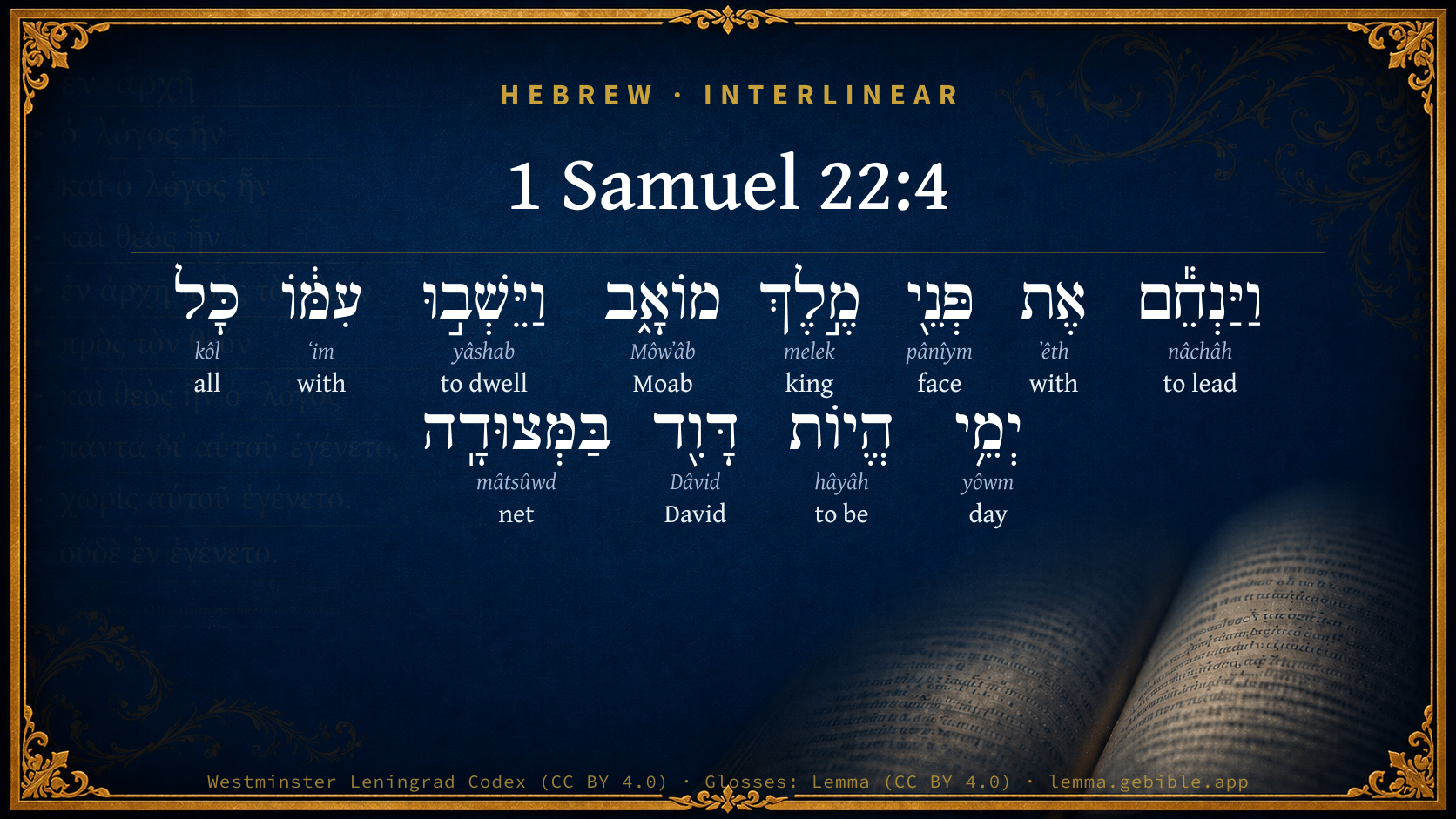
1 Samuel 22:4

Hebrew (Westminster Leningrad Codex) 1 Samuel 22:4 appears in the Hebrew Old Testament. The text above is from the Westminster Leningrad Codex. Each word links to its Strong’s number, a concise gloss, and parsing drawn from the Open Scriptures Hebrew Bible morphology. Click any word for its full Brown-Driver-Briggs (BDB) entry.
Download image
Cite this verse

1 Samuel 22:4 (World English Bible). Public Domain. Lemma interlinear Bible study tool, https://lemma.gebible.app/v/1-samuel/22/4.

Show BibTeX & RIS
BibTeX
RIS
English Translation
He brought them before the king of Moab: and they lived with him all the while that David was in the stronghold.
World English Bible · Public Domain
Highlights
  • 1 first appearance in the Hebrew Bible
Full analysis ↓
Download a study sheet

One document with this verse’s original text, its word-by-word gloss line, the meaning frame, cross-references with their text, attributed commentary, and full source and license credits — printable, and it pastes into notes with its structure intact.

This verse Autodidact and up

Study sheet (.html) Plain text (.txt)

A passage Seminary Student

Up to 50 verses in one chapter. A passage sheet keeps up to 6 commentary sources and 12 cross-references per verse, in the order this page ranks them, and says so on the sheet whenever that leaves anything out. Ask for a single verse and you get the Autodidact verse sheet above.

Everything on this page stays free to read, with no account — the sheet is a download of what is already on screen, not access to it.

Want to remove ads? Support Godless Engineer
Compare translations 3

The same verse in 3 English versions, stacked beneath the original-language interlinear above. Click any original word for its lexicon entry.

Each is an independent rendering of the whole verse — the interlinear is not word-aligned to these translations.

Highlighted words mark where these versions differ — a whole-verse word diff, not a word-by-word alignment.

  • World English Bible Public Domain
    He brought them before the king of Moab: and they lived with him all the while that David was in the stronghold.
  • King James Version Public Domain
    And he brought them before the king of Moab: and they dwelt with him all the while that David was in the hold.
  • unfoldingWord Literal Text CC BY-SA 4.0
    And he led them to the face of the king of Moab. And they stayed with him all of the days of David being in the stronghold.

unfoldingWord Literal Text — © unfoldingWord, licensed CC BY-SA 4.0. Word-aligned USFM3 via Door43 (git.door43.org/unfoldingWord/en_ult).

Versions to compare (up to 4)

3 of 4 selected

Show all 18 translations

Every available English version of this verse, each an independent rendering of the whole verse.

  • World English Bible Public Domain
    He brought them before the king of Moab: and they lived with him all the while that David was in the stronghold.
  • Berean Standard Bible Public Domain
    So he left them in the care of the king of Moab, and they stayed with him the whole time David was in the stronghold.
  • Majority Standard Bible Public Domain
    So he left them in the care of the king of Moab, and they stayed with him the whole time David was in the stronghold.
  • King James Version Public Domain
    And he brought them before the king of Moab: and they dwelt with him all the while that David was in the hold.
  • American Standard Version (1901) Public Domain
    And he brought them before the king of Moab: and they dwelt with him all the while that David was in the stronghold.
  • Revised Version (1885) Public Domain
    And he brought them before the king of Moab: and they dwelt with him all the while that David was in the hold.
  • Geneva Bible (1599) Public Domain
    And he brought them before the King of Moab, and they dwelt with him all the while that Dauid was in the holde.
  • Douay-Rheims (1899) Public Domain
    And he left them under the eyes of the king of Moab, and they abode with him all the days that David was in the hold.
  • Young's Literal Translation Public Domain
    and he leadeth them before the king of Moab, and they dwell with him all the days of David's being in the fortress.
  • Literal Standard Version CC BY-SA 4.0
    and he leads them before the king of Moab, and they dwell with him all the days of David’s being in the fortress.
  • Unlocked Literal Bible CC BY-SA 4.0
    He left them with the king of Moab. His father and mother stayed with him the whole time that David was in his stronghold.
  • unfoldingWord Literal Text CC BY-SA 4.0
    And he led them to the face of the king of Moab. And they stayed with him all of the days of David being in the stronghold.
  • Darby Bible Public Domain
    And he brought them before the king of Moab; and they abode with him all the while that David was in the stronghold.
  • World Messianic Bible Public Domain
    He brought them before the king of Moab; and they lived with him all the time that David was in the stronghold.
  • Webster's Bible Public Domain
    And he brought them before the king of Moab: and they dwelt with him all the while that David was in the hold.
  • Free Bible Version CC BY-SA 4.0
    So he left them with the king of Moab, and they stayed with the king all the time David lived in the stronghold.
  • Bible in Basic English Public Domain
    And he took them to the king of Moab and they went on living with him while David was in his safe place.
  • JPS Tanakh (1917) Public Domain
    And he brought them before the king of Moab; and they dwelt with him all the while that David was in the stronghold.

Literal Standard Version (2020), Covenant Press — licensed CC BY-SA 4.0. Text via the HelloAO Bible API (eBible.org). Unlocked Literal Bible (unfoldingWord) — licensed CC BY-SA 4.0. Text via the HelloAO Bible API (eBible.org). unfoldingWord Literal Text — © unfoldingWord, licensed CC BY-SA 4.0. Word-aligned USFM3 via Door43 (git.door43.org/unfoldingWord/en_ult). Free Bible Version, Dr. Jonathan Gallagher — licensed CC BY-SA 4.0. Text via the HelloAO Bible API (eBible.org).

Word by word

More ways to search: Search by grammar → Find every occurrence → Compare this word →

Practice this passage: Drill this verse → Learn its vocabulary →

בַּמְּצוּדָֽה
mâtsûwd
H4686
“in/at the · net”
Preposition, Determined + Noun, Common, Both, Singular, Absolute
Part of Speech
Preposition + Noun
Type
Common
Gender
Both
Number
Singular
State
Absolute
Full BDB Definition

Origin: for H4685

TWOT: 1885g , 1885i

net, prey, net prey - net - prey - fastness, stronghold
  1. וַיַּנְחֵ֕ם nâchâh H5148 “and · to lead · them” Conjunction + Verb, Hiphil, Sequential Imperfect, 3rd Person, Masculine, Singular + Suffix, Personal, 3rd Person, Masculine, Plural
  2. אֶת ʼêth H854 “with” Preposition
  3. פְּנֵ֖י pânîym H6440 “face(s) of” Noun, Common, Both, Plural, Construct
  4. מֶ֣לֶךְ melek H4428 “king of” Noun, Common, Masculine, Singular, Construct
  5. מוֹאָ֑ב Môwʼâb H4124 “Moab” Noun, Proper
  6. וַיֵּשְׁב֣וּ yâshab H3427 “and · to dwell” Conjunction + Verb, Qal, Sequential Imperfect, 3rd Person, Masculine, Plural
  7. עִמּ֔וֹ ʻim H5973 “with · him” Preposition + Suffix, Personal, 3rd Person, Masculine, Singular
  8. כָּל kôl H3605 “all of” Noun, Common, Masculine, Singular, Construct
  9. יְמֵ֥י yôwm H3117 “days of” Noun, Common, Masculine, Plural, Construct
  10. הֱיוֹת hâyâh H1961 “to be” Verb, Qal, Infinitive Construct
  11. דָּוִ֖ד Dâvid H1732 “David” Noun, Proper

About this verse

These counts appear in no published source. They are computed here, from the morphology-tagged text and Lemma’s own curated glosses. What Lemma adds →

12
words
12
distinct lemmas
Historical
section

Notable vocabulary

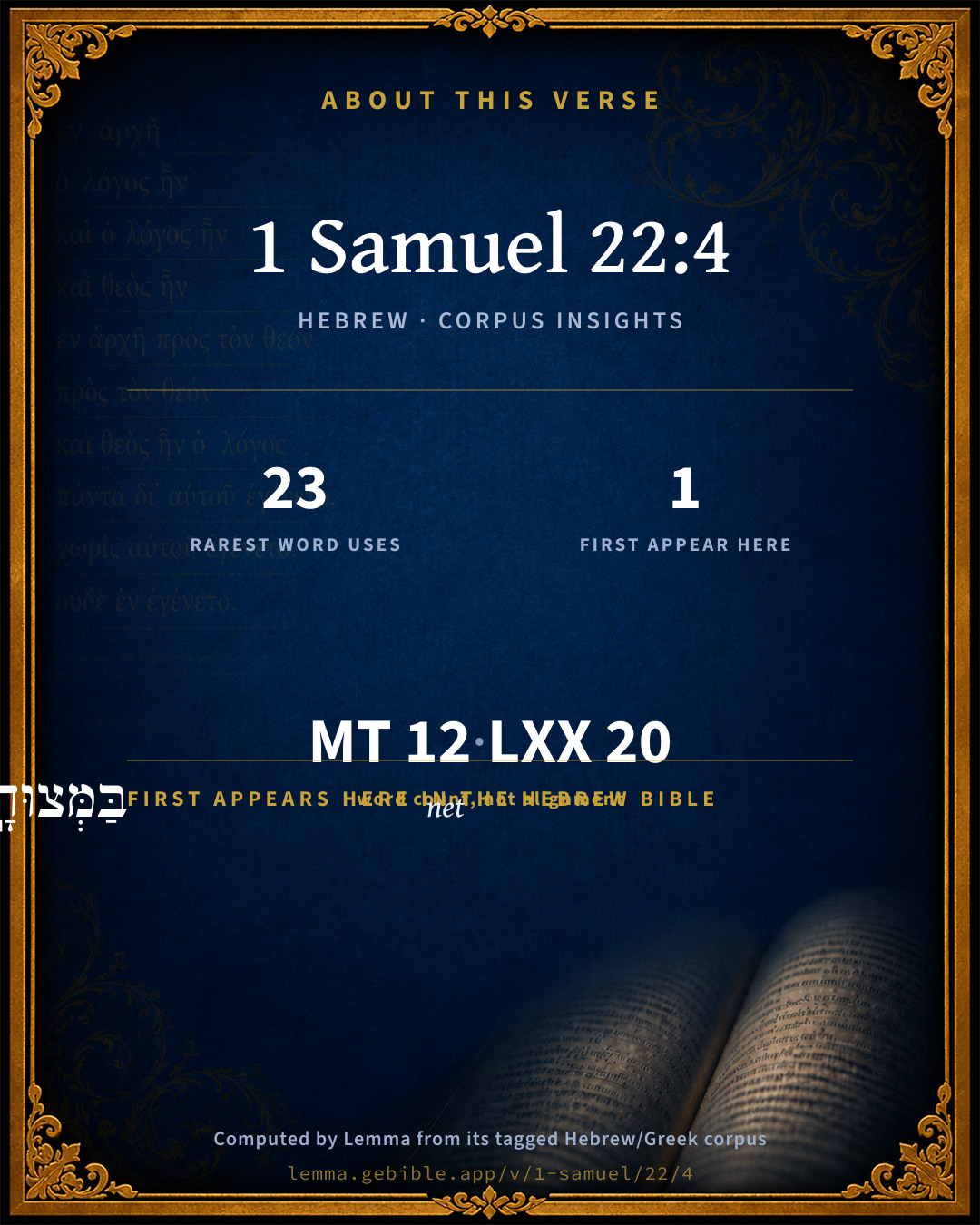
The rarest word here is בַּמְּצוּדָֽה net H4686 — appearing just 23 times in the whole Hebrew Bible.

First appearance in Scripture

This word makes its first canonical appearance in the Hebrew Bible here:

  • בַּמְּצוּדָֽה net H4686

Shared distinctive vocabulary

בַּמְּצוּדָֽה net H4686 occurs in 23 verses of the Hebrew Bible. Also found in:

Grammatical profile

  • 3 verbs
  • 7 nouns
  • 2 prepositions

Verb forms

  • וַיַּנְחֵ֕ם Hiphil · Sequential Imperfect
  • וַיֵּשְׁב֣וּ Qal · Sequential Imperfect
  • הֱיוֹת Qal · Infinitive Construct

Hebrew & Septuagint length

In English translation the verse runs 22 words from the Hebrew and 19 from the Septuagint (LXX English) — closely comparable.

A rough comparison of the two English renderings, which tokenize alike — not a word-level alignment.

Word counts can differ between the Hebrew and the Greek without any difference in meaning — e.g. the Hebrew direct-object marker אֵת has no separate Greek word, and Greek often adds the article ὁ.

In the original languages it is 12 Hebrew tokens and 20 Greek tokens — but the two are counted differently (Hebrew bundles its prefixes and suffixes into one token; the Greek is in lemma form), so that isn’t a like-for-like length.

Cross-references

11

Topical passages linked to 1 Samuel 22:4 in the Treasury of Scripture Knowledge — connected by theme and wording, ordered by reader-vote popularity; previews shown in the World English Bible.

  • Psalms 11:1 In Yahweh, I take refuge. How can you say to my soul, "Flee as a bird to your mountain!"
  • 1 Samuel 23:1–6 They told David, saying, Behold, the Philistines are fighting against Keilah, and are robbing the threshing floors.
  • 2 Samuel 23:13–14 Three of the thirty chief men went down, and came to David in the harvest time to the cave of Adullam; and the troop of the Philistines was encamped in the valley of Rephaim.
  • 2 Samuel 24:11 When David rose up in the morning, the word of Yahweh came to the prophet Gad, David's seer, saying,
  • 1 Chronicles 12:16 There came of the children of Benjamin and Judah to the stronghold to David.
  • 1 Chronicles 21:9 Yahweh spoke to Gad, David's seer, saying,
  • 1 Chronicles 29:29 Now the acts of David the king, first and last, behold, they are written in the history of Samuel the seer, and in the history of Nathan the prophet, and in the history of Gad the seer,
  • 2 Chronicles 29:25 He set the Levites in the house of Yahweh with cymbals, with psalteries, and with harps, according to the commandment of David, and of Gad the king's seer, and Nathan the prophet; for the commandment was of Yahweh by his prophets.
  • Nehemiah 6:11 I said, Should such a man as I flee? and who is there that, being such as I, would go into the temple to save his life? I will not go in.
  • Isaiah 8:12–14 Don't you say, "A conspiracy!" concerning all about which this people shall say, "A conspiracy!" neither fear their fear, nor be in dread [of it].
  • Matthew 10:23 But when they persecute you in this city, flee into the next, for most assuredly I tell you, you will not have gone through the cities of Israel, until the Son of Man has come.

Cross-references courtesy of OpenBible.info (CC BY 4.0).

Hebrew and Greek witnesses Masoretic Hebrew ↔ Greek Septuagint

The same verse in the two great witnesses to the Old Testament, shown verse-for-verse.

These are two independent witnesses, not word-aligned to each other, and the Septuagint is shown in lemma (dictionary) form.

Hebrew 1 Samuel 22:4 Masoretic · Westminster Leningrad Codex

וַיַּנְחֵ֕ם אֶת פְּנֵ֖י מֶ֣לֶךְ מוֹאָ֑ב וַיֵּשְׁב֣וּ עִמּ֔וֹ כָּל יְמֵ֥י הֱיוֹת דָּוִ֖ד בַּמְּצוּדָֽה

He brought them before the king of Moab: and they lived with him all the while that David was in the stronghold.

World English Bible · Public Domain

Greek LXX 1 Samuel 22:4 Septuagint · lemma form

καί παρακαλέω ὁ πρόσωπον ὁ βασιλεύς μωαβ καί καταοἰκέω μετά αὐτός πᾶς ὁ ἡμέρα εἰμί ὁ δαυίδ ἐν ὁ περιοχή

And he persuaded the King of Moab, and they dwell with him continually, while David was in the hold.

LXX2012 (modern English Septuagint) · Public Domain

On this verse, Albert Barnes' Notes on the Bible discusses the Septuagint’s reading. Read the note in Commentary ↓

Hebrew: Westminster Leningrad Codex (CC BY 4.0). Greek: Septuagint (public domain); English from LXX2012 (modern English Septuagint) (Public Domain). How the Septuagint differs from the Hebrew →

Targum (Aramaic paraphrase)

1

The Targum is the ancient Jewish Aramaic paraphrase of the Hebrew Scriptures — an interpretive translation, not the Hebrew text itself. Onkelos (literal) and Pseudo-Jonathan (expansive) render the Torah, and Jonathan the Prophets. Coverage is partial: where no permissively-licensed English translation exists for a verse, only the Aramaic is shown. This is verse-level text, not a word-by-word alignment to the Hebrew.

  1. Targum Jonathan Prophets (Joshua–Malachi)
    וְאַשְׁרִינוּן קֳדָם מַלְכָּא דְמוֹאָב וִיתִיבוּ עִמֵיהּ כָּל יוֹמִין דַהֲוָה דָוִד מִטְמַר בַמְצוּדַיָא:

    (no public-domain English translation for this verse)

    Targum Jonathan — Aramaic: “Mikraot Gedolot” (public domain). English: “Sefaria Community Translation” (CC0 1.0 (public-domain dedication)); “London "Chaldee Paraphrase," 1871” (public domain). Text via Sefaria.

Commentary

Notes on 1 Samuel 22:4 from classic Christian and Jewish commentators (each source and its license shown beneath its notes). The classic Christian expositions comment on the surrounding passage and are grouped to its opening verse, so a note may address several verses; the Jewish commentaries on the Tanakh (Rashi and others) are per-verse, so they appear only where the commentator wrote on this verse.

Lemma curates 59 commentaries, every one of them public domain or Creative Commons licensed, each selected and text-cleaned for this edition rather than reprinted as found. About our sources →

Trapp's Complete Commentary

John Trapp

1Sa 22:4 And he brought them before the king of Moab: and they dwelt with him all the while that David was in the hold.

Ver. 4. And he brought them before the king of Moab.] To whom Jesse, a grave godly man, might haply be as useful and as dear as Solon was to Croesus, or Croesus afterwards to King Cyrus; by whose good counsel he was more enriched and benefited than by all his wealth.

That David was in the hold.] In the cave of Adullam, or, as others think, in Mizpeh of Moab. See 1Sa 22:3.

John Trapp, A Commentary or Exposition upon All the Books of the Old and New Testament (1647–1656) — public domain. Text from a community e-Sword module.

Joseph Benson's Commentary

1Sa 22:4. All the while David was in the hold — In holds; the singular number being put for the plural, as is frequent; that is, as long as David was forced to go from place to place, and from hold to hold, to secure himself; for it concerned David especially to secure his father, and he did doubtless secure him for all that time; and not only while he was in the hold of Mizpeh, or of Adullam, which was but a little while.

Joseph Benson's Commentary on the Old and New Testaments (1811–1818) — public domain. Text from a community e-Sword module.

Geneva Bible (1599)

Geneva Bible translators

That is, in Mizpah, which was a stronghold.

For he feared the rage of Saul against his house.

Geneva Bible (1599) marginal notes — public domain. Text via Bolls.life.

Ellicott's Commentary for English Readers

(4) While that David was in the hold.—This “hold” is, of course, identical with the “hold” of 1Sa_22:5, from which Gad the prophet directs David to depart, and to return into the land of Judah. It was, most likely, in the Land of Moab.

A Bible Commentary for English Readers, edited by Charles John Ellicott (1878–1897) — public domain. Text from a community e-Sword module.

The Cambridge Bible for Schools and Colleges

gen. ed. J. J. S. Perowne

4. in the hold] “Hold” = stronghold or fortress: here apparently the Mizpeh of 1Sa_22:3. What became of David’s parents when he quitted the hold does not appear. A Jewish tradition affirms that the king of Moab betrayed his trust and murdered them, for which David exacted a heavy vengeance when he came to the throne (2Sa_8:2).

The Cambridge Bible for Schools and Colleges (gen. ed. J. J. S. Perowne; Cambridge University Press, 1878–1918) — public domain. Text from a community e-Sword module.

John Gill's Exposition

And he brought them before the king of Moab,.... Having leave from him for it, and left them with him; so the Targum,"caused them to remain before him:"

and they dwelt with him all the whole time that David was in the hold; either in the cave of Adullam, as some think; or rather at Mizpeh in Moab, which might be a fortified place; or the sense may be, while he was in any hold in those parts, as he might go from one to another; what became of David's parents afterwards, we nowhere else read. The Jews (z) say the king of Moab slew his father and his mother, and his brethren, all but one, whom Nahash the Ammonite preserved; and is the kindness David speaks of, Sa2 10:2; and if this was the case, now it was that his father and mother forsook him, and God took him up, Psa 27:10.

(z) Bemnidbar Rabba, sect. 14. fol. 212. 1. Tanchuma apud Jarchium in loc.

John Gill's Exposition of the Whole Bible (1746–1763) — public domain (CC PDM 1.0). Text via the HelloAO Bible API.

Albert Barnes' Notes on the Bible

He brought them before ... - The Septuagint renders it “he persuaded (the face of) the king.”

In the hold - Where David was after he left the cave of Adullam, probably in the land of Moab.

The phrase “all the while,” would indicate that David sojourned a considerable time in Moab.

Albert Barnes' Notes on the Bible (1834–1885) — public domain. Text from a community e-Sword/MySword module.

Haydock's Catholic Bible Commentary

The hold. The strong hold, or fortress of Maspha. (Challoner) --- It signifies "a watch-tower." (Haydock) --- In this place the parents of David probably finished their days, as we find no farther mention of them. (Salien)

George Leo Haydock (1774–1849), Haydock's Catholic Family Bible and Commentary, 1859 edition — public domain. Excludes Psalms (Douay-Rheims chapter numbering differs from Protestant) and Deuterocanonical books (Catholic canon only).

Matthew Poole's English Annotations

Before the king of Moab; into his presence, that he might see them, and give them leave to dwell in his dominion.

In the hold; either,

1. In Mizpeh of Moab, which was a very strong hold. But it is apparent he speaks of some hold where his father and mother were exposed to fear and danger from Saul, which they were not in the king of Moab’s royal city. Or,

2. In the cave of Adullam, mentioned above, 1Sa 22:1. Or,

3. In holes; the singular number being put for the plural, as is frequent; i.e. as long as David was forced to go from place to place, and from hold to hold, to secure himself; for it concerned David to secure his father, and he did doubtless secure him for all that time; and not only whilst he was in the hold of Mizpeh, or of Adullam, which was but a little while.

Matthew Poole's English Annotations on the Holy Bible (1683–1685) — public domain. Text from a community e-Sword/MySword module.

Whedon's Commentary on the Bible

Daniel D. Whedon

4. The hold — מצודה, a stronghold, a fortress, or citadel. The reference is to some fortified place at Mizpeh, where David and his company abode during their stay in the land of Moab. See note on next verse. This is the last we hear of David’s father and mother; but an old Jewish tradition has it, that after David returned to the land of Judah his parents and brothers were put to death by the king of Moab.

Daniel D. Whedon (gen. ed.), Commentary on the Old and New Testaments (1874–1909) — public domain. Text from a community e-Sword module.

The Pulpit Commentary

Ver. 4. (MOAB.)

Awaiting the future.

I know what God will do to me." There are times when our thoughts naturally turn toward the future: the commencement of a fresh enterprise or a new season, suspense in sickness, the approach of critical events, especially when they lie beyond our control or even our probable conjecture. At such times this is the appropriate language of a good man. He awaits it in

I UNCERTAINTY about the events of the future new positions, opportunities, advantages, trials, duties. "We know not with what we must serve the Lord until we come thither". (Exo_10:26) "Ye have not passed this way heretofore", (Jos_3:4) and cannot tell what may befall you therein. "Shadows, clouds, and darkness rest upon it." But the good man is not distracted by curiosity or anxiety, inasmuch as

1. Neither is of any avail.

2. The Father has reserved the times and the seasons "in his own power". (Act_1:7)

3. And he has done so wisely and for our good. "The veil that hides the future is woven by the hand of mercy.

II CONFIDENCE in the care of God. "My times are in thy hand". (Psa_31:15) "I will cry unto God that performeth all things for me". (Psa_57:2) Such confidence respects

1. His perfect knowledge, almighty power, and supreme control of all things, including the thoughts and purposes of men. (1Sa_19:23)

2. His individual observation.

3. His beneficent operation. "Being well assured of the justice of his cause as contrasted with the insane persecutions of Saul, David confidently hoped that God would bring his flight to an end" (Keil).

O Lord, how happy should we be, If we could cast our care on thee, If we from self could rest, And feel at heart that One above, In perfect wisdom, perfect love, Is working for the best". (Keble)

III READINESS for whatever may take place.

1. By watchful attention to every indication of the will of God, looking out for it as a watchman for the dawn of the morning. "I will stand upon my watch," etc.. (Hab_2:1)

2. By cherishing a spirit of humble submissiveness to what he may think fit to do and fixed determination to do what he may require.

3. By faithful fulfilment of the plain and immediate duty of the present time. "Let my father and mother come forth" (from the hold in Mizpeh)

be with you, till," etc. Its performance is the best preparation for the events and duties of the future. D.

The Pulpit Commentary (1880–1919), ed. H.D.M. Spence-Jones & Joseph S. Exell — public domain. Text from a community e-Sword module.

John Wesley's Explanatory Notes

Hold - In holds; the singular number being put for the plural; as is frequent; that is, as long as David was forced to go from place to place, and from hold to hold, to secure himself: for it concerned David to secure his father, and he did doubtless secure him for all that time; and not only while he was in the hold of Mizpeh, or of Adullam, which was but a little while.

John Wesley, Explanatory Notes Upon the Whole Bible (1754–1765) — public domain. Text via the GEBible commentary corpus.

Rashi

Rabbi Shlomo Yitzchaki (Rashi)

And they remained with him all the time that Dovid was in the fortress. Near Moav, and when Dovid left from there to the forest of Cheres, the king of Moav killed his father, mother, and brothers, except for one of them, whom Nochosh the Ammonite raised. This is the kindness which Dovid [referred to when he] said, "as his father did kindness with me," as it is stated in the Midrash of R. Tanchuma.

Rashi on the Tanakh — English translations: “The Judaica Press complete Tanach with Rashi, translated by A. J. Rosenberg” (CC BY 4.0); “Pentateuch with Rashi's commentary by M. Rosenbaum and A.M. Silbermann, 1929-1934” (public domain); “The Metsudah Tanach series, Lakewood, N.J” (CC BY 4.0); and “The Book of Joshua, Metsudah Publications, 1997” (CC BY 4.0). Text via Sefaria.

Lesson kit

Teaching starters — assembled from the data on this page, not authored interpretation. Every prompt links to the verse data it draws on. Edit before teaching.

1 Samuel, in the Historical, opens this verse with 12 words (12 distinct Hebrew lemmas). Its most distinctive word is mâtsûwd (“net”). A historical commentator’s framing appears above. Read the whole chapter for the surrounding context.

Discussion questions

  1. The word mâtsûwd carries the sense “net.” How does it shape the verse?
  2. The word “net” first appears here in Scripture. What is being introduced at this debut?
  3. 1 Samuel 22:5 shares the word «net» with this verse. How do the two illuminate each other?
  4. These translations render this verse differently; the difference is in the English rendering, not the original. What questions does that raise?
  5. The verb «וַיַּנְחֵ֕ם» is Hiphil Sequential Imperfect. How does its form color the action?
  6. Reading how Trapp's Complete Commentary and Joseph Benson's Commentary read this verse, where do the two commentators agree and where do they part?

Things to notice

Reading settings

Reading text

Shown beneath each verse's original-language words.

Old Testament
Old Testament edition

Read the OT as the Masoretic Hebrew (MT) or the Greek Septuagint (LXX).

English shown for the Greek Septuagint (in the Hebrew ↔ Greek comparison).

Comparing translations? Open the Compare panel on any verse page to stack up to four side by side.