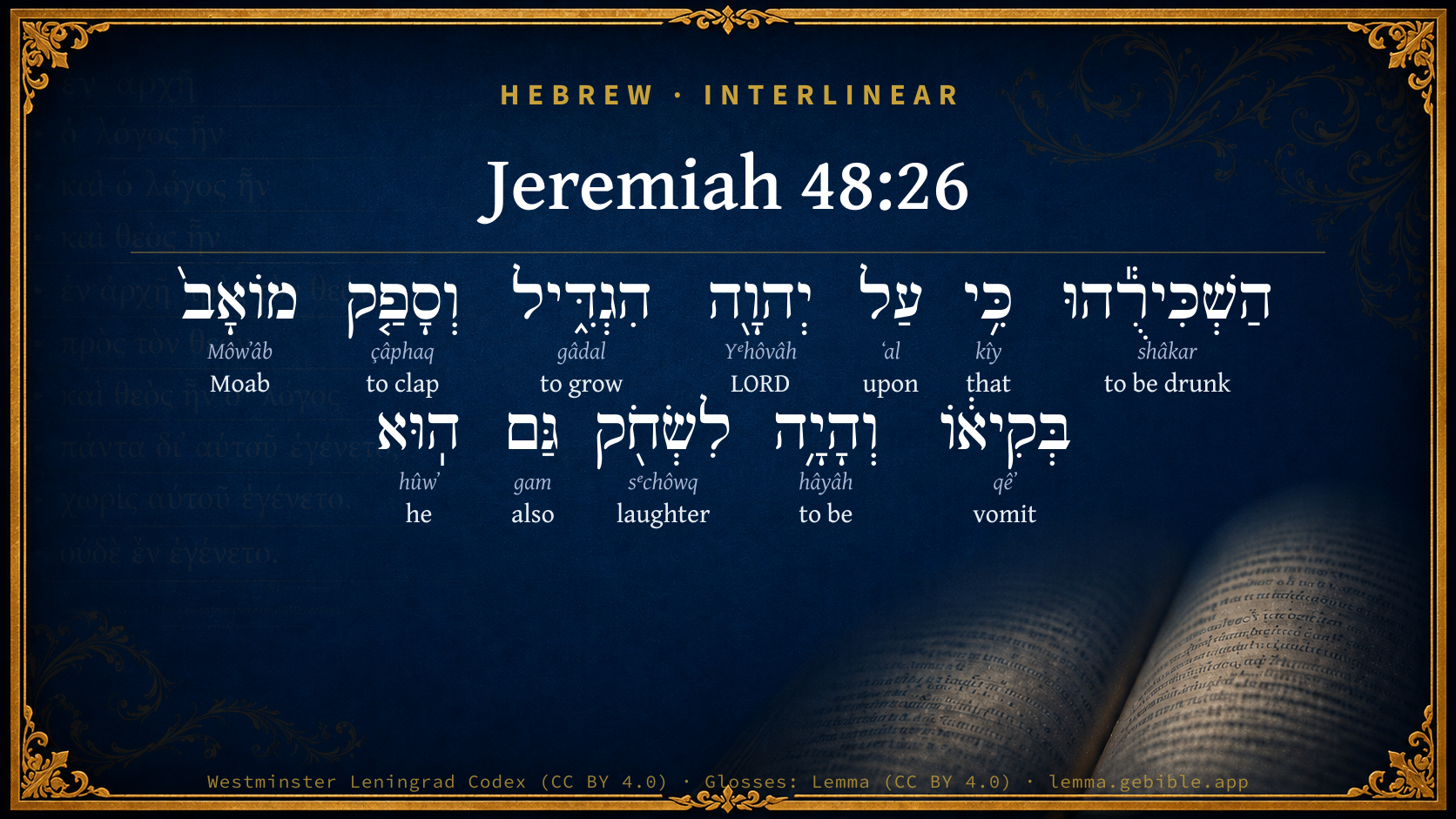
Jeremiah 48:26

Hebrew (Westminster Leningrad Codex) Jeremiah 48:26 appears in the Hebrew Old Testament. The text above is from the Westminster Leningrad Codex. Each word links to its Strong’s number, a concise gloss, and parsing drawn from the Open Scriptures Hebrew Bible morphology. Click any word for its full Brown-Driver-Briggs (BDB) entry.
Download image
Cite this verse

Jeremiah 48:26 (World English Bible). Public Domain. Lemma interlinear Bible study tool, https://lemma.gebible.app/v/jeremiah/48/26.

Show BibTeX & RIS
BibTeX
RIS
English Translation
Make you him drunken; for he magnified himself against Yahweh: and Moab shall wallow in his vomit, and he also shall be in derision.
World English Bible · Public Domain
Download a study sheet

One document with this verse’s original text, its word-by-word gloss line, the meaning frame, cross-references with their text, attributed commentary, and full source and license credits — printable, and it pastes into notes with its structure intact.

This verse Autodidact and up

Study sheet (.html) Plain text (.txt)

A passage Seminary Student

Up to 50 verses in one chapter. A passage sheet keeps up to 6 commentary sources and 12 cross-references per verse, in the order this page ranks them, and says so on the sheet whenever that leaves anything out. Ask for a single verse and you get the Autodidact verse sheet above.

Everything on this page stays free to read, with no account — the sheet is a download of what is already on screen, not access to it.

Want to remove ads? Support Godless Engineer
Compare translations 3

The same verse in 3 English versions, stacked beneath the original-language interlinear above. Click any original word for its lexicon entry.

Each is an independent rendering of the whole verse — the interlinear is not word-aligned to these translations.

Highlighted words mark where these versions differ — a whole-verse word diff, not a word-by-word alignment.

  • World English Bible Public Domain
    Make you him drunken; for he magnified himself against Yahweh: and Moab shall wallow in his vomit, and he also shall be in derision.
  • King James Version Public Domain
    Make ye him drunken: for he magnified himself against the LORD: Moab also shall wallow in his vomit, and he also shall be in derision.
  • unfoldingWord Literal Text CC BY-SA 4.0
    Make him drunk, because he acted proudly against Yahweh. Let Moab wallow in his vomit, and let him be an object of ridicule.

unfoldingWord Literal Text — © unfoldingWord, licensed CC BY-SA 4.0. Word-aligned USFM3 via Door43 (git.door43.org/unfoldingWord/en_ult).

Versions to compare (up to 4)

3 of 4 selected

Show all 18 translations

Every available English version of this verse, each an independent rendering of the whole verse.

  • World English Bible Public Domain
    Make you him drunken; for he magnified himself against Yahweh: and Moab shall wallow in his vomit, and he also shall be in derision.
  • Berean Standard Bible Public Domain
    “Make him drunk, because he has magnified himself against the LORD; so Moab will wallow in his own vomit, and he will also become a laughingstock.
  • Majority Standard Bible Public Domain
    “Make him drunk, because he has magnified himself against the LORD; so Moab will wallow in his own vomit, and he will also become a laughingstock.
  • King James Version Public Domain
    Make ye him drunken: for he magnified himself against the LORD: Moab also shall wallow in his vomit, and he also shall be in derision.
  • American Standard Version (1901) Public Domain
    Make ye him drunken; for he magnified himself against Jehovah: and Moab shall wallow in his vomit, and he also shall be in derision.
  • Revised Version (1885) Public Domain
    Make ye him drunken; for he magnified himself against the LORD: and Moab shall wallow in his vomit, and he also shall be in derision.
  • Geneva Bible (1599) Public Domain
    Make ye him drunken: for he magnified himselfe against the Lord: Moab shall wallowe in his vomite, and he also shalbe in derision.
  • Douay-Rheims (1899) Public Domain
    Make him drunk, because he lifted up himself against the Lord: and Moab shall dash his hand in his own vomit, and he also shall be in derision.
  • Young's Literal Translation Public Domain
    Declare ye him drunk, For against Jehovah he made himself great And Moab hath stricken in his vomit, And he hath been for a derision -- even he.
  • Literal Standard Version CC BY-SA 4.0
    Declare him drunk, || For he made himself great against YHWH || And Moab has struck in his vomit, || And he has been for a derision—even he.
  • Unlocked Literal Bible CC BY-SA 4.0
    Make him drunk, because he acted proudly against Yahweh. Let Moab wallow in his vomit, and let him be an object of ridicule.
  • unfoldingWord Literal Text CC BY-SA 4.0
    Make him drunk, because he acted proudly against Yahweh. Let Moab wallow in his vomit, and let him be an object of ridicule.
  • Darby Bible Public Domain
    Make him drunken, for he magnified himself against Jehovah; and Moab shall wallow in his vomit, and he also shall be in derision.
  • World Messianic Bible Public Domain
    “Make him drunk, for he magnified himself against the LORD. Moab will wallow in his vomit, and he also will be in derision.
  • Webster's Bible Public Domain
    Make ye him drunken; for he magnified himself against the LORD: Moab also shall wallow in his vomit, and he also shall be in derision.
  • Free Bible Version CC BY-SA 4.0
    Make the people of Moab drunk, because they defied the Lord. Then they will roll around in their own vomit, as people laugh at them.
  • Bible in Basic English Public Domain
    Make him full of wine, for his heart has been lifted up against the Lord: and Moab will be rolling in the food he was not able to keep down, and everyone will be making sport of him.
  • JPS Tanakh (1917) Public Domain
    Make ye him drunken, for he magnified himself against the LORD; and Moab shall wallow in his vomit, and he also shall be in derision.

Literal Standard Version (2020), Covenant Press — licensed CC BY-SA 4.0. Text via the HelloAO Bible API (eBible.org). Unlocked Literal Bible (unfoldingWord) — licensed CC BY-SA 4.0. Text via the HelloAO Bible API (eBible.org). unfoldingWord Literal Text — © unfoldingWord, licensed CC BY-SA 4.0. Word-aligned USFM3 via Door43 (git.door43.org/unfoldingWord/en_ult). Free Bible Version, Dr. Jonathan Gallagher — licensed CC BY-SA 4.0. Text via the HelloAO Bible API (eBible.org).

Word by word

More ways to search: Search by grammar → Find every occurrence → Compare this word →

Practice this passage: Drill this verse → Learn its vocabulary →

בְּקִיא֔וֹ
qêʼ
H6892
“in/at · vomit · his”
Preposition + Noun, Common, Masculine, Singular, Construct + Suffix, Personal, 3rd Person, Masculine, Singular
Part of Speech
Preposition + Noun
Type
Common
Gender
Masculine
Number
Singular
State
Construct
Full BDB Definition

Origin: from H6958

TWOT: 2013a , 2013b

vomit, what is vomited up
  1. הַשְׁכִּירֻ֕הוּ shâkar H7937 “be drunk · him” Verb, Hiphil, Imperative, 2nd Person, Masculine, Plural + Suffix, Personal, 3rd Person, Masculine, Singular
  2. כִּ֥י kîy H3588 “that” Conjunction
  3. עַל ʻal H5921 “upon” Preposition
  4. יְהוָ֖ה Yᵉhôvâh H3068 “LORD” Noun, Proper
  5. הִגְדִּ֑יל gâdal H1431 “to grow” Verb, Hiphil, Perfect, 3rd Person, Masculine, Singular
  6. וְסָפַ֤ק çâphaq H5606 “and · to clap” Conjunction + Verb, Qal, Sequential Perfect, 3rd Person, Masculine, Singular
  7. מוֹאָב֙ Môwʼâb H4124 “Moab” Noun, Proper
  8. וְהָיָ֥ה hâyâh H1961 “and · to be” Conjunction + Verb, Qal, Sequential Perfect, 3rd Person, Masculine, Singular
  9. לִשְׂחֹ֖ק sᵉchôwq H7814 “to/for · laughter” Preposition + Noun, Common, Masculine, Singular, Absolute
  10. גַּם gam H1571 “also” Particle, Accusative
  11. הֽוּא hûwʼ H1931 “he” Pronoun, Personal, 3rd Person, Masculine, Singular

About this verse

These counts appear in no published source. They are computed here, from the morphology-tagged text and Lemma’s own curated glosses. What Lemma adds →

12
words
12
distinct lemmas
Prophets
section

Notable vocabulary

The rarest word here is בְּקִיא֔וֹ vomit H6892 — appearing just 4 times in the whole Hebrew Bible.

Shared distinctive vocabulary

בְּקִיא֔וֹ vomit H6892 occurs in 4 verses of the Hebrew Bible. Also found in:

Grammatical profile

  • 4 verbs
  • 4 nouns
  • 1 pronoun
  • 1 preposition
  • 1 conjunction
  • 1 particle

Verb forms

  • הַשְׁכִּירֻ֕הוּ Hiphil · Imperative
  • הִגְדִּ֑יל Hiphil · Perfect
  • וְסָפַ֤ק Qal · Sequential Perfect
  • וְהָיָ֥ה Qal · Sequential Perfect

Cross-references

33

Topical passages linked to Jeremiah 48:26 in the Treasury of Scripture Knowledge — connected by theme and wording, ordered by reader-vote popularity; previews shown in the World English Bible.

  • Isaiah 19:14 Yahweh has mixed a spirit of perverseness in the midst of her; and they have caused Egypt to go astray in every work of it, as a drunken man staggers in his vomit.
  • Isaiah 29:9 Stay you and wonder; take your pleasure and be blind: they are drunken, but not with wine; they stagger, but not with strong drink.
  • Jeremiah 48:42 Moab shall be destroyed from being a people, because he has magnified himself against Yahweh.
  • Jeremiah 51:39 When they are heated, I will make their feast, and I will make them drunken, that they may rejoice, and sleep a perpetual sleep, and not wake, says Yahweh.
  • Exodus 5:2 Pharaoh said, "Who is Yahweh, that I should listen to his voice to let Israel go? I don't know Yahweh, and moreover I will not let Israel go."
  • Jeremiah 48:39 How is it broken down! [how] do they wail! how has Moab turned the back with shame! so shall Moab become a derision and a terror to all who are round about him.
  • Jeremiah 51:7 Babylon has been a golden cup in Yahweh's hand, who made all the earth drunken: the nations have drunk of her wine; therefore the nations are mad.
  • Lamentations 4:21 Rejoice and be glad, daughter of Edom, that dwell in the land of Uz: The cup shall pass through to you also; you shall be drunken, and shall make yourself naked.
  • Daniel 5:23 but have lifted up yourself against the Lord of heaven; and they have brought the vessels of his house before you, and you and your lords, your wives and your concubines, have drunk wine from them; and you have praised the gods of silver and gold, of brass, iron, wood, and stone, which don't see, nor hear, nor know; and the God in whose hand your breath is, and whose are all your ways, you have not glorified.
  • Exodus 9:17 as you still exalt yourself against my people, that you won't let them go.
  • Job 9:4 God who is wise in heart, and mighty in strength: Who has hardened himself against him, and prospered?
  • Psalms 2:4 He who sits in the heavens will laugh. The Lord will have them in derision.
  • Psalms 59:8 But you, Yahweh, laugh at them. You scoff at all the nations.
  • Psalms 60:3 You have shown your people hard things. You have made us drink the wine that makes us stagger.
  • Psalms 75:8 For in the hand of Yahweh there is a cup, Full of foaming wine mixed with spices. He pours it out. Indeed the wicked of the earth drink and drink it to its very dregs.
  • Isaiah 10:15 Shall the axe boast itself against him who hews therewith? Shall the saw magnify itself against him who wields it? as if a rod should wield those who lift it up, [or] as if a staff should lift up [him who is] not wood.
  • Isaiah 51:17 Awake, awake, stand up, Jerusalem, that have drunk at the hand of Yahweh the cup of his wrath; you have drunken the bowl of the cup of staggering, and drained it.
  • Isaiah 63:6 I trod down the peoples in my anger, and made them drunk in my wrath, and I poured out their lifeblood on the earth.
  • Jeremiah 13:13–14 Then shall you tell them, Thus says Yahweh, Behold, I will fill all the inhabitants of this land, even the kings who sit on David's throne, and the priests, and the prophets, and all the inhabitants of Jerusalem, with drunkenness.
  • Jeremiah 25:15–17 For thus says Yahweh, the God of Israel, to me: take this cup of the wine of wrath at my hand, and cause all the nations, to whom I send you, to drink it.
  • Jeremiah 25:27–29 You shall tell them, Thus says Yahweh of Hosts, the God of Israel: Drink you, and be drunken, and spew, and fall, and rise no more, because of the sword which I will send among you.
  • Jeremiah 51:57 I will make drunk her princes and her wise men, her governors and her deputies, and her mighty men; and they shall sleep a perpetual sleep, and not wake up, says the King, whose name is Yahweh of Hosts.
  • Lamentations 1:21 They have heard that I sigh; there is none to comfort me; All my enemies have heard of my trouble; they are glad that you have done it: You will bring the day that you have proclaimed, and they shall be like me.
  • Lamentations 3:15 He has filled me with bitterness, he has sated me with wormwood.
  • Ezekiel 23:31–34 You have walked in the way of your sister; therefore will I give her cup into your hand.
  • Ezekiel 35:12–13 You shall know that I, Yahweh, have heard all your insults which you have spoken against the mountains of Israel, saying, They are laid desolate, they are given us to devour.
  • Daniel 8:11–12 Yes, it magnified itself, even to the prince of the host; and it took away from him the continual [burnt offering], and the place of his sanctuary was cast down.
  • Daniel 11:36 The king shall do according to his will; and he shall exalt himself, and magnify himself above every god, and shall speak marvelous things against the God of gods; and he shall prosper until the indignation be accomplished; for that which is determined shall be done.
  • Nahum 3:11 You also will be drunken. You will be hidden. You also will seek a stronghold because of the enemy.
  • Habakkuk 2:16 You are filled with shame, and not glory. You will also drink, and be exposed! The cup of Yahweh's right hand will come around to you, and disgrace will cover your glory.
  • Zephaniah 2:8–10 I have heard the reproach of Moab, and the insults of the children of Ammon, with which they have reproached my people, and magnified themselves against their border.
  • 2 Thessalonians 2:4 he who opposes and exalts himself against all that is called God or that is worshiped; so that he sits as God in the temple of God, setting himself up as God.
  • Revelation 16:19 The great city was divided into three parts, and the cities of the nations fell. Babylon the great was remembered in the sight of God, to give to her the cup of the wine of the fierceness of his wrath.

Cross-references courtesy of OpenBible.info (CC BY 4.0).

Hebrew and Greek witnesses Masoretic Hebrew ↔ Greek Septuagint

The same verse in the two great witnesses to the Old Testament, shown verse-for-verse.

These are two independent witnesses, not word-aligned to each other, and the Septuagint is shown in lemma (dictionary) form.

Hebrew Jeremiah 48:26 Masoretic · Westminster Leningrad Codex

הַשְׁכִּירֻ֕הוּ כִּ֥י עַל יְהוָ֖ה הִגְדִּ֑יל וְסָפַ֤ק מוֹאָב֙ בְּקִיא֔וֹ וְהָיָ֥ה לִשְׂחֹ֖ק גַּם הֽוּא

Make you him drunken; for he magnified himself against Yahweh: and Moab shall wallow in his vomit, and he also shall be in derision.

World English Bible · Public Domain

Greek LXX Structure differs

In the Septuagint, Jeremiah is about an eighth shorter than the Hebrew and arranges its material differently — the Oracles Against the Nations (Hebrew chapters 46–51) appear in the middle of the Greek book, after 25:13. Because the chapter and verse boundaries do not line up, a verse-for-verse comparison with the Hebrew is not shown.

A verse-for-verse comparison isn’t shown here because the chapters and verses don’t line up. Switch to the LXX edition with the MT / LXX toggle above to read the Greek directly.

Hebrew: Westminster Leningrad Codex (CC BY 4.0). Greek: Septuagint (public domain); English from a public-domain English Septuagint. How the Septuagint differs from the Hebrew →

Targum (Aramaic paraphrase)

1

The Targum is the ancient Jewish Aramaic paraphrase of the Hebrew Scriptures — an interpretive translation, not the Hebrew text itself. Onkelos (literal) and Pseudo-Jonathan (expansive) render the Torah, and Jonathan the Prophets. Coverage is partial: where no permissively-licensed English translation exists for a verse, only the Aramaic is shown. This is verse-level text, not a word-by-word alignment to the Hebrew.

  1. Targum Jonathan Prophets (Joshua–Malachi)
    אַיְתָא עֲלֵיהוֹן עָקָא וִיהוֹן דָמָן לְרַוְיָא אֲרֵי עַל עַמָא דַייָ אִתְרַבְרָבוּ וְיִדְרְשׁוּן מוֹאָבָאֵי בְּאַתְרֵיהוֹן לְלָעֵיב אַף אִינוּן:

    (no public-domain English translation for this verse)

    Targum Jonathan — Aramaic: “Mikraot Gedolot” (public domain). English: “Sefaria Community Translation” (CC0 1.0 (public-domain dedication)); “London "Chaldee Paraphrase," 1871” (public domain). Text via Sefaria.

Commentary

Notes on Jeremiah 48:26 from classic Christian and Jewish commentators (each source and its license shown beneath its notes). The classic Christian expositions comment on the surrounding passage and are grouped to its opening verse, so a note may address several verses; the Jewish commentaries on the Tanakh (Rashi and others) are per-verse, so they appear only where the commentator wrote on this verse.

Lemma curates 59 commentaries, every one of them public domain or Creative Commons licensed, each selected and text-cleaned for this edition rather than reprinted as found. About our sources →

Trapp's Complete Commentary

John Trapp

Jer 48:26 Make ye him drunken: for he magnified [himself] against the LORD: Moab also shall wallow in his vomit, and he also shall be in derision.

Ver. 26. Make ye him drunk.] Ebrietas modis omnibus maledicta. But here is meant a dry drunkenness with the fierce wrath of God. Most things here spoken are to be found in Isaiah, but here more clearly expressed. See Jer 25:17; Jer 25:21.

Moab also shall wallow in his vomit.] As once he did when drunk with wine to the derision of others, so now he shall when drunk with wrath. It will be a woe time with drunkards one day doubtless.

John Trapp, A Commentary or Exposition upon All the Books of the Old and New Testament (1647–1656) — public domain. Text from a community e-Sword module.

Joseph Benson's Commentary

Jer 48:26-27. Make ye him drunken — God’s judgments are often represented under the metaphor of a cup of intoxicating liquors: see note on Jer 25:15. Moab also shall wallow in his vomit — The judgments which God sends upon him shall expose him to the scorn of his enemies; just as a drunken man is the object of men’s laughter and derision. For was not Israel a derision unto thee? — Didst not thou insult over the calamities of the Jews when they were carried away captive? Israel is here put for Judah. Was he found among thieves? — Though the sins of Israel were great in the sight of God, yet, as he had done no injury to the Moabites, there was no reason why they should use him with the same despite and contempt as if he had been a common thief and robber, whom all men think they have a right to abuse. For since thou spakest of him, thou skippedst for joy — This translation, Blaney observes, seems quite foreign to the purpose, and does not accord with the literal meaning of the Hebrew, מדי דברין בו תתנודד, which, he thinks, may be properly rendered, That thou shouldest insult him with all the power of thy words. The sense then of the sentence will be, “Didst thou find Israel among thieves, coming to rob thee of thy property, that thou shouldest think thyself entitled to break out into all manner of revilings against him? Compare Eze 25:8; Zep 2:8; Zep 2:10. Lowth suggests another interpretation, which the words will very well bear, and which agrees with the Chaldee paraphrase, namely, For the words thou hast spoken against him, thou shalt be carried captive. To this purpose also the Vulgar Latin, propter verba tua quæ adversum ilium locutus es, captivus diceres.

Joseph Benson's Commentary on the Old and New Testaments (1811–1818) — public domain. Text from a community e-Sword module.

Whedon's Commentary on the Bible

Daniel D. Whedon

THE CONTRAST, Jer_48:26-47.

26. Make ye him drunken, etc. — This commission is addressed to those who execute God’s vengeance on Moab. For his haughtiness and arrogance are appointed shame and disgrace. Moab is a laughing-stock because Israel was a derision to her, as is said in Jer_48:27.

Daniel D. Whedon (gen. ed.), Commentary on the Old and New Testaments (1874–1909) — public domain. Text from a community e-Sword module.

Keil & Delitzsch

C. F. Keil & F. Delitzsch

Moab's haughtiness and deplorable fall. - Jer 48:26. "Make him drunk - for he hath boasted against Jahveh - so that Moab shall splash down into his vomit, and himself become a laughing-stock. Jer 48:27. Was not Israel a laughing-stock to thee, or was he found among thieves? for whenever thou spakest of him, thou didst shake thine head. Jer 48:28. Leave the cities and dwell in the rock, ye inhabitants of Moab; and be ye like a dove [that] builds its nest in the sides of the mouth of a pit. Jer 48:29. We have heard the very arrogant pride of Moab, his haughtiness, and his arrogance, and his high-mindedness, and his elation of mind. Jer 48:30. I know, saith Jahveh, his wrath, and the untruthfulness of his words; they have done what is untrue. Jer 48:31. Therefore will I howl over Moab, and for all Moab will I cry; they mourn for the people of Kir-heres. Jer 48:32. I will weep for thee [with more] than the weeping of Jazer, O vine of Sibmah, thou whose tendrils have gone over the sea, have reached even to the sea of Jazer; on thy fruit-harvest and thy vintage a spoiler has fallen. Jer 48:33. And joy and gladness are taken from the garden, and from the land of Moab; and I have caused wine to fail from the wine-vats: they shall not tread [with] a shout; the shout shall be no shout. Jer 48:34. From the cry of Heshbon as far as Elealeh, as far as Jahaz, they utter their voice; from Zoar as far as Horonaim and the third Eglath; for even the waters of Nimrim shall become desolations. Jer 48:35. And I will destroy from Moab, saith Jahveh, him that offers on a high place and burns incense to his gods."

Through his pride, Moab has incurred the sentence of destruction to his power. In arrogance and rage he has exalted himself over Jahveh and His people Israel; therefore must he now be humbled, Jer 48:26-30. The summons to make Moab drunk is addressed to those whom God has charged with the execution of the sentence; cf. Jer 48:10 and Jer 48:21. These are to present to the people of Moab the cup of the divine wrath, and so to intoxicate them, that they shall fall like a drunk man into his vomit, and become a laughing-stock to others (cf. Jer 13:13; Jer 25:15), because they have boasted against Jahveh by driving the Israelites from their inheritance, and by deriding the people of God; cf. Zep 2:8. ספק, to strike, frequently of striking the hands together; here it signifies to fall into his vomit, i.e., to tumble into it with a splash. No other explanation of the word can find support from the language used. Cf. Isa 19:14 and Isa 25:10. In the last clause of Jer 48:26, the emphasis lies on גּם הוּא: "he also (Moab, like Israel before) shall become a laughing-stock." This statement is enforced by the question put in Jer 48:27, "Was not Israel a laughing-stock to thee?" ואם־אם shows a double question, like ה־אם; and ואם in the first clause may be further strengthened by the interrogative ה before שׂחק, as in Gen 17:17. For other forms of the double question, see Psa 94:9; Job 21:4; Jer 23:26. On Dagesh dirimens in השּׂחק, cf. Ewald, 104, b. There is no sufficient reason for questioning the feminine form נמצאה in the Qeri; Israel is personified as a woman, just as Moab in Jer 48:20, where חתּה is found. On מדּי דב, cf. Jer 31:20, where, however, דּבּר בּ is used in another meaning. התנודד, to shake oneself, is a stronger expression than הניד בּראשׁ, to shake the head (Jer 18:16), a gesture denoting mockery and rejoicing over another's injury; cf. Psa 64:9.

Keil & Delitzsch — Biblical Commentary on the Old Testament (1861–1891) — public domain (CC PDM 1.0). Text via the HelloAO Bible API. (Old Testament only.)

Tyndale Open Study Notes

Tyndale Open Resources

48:26-27 Moab’s hatred for Israel was ultimately against the Lord.

Tyndale Open Study Notes — © Tyndale Open Resources, licensed CC BY-SA 4.0. Text via the HelloAO Bible API.

Geneva Bible (1599)

Geneva Bible translators

He willed the Chaldeans to lay afflictions enough upon them, till they be like drunken men that fall down to their shame and are derided of all.

Or, shall be full, or clap his hands.

Geneva Bible (1599) marginal notes — public domain. Text via Bolls.life.

Jamieson, Fausset & Brown

Robert Jamieson, A. R. Fausset & David Brown

drunken--(see on Jer 13:12; Jer 25:17). Intoxicated with the cup of divine wrath, so as to be in helpless distraction.

magnified . . . against . . . Lord--boasted arrogantly against God's people, that whereas Israel was fallen, Moab remained flourishing.

wallow in . . . vomit--following up the image of a drunken man, that is, shall be so afflicted by God's wrath as to disgorge all his past pride, riches, and vainglory, and fall in his shameful abasement.

he also . . . derision--He in his disaster shall be an object of derision to us, as we in ours have been to him (Jer 48:27). Retribution in kind.

Jamieson, Fausset & Brown — Commentary Critical and Explanatory on the Whole Bible (1871) — public domain (CC PDM 1.0). Text via the HelloAO Bible API.

John Calvin's Commentaries

The Prophet now addresses the Chaldeans, who were to be the executioners of God’s vengeance: hence he says, Make him drunk, because he has magnified himself against Jehovah, that is, raised himself in his pride against God. Then the Prophet, as God’s herald, encouraged the Chaldeans, fully to execute God’s judgment, who had been chosen to be his servants. And the address had more force in it when the Prophet showed that such a command was committed to him, as we have seen elsewhere; for the Prophets showed how efficacious was their doctrine, when they besieged and stormed cities, when they gave orders to armies. This then is the course which Jeremiah now follows, when as God’s herald he summons the Chaldeans, and commands them vigorously to perform what God approved and what he had decreed, even to inebriate the Moabites with evils. The rest to-morrow.

John Calvin's Commentaries (1540-1563) — public domain. Text from the Calvin Translation Society English edition (1840s-50s) via the Christian Classics Ethereal Library (ccel.org). Calvin's coverage is partial (roughly two-thirds of the Bible); uncommented books and verses are honest gaps, never fabricated. The 19th-century editor's footnotes and remarks are omitted so the notes are faithfully Calvin's own voice.

The Cambridge Bible for Schools and Colleges

gen. ed. J. J. S. Perowne

26. Make ye him drunken] For the metaphor of drunkenness see on ch. Jer_25:15.

he magnified himself against the Lord] He resisted Reuben in his occupation of the territory which the Lord had assigned him, but also in much more recent times. See e.g. 2Ki_24:2.

wallow] or, splash into.

he also shall be in derision] just as he derided Israel.

26, 27. Probably post-Jeremianic.

The Cambridge Bible for Schools and Colleges (gen. ed. J. J. S. Perowne; Cambridge University Press, 1878–1918) — public domain. Text from a community e-Sword module.

John Gill's Exposition

For was not Israel a derision unto thee?.... In the time of his calamity, when the ten tribes were carried captive by the Assyrians some years ago; and of late the two tribes of Judah and Benjamin by the Chaldeans; the Moabites rejoiced at this, which they ought not to have done, upon the common principles of humanity; and especially since they were not only neighbours, but akin; and therefore, according to the law of retaliation, it was but just that they should be had in derision themselves:

was he found among thieves? that is, Israel; that he should be a derision to any, as thieves are when they are taken; men rejoice at it, insult them, and deride them; but was this the case of Israel? had he robbed any? had he done any injury to Moab, or any other? no, verily: why this derision then?

for since thou spakest of him, thou skippedst for joy; or, "shookedst thyself" (c); whenever the Moabites spoke of the distresses and calamities of Israel, and of their captivity, they laughed till they shook themselves; not only shook their heads, but their whole bodies. The Vulgate Latin version is, "therefore, because of thy words which thou hast spoken against him, thou shall be carried captive"; and Jarchi mentions such a sense of the words, as given by some of their Rabbins; and to this agrees the Targum,

"and because ye have multiplied words against them, therefore ye shall go into captivity.''

(c) "commovisti te", Vatablus, Calvin; "commoves te", Junius & Tremellius, Piscator; "motitas te", Schmidt.

John Gill's Exposition of the Whole Bible (1746–1763) — public domain (CC PDM 1.0). Text via the HelloAO Bible API.

Albert Barnes' Notes on the Bible

Make ye him drunken - With the wine-cup of God’s fury, until terror deprive him of his senses.

Albert Barnes' Notes on the Bible (1834–1885) — public domain. Text from a community e-Sword/MySword module.

Haydock's Catholic Bible Commentary

Drunk with the wine of God’s wrath. --- Dash. Hebrew, "roll in," or "they shall clap hands over Moab, in," &c.

George Leo Haydock (1774–1849), Haydock's Catholic Family Bible and Commentary, 1859 edition — public domain. Excludes Psalms (Douay-Rheims chapter numbering differs from Protestant) and Deuterocanonical books (Catholic canon only).

Matthew Poole's English Annotations

Make ye him drunken; either make ye him to stagger like a drunken man, (the cause being put for the effect,) or fill him with the intoxicating wine cup of God’s vengeance, with the effects of God’s wrath. For he magnified himself against the Lord; because of his pride, and exalting himself against the Lord, as if he had been stronger than he, and so ont of the reach of God’s power.

Moab also shall wallow in his vomit, and he also shall be in derision: as drunken men vomit, and stagger, and fall, and wallow in their vomit, so let the Moabites fall by the sword, wallow in their blood, and like drunken men be mocked at and had in derision by all those who see what their vaunts come to, and what vengeance they have pulled upon themselves.

Matthew Poole's English Annotations on the Holy Bible (1683–1685) — public domain. Text from a community e-Sword/MySword module.

The Pulpit Commentary

Vers. 26-35. And what is Moab"s crime? At an earlier point the prophet said that it was the callousness produced by long prosperity (ver. 11); but here another sin is mentioned Moab"s haughty contempt of Jehovah. "For this it deserves that its contempt should be thrown back upon itself, by its being made, like a drunken man, the scorn of all" (Ewald). The figure is, no doubt, a coarse one, but not unnatural in the oratory (we must put aside inspiration, which leaves the forms of speech untouched) of a rude people like the Jews. It occurs not infrequently elsewhere; see especially Isa_19:14 Hab_2:15, Hab_2:16; and, for milder examples of the figure, Jer_13:13, Jer_13:25.

Make ye him drunken. The command is issued to the agents of the Divine wrath (comp. vers. 10, 21). He magnified himself against the Lord. Offences against Israel being also offences against Israel"s God. (see Jephthah"s striking words in Jud_1:11:23, 24) Shall wallow; rather, shall fall heavily (literally, shall clap a pregnant expression).

Vers. 26, 27. Moab exulting over fallen Israel.

Here is another allusion to a wine country. Moab knew well what it was to drink to excess. The drunkard with his silly talk and behavior is a common object of ridicule everywhere. And Moab shall become to other nations abject and degraded as the drunkard. This is the end of its wrong excitement over the fall of Israel Moab has seen Israel in its days of power and glory and pride, and, cooing, has feared. Could the days of Balak and the prophecies of Balaam be forgotten? Nor is it likely that Israel would be without unseemly exultations and reciprocal jealousies. And now at last Israel falls. And all that Moab can take knowledge of is the fact of the fall. That it has been caused by disobedience and rebellion, that Jehovah is the real Author of it and not the King of Babylon, who is but as Jehovah"s sword, Moab cannot well have means for knowing. All it can see is a rival fallen, and. as it seems permanently fallen. Therefore Moab must be taught a lesson. In exulting over Israel it is exulting against Jehovah. Indeed, there is no reason why we should reject the notion of some open and bold comparison between the weakness of Jehovah, God of Israel, and the strength of Chemosh, god of Moab. As if the people said, "See how strong Chemosh is; for we are still here, though Babylonian armies have not been far from us! and see how weak Jehovah is; for the nation to whom he was God is gone into a distant captivity!" To exult over the fall of those who have been avowedly the servants of God is a dangerous thing to do. The man who is tempted and falls should be an object of pity, one to be helped up and reinstated, even though the work needed for this be one with some loss and risk to ourselves. And surely we should be especially careful not to rejoice over the calamities of those whose calamity seems to give us a better chance. Moab had now to drink to the dregs a cup of shame, because it had failed to comprehend the duty of rejoicing with those who rejoiced and weeping with those who wept. Y.

The Pulpit Commentary (1880–1919), ed. H.D.M. Spence-Jones & Joseph S. Exell — public domain. Text from a community e-Sword module.

John Wesley's Explanatory Notes

Drunken - Fill him with the intoxicating wine of God's vengeance.

John Wesley, Explanatory Notes Upon the Whole Bible (1754–1765) — public domain. Text via the GEBible commentary corpus.

unfoldingWord translationNotes

Door43 World Missions Community

Make him drunk, because he acted proudly against Yahweh

Yahweh is speaking. The command "Make him drunk" indicates what Yahweh will cause to happen. Here "him" and "he" refers to Moab which represents the people of Moab. AT: "I, Yahweh, will cause the people of Moab to be drunk, for they acted proudly against me" (See: Imperatives - Other Uses and Metonymy)

Make him drunk

Here people experiencing Yahweh's punishment is spoken of as if they were drunk on wine, acting foolishly so that people laugh at them. AT: "I will cause you to be like a drunk person" (See: Metaphor)

Let Moab wallow in his vomit ... an object for laughter

Yahweh continues speaking of the people of Moab as if they were a drunk person. AT: "Now the people of Moab will be like a person who wallows in his vomit ... an object for laughter (See: Metaphor)

let him be an object of ridicule

"so that people will laugh at him"

For did not Israel become an object for laughter to you?

Yahweh uses a question to remind the people of Moab how they treated the people of Israel. AT: "For you used to mock and laugh at the people of Israel." (See: Rhetorical Question)

Israel ... Was he found ... at him ... about him

Here "Israel" represents the people of Israel. AT: "the people of Israel ... Were they found ... at them ... about them" (See: Metonymy)

Was he found among thieves, so that you shook your head ... about him?

Here Yahweh uses a question to rebuke the people of Moab for treating the people of Israel with shame though they did nothing wrong. AT: "Although they were not thieves, you still shook your head ... about him." (See: Rhetorical Question)

shook your head at him

This is a symbolic action that shows feeling of scorn or disgust towards someone. (See: Symbolic Action)

translationWords

drunk

proud

Yahweh

Moab

Israel

thief

unfoldingWord translationNotes — © Distant Shores Media and the Door43 World Missions Community, licensed CC BY-SA 4.0. Source: git.door43.org/Door43/en_tn.

Rashi

Rabbi Shlomo Yitzchaki (Rashi)

Make him drunk Give him to drink [the cup of] weakness until he is drunk.

he too Just as Israel was derided by him [i.e., Moab].

Rashi on the Tanakh — English translations: “The Judaica Press complete Tanach with Rashi, translated by A. J. Rosenberg” (CC BY 4.0); “Pentateuch with Rashi's commentary by M. Rosenbaum and A.M. Silbermann, 1929-1934” (public domain); “The Metsudah Tanach series, Lakewood, N.J” (CC BY 4.0); and “The Book of Joshua, Metsudah Publications, 1997” (CC BY 4.0). Text via Sefaria.

Lesson kit

Teaching starters — assembled from the data on this page, not authored interpretation. Every prompt links to the verse data it draws on. Edit before teaching.

Jeremiah, in the Prophets, opens this verse with 12 words (12 distinct Hebrew lemmas). Its most distinctive word is qêʼ (“vomit”). A historical commentator’s framing appears above. Read the whole chapter for the surrounding context.

Discussion questions

  1. What does “vomit” (qêʼ) contribute to the verse as a whole?
  2. How does Proverbs 26:11, which shares the word «vomit», read alongside this verse?
  3. The translations on this page render this verse differently — a whole-verse word diff, not a word-by-word alignment. What might account for the different wordings?
  4. «הַשְׁכִּירֻ֕הוּ» is a Hiphil Imperative verb. How does that grammatical form shape the action described?
  5. Compare how Trapp's Complete Commentary and Joseph Benson's Commentary read this verse. Where do they agree or differ?

Things to notice

Reading settings

Reading text

Shown beneath each verse's original-language words.

Old Testament
Old Testament edition

Read the OT as the Masoretic Hebrew (MT) or the Greek Septuagint (LXX).

English shown for the Greek Septuagint (in the Hebrew ↔ Greek comparison).

Comparing translations? Open the Compare panel on any verse page to stack up to four side by side.