
Jeremiah 40:11

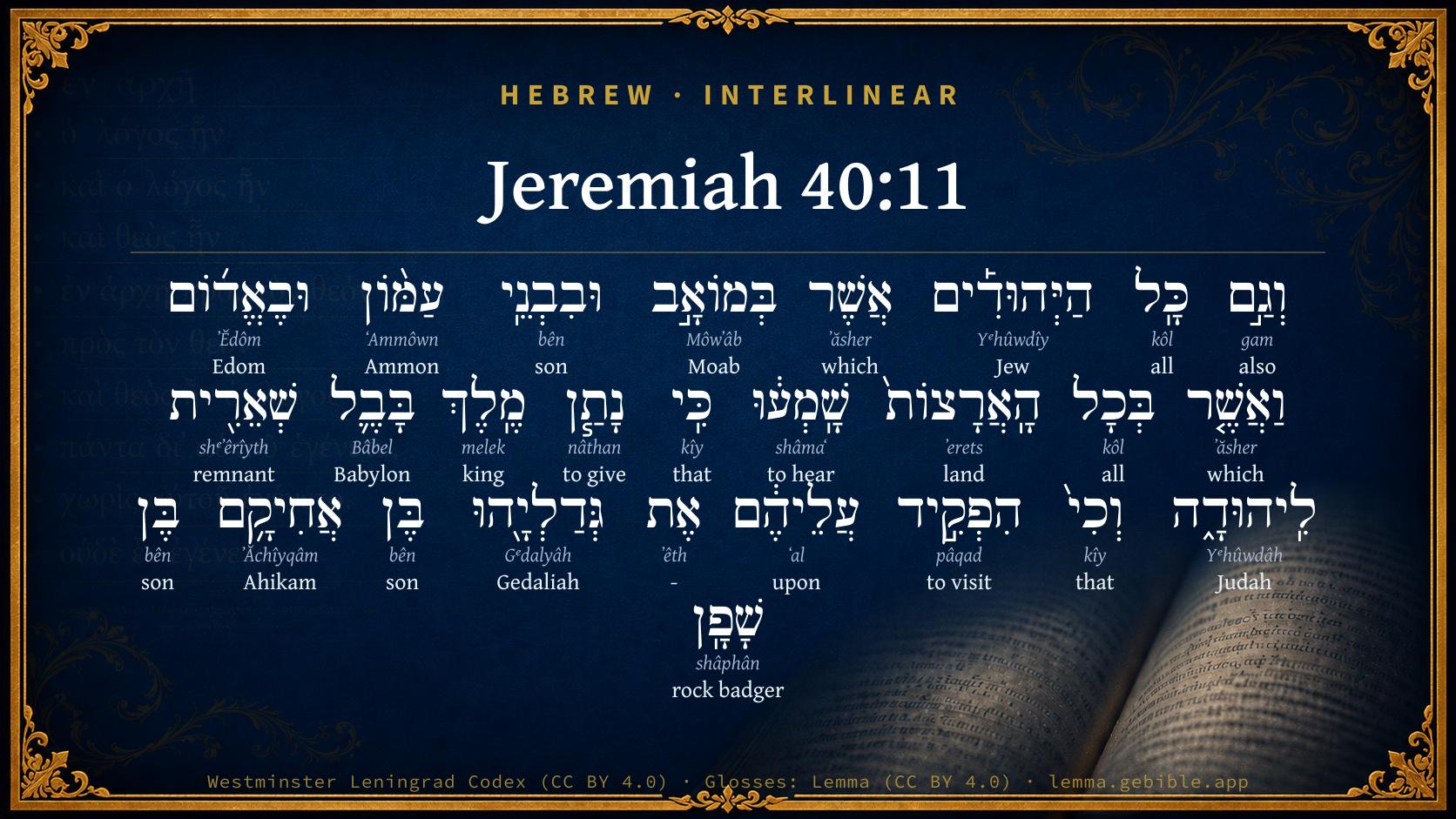
Hebrew (Westminster Leningrad Codex) Jeremiah 40:11 appears in the Hebrew Old Testament. The text above is from the Westminster Leningrad Codex. Each word links to its Strong’s number, a concise gloss, and parsing drawn from the Open Scriptures Hebrew Bible morphology. Click any word for its full Brown-Driver-Briggs (BDB) entry.
Download image
Cite this verse

Jeremiah 40:11 (World English Bible). Public Domain. Lemma interlinear Bible study tool, https://lemma.gebible.app/v/jeremiah/40/11.

Show BibTeX & RIS
BibTeX
RIS
English Translation
Likewise when all the Jews who were in Moab, and among the children of Ammon, and in Edom, and who were in all the countries, heard that the king of Babylon had left a remnant of Judah, and that he had set over them Gedaliah the son of Ahikam, the son of Shaphan;
World English Bible · Public Domain
Download a study sheet

One document with this verse’s original text, its word-by-word gloss line, the meaning frame, cross-references with their text, attributed commentary, and full source and license credits — printable, and it pastes into notes with its structure intact.

This verse Autodidact and up

Study sheet (.html) Plain text (.txt)

A passage Seminary Student

Up to 50 verses in one chapter. A passage sheet keeps up to 6 commentary sources and 12 cross-references per verse, in the order this page ranks them, and says so on the sheet whenever that leaves anything out. Ask for a single verse and you get the Autodidact verse sheet above.

Everything on this page stays free to read, with no account — the sheet is a download of what is already on screen, not access to it.

Want to remove ads? Support Godless Engineer
Compare translations 3

The same verse in 3 English versions, stacked beneath the original-language interlinear above. Click any original word for its lexicon entry.

Each is an independent rendering of the whole verse — the interlinear is not word-aligned to these translations.

Highlighted words mark where these versions differ — a whole-verse word diff, not a word-by-word alignment.

  • World English Bible Public Domain
    Likewise when all the Jews who were in Moab, and among the children of Ammon, and in Edom, and who were in all the countries, heard that the king of Babylon had left a remnant of Judah, and that he had set over them Gedaliah the son of Ahikam, the son of Shaphan;
  • King James Version Public Domain
    Likewise when all the Jews that were in Moab, and among the Ammonites, and in Edom, and that were in all the countries, heard that the king of Babylon had left a remnant of Judah, and that he had set over them Gedaliah the son of Ahikam the son of Shaphan;
  • unfoldingWord Literal Text CC BY-SA 4.0
    Then all the Judeans in Moab, among the people of Ammon, and in Edom, and in every land heard that the king of Babylon had allowed a remnant of Judah to stay, that he had appointed Gedaliah son of Ahikam son of Shaphan over them.

unfoldingWord Literal Text — © unfoldingWord, licensed CC BY-SA 4.0. Word-aligned USFM3 via Door43 (git.door43.org/unfoldingWord/en_ult).

Versions to compare (up to 4)

3 of 4 selected

Show all 18 translations

Every available English version of this verse, each an independent rendering of the whole verse.

  • World English Bible Public Domain
    Likewise when all the Jews who were in Moab, and among the children of Ammon, and in Edom, and who were in all the countries, heard that the king of Babylon had left a remnant of Judah, and that he had set over them Gedaliah the son of Ahikam, the son of Shaphan;
  • Berean Standard Bible Public Domain
    When all the Jews in Moab, Ammon, Edom, and all the other lands heard that the king of Babylon had left a remnant in Judah and had appointed Gedaliah son of Ahikam, the son of Shaphan, over them,
  • Majority Standard Bible Public Domain
    When all the Jews in Moab, Ammon, Edom, and all the other lands heard that the king of Babylon had left a remnant in Judah and had appointed Gedaliah son of Ahikam, the son of Shaphan, over them,
  • King James Version Public Domain
    Likewise when all the Jews that were in Moab, and among the Ammonites, and in Edom, and that were in all the countries, heard that the king of Babylon had left a remnant of Judah, and that he had set over them Gedaliah the son of Ahikam the son of Shaphan;
  • American Standard Version (1901) Public Domain
    Likewise when all the Jews that were in Moab, and among the children of Ammon, and in Edom, and that were in all the countries, heard that the king of Babylon had left a remnant of Judah, and that he had set over them Gedaliah the son of Ahikam, the son of Shaphan;
  • Revised Version (1885) Public Domain
    Likewise when all the Jews that were in Moab, and among the children of Ammon, and in Edom, and that were in all the countries, heard that the king of Babylon had left a remnant of Judah, and that he had set over them Gedaliah the son of Ahikam, the son of Shaphan;
  • Geneva Bible (1599) Public Domain
    Likewise when all the Iewes that were in Moab, and among the Ammonites, and in Edom, and that were in all the countries, heard that the King of Babel had left a remnant of Iudah, and that he had set ouer them Gedaliah the sonne of Ahikam the sonne of Shaphan,
  • Douay-Rheims (1899) Public Domain
    Moreover all the Jews that were in Moab, and among the children of Ammon, and in Edom, and in all the countries, when they heard that the king of Babylon had left a remnant in Judea, and that he had made Godolias the son of Ahicam the son of Saphan ruler over them:
  • Young's Literal Translation Public Domain
    And also all the Jews who `are' in Moab, and among the sons of Ammon, and in Edom, and who `are' in all the lands, have heard that the king of Babylon hath given a remnant to Judah, and that he hath appointed over them Gedaliah son of Ahikam, son of Shaphan,
  • Literal Standard Version CC BY-SA 4.0
    And also all the Jews who [are] in Moab, and among the sons of Ammon, and in Edom, and who [are] in all the lands, have heard that the king of Babylon has given a remnant to Judah, and that he has appointed over them Gedaliah son of Ahikam, son of Shaphan,
  • Unlocked Literal Bible CC BY-SA 4.0
    Then all the Judeans in Moab, among the people of Ammon, and in Edom, and in every land heard that the king of Babylon had allowed a remnant of Judah to stay, that he had appointed Gedaliah son of Ahikam son of Shaphan over them.
  • unfoldingWord Literal Text CC BY-SA 4.0
    Then all the Judeans in Moab, among the people of Ammon, and in Edom, and in every land heard that the king of Babylon had allowed a remnant of Judah to stay, that he had appointed Gedaliah son of Ahikam son of Shaphan over them.
  • Darby Bible Public Domain
    Likewise all the Jews that were in Moab, and among the children of Ammon and in Edom, and that were in all the lands, heard that the king of Babylon had left a remnant in Judah, and that he had appointed over them Gedaliah the son of Ahikam the son of Shaphan;
  • World Messianic Bible Public Domain
    Likewise when all the Jews who were in Moab, and among the children of Ammon, and in Edom, and who were in all the countries, heard that the king of Babylon had left a remnant of Judah, and that he had set over them Gedaliah the son of Ahikam, the son of Shaphan,
  • Webster's Bible Public Domain
    Likewise when all the Jews that were in Moab, and among the Ammonites, and in Edom, and that were in all the countries, heard that the king of Babylon had left a remnant of Judah, and that he had set over them Gedaliah the son of Ahikam the son of Shaphan;
  • Free Bible Version CC BY-SA 4.0
    Those people of Judea who were living in Moab, Ammon, Edom, and all the other countries heard that the king of Babylon had left some people behind in Judah and had appointed Gedaliah son of Ahikam, the son of Shaphan, as their governor.
  • Bible in Basic English Public Domain
    In the same way, when all the Jews who were in Moab and among the children of Ammon and in Edom and in all the countries, had news that the king of Babylon had let Judah keep some of its people and that he had put over them Gedaliah, the son of Ahikam, the son of Shaphan;
  • JPS Tanakh (1917) Public Domain
    Likewise when all the Jews that were in Moab, and among the children of Ammon, and in Edom, and that were in all the countries, heard that the king of Babylon had left a remnant of Judah, and that he had set over them Gedaliah the son of Ahikam, the son of Shaphan;

Literal Standard Version (2020), Covenant Press — licensed CC BY-SA 4.0. Text via the HelloAO Bible API (eBible.org). Unlocked Literal Bible (unfoldingWord) — licensed CC BY-SA 4.0. Text via the HelloAO Bible API (eBible.org). unfoldingWord Literal Text — © unfoldingWord, licensed CC BY-SA 4.0. Word-aligned USFM3 via Door43 (git.door43.org/unfoldingWord/en_ult). Free Bible Version, Dr. Jonathan Gallagher — licensed CC BY-SA 4.0. Text via the HelloAO Bible API (eBible.org).

Word by word

More ways to search: Search by grammar → Find every occurrence → Compare this word →

Practice this passage: Drill this verse → Learn its vocabulary →

אֲחִיקָ֥ם
ʼĂchîyqâm
H296
“Ahikam”
Noun, Proper
Part of Speech
Noun
Type
Proper
Full BDB Definition

Origin: from H251 and H6965

TWOT: None

Ahikam = "my brother has risen (arisen)" - son of Shaphan, an officer in Josiah's reign - protector of Jeremiah - father of Gedaliah
  1. וְגַ֣ם gam H1571 “and · also” Conjunction + Particle, Accusative
  2. כָּֽל kôl H3605 “all of” Noun, Common, Masculine, Singular, Construct
  3. הַיְּהוּדִ֡ים Yᵉhûwdîy H3064 “the · Jews” Particle, Definite Article + Noun, Gentilic, Masculine, Plural, Absolute
  4. אֲשֶׁר ʼăsher H834 “which” Particle, Relative
  5. בְּמוֹאָ֣ב Môwʼâb H4124 “in/at · Moab” Preposition + Noun, Proper
  6. וּבִבְנֵֽי bên H1121 “and · in/at · sons of” Conjunction + Preposition + Noun, Common, Masculine, Plural, Construct
  7. עַמּ֨וֹן ʻAmmôwn H5983 “Ammon” Noun, Proper
  8. וּבֶאֱד֜וֹם ʼĔdôm H123 “and · in/at · Edom” Conjunction + Preposition + Noun, Proper
  9. וַאֲשֶׁ֤ר ʼăsher H834 “and · which” Conjunction + Particle, Relative
  10. בְּכָל kôl H3605 “in/at · all of” Preposition + Noun, Common, Masculine, Singular, Construct
  11. הָֽאֲרָצוֹת֙ ʼerets H776 “the · lands” Particle, Definite Article + Noun, Common, Both, Plural, Absolute
  12. שָֽׁמְע֔וּ shâmaʻ H8085 “to hear” Verb, Qal, Perfect, 3rd Person, Common, Plural
  13. כִּֽי kîy H3588 “that” Conjunction
  14. נָתַ֧ן nâthan H5414 “to give” Verb, Qal, Perfect, 3rd Person, Masculine, Singular
  15. מֶֽלֶךְ melek H4428 “king of” Noun, Common, Masculine, Singular, Construct
  16. בָּבֶ֛ל Bâbel H894 “Babylon” Noun, Proper
  17. שְׁאֵרִ֖ית shᵉʼêrîyth H7611 “remnant” Noun, Common, Feminine, Singular, Absolute
  18. לִֽיהוּדָ֑ה Yᵉhûwdâh H3063 “to/for · Judah” Preposition + Noun, Proper
  19. וְכִי֙ kîy H3588 “and · that” Conjunction + Conjunction
  20. הִפְקִ֣יד pâqad H6485 “to visit” Verb, Hiphil, Perfect, 3rd Person, Masculine, Singular
  21. עֲלֵיהֶ֔ם ʻal H5921 “upon · them” Preposition + Suffix, Personal, 3rd Person, Masculine, Plural
  22. אֶת ʼêth H853 “-” Particle, Direct Object
  23. גְּדַלְיָ֖הוּ Gᵉdalyâh H1436 “Gedaliah” Noun, Proper
  24. בֶּן bên H1121 “son of” Noun, Common, Masculine, Singular, Construct
  25. בֶּן bên H1121 “son of” Noun, Common, Masculine, Singular, Construct
  26. שָׁפָֽן shâphân H8227 “rock badger” Noun, Proper

About this verse

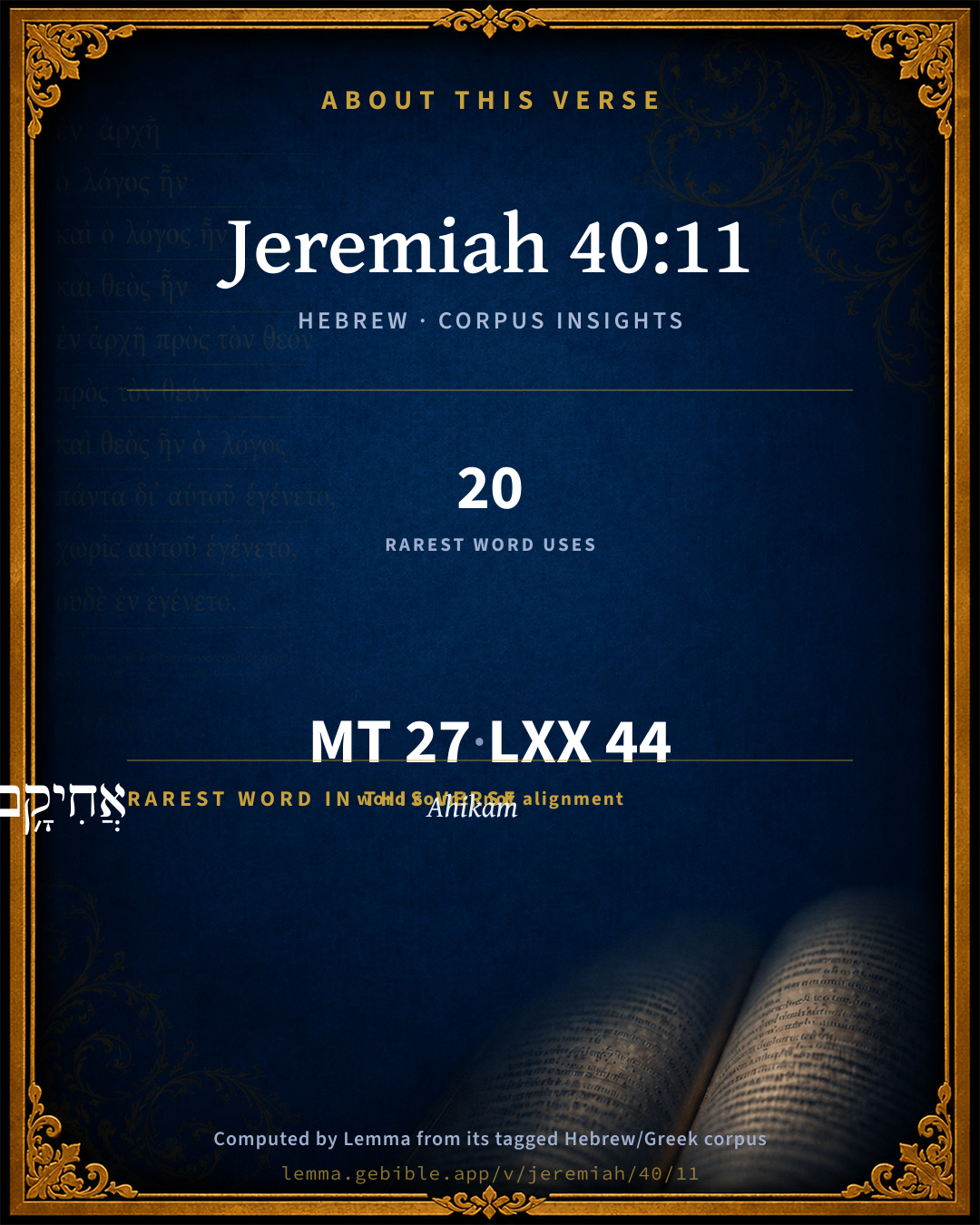
These counts appear in no published source. They are computed here, from the morphology-tagged text and Lemma’s own curated glosses. What Lemma adds →

27
words
22
distinct lemmas
Prophets
section

Notable vocabulary

The rarest word here is אֲחִיקָ֥ם Ahikam H296 — appearing just 20 times in the whole Hebrew Bible.

Shared distinctive vocabulary

אֲחִיקָ֥ם Ahikam H296 occurs in 20 verses of the Hebrew Bible. Also found in:

Grammatical profile

  • 3 verbs
  • 17 nouns
  • 1 preposition
  • 2 conjunctions
  • 4 particles

Verb forms

  • שָֽׁמְע֔וּ Qal · Perfect
  • נָתַ֧ן Qal · Perfect
  • הִפְקִ֣יד Hiphil · Perfect

Repetition

Words recur within this verse — often emphatic in Hebrew:

  • וּבִבְנֵֽי son H1121 ×3
  • כָּֽל all H3605 ×2
  • אֲשֶׁר which H834 ×2
  • כִּֽי that H3588 ×2

Hebrew & Septuagint length

In the original languages it is 27 Hebrew tokens and 44 Greek tokens — but the two are counted differently (Hebrew bundles its prefixes and suffixes into one token; the Greek is in lemma form), so that isn’t a like-for-like length.

Cross-references

16

Topical passages linked to Jeremiah 40:11 in the Treasury of Scripture Knowledge — connected by theme and wording, ordered by reader-vote popularity; previews shown in the World English Bible.

  • Isaiah 16:4 Let my outcasts dwell with you; as for Moab, be a covert to him from the face of the destroyer. For the extortioner is brought to nothing, destruction ceases, the oppressors are consumed out of the land.
  • Genesis 36:8 Esau lived in the hill country of Seir. Esau is Edom.
  • Numbers 22:1 The children of Israel traveled, and encamped in the plains of Moab beyond the Jordan at Jericho.
  • Numbers 25:1 Israel abode in Shittim; and the people began to play the prostitute with the daughters of Moab:
  • 1 Samuel 11:1 Then Nahash the Ammonite came up, and encamped against Jabesh Gilead: and all the men of Jabesh said to Nahash, Make a covenant with us, and we will serve you.
  • 1 Samuel 12:12 When you saw that Nahash the king of the children of Ammon came against you, you said to me, No, but a king shall reign over us; when Yahweh your God was your king.
  • Jeremiah 24:9 I will even give them up to be tossed back and forth among all the kingdoms of the earth for evil; to be a reproach and a proverb, a taunt and a curse, in all places where I shall drive them.
  • Ezekiel 5:3 You shall take of it a few in number, and bind them in your skirts.
  • Ezekiel 5:12 A third part of you shall die with the pestilence, and with famine shall they be consumed in the midst of you; and a third part shall fall by the sword round about you; and a third part I will scatter to all the winds, and will draw out a sword after them.
  • Ezekiel 25:2 Son of man, set your face toward the children of Ammon, and prophesy against them:
  • Ezekiel 25:6 For thus says the Lord Yahweh: Because you have clapped your hands, and stamped with the feet, and rejoiced with all the despite of your soul against the land of Israel;
  • Ezekiel 25:8 Thus says the Lord Yahweh: Because Moab and Seir say, Behold, the house of Judah is like all the nations;
  • Ezekiel 25:12 Thus says the Lord Yahweh: Because Edom has dealt against the house of Judah by taking vengeance, and has greatly offended, and revenged himself on them;
  • Ezekiel 35:5 Because you have had a perpetual enmity, and have given over the children of Israel to the power of the sword in the time of their calamity, in the time of the iniquity of the end;
  • Ezekiel 35:15 As you did rejoice over the inheritance of the house of Israel, because it was desolate, so will I do to you: you shall be desolate, Mount Seir, and all Edom, even all of it; and they shall know that I am Yahweh.
  • Obadiah 1:11–14 In the day that you stood on the other side, in the day that strangers carried away his substance, and foreigners entered into his gates, and cast lots for Jerusalem, even you were like one of them.

Cross-references courtesy of OpenBible.info (CC BY 4.0).

Hebrew and Greek witnesses Masoretic Hebrew ↔ Greek Septuagint

The same verse in the two great witnesses to the Old Testament, shown verse-for-verse.

These are two independent witnesses, not word-aligned to each other, and the Septuagint is shown in lemma (dictionary) form.

Hebrew Jeremiah 40:11 Masoretic · Westminster Leningrad Codex

וְגַ֣ם כָּֽל הַיְּהוּדִ֡ים אֲשֶׁר בְּמוֹאָ֣ב וּבִבְנֵֽי עַמּ֨וֹן וּבֶאֱד֜וֹם וַאֲשֶׁ֤ר בְּכָל הָֽאֲרָצוֹת֙ שָֽׁמְע֔וּ כִּֽי נָתַ֧ן מֶֽלֶךְ בָּבֶ֛ל שְׁאֵרִ֖ית לִֽיהוּדָ֑ה וְכִי֙ הִפְקִ֣יד עֲלֵיהֶ֔ם אֶת גְּדַלְיָ֖הוּ בֶּן אֲחִיקָ֥ם בֶּן שָׁפָֽן

Likewise when all the Jews who were in Moab, and among the children of Ammon, and in Edom, and who were in all the countries, heard that the king of Babylon had left a remnant of Judah, and that he had set over them Gedaliah the son of Ahikam, the son of Shaphan;

World English Bible · Public Domain

Greek LXX Structure differs

In the Septuagint, Jeremiah is about an eighth shorter than the Hebrew and arranges its material differently — the Oracles Against the Nations (Hebrew chapters 46–51) appear in the middle of the Greek book, after 25:13. Because the chapter and verse boundaries do not line up, a verse-for-verse comparison with the Hebrew is not shown.

A verse-for-verse comparison isn’t shown here because the chapters and verses don’t line up. Switch to the LXX edition with the MT / LXX toggle above to read the Greek directly.

Hebrew: Westminster Leningrad Codex (CC BY 4.0). Greek: Septuagint (public domain); English from a public-domain English Septuagint. How the Septuagint differs from the Hebrew →

Targum (Aramaic paraphrase)

1

The Targum is the ancient Jewish Aramaic paraphrase of the Hebrew Scriptures — an interpretive translation, not the Hebrew text itself. Onkelos (literal) and Pseudo-Jonathan (expansive) render the Torah, and Jonathan the Prophets. Coverage is partial: where no permissively-licensed English translation exists for a verse, only the Aramaic is shown. This is verse-level text, not a word-by-word alignment to the Hebrew.

  1. Targum Jonathan Prophets (Joshua–Malachi)
    וְאַף כָּל יְהוּדָאֵי דִי בְמוֹאָב וּבִבְנֵי עַמוֹן וּבֶאֱדוֹם וְדִי בְכָל מְדִינָתָא שְׁמָעוּ אֲרֵי שְׁבַק מַלְכָּא דְבָבֶל שְׁאָרָא לִדְבֵית יְהוּדָה וַאֲרֵי מַנִי עֲלֵיהוֹן יַת גְדַלְיָה בַּר אֲחִיקָם בַּר שָׁפָן:

    (no public-domain English translation for this verse)

    Targum Jonathan — Aramaic: “Mikraot Gedolot” (public domain). English: “Sefaria Community Translation” (CC0 1.0 (public-domain dedication)); “London "Chaldee Paraphrase," 1871” (public domain). Text via Sefaria.

Commentary

Notes on Jeremiah 40:11 from classic Christian and Jewish commentators (each source and its license shown beneath its notes). The classic Christian expositions comment on the surrounding passage and are grouped to its opening verse, so a note may address several verses; the Jewish commentaries on the Tanakh (Rashi and others) are per-verse, so they appear only where the commentator wrote on this verse.

Lemma curates 59 commentaries, every one of them public domain or Creative Commons licensed, each selected and text-cleaned for this edition rather than reprinted as found. About our sources →

Trapp's Complete Commentary

John Trapp

Jer 40:11 Likewise when all the Jews that [were] in Moab, and among the Ammonites, and in Edom, and that [were] in all the countries, heard that the king of Babylon had left a remnant of Judah, and that he had set over them Gedaliah the son of Ahikam the son of Shaphan;

Ver. 11. Likewise when all the Jews.] Who had fled into foreign parts, for help and safety.

John Trapp, A Commentary or Exposition upon All the Books of the Old and New Testament (1647–1656) — public domain. Text from a community e-Sword module.

Joseph Benson's Commentary

Jer 40:11-12. Likewise when all the Jews that were in Moab, &c. — Probably, upon the king of Babylon’s first invading Judea, many fled, and more as he proceeded in his conquests, overrunning the country; and it is likely, at the taking of the city, many escaped and fled into different countries, as they had opportunity, or judged this or that country would be the safest place of refuge. Some, therefore, fled to Moab, some to Ammon, some to Edom, and some to other countries; but when they heard that the king of Babylon had appointed a governor over the country of their own nation and religion, they returned, and, there being few people left in the land, which was of itself wonderfully fruitful, they gathered a great quantity of grapes and other summer-fruits, such as it produced.

Joseph Benson's Commentary on the Old and New Testaments (1811–1818) — public domain. Text from a community e-Sword module.

Tyndale Open Study Notes

Tyndale Open Resources

40:11-12 The new governor’s promises encouraged people of Judah who had fled to neighboring countries to move back to their land. The mention of a great harvest indicates that the Babylonians had not destroyed the crops when they laid siege to Jerusalem.

Tyndale Open Study Notes — © Tyndale Open Resources, licensed CC BY-SA 4.0. Text via the HelloAO Bible API.

Geneva Bible (1599)

Geneva Bible translators

Which were fled also for fear of the Chaldeans.

Geneva Bible (1599) marginal notes — public domain. Text via Bolls.life.

Jamieson, Fausset & Brown

Robert Jamieson, A. R. Fausset & David Brown

Jews . . . in Moab--who had fled thither at the approach of the Chaldeans. God thus tempered the severity of His vengeance that a remnant might be left.

Jamieson, Fausset & Brown — Commentary Critical and Explanatory on the Whole Bible (1871) — public domain (CC PDM 1.0). Text via the HelloAO Bible API.

John Calvin's Commentaries

The Prophet shews here, that except intestine wickedness had arisen, the condition of the people would have been endurable until the time of exile had elapsed. God had pre-fixed, as it has been before stated, seventy years. Nebuchadnezzar had already so withdrawn the flower of the people, that still some inhabitants remained, that the land might not be wholly naked and forsaken. For besides the poor who had been left, he has already told us, that some chief men came with their troops. He now adds that all the Jews, who had fled to neighboring nations, came to Geda-liah; some had taken refuge among the Ammonites, and some among the Moabites; these came and dwelt in the land. Then God did thus moderate the rigor of his vengeance, so that some remnants continued in Judea until the restoration of the whole people. But the perverseness of those who had before despised his favor, is on the other hand most clearly shewn. God no doubt designed to make manifest their extreme wickedness; for they not only despised the kindness of King Nebuchadnezzar, but rushed headlong to their own ruin; for their fury and madness led them on to kill their own leader, and thus all things were thrown into confusion, as this might have provoked the indignation of the conqueror to obliterate the very name of the people by slaying the captives as well as those who had been left in the land. To point out this was the object of the Prophet in this part of the chapter.

John Calvin's Commentaries (1540-1563) — public domain. Text from the Calvin Translation Society English edition (1840s-50s) via the Christian Classics Ethereal Library (ccel.org). Calvin's coverage is partial (roughly two-thirds of the Bible); uncommented books and verses are honest gaps, never fabricated. The 19th-century editor's footnotes and remarks are omitted so the notes are faithfully Calvin's own voice.

Ellicott's Commentary for English Readers

(11, 12) When all the Jews that were in Moab . . .—It lay in the nature of things that many of the dwellers in Judæa fled before the march of the Chaldæan armies, and took refuge in the neighbouring regions. In Rth_1:2, 1Sa_22:3, Isa_16:4, we find analogous instances of fugitives from Judah finding shelter in the Moabite country. These, on hearing of the generous policy adopted by Gedaliah, took courage and returned in time to profit by his permission to gather the produce which otherwise would have been left to perish on the soil.

A Bible Commentary for English Readers, edited by Charles John Ellicott (1878–1897) — public domain. Text from a community e-Sword module.

John Gill's Exposition

Likewise, when all the Jews that were in Moab,.... Who had fled thither, and to the places after mentioned, when the king of Babylon first invaded the land, and where they had continued unto this time:

and among the Ammonites, and in Edom, and that were in all the countries; in all other neighbouring countries, besides Moab, Ammon, and Edom; some fleeing one way, and some another, which lay nearest to their borders, or where they thought themselves safest: when they

heard that the king of Babylon had left a remnant of Judah; a few of their brethren, to cultivate the land, and repopulated it:

and that he had set over them Gedaliah the son of Ahikam the son of Shaphan; whom they knew to be a wise and good man; these were engaging motives to them to return to their own land, being more desirable to live in than any other, could they enjoy peace and safety; and to dwell with their brethren, their own countrymen, and of the same religion with them, was more eligible than to dwell in foreign idolatrous countries; and especially since there was a government established to protect and defend them, and that in the hands of so worthy a prince as Gedaliah.

John Gill's Exposition of the Whole Bible (1746–1763) — public domain (CC PDM 1.0). Text via the HelloAO Bible API.

Haydock's Catholic Bible Commentary

Countries. They had fled to avoid the taxes, &c., but found no redress, Lamentations i. 3.

George Leo Haydock (1774–1849), Haydock's Catholic Family Bible and Commentary, 1859 edition — public domain. Excludes Psalms (Douay-Rheims chapter numbering differs from Protestant) and Deuterocanonical books (Catholic canon only).

Whedon's Commentary on the Bible

Daniel D. Whedon

11. All the Jews that were in Moab — They had betaken themselves thither as a place of refuge.

Daniel D. Whedon (gen. ed.), Commentary on the Old and New Testaments (1874–1909) — public domain. Text from a community e-Sword module.

unfoldingWord translationNotes

Door43 World Missions Community

remnant of Judah

"remnant of the people of Judah"

had appointed ... over them

"had put ... in charge of them"

Gedaliah son of Ahikam son of Shaphan

See how you translated this in Jeremiah 39:14.

over them

"over the people of Judah"

where they had been scattered

This can be translated in active form. AT: "where the Babylonians had driven them" (See: Active or Passive)

wine and summer fruit in great abundance

"a huge amount of grapes and summer fruit"

summer fruit

"fruit that becomes ripe during the summer." See how you translated this in Jeremiah 40:10.

translationWords

kingdom of Judah

Moab

people group

Ammon

Edom

king

Babylon

remnant

appoint

Mizpah

harvest

wine

fruit

unfoldingWord translationNotes — © Distant Shores Media and the Door43 World Missions Community, licensed CC BY-SA 4.0. Source: git.door43.org/Door43/en_tn.

Lesson kit

Teaching starters — assembled from the data on this page, not authored interpretation. Every prompt links to the verse data it draws on. Edit before teaching.

Jeremiah, in the Prophets, opens this verse with 27 words (22 distinct Hebrew lemmas). Its most distinctive word is ʼĂchîyqâm (“Ahikam”). A historical commentator’s framing appears above. Read the whole chapter for the surrounding context.

Discussion questions

  1. What does “Ahikam” (ʼĂchîyqâm) contribute to the verse as a whole?
  2. How does 2 Kings 22:12, which shares the word «Ahikam», read alongside this verse?
  3. What does the repetition of “son” (3× in this one verse) do in this verse?
  4. These translations render this verse differently. What is at stake in choosing one wording over another?
  5. «שָֽׁמְע֔וּ» is a Qal Perfect verb. How does that grammatical form shape the action described?
  6. Compare how Trapp's Complete Commentary and Joseph Benson's Commentary read this verse. Where do they agree or differ?

Things to notice

Reading settings

Reading text

Shown beneath each verse's original-language words.

Old Testament
Old Testament edition

Read the OT as the Masoretic Hebrew (MT) or the Greek Septuagint (LXX).

English shown for the Greek Septuagint (in the Hebrew ↔ Greek comparison).

Comparing translations? Open the Compare panel on any verse page to stack up to four side by side.