
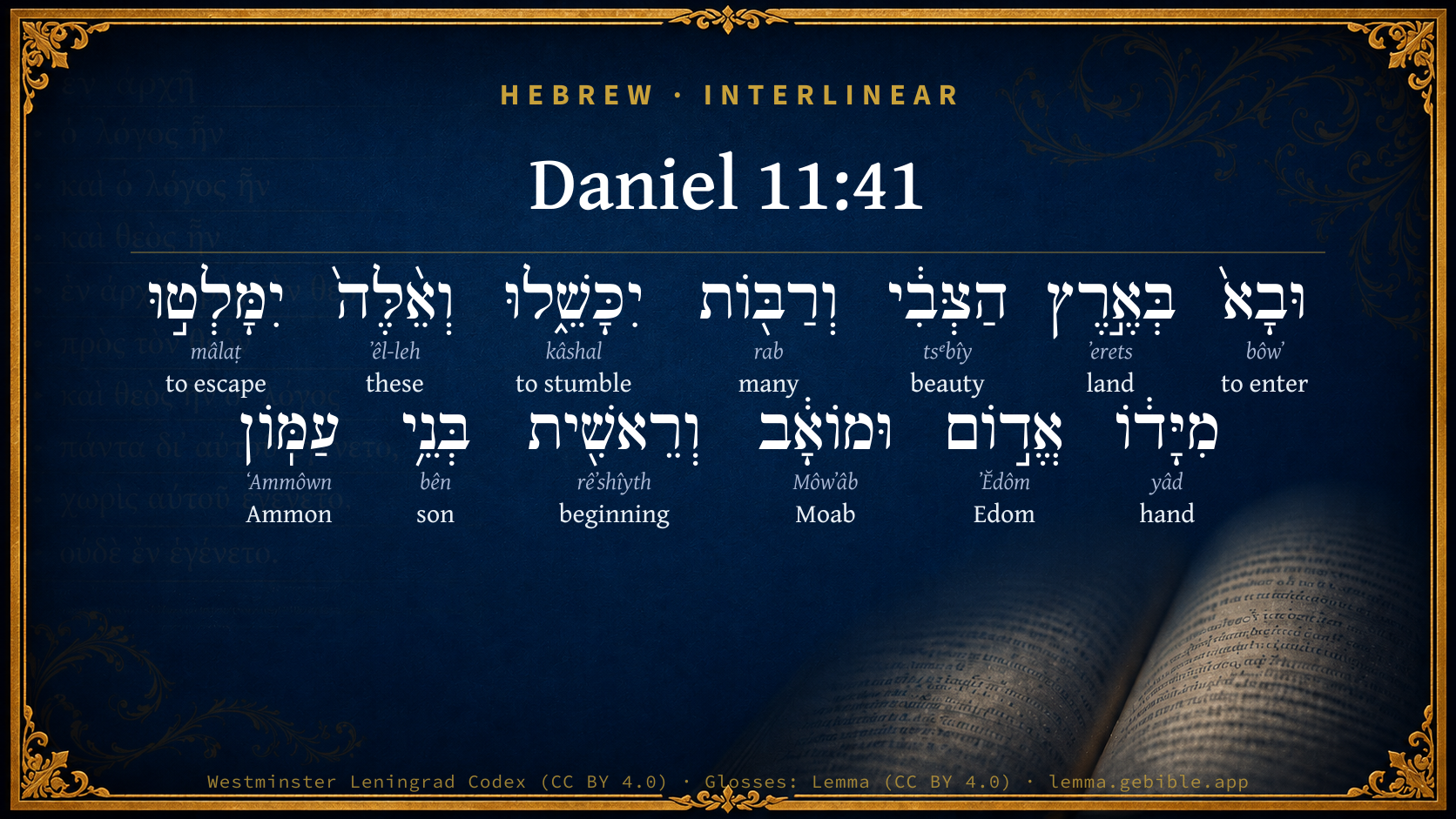
Daniel 11:41

Hebrew (Westminster Leningrad Codex) Daniel 11:41 appears in the Hebrew Old Testament. The text above is from the Westminster Leningrad Codex. Each word links to its Strong’s number, a concise gloss, and parsing drawn from the Open Scriptures Hebrew Bible morphology. Click any word for its full Brown-Driver-Briggs (BDB) entry.
Download image
Cite this verse

Daniel 11:41 (World English Bible). Public Domain. Lemma interlinear Bible study tool, https://lemma.gebible.app/v/daniel/11/41.

Show BibTeX & RIS
BibTeX
RIS
English Translation
He shall enter also into the glorious land, and many [countries] shall be overthrown; but these shall be delivered out of his hand: Edom, and Moab, and the chief of the children of Ammon.
World English Bible · Public Domain
Download a study sheet

One document with this verse’s original text, its word-by-word gloss line, the meaning frame, cross-references with their text, attributed commentary, and full source and license credits — printable, and it pastes into notes with its structure intact.

This verse Autodidact and up

Study sheet (.html) Plain text (.txt)

A passage Seminary Student

Up to 50 verses in one chapter. A passage sheet keeps up to 6 commentary sources and 12 cross-references per verse, in the order this page ranks them, and says so on the sheet whenever that leaves anything out. Ask for a single verse and you get the Autodidact verse sheet above.

Everything on this page stays free to read, with no account — the sheet is a download of what is already on screen, not access to it.

Want to remove ads? Support Godless Engineer
Compare translations 3

The same verse in 3 English versions, stacked beneath the original-language interlinear above. Click any original word for its lexicon entry.

Each is an independent rendering of the whole verse — the interlinear is not word-aligned to these translations.

Highlighted words mark where these versions differ — a whole-verse word diff, not a word-by-word alignment.

  • World English Bible Public Domain
    He shall enter also into the glorious land, and many [countries] shall be overthrown; but these shall be delivered out of his hand: Edom, and Moab, and the chief of the children of Ammon.
  • King James Version Public Domain
    He shall enter also into the glorious land, and many countries shall be overthrown: but these shall escape out of his hand, even Edom, and Moab, and the chief of the children of Ammon.
  • unfoldingWord Literal Text CC BY-SA 4.0
    He will come into the Beautiful Land, and many will fall. But these will escape from his hand: Edom, Moab, and the main part of the sons of Ammon.

unfoldingWord Literal Text — © unfoldingWord, licensed CC BY-SA 4.0. Word-aligned USFM3 via Door43 (git.door43.org/unfoldingWord/en_ult).

Versions to compare (up to 4)

3 of 4 selected

Show all 18 translations

Every available English version of this verse, each an independent rendering of the whole verse.

  • World English Bible Public Domain
    He shall enter also into the glorious land, and many [countries] shall be overthrown; but these shall be delivered out of his hand: Edom, and Moab, and the chief of the children of Ammon.
  • Berean Standard Bible Public Domain
    He will also invade the Beautiful Land, and many countries will fall. But these will be delivered from his hand: Edom, Moab, and the leaders of the Ammonites.
  • Majority Standard Bible Public Domain
    He will also invade the Beautiful Land, and many countries will fall. But these will be delivered from his hand: Edom, Moab, and the leaders of the Ammonites.
  • King James Version Public Domain
    He shall enter also into the glorious land, and many countries shall be overthrown: but these shall escape out of his hand, even Edom, and Moab, and the chief of the children of Ammon.
  • American Standard Version (1901) Public Domain
    He shall enter also into the glorious land, and many `countries' shall be overthrown; but these shall be delivered out of his hand: Edom, and Moab, and the chief of the children of Ammon.
  • Revised Version (1885) Public Domain
    He shall enter also into the glorious land, and many countries shall be overthrown: but these shall be delivered out of his hand, Edom, and Moab, and the chief of the children of Ammon.
  • Geneva Bible (1599) Public Domain
    He shall enter also into the pleasant land, and many countreis shalbe ouerthrowen: but these shall escape out of his hand, euen Edom and Moab, and the chiefe of the children of Ammon.
  • Douay-Rheims (1899) Public Domain
    And he shall enter into the glorious land, and many shall fall: and these only shall be saved out of his hand, Edom, and Moab, and the principality of the children of Ammon.
  • Young's Literal Translation Public Domain
    and hath come into the desirable land, and many do stumble, and these escape from his hand: Edom, and Moab, and the chief of the sons of Ammon.
  • Literal Standard Version CC BY-SA 4.0
    and has come into the desirable land, and many stumble, and these escape from his hand: Edom, and Moab, and the chief of the sons of Ammon.
  • Unlocked Literal Bible CC BY-SA 4.0
    He will go into the land of beauty, and tens of thousands of Israelites will fall. But these will escape from his hand: Edom, Moab, and the remainder of the people of Ammon.
  • unfoldingWord Literal Text CC BY-SA 4.0
    He will come into the Beautiful Land, and many will fall. But these will escape from his hand: Edom, Moab, and the main part of the sons of Ammon.
  • Darby Bible Public Domain
    And he shall enter into the land of beauty, and many [countries] shall be overthrown; but these shall escape out of his hand: Edom, and Moab, and the chief of the children of Ammon.
  • World Messianic Bible Public Domain
    He will enter also into the glorious land, and many countries will be overthrown; but these will be delivered out of his hand: Edom, Moab, and the chief of the children of Ammon.
  • Webster's Bible Public Domain
    He shall enter also into the glorious land, and many countries shall be overthrown: but these shall escape out of his hand, even Edom, and Moab, and the chief of the children of Ammon.
  • Free Bible Version CC BY-SA 4.0
    He will invade the Beautiful Land and kill many people there. However, Moab, Edom, and most of the Ammonites will escape his power.
  • Bible in Basic English Public Domain
    And he will come into the beautiful land, and tens of thousands will be overcome: but these will be kept from falling into his hands: Edom and Moab and the chief of the children of Ammon.
  • JPS Tanakh (1917) Public Domain
    He shall enter also into the beauteous land, and many countries shall be overthrown; but these shall be delivered out of his hand, Edom, and Moab, and the chief of the children of Ammon.

Literal Standard Version (2020), Covenant Press — licensed CC BY-SA 4.0. Text via the HelloAO Bible API (eBible.org). Unlocked Literal Bible (unfoldingWord) — licensed CC BY-SA 4.0. Text via the HelloAO Bible API (eBible.org). unfoldingWord Literal Text — © unfoldingWord, licensed CC BY-SA 4.0. Word-aligned USFM3 via Door43 (git.door43.org/unfoldingWord/en_ult). Free Bible Version, Dr. Jonathan Gallagher — licensed CC BY-SA 4.0. Text via the HelloAO Bible API (eBible.org).

Word by word

More ways to search: Search by grammar → Find every occurrence → Compare this word →

Practice this passage: Drill this verse → Learn its vocabulary →

הַצְּבִ֔י
tsᵉbîy
H6643
“the · beauty”
Particle, Definite Article + Noun, Common, Masculine, Singular, Absolute
Part of Speech
Particle + Noun
Type
Common
Gender
Masculine
Number
Singular
State
Absolute
Full BDB Definition

Origin: from H6638 in the sense of prominence

TWOT: 1869a , 1870a

beauty, glory, honour - beauty, decoration - honour - roebuck, gazelle - perhaps an extinct animal, exact meaning unknown
  1. וּבָא֙ bôwʼ H935 “and · to enter” Conjunction + Verb, Qal, Sequential Perfect, 3rd Person, Masculine, Singular
  2. בְּאֶ֣רֶץ ʼerets H776 “in/at · land of” Preposition + Noun, Common, Both, Singular, Construct
  3. וְרַבּ֖וֹת rab H7227 “and · many” Conjunction + Adjective, Adjective, Feminine, Plural, Absolute
  4. יִכָּשֵׁ֑לוּ kâshal H3782 “to stumble” Verb, Niphal, Imperfect, 3rd Person, Masculine, Plural
  5. וְאֵ֨לֶּה֙ ʼêl-leh H428 “and · these” Conjunction + Pronoun, Demonstrative, Common, Plural
  6. יִמָּלְט֣וּ mâlaṭ H4422 “to escape” Verb, Niphal, Imperfect, 3rd Person, Masculine, Plural
  7. מִיָּד֔וֹ yâd H3027 “from · hand · his” Preposition + Noun, Common, Both, Singular, Construct + Suffix, Personal, 3rd Person, Masculine, Singular
  8. אֱד֣וֹם ʼĔdôm H123 “Edom” Noun, Proper
  9. וּמוֹאָ֔ב Môwʼâb H4124 “and · Moab” Conjunction + Noun, Proper
  10. וְרֵאשִׁ֖ית rêʼshîyth H7225 “and · beginning of” Conjunction + Noun, Common, Feminine, Singular, Construct
  11. בְּנֵ֥י bên H1121 “sons of” Noun, Common, Masculine, Plural, Construct
  12. עַמּֽוֹן ʻAmmôwn H5983 “Ammon” Noun, Proper

About this verse

These counts appear in no published source. They are computed here, from the morphology-tagged text and Lemma’s own curated glosses. What Lemma adds →

13
words
13
distinct lemmas
Prophets
section

Shared distinctive vocabulary

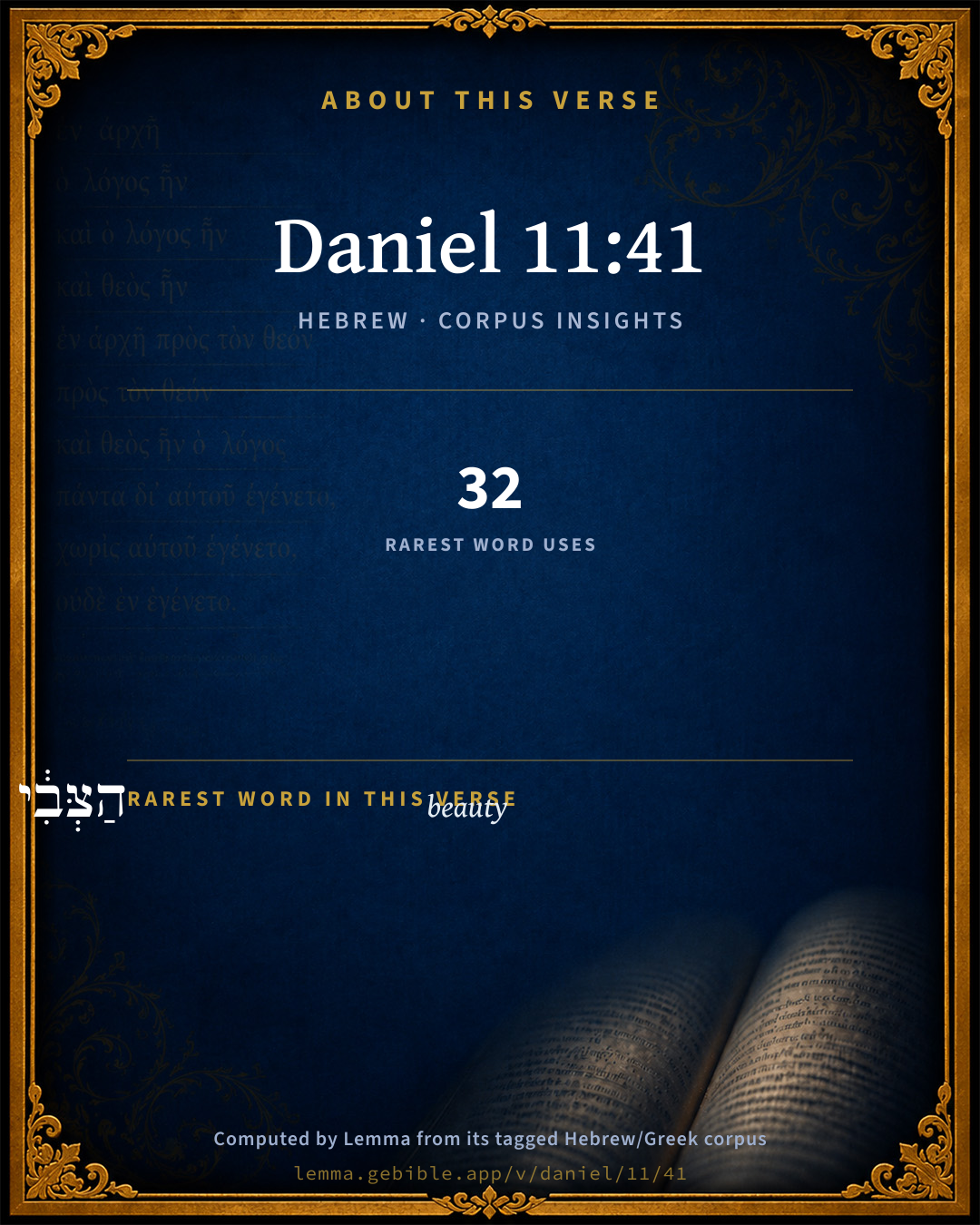
הַצְּבִ֔י beauty H6643 occurs in 32 verses of the Hebrew Bible. Also found in:

Grammatical profile

  • 3 verbs
  • 8 nouns
  • 1 adjective
  • 1 pronoun

Verb forms

  • וּבָא֙ Qal · Sequential Perfect
  • יִכָּשֵׁ֑לוּ Niphal · Imperfect
  • יִמָּלְט֣וּ Niphal · Imperfect

Hebrew & Septuagint length

In English translation the verse runs 34 words from the Hebrew and 32 from the Septuagint (LXX English) — closely comparable.

A rough comparison of the two English renderings, which tokenize alike — not a word-level alignment.

Word counts can differ between the Hebrew and the Greek without any difference in meaning — e.g. the Hebrew direct-object marker אֵת has no separate Greek word, and Greek often adds the article ὁ.

Cross-references

8

Topical passages linked to Daniel 11:41 in the Treasury of Scripture Knowledge — connected by theme and wording, ordered by reader-vote popularity; previews shown in the World English Bible.

  • Jeremiah 48:47 Yet will I bring back the captivity of Moab in the latter days, says Yahweh. Thus far is the judgment of Moab.
  • Jeremiah 49:6 But afterward I will bring back the captivity of the children of Ammon, says Yahweh.
  • Isaiah 11:13–15 The envy also of Ephraim shall depart, and those who vex Judah shall be cut off: Ephraim shall not envy Judah, and Judah shall not vex Ephraim.
  • Jeremiah 9:26 Egypt, and Judah, and Edom, and the children of Ammon, and Moab, and all that have the corners [of their hair] cut off, who dwell in the wilderness; for all the nations are uncircumcised, and all the house of Israel are uncircumcised in heart.
  • Ezekiel 38:8–13 After many days you shall be visited: in the latter years you shall come into the land that is brought back from the sword, that is gathered out of many peoples, on the mountains of Israel, which have been a continual waste; but it is brought forth out of the peoples, and they shall dwell securely, all of them.
  • Daniel 8:9 Out of one of them came forth a little horn, which grew exceeding great, toward the south, and toward the east, and toward the glorious [land].
  • Daniel 11:16 But he who comes against him shall do according to his own will, and none shall stand before him; and he shall stand in the glorious land, and in his hand shall be destruction.
  • Daniel 11:45 He shall plant the tents of his palace between the sea and the glorious holy mountain; yet he shall come to his end, and none shall help him.

Cross-references courtesy of OpenBible.info (CC BY 4.0).

Hebrew and Greek witnesses Masoretic Hebrew ↔ Greek Septuagint

The same verse in the two great witnesses to the Old Testament, shown verse-for-verse.

These are two independent witnesses, not word-aligned to each other, and the Septuagint is shown in lemma (dictionary) form.

Hebrew Daniel 11:41 Masoretic · Westminster Leningrad Codex

וּבָא֙ בְּאֶ֣רֶץ הַצְּבִ֔י וְרַבּ֖וֹת יִכָּשֵׁ֑לוּ וְאֵ֨לֶּה֙ יִמָּלְט֣וּ מִיָּד֔וֹ אֱד֣וֹם וּמוֹאָ֔ב וְרֵאשִׁ֖ית בְּנֵ֥י עַמּֽוֹן

He shall enter also into the glorious land, and many [countries] shall be overthrown; but these shall be delivered out of his hand: Edom, and Moab, and the chief of the children of Ammon.

World English Bible · Public Domain

Greek LXX Daniel 11:41 Septuagint · lemma form

καί ἐπιἔρχομαι εἰς ὁ χώρα ἐγώ

and he shall enter into the land of beauty, and many shall fail: but these shall escape out of his hand, Edom, and Moab, and the chief of the children of Ammon.

LXX2012 (modern English Septuagint) · Public Domain

On this verse, The Pulpit Commentary discusses the Septuagint’s reading. Read the note in Commentary ↓

Hebrew: Westminster Leningrad Codex (CC BY 4.0). Greek: Septuagint (public domain); English from LXX2012 (modern English Septuagint) (Public Domain). How the Septuagint differs from the Hebrew →

Commentary

Notes on Daniel 11:41 from classic Christian and Jewish commentators (each source and its license shown beneath its notes). The classic Christian expositions comment on the surrounding passage and are grouped to its opening verse, so a note may address several verses; the Jewish commentaries on the Tanakh (Rashi and others) are per-verse, so they appear only where the commentator wrote on this verse.

Lemma curates 59 commentaries, every one of them public domain or Creative Commons licensed, each selected and text-cleaned for this edition rather than reprinted as found. About our sources →

Trapp's Complete Commentary

John Trapp

Dan 11:41 He shall enter also into the glorious land, and many [countries] shall be overthrown: but these shall escape out of his hand, [even] Edom, and Moab, and the chief of the children of Ammon.

Ver. 41. He shall enter also into the glorious land.] Judea, {as Dan 11:16} but for no good. In Greece they say, Where the Grand Seignior once setteth his foot, there groweth no more grass.

But they shall escape.] Because they shall side with him.

John Trapp, A Commentary or Exposition upon All the Books of the Old and New Testament (1647–1656) — public domain. Text from a community e-Sword module.

Joseph Benson's Commentary

Dan 11:41. He shall enter into the glorious or pleasant land — By this title it is beyond a doubt Judea is signified, chap. Dan 8:9, and therefore it is reasonable to conclude Judea is meant here; and this seems to be spoken of Antiochus’s sending his captains Apollonius, Lysius, and Gorgias into the land of Judea, of which we have an account in the books of the Maccabees; for a king is said to enter a country when he sends his armies into it, though he be not there in person. And many countries shall be overthrown — Many of the neighbouring nations shall be cut off. But these shall escape out of his hand — These shall not be destroyed. Edom and Moab, and the children of Ammon — Grotius expounds the words to this sense, That Antiochus did not make war upon these people, because they readily complied with his commands, and joined with him against the Jews: for which cause Judas Maccabees made war upon them: see 1Ma 5:3-4.

Joseph Benson's Commentary on the Old and New Testaments (1811–1818) — public domain. Text from a community e-Sword module.

Tyndale Open Study Notes

Tyndale Open Resources

11:41 the glorious land of Israel: Israel (cp. 8:9; 11:16) is again the center of attack by an evil king. • Moab, Edom, and Ammon were nations surrounding ancient Israel and Judah.

Tyndale Open Study Notes — © Tyndale Open Resources, licensed CC BY-SA 4.0. Text via the HelloAO Bible API.

Geneva Bible (1599)

Geneva Bible translators

The Angel forewarneth the Jews that when they should see the Romans invade them, and that the wicked should escape their hands, that then they should not think but that all this was done by God’s providence, forasmuch as he warned them of it so long afore, and therefore he would still preserve them.

Geneva Bible (1599) marginal notes — public domain. Text via Bolls.life.

Jamieson, Fausset & Brown

Robert Jamieson, A. R. Fausset & David Brown

Antiochus, according to PORPHYRY, marching against Ptolemy, though he turned from his course to wreak his wrath on the Jews, did not meddle with Edom, Moab, and Ammon on the side of Judea. In 1 Maccabees 4:61; 5:3; &c., it is stated that he used their help in crushing the Jews, of whom they were the ancient enemies. Compare Isa 11:14, as to Israel's future retribution, just as the Maccabees made war on them as the friends of Antiochus (1 Maccabees 5:1-68). Antitypically, the Turks under Selim entered Jerusalem on their way to Egypt, and retain "the glorious land" of Palestine to this day. But they never could conquer the Arabs, who are akin to Edom, Moab, and Ammon (Gen 16:12). So in the case of the final Antichrist.

Jamieson, Fausset & Brown — Commentary Critical and Explanatory on the Whole Bible (1871) — public domain (CC PDM 1.0). Text via the HelloAO Bible API.

Adam Clarke's Commentary

Verse 41. He shall enter also into the glorious land] Entirely subdue Judea.

And many countries shall be overthrown] Aleppo, Damascus, Gaza, and many other cities were forced to submit to them; and they hold them still.

But these shalt escape - Edom and Moab, and the chief of the children of Ammon.] These and other Arabians they have never been able to subdue. They still occupy the deserts; and receive a yearly pension of forty thousand crowns of gold from the Ottoman emperors, to permit the caravans, with the pilgrims for Mecca, to have a free passage.

Adam Clarke's Commentary on the Bible (1810–1826) — public domain. Text from a community e-Sword/MySword module.

John Calvin's Commentaries

The land of Judea is called the pleasant or desirable land, because God thought it worthy of his peculiar favor. He chose it for his dwelling-place, called it his resting-place, and caused his blessing to remain in it. In this verse also, regions are treated, and not merely cities, as the regions of Edom and of Moab. After the angel had briefly predicted the occurrence of the most grievous wars with the Romans, he now adds what he had briefly commenced in the last verse, — namely their becoming conquerors of all nations. They shall come, he says, into the desirable land This is the reason why the angel prophesies of the Roman empire, for he was not sent to explain to Daniel the history of the whole world, but to retain the faithful in their allegiance, and to persuade them under the most harassing convulsions to remain under the protection and guardianship of God. For this reason he states, — they shall come into the desirable land This would be a dreadful temptation, and might overthrow all feelings of piety, as the Jews would be harassed on all sides, first by the Syrians and then by the Egyptians. And we know with what cruelty Antiochus endeavored not only to oppress but utterly to blot out the whole nation. Neither the Syrians nor the Egyptians spared them. The Romans came almost from the other side of the globe; at first they made an alliance with these states, and then entered Judea as enemies. Who would have supposed that region under God’s protection, when it was so exposed to all attacks of robbery and oppression? Hence it was necessary to admonish the faithful not to fall away through this utter confusion.

They shall come, then, into the desirable land, and many regions shall fall; meaning, no hope should remain for the Jews after the arrival of the Romans, as victory was already prepared to their hand. The angel’s setting before the faithful this material for despair was not likely to induce confidence and comfort, but as they were aware of these divine predictions, they knew also that the remedy was prepared by the same God who had admonished them by means of the angel. It was in his power to save his Church from a hundred deaths. This prophecy became an inestimable treasury, inspiring the faithful with the hope of the promised deliverance. The angel will afterwards add the promise intended to support and strengthen and revive their drooping spirits. But he here announces that God’s aid should not immediately appear, because he would give the Romans full permission to exercise a cruel sway, tyranny, and robbery, throughout the whole of Asia and the East. He says, The lands of Edom, Moab, and a portion of Ammon should escape from their slaughter This trial would in no slight degree affect the minds of the pious: What does he mean? He suffers the land that he promised should be at rest, to be now seized and laid waste by its enemies! The land of Moab is at peace and enjoys the greatest tranquillity, and the condition of the sons of Ammon is prosperous! We should here bear in mind what the prophets say of these lands: Esau was banished into the rugged mountains, and God assigned to the Moabites a territory beyond the borders of the land of blessings. (Malachi 1:3.) The Jews alone had any peculiar right and privilege to claim that territory in which the Lord had promised them perfect repose. Now, when Judea is laid waste and their foes according to their pleasure not only seize upon everything valuable in the city and the country, but seem to have a special permission to ravage the land at their will, what could the Jews conjecture? The angel therefore meets this objection, and alleviates these feelings of anxiety to which the faithful could be subject from such slaughters. He states that the territories of Edom and Moab, and of the children of Ammon, should be tranquil and safe from those calamities. By the expression, to the beginning of the children of Ammon, he most probably refers to that, retreat whence the Ammonites originated. For doubtless the Romans would not have spared the Ammonites unless they had been concealed among the mountains, for every district in the neighborhood of Judea was subject to the same distress. Those who interpret this passage of Antichrist, suppose safety to be extended only to that portion of the faithful who shall escape from the world and take refuge in the deserts. But there is no reason in this opinion, and it is sufficient to retain the sense already proposed as the genuine one. He afterwards adds, The Romans should send their army into the land, and even in the land of Egypt, they should not escape The angel without doubt here treats of the numerous victories which the Romans should obtain in a short time. They carried on war with Mithridates for a long period, and then Asia was almost lost; but they soon afterwards began to extend their power, first over all Asia Minor, and then over Syria; Armenia was next added to their sway, and Egypt after that: meanwhile this was but a moderate addition, till at length they ruled over the Persians, and thus their power became formidable. Wherefore this prophet was fulfilled by their extending their power over many regions, and by the land of Egypt becoming a portion of their booty It follows:

John Calvin's Commentaries (1540-1563) — public domain. Text from the Calvin Translation Society English edition (1840s-50s) via the Christian Classics Ethereal Library (ccel.org). Calvin's coverage is partial (roughly two-thirds of the Bible); uncommented books and verses are honest gaps, never fabricated. The 19th-century editor's footnotes and remarks are omitted so the notes are faithfully Calvin's own voice.

Ellicott's Commentary for English Readers

(41) The glorious land.—See Dan_11:16. On the occasion of his hasty march against Egypt, while passing through Palestine, the king takes the shortest route, avoiding the three tribes which had been distinguished by their hostility towards the people of Israel. It is remarkable that these nations (two of which appear as figures of Antichrist, Isa_25:10; Isa_63:1) should escape, while other nations fell before Antichrist. It is also noteworthy that these three tribes are called nations, for after the return from the exile it appears that they ceased to have any distinct national existence. As tribes they had some considerable power, taking the part of Antiochus in the Maccabee wars. (See 1Ma_3:10; 1Ma_5:1-8.) Judas also fortified Zion against the Idumæans.

The chief of—i.e., the best of them. (Comp. Num_24:20.)

A Bible Commentary for English Readers, edited by Charles John Ellicott (1878–1897) — public domain. Text from a community e-Sword module.

The Cambridge Bible for Schools and Colleges

gen. ed. J. J. S. Perowne

41. the beauteous land] the land of Israel, as Dan_11:16.

shall be overthrown] lit. shall stumble (Dan_11:14; Dan_11:19; Dan_11:33; Dan_11:35), i.e. be ruined: cf., for the expression, Isa_3:8 ‘Jerusalem hath stumbled’ (A.V., R.V., is ruined). The word for ‘many’ is fem.: hence ‘countries’ must be understood from Dan_11:40, though it is, of course, their inhabitants who are really meant. Bevan, Behrmann, Marti, Kamph., and Prince (with the change of a point) read ‘tens of thousands shall be overthrown’ (cf. Dan_11:12).

Some countries will, however, escape; in particular, three of Israel’s ancient foes, of whom at least Edom and the Ammonites shewed hostility against the Jews at this time (cf. 1Ma_4:61; 1Ma_5:1-8). Jason, the renegade high-priest, twice found an asylum with the Ammonites (2Ma_4:26; 2Ma_5:7).

escape] be delivered (R.V.). (Escape is needed for a different Heb. word in Dan_11:42.)

the chief of, &c.] i.e. the principal part of them. Cf., for the word, Num_24:20; Jer_49:35; Amo_6:1.

The Cambridge Bible for Schools and Colleges (gen. ed. J. J. S. Perowne; Cambridge University Press, 1878–1918) — public domain. Text from a community e-Sword module.

John Gill's Exposition

He shall enter also into the glorious land,.... The land of Israel, as the Syriac version expresses it; or the land of Judea, which the Turk entered into, and got possession of, and still retains, notwithstanding all the attempts made by the European princes to get it out of his hand:

and many countries shall be overthrown; of which the eastern empire listed as Bithynia, Mysia, Lycaonia, Phrygia, and Carlo, and to the Hellesport and the Euxine sea, conquered by Ottoman and his son Urchenes; Callipolis, Hadrianople, by Amurath; Thessalia, Macedonia, Phocis, Mysia, and Bulgaria, by Bajazet; and at last Constantinople itself by Mahomet the second, which put an end to the eastern empire: though perhaps those countries and places may be here more especially meant which lay near Judea, and fell into the hands of the Turk when that did; as Comagene of Syria, Antioch, Damascus, Tripolis, Berytus, Sidon, and all Palestine, and all the sea coast to Egypt:

but these shall escape out of his hand, even Edom and Moab, and the chief of the children of Ammon; by which according to Jerom is meant Arabia, left untouched by him; so Mr. Mede interprets them of Arabia and Petraea, which some of the above people formerly inhabited, as Jacchiades observes; and which Arabians were never subdued by the Turks, but are independent of them to this day; yea, the Turks pay a yearly tribute to them for the passage of their pilgrims to Mecca, as well as pay for the canyons that pass through their country, as is affirmed (z) by modern travellers; and yet it may be observed that these countries did not escape Antiochus, who particularly took Rabbath, the metropolis of Ammon.

(z) See Dr. Newton's Dissertations on the Prophecies. p. 53, 54, &c.

John Gill's Exposition of the Whole Bible (1746–1763) — public domain (CC PDM 1.0). Text via the HelloAO Bible API.

Albert Barnes' Notes on the Bible

He shall enter also into the glorious land - Margin, “land of delight,” or ornament, or goodly land. The Hebrew is, “land of ornament;” that is, of beauty, to wit, Palestine, or the holy land. The same word is used in Dan 11:16. See the note at that place. As to the fact that he would invade that land, see the notes at Dan 11:28, Dan 11:31-33.

And many countries shall be overthrown - The word countries here is supplied by the translators. The Hebrew word רבות rabôth may denote “many things,” and might refer to cities, dwellings, institutions, etc. The meaning is, that he would produce wide devastation, which was true of Antiochus, when, either personally or by his generals, he invaded the land of Palestine. See the notes above.

But these shall escape out of his hand ... - Intent on his work in Palestine, and having enough there to occupy his attention, the neighboring lands of Edom, Moab, and Ammon shall not be molested by him. The wrath of Antiochus was particularly against the Jews, and it is not a little remarkable that no mention is made of his invading these adjacent countries. The route which he pursued was to Egypt, along the shores of the Mediterranean, and though he turned from his course to wreak his vengeance on the Jews, yet it does not appear that he carried his arms farther from the main line of his march. Antiochus was principally engaged with the Egyptians and the Romans; he was also engaged with the Jews, for Palestine had been the battlefield - the main place and object of contention between the king of Syria and the king of Egypt. Moab, and Edom, and Ammon were comparatively remote from the scene of conflict, and were left unmolested. It would seem most probable, also, that these nations were friendly to Antiochus, and were in alliance with him, or at least it is certain that they were hostile to the Jews, which, for the purposes of Antiochus, amounted to the same thing. Judas Maccabeus is represented as engaged with them in war, and consequently they must have either been in alliance with Antiochus, or in some other way promoting his interests. See 1 Macc. 4:61; 5:3, 6-9. These countries were, therefore, in fact, secure from the invasions of Antiochus, and so far the prophecy was literally fulfilled. It may be added

(a), that no occurrence since that time has taken place to which the prophecy can with propriety be applied; and

(b), that no natural sagacity could have foreseen this, and that, therefore, if the prediction was uttered before the days of Antiochus, it must have been the result of Divine inspiration.

As to the former of these remarks (a), if anyone is desirous of seeing how forced and unnatural must be any attempt to apply this to any other times than those of Antiochus, he has only to consult Bishop Newton on the Prophecies (pp. 311-313), who explains it as referring to the Ottoman empire, and to the fact that though the Turks have been able to take Jerusalem, they have never been able to subdue the Arabians, the Moabites, or the Ammonites. Aleppo, Damascus, and Gaza, says he, were forced to submit, but these other places “escaped out of the hands” of the Turks. As to the other remark (b), if one, writing after the events, had intended to give a brief and striking view of what Antiochus did, he could not find better language to express it than to say in the words of the passage before us, “He shall enter also into the glorious land, and many countries shall be overthrown; but these shall escape out of his hand, even Edom, and Moab, and the chief of the children of Ammon.” But it is clear that there is no natural sagacity by which this could be foreseen. There was nothing in the character of those nations, or in the nature of the case, which would lead one to anticipate it - for the presumption would be, that if a desolating war were waged on Palestine by a cruel conqueror, his ravages would be extended to the neighboring countries also.

Albert Barnes' Notes on the Bible (1834–1885) — public domain. Text from a community e-Sword/MySword module.

Haydock's Catholic Bible Commentary

Land; Egypt, or rather Judea. (Calmet) --- Ammon. He will not divide his forces. (St. Jerome)

George Leo Haydock (1774–1849), Haydock's Catholic Family Bible and Commentary, 1859 edition — public domain. Excludes Psalms (Douay-Rheims chapter numbering differs from Protestant) and Deuterocanonical books (Catholic canon only).

Matthew Poole's English Annotations

When the Turk should subdue Judea, those people of Edom, Moab, and Ammon shall be left, because all along to this day these Arabians live partly by robberies, and partly by Turkish salaries to secure their caravans; these shall live, and not be overthrown by Mahometans.

Matthew Poole's English Annotations on the Holy Bible (1683–1685) — public domain. Text from a community e-Sword/MySword module.

Whedon's Commentary on the Bible

Daniel D. Whedon

41. The glorious land — That is, Palestine. (See Dan_7:9.)

Edom, and Moab,… Ammon — Why are these mentioned? Perhaps to make vivid the fact that while Antiochus burst with such fury upon the holy people and the Holy Land the nations nearest to the Israelites, and their hereditary enemies, were not disturbed. His special wrath was against the “Holy Covenant.” Dr. Terry would take these allusions to Edom, Moab, etc., to be “symbolical,” as in Isa_11:14-15. Ewald would understand these as terms of reproach applied to apostate Israelites. Even in the days of Cromwell such expressions were used of all antagonists and were thoroughly understood by the “wise.” However, as an historical fact, Edom and Ammon did help Antiochus against the Jews (1Ma_4:61; 1Ma_5:3-8), and as a tribe of Moabites was still in existence at that time (Behrmann) it would naturally do the same.

Daniel D. Whedon (gen. ed.), Commentary on the Old and New Testaments (1874–1909) — public domain. Text from a community e-Sword module.

The Pulpit Commentary

He shall enter also into the glorious land, and many countries shall be overthrown: but these shall escape out of his hand, even Edom, and Moab, and the chief of the children of Ammon. The Septuagint rendering is slightly of the nature of a paraphrase, "And he shall pass into my land, and many (feminine) shall be offended, and these shall be saved from his hand, Edom, and Moab, and the head of the sons of Ammon." It is possible that the word tzebee was omitted, and the pronominal suffix attached to aretz. Theodotion renders, "And he shall enter into the land of the Sabaeem, and many shall be made weak; but these shall be delivered out of his hand, Edom, and Moab, and chief of the sons of Ammon." The transliteration here might suggest instead of ybix, and a mistake of the former for y is in the square letters not impossible; but x and are, in the older scripts, very unlike. The Peshitta, while agreeing with the Massoretic generally, renders, "the glorious land, the land of Israel an evident paraphrase. The Vulgate introduces solae before Edom and Moab, otherwise agreeing with the received text. The expedition of Antiochus reaches Palestine, on which the full force of the tempest is represented as being directed. The countries adjacent escape. Edom, Moab, and Ammon are mentioned, but Moab had by this time disappeared as a national name. It may have been inserted as suggested by Professor Bevan in consequence of the frequent conjunction of the three names, "Moab, Am-men, and Mount Seir." It is, however, singular that these nations should be named as "escaping," since they were the allies of Antiochus, or more properly, as they would be regarded by him as subjects, his instruments in the oppression of Israel. It may be that this version of the vision of Daniel has been less modified from the original than what has preceded. In the original document, Edom, Moab, and Ammon might have some symbolic reference. The glorious land can scarcely be other than Palestine. It is rendered by Ewald, "the land of the ornament" It might be rendered, "the land of the gazelle." Out of the thirty passages in which this word occurs in Scripture, fourteen times it must have this meaning, in some of the other cases it may have it. So far, then, as the name goes, it might apply to any country fitted for the habitation of the gazelle; but the mention of "Edom, Mesh, and Ammon" renders it nearly a necessity that the reference here be to Palestine. Many countries shall be overthrown. The verb used is kashal, which means, in the niphal, "to totter," "to fall," "to be weak." It is assumed by Hitzig and Fuller, as by the English versions, that "countries" is to be understood. Ewald, however, and many other commentators, following the older versions, would refer to men, and translate, "myriads shall fall." In the version from which Origen has supplemented the Septuagint it is rendered, "Many women or countries shall be offended (skandalisqhsontai)," the feminine rendering being due to the feminine termination - oth in rabboth, but the verb is masculine.

The Pulpit Commentary (1880–1919), ed. H.D.M. Spence-Jones & Joseph S. Exell — public domain. Text from a community e-Sword module.

John Wesley's Explanatory Notes

The children of Ammon - He will not hurt them; because they helped him against the Jews.

John Wesley, Explanatory Notes Upon the Whole Bible (1754–1765) — public domain. Text via the GEBible commentary corpus.

Lesson kit

Teaching starters — assembled from the data on this page, not authored interpretation. Every prompt links to the verse data it draws on. Edit before teaching.

Daniel, in the Prophets, opens this verse with 13 words (13 distinct Hebrew lemmas). Its most distinctive word is tsᵉbîy (“beauty”). A historical commentator’s framing appears above. Read the whole chapter for the surrounding context.

Discussion questions

  1. How does “beauty” (tsᵉbîy) shape what this verse is saying?
  2. Deuteronomy 12:15 shares the word «beauty» with this verse. How do the two illuminate each other?
  3. These translations render this verse differently; the difference is in the English rendering, not the original. What questions does that raise?
  4. The verb «וּבָא֙» is Qal Sequential Perfect. How does its form color the action?
  5. Reading how Trapp's Complete Commentary and Joseph Benson's Commentary read this verse, where do the two commentators agree and where do they part?

Things to notice

Reading settings

Reading text

Shown beneath each verse's original-language words.

Old Testament
Old Testament edition

Read the OT as the Masoretic Hebrew (MT) or the Greek Septuagint (LXX).

English shown for the Greek Septuagint (in the Hebrew ↔ Greek comparison).

Comparing translations? Open the Compare panel on any verse page to stack up to four side by side.