
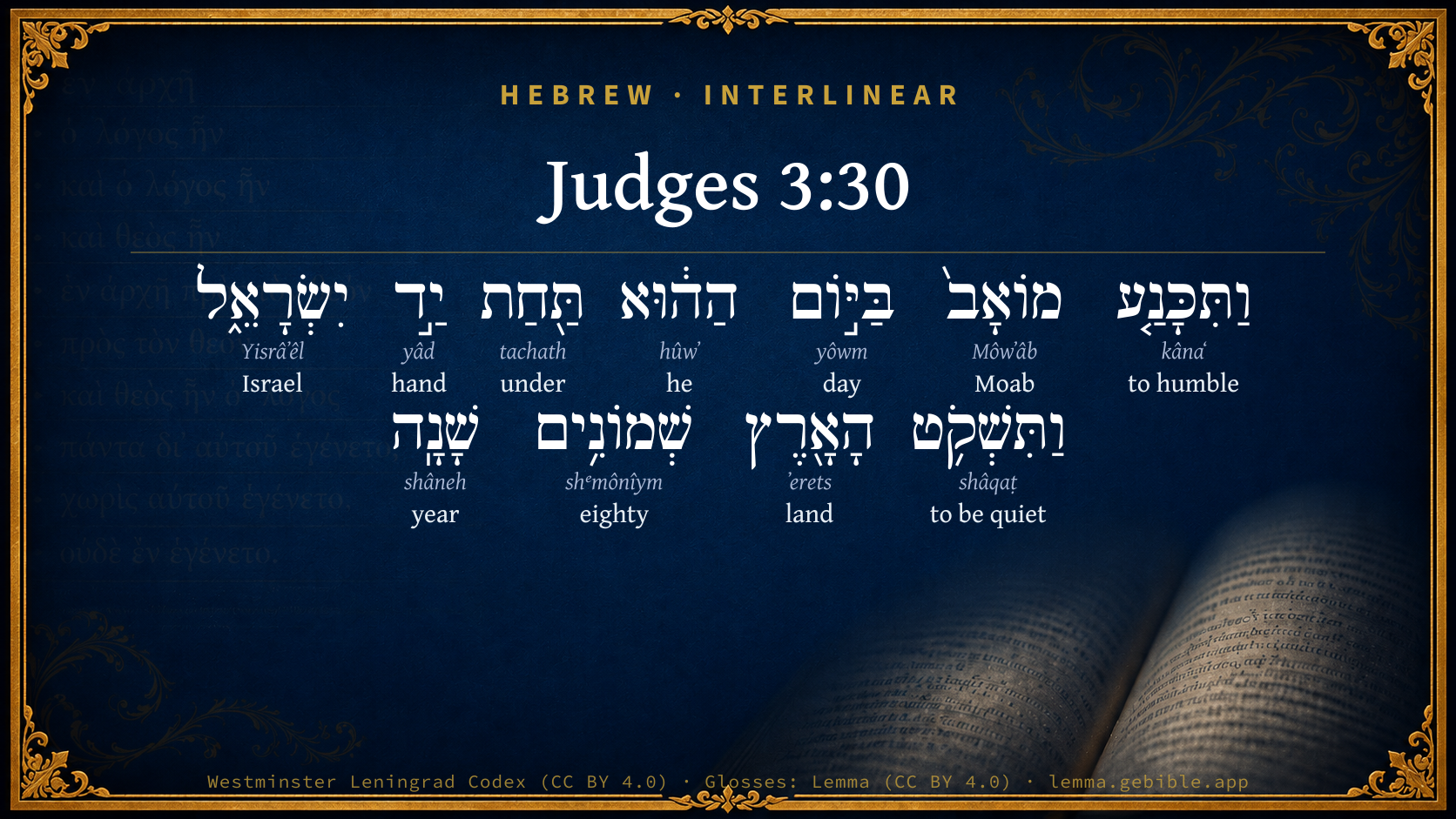
Judges 3:30

Hebrew (Westminster Leningrad Codex) Judges 3:30 appears in the Hebrew Old Testament. The text above is from the Westminster Leningrad Codex. Each word links to its Strong’s number, a concise gloss, and parsing drawn from the Open Scriptures Hebrew Bible morphology. Click any word for its full Brown-Driver-Briggs (BDB) entry.
Download image
Cite this verse

Judges 3:30 (World English Bible). Public Domain. Lemma interlinear Bible study tool, https://lemma.gebible.app/v/judges/3/30.

Show BibTeX & RIS
BibTeX
RIS
English Translation
So Moab was subdued that day under the hand of Israel. The land had rest eighty years.
World English Bible · Public Domain
Download a study sheet

One document with this verse’s original text, its word-by-word gloss line, the meaning frame, cross-references with their text, attributed commentary, and full source and license credits — printable, and it pastes into notes with its structure intact.

This verse Autodidact and up

Study sheet (.html) Plain text (.txt)

A passage Seminary Student

Up to 50 verses in one chapter. A passage sheet keeps up to 6 commentary sources and 12 cross-references per verse, in the order this page ranks them, and says so on the sheet whenever that leaves anything out. Ask for a single verse and you get the Autodidact verse sheet above.

Everything on this page stays free to read, with no account — the sheet is a download of what is already on screen, not access to it.

Want to remove ads? Support Godless Engineer
Compare translations 3

The same verse in 3 English versions, stacked beneath the original-language interlinear above. Click any original word for its lexicon entry.

Each is an independent rendering of the whole verse — the interlinear is not word-aligned to these translations.

Highlighted words mark where these versions differ — a whole-verse word diff, not a word-by-word alignment.

  • World English Bible Public Domain
    So Moab was subdued that day under the hand of Israel. The land had rest eighty years.
  • King James Version Public Domain
    So Moab was subdued that day under the hand of Israel. And the land had rest fourscore years.
  • unfoldingWord Literal Text CC BY-SA 4.0
    So Moab was subdued on that day under the hand of Israel, and the land rested 80 years.

unfoldingWord Literal Text — © unfoldingWord, licensed CC BY-SA 4.0. Word-aligned USFM3 via Door43 (git.door43.org/unfoldingWord/en_ult).

Versions to compare (up to 4)

3 of 4 selected

Show all 18 translations

Every available English version of this verse, each an independent rendering of the whole verse.

  • World English Bible Public Domain
    So Moab was subdued that day under the hand of Israel. The land had rest eighty years.
  • Berean Standard Bible Public Domain
    So Moab was subdued under the hand of Israel that day, and the land had rest for eighty years.
  • Majority Standard Bible Public Domain
    So Moab was subdued under the hand of Israel that day, and the land had rest for eighty years.
  • King James Version Public Domain
    So Moab was subdued that day under the hand of Israel. And the land had rest fourscore years.
  • American Standard Version (1901) Public Domain
    So Moab was subdued that day under the hand of Israel. And the land had rest fourscore years.
  • Revised Version (1885) Public Domain
    So Moab was subdued that day under the hand of Israel. And the land had rest fourscore years.
  • Geneva Bible (1599) Public Domain
    So Moab was subdued that daye, vnder the hand of Israel: and the land had rest fourescore yeeres.
  • Douay-Rheims (1899) Public Domain
    And Moab was humbled that day under the hand of Israel: and the land rested eighty years.
  • Young's Literal Translation Public Domain
    and Moab is humbled in that day under the hand of Israel; and the land resteth eighty years.
  • Literal Standard Version CC BY-SA 4.0
    and Moab is humbled in that day under the hand of Israel; and the land rests [for] eighty years.
  • Unlocked Literal Bible CC BY-SA 4.0
    So that day Moab was subdued by the strength of Israel, and the land had rest for eighty years.
  • unfoldingWord Literal Text CC BY-SA 4.0
    So Moab was subdued on that day under the hand of Israel, and the land rested 80 years.
  • Darby Bible Public Domain
    So Moab was subdued that day under the hand of Israel. And the land had rest for eighty years.
  • World Messianic Bible Public Domain
    So Moab was subdued that day under the hand of Israel. Then the land had rest eighty years.
  • Webster's Bible Public Domain
    So Moab was subdued that day under the hand of Israel: and the land had rest eighty years.
  • Free Bible Version CC BY-SA 4.0
    Moab was conquered that day and made subject to Israel, and the country was at peace for eighty years.
  • Bible in Basic English Public Domain
    So Moab was broken that day under the hand of Israel. And for eighty years the land had peace.
  • JPS Tanakh (1917) Public Domain
    So Moab was subdued that day under the hand of Israel. And the land had rest fourscore years.

Literal Standard Version (2020), Covenant Press — licensed CC BY-SA 4.0. Text via the HelloAO Bible API (eBible.org). Unlocked Literal Bible (unfoldingWord) — licensed CC BY-SA 4.0. Text via the HelloAO Bible API (eBible.org). unfoldingWord Literal Text — © unfoldingWord, licensed CC BY-SA 4.0. Word-aligned USFM3 via Door43 (git.door43.org/unfoldingWord/en_ult). Free Bible Version, Dr. Jonathan Gallagher — licensed CC BY-SA 4.0. Text via the HelloAO Bible API (eBible.org).

Word by word

More ways to search: Search by grammar → Find every occurrence → Compare this word →

Practice this passage: Drill this verse → Learn its vocabulary →

וַתִּכָּנַ֤ע
kânaʻ
H3665
“and · to humble”
Conjunction + Verb, Niphal, Sequential Imperfect, 3rd Person, Feminine, Singular
Part of Speech
Conjunction + Verb
Stem
Niphal
Form
Sequential Imperfect
Person
3rd Person
Gender
Feminine
Number
Singular
Full BDB Definition

Origin: a primitive root

TWOT: 1001

to be humble, be humbled, be subdued, be brought down, be low, be under, be brought into subjection - (Niphal) - to humble oneself - to be humbled, be subdued - (Hiphil) - to humble - to subdue
  1. מוֹאָב֙ Môwʼâb H4124 “Moab” Noun, Proper
  2. בַּיּ֣וֹם yôwm H3117 “in/at the · day” Preposition, Determined + Noun, Common, Masculine, Singular, Absolute
  3. הַה֔וּא hûwʼ H1931 “the · he” Particle, Definite Article + Pronoun, Personal, 3rd Person, Masculine, Singular
  4. תַּ֖חַת tachath H8478 “under” Preposition
  5. יַ֣ד yâd H3027 “hand of” Noun, Common, Both, Singular, Construct
  6. יִשְׂרָאֵ֑ל Yisrâʼêl H3478 “Israel” Noun, Proper
  7. וַתִּשְׁקֹ֥ט shâqaṭ H8252 “and · to be quiet” Conjunction + Verb, Qal, Sequential Imperfect, 3rd Person, Feminine, Singular
  8. הָאָ֖רֶץ ʼerets H776 “the · land” Particle, Definite Article + Noun, Common, Both, Singular, Absolute
  9. שְׁמוֹנִ֥ים shᵉmônîym H8084 “eighty” Adjective, Cardinal number, Both, Plural, Absolute
  10. שָׁנָֽה shâneh H8141 “year” Noun, Common, Feminine, Singular, Absolute

About this verse

These counts appear in no published source. They are computed here, from the morphology-tagged text and Lemma’s own curated glosses. What Lemma adds →

11
words
11
distinct lemmas
Historical
section

Shared distinctive vocabulary

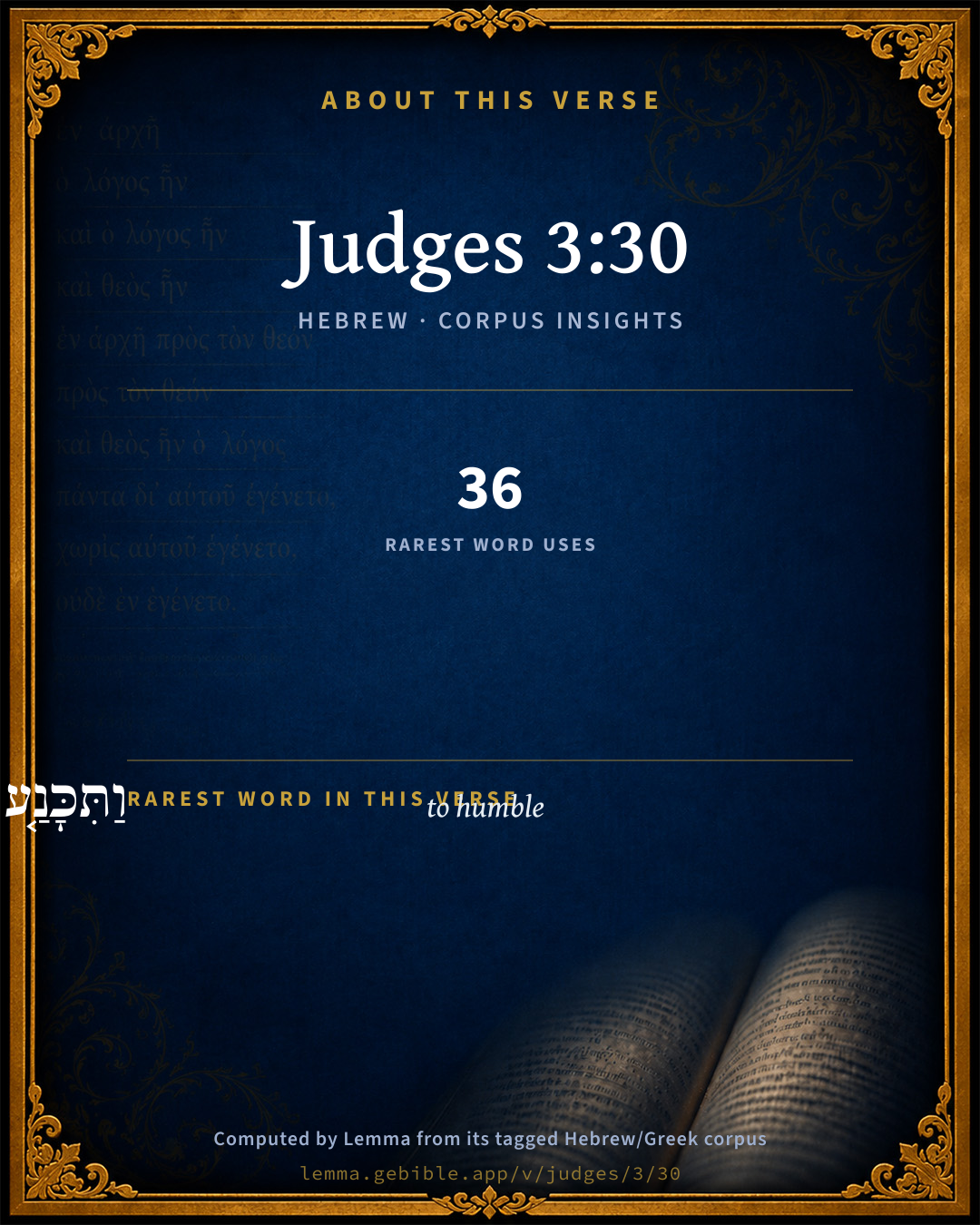
וַתִּכָּנַ֤ע to humble H3665 occurs in 32 verses of the Hebrew Bible. Also found in:

Grammatical profile

  • 2 verbs
  • 6 nouns
  • 1 adjective
  • 1 pronoun
  • 1 preposition

Verb forms

  • וַתִּכָּנַ֤ע Niphal · Sequential Imperfect
  • וַתִּשְׁקֹ֥ט Qal · Sequential Imperfect

Hebrew & Septuagint length

In English translation the verse runs 17 words from the Hebrew and 26 from the Septuagint (LXX English) — the Septuagint runs noticeably longer here. See the side-by-side →

A rough comparison of the two English renderings, which tokenize alike — not a word-level alignment.

Word counts can differ between the Hebrew and the Greek without any difference in meaning — e.g. the Hebrew direct-object marker אֵת has no separate Greek word, and Greek often adds the article ὁ.

Cross-references

2

Topical passages linked to Judges 3:30 in the Treasury of Scripture Knowledge — connected by theme and wording, ordered by reader-vote popularity; previews shown in the World English Bible.

  • Judges 3:11 The land had rest forty years. Othniel the son of Kenaz died.
  • Judges 5:31 So let all your enemies perish, Yahweh: But let those who love him be as the sun when he goes forth in his might. The land had rest forty years.

Cross-references courtesy of OpenBible.info (CC BY 4.0).

Hebrew and Greek witnesses Masoretic Hebrew ↔ Greek Septuagint

The same verse in the two great witnesses to the Old Testament, shown verse-for-verse.

Here the Septuagint runs noticeably longer than the Hebrew — LXX2012 (modern English Septuagint) 26 words vs World English Bible 17. A rough length comparison of the two English translations, not a word-level alignment — read both below.

These are two independent witnesses, not word-aligned to each other, and the Septuagint is shown in lemma (dictionary) form.

Hebrew Judges 3:30 Masoretic · Westminster Leningrad Codex

וַתִּכָּנַ֤ע מוֹאָב֙ בַּיּ֣וֹם הַה֔וּא תַּ֖חַת יַ֣ד יִשְׂרָאֵ֑ל וַתִּשְׁקֹ֥ט הָאָ֖רֶץ שְׁמוֹנִ֥ים שָׁנָֽה

So Moab was subdued that day under the hand of Israel. The land had rest eighty years.

World English Bible · Public Domain

Greek LXX Judges 3:30 Septuagint · lemma form

καί ἐντρέπω μωαβ ἐν ὁ ἡμέρα ἐκεῖνος ὑπό χείρ ἰσραήλ καί ἡσυχάζω ὁ γῆ ὀγδοήκοντα ἔτος καί κρίνω αὐτός αωδ ἕως ὅς ἀποθνήσκω

So Moab was humbled in that day under the hand of Israel, and the land had rest eighty years; and Aod judged them till he died.

LXX2012 (modern English Septuagint) · Public Domain

On this verse, Ellicott's Commentary for English Readers discusses the Septuagint’s reading. Read the note in Commentary ↓

Hebrew: Westminster Leningrad Codex (CC BY 4.0). Greek: Septuagint (public domain); English from LXX2012 (modern English Septuagint) (Public Domain). How the Septuagint differs from the Hebrew →

Targum (Aramaic paraphrase)

1

The Targum is the ancient Jewish Aramaic paraphrase of the Hebrew Scriptures — an interpretive translation, not the Hebrew text itself. Onkelos (literal) and Pseudo-Jonathan (expansive) render the Torah, and Jonathan the Prophets. Coverage is partial: where no permissively-licensed English translation exists for a verse, only the Aramaic is shown. This is verse-level text, not a word-by-word alignment to the Hebrew.

  1. Targum Jonathan Prophets (Joshua–Malachi)
    וְאִתַּבָּרוּ מוֹאֲבָאֵי בְּיוֹמָא הַהוּא תְּחוֹת יַד אֱנַשׁ יִשְׂרָאֵל וּשְׁדוֹכַת אַרְעָא דְיִשְׂרָאֵל תְּמָנָן שְׁנִין:

    (no public-domain English translation for this verse)

    Targum Jonathan — Aramaic: “Mikraot Gedolot” (public domain). English: “Sefaria Community Translation” (CC0 1.0 (public-domain dedication)); “London "Chaldee Paraphrase," 1871” (public domain). Text via Sefaria.

Commentary

Notes on Judges 3:30 from classic Christian and Jewish commentators (each source and its license shown beneath its notes). The classic Christian expositions comment on the surrounding passage and are grouped to its opening verse, so a note may address several verses; the Jewish commentaries on the Tanakh (Rashi and others) are per-verse, so they appear only where the commentator wrote on this verse.

Lemma curates 59 commentaries, every one of them public domain or Creative Commons licensed, each selected and text-cleaned for this edition rather than reprinted as found. About our sources →

Trapp's Complete Commentary

John Trapp

Jdg 3:30 So Moab was subdued that day under the hand of Israel. And the land had rest fourscore years.

Ver. 30. And the land had rest fourscore years.] That is, To the end of fourscore years, reckoning from the death of Othniel.

John Trapp, A Commentary or Exposition upon All the Books of the Old and New Testament (1647–1656) — public domain. Text from a community e-Sword module.

Joseph Benson's Commentary

Jdg 3:30. The land had rest fourscore years — Not the whole land of Israel, but the eastern part of it, which had thus shaken off the yoke of Moab. For in the mean time the Philistines invaded the western parts, as it here follows, and were repulsed by Shamgar; and Jabin afflicted the northern, as it follows in the next chapter.

Joseph Benson's Commentary on the Old and New Testaments (1811–1818) — public domain. Text from a community e-Sword module.

Geneva Bible (1599)

Geneva Bible translators

Hebrew, humbled.

Meaning, the Israelites.

Geneva Bible (1599) marginal notes — public domain. Text via Bolls.life.

Adam Clarke's Commentary

Verse 30. The land had rest fourscore years.] This is usually reckoned from the deliverance under Othniel, that being a term from which they dated every transaction, as in other cases they dated from the exodus, from the building of Solomon's temple, c., and as other nations did from particular events: the ROMANS, from the building of the city the MOHAMMEDANS, from the Hijreh, or flight of Mohammed to Medina; the CHRISTIANS, from the birth of Christ, &c., &c. But see the preface, and the different chronological schemes there mentioned.

Adam Clarke's Commentary on the Bible (1810–1826) — public domain. Text from a community e-Sword/MySword module.

Ellicott's Commentary for English Readers

(30) The land.—Meaning, probably, the southern tribes.

Fourscore years.—The LXX. add, “And Ehud judged them till he died.” Josephus (Antt. v. 5, § 1) seems to have read “eight years.”

As to the moral aspect of the assassination committed by Ehud, it is only necessary to say that while his courage, and capacity, and readiness to sacrifice himself, if need be, for the deliverance of his country were thoroughly noble, the act by which he achieved his end was unjustifiable. To quote his example in defence of the principle of assassination is a gross abuse of Scripture. Those who defend the murder do so by assuming that the Divine call to Ehud to deliver his people sanctioned and possibly even suggested the means by which it was accomplished. But such methods of inferential exegesis undermine the very bases of morals. It is not in the least surprising that, when adopted, they are liable to the grossest abuse, and made to cover the most horrible crimes. Thus, when Jacques Clement asked whether a priest might kill a tyrant, he was told that “it was not a mortal sin, but only an irregularity”; and when Pope Paul V. heard of the murder of Henry IV. by Ravaillac, he said, “The God of nations did this, because he was given over to a reprobate mind.” If it has been always true that

“The devil can quote Scripture for his purpose,”

he has done so not rarely by the lips of those who have professed to teach it. “Worse than the dagger,” says Prof. Cassel, “is such doctrine.”

A Bible Commentary for English Readers, edited by Charles John Ellicott (1878–1897) — public domain. Text from a community e-Sword module.

The Cambridge Bible for Schools and Colleges

gen. ed. J. J. S. Perowne

30. was subdued] Similarly in the conclusions to the other stories, Jdg_4:23, Jdg_8:28, Jdg_11:33; 1Sa_7:13. The expression, which seems to form a more integral part of the narrative proper than the rest of the recurring phrases, “may mark the portions due to the pre-Deuteronomic compiler,” Driver, Introd., p. 167. The rest of the verse certainly belongs to the framework; cf. Jdg_3:11 note.

The Cambridge Bible for Schools and Colleges (gen. ed. J. J. S. Perowne; Cambridge University Press, 1878–1918) — public domain. Text from a community e-Sword module.

John Gill's Exposition

And after him was Shamgar the son of Anath,.... That is, after the death of Ehud, when the people of Israel were in distress again from another quarter, this man was raised up of God to be a judge and deliverer of them; but who he was, and who his father, and of what tribe, we nowhere else read:

which slew of the Philistines six hundred men; who invaded the land, and came in an hostile manner into it; or rather, as it seems from Jdg 5:6; they entered as a banditti of thieves and robbers, who posted themselves in the highways, and robbed travellers as they passed, so that they were obliged to leave off travelling, or go through bypaths, and not in the public road; and this man, who seems to have been called from the plough to be a judge of Israel, as some among the Romans were called from thence to be dictators and deliverers of them from the Gauls:

with an ox goad; which he had used to push on his oxen with at ploughing, cleared the country of them, and with no other weapon than this slew six hundred of them, either at certain times, or in a body together; which is no ways incredible, being strengthened and succeeded by the Lord, any more than Samson's slaying a thousand men with the jawbone of an ass, Jdg 15:15. So Lycurgus is said to put to flight the forces of Bacchus with an ox goad (q) which is said to be done near Carmel, a mountain in Judea, which makes it probable that this is hammered out of the sacred history; or that Shamgar and Lycurgus are the same, as Bochart conjectures (r). The ox goad, as now used in those parts, is an instrument fit to do great execution with it, as Mr. Maundrell (s), who saw many of them, describes it; on measuring them, he found them to be eight feet long, at the bigger end six inches in circumference, at the lesser end was a sharp prickle for driving the oxen, and at the other end a small spade, or paddle of iron, for cleansing the plough from the clay:

and he also delivered Israel, from those robbers and plunderers, and prevented their doing any further mischief in the land, and subjecting it to their power, and so may very properly be reckoned among the judges of Israel; but how long he judged is not said, perhaps his time is to be reckoned into the eighty years of rest before mentioned; or, as Abarbinel thinks, into the forty years of Deborah, the next judge; and who also observes, that their Rabbins say, Shamgar judged but one year.

(q) Homer. Iliad. 6. ver. 135. (r) Hieozoic. par. 1. l. 2. c. 39. col. 385. & Canaan. l. 1. c. 18. col. 446. (s) Journey to Aleppo, &c. p. 110, 111.

Next: Judges Chapter 4

John Gill's Exposition of the Whole Bible (1746–1763) — public domain (CC PDM 1.0). Text via the HelloAO Bible API.

Albert Barnes' Notes on the Bible

The land - i. e. that portion of it which had suffered from the oppression of Moab, probably Benjamin and Ephraim chiefly (see Jdg 3:11).

In judging of the nature of Ehud’s act there are many considerations which must greatly modify our judgment. Acts of violence or cunning, done in an age when human society applauded such acts, when the best men of the age thought them right, and when men were obliged to take the law into their own hands in self-defense, are very different from the same acts done in an age when the enlightened consciences of men generally condemn them, and when the law of the land and the law of nations give individuals adequate security. We can allow faith and courage and patriotism to Ehud, without being blind to those defective views of moral right which made him and his countrymen glory in an act which in the light of Christianity is a crime. It is remarkable that neither Ehud nor Jael are included in Paul’s list in Heb 11:32.

Albert Barnes' Notes on the Bible (1834–1885) — public domain. Text from a community e-Sword/MySword module.

Haydock's Catholic Bible Commentary

Eighty. The Hebrews use the letter p to express this number; and, as it is very like their c, which stands for 20, Houbigant suspects that he first number is a mistake of the transcribers. Usher confesses that it is "extremely improbable" that Aod should have governed so long, after he had slain Eglon, as he must have been at that time, about 40 years old; and the Israelites were not often so constant for such a length of time. (Houbigant, Proleg.) --- But this difficulty does not affect Usher, as he brings Aod forward only in the 80th year from the peace of Othoniel; and instead of allowing him 80 years of peaceful sway, he says Samgar appeared after him; but, it seems, both together did not reign a year, since in that 80th year, he commences the servitude, which Jabin brought upon Israel, from the year of the world 2679 till 2699, and peace was not restored by Barac for about 20 years! (Haydock)

George Leo Haydock (1774–1849), Haydock's Catholic Family Bible and Commentary, 1859 edition — public domain. Excludes Psalms (Douay-Rheims chapter numbering differs from Protestant) and Deuterocanonical books (Catholic canon only).

Matthew Poole's English Annotations

How these are to be understood, see Poole "Jdg 3:11". Instead of eighty, some copies read eight years.

Matthew Poole's English Annotations on the Holy Bible (1683–1685) — public domain. Text from a community e-Sword/MySword module.

John Wesley's Explanatory Notes

Fourscore years - Chiefly that part of it which lay east of Jordan: for the other side of the country, which lay southwest, was even then infested by the Philistines.

John Wesley, Explanatory Notes Upon the Whole Bible (1754–1765) — public domain. Text via the GEBible commentary corpus.

Keil & Delitzsch

C. F. Keil & F. Delitzsch

Thus Moab was subdued under the hand of Israel, and the land had rest for eighty years.

Keil & Delitzsch — Biblical Commentary on the Old Testament (1861–1891) — public domain (CC PDM 1.0). Text via the HelloAO Bible API. (Old Testament only.)

Lesson kit

Teaching starters — assembled from the data on this page, not authored interpretation. Every prompt links to the verse data it draws on. Edit before teaching.

Judges, in the Historical, opens this verse with 11 words (11 distinct Hebrew lemmas). Its most distinctive word is kânaʻ (“to humble”). The Greek Septuagint runs longer here. A historical commentator’s framing appears above. Read the whole chapter for the surrounding context.

Discussion questions

  1. The word kânaʻ carries the sense “to humble.” How does it shape the verse?
  2. Leviticus 26:41 shares the word «to humble» with this verse. How do the two illuminate each other?
  3. Compared with the Hebrew, the Septuagint runs longer here. What questions does that raise?
  4. The translations on this page render this verse differently — a whole-verse word diff, not a word-by-word alignment. What might account for the different wordings?
  5. The verb «וַתִּכָּנַ֤ע» is Niphal Sequential Imperfect. How does its form color the action?
  6. Reading how Trapp's Complete Commentary and Joseph Benson's Commentary read this verse, where do the two commentators agree and where do they part?

Things to notice

Reading settings

Reading text

Shown beneath each verse's original-language words.

Old Testament
Old Testament edition

Read the OT as the Masoretic Hebrew (MT) or the Greek Septuagint (LXX).

English shown for the Greek Septuagint (in the Hebrew ↔ Greek comparison).

Comparing translations? Open the Compare panel on any verse page to stack up to four side by side.