
Numbers 33:49

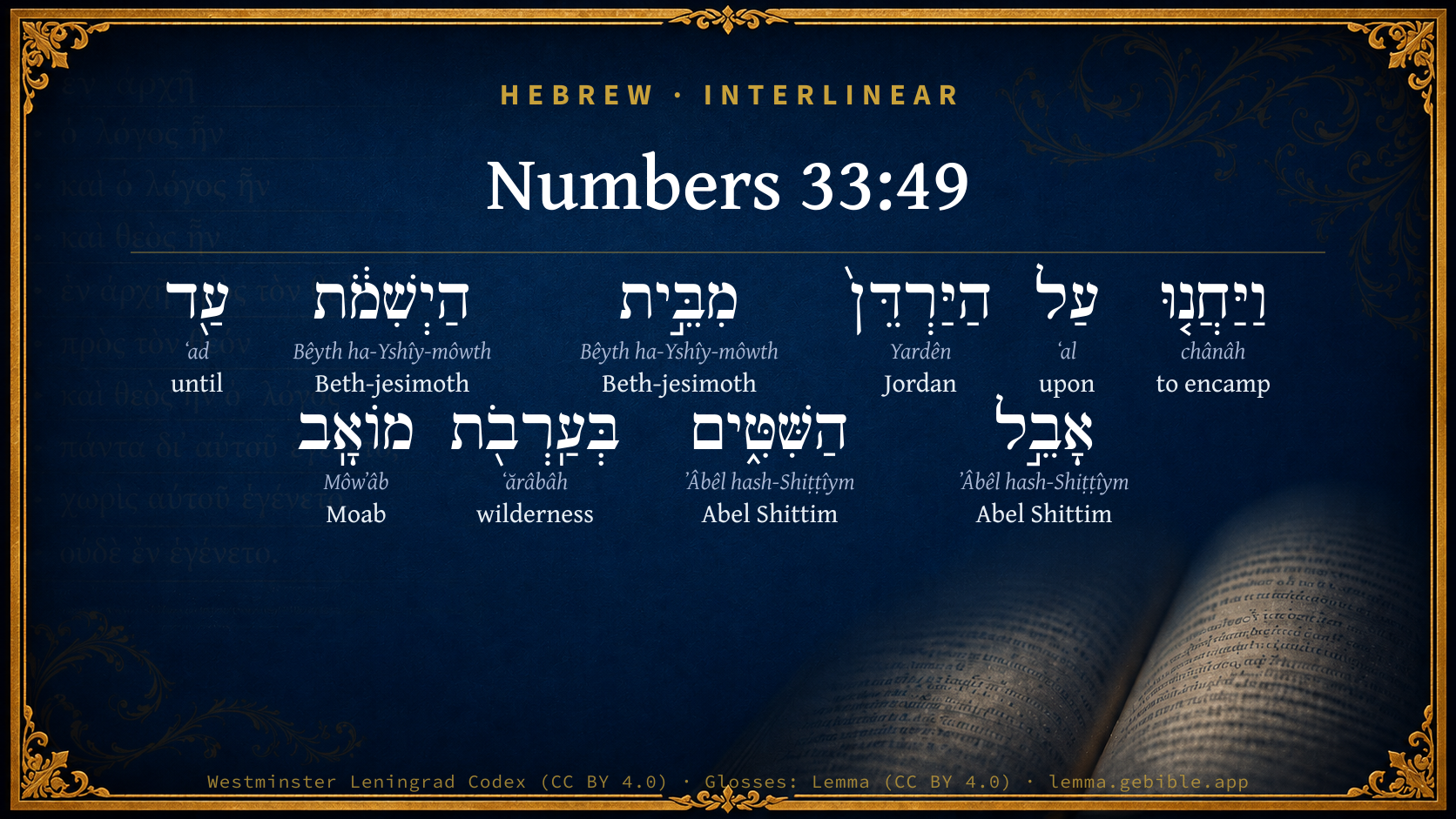
Hebrew (Westminster Leningrad Codex) Numbers 33:49 appears in the Hebrew Old Testament. The text above is from the Westminster Leningrad Codex. Each word links to its Strong’s number, a concise gloss, and parsing drawn from the Open Scriptures Hebrew Bible morphology. Click any word for its full Brown-Driver-Briggs (BDB) entry.
Download image
Cite this verse

Numbers 33:49 (World English Bible). Public Domain. Lemma interlinear Bible study tool, https://lemma.gebible.app/v/numbers/33/49.

Show BibTeX & RIS
BibTeX
RIS
English Translation
They encamped by the Jordan, from Beth-jeshimoth even to Abel Shittim in the plains of Moab.
World English Bible · Public Domain
Highlights
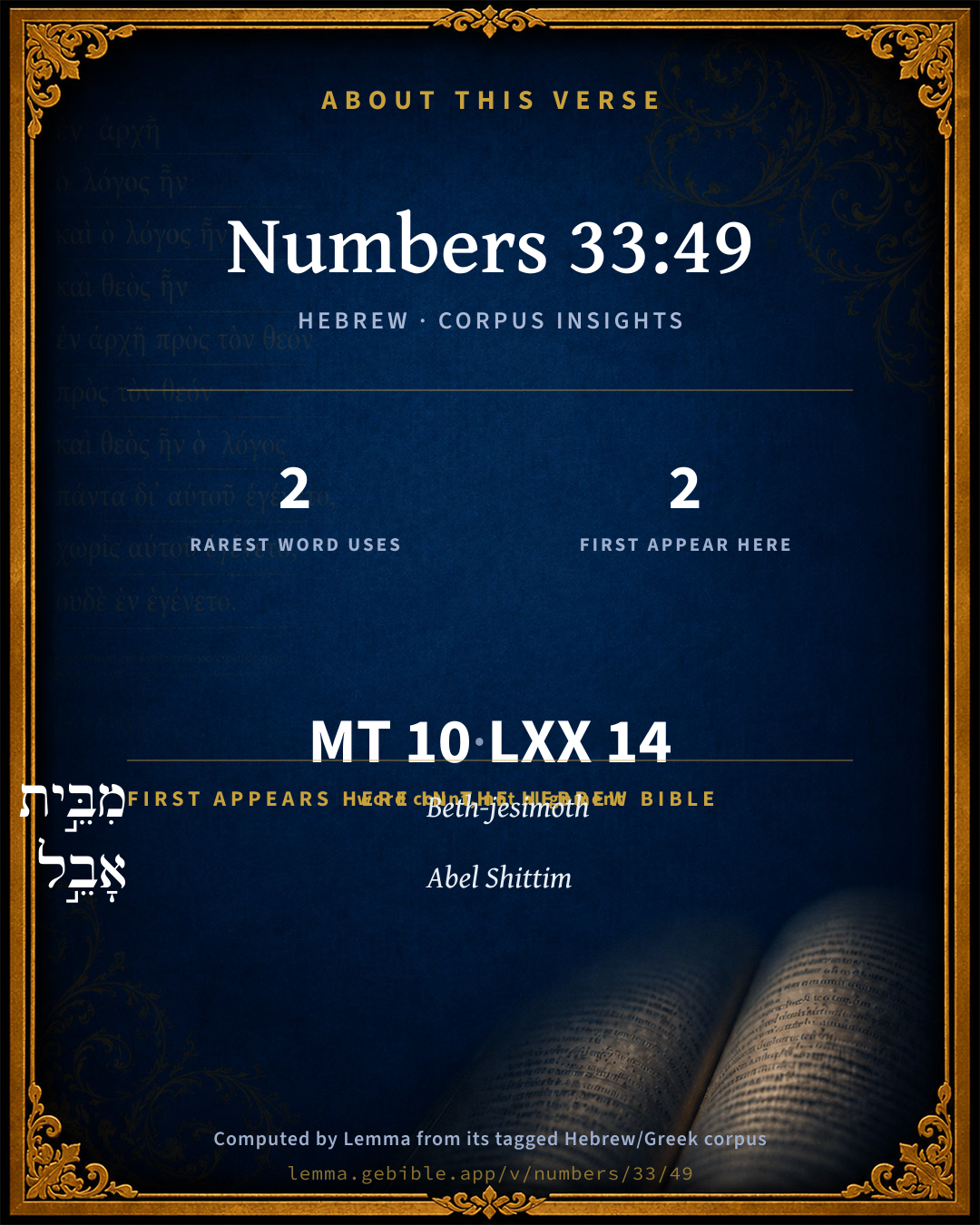
  • 2 first appearances in the Hebrew Bible
Full analysis ↓
Download a study sheet

One document with this verse’s original text, its word-by-word gloss line, the meaning frame, cross-references with their text, attributed commentary, and full source and license credits — printable, and it pastes into notes with its structure intact.

This verse Autodidact and up

Study sheet (.html) Plain text (.txt)

A passage Seminary Student

Up to 50 verses in one chapter. A passage sheet keeps up to 6 commentary sources and 12 cross-references per verse, in the order this page ranks them, and says so on the sheet whenever that leaves anything out. Ask for a single verse and you get the Autodidact verse sheet above.

Everything on this page stays free to read, with no account — the sheet is a download of what is already on screen, not access to it.

Want to remove ads? Support Godless Engineer
Compare translations 3

The same verse in 3 English versions, stacked beneath the original-language interlinear above. Click any original word for its lexicon entry.

Each is an independent rendering of the whole verse — the interlinear is not word-aligned to these translations.

Highlighted words mark where these versions differ — a whole-verse word diff, not a word-by-word alignment.

  • World English Bible Public Domain
    They encamped by the Jordan, from Beth-jeshimoth even to Abel Shittim in the plains of Moab.
  • King James Version Public Domain
    And they pitched by Jordan, from Bethjesimoth even unto Abelshittim in the plains of Moab.
  • unfoldingWord Literal Text CC BY-SA 4.0
    And they camped beside the Jordan, from Beth Jeshimoth to Abel Shittim in the plains of Moab.

unfoldingWord Literal Text — © unfoldingWord, licensed CC BY-SA 4.0. Word-aligned USFM3 via Door43 (git.door43.org/unfoldingWord/en_ult).

Versions to compare (up to 4)

3 of 4 selected

Show all 18 translations

Every available English version of this verse, each an independent rendering of the whole verse.

  • World English Bible Public Domain
    They encamped by the Jordan, from Beth-jeshimoth even to Abel Shittim in the plains of Moab.
  • Berean Standard Bible Public Domain
    And there on the plains of Moab they camped by the Jordan, from Beth-jeshimoth to Abel-shittim.
  • Majority Standard Bible Public Domain
    And there on the plains of Moab they camped by the Jordan, from Beth-jeshimoth to Abel-shittim.
  • King James Version Public Domain
    And they pitched by Jordan, from Bethjesimoth even unto Abelshittim in the plains of Moab.
  • American Standard Version (1901) Public Domain
    And they encamped by the Jordan, from Beth-jeshimoth even unto Abel-shittim in the plains of Moab.
  • Revised Version (1885) Public Domain
    And they pitched by Jordan, from Beth-jeshimoth even unto Abel-shittim in the plains of Moab.
  • Geneva Bible (1599) Public Domain
    And they pitched by Iorden, from Bethieshimoth vnto Abel-shittim in the playne of Moab.
  • Douay-Rheims (1899) Public Domain
    And there they camped from Bethsi moth even to Ablesatim in the plains of the Moabites,
  • Young's Literal Translation Public Domain
    And they encamp by the Jordan from Beth-Jeshimoth, unto Abel-Shittim, in the plains of Moab.
  • Literal Standard Version CC BY-SA 4.0
    And they encamp by the Jordan, from Beth-Jeshimoth as far as Abel-Shittim in the plains of Moab.
  • Unlocked Literal Bible CC BY-SA 4.0
    They camped by the Jordan, from Beth Jeshimoth to Abel Shittim in the plains of Moab.
  • unfoldingWord Literal Text CC BY-SA 4.0
    And they camped beside the Jordan, from Beth Jeshimoth to Abel Shittim in the plains of Moab.
  • Darby Bible Public Domain
    And they encamped by the Jordan, from Beth-jeshimoth unto Abel-Shittim, in the plains of Moab.
  • World Messianic Bible Public Domain
    They encamped by the Jordan, from Beth Jeshimoth even to Abel Shittim in the plains of Moab.
  • Webster's Bible Public Domain
    And they encamped by Jordan, from Beth-jeshimoth even to Abel-shittim in the plains of Moab.
  • Free Bible Version CC BY-SA 4.0
    There on the plains of Moab they set up camp beside the Jordan, from Beth-jeshimoth to Abel-shittim.
  • Bible in Basic English Public Domain
    Planting their tents by the side of Jordan from Beth-jeshimoth as far as Abel-shittim in the lowlands of Moab.
  • JPS Tanakh (1917) Public Domain
    And they pitched by the Jordan, from Beth-jeshimoth even unto Abel-shittim in the plains of Moab.

Literal Standard Version (2020), Covenant Press — licensed CC BY-SA 4.0. Text via the HelloAO Bible API (eBible.org). Unlocked Literal Bible (unfoldingWord) — licensed CC BY-SA 4.0. Text via the HelloAO Bible API (eBible.org). unfoldingWord Literal Text — © unfoldingWord, licensed CC BY-SA 4.0. Word-aligned USFM3 via Door43 (git.door43.org/unfoldingWord/en_ult). Free Bible Version, Dr. Jonathan Gallagher — licensed CC BY-SA 4.0. Text via the HelloAO Bible API (eBible.org).

Word by word

More ways to search: Search by grammar → Find every occurrence → Compare this word →

Practice this passage: Drill this verse → Learn its vocabulary →

About this verse

These counts appear in no published source. They are computed here, from the morphology-tagged text and Lemma’s own curated glosses. What Lemma adds →

10
words
8
distinct lemmas
Pentateuch
section

Notable vocabulary

The rarest word here is אָבֵ֣ל Abel Shittim H63 — appearing just 2 times in the whole Hebrew Bible.

First appearance in Scripture

These words make their first canonical appearance in the Hebrew Bible here:

  • מִבֵּ֣ית Beth-jesimoth H1020
  • אָבֵ֣ל Abel Shittim H63

Grammatical profile

  • 1 verb
  • 7 nouns
  • 2 prepositions

Verb forms

  • וַיַּחֲנ֤וּ Qal · Sequential Imperfect

Repetition

Words recur within this verse — often emphatic in Hebrew:

  • מִבֵּ֣ית Beth-jesimoth H1020 ×2
  • אָבֵ֣ל Abel Shittim H63 ×2

Hebrew & Septuagint length

In English translation the verse runs 16 words from the Hebrew and 16 from the Septuagint (LXX English) — the same length.

A rough comparison of the two English renderings, which tokenize alike — not a word-level alignment.

Word counts can differ between the Hebrew and the Greek without any difference in meaning — e.g. the Hebrew direct-object marker אֵת has no separate Greek word, and Greek often adds the article ὁ.

In the original languages it is 10 Hebrew tokens and 14 Greek tokens — but the two are counted differently (Hebrew bundles its prefixes and suffixes into one token; the Greek is in lemma form), so that isn’t a like-for-like length.

Cross-references

7

Topical passages linked to Numbers 33:49 in the Treasury of Scripture Knowledge — connected by theme and wording, ordered by reader-vote popularity; previews shown in the World English Bible.

  • Exodus 25:5 rams' skins dyed red, sea cow hides, acacia wood,
  • Exodus 25:10 "They shall make an ark of acacia wood. Its length shall be two and a half cubits, its breadth a cubit and a half, and a cubit and a half its height.
  • Exodus 25:23 "You shall make a table of acacia wood. Two cubits shall be its length, and a cubit its breadth, and one and a half cubits its height.
  • Numbers 25:1–9 Israel abode in Shittim; and the people began to play the prostitute with the daughters of Moab:
  • Joshua 2:1 Joshua the son of Nun sent out of Shittim two men as spies secretly, saying, Go, view the land, and Jericho. They went and came into the house of a prostitute whose name was Rahab, and lay there.
  • Joshua 13:20 and Beth Peor, and the slopes of Pisgah, and Beth-jeshimoth,
  • Ezekiel 25:9 therefore, behold, I will open the side of Moab from the cities, from his cities which are on his frontiers, the glory of the country, Beth-jeshimoth, Baal Meon, and Kiriathaim,

Cross-references courtesy of OpenBible.info (CC BY 4.0).

Hebrew and Greek witnesses Masoretic Hebrew ↔ Greek Septuagint

The same verse in the two great witnesses to the Old Testament, shown verse-for-verse.

These are two independent witnesses, not word-aligned to each other, and the Septuagint is shown in lemma (dictionary) form.

Hebrew Numbers 33:49 Masoretic · Westminster Leningrad Codex

וַיַּחֲנ֤וּ עַל הַיַּרְדֵּן֙ מִבֵּ֣ית הַיְשִׁמֹ֔ת עַ֖ד אָבֵ֣ל הַשִּׁטִּ֑ים בְּעַֽרְבֹ֖ת מוֹאָֽב

They encamped by the Jordan, from Beth-jeshimoth even to Abel Shittim in the plains of Moab.

World English Bible · Public Domain

Greek LXX Numbers 33:49 Septuagint · lemma form

καί παρα ἐνβάλλω παρά ὁ ἰορδάνης ἀνά μέσος αισιμωθ ἕως βελσαττιμ κατά δυσμή μωαβ

And they encamped by Jordan between Aesimoth, as far as Belsa to the west of Moab.

LXX2012 (modern English Septuagint) · Public Domain

Hebrew: Westminster Leningrad Codex (CC BY 4.0). Greek: Septuagint (public domain); English from LXX2012 (modern English Septuagint) (Public Domain). How the Septuagint differs from the Hebrew →

Targum (Aramaic paraphrase)

2

The Targum is the ancient Jewish Aramaic paraphrase of the Hebrew Scriptures — an interpretive translation, not the Hebrew text itself. Onkelos (literal) and Pseudo-Jonathan (expansive) render the Torah, and Jonathan the Prophets. Coverage is partial: where no permissively-licensed English translation exists for a verse, only the Aramaic is shown. This is verse-level text, not a word-by-word alignment to the Hebrew.

  1. Targum Onkelos Torah (Genesis–Deuteronomy)
    וּשְׁרוֹ עַל יַרְדְנָא מִבֵּית יְשִׁימוֹת עַד מֵישַׁר שִׁטִין בְּמֵישְׁרַיָא דְמוֹאָב

    (no public-domain English translation for this verse)

    Targum Onkelos — Aramaic: “Onkelos Genesis” (public domain); “Onkelos Exodus” (public domain); “Onkelos Leviticus” (public domain); “Onkelos Numbers” (public domain); “Onkelos Deuteronomy” (public domain). English: “Sefaria Community Translation” (CC0 1.0 (public-domain dedication)); “J.W. Etheridge. The Targums of Onkelos and Jonathan Ben Uzziel on the Pentateuch. London: Longmans, Green, 1862” (public domain). Text via Sefaria.

  2. Targum Pseudo-Jonathan Torah (Genesis–Deuteronomy)
    וּשְׁרוֹ עַל יוֹרְדְנָא מִבֵּית יְשִׁימוֹת עַד מֵישַׁר שִׁיטִין בְּמֵישְׁרַיָא דְמוֹאָב

    and they encamped by the Jordan, from Bethjeshimon unto the plain of Sillan in the fields of Moab.

    Targum Pseudo-Jonathan — Aramaic: “Targum Jonathan on Genesis” (public domain); “Targum Jonathan on Exodus” (public domain); “Targum Jonathan on Leviticus” (public domain); “Targum Jonathan on Numbers” (public domain); “Targum Jonathan on Deuteronomy” (public domain). English: “The Targum of Jonathan ben Uzziel, trans. J. W. Etheridge, London, 1862” (public domain). Text via Sefaria.

Commentary

Notes on Numbers 33:49 from classic Christian and Jewish commentators (each source and its license shown beneath its notes). The classic Christian expositions comment on the surrounding passage and are grouped to its opening verse, so a note may address several verses; the Jewish commentaries on the Tanakh (Rashi and others) are per-verse, so they appear only where the commentator wrote on this verse.

Lemma curates 59 commentaries, every one of them public domain or Creative Commons licensed, each selected and text-cleaned for this edition rather than reprinted as found. About our sources →

Joseph Benson's Commentary

Num 33:49. Abel-shittim — The place where the people sinned in the matter of Peor, called simply Shittim, Num 25:1; but here Abel-shittim, for the grievous mourning (Abel signifying mourning) which was there, both for the heinous crimes committed, and the severe judgments inflicted. This was their forty-second and last station, before their entrance into Canaan, and here we left them in the last transactions of this history.

Joseph Benson's Commentary on the Old and New Testaments (1811–1818) — public domain. Text from a community e-Sword module.

Adam Clarke's Commentary

STAT. XLII.

Verse 49. From BETH-JESIMOTH even unto ABEL-SHITTIM] The former of these places fell to the Reubenites, Jos 13:15-20. The Israelites were now come to the edge of Jordan, over against Jericho, where they afterwards passed.

For farther information on the subject of these different encampments, the reader is requested to refer to the extracts from Dr. Shaw at the end of the book of Exodus. See Clarke on Ex 40:38.

Adam Clarke's Commentary on the Bible (1810–1826) — public domain. Text from a community e-Sword/MySword module.

Ellicott's Commentary for English Readers

(49) Beth-jesimoth even unto Abel-shittim . . . —See Num_22:1, and Note, and Num_25:1, where Abel-shittim is mentioned as Shittim.

A Bible Commentary for English Readers, edited by Charles John Ellicott (1878–1897) — public domain. Text from a community e-Sword module.

Haydock's Catholic Bible Commentary

Moabites. Here they were deluded by wicked women, chap. xxv. (Haydock) --- From these 42 stations, the Fathers take occasion to shew, how we must advance in a spiritual life. (Du Hamel)

George Leo Haydock (1774–1849), Haydock's Catholic Family Bible and Commentary, 1859 edition — public domain. Excludes Psalms (Douay-Rheims chapter numbering differs from Protestant) and Deuterocanonical books (Catholic canon only).

Matthew Poole's English Annotations

Abel-shittim; called Shittim, Num 25:1, and here Abel-shittim, for the grievous mourning which there was both for the heinous crimes committed, and horrible judgments there inflicted.

Matthew Poole's English Annotations on the Holy Bible (1683–1685) — public domain. Text from a community e-Sword/MySword module.

Whedon's Commentary on the Bible

Daniel D. Whedon

49. Beth-jesimoth — House of wastes. It was at the south end of the Jordan valley, the southern limit of the camp which stretched northward to Abel-shittim, or Shittim, or “acacia-groves,” which still remain, says Stanley, “marking with a line of verdure the upper terraces of the Jordan valley.” Jos_2:1, note.

Daniel D. Whedon (gen. ed.), Commentary on the Old and New Testaments (1874–1909) — public domain. Text from a community e-Sword module.

The Pulpit Commentary

From Beth-jesimoth even unto Abel-shittim. Beth-jesimoth, "house of the wastes," must have been very near the point where Jordan empties itself into the Dead Sea, on the verge of the salt desert which bounds that sea on the east. It formed the boundary of Sihon"s kingdom at the south-west corner. Abel-shittim, "meadow of acacias," is better known by the abbreviated name "Shittim". (Num_25:1 Mic_6:5) Its exact site cannot be recovered, but the Talmud states that it was twelve miles north of the Jordan mouth. Probably the center of the camp was opposite to the great fords, and the road leading to Jericho.

NOTE ON THE TWO LISTS OF STATIONS BETWEEN EGYPT AND THE JORDAN.

There can be no question that the chief interest of the Itinerary here given is due to its literary character as a document containing elements at least of extreme and unquestioned antiquity. At the same time it is a matter of some importance to compare it with the history as given at large in Exodus and Numbers, and to note carefully the points of contact and divergence. It is evident at first sight that no pains have been taken to make the two lists of stages agree, each list containing several names which the other lacks, and (in some cases) each having a name of its own for what appears to be the same place. With respect to the latter point, the explanation usually given seems quite natural and satisfactory: the names were in many cases given by the Israelites themselves, and in others were derived from some small local peculiarity, or belonged to insignificant hamlets, so that the same encampment may very well have received one name in the official record of the movements of the tabernacle, and retained another in the popular recollection of the march. With respect to the former point, it may fairly be argued that the narrative only records as a rule the names of places where something memorable occurred, and indeed does not always mention the place even then, while the Itinerary is simply concerned with the consecutive encampments as such. It would be more correct to say that the narrative is essentially fragmentary, and does not purport to record more than certain incidents of the wanderings.

We have, therefore, no difficulty in understanding why the Itinerary gives us the names of three stations between Egypt and Mount Sinai not mentioned in Exodus. There is much more difficulty with the ensuing notices, because the name of Kadesh only occurs once in the list, whereas it is absolutely necessary, in order to bring the narrative into any chronological sequence, to assume (what the narrative itself pretty clearly intimates) that there were two encampments at Kadesh, separated by an interval of more than thirty-eight years. It has accordingly been very generally agreed that the Rithmah of the Itinerary is identical with the nameless station "in the wilderness of Paran," afterwards called Kadesh in the narrative. This is of course an assumption which has only probabilities to support it, but it may fairly be said that there is nothing against it. The retem, or broom, is so common that it must have given a name to many different spots a name too common, and possessing too few associations, to stand its ground in popular remembrance against any rival name (see note on verse 18). It has been argued by some that the whole of the twenty-one stages enumerated in verses 16-35 were made on the one journey from Sinai to Kadesh; and as far as the mere number goes there is nothing improbable in the supposition; the "eleven days" of Deu_1:2 are no doubt the days of ordinary travelers, not of women and children, flocks and herds. It is true that the supposition is commonly connected with a theory which throws the whole historical narrative into confusion, viz., that Israel spent only two years instead of forty in the wilderness; but that need not cause its rejection, for the whole thirty-eight may be intercalated between verse 36 and verse 37 of the Itinerary, and we could explain a total silence concerning the wanderings of those years better than we can the mention of (only) seventeen stations. The only serious difficulty is presented by the name Ezion-geber, which it is very difficult not to identify with the place of that name, so well known afterwards, at the head of the Elanitic Gulf; for it is impossible to find the last stage towards Kadesh at a spot as near to Sinai as to any of the supposed sites of Kadesh.

It is of course possible that more than one place was known as the "giant"s backbone;" but, on the other hand, the fact that at Moseroth Israel was near Mount Hor, and that they made five marches thence to Ezion-geber, is quite in accordance with the site usually assigned to it. It must remain, therefore, an unsettled point as to which nothing more can be said than that a balance of probabilities is in favour of the identification of Rithmah with the first encampment at Kadesh. Proceeding on this assumption, we have thereafter eleven names of stations concerning which nothing is known, and nothing can be with any profit conjectured. Then come four others which are evidently the same as those mentioned in Deu_10:6, Deu_10:7. That this latter passage is a fragment which has come into its present position (humanly speaking) by some accident of transcription does not admit of serious debate; but it is evidently a fragment of some ancient document, possibly of the very Itinerary of which we have only an abbreviation here. Comparing the two, we are met at once with the difficulty that Aaron is said to have died and been buried at Moserah, whereas, according to the narrative and the Itinerary, he died on Mount Hor during the last journey from Kadesh. This is not unnaturally explained by assuming that the official name of the encampment under, or opposite to, Mount Hor, from which Aaron ascended the mountain to die, was Moserah or Moseroth, and that the Israelites were twice encamped there once on their way to Ezion-geber and back to Kadesh, and again on the last march round Edom, to which the fragment in Deuteronomy refers. There remain, however, unexplained the singular facts

1. That the station where Aaron died is called Moserah in Deu_10:6, whereas it is called Mount Hor not only in the narrative, but in the Itinerary, which nevertheless does give the name Moseroth to this very station when occupied on a previous occasion.

2. That the fragment gives Bene-Jaakan, Moseroth, Gudgod, and Jotbath as stages on the last journey, whereas the Itinerary gives them (the order of the first two being inverted) as stages on a previous journey, and gives other names for the encampments of the last journey. There is no doubt room for all four, and more besides, between Mount Hor and Oboth; but it cannot be denied that there is an appearance of error either in the fragment or in the Itinerary.

A further objection has been made to the statement that Israel marched from Ezion-geber to Kadesh, both on the score of distance and of the apparent absurdity of returning to Kadesh only to retrace their steps once more. It is replied

(1) that the return to Kadesh for the final move may have been hurried, and no regular encampment pitched;

(2) that when Israel returned to Kadesh it was still in expectation of entering Canaan "by the way of the spies," and in ignorance that they would have to treat with Edom for a passage much more that they would have to come down the Arabah once again.

Lastly, with respect to the names which occur after Ije-abarim, we have again an almost total want of coincidence with this peculiarity, that the narrative gives seven names where the Itinerary only gives three. It must, however, be remembered that the whole distance from the brook of Arnon, where the Israelites crossed it, to the Arboth Moab is only thirty miles in a straight line. Over this short distance it is quite likely that the armies of Israel moved in lines more or less parallel, the tabernacle probably only shifting its place as the general advance made it desirable. That the two accounts are based on different documents, or drawn from different sources, is likely enough; but both may nevertheless be equally correct. If (as regards the last march) one record was kept by Eleazar, and another by Joshua, the apparent disagreement may be readily explained.

The Pulpit Commentary (1880–1919), ed. H.D.M. Spence-Jones & Joseph S. Exell — public domain. Text from a community e-Sword module.

Rashi

Rabbi Shlomo Yitzchaki (Rashi)

מבית הישמת עד אבל השטים [AND THEY ENCAMPED] … FROM BETH-JESIMOTH EVEN UNTO ADEL-SHITTIM — Here it tells you that the extent of Israel’s camp was twelve miles, for Rabba bar bar Chana said: “I myself have seen that place etc., and it is three Parsangs (12 miles) square” (Eruvin 55b).

אבל השטים — The plain of Shittim had the name אבל (cf. Rashi on Genesis 14:6).

Rashi on the Tanakh — English translations: “The Judaica Press complete Tanach with Rashi, translated by A. J. Rosenberg” (CC BY 4.0); “Pentateuch with Rashi's commentary by M. Rosenbaum and A.M. Silbermann, 1929-1934” (public domain); “The Metsudah Tanach series, Lakewood, N.J” (CC BY 4.0); and “The Book of Joshua, Metsudah Publications, 1997” (CC BY 4.0). Text via Sefaria.

Lesson kit

Teaching starters — assembled from the data on this page, not authored interpretation. Every prompt links to the verse data it draws on. Edit before teaching.

Numbers, in the Pentateuch, opens this verse with 10 words (8 distinct Hebrew lemmas). Its most distinctive word is ʼÂbêl hash-Shiṭṭîym (“Abel Shittim”). A historical commentator’s framing appears above. Read the whole chapter for the surrounding context.

Discussion questions

  1. What does “Abel Shittim” (ʼÂbêl hash-Shiṭṭîym) contribute to the verse as a whole?
  2. 2 words make their first appearance in Scripture here. What does this debut establish?
  3. How does Exodus 25:5, which shares this passage’s theme, read alongside this verse?
  4. What does the repetition of “Beth-jesimoth” (2× in this one verse) do in this verse?
  5. The translations on this page render this verse differently — a whole-verse word diff, not a word-by-word alignment. What might account for the different wordings?
  6. «וַיַּחֲנ֤וּ» is a Qal Sequential Imperfect verb. How does that grammatical form shape the action described?
  7. Compare how Joseph Benson's Commentary and Adam Clarke's Commentary read this verse. Where do they agree or differ?

Things to notice

Reading settings

Reading text

Shown beneath each verse's original-language words.

Old Testament
Old Testament edition

Read the OT as the Masoretic Hebrew (MT) or the Greek Septuagint (LXX).

English shown for the Greek Septuagint (in the Hebrew ↔ Greek comparison).

Comparing translations? Open the Compare panel on any verse page to stack up to four side by side.