
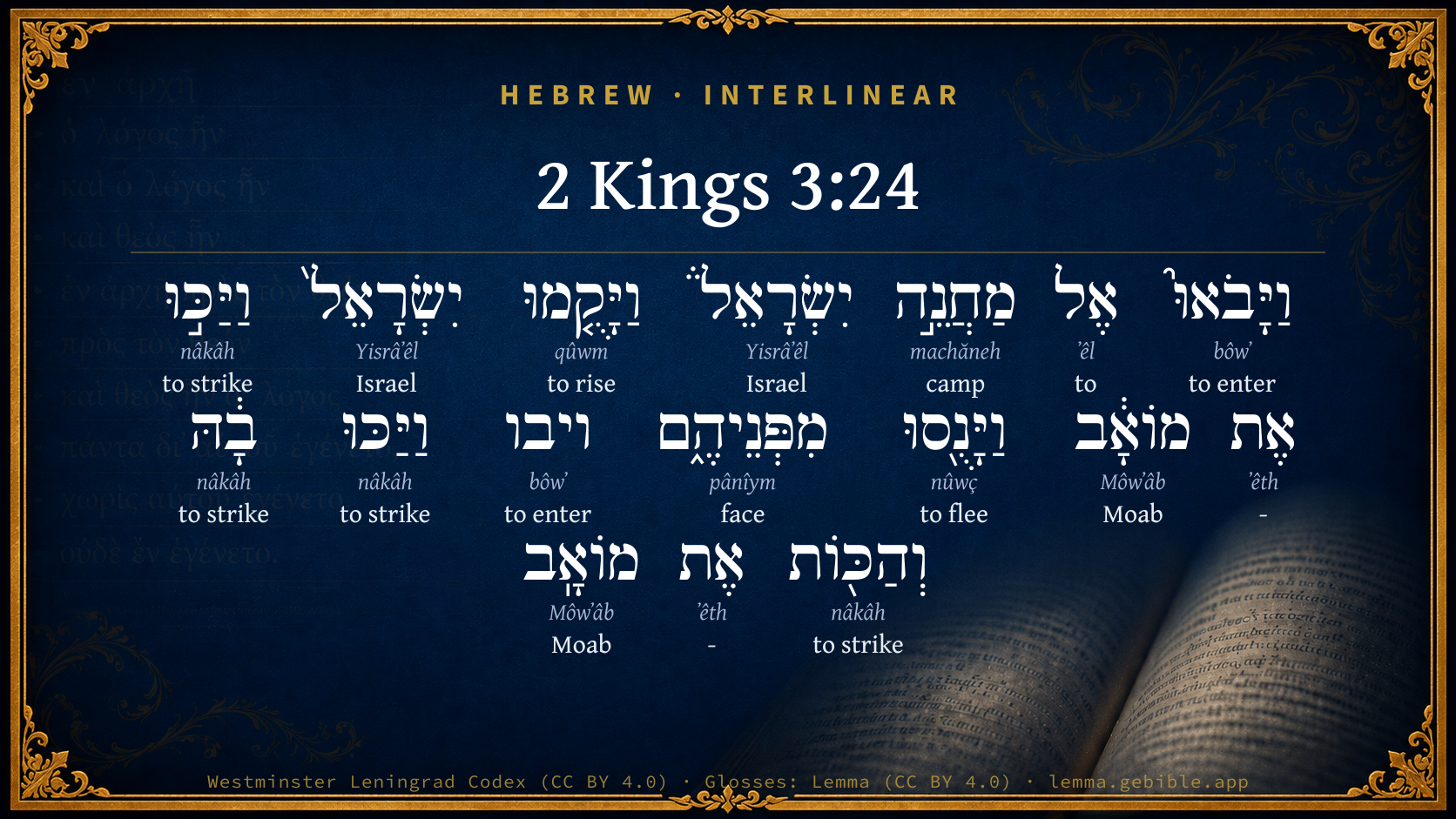
2 Kings 3:24

Hebrew (Westminster Leningrad Codex) 2 Kings 3:24 appears in the Hebrew Old Testament. The text above is from the Westminster Leningrad Codex. Each word links to its Strong’s number, a concise gloss, and parsing drawn from the Open Scriptures Hebrew Bible morphology. Click any word for its full Brown-Driver-Briggs (BDB) entry.
Download image
Cite this verse

2 Kings 3:24 (World English Bible). Public Domain. Lemma interlinear Bible study tool, https://lemma.gebible.app/v/2-kings/3/24.

Show BibTeX & RIS
BibTeX
RIS
English Translation
When they came to the camp of Israel, the Israelites rose up and struck the Moabites, so that they fled before them; and they went forward into the land smiting the Moabites.
World English Bible · Public Domain
Download a study sheet

One document with this verse’s original text, its word-by-word gloss line, the meaning frame, cross-references with their text, attributed commentary, and full source and license credits — printable, and it pastes into notes with its structure intact.

This verse Autodidact and up

Study sheet (.html) Plain text (.txt)

A passage Seminary Student

Up to 50 verses in one chapter. A passage sheet keeps up to 6 commentary sources and 12 cross-references per verse, in the order this page ranks them, and says so on the sheet whenever that leaves anything out. Ask for a single verse and you get the Autodidact verse sheet above.

Everything on this page stays free to read, with no account — the sheet is a download of what is already on screen, not access to it.

Want to remove ads? Support Godless Engineer
Compare translations 3

The same verse in 3 English versions, stacked beneath the original-language interlinear above. Click any original word for its lexicon entry.

Each is an independent rendering of the whole verse — the interlinear is not word-aligned to these translations.

Highlighted words mark where these versions differ — a whole-verse word diff, not a word-by-word alignment.

  • World English Bible Public Domain
    When they came to the camp of Israel, the Israelites rose up and struck the Moabites, so that they fled before them; and they went forward into the land smiting the Moabites.
  • King James Version Public Domain
    And when they came to the camp of Israel, the Israelites rose up and smote the Moabites, so that they fled before them: but they went forward smiting the Moabites, even in their country.
  • unfoldingWord Literal Text CC BY-SA 4.0
    And they came to the camp of Israel, and Israel arose, and they struck Moab, and they fled from their face. And they came into it, and they struck Moab.

unfoldingWord Literal Text — © unfoldingWord, licensed CC BY-SA 4.0. Word-aligned USFM3 via Door43 (git.door43.org/unfoldingWord/en_ult).

Versions to compare (up to 4)

3 of 4 selected

Show all 18 translations

Every available English version of this verse, each an independent rendering of the whole verse.

  • World English Bible Public Domain
    When they came to the camp of Israel, the Israelites rose up and struck the Moabites, so that they fled before them; and they went forward into the land smiting the Moabites.
  • Berean Standard Bible Public Domain
    But when the Moabites came to the camp of Israel, the Israelites rose up and attacked them, and they fled before them. So the Israelites invaded their land and struck down the Moabites.
  • Majority Standard Bible Public Domain
    But when the Moabites came to the camp of Israel, the Israelites rose up and attacked them, and they fled before them. So the Israelites invaded their land and struck down the Moabites.
  • King James Version Public Domain
    And when they came to the camp of Israel, the Israelites rose up and smote the Moabites, so that they fled before them: but they went forward smiting the Moabites, even in their country.
  • American Standard Version (1901) Public Domain
    And when they came to the camp of Israel, the Israelites rose up and smote the Moabites, so that they fled before them; and they went forward into the land smiting the Moabites.
  • Revised Version (1885) Public Domain
    And when they came to the camp of Israel, the Israelites rose up and smote the Moabites, so that they fled before them: and they went forward into the land smiting the Moabites.
  • Geneva Bible (1599) Public Domain
    And when they came to the host of Israel, the Israelites arose vp, and smote the Moabites, so that they fled before them, but they inuaded them, and smote Moab.
  • Douay-Rheims (1899) Public Domain
    And they went into the camp of Israel: but Israel rising up defeated Moab, who fled before them. And they being conquerors, went and smote Moab.
  • Young's Literal Translation Public Domain
    And they come in unto the camp of Israel, and the Israelites rise, and smite the Moabites, and they flee from their face; and they enter into Moab, so as to smite Moab,
  • Literal Standard Version CC BY-SA 4.0
    And they come to the camp of Israel, and Israel rises, and strikes the Moabites, and they flee from their face; and they enter into Moab, so as to strike Moab,
  • Unlocked Literal Bible CC BY-SA 4.0
    When they came to the camp of Israel, the Israelites surprised them and attacked the Moabites, who fled before them. The army of Israel drove the Moabites across the land, killing them.
  • unfoldingWord Literal Text CC BY-SA 4.0
    And they came to the camp of Israel, and Israel arose, and they struck Moab, and they fled from their face. And they came into it, and they struck Moab.
  • Darby Bible Public Domain
    And when they came to the camp of Israel, the Israelites rose up and smote the Moabites, and they fled before them; and they entered in and smote Moab.
  • World Messianic Bible Public Domain
    When they came to the camp of Israel, the Israelites rose up and struck the Moabites, so that they fled before them; and they went forward into the land attacking the Moabites.
  • Webster's Bible Public Domain
    And when they came to the camp of Israel, the Israelites rose and smote the Moabites, so that they fled before them: but they went forward smiting the Moabites, even in their country.
  • Free Bible Version CC BY-SA 4.0
    But when the Moabites arrived at the Israelite camp, the Israelites ran out and attacked them, and they ran away from them. So the Israelites invaded their country and killed the Moabites.
  • Bible in Basic English Public Domain
    But when they came to the tents of Israel, the Israelites came out and made a violent attack on the Moabites, so that they went in flight before them; and they went forward still attacking them;
  • JPS Tanakh (1917) Public Domain
    And when they came to the camp of Israel, the Israelites rose up and smote the Moabites, so that they fled before them. And they smote the land, even Moab, mightily.

Literal Standard Version (2020), Covenant Press — licensed CC BY-SA 4.0. Text via the HelloAO Bible API (eBible.org). Unlocked Literal Bible (unfoldingWord) — licensed CC BY-SA 4.0. Text via the HelloAO Bible API (eBible.org). unfoldingWord Literal Text — © unfoldingWord, licensed CC BY-SA 4.0. Word-aligned USFM3 via Door43 (git.door43.org/unfoldingWord/en_ult). Free Bible Version, Dr. Jonathan Gallagher — licensed CC BY-SA 4.0. Text via the HelloAO Bible API (eBible.org).

Word by word

More ways to search: Search by grammar → Find every occurrence → Compare this word →

Practice this passage: Drill this verse → Learn its vocabulary →

וַיָּנֻ֖סוּ
nûwç
H5127
“and · to flee”
Conjunction + Verb, Qal, Sequential Imperfect, 3rd Person, Masculine, Plural
Part of Speech
Conjunction + Verb
Stem
Qal
Form
Sequential Imperfect
Person
3rd Person
Gender
Masculine
Number
Plural
Full BDB Definition

Origin: a primitive root

TWOT: 1327

to flee, escape - (Qal) - to flee - to escape - to take flight, depart, disappear - to fly (to the attack) on horseback - (Polel) to drive at - (Hithpolel) to take flight - (Hiphil) - to put to flight - to drive hastily - to cause to disappear, hide
  1. וַיָּבֹאוּ֮ bôwʼ H935 “and · to enter” Conjunction + Verb, Qal, Sequential Imperfect, 3rd Person, Masculine, Plural
  2. אֶל ʼêl H413 “to” Preposition
  3. מַחֲנֵ֣ה machăneh H4264 “camp of” Noun, Common, Both, Singular, Construct
  4. יִשְׂרָאֵל֒ Yisrâʼêl H3478 “Israel” Noun, Proper
  5. וַיָּקֻ֤מוּ qûwm H6965 “and · to rise” Conjunction + Verb, Qal, Sequential Imperfect, 3rd Person, Masculine, Plural
  6. יִשְׂרָאֵל֙ Yisrâʼêl H3478 “Israel” Noun, Proper
  7. וַיַּכּ֣וּ nâkâh H5221 “and · to strike” Conjunction + Verb, Hiphil, Sequential Imperfect, 3rd Person, Masculine, Plural
  8. אֶת ʼêth H853 “-” Particle, Direct Object
  9. מוֹאָ֔ב Môwʼâb H4124 “Moab” Noun, Proper
  10. מִפְּנֵיהֶ֑ם pânîym H6440 “from · face(s) · their” Preposition + Noun, Common, Both, Plural, Construct + Suffix, Personal, 3rd Person, Masculine, Plural
  11. ויבו bôwʼ H935 “and · to enter” Conjunction + Verb, Qal, Sequential Imperfect, 3rd Person, Masculine, Plural
  12. וַיַּכּוּ nâkâh H5221 “and · to strike” Conjunction + Verb, Hiphil, Sequential Imperfect, 3rd Person, Masculine, Plural
  13. בָ֔הּ nâkâh H5221 “in/at · her” Preposition + Suffix, Personal, 3rd Person, Feminine, Singular
  14. וְהַכּ֖וֹת nâkâh H5221 “and · to strike” Conjunction + Verb, Hiphil, Infinitive Construct
  15. אֶת ʼêth H853 “-” Particle, Direct Object
  16. מוֹאָֽב Môwʼâb H4124 “Moab” Noun, Proper

About this verse

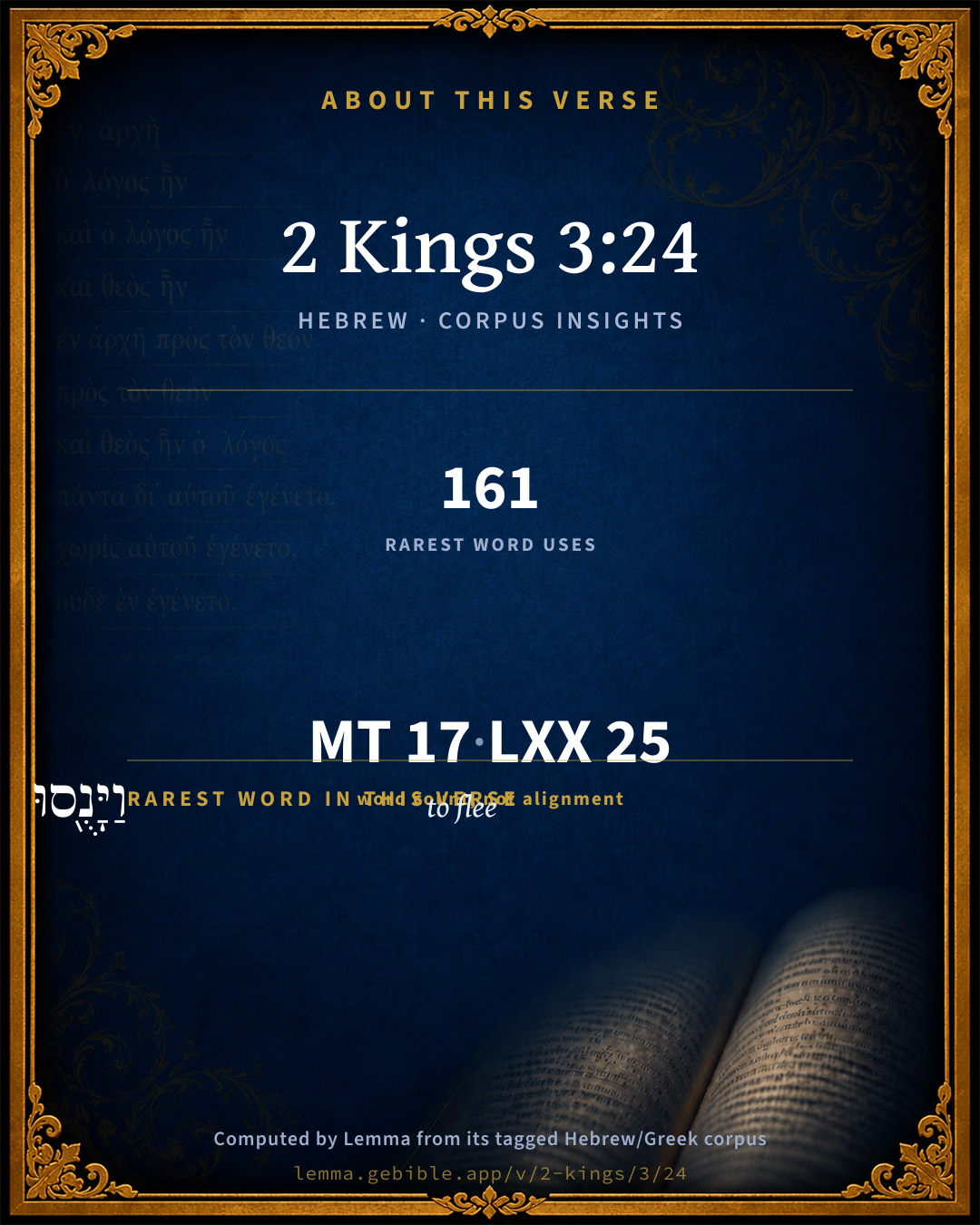
These counts appear in no published source. They are computed here, from the morphology-tagged text and Lemma’s own curated glosses. What Lemma adds →

17
words
10
distinct lemmas
Historical
section

Grammatical profile

  • 7 verbs
  • 6 nouns
  • 2 prepositions
  • 2 particles

Verb forms

  • וַיָּבֹאוּ֮ Qal · Sequential Imperfect
  • וַיָּקֻ֤מוּ Qal · Sequential Imperfect
  • וַיַּכּ֣וּ Hiphil · Sequential Imperfect
  • וַיָּנֻ֖סוּ Qal · Sequential Imperfect
  • ויבו Qal · Sequential Imperfect
  • וַיַּכּוּ Hiphil · Sequential Imperfect
  • וְהַכּ֖וֹת Hiphil · Infinitive Construct

Repetition

Words recur within this verse — often emphatic in Hebrew:

  • וַיַּכּ֣וּ to strike H5221 ×4
  • וַיָּבֹאוּ֮ to enter H935 ×2
  • יִשְׂרָאֵל֒ Israel H3478 ×2
  • מוֹאָ֔ב Moab H4124 ×2

Hebrew & Septuagint length

In English translation the verse runs 32 words from the Hebrew and 30 from the Septuagint (LXX English) — closely comparable.

A rough comparison of the two English renderings, which tokenize alike — not a word-level alignment.

Word counts can differ between the Hebrew and the Greek without any difference in meaning — e.g. the Hebrew direct-object marker אֵת has no separate Greek word, and Greek often adds the article ὁ.

In the original languages it is 17 Hebrew tokens and 25 Greek tokens — but the two are counted differently (Hebrew bundles its prefixes and suffixes into one token; the Greek is in lemma form), so that isn’t a like-for-like length.

Cross-references

3

Topical passages linked to 2 Kings 3:24 in the Treasury of Scripture Knowledge — connected by theme and wording, ordered by reader-vote popularity; previews shown in the World English Bible.

  • Joshua 8:20–22 When the men of Ai looked behind them, they saw, and, behold, the smoke of the city ascended up to heaven, and they had no power to flee this way or that way: and the people who fled to the wilderness turned back on the pursuers.
  • Judges 20:40–46 But when the cloud began to arise up out of the city in a pillar of smoke, the Benjamites looked behind them; and, behold, the whole of the city went up in smoke to the sky.
  • 1 Thessalonians 5:3–4 For when they are saying, "Peace and safety," then sudden destruction will come on them, like birth pains on a pregnant woman; and they will in no way escape.

Cross-references courtesy of OpenBible.info (CC BY 4.0).

Hebrew and Greek witnesses Masoretic Hebrew ↔ Greek Septuagint

The same verse in the two great witnesses to the Old Testament, shown verse-for-verse.

These are two independent witnesses, not word-aligned to each other, and the Septuagint is shown in lemma (dictionary) form.

Hebrew 2 Kings 3:24 Masoretic · Westminster Leningrad Codex

וַיָּבֹאוּ֮ אֶל מַחֲנֵ֣ה יִשְׂרָאֵל֒ וַיָּקֻ֤מוּ יִשְׂרָאֵל֙ וַיַּכּ֣וּ אֶת מוֹאָ֔ב וַיָּנֻ֖סוּ מִפְּנֵיהֶ֑ם ויבו וַיַּכּוּ בָ֔הּ וְהַכּ֖וֹת אֶת מוֹאָֽב

When they came to the camp of Israel, the Israelites rose up and struck the Moabites, so that they fled before them; and they went forward into the land smiting the Moabites.

World English Bible · Public Domain

Greek LXX 2 Kings 3:24 Septuagint · lemma form

καί εἰςἔρχομαι εἰς ὁ παρεμβολή ἰσραήλ καί ἰσραήλ ἀναἵστημι καί πατάσσω ὁ μωαβ καί φεύγω ἀπό πρόσωπον αὐτός καί εἰςἔρχομαι εἰςπορεύομαι καί τύπτω ὁ μωαβ

And they entered into the camp of Israel; and Israel arose and struck Moab, and they fled from before them; and they went on and struck Moab as they went.

LXX2012 (modern English Septuagint) · Public Domain

On this verse, Ellicott's Commentary for English Readers discusses the Septuagint’s reading. Read the note in Commentary ↓

Hebrew: Westminster Leningrad Codex (CC BY 4.0). Greek: Septuagint (public domain); English from LXX2012 (modern English Septuagint) (Public Domain). How the Septuagint differs from the Hebrew →

Targum (Aramaic paraphrase)

1

The Targum is the ancient Jewish Aramaic paraphrase of the Hebrew Scriptures — an interpretive translation, not the Hebrew text itself. Onkelos (literal) and Pseudo-Jonathan (expansive) render the Torah, and Jonathan the Prophets. Coverage is partial: where no permissively-licensed English translation exists for a verse, only the Aramaic is shown. This is verse-level text, not a word-by-word alignment to the Hebrew.

  1. Targum Jonathan Prophets (Joshua–Malachi)
    וַאֲתוֹ לְמַשְׁרִיתָא דְיִשְׂרָאֵל וְקָמוּ יִשְׂרָאֵל וּמְחוֹ יַת מוֹאֲבָאֵי וַאֲפָּכוּ מִן קֳדָמֵיהוֹן וּמְחוֹ בְהוֹן וּקְטַלוּ יַת מוֹאֲבָאֵי:

    (no public-domain English translation for this verse)

    Targum Jonathan — Aramaic: “Mikraot Gedolot” (public domain). English: “Sefaria Community Translation” (CC0 1.0 (public-domain dedication)); “London "Chaldee Paraphrase," 1871” (public domain). Text via Sefaria.

Commentary

Notes on 2 Kings 3:24 from classic Christian and Jewish commentators (each source and its license shown beneath its notes). The classic Christian expositions comment on the surrounding passage and are grouped to its opening verse, so a note may address several verses; the Jewish commentaries on the Tanakh (Rashi and others) are per-verse, so they appear only where the commentator wrote on this verse.

Lemma curates 59 commentaries, every one of them public domain or Creative Commons licensed, each selected and text-cleaned for this edition rather than reprinted as found. About our sources →

Trapp's Complete Commentary

John Trapp

2Ki 3:24 And when they came to the camp of Israel, the Israelites rose up and smote the Moabites, so that they fled before them: but they went forward smiting the Moabites, even in [their] country.

Ver. 24. And when they came to the camp of Israel.] Ordinibas non servatis et acie non instructa, disranked and disordered. Their misconceit undid them, as it still doth many.

John Trapp, A Commentary or Exposition upon All the Books of the Old and New Testament (1647–1656) — public domain. Text from a community e-Sword module.

Joseph Benson's Commentary

2Ki 3:24. They went forward, smiting the Moabites, even in their country — They pursued them to their own country, and entered it with and after them; the passes, which the Moabites had before defended, being now open to them.

Joseph Benson's Commentary on the Old and New Testaments (1811–1818) — public domain. Text from a community e-Sword module.

Tyndale Open Study Notes

Tyndale Open Resources

3:24-25 The army of Israel . . . destroyed the towns. Elisha’s prophecy was fulfilled, although Kir-hareseth escaped total destruction.

Tyndale Open Study Notes — © Tyndale Open Resources, licensed CC BY-SA 4.0. Text via the HelloAO Bible API.

Geneva Bible (1599)

Geneva Bible translators

Meaning, they followed them into the towns.

Geneva Bible (1599) marginal notes — public domain. Text via Bolls.life.

Ellicott's Commentary for English Readers

(24) Smote the Moabites.—Who were unprepared for resistance.

But they went forward smiting . . . country.—The Hebrew text (Kethib) has, and he went (way-yâbô, spelt defectively, as in 1Ki_12:12) into it (i.e., the land of Moab), and smote (literally, smiting an infinitive for a finite form) Moab. This is better than the Hebrew margin (Qeri), and they smote it (i.e. Moab), or the reading of some MSS. and the Targum and Syriac, “and they smote them, and smote Moab,” which is tautologous. The original reading is perhaps represented by that of the LXX., καὶ ἐπάταξαν εἰσπορευόμενοι καὶτύπτοντες τὴν Μωαβ, “and they entered the country, destroying as they went on.” (In Hebrew the participles would be infinitives.)

A Bible Commentary for English Readers, edited by Charles John Ellicott (1878–1897) — public domain. Text from a community e-Sword module.

The Cambridge Bible for Schools and Colleges

gen. ed. J. J. S. Perowne

24. the Israelites rose up and smote the Moabites] The hasty and irregular manner in which the Moabites rushed forward, with no thought but of an easy booty, gave the Israelites an opportunity which otherwise they would not have had. Before their assailants could gather themselves for resistance they were able to put them to a confused flight. And the discovery of their mistake would paralyse the Moabites and make victory certain for Israel and their allies.

but they went forward smiting the Moabites, even in their country] R.V. they went forward into the land smiting the Moabites. The Hebrew text presents some difficulty here. The word which R.V. has represented by ‘into the land’ is literally ‘into it’. But as Moab (translated Moabites) has been mentioned in the previous clause the pronoun may fairly be referred to it. The verb ‘they went forward’ is not of the usual form and for יכאו = יכו the marginal reading of the Massoretic text suggests יכו = they smote, and this the margin of A.V. translates, ‘and they smote in it, even smiting’. But the suggestion seems unnecessary. The LXX. read יכו for they give εἰσῆλθον εἰσπορευόμενοι, apparently having taken the preposition and pronoun בה for the verb בוא.

The Cambridge Bible for Schools and Colleges (gen. ed. J. J. S. Perowne; Cambridge University Press, 1878–1918) — public domain. Text from a community e-Sword module.

John Gill's Exposition

Then he took his eldest son, that should have reigned in his stead,.... Not the eldest son of the king of Edom, whom the king of Moab had in his hands before, which made the king of Edom the more willing to join in this expedition for the recovery of his son, as Joseph Kimchi thinks; or whom he took now in his sally out upon him, as Moses Kimchi and Ben Gersom, proceeding upon a mistaken sense of Amo 2:1 for the king of Edom could have no son that had a right, or was designed to succeed him, since he was but a deputy king himself; and besides, the sacrificing of him was not the way to cause the kings to raise the siege, but rather to provoke them to press it the more closely: it was the king of Moab that took his son and heir to the crown,

and offered him for a burnt offering upon the wall; that it might be seen by the camp of Israel, and move their compassion; or rather this was done as a religious action, to appease the deity by an human sacrifice so dear and precious, to give success, and cause the enemy to break up the siege; and was either offered to the true God, the God of Israel, in imitation of Abraham, as some Jewish writers fancy (n), or to his idol Chemosh, the sun; and Jarchi observes, out of an exposition of theirs, that "vau" is wanting in the word for wall, and so may be interpreted of the sun, towards which this burnt offering was offered; and it is observed, from various Heathen authors, that it was usual with the Heathens, when in calamity and distress, to offer up to their gods what was most dear and valuable to them; and particularly the Phoenicians (o), and from them the Carthaginians had this custom, who at one time offered up two hundred sons of their nobility, to appease their gods (p):

and there was great indignation against Israel; not of the king of Edom against them, for not rescuing his son, or because they were the means of this disaster which befell him; but of the king of Moab, who was quite desperate, and determined to hold out the siege to the utmost extremity: and they departed, and returned to their own land; the three kings, the one to Edom, the other to Israel, and the third to Judah; when they saw the Moabites would sell their lives so dear, and hold out to the last man, they thought fit to break up the siege; and perhaps were greatly affected with the barbarous shocking sight they had seen, and might fear, should they stay, something else of the like kind would be done.

(n) T. Bab. Sanhedrin, fol. 39. 2. Pesikta in Abarbinel in loc. (o) Vid. Euseb. Evangel. Praepar. l. 1. c. 10. p. 40. l. 4. c. 16. p. 156. Porphyr. de Abstinentia, l. 2. sect. 56. Vid. Aelian. Var. Hist. l. 12. c. 28. (p) Diodor. Sicul. Bibliothec. l. 20. p. 756.

Next: 2 Kings Chapter 4

John Gill's Exposition of the Whole Bible (1746–1763) — public domain (CC PDM 1.0). Text via the HelloAO Bible API.

Haydock's Catholic Bible Commentary

Moab. Hebrew adds, "even in the country."

George Leo Haydock (1774–1849), Haydock's Catholic Family Bible and Commentary, 1859 edition — public domain. Excludes Psalms (Douay-Rheims chapter numbering differs from Protestant) and Deuterocanonical books (Catholic canon only).

Matthew Poole's English Annotations

They pursued them to their own country, and entered it with and after them; the passes, which before the Moabites defended, being now open for them.

Matthew Poole's English Annotations on the Holy Bible (1683–1685) — public domain. Text from a community e-Sword/MySword module.

The Pulpit Commentary

And when they came to the camp of Israel, the Israelites rose up. The first rush of the main body would be upon the camp, where they would expect to find the richest spoil. It was near at hand; and the occupants kept themselves concealed in it, expecting the disorderly attack which actually took place. They then "rose up," and fell upon the crowd of assailants, who were off their guard, and expecting nothing less. A confused rout followed. And smote the Moabites, so that they fled before them. Josephus says, "Some of the Moabites were cut to pieces; the others fled, and dispersed themselves over their country." But they went forward, smiting the Moabites even in their country. There are two readings here, wbyw and wkyw. The former is to be preferred, and is to be pointed wObYw (for awObYw, as in 1Ki_12:12. This gives the meaning of the text. The marginal translation follows the Keri WkYw, which is (as Keil says) "a bad emendation."

The Pulpit Commentary (1880–1919), ed. H.D.M. Spence-Jones & Joseph S. Exell — public domain. Text from a community e-Sword module.

unfoldingWord translationNotes

Door43 World Missions Community

camp of Israel

Here "Israel" refers only to the Israelite soldiers and not to the whole nation of Israel. AT: "the area where the Israelite soldiers had set up their tents" (See: Synecdoche)

the Israelites surprised

Here "Israelites" refers only to the Israelite soldiers and not to the whole nation of Israel. AT: "the Israelite soldiers surprised" (See: Synecdoche)

fled before them

"ran away from them"

Kir Hareseth

This is the capital of Moab. (See: How to Translate Names)

was left with its rocks in place

The walls and buildings of the city were made of stones. The meaning of this can be made clear. AT: "still had its stone walls and buildings in place" (See: Assumed Knowledge and Implicit Information)

with slings

A "sling" is piece of animal skin with long cords at both ends in which a person can put a stone or other small, hard object and throw it a long distance.

translationWords

kingdom of Israel

Moab

unfoldingWord translationNotes — © Distant Shores Media and the Door43 World Missions Community, licensed CC BY-SA 4.0. Source: git.door43.org/Door43/en_tn.

Lesson kit

Teaching starters — assembled from the data on this page, not authored interpretation. Every prompt links to the verse data it draws on. Edit before teaching.

2 Kings, in the Historical, opens this verse with 17 words (10 distinct Hebrew lemmas). Its most distinctive word is nûwç (“to flee”). A historical commentator’s framing appears above. Read the whole chapter for the surrounding context.

Discussion questions

  1. The word nûwç carries the sense “to flee.” How does it shape the verse?
  2. How does Joshua 8:20–22, which shares this passage’s theme, read alongside this verse?
  3. What does the repetition of “to strike” (4× in this one verse) do in this verse?
  4. The translations on this page render this verse differently — a whole-verse word diff, not a word-by-word alignment. What might account for the different wordings?
  5. «וַיָּבֹאוּ֮» is a Qal Sequential Imperfect verb. How does that grammatical form shape the action described?
  6. Compare how Trapp's Complete Commentary and Joseph Benson's Commentary read this verse. Where do they agree or differ?

Things to notice

Reading settings

Reading text

Shown beneath each verse's original-language words.

Old Testament
Old Testament edition

Read the OT as the Masoretic Hebrew (MT) or the Greek Septuagint (LXX).

English shown for the Greek Septuagint (in the Hebrew ↔ Greek comparison).

Comparing translations? Open the Compare panel on any verse page to stack up to four side by side.